Publisher: Centre of Excellence for Scientific & Research Journalism, COES&RJ LLC Online Publication Date: 1st
July 2019 Online Issue: Volume 8, Number 3, July 2019 https://doi.org/10.25255/jss.2019.8.3.509.525
Cloud-Based Management Information System: A Systematic Review and
Future Research Scope
Raed Kareem Kanaan, Amman Arab University, [email protected] Ghassan Abumatar, Amman Arab University, [email protected] Alhareth Mohammed Abu Hussein, Amman Arab University, [email protected]
Abstract:
Several organizations, mostly governmental, have adopted information systems for management. They are considered especially helpful for large projects that have a high degree of complexity. Due to this, most firms, especially in developing countries like Jordan, can remain on their core functions with the successful adoption of cloud-based management information systems. This study primarily focuses on the systematic review of several studies in the literature that have evaluated management information system through cloud computing technology. In order to achieve the aim of this study, a systematic review of management and business process journals is conducted Results returned are evaluated and assessed to understand principle functioning of information systems, their uses in management, and adaptation of cloud-based MIS. Results of the assessment are compiled and a collective conclusion about the adoption of cloud-based MIS has been discerned for our present study. Findings indicate a structural focus on cloud-based management information systems among small and medium enterprises, several organizations, mostly governmental as well as industrial giants. Therefore, through this research study, the applicability of cloud-based MIS into the management processes is explored and highlighted. Various advantages and applications of cloud-based MIS in outsourcing and management are compiled from related studies in the literature.
Keywords:
cloud computing, security, technology, MIS
Citation:
Kanaan, Raed Kareem; Abumatar, Ghassan; Abu Hussein, Alhareth Mohammed (2019); Cloud-Based Management Information System: A Systematic Review and Future Research Scope;
Journal of Social Sciences (COES&RJ-JSS), Vol.8, No.3, pp:509-525;
1. Introduction
Management information systems are burgeoning into widely accepted modes of process management in several industries. It is of special consequence in projects of high complexity. Information systems provide an edge in the effective management of complex and multifaceted projects (Altamony et al., 2012; Khalid et al., 2018). Therefore, governmental organizations have witnessed a sudden upsurge in the use of management information systems and wide transformation in the sector of management information systems has been witnessed in recent times. The drastic changes in the environment of business development are attributed to the accuracy, safety of information, and cutting-edge technological parameters (Pan & Jang, 2008; Sultan, 2010). As a result, innovation in information technology has led to widespread adoption of cutting edge technologies of cloud computing for business management (Menzel & Meinel, 2010; Karajeh & Maqableh, 2014). Businesses benefit greatly from the use of cloud-based technology owing to its sustained (Armbrust et al., 2010). Use of cloud-based computing has been adapted into mainstream information systems. Technologies of operating systems, solutions for technological platforms, software applications, etc. are being used increasingly in businesses (Tuncay, 2010).
priority without the requirement of complex technological knowledge (Dodonov & de Mello, 2010). Alongside these requirements, the consolidation of information systems of an organisation requires consorted storage and utilisation spaces (Daraghmi & Yuan, 2015). Availability of these sources on the internet-based platform increases accessibility manifold. Therefore, most firms prefer the utilization of cloud-based MIS in their businesses. Subsequently, as there is a necessitation of scalability and dynamism in information systems, therefore, it is important to use a dynamic platform such as cloud computing (Chiregi & Navimipour, 2016). Since services associated with cloud computing include several resources require frequent visualization and are based on internet-based networking, there is a need for efficient platform for its incorporation (Melville, 2010). Platforms for cloud-based management information systems develop a crucial platform for developing ideal scenarios of remote computing sites whereas communication, data storage, and management are essential within organizations (Celesti et al., 2012). Due to the indispensable advantages provided by cloud-based services, they are typically designed to aid in process and employee management and networking in businesses. Therefore, the applications required for cloud-based information systems typically require a platform that is scalable and flexible (Rath et al., 2012). Owing to the crucially for these services to have scalability and elasticity for facilitating rapid collaboration between various platforms, there is a need to incorporate cloud-based MIS in all systems across the organization. Hence, for effective performance grading in firms, there is a constant requirement for initiation of moderate services (Low et al., 2011).
volumes and complexity (Marston et al., 2011). Cloud-based MIS platform provides necessary operational access and easy replacement through data scalability. Employment of cloud-based information systems, therefore, increases reliability, data coordination, and accessibility, which is a pertinent solution to data overload problems discussed above (Armbrust et al., 2010). 2. Literature Review
Management information systems through cloud-based platforms have emerged as a popular tool of data management among organizations. Cloud management of data provides non-transparency within the market owing to higher degrees of adaptation among service providers and clients (Repschlaeger et al., 2012). Several heterogeneous providers of services and models of cloud computing have emerged as competent markets of cloud service alignment. Due to an extended degree of efficiency provided by the cloud platform, the usage of cloud-based systems in management information systems has increased voluminously (Khalid et al., 2018). Cloud-based computing systems render efficiency as well as facilitate the inclusion of various datasets that have compromised accessibility within normal systems (Melville, 2010) and it provide sustained orientation to service provision and management. Evaluation of cloud computing within information systems demonstrates higher efficiency and value addition. (Tuncay, 2010) It has a potential ability to flexible access to data networks as cloud-based MIS systems are adept in handling the complex data-sets that are frequently used in company processes (Navimipour & Soltani, 2016).
The main reasons for adoption of MIS based on cloud computing formulation include an overall reduction in costs to the company, increased efficiency of data management, regulation of data flow, and accuracy of handling of data. Organizational data management is complex on levels of workload balancing, and storage; therefore, discrepancies in both of these functional operations can result in data loss. Cloud computing possesses technological semblances to Enterprise Resource Planning (ERP), email, software such as MS Office, etc. However, it utilizes a ubiquitous resource bank. These resources are based on a platform that allows for data sharing (Tuncay, 2010). Therefore, organizations prefer cloud-based systems as they allow cloud data sharing to business partners and other stakeholders of the concerned data bank. Businesses are potentially benefited from ubiquitous data resource access and sharing as they are involved in coordination between various concerned parties (Low et al., 2011).
the cloud computing system, and organizational information is controlled, analyzed, and integrated based on its functional algorithm (Khalid et al., 2018).
Businesses, both large and small scale, prioritize effective integration of information, therefore posing the need for integration of business processes into current information systems is emphasized (Abrishami & Naghibzadeh, 2012), thus, cloud-based MIS has gained wide popularity (Abdulhamid et al., 2014).
2.1. Benefits of Cloud Computing
Business organizations prefer cloud-based MIS due to its connection to technological support for business transactions (Repschlaeger et al., 2012). For instance, data sharing and information relay between organizations are discerned as the benefits of cloud computing. Furthermore, regulated transactions of business information may be carried out through cloud systems are also perceived as the benefits of using cloud computing (Tuncay, 2010). In addition to the failure of information systems of organizations that can be checked by employing cloud-based systems (Navimipour & Zareie, 2015). Transactions of businesses, as well, including the activities of buying, selling, and partnering are transformed by the employment of cloud-based services of information system management (Tuncay, 2010).
Demands in the investment sector have increased several folds with the intervention of rich technological advancements (Belton, 2017). Due to this, the complexity of technological organization and overview of various elements of business transactions are being considered (Koo et al., 2015). Currently, businesses consider interactions between partnering bodies and consumer base as a high priority activity. Thereby, through the channelling of futuristic data management, the necessary interactive abilities between organizations are regarded as imperative. Since most organizations deal with massive data sets, they are switching to cloud-based MIS to ensure efficient data management. This subsequently results in increased costs of data rendering, management, and storage (Archetti et al., 2015).
Benefits of cloud-based models of MIS are available to all stakeholders of cloud computing including service providers and consumers (Tuncay, 2010). Evaluating the basic process of cloud coordinated MIS is essential to determine its usage for eventualities that might be caused by mismanaged data sets. Organizational MIS has to be free of risk of failure. Therefore, businesses place is discerned to have a great emphasis on the accurate management of data (Archetti et al., 2015). Moreover, the rapid access to scalable data is given high priority by business organizations that have crucial and open-ended data sets for primary operations. Since operational and functional management of data becomes a critical consideration for industrial giants, scalability and flexibility rendered by cloud-based MIS is considered an ideal solution for data management.
One of the crucial functions of cloud-based MIS in business operations includes the appropriate balancing of load (Khalid et al., 2018). In scenarios of overloading of data, it is essential to balance the workload to pre-empt failure of the information system of the company as it is a crucial challenge for large organizations with massive data reservoirs, (Melville, 2010). Therefore, cloud computing provides the solution of data migration to shared systems through channelled and progressive telecommunication networks (Rath et al., 2012). Telecommunication technological advancements including WiMax, FTTH, and 4G provide accurate and rapid execution of data migration (Pan & Jang, 2008). Organizational MIS, therefore, relies heavily on cloud-based systems due to the prospect of load balancing and apt data management (Sultan, 2010).
2.2. Challenges, Risks and Importance of Cloud Computing
• Infrastructural preparedness of the firm in terms of financial, organization, and personnel level elements.
• Data protection and privacy policies determined by the company which chooses to outsource through third-party cloud-based MIS provider.
• Efficient systems for inflow and outflow of data in cases of internal data management as well as in outsourcing.
The effects of the above-mentioned determinants are discussed below:
1. Infrastructural preparedness: Any organization that chooses to adopt cloud-based MIS must review the availability of various resources of the organization in terms of financial, personnel, and process elements. For industrial giants, the adoption may be relatively easy due to higher financial strength when compared to small and medium enterprises. Therefore, organizations which lack resources to incorporate cloud-based MIS internally can outsource technical support to cloud service providers (Asatiani, 2016). Therefore, they can focus on their core business area, which ensures subsequently better organizational progress. Additionally, businesses can concentrate on the specific needs of their customers to enhance their progression in the market (Pan & Jang, 2008). Firms often regard information system management as a complex process due to the high volume of data that needs to be managed (Leavitt, 2009).
For the small and medium enterprises (SMEs), management of information technology and information systems has largely reduced (Mehrtens et al., 2001). Since business giants possess more financial and related resources along with higher operational range, the adoption of cloud-based MIS is easier for them as compared to smaller ventures (Goscinski & Brock 2010). However, due to lack of expertise to handle complex data there is a limitation in the context of SMEs to non-adoption of cloud services. Therefore, it is essential to outsource data management through third-party cloud-based MIS providers to obtain the necessary technological support. For information system access, it is important for business progression to be consistent (Rath et al., 2012). This places an indispensable need for coordinated business management and data operations. Noticeably, there is a prominent lag in information system operation among SMEs. Therefore, the migration of data and data sharing need to be carried out through effective cloud service providers (Hoefer & Karagiannis, 2010).
3. Data management: Most companies deal with large volumes of complex data which need to be managed with precision and safety. Hence, companies make considerable investments for data inflow and outflow management, which impacts their scope of business, ultimately discouraging them to adopt cloud-based MIS. As a result, there is a high cost to company for data management alone. Therefore, access to narrow market regions and sustainable targets of business propagation are directly correlated to a reduction in costs to the company in terms of data management. Additionally, the availability of the product increases due to the higher spectrum of sellers. Also, the cost of product availability and distribution are reduced greatly (Hoefer & Karagiannis, 2010). Businesses, especially SMEs have a higher potential of increasing product quality along with increased productivity, as data management through cloud-based MIS ensures effective data management, thereby enhancing process functionality (Gangwar et al., 2015). Existing products can also be sold at higher rates with the help of the formulation of new methods of selling. It is, therefore, considered inevitable for companies to consider the prospect of management of data through investment in technology in which in turns increased business offshoots (Mirchandani & Motwani, 2001).
2.3. Security and Privacy Threats of Cloud-based Management Information System
Cloud-based MIS has gained high popularity among businesses as well as government sectors. Therefore, cloud-based MIS has become an indispensable part of data management in these sectors. Although cloud computing assures data sharing between stakeholders, the protection and privacy of data remains a major concern of business strategizing (Navimipour & Zareie, 2015).
Protection of data is stable to context and specific requirements of the organization in concern. According to Stone & Vance (2010), there are several concerns about successful data protection through cloud services due to the following pertinent reasons:
1- Cloud controlled assets and data are not in the control of the company which adopts cloud-based MIS. Therefore, the loss of cloud-hosted data eliminates the process of security management according to the protocol of the product. IT assets are within the control of cloud hosting agents due to which the management of security issues becomes a challenge (Almorsy et al., 2011).
2- There is no particular guarantee of the operation through cloud providers or cloud hosting (Almorsy et al., 2011).
3- There is an impending risk of sharing of important data to market rivals and malicious users (Almorsy et al., 2011).
In the context of businesses and governmental organizations dealing with complex and high volumes of data, it is often challenging to trust the cloud platform entirely (Navimipour & Zareie, 2015). Therefore, cloud-based MIS needs to be monitored with complete attention to specific concerns of data security (Almorsy et al., 2011) As a result, it is essential to handle data with accuracy and emphasis on data security issues as they are critical to the privacy policies of any business (Armbrust et al., 2010).
Management and regulation of the heterogeneous stakeholders who have control over data management in cloud-based MIS need to be monitored (Almorsy et al., 2011). For SMEs, it is challenging to handle heterogeneity due to multiple users in the platform of data management (Stone & Vance, 2010). Therefore, the dynamic transfer of data results in a multitude of challenging data handling. Several dimensions of sensitive data handling due to a large number of intermittent processors of data results in varied appropriation. Consequently, strategic planning of data management needs to be made according to the regulated security protocol of the company (Almorsy et al., 2011).
ownership of data, it is important for organizations to plan and manage data according to the protocols of their security handling (Almorsy et al, 2011).
Project planning and constructs of data flow need to be accurate to avoid potential misappropriations of data (Gangwar et al., 2015). In cases of businesses handling large amounts of data, formulation of data management patterns becomes imperative.
Several factors need to be considered for challenges in data handling (Archetti et al, 2015). As a result, it is essential to consider the factors that are responsible for the potential failure of projects. This can lead to failure of deadline achievement and project completion (Mehrtens et al., 2001). Consequent losses in management of data are considered important causes for business failure, due to which companies typically invest heavily in process data management systems. As a result, there is a requirement for finding an alternative solution for data management which is cost-effective as well as efficacious (Armbrust et al., 2010).
Specific security requirements and contents of data being transferred by third party service providers are usually unknown to those providers. Specifically, cloud-based MIS involves critical data assets of the organization (Mehrtens et al, 2001). However, since the cloud platforms and services are not under the control of the company, it makes them susceptible to loss of data (Almorsy et al, 2011). Therefore, it is a crucial consideration for the adoption decision Most of the security concerns are directed towards cloud-based services including web services. However, the security of the underlying platform is often neglected by these services. Multiple tenants of cloud service usage, which is the main concern of cloud support system, are not addressed by the existing security control options (Almorsy et al., 2011). Cloud-hosted assets are subject to security issues which need to be scrutinized and handled accurately.
2.4. Opportunities and Future Scope of Cloud-based MIS
Project planning in public sectors is an elaborated process and involves huge costs. It is, therefore, an expensive and time-consuming activity. These issues result in project planning becoming a challenging task for most managers in both public and private sector (Rose et al., 2018). Adoptions of MIS in both Government and public sector have been proved as cost-effective and increase the efficiency of time management (Soufi & Maguire, 2007; Alenezi et al, 2015, 2017; Kanaan & Masa'deh, 2018). Cloud-based MIS greatly increases the apprehension of governmental working and policies among the public (Rose et al., 2018). Public cognizance of governmental activities is largely beneficial for national progress. A progressive and interactive platform is created between the government and the general public. Additionally, services offered by the government have enhanced availability and accessibility to the public (Khalid et al., 2018). However, project managers of cloud-based MIS are required to possess a varied skill set, they need to utilize their time more effectively as prioritization of important tasks is necessary for effective management of tasks. Several contemporary challenges in public sector project management have been observed (Khalid et al., 2018). Although considerations are variant for companies regardless their size, consumer satisfaction is uniform and high for organizations adopting cloud-based MIS (Banerjee et al., 2015). Primarily, it is of great consequence that cloud-based systems increase interactiveness, transparency, reliability, and accessibility (Sharma et al., 2010).
3. Conceptual Framework
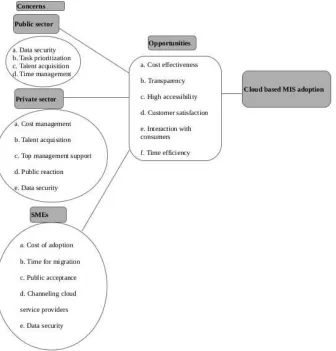
The conceptual framework typically explains the relationship between various dependent and independent variables in a study. This study has indulged in a review of existing literature to analyze considerations, problems, and opportunities of cloud-based MIS in different both public and private (including SMEs) sector.
Dependent variables are classified based on different sectors of industry. This helps in the analysis of similarities and dissimilarities between these sectors.
Figure 1. Conceptual model depicting cloud-based management information system adoption in different organizations
these sectors include effective cost management, data provision, transparency of operation, functionality. Additionally, customer satisfaction increases due to higher accessibility of data, interactiveness, and efficiency of time management (Soufi & Maguire, 2007). Adoption decision of cloud-based MIS is therefore subject to specific conditions of the organization, their opportunities, growth, nature of data, and availability of project managers capable of handling cloud-based MIS. With effective consideration and analysis of concerns and opportunities of adoption, the decision-making process is effected (Rath et al., 2012). Conceptual framework design provides for a visual representation of specific concerns across all sectors and the resulting advantages. . In general, the organizations are faced with a primary concern of data security. This can be effectively handled by monitoring and channelling of third-party cloud service providers. Therefore, it is imperative that security issues are discussed and agreed upon before decision making (Almorsy et al., 2011). Thereby, the increased form of accessibility of services to users enhances their preference for cloud-based MIS. Consequently, since cloud-based MIS provides scope for interaction with government for service-related queries, there is an enhancement of customer satisfaction. Consequently, consumers can establish a direct connection with governmental services and access them easily through cloud-based MIS adoption. It also increased transparency of services which in turn increased trust in governmental services (Armbrust et al., 2010). Data sharing enables effective management of time and increased transparency of service provision. Additionally, a higher accessibility of necessary data is enabled not just for consumers, but also for all stakeholders. It is important to consider opportunities as a driving force of the adoption decision. However, specific concerns of data operations through cloud-based MIS need to be addressed and resolved (Alghamdi et al., 2019). The conceptual framework helps in identifying particular concerns and determination of ways to address them.
4. Findings and Discussion
Adoption of cloud-based MIS is a widely discussed prospect due to lucrative opportunities that are associated with it. This study conducts a systematic review of existing literature to analyze underlying adoption factors, opportunities, challenges, and concerns for different sectors. Also, definitive characteristics of cloud-based MIS and challenges involved are determined (Repschlaeger et al., 2012). Various attributes of cloud-based MIS are considered such as talent and skills required for data management (Archetti, Giordani, & Candelieri, 2015). Project planning, strategizing, and data processing come across as major concerns in the adoption of cloud-based MIS (Brous, Janssen, & Herder, 2018).
The study finds that cloud-based MIS increases accessibility, transparency, and customer satisfaction (Almarabeh & Majdalawi, 2019). However, data security has been identified as a challenging prospect. Additionally, coordination between firms and cloud service providers is considered an important factor for increasing reliability of data handling and sharing. Organizations need to analyze data access and operational procedures to interpret particular advantages as opposed to limitations. Interaction between consumers and firms enhances business opportunities for small and medium enterprises. Since transactions of businesses and governmental firms gain transparency from the adoption of cloud-based MIS, consumer satisfaction and trust expected to be increased greatly.
Data sharing typically occurs through a third party channel which in turns Cloud handle data sharing and management done by service providers (Khalid et al., 2018). A threat of channelling data to malicious users or industrial competitors is impending. Therefore, appropriate security terms of data use and sharing need to be exercised. Moreover, the operational flow of data across sectors and stakeholders need to be monitored accurately. Considering various challenges and opportunities of data usage, the literature indicates the increasing popularity of cloud-based MIS (Almorsy et al, 2011). Management of assets is a priority of organizations of all sectors Assets mainly include operational, functional, and informational data sets involving several departments of the organizational construct. Due to this, project management, strategization, and project planning have been provided emphasis. It is considered important to analyse these issues of asset management before deciding whether or not to adopt cloud technology (Marston et al., 2010). Therefore, several governmental organizations, SMEs, and private firms have been involved in the regulation of decision-making processes. Essentially in SMEs, required talent base for effective project planning, data management, and asset handling is not available in the initial phases of growth (Navimipour & Zareie, 2015). Similarly, in the case of governmental organizations, data protection is considered necessary as they involve services of the public sector. Most entrepreneurs need to resort to the management of projects by themselves due to lack of resources and project managers. Therefore, it is important to consider data management issues with close reference to consumer response, data security, and efficiency of handling data processing through cloud-based MIS (Almarabeh & Majdalawi, 2019). Quality of data and provenance need to be examined appropriately before adoption decision. Continuous monitoring of quality parameters as well as security concerns is essential for successful incorporation of cloud-based MIS. . Cloud-based MIS adoption in governmental organizations, SMEs, and private sector increases the expectancy of value and quality. Additionally, the economic implications of adoption are evident. Findings indicate that economical progression is correlated with the adoption decision of cloud-based MIS. Enhanced transparency of processes and increased accessibility increases consumer base (Brous et al, 2018).
5. Conclusion
Cloud-based MIS refers to the management of operations and transactions within an organization of either governmental or non-governmental sector through the implementation of management information systems supported by cloud services (Navimipour & Zareie, 2015). Cloud-based MIS is incorporated in these organizations for asset management, data channelling, data processing, and operational management. Recently the popularity of adoption of cloud-based systems for an information system has been increased (Navimipour & Soltani, 2016).
Along with this, competitive graphs in the market need to be assessed. Market competition largely dictates the prospect of adoption. Also, changes inflicted on the business environment, information technology data sets, and implementation of data sourcing is crucial factors. This has resulted in businesses adopting cloud-based MIS experience migration to the internet and web-based platforms. However, prior to the adoption decision, the existing system of addressal of security concerns primarily focusing on web-based solutions need to switched with efficient practice of definite regulations of data use, and data sharing (Hoefer & Karagiannis, 2010; Khwaldeh et al., 2017; Yassien & Mufleh, 2017). This is critical in order to avoid sharing to malicious users on internet-based platforms and business competitors in the market (Goscinski & Brock, 2010). Partnering with telecommunication service providers for cloud-based MIS adoption through technologies such as FTTH and WiMax need to be accurately processed. This increases operational strength and security within the organization. In contexts of SMEs, there is an inevitable need for appropriate individuals with specific knowledge of data management through cloud-based MIS (Low & Chen, 2011). Cloud computing technology is witnessing a large increase in usage across various sectors including education and business. Adoption of cloud-based MIS is one of the main ways of incorporation of cloud computing into existing systems. Operating systems, databases, assets, and information is typically migrated into a cloud-based platform to enable efficient data management (Armbrust et al., 2010). Migration of data operations into a cloud-based system initiates changes in the environment of business operations. This also leads to a paradigm shift in interaction with consumer base and partners (Tuncay et al., 2010). Time and cost-effectiveness may be observed largely due to internet-based processing of data. Since cloud-based MIS provides enhanced scope for data accessibility, the systematic incorporation of cloud-based MIS improves the overall business process (Goscinski& Brock, 2010).
Research indicates that adoption of cloud-based systems of management information can have necessary implications on the determination of the quality of data. This, in turn, facilitates improvisation of data quality. Essentially, monitoring of infrastructure of organisational or firm-level paradigm is facilitated (Armbrust et al., 2010). Cloud-based MIS adoption provides a potential platform for infrastructural and quality assessments. As companies prioritize high quality analysis and accuracy of data, data efficiency provided by cloud-based MIS is considered the prime advantage of adopting it within organizations of various sectors (Brous et al., 2018). Regulatory framework of data management is affected by the adoption of cloud-based MIS. Cost savings is considered one of the most important factors for adoption decision (Wade & Hulland, 2004). Cost cutting in the operational data process and mass engagement of management information system results in increased popularity of cloud solution (Ardalan et al., 1992). Large data sets are managed by sharing between various reserves, thus eliminating the risk of data loss (Melville, 2010). Therefore, it is crucial to enable data sharing through a secureprocess to avoid misappropriations. This is one of the main reasons for the increasing popularity of cloud-based MIS which provides a competitive advantage to organizations owing to its potent opportunities (Rath et al., 2012).
References
Abdulhamid, S.I.M., Latiff, A., Shafie, M., & Bashir, M.B. (2014). Scheduling Techniques in on-Demand Grid as a Service Cloud: A Review. Journal of Theoretical & Applied Information Technology, 63(1).
Aghdam, S.M., & Navimipour, N.J. (2016). Opinion Leaders Selection in the Social Networks based on Trust Relationships Propagation. Karbala International Journal of Modern Science, 2(2), 88-97.
Alenezi, H., Tarhini, A., & Masa'deh, R. (2015). Investigating the Strategic Relationship between Information Quality and E-Government Benefits: A Literature Review. International Review of Social Sciences and Humanities, 9(1), 33-50.
Alenezi, H., Tarhini, A., Alalwan, A., & Al-Qirim, N. (2017). Factors Affecting the Adoption of E-Government in Kuwait: A Qualitative Study. Electronic Journal of e-E-Government, 15(2), 84-102.
Alghamdi, B.S., Elnamaky, M., Arafah, M.A., Alsabaan, M., & Bakry, S.H. (2019). A Context Establishment Framework for Cloud Computing Information Security Risk Management Based on the STOPE View. IJ Network Security, 21(1), 166-176.
Ali M. Alakeel (2010). A Guide to Dynamic Load Balancing in Distributed Computer Systems. International Journal of Computer Science and Information Security, 153-160.
Almarabeh, Tamara, & Yousef KhMajdalawi. (2019). Cloud Computing of E-commerce. Modern Applied Science, 13(1).
Altamony, H., Alshurideh, M., & Obeidat, B. (2012). Information Systems for Competitive Advantage: Implementation of an Organizational Strategic Management Process. Proceedings of the 18th IBIMA Conference on Innovation and Sustainable Economic Competitive Advantage: From Regional Development to World Economic, Istanbul, Turkey, 9th-10th May.
Archetti, F., Giordani, I., & Candelieri, A. (2015). Data Science and Environmental Management in Smart Cities. Environmental Engineering and Management Journal, 14(9), 2095-2102.
Ardalan, A., Hammesfahr, J., & Pope, J. (1992). Total Quality Control: The Repair Facility. Industrial Management & Data Systems, 92(8), 7-10.
Armbrust, M., Fox, A., Griffith, R., Joseph, A.D., Katz, R., Konwinski, A., Lee, G., Patterson, D., Rabkin, A., Stoica, I., & Zaharia, M. (2010). A View of Cloud Computing. Communications of the ACM, 53, 50-58.
Asatiani, A. (2016). Impact of Cloud Computing on Business Process Outsourcing-Case: Accounting in Small and Medium-sized Enterprises. PhD Thesis, Department of Information and Services Economy, Aalto University.
Asghari, S. & Navimipour, N. (2016). Review and Comparison of Meta-Heuristic Algorithms for Service Composition in Cloud Computing. Majlesi Journal of Multimedia Processing, 4(4).
Banerjee, S., Adhikari, M., Kar, S., & Biswas, U. (2015). Development and Analysis of a New Cloudlet Allocation Strategy for QoS Improvement in Cloud. Arabian Journal for Science and Engineering, 40(5), 1409-1425.
Boos, D., Guenter, H., Grote, G., & Kinder, K. (2013), Controllable Accountabilities: The Internet of Things and its Challenges for Organisations. Behaviour & Information Technology, 32(5), 449-467.
Brous, P., Janssen, M., & Herder, P. (2019). Internet of Things Adoption for Reconfiguring Decision-Making Processes in Asset Management. Business Process Management Journal, 25(3), 495-511.
Celesti, A., Fazio, M., Villari, M., & Puliafito, A. (2012). Virtual Machine Provisioning through Satellite Communications in Federated Cloud Environments. Future Generation Computer Systems, 28(1), 85-93.
Chiregi, M., & Navimipour, N. (2016). A New Method for Trust and Reputation Evaluation in the Cloud Environments Using the Recommendations of Opinion Leaders' Entities and Removing the Effect of Troll Entities. Computers in Human Behavior, 60, 280-292.
Daraghmi, E.Y., & Yuan, S. (2015). A Small World based Overlay Network for Improving Dynamic Load-Balancing. Journal of Systems and Software, 107, 187-203.
De Falco, I., Laskowski, E., Olejnik, R., Scafuri, U., Tarantino, E., & Tudruj, M. (2015). Extremal Optimization Applied to Load Balancing in Execution of Distributed Programs. Applied Soft Computing, 30, 501-513.
Dodonov, E., & de Mello, R. (2010). A Novel Approach for Distributed Application Scheduling based on a Prediction of Communication Events. Future Generation Computer Systems, 26(5), 740-752.
Gangwar, H., Date, H., & Ramaswamy, R. (2015). Understanding Determinants of Cloud Computing Adoption Using an Integrated TAM-TOE Model. Journal of Enterprise Information Management, 28(1), 107-130.
Goscinski, A., & Brock, M. (2010). Toward Dynamic and Attribute based Publication, Discovery, and Selection for Cloud Computing. Future Generation Computer Systems, 26, 947-970.
Hoefer, C.N., & Karagiannis, G. (2010). Taxonomy of Cloud Computing Services. IEEE Globecom Workshop on Enabling the Future Service-Oriented Internet.
Kalra, M., & Singh, S. (2015). A Review of Metaheuristic Scheduling Techniques in Cloud Computing. Egyptian Informatics Journal, 16(3), 275-295.
Kanaan, R., & Masa'deh, R. (2018). Increasing Citizen Engagement and Participation through eGovernment in Jordan. Modern Applied Science, 12(11), 225-231.
Katyal, M., & Mishra, A. (2014). A Comparative Study of Load Balancing Algorithms in Cloud Computing Environment. arXiv preprint arXiv:1403.6918.
Khalid, H., Noor, A., Iqbal, J., Farid, S., & Chang, V. (2018). Development of Public Sector Information Management Systems: Challenges and Promising Practices. Information Discovery and Delivery, 46(3), 184-195.
Khanli, L.M., & Razavi, S. (2008). LGR: The New Genetic Based Scheduler for Grid Computing Systems. Computational Intelligence for Modelling Control & Automation, 2008 International Conferenceon Computational Intelligence for Modelling Control & Automation, IEEE. Vienna, Austria.
Khwaldeh, S., Al-Hadid, I., Masa'deh, R., & Alrowwad, A. (2017). The Association between E-Services Web Portals Information Quality and ICT Competence in the Jordanian Universities. Asian Social Science, 13(3), 156-169.
Koo, D., Piratla, K., & Matthews, C.J. (2015). Towards Sustainable Water Supply: Schematic Development of Big Data Collection Using the Internet of Things (IoT). Presented at the Procedia Engineering, 118, 89-497, Available at: https://doi.org/10.1016/j.proeng.2015.08.465
Kupiainen, E., Mäntylä, M.V., & Itkonen, J. (2015). Using Metrics in Agile and Lean Software Development–A Systematic Literature Review of Industrial Studies. Information and Software Technology, 62, 143-163.
Leavitt, N. (2009). Is Cloud Computing Really Ready for Prime Time?. Computer, 42(1), IEEE. https://ieeexplore.ieee.org/document/4755149
Lee, C.S. (2001). Modeling the Business Value of Information Technology. Information and Management, 39, 191-210.
Li, K. (2012). Optimal Load Distribution for Multiple Heterogeneous Blade Servers in a Cloud Computing Environment. Journal of Grid Computing, 11(1), 27-46.
Liu, Y., Zhang, C., Li, B., & Niu, J. (2017). DeMS: A Hybrid Scheme of Task Scheduling and Load Balancing in Computing Clusters. Journal of Network and Computer Applications, 83, 213-220.
Low, C., Chen, Y., & Wu, M. (2011). Understanding the Determinants of Cloud Computing Adoption. Industrial Management & Data Systems, 111(7), 1006-1023.
Lu, Y., Xie, Q., Kliot, G., Geller, A., Larus, J.R., & Greenberg, A. (2011). Join-Idle-Queue: A Novel Load Balancing Algorithm for Dynamically Scalable Web Services. Performance Evaluation journal, 68(11), 1056-1071.
Marston, S., Li, Z., Bandyopadhyay, S., Zhang, J., & Ghalsasi, A. (2011). Cloud Computing-The Business Perspective. Decision Support Systems, 51(1), 176-189.
Melville, N.P. (2010). Information Systems Innovation for Environmental Sustainability. MIS Quarterly, 34(1), 1-21.
Menzel, M., & Meinel, C. (2010). Secure SOA Modelling Security Requirements for Service-Oriented Architectures. IEEE International Conference on Services Computing.
Milani, B.A., & Navimipour, N. (2016). A Comprehensive Review of the Data Replication Techniques in the Cloud Environments: Major Trends and Future Directions. Journal of Network and Computer Applications, 64, 229-238.
Mirchandani, A.A., & Motwani, J. (2001). Understanding Small Business Electronic Commerce Adoption: An Empirical Analysis. Journal of Computer Information Systems, 70-73.
Mohamed, N., Al-Jaroodi, J., & Eid, A. (2013). A Dual-Direction Technique for Fast File Downloads with Dynamic Load Balancing in the Cloud. Journal of Network and Computer Applications, 36(4), 1116-1130.
Mohemed Almorsy, Grundy, J., & Ibrahim, Amani, S. (2011). Collaboration-based Cloud Computing Security Management Framework. In Proceedings of 2011 IEEE International Conference on Cloud Computing (CLOUD 2011). (Washington, USA).
Navimipour, N.J., Rahmani, A.M., Navin, A.H., & Hosseinzadeh, M. (2015). Expert Cloud: A Cloud-based Framework to Share the Knowledge and Skills of Human Resources. Computers in Human Behavior, 46, 57-74.
Navimipour, N.J., & Soltani, Z. (2016). The Impact of Cost, Technology Acceptance and Employees' Satisfaction on the Effectiveness of the Electronic Customer Relationship Management Systems. Computers in Human Behavior, 55, 1052-1066.
Navimipour, N.J., & Zareie, B. (2015). A Model for Assessing the Impact of E-Learning Systems on Employees’ Satisfaction. Computers in Human Behavior, 53, 475-485.
Pan, M.J., & Jang, W.Y. (2008). Determinants of the Adoption of Enterprise Resource Planning within the Technology-Organization-Environment Framework: Taiwan's Communications Industry. Journal of Computer Information Systems, 48, 94-102.
Patil, D.H., Bhavsar, R.R., & Thorve, A.S. (2012). Data Security over Cloud. International Journal of Computer Applications, 5, 11-14.
Rath, A., Kumar, S., Mohapatra, S., & Thakurta, R. (2012). Decision Points for Adoption Cloud Computing in Small, Medium Enterprises (SMEs). In 2012 International Conference for Internet Technology and Secured Transactions, 688-691, IEEE.
Repschlaeger, J., Zarnekow, R., Wind, S., & Klaus, T. (2012). Cloud Requirement Framework: Requirements and Evaluation Criteria to Adopt Cloud Solutions. ECIS 2012 Proceedings, 42. https://aisel.aisnet.org/ecis2012/42.
Sharma, M., Mehra, A., Jola, H., Kumar, A., Misra, M. & Tiwar, V. (2010). Scope of Cloud Computing in India. Journal of Computing, 2(5), 144-149.
Soufi, B., & Maguire, M. (2007). Achieving Usability within E-government Web Sites Illustrated by a Case Study Evaluation. In Symposium on Human Interface and the Management of Information (pp. 777-784). Springer, Berlin, Heidelberg.
Stone, B., & Vance, A. (2010). Companies Slowly Join Cloud-Computing. New York Times 19 April 2010. https://www.nytimes.com/2010/04/19/technology/19cloud.html
Sultan, N. (2010). Cloud Computing for Education: New Dawn?. International Journal of Information Management, 30, 109-116.
Tarhini, A., Al-Badi, A., Almajali, M., & Alrabayaah, S. (2017a). Factors Influencing Employees’ Intention to Use Cloud Computing. Journal of Management and Strategy, 8(2), 47.
Tarhini, A., Al-Busaidi, K., Bany Mohammed, A., & Maqableh, M. (2017b). Factors Influencing Students' Adoption of E-Learning: A Structural Equation Modeling Approach. Journal of International Education in Business, 10(2), 164-182.
Tarhini, A., Mgbemena, C., & Trab, MSA. (2015). User Adoption of Online Banking in Nigeria: A Qualitative Study. Journal of Internet Banking and Commerce, 20(3), 1-8.
Tuncay, E. (2010). Effective Use of Cloud Computing in Educational Institutions. Procedia- Social and Behavioral Sciences, 2, 938-942.
Wade, M., & Hulland, J. (2004). The Resource-based View and Information Systems Research: Review, Extension, and Suggestions for Future Research. MIS Quarterly, 28(1), 107-142.