R E S E A R C H
Open Access
Anti-inflammatory function of arctiin by inhibiting
COX-2 expression via NF-
B pathways
Sungwon Lee
1, Seulmee Shin
1, Hyunyul Kim
1, Shinha Han
1, Kwanghee Kim
1, Jeunghak Kwon
1, Jin-Hwan Kwak
2,
Chong-Kil Lee
3, Nam-Joo Ha
1, Dongsool Yim
1and Kyungjae Kim
1*Abstract
Background:Arctiin, isolated fromForsythia suspensa has been reported to have anti-inflammatory, anti-oxidant, antibacterial, and antiviral effectsin vitro. However, there has been a lack of studies regarding its effects on immunological activity. The aim of this study is to investigate the anti-inflammatory potential and possible mechanisms of arctiin in LPS-induced macrophages.
Methods:We investigated the mRNA and protein levels of proinflammatory cytokines through RT-PCR and western blot analysis, followed by a FACS analysis for surface molecule changes.
Results:Arctiin dose dependently decreased the production of NO and proinflammatory cytokines such as IL-1b, IL-6, TNF-a, and PGE2, and it reduced the gene and protein levels as determined by RT-PCR and western blot
analysis, respectively. The expression of co-stimulatory molecules such as B7-1 and B7-2 were also inhibited by arctiin. Furthermore, the activation of the nuclear transcription factor, NF-B in macrophages was inhibited by arctiin.
Conclusion:Taken together these results provide evidence of the bioactivity of arctiin in inflammatory diseases and suggest that arctiin may exert anti-inflammatory effect by inhibiting the pro-inflammatory mediators through the inactivation of NF-kB.
Background
Non-steroidal anti-inflammatory drugs (NSAIDs) have been widely used in the treatment of acute and chronic inflammatory diseases, which play their therapeutic effects via inhibiting cyclooxygenase (COX) to prevent the pro-duction of pro-inflammatory prostaglandins. However, their long-term use shows the major side-effects of gastro-intestinal diseases. Thus researchers have tried to screen new biological components from various plant sources including medicinal plants which inhibited COX with lower toxicity and higher anti-inflammatory activity on the great deal in the therapeutic application [1].
The fruit ofForsythia suspensa Vahl, Forsythiae
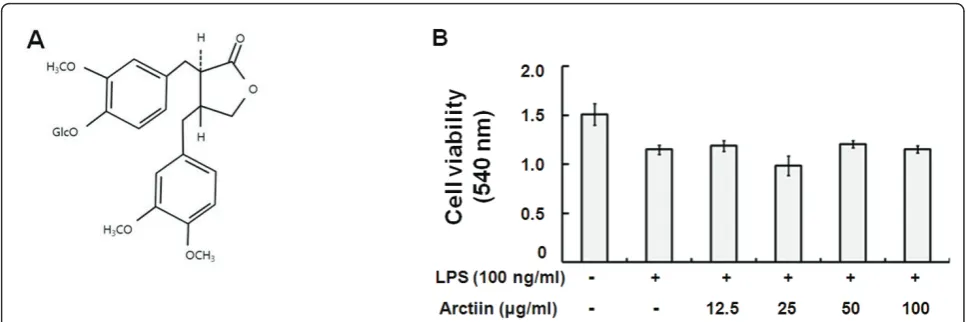
Fruc-tus, has been widely used in traditional medicines to treat swelling, gonorrhea, urination, hemorrhoids, tubercle, and other afflictions [2]. Arctiin is a lignan compound isolated fromForsythiae Fructus(Figure 1A); it has been
found to significantly induce cell detachment and decrease the number of PC-3 cells in human prostate cancer [3]. Moreover, it has been demonstrated to pos-sess many kinds of bioactivities [4] and a number of important pharmacological properties including being demutagenic [5,6] cytotoxic, anti-proliferative [7,8], plate-let activating factor (PAF) antagonistic [9], calcium antagonistic [10], and anti-carcinogenetic. In animal stu-dies, arctiin effectively inhibited the formation of 12-O-tetradecanoylphorbol-13-acetate (TPA)-induced ear edema in mice [11]. However, there has been a lack of studies regarding the effects of arctiin on inflammation.
Chronic inflammation and infection has been demon-strated to lead to an upregulation of a series of enzymes and signaling proteins in affected tissues and cells. Inflam-mation has been shown to be a multi-step process, mediated by activated inflammatory and immune cells including macrophages and monocytes [12]. Inflammatory reactions, phagocytosis, natural cytotoxicity, cytokine pro-duction, antibody response, and cellular immunity are defensive mechanisms that have been suggested to be
* Correspondence: [email protected] 1
College of Pharmacy, SahmYook University, Seoul 139-742, Republic of Korea
Full list of author information is available at the end of the article
modulated by therapeutic doses of antimicrobial agents [13]. Activated macrophages include the inducible forms of nitric oxide synthase (iNOS) and cyclooxygenase-2 (COX-2), which have been reported to be responsible for increasing the levels of nitric oxide (NO) and prostaglan-dins (PGs), the overproduction of proinflammatory cyto-kines (e.g. TNF-a, IL-6, IL-1b) and inflammatory mediators (e.g. PGE2, NO), and the mediation of many
inflammatory diseases [14].
Costimulatory molecules are one class of receptors, which have recently been implicated as fulfilling this role in the innate immune response. B7-1 and -2 repre-sent one class of costimulatory receptors. They consist of structurally related, cell-surface protein ligands, which bind to receptors on lymphocytes that regulate immune responses. In addition, they are stimulated via CD28 while CTLA4 serves as both a stoichiometric inhibitor of CD28-B7-1/-2 engagement as well as serving to directly induce immunosuppressive signals within den-dritic cells [15].
In this study, we evaluated the potential of arctiin as a therapeutic modality for inflammation in RAW264.7 mouse macrophage cells as well as in primary peritoneal macrophages. Our results demonstrated that arctiin lar-gely inhibited the excessive production of inflammatory mediators such as NO, PGE2, TNF-a, IL-1band IL-6 as
well as the suppression of COX-2 through the inhibition of NF-kB translocation pathway.
Methods
Chemicals and reagents
Dulbecco’s Modified Eagle Medium (DMEM)-1640, fetal bovine serum (FBS), and penicillin/streptomycin were purchased from Hyclone (Logan, USA).Escherichia coli lipopolysaccharide (LPS) was purchased from sigma (St. Louis, USA).b-actin, i-NOS, COX-2, p65, p-IBa, PE-B7-1, and FITC-B7-2 anti-bodies were purchased from
BD Pharmingen™(San Jose, USA). Enzyme immunoas-say kits for the measurement of PGE2, IL-1b, IL-6, and
TNF-awere purchased from R&D system (Minneapolis, USA).
Isolation of arctiin from Forsythiae Fructus
Forsythiae Fructus obtained from an herbal market in Seoul, Korea, was extracted three times with hot MeOH (3 hours) and then evaporated at 40°C under reduced pressure to dryness. The MeOH extract was then resus-pended in distilled water and successively partitioned with CHCl3, EtOAc, and n-BuOH. The BuOH fraction
was then loaded onto a silica gel column and eluted with MeOH-CHCl3 mixtures (1:5 to 1:1). The result was
white amorphous powders, which were identified as authentic samples using spectrometric data of nuclear magnetic resonance (1H-NMR), mass spectrometry (MS).1H-NMR (300 MHz), DMSO-d6 : δ6.97(1H, d,J
= 8.3, H-5), 6.82 (1H, d, J = 8.0, H-5’), 6.77 (1H, d,J= 1.7, H-2), 6.65 (1H, dd,J = 8.3, 1.7, H-6), 6.65 (1H, s, H-2’), 6.59 (1H, dd, J = 8.0, 1.8, H-6’), 4.83 (1H, d,J = 7.3, H-1’’), 4.00 (2H, m, H-9’), 3.70 (3H, s, OCH3), 3.69
(6H, s, OCH3), 2.76 (2H, m, H-7’), 2.54 (4H, m, H-7, 8,
8’). Positive FABMS (m/z): 557 (M + Na+), 372 (M + gluco), 154, 136. The white amorphous powder com-pound analyzed by NMR and MS was identified to arc-tiin (Figure 1A).
Animals
ICR mice (6-8 weeks old, specific pathogen-free) were obtained from Orient-Bio Co. (Seongnam, Korea). Ani-mals were fed with standard laboratory chow (PMI Lab Diet, Richmond, USA) and autoclaved distilled water (DW). They were acclimatized in an animal facility (Sah-myook University, Korea) and maintained at 22 ± 2°C in 50 ± 10% relative humidity and a light/dark (12 hrs/12 hrs) cycle for at least 7 days prior to the experiments.
Cell culture
Male ICR mice (6-8 weeks) were intraperitoneally injected with 1.5 ml thioglycollate broth for recruitment of macro-phages. RAW 264.7 cells were obtained from the American Type Culture Collection (ATCC, Rockville, USA). These cells were grown at 37°C in DMEM medium supplemented with 10% FBS and 1% (v/v) penicillin (10,000 U/ml)/strep-tomycin (10,000 U/ml) in a humidified 5% CO2-95% air
incubator under standard conditions.
Cell viability assay
A commercially available cell viability assay was employed to evaluate the cytotoxic effect of arctiin using thiazolyl blue tetrazolium bromide (SIGMA, USA). RAW264.7 cells (2 × 10⁵ cells/well) were plated with various concentra-tions of arctiin in 96-well microtiter plates (Nunc, Roskilde, Denmark) and were then cultured at 37°C in a 5% CO2incubator. Subsequently, 50μl of MTT solution
was added to each well, and the cells were then cultured for 4 hrs at 37°C in the same incubator. Following this, 100μl of solubilized solution were added to each well and the plate was allowed to stand overnight in the incubator. The optical density (OD) was then measured at 560 nm by a microplate reader (Molecular devices, USA).
Nitrite measurement
RAW 264.7 cells were added to each well (200μl; 1 × 10⁶ cells/ml) of a flat-bottomed 96-well plate according to the following treatment condition: LPS (100 ng/ml), LPS/arctiin (12.5, 25, 50, 100 μg/ml), and media only (DMEM-10). Nitric oxide was measured in culture supernatants by reaction with the Griess reagent (1% sulfanilamide and 0.1% N-[1-naphthy]-ethylenediamine dihydrochloride in 5% phosphoric acid; Roche) to 100μl of culture supernatant for 15 min at room temperature in the dark. The absorbance at 540 nm was then deter-mined using a microplate reader (Molecular devices, USA) and a standard curve was generated using NaNO2.
Determination of pro-inflammatory cytokines and PGE2
RAW 264.7 cells and primary macrophages were cul-tured in 12-well flat plates at a density of 5 × 10⁶cells/ well. The cells were then treated with various concentra-tions of arctiin and subsequently stimulated with LPS (100 ng/ml) at 37°C for 48 hrs in humidified air with 5% CO2. The supernatants were then collected and
mea-sured for TNF-a, IL-1b, IL-6, and PGE2 by an
enzyme-linked immunosorbent assay (ELISA) according to the manufacturer’s protocol.
RT-PCR (reverse transcription polymerase chain reaction) Total RNA was extracted from macrophages using the RNeasy Mini Kit (QIAGEN, USA) in an RNase-free envir-onment. The reverse transcription of 1 μg RNA was
carried out using M-MLV reverse transcriptase (Promega, USA), oligo (dT) 16 primer, dNTP (0.5 mM) and 1 U RNase inhibitor. After incubation at 65°C for 5 min and 37°C for 60 min, M-MLV reverse transcriptase was inacti-vated by heating at 70°C for 15 min. The polymerase chain reaction (PCR) was performed in 50 mM KCl, 10 mM Tris-HCl (pH8.3), 1.5 mM MgCl2, and 2.5 mM dNTPs
with 5 units of Taq DNA polymerase and 10 pM of each primer set for IL-1b, IL-6, TNF-a, iNOS, and COX-2. The cDNA was amplified by 35 cycles of denaturing at 94°C for 45 s, annealing at 60°C for 45 s, and extension at 72°C for 1 min. Final extension was performed at 72°C for 5 min. The PCR products were electrophoresed on 1.5% agarose gels and stained with ethidium bromide. The pri-mer sequences were as follows: 5’- AGC TCC TCC CAG
GAC CAC AC-3’ (forward), 5’-ACG CTG AGT ACC
TCA TTG GC-3’(reverse) for i-NOS, 5’-AAG AAG AAA GTT CAT TCC TGA TCC C-3’(forward), 5’-TGA CTG TGG GAG GAT ACA TCT CTC-3’(reverse) for COX-2, and 5’-GTG GGC CGC CCT AGG ACC AG-3’(forward), 5’- GGA GGA AGA GGA TGC GGC AG T-3’(reverse) forb-actin as a control for PCR. The band intensity was quantified by densitometric analysis (Infinity 3026, Vilber Lourmat, France).
Preparation of cytosolic and nuclear extracts
The cells were collected after culture and washed twice with cold PBS, resuspended in hypotonic buffer (10 mM HEPES, pH 7.9, 10 mM KCl, 1.5 mM MgCl2, 0.2 mM
PMSF, 0.5 mM DTT, 10μg/ml aportinin). After 15 min incubation on ice, the cells were lysed by the addition of 0.1% NP-40 and vigorous vortexing for 1 min. The nuclei were pelleted by centrifugation at 12,000 × g for 1 min at 4°C and resuspended in high salt buffer (20 mM HEPES, pH 7.9, 25% glycerol, 400 mM KCl, 1.5 mM MgCl2,
0.2 mM EDTA, 0.5 mM DTT, 1 mM NaF, 1 mM sodium orthovanadate). The cytosolic and nuclear extracts were stored in aliquots at -70°C.
Western blot analysis
Flow cytometry
RAW 264.7 cells (1 X 10⁶ cells/ ml) were cultured in Petri-dishes. The cells were treated with various concen-trations (12.5, 25, 50, 100μg/ ml) of arctiin in the pre-sence of LPS (100 ng/ ml). The dishes were incubated at 37°C for overnight in humidified 5% CO2 incubator
under standard conditions. The cells were then washed with PBS. The washed cells were blocked with staining buffer containing 10% normal mouse serum (NMS) for 20 min on ice. The blocked cells were incubated with co-stimulatory molecules such as B7-1 and B7-2 anti-body (BD Biosciences, San Jose, USA) for 20 min on ice. The incubated cells were washed three times with stain-ing buffer and then fixed by 1% paraformaldehyde in PBS. The fixed cells were measured by flow cytometry (Beckman coulter, Brea, USA).
Statistical analysis
All data are presented as mean ± SEM values. Signifi-cant differences (P < 0.05) between groups were evalu-ated using a one-way analysis of variance with SPSS (Chicago, IL, USA) for Windows and Duncan’s Multiple Range Test where appropriate.
Results
Prior to evaluating whether arctiin showed anti-inflam-matory activity, we examined its effect on cell growth in RAW264.7 cells and found that arctiin did not affect
normal cell growth at concentrations up to 100μg/ml (Figure 1B). Thus, in the following experiments, arctiin was studied at concentrations up to 100μg/ml in order to exclude any effects on the normal growth status of cells.
Effect of arctiin on PGE2and NO production in
macrophages
In the present study, we examined whether or not arc-tiin suppress macrophages activation induced by LPS, one of the most potent macrophages activation factors. Arctiin significantly suppressed COX-2 protein expres-sion (Figure 2A) in LPS-stimulated RAW 264.7 cells. The pro-inflammatory mediator, PGE2 is also generated
by the COX-2 enzyme in response to stimulation by LPS. Results showed that arctiin significantly inhibited PGE2 production (Figure 2B) and mRNA of COX-2 in
RAW 264.7 cells (Figure 2C) and primary macrophages (Figure 2D) by western blot analyses and subsequent RT-PCR.
NO is known to be a pro-inflammatory mediator in inflammatory diseases. Several studies have demonstrated that overproduction of NO by iNOS was associated with inflammatory responses and also with serious disorders, including RA. Therefore, we investigated whether arctiin inhibits NO production in macrophages that were acti-vated with LPS. Interestingly, in LPS (100 ng/ml) stimu-lated RAW264.7 cells, when various concentrations of
arctiin (12.5, 25, 50, 100 uGu/ml) were added to the cul-ture media at the time of cell stimulation, LPS-induced production of NO was significantly inhibited in a dose-dependent manner (Figure 3A). Subsequent RT-PCR and western blot analyses showed that arctiin inhibited protein expression of i-NOS (Figure 3B) and mRNA (Figure 3C) in RAW 264.7 cells as well as the primary macrophages (Figure 3D).
Arctiin down-regulates production of pro-inflammatory cytokines
The in vitroanti-inflammatory activity of arctiin was monitored by evaluating the gene and protein expression levels of inflammation-related enzymes (iNOS and COX-2) and several proinflammatory cytokines (IL-1b, IL-6, and TNF-a) with ELISA and western blot analysis. As shown in Figure 4A, arctiin significantly suppressed the protein expression of pro-inflammatory cytokines in LPS-stimulated macrophages. Moreover, productions of cytokine were significantly attenuated by 100μg/ml of arctiin in the both RAW 264.7 cells (Figure 4B, D, and F) and primary macrophages (Figure 4C, E, and D).
Effect of arctiin on the expression of co-stimulatory molecules
Adhesion molecules play an important role in the macrophage activation process. RAW264.7 cell surface expression of B7-1 and B7-2 was examined using flow
cytometry. Results demonstrated that arctiin inhibited cell surface molecules in a dose-dependent manner. Further, LPS-stimulated RAW264.7 cells treated with a high concentration of arctiin (100μg/ml) had a greater reduction than other concentrations (Figure 5).
Effect of arctiin on the activation of NF-B
NF-кB proteins are present in the cytoplasm as inactive heterodimers composed of two subunits, P50 and P65, and are bound to the inhibitory protein IBawhich pre-vents it from the translocation into the nucleus of the cell [16]. Upon stimulation, IBais phosphorylated and proteolytically degraded through a 26S proteasome-mediated pathway which facilitates NF-кB translocation into the nucleus and regulates gene transcription [17]. To investigate whether arctiin could affect nuclear trans-location of NF-кB, western blot analysis of NF-кB p65 was carried out using RAW264.7 cell lysates. The amount of NF-кB p65 was markedly increased upon exposure to LPS alone, whereas arctiin inhibited it (Fig-ure 6). Furthermore, we examined how arctiin modu-lated translocation of NF-B, western blot analysis of phosphorylation of I-Ba in cytoplasm. Arctiin signifi-cantly attenuated IBa phosphorylation in RAW 264.7 cells (Figure 6). These results suggest that inhibition of i-NOS, IL-1b, IL-6, TNF-a, and COX-2 gene expression by arctiin may have been due to the down regulation of NF-B activation.
Discussion
Arctiin is lignin compound isolated from Forsythiae
Fructus. The anti-cancer [3,7,8] and platelet activat-ing factor antagonistic effects [9] of arctiin have been well documented but the mechanisms underly-ing anti inflammatory effect are still not understood. The present study found that arctiin significantly inhibited the effects of LPS by suppressing a key inflammatory pathway related to NF-B, PGE2 and
NO production, and pro-inflammatory cytokines expression.
Inflammation is a reaction of the body to injury or to infectious, allergic, or chemical irritation. Leukocytes destroy harmful microorganisms and dead cells, prevent-ing the spread of the irritation and permittprevent-ing the injured tissue to repair itself. However, excessive or per-sistent inflammation causes a variety of pathological conditions, such as bacterial septic shock, and rheuma-toid arthritis [18,19]. Inflammatory mediators (e.g. nitric oxide and pro-inflammatory cytokines) have been demonstrated to be critically involved in the develop-ment of inflammatory diseases.
QXFOHDUS
S ,ț%Į
±
/36QJPO
$UFWLLQȝJPO
±
±
ȕDFWLQ
Figure 6 Arctiin inhibits the IBaphosphorylation in cytoplasm and nuclear translocation of NF-B p65 in LPS-stimulated macrophages. RAW 264.7 cells were treated with different concentrations of arctiin (12.5~100μg/ml) in the presence of LPS (100 ng/ml) and was monitored as described in‘Materials and Methods’.
Macrophages play important roles in regulating cell-mediated immune responses, such as adaptive immune, innate immune, and allergic reactions, as well as inflam-mation in response to microbes and microbial products such as LPS [20]. In addition to the well-known func-tion of endocytosis, macrophages can be induced to secrete nitric oxide and a series of cytokines including TNF-a, IL-1b, IL-6, and IL-12 that express NF- B-dependent i-NOS [21,22] and COX-2 [23]. Many dis-eases, such as arteriosclerosis, chronic hepatitis and pul-monary fibrosis, involve the overproduction of inflammatory mediators [24-27] and thus, inhibiting their production may serve to prevent or suppress a variety of inflammatory diseases, including rheumatoid arthritis (RA), sepsis, and endotoxemia. Despite the exact cause of autoimmune disease remaining obscure, deregulated overproduction of pro-inflammatory cyto-kines and a disruption in the regulation of cytokine sig-nal transduction have been indicated as underlying mechanisms of some autoimmune diseases such as RA and Crohn’s disease [28,29].
Nitric oxide is synthesized via the oxidation of argi-nine by a family of NOS, and it plays a vital role in reg-ulating physiological processes, such as blood vessel tone and neurotransmission, as well as in host defense and immunity [30,31]. Pro-inflammatory cytokines, IL-1b, IL-6, and TNF-a, have attracted more attention in that they can be localized to the infected tissue, mani-fested systemically throughout the body, and cause vaso-dilation as well as symptoms of inflammation [32-34]. Our findings that arctiin inhibits the formation of NO and pro-inflammatory cytokines showed the importance of arctiin as an anti-inflammatory compound. The reduced NO production by arctiin was a consequence of an inhibition of iNOS, the key enzyme responsible for NO production under pathological conditions.
PGE2 plays major roles in the angiogenesis of
syno-vium through the expression of vascular endothelial growth factors [35], synovial inflammation, and joint erosion in RA [36]. Further, in the prostaglandin bio-synthesis pathway, COX-2 is the key enzyme that cata-lyzes the conversion of arachidonic acid to PGE2. It is
generally accepted that PGE2 is produced by COX-2 at
sites of inflammation, and that COX-1, another consti-tutive isoform, is relevant in the production of prosta-glandins that regulate normal cellular processes such as vascular homeostasis regulation, gastric mucosal protec-tion and renal integrity maintenance [37]. In the present study, we found that arctiin suppressed PGE2
produc-tion via inhibiproduc-tion of COX-2 enzyme activity and this may in part be responsible for some of anti-inflamma-tory properties of this compound.
The transcriptional factor NF-B is important for the expression of immune and inflammatory genes. The
activated NF-B then binds B motifs in the promoters via its p65 subunit, leading to expression of several inflammatory genes. Because NF-B transcription fac-tors are uniquely positioned downstream of multiple innate and adaptive signaling pathways, they seem ide-ally placed to integrate and coordinate innate and adap-tive signals required for formation of producadap-tive immune responses. In the present study, we found that arctiin could inhibit the NF-B nucleus translocation induced by LPS through a reduction in IB phosphory-lation status.
The B7 family is related immunoglobulin supergene family members that are expressed by multiple cell types involved in antigen presentation. Both B7-1 and B7-2 are constitutively expressed on dendritic cells and are regulated on monocytes, macrophages, B cells, and T cells following activation. In agreement with our find-ings, arctiin has also been shown to suppress co-stimu-latory molecules such as B7-1 and B7-2 in macrophages. In summary, these results suggest that arctiin has anti-inflammatory effects on macrophages through the reduced pro-inflammatory cytokines are associated with NF-B inactivation and the suppression of NF-kB-regu-lated proteins, and other bioactive substances as well as through inhibition of the expression of co-stimulatory molecules.
Acknowledgements
This study was supported by the Sahmyook University Research fund in 2010.
Author details
1
College of Pharmacy, SahmYook University, Seoul 139-742, Republic of Korea.2School of Life Sciences, Handong Global University, Pohang 791-708, Republic of Korea.3College of Pharmacy, Chungbuk National University, Cheongju 361-763, Republic of Korea.
Authors’contributions
SL participated in the design of this study and performed the statistical analysis in whole research. SS carried out the Western blot assay of iNOS, COX-2, and proinflammatory cytokines. HK carried out the RT-PCR assay. SH carried out the FACS analysis in B7 family. KK carried out the preparation of peritoneal macrophages, participated in the maintenance of SPF room and care of animal. JK carried out the cytokine assay (ELISA). JHK participated in the design of the study, and proofread a manuscript aboutin vitro experiments design. CKL participated in the design of the study, and proofread a manuscript aboutin vivoexperiments design. NJH participated in the test of toxicity of this compound, and proofread a manuscript about cell toxicity. DY carried out the separation of arctiin fromForsythiae Fructus. KK conceived of the study, and participated in its design and coordination. All authors read and approved the final manuscript.
Competing interests
The authors declare that they have no competing interests.
Received: 17 June 2010 Accepted: 7 July 2011 Published: 7 July 2011
References
2. Kim TJ:Korean resources plants.Seoul;, first 1991.
3. Huang DM, Shen YC, Wu C, Huang YT, Kung FL, Teng CM, Guh JH:
Investigation of extrinsic and intrinsic apoptosis pathways of new clerodane diterpenoids in human prostate cancer PC-3 cells.Eur J Pharmacol2004,503(1-3):17-24.
4. Macrae WD, Tower GH:Biological activities of Lignans.Phytochemistry 1984,23:1207-1220.
5. Morita K, Nishijima Y, Kada T:Chemical nature of a desmutagenic factor from Burdock (Arctium lappa Linne).Agr Biol Chem1985,49:925-932. 6. Kazuki S, Seikichi K, Misao M, Zwe-Ling K, Hiroshi H:Antimutagenicity of
Dialyzates of Vegetables and Fruits (Food & Nutrition).Agr Biol Chem 1988,52:1369-1375.
7. Ryu S, Ahn J, Kang Y, Han B:Antiproliferative effect of arctigenin and arctiin.Arch Pharmacol Res1995,18:462-463.
8. Moritani S, Nomura M, Takeda Y, Miyamoto K:Cytotoxic components of bardanae fructus (goboshi).Biol Pharm Bull1996,19:1515-1517. 9. Iwakami S, Wu JB, Ebizuka Y, Sankawa U:Platelet activating factor (PAF)
antagonists contained in medicinal plants: lignans and sesquiterpenes.
InChem Pharm Bull. Volume 40.Tokyo; 1992:1196-1198.
10. Ichikawa K, Kinoshita T, Nishibe S, Sankawa U:The Ca2+ activity of lignans.
Chem Pharm Bull1986,34:3514-3517.
11. Liu S, Chen K, Schliemann W, Strack D:Isolation and identification of arctiin and arctigenin in leaves of burdock (Arctium lappa L.) by polyamide column chromatography in combination with HPLC-ESI [sol] MS.Phytochem Anal2005,16:86-89.
12. Minagar A, Shapshak P, Fujimura R, Ownby R, Heyes M, Eisdorfer C:The role of macrophage/microglia and astrocytes in the pathogenesis of three neurologic disorders: HIV-associated dementia, Alzheimer disease, and multiple sclerosis.J Neurol Sci2002,202:13-23.
13. Stevens DL:Immune modulatory effects of antibiotics.Curr Opin Infec Dis 1996,9:165-169.
14. Nathan C:Nitric oxide as a secretory product of mammalian cells.FASEB J1992,6:3051-3064.
15. Sharpe AH, Freeman GJ:The B7-CD28 superfamily.Nat Rev Immunol2002,
2:116-126.
16. Gomez PF, Pillinger MH, Attur M, Marjanovic N, Dave M, Park J:Resolution of inflammation: prostaglandin E2 dissociates nuclear trafficking of individual NF-kappaB subunits (p65, p50) in stimulated rheumatoid synovial fibroblasts.J Immunol2005,175:6924-6930.
17. Strayhorn WD, Wadzinski BE:A novel in vitro assay for deubiquitination of I kappa B alpha.Arch Biochem Biophys2002,400:76-84.
18. Dinarello C:Proinflammatory and anti-inflammatory cytokines as mediators in the pathogenesis of septic shock.Chest1997,
112:321S-329S.
19. Palladino M, Bahjat F, Theodorakis E, Moldawer L:Anti-TNF-alpha therapies: the next generation.Nat Rev Drug Discov2003,2:736-746. 20. Firestein GS:Invasive fibroblast-like synoviocytes in rheumatoid arthritis.
Passive responders or transformed aggressors?Arthritis Rheum1996,
39:1781-1790.
21. Nathan C:Inducible nitric oxide synthase: what difference does it make?
J Clin Invest1997,100:2417-2423.
22. Bogdan C:Nitric oxide and the immune response.Nat Immunol2001,
2:907-916.
23. Vila-del Sol V, Fresno M:Involvement of TNF and NF-kappa B in the transcriptional control of cyclooxygenase-2 expression by IFN-gamma in macrophages.J Immunol2005,174:2825-2833.
24. Isomaki P, Punnonen J:Pro- and anti-inflammatory cytokines in rheumatoid arthritis.Ann Med1997,29:499-507.
25. Libby P, Ridker P, Maseri A:Inflammation and atherosclerosis.Am Heart Assoc2002,150:1135-1143.
26. Tilg H, Wilmer A, Vogel W, Herold M, Nolchen B, Judmaier G:Serum levels of cytokines in chronic liver diseases.Gastroenterology1992,103:264-274. 27. Coker RK, Laurent GJ:Pulmonary fibrosis: cytokines in the balance.Eur
Respir J1998,11:1218-1221.
28. Chenevier-Gobeaux C, Morin-Robinet S, Lemarechal H, Poiraudeau S, Ekindjian JC, Borderie D:Effects of pro- and anti-inflammatory cytokines and nitric oxide donors on hyaluronic acid synthesis by synovial cells from patients with rheumatoid arthritis.Clin Sci (Lond)2004,107:291-296. 29. Nishimoto N:Cytokine signal regulation and autoimmune disorders.
Autoimmunity2005,38:359-367.
30. Furchgott R, Cherry P, Zawadzki J, Jothianandan D:Endothelial cells as mediators of vasodilation of arteries.J Cardiovasc Pharmacol1984,6: S336-343.
31. Wei X, Charles I, Smith A, Ure J, Feng G, Huang H:Altered immune responses in mice lacking inducible nitric oxide synthase.Nature1995,
375:408-4011.
32. Haddad JJ, Safieh-Garabedian B, Saadé NE, Kanaan SA, Land SC:
Chemioxyexcitation (delta pO2/ROS)-dependent release of IL-1 beta, IL-6 and TNF-alpha: evidence of cytokines as oxygen-sensitive mediators in the alveolar epithelium.Cytokine2001,13:138-147.
33. Moldoveanu A, Shephard R, Shek P:Exercise elevates plasma levels but not gene expression of IL-1β, IL-6, and TNF-αin blood mononuclear cells.J Appl Physiol2000,89:1499-1504.
34. Ben-Av P, Crofford L, Wilder R, Hla T:Induction of vascular endothelial growth factor expression in synovial fibroblasts by prostaglandin E and interleukin-1: a potential mechanism for inflammatory angiogenesis.
FEBS Lett1995,372:83-87.
35. Dayer J:Prostaglandin production by rheumatoid synovial cells: stimulation by a factor from human mononuclear Cells.J Exp Med1977,
145:1399-1404.
36. Lecomte M, Laneuville O, Ji C, DeWitt D, Smith W:Acetylation of human prostaglandin endoperoxide synthase-2 (cyclooxygenase-2) by aspirin.J Biol Chem1994,269:13207-13215.
37. Vane J, Bakhle Y, Botting R:Cyclooxygenases 1 and 2.Annu Rev Pharmacol Toxicol1998,38:97-120.
doi:10.1186/1476-9255-8-16
Cite this article as:Leeet al.:Anti-inflammatory function of arctiin by inhibiting COX-2 expression via NF-B pathways.Journal of Inflammation 20118:16.
Submit your next manuscript to BioMed Central and take full advantage of:
• Convenient online submission
• Thorough peer review
• No space constraints or color figure charges
• Immediate publication on acceptance
• Inclusion in PubMed, CAS, Scopus and Google Scholar
• Research which is freely available for redistribution