M E T H O D O L O G Y
Open Access
Onco-STS: a web-based laboratory information
management system for sample and analysis
tracking in oncogenomic experiments
Mike Gavrielides
1†, Simon J Furney
1†, Tim Yates
2, Crispin J Miller
2and Richard Marais
1*Abstract
Background:Whole genomes, whole exomes and transcriptomes of tumour samples are sequenced routinely to identify the drivers of cancer. The systematic sequencing and analysis of tumour samples, as well other oncogenomic experiments, necessitates the tracking of relevant sample information throughout the investigative process. These meta-data of the sequencing and analysis procedures include information about the samples and projects as well as the sequencing centres, platforms, data locations, results locations, alignments, analysis specifications and further information relevant to the experiments.
Results:The current work presents a sample tracking system for oncogenomic studies (Onco-STS) to store these data and make them easily accessible to the researchers who work with the samples. The system is a web application, which includes a database and a front-end web page that allows the remote access, submission and updating of the sample data in the database. The web application development programming framework Grails was used for the development and implementation of the system.
Conclusions:The resulting Onco-STS solution is efficient, secure and easy to use and is intended to replace the manual data handling of text records. Onco-STS allows simultaneous remote access to the system making collaboration among researchers more effective. The system stores both information on the samples in oncogenomic studies and details of the analyses conducted on the resulting data. Onco-STS is based on open-source software, is easy to develop and can be modified according to a research group’s needs. Hence it is suitable for laboratories that do not require a commercial system.
Keywords:Sample tracking, LIMS, Oncogenomic data, Cancer, Grails, Web application, Database
Background
The field of cancer genomics has been revolutionized by the development of high throughput sequencing technolo-gies to survey tumour genomes [1]. Targeted and genome-scale sequencing and analysis have been conducted on DNA and RNA from multiple samples to detect aberra-tions in many tumour types [2-6]. Whole genomes and exomes are investigated to detect some or all of single nu-cleotide variations (SNVs), small insertions and deletions (indels), copy number alteration and structural variation. Messenger RNA and micro RNA expression are also
analysed to obtain insights in gene expression differences in tumour cells [3-6].
Recently, large scale cancer genomics projects such as the International Cancer Genome Consortium (ICGC) [7] and the Cancer Genome Atlas (TCGA) [8] have been launched and are already beginning to bear fruit. In addition, the plummeting cost of next-generation sequen-cing has allowed smaller sequensequen-cing efforts, such as our own and others, to address questions in cancer genomics beyond the remit of the larger scale projects [9-13]. How-ever, even smaller oncogenomic projects can produce data from different techniques and sequencing platforms that then undergo a variety of alignment and analysis proce-dures. Furthermore, more established oncogenomic exper-iments such as mRNA and DNA microarrays and array comparative genomic hybridization (aCGH) are often * Correspondence:[email protected]
†Equal contributors
1
Molecular Oncology Group, University of Manchester, Wilmslow Road, Manchester M20 4BX, UK
Full list of author information is available at the end of the article
used in tandem with next generation technologies. Hence a sample from a patient may be surveyed by a number of different technologies within the same laboratory or study. Molecular biology laboratories need to store relevant in-formation from the sequencing procedures and analysis to be able to track an experiment’s progress and specifica-tions of each sample under study. The data management and sample tracking systems implemented by larger initia-tives are often not available to smaller institutes or labora-tories and information is sometimes stored in manually managed text or spreadsheet files that render access, search and management of the data tedious.
A number of Laboratory Information Management Sys-tems (LIMS) for next generation sequencing experiments are freely available, including GNomEx [14], openBIS [15], Galaxy LIMS [16] and SeqBench [17]. However, none of these systems is designed specifically for oncogenomic experiments in which both array based and different se-quencing technologies are used to analyse samples from tumour, germline,in vitroand xenograft models.
This work presents an open-source and platform inde-pendent web-based system that facilitates remote storage and retrieval of next-generation sequencing/oncogenomic experiment related information. The Sample Tracking System (Onco-STS) enables users to track DNA and RNA samples that have been sequenced or analysed in genomic studies. Onco-STS, which runs on a server, is accessible remotely by users and includes a database and a web interface through which users interact with the database.
Methods
Implementation
The system has been developed using the web develop-ment framework, Grails (http://www.grails.org/). Grails has a persistence engine built on Hibernate (http://www. hibernate.org/), and a straightforward Object Relational Mapping (ORM) that makes it ideal for the rapid devel-opment of database-backed web applications, since most database actions can be handled automatically without any explicit SQL or XML coding on the part of the pro-grammer. The entire Grails project is wrapped in a war file with a single command and deployed in an Apache Tomcat servlet container. The application is easy to install and takes about 30 minutes. All the necessary files and instructions to run the application are included in the supplementary material submitted with this work. The system is protected by an authentication system and users must have an account to login to the service in order to use it. Users may also be granted different au-thorities according to the different privileges they may have. As the system is designed for individual laborator-ies and facilitlaborator-ies within a research institute, registered users have access to the complete database, which means
that any registered user can see all samples in the data-base and edit them if they have been assigned editing privileges. There are three different user account types: a
“read-only” account for users that need only to access the data but will not be allowed to add new or alter the existing data, a“write”account for users that will be able to submit new samples and add new data for the existing ones and “administrator” account for the administrators of the system that in addition to updating privileges they will also be able to manage the users and their accounts.
Onco-STS also has an optional automatic mailing sys-tem that notifies the users and investigators about sample and experimental updates. If activated, only users and investigators associated with the updated sample will be informed. Mailing settings and user management are available in the Administration page. The homepage of Onco-STS is shown in Additional file 1: Figure S1.
Results
Sample tracking data
Data to be submitted to the database include the tumour or germline sample tissue information, nucleic acid ex-traction information, the different stages of the oncoge-nomic experiments that have been conducted on the samples, the projects that the samples are involved in and the sources from which the samples have been extracted.
Each sample belongs to a particular project that has a unique code and name and involves a number of investi-gators. A project can have multiple samples from the same or different sources (Additional file 1: Figure S2). Sample information includes the sample name, the type of sample (whether it is germline, a primary tumour, a metastasis, xenograft, cell line or allograft), the site and histology, surgery information and mouse generation and number in case of a xenograft/allograft. The meta-data of the samples include the dates the sample was submitted to the database, the last time they were al-tered, the user who created the sample and all the users who have edited the sample or any other information re-lated to the sample experiments. Storage information of the samples under various conditions is also supported (Additional file 1: Figures S3 & S4). To access samples of interest users can list all the samples of a project by navi-gating to the project page or they can use the search form to search for samples by their main attributes (e.g. name, type, site, histology, user that submitted the sample). A quick sample search at the home page is also available.
sample and analysis metadata and not for hosting the actual sequencing and analysis data. Nevertheless, loca-tion and paths to these data can be saved in the sample experiment data under “Sequencing Data” section and
“Results Location/Directory” in analysis section, thus multiple files for the same sample can be tracked.
i. Whole Genome Sequencing;
The whole genome sequencing data include the genome library, the sequencing process and data -dates, sequencing centre, platform, number of lanes, insert and fragment size, location of results etc.– alignment, analysis and somatic analysis, which includes used algorithms, duplicates, mapping information, results locations, dates performed etc. For the sequencing part quality control information for each lane can also be stored.
ii. Whole Exome Sequencing;
The tracking data of WES are the same as the WGS data with additional information for the exome target capture protocol - manufacturer, kit, date performed and by whom.
iii.RNA-Seq;
Sequencing of the transcriptome provides information on gene expression, alternative splicing and gene fusion transcripts. The tracking data are similar to Whole Genome Sequencing with differences in alignment–proportion of reads aligned to introns, exons and ribosomal RNA.
iv.SNP array;
SNP arrays are conducted for single nucleotide polymorphisms detection among individuals. Tracking data include array information, array centre, platform and array quality control as well as results location and analysis algorithms used.
v. mRNA microarrays;
Tracking data of mRNA microarrays for mRNA analysis is largely similar to the SNP array data. vi.Array-comparative genomic hybridization (aCGH).
aCGH is a method for detection of copy number alterations in the genome. The data include Genomic Hybridisation, dates, aCGH centre and platform, as well as location of results and algorithms used for analysis.
Acommentsfield is available for all the system entities (samples, projects, sources and experiments) to allow any kind of information that is not specified by the database to be entered.
Sample tracking database schema
Sample table
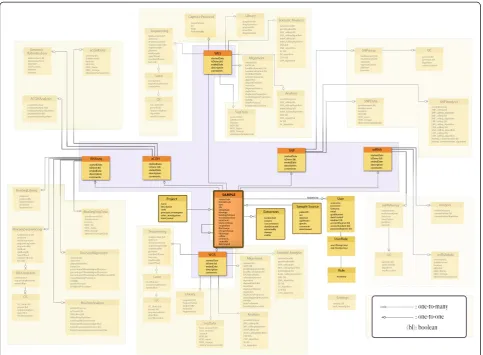
Onco-STS is a sample driven application. The Sample table (Figure 1) is connected with a one-to-one (1:1) rela-tionship to six tables that correspond to the six different
oncogenomic experiments: WGS, WES, SNP, RNA-Seq, mRNAandaCGH. A one-to-one relationship denotes that each sample record is linked with foreign keys to one par-ticular record from each of the experiment tables.
Each sample belongs to a particular source and pro-ject. Consequently, the Sample table is also connected with aSourceand Project table. The connection to both tables is through a one-to-many (1:m) relationship, with
“many”on theSampleside, since each project and source may have multiple different samples (Figure 1).
The users who update theSampletable and any other table that is directly or indirectly linked to the Sample table are tracked. To accomplish this theSampletable is linked with a one-to-many relationship to theUsertable, with “many” on the user’s side, denoting that a sample can be updated by many users (Figure 1). Information for multiple DNA and RNA extractions for each sample is included in the Extraction table linked to the Sample table (Figure 1).
A sample can be linked to an existing primary sample due to the occurrence of metastases or it can be derived from a primary sample for experiments involving cell-lines, allografts and xenografts. To accomplish this inter-sample relationship theSampletable has a self-referencing mechanism, which is used to link samples with each other in a parent–child manner.
Experiments
All six experiment tables directly linked to the Sample table have exactly the same columns including dates, de-scription and comments. Each of the experiment tables is linked to other tables that hold all the information needed for each experimental record.
i. TheWGStable has a 1:1 link to aSequencing, Sequencing Data,Library,Alignment,Analysisand Somatic Analysistable (Additional file1: Figure S5). The sequencing procedure can be conducted using multiple lanes so theSequencingtable has a 1:m link to aLanetable. TheLanetable is 1:1 linked with a Quality Control(QC) table to store the quality control information of each lane sequenced. ii. TheWEStable is similar to WGS table with
Sequencing, Sequencing Data, Library, Alignment, Analysis, Somatic Analysistables, plus an additional Capture Protocoltable. TheLaneandQCtables are also the same as inWGS(Additional file1: Figure S6).
iii. TheRNA-Seqsection is similar toWGSwith some differences in theAlignmentandAnalysistables (Additional file1: Figure S7).
the quality control information for each SNP array record (Additional file1: Figure S8).
v. ThemRNAtable has 1:1 links to anArray, Data, andAnalysistable. TheArraytable is connected with 1:1 relation to aQuality Controltable to store the quality control information for each mRNA array record (Additional file1: Figure S9). vi. TheaCGHtable has 1:1 links to anArray, Data,
andGenome Hybridizationtable (Additional file1: Figure S10).
The UserandRole tables have records of all the users of the system and the different kind of roles/authorities granted to them. An entire representation of the data-base schema is shown in Additional file 1: Figure S11.
Discussion
The sample tracking system developed in this project is a LIMS for oncogenomics studies and facilitates the fast, secure storage and retrieval of sample-associated
information. Importantly, details of quality control pro-cedures and analyses of the oncogenomic data are re-corded in the system in addition to information on the samples. The web-based service provides advantages over locally accessed software tools as it is platform in-dependent and can be accessed even through mobile devices with a compatible web browser in which case the user interface will be adjusted to the screen size. Additionally, minimal system requirements (and no in-stallation) are needed from the client site and service updates/bug fixes become immediately available to all users. As it is a web application that runs on a server it allows users to access centralized data repositories, which can make collaborations among distant research groups more effective. Furthermore, any new data sub-mitted to the system become instantly available to all scientific staff with access to the system.
We have designed the system to facilitate its use by multiple different users. For example, it is envisaged that new samples could be created by a researcher responsible
Figure 1Summary of the database schema with thesample,patient,projectand the six experiments tables (WGS, WES, RNASeq, aCGH,
for a project. Subsequently, information about the sequen-cing process would be added by a technician or core facil-ity personnel. Thereafter, alignment and analysis tracking would be completed by a bioinformatician. Hence, the sys-tem provides a model enabling multiple users to enter data on specific samples. Each one of the experiment steps can be marked as completed which will allow users to check what has been conducted for the experiment and what follows next. Additionally, the progress of each experiment is shown with a progress bar on the sample page to track the progress as it is processed (Additional file 1: Figure S4). The system’s security prevents any unauthorized users from accessing or editing the database. The web application overcomes many of the draw-backs of having the sample information stored in other forms such as in text file records and allows quick sub-mission, editing and querying of the database.
Onco-STS is limited to allow submission of types of data that have been defined in the system schema. Com-ments fields in all the system sections provide a facility for the addition of further information. Importantly, the system allows linking of samples from the same source (e.g. primary and metastatic tumours from an individual, or cell lines and xenografts derived from a tumour). We have designed the system based on the oncogenomic studies that we conduct routinely in our laboratory. Thus the system is not designed to be a comprehensive resource and is the first version we have constructed. Further versions will include experiment tables for prote-omic and epigenprote-omic studies, however these additions are beyond the scope of the present study.
Although Laboratory Information Management Sys-tems (LIMS) already exist, many of them are commercial and not affordable by small research facilities. Addition-ally, not all of them provide remote and simultaneous access by multiple users. Whilst large scale projects such as the ICGC and TCGA will have dedicated sample tracking solutions, and other research institutes and large laboratories are likely to have implemented systems, many of these are likely to be proprietary or commercial LIMS systems such as the ones offered by Genologics (http://genologics.com/). Although open-source systems for next generation sequencing studies have been pub-lished [14-16], our system is tailored for oncogenomic experiments from multiple samples from the same or different sources.
Conclusions
The current work presents a sample tracking system for oncogenomic studies (Onco-STS) to store these data and make them easily accessible to the researchers who work with the samples. Onco-STS is an easily implemented sys-tem based on open-source software and is amenable to
future development and modification. Hence it is a good solution for smaller laboratories.
Availability and requirements
Project name:Onco-STS.
Project homepage: http://sourceforge.net/projects/on costs/?source=directory.
Operating system:Platform independent.
RAM:4 GB.
Programming language:Groovy/Grails 2.1.0, Java 1.6.
Other requirements:Grails 2.1.0 installation, Java De-velopment Kit (JDK) version 1.6 or above, a Java servlet container like Apache Tomcat, MySQL 5.
Recommended developing tools:Groovy/Grails Tool Suite IDE.
Service usage requirements: Any operating system with any modern web browser.
License:GNU GPL3.
Any restrictions to use by non-academics:free to use.
Additional file
Additional file 1: Figure S1.The homepage of Onco-STS. Purple arrows denote some functional areas of the page.Figure S2.A project record view with its attributes and all the samples included in it along with their basic properties.Figure S3.Form for new sample submission.Figure S4.A sample record view with its properties, links to source and projects it belongs to, and links the six next generation experiments and their sub-sections. The ongoing step for each experiment is show on the experiment progress bar.Figure S5.Whole Genome Sequencing table connected with the Sequencing, Sequencing Data, Library, Alignment, Analysis, Lane and Quality Control tables.Figure S6.Whole Exome Sequencing table connected with the Sequencing, Sequencing Data, Library, Alignment, Analysis, Capture Protocol, Lane and Quality Control tables.Figure S7.RNA Sequencing table connected with the Sequencing, Sequencing Data, Library, Alignment, Analysis, Lane and Quality Control tables.Figure S8.
SNP array table connected with the Array, Data, Analysis and Quality Control tables.Figure S9.mRNA microarrays Array table connected with the Array, Data, Analysis and Quality Control tables.Figure S10.Array-Comparative Genomic Hybridization Array table connected with the Genomic Hybridization, Data and Analysis tables.Figure S11.The entire database schema of the Onco-STS.
Abbreviations
TCGA:The Cancer Genome Atlas; ICGC: International Cancer Genome Consortium; SNP: Single Nucleotide Polimorphism; SNV: Single Nucleotide Variations; WGS: Whole Genome Sequencing; WES: Whole Exome Sequencing; SNP: Single Nucleotide Polymorphism Array; aCGH: Array-comparative genomic hybridization; QC: Quality Control; GORM: Grails Object Relational Mapping; LIMS: Laboratory Information Management System.
Competing interests
The authors declare that they have no competing interests.
Authors’contributions
SJF conceived and supervised the project, and designed the database schema. MG constructed and implemented the system. TY and CJM contributed technical advice. SJF, MG and RM drafted the manuscript. All authors approved the final manuscript.
Acknowledgements
Author details
1
Molecular Oncology Group, University of Manchester, Wilmslow Road, Manchester M20 4BX, UK.2Applied Computational Biology and
Bioinformatics Group, Cancer Research UK Manchester Institute, University of Manchester, Wilmslow Road, Manchester M20 4BX, UK.
Received: 23 October 2013 Accepted: 12 November 2014
References
1. Mardis ER:Genome sequencing and cancer.Curr Opin Genet Dev2012,
22(3):245–250.
2. Garraway LA, Lander ES:Lessons from the cancer genome.Cell2013,
153(1):17–37.
3. Imielinski M, Berger AH, Hammerman PS, Hernandez B, Pugh TJ, Hodis E, Cho J, Suh J, Capelletti M, Sivachenko A, Sougnez C, Auclair D, Lawrence MS, Stojanov P, Cibulskis K, Choi K, de Waal L, Sharifnia T, Brooks A, Greulich H, Banerji S, Zander T, Seidel D, Leenders F, Ansen S, Ludwig C, Engel-Riedel W, Stoelben E, Wolf J, Goparju C,et al:Mapping the hallmarks of lung adenocarcinoma with massively parallel sequencing.Cell2012,
150(6):1107–1120.
4. The Cancer Genome Atlas Network:Comprehensive molecular portraits of human breast tumours.Nature2012,490(7418):61–70.
5. The Cancer Genome Atlas Network:Integrated genomic analyses of ovarian carcinoma.Nature2011,474(7353):609–615.
6. The Cancer Genome Atlas Network:Comprehensive molecular characterization of human colon and rectal cancer.Nature2012,487(7407):330–337. 7. Hudson TJ, Anderson W, Artez A, Barker AD, Bell C, Bernabe RR, Bhan MK,
Calvo F, Eerola I, Gerhard DS, Guttmacher A, Guyer M, Hemsley FM, Jennings JL, Kerr D, Klatt P, Kolar P, Kusada J, Lane DP, Laplace F, Youyong L, Nettekoven G, Ozenberger B, Peterson J, Rao TS, Remacle J, Schafer AJ, Shibata T, Stratton MR, Vockley JG,et al:International network of cancer genome projects.Nature2010,464(7291):993–998.
8. The Cancer Genome Atlas Network:Comprehensive genomic characterization defines human glioblastoma genes and core pathways.Nature2008,
455(7216):1061–1068.
9. Natrajan R, Mackay A, Lambros MB, Weigelt B, Wilkerson PM, Manie E, Grigoriadis A, A'Hern R, van der Groep P, Kozarewa I, Popova T, Mariani O, Turajlic S, Furney SJ, Marais R, Rodruigues DN, Flora AC, Wai P, Pawar V, McDade S, Carroll J, Stoppa-Lyonnet D, Green AR, Ellis IO, Swanton C, van Diest P, Delattre O, Lord CJ, Foulkes WD, Vincent-Salomon A,et al:A whole-genome massively parallel sequencing analysis of BRCA1 mutant oestrogen receptor-negative and -positive breast cancers.J Pathol2012,227(1):29–41. 10. Turajlic S, Furney SJ, Lambros MB, Mitsopoulos C, Kozarewa I, Geyer FC,
Mackay A, Hakas J, Zvelebil M, Lord CJ, Ashworth A, Thomas M, Stamp G, Larkin J, Reis-Filho JS, Marais R:Whole genome sequencing of matched primary and metastatic acral melanomas.Genome Res2012,22(2):196–207. 11. Furney SJ, Turajlic S, Stamp G, Nohadani M, Carlisle A, Thomas JM, Hayes A,
Strauss D, Gore M, van den Oord J, Larkin J, Marais R:Genome sequencing of mucosal melanomas reveals that they are driven by distinct mechanisms from cutaneous melanoma.J Pathol2013,230(3):261–269. 12. Turajlic S, Furney SJ, Stamp G, Rana S, Ricken G, Oduko Y, Saturno G,
Springer C, Hayes A, Gore M, Larkin J, Marais R:Whole-genome sequencing reveals complex mechanisms of intrinsic resistance to BRAF inhibition.
Ann Oncol2014,25(5):959–967.
13. Furney SJ, Pedersen M, Gentien D, Dumont AG, Rapinat A, Desjardins L, Turajlic S, Piperno-Neumann S, de la Grange P, Roman-Roman S, Stern MH, Marais R:SF3B1 mutations are associated with alternative splicing in uveal melanoma.Cancer Discov2013,3(10):1122–1129.
14. Nix DA, Di Sera TL, Dalley BK, Milash BA, Cundick RM, Quinn KS, Courdy SJ:
Next generation tools for genomic data generation, distribution, and visualization.BMC Bioinformatics2010,11:455.
15. Bauch A, Adamczyk I, Buczek P, Elmer FJ, Enimanev K, Glyzewski P, Kohler M, Pylak T, Quandt A, Ramakrishnan C, Beisel C, Malmstrom L, Aebersold R, Rinn B:openBIS: a flexible framework for managing and analyzing complex data in biology research.BMC Bioinformatics2011,12:468.
16. Scholtalbers J, Rossler J, Sorn P, de Graaf J, Boisguerin V, Castle J, Sahin U:
Galaxy LIMS for next-generation sequencing.Bioinformatics2013,
29(9):1233–1234.
17. Dander A, Pabinger S, Sperk M, Fischer M, Stocker G, Trajanoski Z:
SeqBench: integrated solution for the management and analysis of exome sequencing data.BMC Res Notes2014,7:43.
doi:10.1186/s13029-014-0025-z
Cite this article as:Gavrielideset al.:Onco-STS: a web-based laboratory information management system for sample and analysis tracking in oncogenomic experiments.Source Code for Biology and Medicine 20149:25.
Submit your next manuscript to BioMed Central and take full advantage of:
• Convenient online submission
• Thorough peer review
• No space constraints or color figure charges
• Immediate publication on acceptance
• Inclusion in PubMed, CAS, Scopus and Google Scholar
• Research which is freely available for redistribution