www.wjpls.org 197 Fatima et al. World Journal of Pharmaceutical and Life Sciences
AN ASSAY METHOD FOR SIMULTANEOUS ESTIMATION OF AMLODIPINE AND
BENAZEPRIL IN ITS BULK AND PHARMACEUTICAL DOSAGE FORM BY RP-HPLC
METHOD
Fatima Mazher*1 and Dr. R. Vani1
Department of Pharmaceutical Analysis, Shadan Women’s College of Pharmacy, Hyderabad.
Article Received on 20/09/2019 Article Revised on 10/10/2019 Article Accepted on 30/10/2019
INTRODUCTION
Benazepril,2-[(3S)-3-{[(2S)-1-ethoxy-1-oxo-4- phenylbutan-2-yl]amino}-2-oxo-2,3,4,5-tetrahydro-1H-1-benzazepin -1-yl]acetic acid brand name Lotensin, is a medication used to treat high blood pressure (hypertension), congestive heart failure, and chronic renal failure. Upon cleavage of its ester group by the liver, benazepril is converted into its active form benazeprilat, a non-sulfhydryl angiotensin-converting enzyme (ACE) inhibitor.
Fig. 1: Benazepril,
2-[(3S)-3-{[(2S)-1-ethoxy-1-oxo-4-phenylbutan-2-yl]
amino}-2-oxo-2,3,4,5-tetrahydro-1H-1-benzazepin -1-yl]acetic acid
Amlodipine, 3-ethyl 5-methyl 2-[(2-aminoethoxy) me thyl]4(2chlorophenyl)6methyl1,4dihydropyridine -3,5-dicarboxylate initially approved by the FDA in 1987, is a popular antihypertensive drug belonging to the group of drugs called dihydropyridine calcium channel blockers. Due to their selectivity for the peripheral blood vessels, dihydropyridine calcium channel blockers are associated with a lower incidence of myocardial depression and cardiac conduction abnormalities than other calcium channel blockers.
Fig. 2 Amlodipine, 3-ethyl 5-methyl
2-[(2-aminoethoxy)
methyl]-4-(2-chlorophenyl)-6-methyl-1,4-dihydropyridine-3,5-dicarboxylate
World Journal of Pharmaceutical and Life Sciences
WJPLS
www.wjpls.org
SJIF Impact Factor: 6.129*Corresponding Author: Fatima Mazher
Department of Pharmaceutical Analysis, Shadan Women’s College of Pharmacy, Hyderabad.
ABSTRACT
A short selective, precise, accurate and sensitive for the estimation of Benazepril and Amlodipine was done by RP-HPLC. The assay of Benazepril and Amlodipine was performed with tablets and the % assay was found to be 100.08 and 100.66 which shows that the method is useful for routine analysis. The linearity of Benazepril and Amlodipine was found to be linear with a correlation coefficient of 0.999 and 0.999, which shows that the method is capable of producing good sensitivity. The acceptance criteria of precision is RSD should be not more than 2.0% and the method show precision 0.8 and 0.9 for Benazepril and Amlodipine which shows that the method is precise. The acceptance criteria of intermediate precision is RSD should be not more than 2.0% and the method show precision 0.5 and 0.7 for Benazepril and Amlodipine which shows that the method is repeatable when performed in different days also.
Experimental
Optimized chromatographic conditions
Instrument used : Waters HPLC with auto sampler and UV detector. Temperature : Ambient
Column : Inertsil ODSC18 (4.6×150mm 5µm)
Buffer : Phosphate buffer pH 4.8
pH : 3.0
Mobile phase : Buffer: Acetonitrile (35:65) Flow rate : 0.8 ml per min
Wavelength : 242 nm Injection volume : 20 l Run time : 10 min.
Preparation of buffer and mobile phase Preparation of phosphate buffer pH 4.8
Weigh accurately 6.8gms of potassium di hydrogen orthophosphate dissolved in 1000 ml of HPLC water Ph was adjusted up to 3.0. Final solution was filtered through 0.44 m Membrane filter and sonicate it for 10 mins.
Preparation of mobile phase
Accurately measured 350 ml (35%) of above buffer and 650 ml of Acetonitrile HPLC (65%) were mixed and degassed in an ultrasonic water bath for 10 minutes and then filtered through 0.45 µ filter under vacuum filtration.
Diluent Preparation
The Mobile phase was used as the diluent.
Preparation of the benazepril & amlodipine standard & sample solution
Standard Solution Preparation
Accurately weigh and transfer 40 mg of Benazepril and 20 mg of Amlodipine working standard into a 100 ml clean dry volumetric flask add about 7 mL of Diluent and sonicate to dissolve it completely and make volume up to the mark with the same solvent. (Stock solution).
Further pipette 1.5 ml of the above stock solutions into a 10ml volumetric flask and dilute up to the mark with diluent.
Sample Solution Preparation
Accurately weigh 10 tablets crush in mortor and pestle and transfer equivalent to 40 mg of Benazepril and 20 mg Amlodipine sample into a 100 mL clean dry volumetric flask add about 7 mL of Diluent and sonicate it up to 15 mins to dissolve it completely and make volume up to the mark with the same solvent. Then it is Filtered through 0.45 micron Injection filter. (Stock solution).
Further pipette 1.5ml of Benazepril and Amlodipine from the above stock solution into a 10ml volumetric flask and dilute up to the mark with diluent.
Procedure
Inject 20 l of the standard, sample into the chromatographic system and measure the areas for Benazepril and Amlodipine peaks and calculate the %Assay by using the formulae.
RESULTS AND DISCUSSION
Fig. 3: Standard Chromatogram of Benazepril and Amlodipine.
Table 1: Results of system suitability parameters.
S. No. Name RT(min) Area (µVsec) Height (µV) USP resolution USP tailing USP plate count
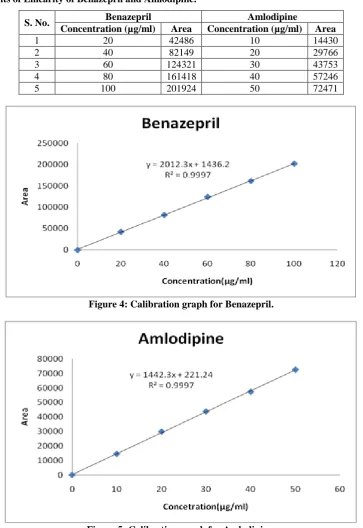
Table 2: Results of Linearity of Benazepril and Amlodipine.
S. No. Benazepril Amlodipine
Concentration (µg/ml) Area Concentration (µg/ml) Area
1 20 42486 10 14430
2 40 82149 20 29766
3 60 124321 30 43753
4 80 161418 40 57246
5 100 201924 50 72471
Figure 4: Calibration graph for Benazepril.
Figure 5: Calibration graph for Amlodipine.
Table 3: Results of Precision for Benazepril.
Injection Area
Injection-1 123578 Injection-2 122050 Injection-3 123931 Injection-4 121272 Injection-5 123137 Injection-6 122702
Average 122778.3
Standard Deviation 990.2
Table 4: Results of Precision for Amlodipine.
Injection Area
Injection-1 43604 Injection-2 43572 Injection-3 43902 Injection-4 43587 Injection-5 44286 Injection-6 44447
Average 43899.7
Standard Deviation 385.1
%RSD 0.9
Table 5: Accuracy (recovery) data for Benazepril.
%Concentration
(at specification Level) Area
Amount Added (mg)
Amount Found
(mg) % Recovery
Mean Recovery
50% 60984.7 20 20.04 100.21
100.42 100% 122049.7 40 40.11 100.28
150% 184002.3 60 60.47 100.78 *Average of three determinations
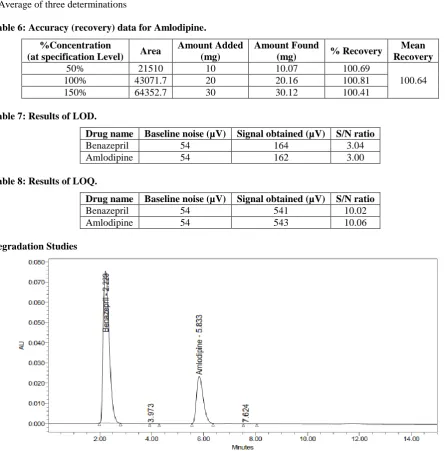
Table 6: Accuracy (recovery) data for Amlodipine.
%Concentration
(at specification Level) Area
Amount Added (mg)
Amount Found
(mg) % Recovery
Mean Recovery
50% 21510 10 10.07 100.69
100.64 100% 43071.7 20 20.16 100.81
150% 64352.7 30 30.12 100.41
Table 7: Results of LOD.
Drug name Baseline noise (µV) Signal obtained (µV) S/N ratio
Benazepril 54 164 3.04
Amlodipine 54 162 3.00
Table 8: Results of LOQ.
Drug name Baseline noise (µV) Signal obtained (µV) S/N ratio
Benazepril 54 541 10.02
Amlodipine 54 543 10.06
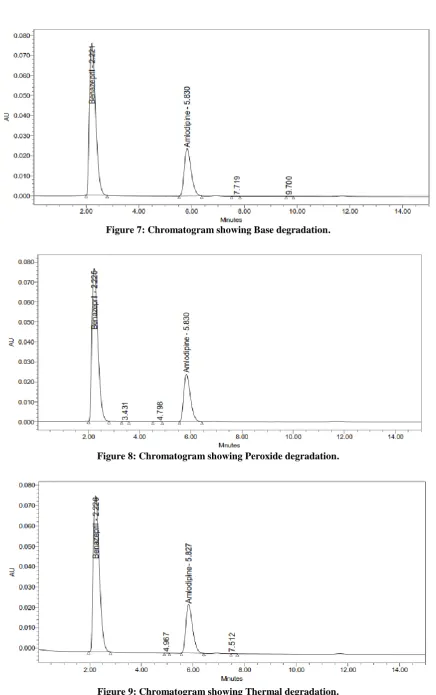
Degradation Studies
Figure 7: Chromatogram showing Base degradation.
Figure 8: Chromatogram showing Peroxide degradation.
Figure 10: Chromatogram showing Photo degradation.
Table 9: Results for Stability of Benazepril and Amlodipine.
Sample Name Benazepril Amlodipine
Area % Degraded Area % Degraded
Standard 121403 42673
Acid 119736 1.37 41662 2.37
Base 117533 3.19 41776 2.10
Peroxide 113863 6.21 40623 4.80
Thermal 116563 3.99 40572 4.92
Photo 115552 4.82 39772 6.80
Table 10: Results of Assay for Benazepril and Amlodipine.
Label Claim (mg) % Assay
Benazepril 20 100.08
Amlodipine 10 100.66
SUMMARY AND CONCLUSION
The estimation of Benazepril and Amlodipine was done by RP-HPLC.
The assay of Benazepril and Amlodipine was performed with tablets and the % assay was found to be 100.08 and 100.66 which shows that the method is useful for routine analysis.
The linearity of Benazepril and Amlodipine was found to be linear with a correlation coefficient of 0.999 and 0.999, which shows that the method is capable of producing good sensitivity.
The acceptance criteria of precision is RSD should be not more than 2.0% and the method show precision 0.8 and 0.9 for Benazepril and Amlodipine which shows that the method is precise.
The acceptance criteria of intermediate precision is RSD should be not more than 2.0% and the method show
precision 0.5 and 0.7 for Benazepril and Amlodipine which shows that the method is repeatable when performed in different days also.
The accuracy limit is the percentage recovery should be in the range of 97.0% - 103.0%. The total recovery was found to be 100.42% and 100.64% for Benazepril and Amlodipine. The validation of developed method shows that the accuracy is well within the limit, which shows that the method is capable of showing good accuracy and reproducibility.
The acceptance criteria for LOD and LOQ are 3.00 and 10.00. The LOD and LOQ for Benazepril was found to be 3.04 and 10.02 and LOD and LOQ for Amlodipine was found to be 3.00 and 10.06.
BIBLIOGRAPHY
1. Gurudeep Chatwal and Sham Anand, Instrumental methods of chemical analysis. Himalaya publishers, 7th edition, 1992; 2.624-2.639.
2. Skoog et al., Principles of Instrumental Analysis. Barkhanath publishers, 8th edition, 973-995.
3. Hobart. H. Willard et al., Instrumental methods of analysis, CBS Publications and Distributors, New Delhi, 1st edition, 1986, 529-563.
4. Sethi P.D., Quantitative analysis of Drugs & Pharmaceuticals. CBS publishers and distributors, New Delhi, 3rd edition, 2001; 1-120.
5. Janeyulu.Y & Marayyah, Quality Assurance & Quality Management in Pharmaceutical Industry. Pharma book publishers,Hyd, edition, 2005; 78-108. 6. Vogel’s Text book of quantitative chemical analysis.
Published by Dorling Kindersley pvt.ltd. 6th edition, 289-304.
7. Lloyd R. Snyder et al., practical HPLC method development. John Wiley & sons publishers, 2nd edition, 350-400.
8. Knevel A.M. & Digengl F.E, Jenkins Quantitative Pharmaceutical Chemistry, Mc Graw Hill Book Co. 9. Daniel W.Armstrong, Bonded Phase material for
Chromatographic separations, 1985, U.S. Patent 4539399.
![Fig. 1: Benazepril, 2-[(3S)-3-{[(2S)-1-ethoxy-1-oxo-4- phenylbutan-2-yl] amino}-2-oxo-2,3,4,5-tetrahydro-1H-1-benzazepin -1-yl]acetic acid](https://thumb-us.123doks.com/thumbv2/123dok_us/9789894.1964654/1.595.95.253.574.707/benazepril-ethoxy-phenylbutan-amino-tetrahydro-benzazepin-acetic-acid.webp)