Introduction
Stroke is a devastating condition encompassing a wide range of pathophysiological entities that include thrombus, hemorrhage, and embolism. Currently, diagnosis of stroke relies on physical examination and is further supplemented with various neuro imaging technique. A single set or multiple set of blood biomarkers that could be used differentiate between stroke subtypes or even predict an initial/reoccurring stroke could be extremely valuable.
In recent year, neurobiochemical markers have gained particular attention in the determination of brain damage from stroke. Stroke is a third leading cause of morbidity
and mortality in the world. Hence, there is a need of determination of these markers make it possible to reach a faster diagnosis and to start treatment earlier. Elevated S-100 protein level in cerebrospinal fluid (CSF) in acute cerebral damage have been reported earlier in stroke,[1-3] but the difficulty in collecting CSF sample make researchers to examine the biochemical markers in the blood.
S-100 protein is a low molecular weight protein (approximately 10 kda) that belong to a multigenic family of calcium-mediated protein, so named their solubility in 100% ammonium sulfate.[4] S-100 protein is released into CSF upon structural damage to the neuronal cells, but the underlying mechanism of passage through the blood-brain barrier has not seen clearly elucidated. The correlation of S-100 is 40 fold higher in CSF then serum. The biomarkers is not affected by hemolysis and has exceptional stability[5] giving it appeal for use as clinical biomarkers.
Several studies have demonstrated the serum S-100 protein concentration are increased significantly following stroke.[6-13] S-100 protein level measure
Address for correspondence:
Dr. Harish Kumar, Department of Medicine, SP Medical College, PBM Hospital, Bikaner - 334 001, Rajasthan, India. E-mail: [email protected]
Original Article
To study the correlation of serum S-100 protein
level with the severity of stroke and its prognostic
implication
Harish Kumar, Manoj Lakhotia, Hansraj Pahadiya, Jagdish Singh
Department of Medicine, SP Medical College, PBM Hospital, Bikaner, Department of Medicine, SN Medical College, Jodhpur, Rajasthan, India
ABSTRACT
Objective: This study investigated correlation between mortality, stroke subtype and stroke severity with serum
S‑100 protein level prior to the treatment of the patients admitted to the emergency department and diagnosed with
a stroke. Methods: Pretreatment sample were collected from the patients (n = 142) to determine S‑100 protein level,
age and sex‑matched healthy individuals (n = 40) served as control. All patients had cranial computerized tomography
scan/magnetic resonance imaging in the first 24 h. The neurological evaluation was made with the National Institute of Health Stroke Scale (NIHSS) in the acute stage. Results: Compared with controls, S‑100 protein level were significantly higher in the stroke groups. In stroke groups, S‑100 protein level was more significantly higher in the ischemic group
than hemorrhage and transient ischemic attack group and highest in expired patients. Conclusion: Serum S‑100 protein measurement can be used as an early marker of brain damage. There is a role of S‑100 protein as a co‑predictor
of outcome in patients with acute stroke.
Key word: National Institute of Health Stroke Scale, prognosis, S‑100 protein, stroke
Access this article online
Quick Response Code:
Website:
www.ruralneuropractice.com
DOI:
before specific treatment was given and mortality stroke subtype and severity were examined in patients with stroke admitted to hospital emergency department.
Patients, Methods, and S‑100 Protein
Measurement
This was a prospective observational study with a definite diagnosis of stroke made both clinically and radiologically, conducted among patients admitted in Mahatma Gandhi Hospital (MGH) Jodhpur.
This study was approved by the Local Research Ethics Committee. Inclusion criteria for the study were patients of acute stroke admitted within 48 h of onset, diagnosis confirmed by computerized tomography/ magnetic resonance imaging and patients above the age of 18 years. Exclusion criteria were patients with peripheral vascular disease, systemic inflammatory disorder or tumor, patients whose National Institute of Health Stroke Scale (NIHSS) score could not be calculated at the time of admission. Venous samples were drawn within 48 h of the onset of symptoms and sent for routine blood examinations including measurement of the protein level. The concentration of protein in blood samples was measured in electrochemiluminescence immunoassay is intended for use on Elecsys and cobas E-immunoassay analyzers. Clinical outcome was recorded at 1-week and graded according to Modified Rankin Scale.
Statistical analysis
Parametric data are expressed as mean value ± standard deviation (SD) and categorical variables as percentages. The Chi-square test was used for the comparison of dichotomous variables and the Student’s t-test for continuous variables. One-way ANOVA was used to test differences on multiple levels by a single factor (independent) variable. P < 0.05 was considered statistically significant. All statistical analysis was performed using SPSS Windows (SPSS version 17.0.2009).
Results
The study included 142 patients with acute stroke who fulfilled inclusion criteria were admitted the MGH attached to Dr. Sampurnanand Medical College Jodhpur. Out of total 80 (56.33) male and 62 (43.66) were female. In addition, 38 healthy volunteers (25 female and 13 females) similar to the patients cohort in term of age and sex formed the central group. The mean ± SD age
of the total patients was 63.73 ± 14.11 years and of the control was 57.94 ± 10.66.
Types of strokes and serum S-100 protein level
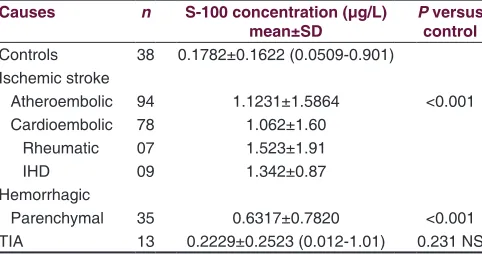
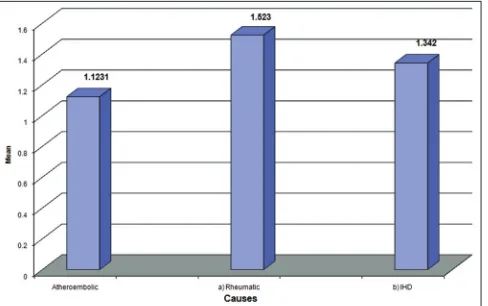
The most common type of stroke in our study was ischemic (66.19) followed by hemorrhage (24.64) and transient ischemic attack (TIA) (9.15). The most common condition in stroke patients was HTN (68.30), followed by ischemic heart disease (47.8%) diabetes mellitus was seen in 28.87% and dyslipidemia in 23.94%. Seven patients had rheumatic heart disease (RHD) 5%. Serum S-100 protein concentration were increased above the normal value (0.1782 ± 0.1622 ng/ml) in both ischemic (1.12 ± 1.58) and hemorrhage (0.6317 ± 0.782) stroke group which was statistically significant (P < 0.001) when compared to TIA (0.22 ± 0.25) which was not significant (P = 0.23). When within patients group, comparison were made there was a statistically significant difference in serum S-100 protein level between the group according to stroke subtype. Serum S-100 level were significantly higher in the cardioembolic stroke and hemorrhage stroke group than in than TIA group. In our study, serum S-100 level was significantly higher in the ischemic group than in other group of stroke. Atherosclerosis (82.5%) 78 was the most common etiology of the ischemic stroke, followed by ischemic cardio embolism (9.3%) and rheumatic cardio-embolism (8.2%). S-100 protein level maximum for RHD (1.523).
Patients followed by IHD (1.342) and atherosclerosis (1.062) patients [Table 1, Figures 1 and 2].
Severity of stroke and serum S-100 protein level
According to the NIHSS score[14] stroke group were compared with control according to low (NIHSS 1–7) moderate[8-15] high (>15) severity stroke had significantly higher serum S-100 protein level (P < 0.001,0.001,0.0001) respectively and S-100 protein level (all comparison P < 0.001), when within patients group comparison
Table 1: S‑100 protein level in hemorrhagic and ischemic stroke
Causes n S‑100 concentration (μg/L)
mean±SD Pcontrol versus Controls 38 0.1782±0.1622 (0.0509-0.901)
Ischemic stroke
Atheroembolic 94 1.1231±1.5864 <0.001
Cardioembolic 78 1.062±1.60
Rheumatic 07 1.523±1.91
IHD 09 1.342±0.87
Hemorrhagic
Parenchymal 35 0.6317±0.7820 <0.001
TIA 13 0.2229±0.2523 (0.012-1.01) 0.231 NS
were made for stroke severity there was a statistical difference for S-100 protein level were significantly higher in patients with high severity stroke compared those who had low and moderate severity (S-100 median 0.157, 0.270, 1.21). Thus mean S-100 level significantly higher in the stroke patients who belong to NIHSS > 15 [Table 2 and Figure 3].
Mortality and serum S-100 protein level
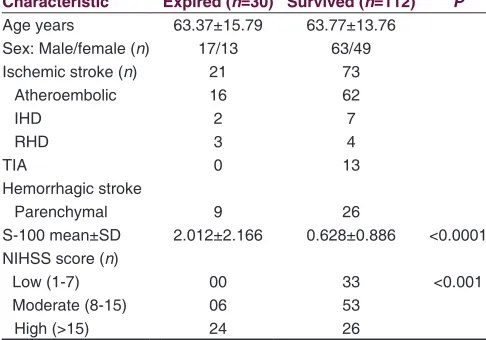
In total, 30 (21.9%) patients died during the study. Demographic and clinical difference between patients who died and those who survived age are given in Table 3. There was a significantly higher value of serum S-100 protein level in patients who expired after stroke than in patients who survive (P < 0.0001). Of the 30 patients who died, 24 patients had NIHSS score ≥15 (P < 0.001). Of the 30 died patients 21 patients was ischemic and 9 patients was a hemorrhagic stroke group and no one died in TIA
group. The S-100 protein level was significantly higher in patients who died of ischemic stroke than hemorrhagic stroke [Figure 4, Tables 3 and 4].
Discussion
S-100 protein is such a neurochemical marker of brain damage which is a major component of the cytosol, particularly in the astroglial cells and is released in the CSF and peripheral blood due to disruption of blood brain barrier after the brain damage. The present study primarily confirmed that S-100 protein level are higher in patients with stroke compared with healthy volunteers. The high level of S-100 protein in acute stroke was also observed with other studies in the literature.[15,16] This study
Figure 1: Serum S-100 protein level in stroke patients Figure 2: Serum S-100 protein level in subtype of strok
Figure 3: Serum S-100 level with severity of stroke according to
National Institute of Health Stroke Scale scale Figure 4: Serum S-100 level in survived and expired patients
Table 2: S‑100 B protein according to the severity of NIHSS classification on admission
Biomarker NIHSS scale
Mild (1‑7) (n=33) Moderate(8‑15) (n=59) Severe (>15) (n=50)
Median (minimum-maximum) 0.2150±0.254
0.157 (0.0121-1.51)
0.4598±0.531 0.2705 (0.112-2.85)
also gives the information that S-100 protein level is much higher in ischemic stroke group than other. S-100 protein level was significantly higher in the athero embolic stroke group than in the TIA, cardio embolic and lacunar stroke. S-100 protein level was significantly higher in the patients who died compared with survivors. In predicting stroke subtype and severity although S-100 protein was more valuable for mortality.
An elevated level of S-100 protein was not diagnostic of stroke as it is elevated in all the stroke patients irrespective of types as compared to control. However, S-100 protein can only predict the presence of neuronal damage in the brain but does not specify the cause for it. Hence, S-100 protein has high sensitivity with low specificity in stroke. In other studies also elevated levels was not diagnostic of stroke, the negative predictive value was 0.92.[17] However, it is definitely predicted the prognosis of the patients.
The importance of S-100 protein in acute stroke also confirmed with other studies.[15,18] Person et al.,[6] Kim et al.[19] and Missler et al.[20] report an association between single biochemical marker
from blood in the acute phase of stroke and functional outcome of infarction.
Foerch etal.[21] measured single S-100 protein in acute stroke within 12–24 h and found it as a valuable marker in guiding clinical and therapeutic aspects in stroke. Herrmann etal.[22] found serum S-100 protein level with the size of the brain lesion and neurological status at discharge. In this study, there is a correlation between serum S-100 protein level, infarct size and outcome.[17,23] Kenangil etal.[23] who found that size of the infarct in middle cerebral artery (MCA) territory correlation with the level of S-100 protein. A patient with large MCA infarction had highest serum S-100 level, and their short and long prognosis was the worst. Similar report presented by Buttner etal.[8] Rainer etal.[24] report that within first 24 h there was increased the level of S-100 protein level in stroke patients.
Conclusion
Serum S-100 protein level significantly rises in patient with acute stroke due to ischemia and hemorrhage, but not significant in TIA. It helps in the diagnosis of stroke and the severity of stroke as it is significant increases according to the size of the lesion thus it is more valuable for the prognosis. S-100 protein levels have a positive correlation with NIHSS. Finally, we conclude that serum S-100 protein measurement can be used as an early marker of brain damage. There is a role of S-100 protein as a co-predictor of outcome in patients with acute stroke.
Acknowledgment
Special thanks to Dr. Prakash Choudhary.
References
1. Hårdemark HG, Ericsson N, Kotwica Z, Rundström G, Mendel‑Hartvig I, Olsson Y, et al. S‑100 protein and neuron‑specific enolase in CSF after
experimental traumatic or focal ischemic brain damage. J Neurosurg 1989;71:727‑31.
2. Mokuno K, Kato K, Kawai K, Matsuoka Y, Yanagi T, Sobue I.
Neuron‑specific enolase and S‑100 protein levels in cerebrospinal fluid of
patients with various neurological diseases. J Neurol Sci 1983;60:443‑51. 3. Lamers KJ, van Engelen BG, Gabreëls FJ, Hommes OR, Borm GF,
Wevers RA. Cerebrospinal neuron‑specific enolase, S‑100 and myelin basic
protein in neurological disorders. Acta Neurol Scand 1995;92:247‑51. 4. Moore BW. A soluble protein characteristic of the nervous system.
Biochem Biophys Res Commun 1965;19:739‑44.
5. Kanner AA, Marchi N, Fazio V, Mayberg MR, Koltz MT, Siomin V, et al.
Serum S100beta: A noninvasive marker of blood‑brain barrier function and brain lesions. Cancer 2003;97:2806‑13.
6. Persson L, Hårdemark HG, Gustafsson J, Rundström G, Table 3: Relationship of serum S‑100 protein in
expired and survived patients of stroke
Expired Survived P
n Mean±SD n Mean±SD
Ischemic (n=94) 21 2.528±2.651 73 0.8033±1.043 <0.0001 Hemorrhagic (n=35) 9 1.4704±1.1247 26 0.3414±0.2933 <0.0001 Total (n=129) 30 2.210±2.305 99 0.6798±0.9258 <0.0001 SD: Standard deviation
Table 4: Clinical characteristics of the stroke patients who survived and expired and severity according to NIHSS Characteristic Expired (n=30) Survived (n=112) P
Age years 63.37±15.79 63.77±13.76
Sex: Male/female (n) 17/13 63/49
Ischemic stroke (n) 21 73
Atheroembolic 16 62
IHD 2 7
RHD 3 4
TIA 0 13
Hemorrhagic stroke
Parenchymal 9 26
S-100 mean±SD 2.012±2.166 0.628±0.886 <0.0001 NIHSS score (n)
Low (1-7) 00 33 <0.001
Moderate (8-15) 06 53
High (>15) 24 26
Mendel‑Hartvig I, Esscher T, et al. S‑100 protein and neuron‑specific enolase in cerebrospinal fluid and serum: Markers of cell damage in
human central nervous system. Stroke 1987;18:911‑8.
7. Abraha HD, Butterworth RJ, Bath PM, Wassif WS, Garthwaite J, Sherwood RA. Serum S‑100 protein, relationship to clinical outcome in acute stroke. Ann Clin Biochem 1997;34 (Pt 5):546‑50.
8. Büttner T, Weyers S, Postert T, Sprengelmeyer R, Kuhn W. S‑100 protein: Serum marker of focal brain damage after ischemic territorial MCA infarction. Stroke 1997;28:1961‑5.
9. Elting JW, de Jager AE, Teelken AW, Schaaf MJ, Maurits NM, van der Naalt J, et al. Comparison of serum S‑100 protein levels following stroke and traumatic brain injury. J Neurol Sci 2000;181:104‑10.
10. Wunderlich MT, Wallesch CW, Goertler M. Release of neurobiochemical markers of brain damage is related to the neurovascular status on admission and the site of arterial occlusion in acute ischemic stroke. J Neurol Sci 2004;227:49‑53.
11. Jauch EC, Lindsell C, Broderick J, Fagan SC, Tilley BC, Levine SR, et al.
Association of serial biochemical markers with acute ischemic stroke: The National Institute of Neurological Disorders and Stroke recombinant tissue plasminogen activator Stroke Study. Stroke 2006;37:2508‑13. 12. Foerch C, du Mesnil de Rochemont R, Singer O, Neumann‑Haefelin T,
Buchkremer M, Zanella FE, et al. S100B as a surrogate marker for successful clot lysis in hyperacute middle cerebral artery occlusion. J Neurol Neurosurg Psychiatry 2003;74:322‑5.
13. Foerch C, Singer OC, Neumann‑Haefelin T, du Mesnil de Rochemont R, Steinmetz H, Sitzer M. Evaluation of serum S100B as a surrogate marker for long‑term outcome and infarct volume in acute middle cerebral artery infarction. Arch Neurol 2005;62:1130‑4.
14. Bamford J, Sandercock P, Dennis M, Burn J, Warlow C. Classification and natural history of clinically identifiable subtypes of cerebral infarction.
Lancet 1991;337:1521‑6.
15. Wen HM, Lam WW, Rainer T, Fan YH, Leung TW, Chan YL, et al.
Multiple acute cerebral infarcts on diffusion‑weighted imaging and risk
of recurrent stroke. Neurology 2004;63:1317‑9.
16. Coutts SB, Hill MD, Simon JE, Sohn CH, Scott JN, Demchuk AM,
et al. Silent ischemia in minor stroke and TIA patients identified on MR
imaging. Neurology 2005;65:513‑7.
17. Cojocaru M, Ghinescu M, Cojocaru IM, Şapira V, Grigorian M, Lilios G.
Increased serum S‑100 protein in patients with acute ischemic stroke; relationshop to clinical outcome. Med Connnect 2012;7:45‑8.
18. Sylaja PN, Coutts SB, Subramaniam S, Hill MD, Eliasziw M, Demchuk AM, et al. Acute ischemic lesions of varying ages predict risk of ischemic events in stroke/TIA patients. Neurology 2007;68:415‑9. 19. Kim JS, Yoon SS, Kim YH, Ryu JS. Serial measurement of interleukin‑6,
transforming growth factor‑beta, and S‑100 protein in patients with acute stroke. Stroke 1996;27:1553‑7.
20. Missler U, Wiesmann M, Friedrich C, Kaps M. S‑100 protein and
neuron‑specific enolase concentrations in blood as indicators of infarction
volume and prognosis in acute ischemic stroke. Stroke 1997;28:1956‑60. 21. Foerch C, Otto B, Singer OC, Neumann‑Haefelin T, Yan B, Berkefeld J,
et al. Serum S100B predicts a malignant course of infarction in patients with acute middle cerebral artery occlusion. Stroke 2004;35:2160‑4. 22. Herrmann M, Vos P, Wunderlich MT, de Bruijn CH, Lamers KJ. Release
of glial tissue‑specific proteins after acute stroke: A comparative analysis of serum concentrations of protein S‑100B and glial fibrillary acidic
protein. Stroke 2000;31:2670‑7.
23. Kenangil G, Yalçın AD, Haklar G, Cacina H, Forta H. Relation of serum S‑100
protein to infarct size and clinical prognosis. Marmara Med J 2004;17:105‑8. 24. Rainer TH, Wong KS, Lam W, Lam NY, Graham CA, Lo YM. Comparison
of plasma beta‑globin DNA and S‑100 protein concentrations in acute stroke. Clin Chim Acta 2007;376:190‑6.
How to cite this article: Kumar H, Lakhotia M, Pahadiya H, Singh J. To study the correlation of serum S-100 protein level with the severity of stroke and its prognostic implication. J Neurosci Rural Pract 2015;6:326-30.