Impact Factor: 5.515
MALWARE DETECTION AND SEARCH
RANK FRAUD IN NETWORK USING
DATAMINING TECHNIQUES
K.Saranya
[email protected] V.S.B. College of Engineering Technical Campus - Coimbatore.
D.Arthi
[email protected] V.S.B. College of Engineering Technical Campus - Coimbatore.
V.Devi
[email protected] V.S.B. College of Engineering Technical Campus - Coimbatore.
ABSTRACT: Security has become present in each domain these days as fresh rising malware create Associate in Nursing ever increasing parlous threat to systems. It is able to entice attacks, record intrusion info regarding tools and activities of the hacking method, and prevents attacks outward the compromised system. Honey pots may be thought of to be traps for hackers and intruders and square measure typically deployed complimentary to Intrusion Detection Systems (IDS) and Intrusion hindrance Systems (IPS) in a very network. However, honey pots would serve a rather completely different purpose in our projected system. We intend to use honey pots for searching rank fraud and malwares in networks using honey pots. The advantage of implementing this technology is that an effective initial control can be exercised in fraud rank and malware detection in networks. Keywords: Network security, Malware detection, Machine learning, and Honey pots initial control can be exercised in fraud rank and malware detection in networks.
Keywords: Network security, Malware detection, Machine learning, and Honeypots
1. INTRODUCTION
Impact Factor: 5.515
2. OUR APPROACH
Current antivirus engine techniques aren't optimum in police investigation viruses in real time. They may be useful in controlling malwares once they infect systems, which is again, fateful for enterprise networks.
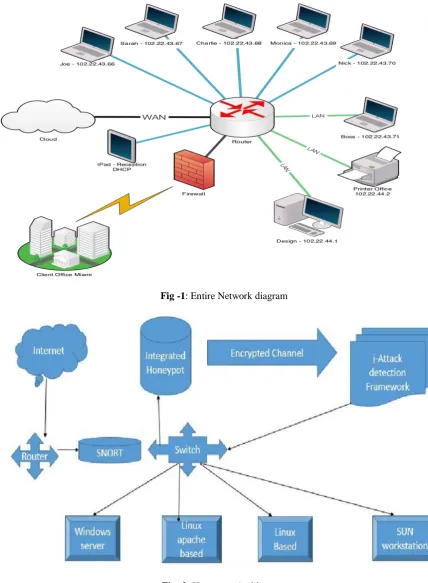
This analysis is so aimed toward a central resolution that works at the firewall level of the enterprise network. The complete system diagram is shown in Figure 1 and our process diagram is shown in Figure 2.
Fig -1:Entire Network diagram
Impact Factor: 5.515
3. MALWARE DETECTION PHASE
We used three datasets: a training dataset, a test dataset, and a “scale-up” dataset. The number of malware files and respectively clean files in these datasets is shown in the first two columns of Table 1.1. As stated above, our main goal is to achieve malware detection with only a few (if possible 0) false positives, therefore the clean files in this dataset (and also in the scale-up dataset) are much larger than the number of malware files. The clean files in the training database are mainly system files (from different versions of operating systems) and executable and library files from different popular applications. We also use clean files that are packed or have the same form or the same geometrical similarities with malware files (e.g use the same packer) in order to better train and test the system.
Table-1: Number of files and Unique Combinations of Feature Values in the Training, Test, and Scale-Up Datasets.
Files Unique combinations
Database malware clean malware clean
Training Test Scale up
27475 11605 Approx. 3M
2731133 6522 Approx.180M
7822 506 12817
415 130 16437
3.1 Algorithm 1 One-Sided Perceptron
NumberOfIterations ← 0
M axIterations ← 100
repeat
Train (R, 1, -1)
while FP(R) > 0 do
Train (R, 0, -1)
end while
NumberOfIterations ← NumberOfIterations + 1
until (TP(R) = NumberOfM alwareF iles) or
(NumberOfIterations = M axIterations)
For what we call the mapped one-sided perceptron, we will use the previous perceptron algorithm, except we first map
all 13 our features in a different space using a simple feature generation algorithm, presented in the thesis as Algorithm 3.
Finally, we used the same one-sided perceptron (Algorithm 1), but in the dual form [3] and with the training entry
mapped into a larger feature space via a kernel function K [9]. The resulting kernelized one-sided perceptron is the
Impact Factor: 5.515
3.2 Algorithm 2 Kernelized One-Sided Perceptron
for i = 1 to n do
∆i ← 0
αi ← 0
end for
for i = 1 to n do
if (labeli × Pn j=1(αj × K(i, j))) ≤ 0 then
∆i ← ∆i + labeli
end if
endfor
for i = 1 to n do
αi ← αi + ∆i
∆i ← 0
end for
3.3 Results with Perceptron algorithms
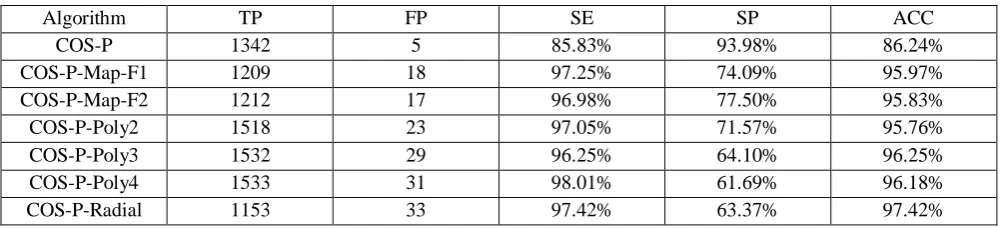
Cross-validation tests for 3, 5, 7, and 10 folds were performed for each algorithm (COS-P, COS-P-Map, COS-P-Poly and
COS-Radial) on the training dataset. For each algorithm, we used the best result from maximum 100 iterations. The
cross-validation results found in Table 2 show that although the COS-P-Poly4 algorithm has the best malware detection
rate on training dataset, the number of false alarms produced by this algorithm is much higher than the one obtained for
the COS-P algorithm.
Table 3: 5-fold Cross-validation Results on the Training Dataset.
Algorithm TP FP SE SP ACC
COS-P 1342 5 85.83% 93.98% 86.24%
COS-P-Map-F1 1209 18 97.25% 74.09% 95.97%
COS-P-Map-F2 1212 17 96.98% 77.50% 95.83%
COS-P-Poly2 1518 23 97.05% 71.57% 95.76%
COS-P-Poly3 1532 29 96.25% 64.10% 96.25%
COS-P-Poly4 1533 31 98.01% 61.69% 96.18%
Impact Factor: 5.515
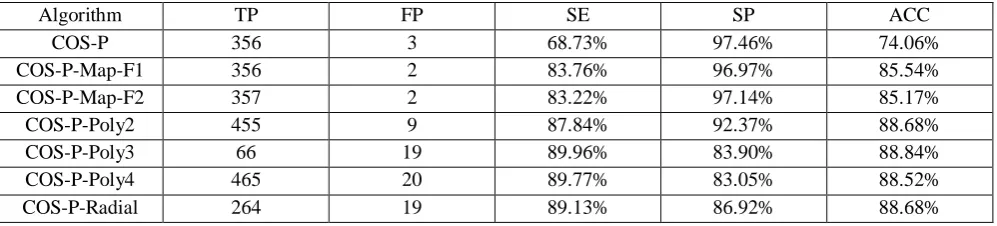
Table 4: Results on the Test Dataset.
Algorithm TP FP SE SP ACC
COS-P 356 3 68.73% 97.46% 74.06%
COS-P-Map-F1 356 2 83.76% 96.97% 85.54%
COS-P-Map-F2 357 2 83.22% 97.14% 85.17%
COS-P-Poly2 455 9 87.84% 92.37% 88.68%
COS-P-Poly3 66 19 89.96% 83.90% 88.84%
COS-P-Poly4 465 20 89.77% 83.05% 88.52%
COS-P-Radial 264 19 89.13% 86.92% 88.68%
4. CONCLUSION
In this analysis, we've got projected a malware detection module supported advanced data processing and machine learning. While such a method can be implemented at enterprise gateway level to act as a central antivirus engine to supplement anti viruses present on end user computers. This will not only easily detect known malwares, but act as a knowledge that will detect newer forms of harmful files. While a costly model requiring costly infrastructure, it can help in protecting invaluable enterprise data from security threat, and prevent immense financial damage in network.
REFERENCES
[1] Pomsathit, A., "Effective of Unicast and Multicast IP Address Attack over Intrusion Detection System with Honeypot," Congress on Engineering and Technology (S-CET), vol., no., pp.1-4, 27-30 May 2012
[2] H. Witten and E. Frank. 2005. Data mining: Practical machine learning tools with Java implementations. Morgan Kaufmann, ISBN-10: 0120884070.
[3] Zach Miners. Report: Malware-infected Android apps spike in the Google Play store. PCWorld, 2014
Impact Factor: 5.515
BIOGRAPHIES
K.SARANYA
Assistant Professor
Received her M.E Computer Science and Engineering from Sethu institute of Technology in 2014. At present working as an Assistant professor under the department of Computer Science and Engineering, in V.S.B. College of Engineering Technical Campus, Coimbatore - 641 103.
D.ARTHI
Assistant Professor
Received her M.E Computer Science and Engineering from Avinashilingam University in 2013. At present working as an Assistant professor under the department of Computer Science and Engineering, in V.S.B. College of Engineering Technical Campus, Coimbatore - 641 103.
V.DEVI
Assistant Professor
Received her M.E Computer Science and Engineering from SRM University in 2014. At present working as an Assistant professor under the department of Computer Science and Engineering, in V.S.B. College of Engineering Technical Campus, Coimbatore - 641 103.