Algorithms for Sparse Linear Classifiers in the Massive Data Setting
Suhrid Balakrishnan [email protected]
Department of Computer Science Rutgers University
Piscataway, NJ 08854, USA
David Madigan [email protected]
Department of Statistics Columbia University New York, NY 10027, USA
Editor: Peter Bartlett
Abstract
Classifiers favoring sparse solutions, such as support vector machines, relevance vector machines, LASSO-regression based classifiers, etc., provide competitive methods for classification problems in high dimensions. However, current algorithms for training sparse classifiers typically scale quite unfavorably with respect to the number of training examples. This paper proposes online and multi-pass algorithms for training sparse linear classifiers for high dimensional data. These algorithms have computational complexity and memory requirements that make learning on massive data sets feasible. The central idea that makes this possible is a straightforward quadratic approximation to the likelihood function.
Keywords: Laplace approximation, expectation propagation, LASSO
1. Introduction
We consider the problem of learning high-dimensional sparse linear classifiers from large numbers of training examples. A number of different applications from finance, text mining, and bioinfor-matics motivate this work. We concern ourselves specifically with binary classification and consider
L1-regularized logistic and probit regression models. Such models have provided excellent
predic-tive accuracy in many applications (see, for example, Genkin et al., 2007; Figueiredo and Jain, 2001; Shevade and Keerthi, 2003) and attack overfitting and variable selection in a unified manner.
L1-regularization and a maximum a posteriori (MAP) Bayesian analysis with so-called Laplacian
priors yield identical results (Tibshirani, 1996) and in order to streamline our presentation, we adopt
the Bayesian approach. Many training algorithms now exist for L1-logistic regression that can
han-dle high-dimensional input vectors (Hastie et al., 2004; Shevade and Keerthi, 2003; Koh et al., 2007). However, these algorithms generally begin with a “load data into memory” step that pre-cludes applications with large numbers of training examples. More precisely, consider a training
data set that comprises t examples each of dimension d. Due to matrix multiplications on t×t or
d×d matrices, typical computational time requirements are O(t3+d3), with memory requirements
that are O(td+d2). In our target applications, both t and d can exceed 106so standard algorithms
This paper presents two basic algorithms for learning L1-logistic and/or probit regression
mod-els. Both operate in the data streaming model, by which we mean that they scan the data sequen-tially, and never require storing processed observations. The first algorithm we present is an online algorithm which sequentially processes each observation only once. This algorithm is provably
non-divergent and uses in the worst case O(d2)time and O(d2) space to assimilate each new training
example (note that both costs are constant with respect to the number of observations, t). Further, if the input data are sparse, the practical computational cost can be significantly lower.
For massive data sets where t is constant, that is, when given a fixed training data set, we present a second algorithm that allows practitioners to trade-off computational time for improved accuracy. This multi-pass algorithm (the MP algorithm) also processes data sequentially but makes a small constant number of extra passes over the data set. Hence, this sequential algorithm provides results similar to those of batch algorithms for this problem. The MP algorithm’s computational cost is a constant factor higher and memory costs are essentially the same as those of the online algorithm. Finally, we propose the RMMP (Reduced Memory MP) algorithm that has significantly lower worst
case memory costs, O(d+k2)(where kd) and the same computational costs as the MP algorithm
(thus both computational and memory costs are essentially linear in t and d). We will comment on the similarities and differences of our technique to other learning algorithms, in particular other online algorithms, in the following sections.
2. Background and Notation
Throughout this manuscript, we concern ourselves with the task of binary classification, with class labels y∈ {0,1}. The training data comprise t labeled training examples, that is, Dt={(xi,yi)}ti=1,
with input vectors xi = [xi1, . . . ,xid]T inRd and corresponding labels yi, i=1, . . . ,t. We consider
probabilistic classifiers of the form:
p(y=1|x) =Φ(βTx)
where β∈Rd is a vector of regression parameters and Φ(·) is a link function. We restrict our
analytical results to the two most commonly used link functions, the probitΦ(z) =Rz
−∞√12πe −x2/2
dx
and logisticΦ(z) = ez
1+ez link functions.
The machine learning problem is thus to estimate the parameters β, in the light of the training
data Dt. We tailor our results towards high input dimension, that is, large d, and large numbers of
training vectors, large t. Viewing the learning problem as one of Bayesian inference, we work with
the posterior distribution of the parametersβconditioned on a labeled training data set Dt, given a
prior distribution on the parametersβ:
p(β|Dt)∝ t
∏
i=1p(yi|β) !
p(β). (1)
The quantity on the left hand side of (1) is the required posterior distribution ofβgiven the data set
Dt, while the second term on the right hand side is the prior distribution onβ, which we will specify
momentarily. The first term on the right hand side is the likelihood:
t
∏
i=1p(yi|β) = t
∏
i=1yiΦ(βTxi) + (1−yi)(1−Φ(βTxi)
Finding the MAPβleads to the optimization problem we wish to solve (now on the log scale):
max
β (log p(β|Dt))
≡ max
β t
∑
i=1logyiΦ(βTxi) + (1−yi)(1−Φ(βTxi)
−log p(β) !
. (2)
The prior distribution p(β)we pick for the parameters is the LASSO prior (Tibshirani, 1996), a
product of independent Laplacian or double-exponential prior distributions on each componentβj
(with mean 0):
p(βj|γ) = γ 2e
−γ|βj|,γ>0,j=1, . . . ,d.
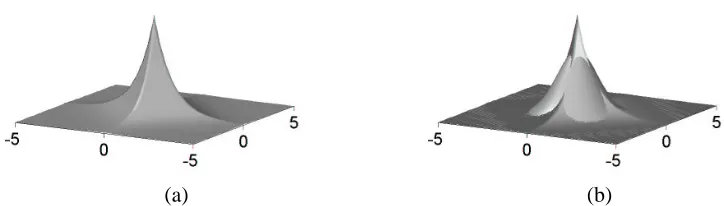
A prior of this form places high probability mass near zero and along individual component axes. It also has heavier tails than a Gaussian distribution—see Figure 1 for plots of the 2-dimensional distributions. It thus favors locations in parameter space with component magnitudes either exactly
(a) (b)
Figure 1: (a) A standard Laplacian distribution,γ=1 (b) A superposition of standard (zero mean,
unit variance) Gaussian distribution, and the Laplacian distribution showing both the higher probability mass the Laplacian assigns along the axes and at zero as well as its heavier tails.
zero, and hence pruned from our predictive model, or shrunk towards zero. With this prior distri-bution, (2) presents a convex optimization problem and yields the same solutions as the LASSO (Tibshirani, 1996) and Basis Pursuit (Chen et al., 1999):
max
β (log p(β|Dt))
≡ max
β t
∑
i=1log
yiΦ(βTxi) + (1−yi)(1−Φ(βTxi)
−γkβk1 !
. (3)
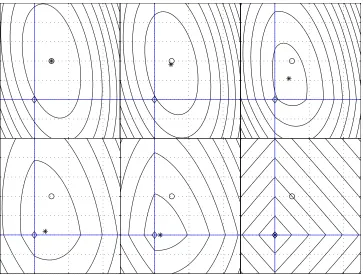
The parameter γin the above problem controls the amount of regularization. Figure 2 shows
asγis varied. The choice of the regularization parameter is an important but separate question in itself (Efron et al., 2004; Hastie et al., 2004). Methods such as cross validation can be used to pick its value and algorithms also exist to find solutions for all values of the regularization parameter (commonly called regularization path algorithms). However, we do not address such issues in this
manuscript, and we simply assumeγis some fixed, user-specified constant.
Figure 2: L1-regularization in two dimensions (i.e., d=2). The axes are the solid lines, the
horizon-tal axis representingβ1and the vertical axis representingβ2. The diamond represents the
origin and the open circle represents the (non-regularized) maximum likelihood solution. The figure shows contours of the function in (3), the objective function, for increasing amounts of regularization (right to left and then top to bottom). The star shows the MAP location. The top row, left figure, shows negligible regularization; the MAP and
maxi-mum likelihood estimates coincide and the contours show no L1-induced discontinuities.
The top row, right figure, shows noticeable L1effects and the MAP and maximum
likeli-hood solutions differ. The bottom row, middle panel shows enough L1-regularization to
setβ2 to zero (i.e., variable selection has occurred). The bottom row, right panel, shows
extreme regularization, where bothβ1andβ2are zero.
To the best of our knowledge, all existing algorithms solve the above convex optimization
prob-lem in the batch setting, that is, by storing the data set Dt in memory and iterating over it (Fu, 1998;
now attempts to overcome this limitation and thereby provide algorithms for training sparse linear classifiers without loading the entire data set into memory.
3. Approximating the Likelihood for Online Learning
The Bayesian paradigm supports online learning in a natural fashion; starting from the prior, the first training example produces a posterior distribution incorporating the evidence from the first example. This then becomes the prior distribution awaiting the arrival of the second example, and so on. In practice, however, except in those cases where the posterior distribution has the same mathematical form as the prior distribution, some form of approximation is required to carry out the sequential updating.
We want to avoid algorithms that begin with a “load data into memory” step and also avoid memory costs that increase with increasing amounts of data. In other words, we want memory costs independent of t. This requirement in turn, necessitates that we “forget” examples after processing
them. We achieve this by maintaining the sufficient statistics of a quadratic approximation inβto
the log-likelihood of the parameters after incorporating each observation. We approximate the log-likelihood as:
t
∑
i=1log(p(yi|β)) = t
∑
i=1log
yiΦ(βTxi) + (1−yi)(1−Φ(βTxi)
≈
t
∑
i=1
ai(βTxi)2+bi(βTxi) +ci
,
where ai(βTxi)2+bi(βTxi) +ci approximates logΦ(βTxi)when yi=1 and approximates log(1− Φ(βTxi))when yi=0, i=1, . . . ,t. In either case the approximation uses a simple Taylor
expan-sion around βTi−1xi, where βi−1 estimates the posterior mode given the first i−1 examples, Di−1
(Appendix A provides expressions for ai,bi for the probit and logistic link functions). We then
have:
t
∑
i=1log(p(yi|β)) ≈ t
∑
i=1ai(βTxi)2+bi(βTxi) +ci
= t
∑
i=1ai(βTxi)(xTi β) + t
∑
i=1bi(βTxi) + t
∑
i=1ci
= βTΨtβ+βTθt+ t
∑
i=1ci
where:
Ψt= t
∑
i=1aixixTi, andθt= t
∑
i=1bixi.
We now substitute this approximation of the log-likelihood function into Equation (3) to obtain the modified (approximate) optimization problem:
max
β (log p(β|Dt))≈maxβ
βTΨ
tβ+βTθt−γkβk1
Note that we can ignore the term involving the ci’s, as it is not a function ofβ. Further, the fixed
size d×d matrixΨand the d×1 vectorθcan be updated in an online fashion as data accumulate:
Ψt+1=Ψt+at+1xt+1xTt+1, andθt+1=θt+bt+1xt+1. (5) The size of the optimization problem in (4) doesn’t depend on t, the size of the data set seen so far. Thus, solving a fixed (with respect to t) size optimization problem allows one to sequentially process labeled data items and march through the data set. In data streaming terminology, the matrix
Ψand the vectorθprovide a constant size sketch or summary of the labeled observations seen so
far.
A number of questions now present themselves: how good is this approximation? How do we solve the approximate optimization problem efficiently? How does this approach differ from other likelihood approximation schemes (some of which are also quadratic)? Also, the scheme as set
up requires O(d2) memory in the worst case. Since we would like to use this approach for high
dimensional data sets, can we reduce the memory requirements?
The remainder of this manuscript addresses these and other questions. First, we consider how to efficiently obtain the MAP solution of (4), the approximate optimization problem.
3.1 The Modified Shooting Algorithm
Recall that we need to findβthat solves:
max β
βTΨβ+βTθ
−γkβk1
. (6)
In the above equation and following discussion, we drop the subscript t from Ψ,θfor notational
convenience. This is a convex optimization problem and a number of efficient techniques exist to solve it. Newton’s method and other Hessian-based algorithms may be prohibitively expensive
as they need O(d3) computational time in order to construct the Hessian/invert d×d matrices.
Other authors have described good results on the arguably tougher (non-approximate) optimization
problem for logistic regression (essentially the terms in Equation 3, but with L2regularization ofβ)
with techniques such as fixed memory BFGS (Minka, 2000), modified conjugate gradient (Komarek and Moore, 2005) and cyclic coordinate descent (Zhang and Oles, 2001; Genkin et al., 2007).
In this paper, we employ instead a slight modification of the Shooting algorithm (Fu, 1998), see Algorithm 1. Shooting is essentially a coordinate-wise gradient ascent algorithm, explicitly tailored
for convex L1-constrained regression problems (squared loss). Since our approximate optimization
problem is also quadratic, the resulting modifications required are straightforward. The vector Ω
in the algorithm is defined asΩ=2Ψ0β+θ, whereΨ0is the matrixΨwith its diagonal entries set
to zero (see Appendix B for details). This vector is related to the gradient of the differentiable part of the objective function and consequently can be used for optimality checking. Minor variants of this algorithm have been independently proposed by Shevade and Keerthi (2003) and Krishnapuram et al. (2005). Although Fu originally derived the algorithm by taking the limit of a modified Newton-Raphson method, it can also be obtained by a subgradient analysis of the system (subgradients are
necessary due to the non-differentiability that the L1constraints onβresult in, see Appendix B for
the derivation).
While one can think of numerous stopping criteria for the algorithm, in this paper we stop
Algorithm 1: The modified Shooting algorithm. Data: Ψ,θ,β0,γ.
β0is initialβvector.
Ωjrefers to the j’th component ofΩ.
Ψj jrefers to the(j,j)’th element of matrixΨ. Result: βsatisfying (6).
while not converged do for j←1 to d do
βj=
0, if|Ωj| ≤γ
γ−Ωj
2Ψj j, ifΩj>γ −γ−Ωj
2Ψj j , ifΩj<−γ
UpdateΩ.
end end
norm). More precisely, we declare convergence wheneverkβi−βi−1k2/kβi−1k2is less than some
user specified tolerance. Note thatβi is the parameter vector at iteration i, which is obtained after
cycling through and updating all d components once.
In the worst case, each iteration of Shooting requires O(d2)computational time. However, for
reasonable amounts of regularization, where the final set of non-zero βvalues is small, the time
requirements are much smaller. Indeed, the practical computational cost is perhaps better reflected
by bounds in terms of the sparsity of MAP β. Let m denote the maximum number of non-zero
components ofβalong the solution path to MAPβ(hence m≤d). Implemented carefully, Shooting
requires O(md) time per iteration (see Appendix B for details). Shooting can be initialized with
β0=0 if no information about the optimalβis known or to an appropriate “warm” starting point.
While coordinate-wise approaches are commonly regarded as slow in the literature (for example, Minka, 2001a), for sparse classifiers, they are much faster (see for example, Shevade and Keerthi, 2003). In our experiments, the Shooting algorithm has proven to be practical even for d in the hundreds of thousands.
4. An Online Algorithm
The quadratic approximation and the Shooting algorithm lead straightforwardly to an online
algo-rithm. After initializing the sketch parameters Ψ0,θ0 and the initial parameter vectorβ0, process
the data set one observation at a time. Calculate the quadratic Taylor series approximation to each
observation’s log-likelihood at the current estimate of the posterior mode,βi−1, thus finding
param-eters ai,bi. Use these parameters and the observation to update the sketches, Ψ,θ. Now run the
modified Shooting algorithm to update the posterior mode, producing βi and repeat for the next
labelled observation—see Algorithm 2.
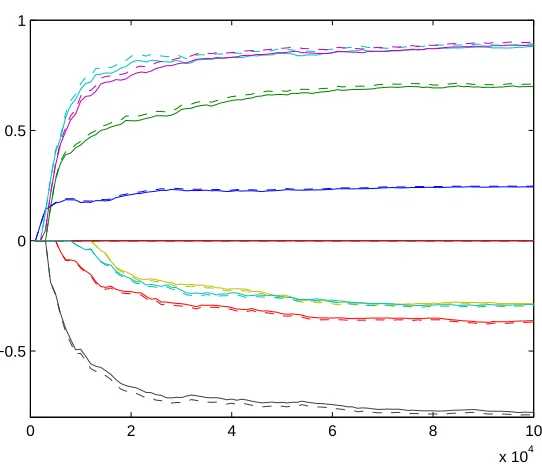
We show the performance of the online algorithm on a low dimensional simulated data set
in Figure 3 (the data generating mechanism is a logistic regression model with d=11, and t =
100,000. For details see the Experiments section of the manuscript). As we process greater
Algorithm 2: The Online algorithm. Data: Dt,γ.
Result: For each i, producesβi, an approximation to the MAP estimate ofβfor observations
(x1,y1). . .(xi,yi).
Initializeβ0=θ0=0,Ψ0=0, i=1. while i<t do
Get i’th observation(xi,yi).
Obtain quadratic approximation to term likelihood atβi−1, that is, obtain ai,bi. Ψi←Ψi−1+aixixTi .
θi←θi−1+bixi.
βi←modified Shooting(Ψi,θi,βi−1,γ)
i←i+1.
end
estimates (the dashed lines which we obtain using BBR, Genkin et al. 2007, publicly available
software for batch L1penalized logistic regression). See Figure 3, where different colors represent
different components of MAPβi. Figure 4 shows individual plots of the online and batch estimates
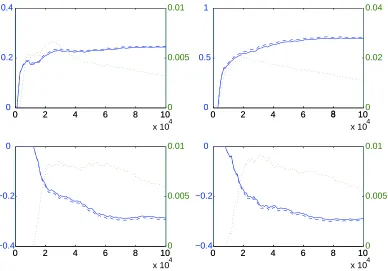
for four representative components of MAPβiin blue. We also plot the absolute difference between
the batch and online estimates in green (dotted line) on the same plot on the right (green) axis. As we expect, after the parameter estimates stabilize, this difference steadily tapers off with increasing amounts of data.
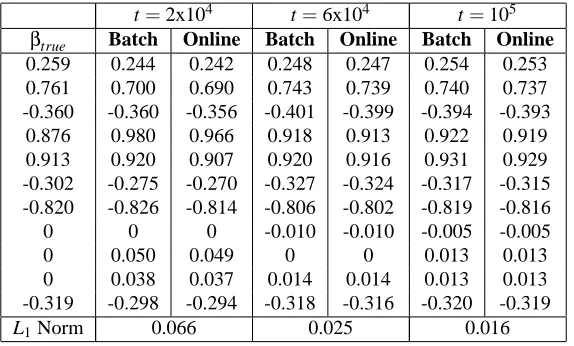
t=2x10⁴ t=6x10⁴ t=105
βtrue Batch Online Batch Online Batch Online
0.259 0.244 0.242 0.248 0.247 0.254 0.253 0.761 0.700 0.690 0.743 0.739 0.740 0.737 -0.360 -0.360 -0.356 -0.401 -0.399 -0.394 -0.393 0.876 0.980 0.966 0.918 0.913 0.922 0.919 0.913 0.920 0.907 0.920 0.916 0.931 0.929 -0.302 -0.275 -0.270 -0.327 -0.324 -0.317 -0.315 -0.820 -0.826 -0.814 -0.806 -0.802 -0.819 -0.816
0 0 0 -0.010 -0.010 -0.005 -0.005
0 0.050 0.049 0 0 0.013 0.013
0 0.038 0.037 0.014 0.014 0.013 0.013 -0.319 -0.298 -0.294 -0.318 -0.316 -0.320 -0.319
L1Norm 0.066 0.025 0.016
Table 1: Table with columns showing values ofβtrue, and the MAP estimates ofβobtained by the
batch algorithm and the online algorithm, for increasing amounts of data on the simulated data set. To aid assessing convergence of the online to the batch estimates, we show the
value of the L1norm of the adjacent vectors (batch vs. online estimates) in the last row.
For this example,γ=10 (logistic link function).
In the worst case, the online algorithm requires O(d2)space and O(d2)computational time to
0 2 4 6 8 10 x 104 1
0 0.5
−0.5
Figure 3: Performance of the online algorithm on a simulated data set, with regularization
parame-terγ=100 (see text for details). The y-axis is the parameter value, the x-axis the number
of observations processed, t.
which is true of text data for instance, the algorithm leverages this. Let the maximum number of non-zero components in any x be f and assume a constant number of iterations of the modified Shooting algorithm. In such case, the practical computational time requirement of the algorithm is
O(f2+md)per observation (we remind the reader that the md term, is for the cost of the Shooting
algorithm—see 3.1). Although the practical memory costs of the algorithm will likely be less than
O(d2), exactly how much less depends heavily on the data, since Ψ(the part of the sketch
domi-nating the memory requirements) is a weighted sum of outer products of the xi’s. It is possible that
even very sparse data may result in the full O(d2)memory requirement.
Here, we highlight the fact that the online algorithm is accurate and practical if the problem is of low to medium input dimension, but massive in terms of the number of observations. Appendix C proves non-divergence of the algorithm in the infinite data limit.
4.1 Heuristics for Improvement/Issues
While one can also obtain parameter estimates for fixed t ( batch problems) using the online algo-rithm, multiple passes typically provide better estimates, albeit with increased computational cost.
Denote byβ∗the solution to the exact optimization problem (3) for some fixed t. Since the online
algorithm typically initializes itself far fromβ∗, it is only after processing a sufficient number of
examples that the online algorithm’s term approximations will start being taken closer toβ∗. The
0 2 4 6 8 10 x 104
0 0.2 0.4
0 2 4 6 8 100
0.005 0.01
0 2 4 6 8 10
x 104
0 0.5
1
0 2 4 6 8 100
0.02 0.04
0 2 4 6 8 10
x 104
−0.4 −0.2 0
0 2 4 6 8 100
0.005 0.01
0 2 4 6 8 10
x 104
−0.4 −0.2 0
0 2 4 6 8 100
0.005 0.01
Figure 4: Slightly more detailed version of Figure 3. The panels show four representative
parame-ters from that figure, also showing tapering L1loss (dotted green line) between the online
and batch algorithm estimates on the right axis (in green). Simulated data set,γ=100.
Once again, the (left) y-axis is the parameter value and the x-axis the number of observa-tions processed, t.
magnitude than their respective final values,Ψt,θt. However, the amount of regularization remains
relatively fixed atγkβk1. Hence, if the online algorithm is initialized atβ0=0, for any i<t, the
output MAP estimateβi will be more shrunk towards zero thanβ∗. Figure 3 illustrates this for
smaller values of t where the solid lines (approximate MAP estimates) are closer to zero than the dashed lines (exact batch estimates).
This suggests the following two heuristics to improve the quality of estimates from the online algorithm. The first is to increase the amount of regularization gradually as the algorithm processes
observations sequentially (via a schedule, linearly say,∝t from zero initially to the specified value
γat the end of the data set1). Less regularization of the first few observations somewhat mitigates
the effect of taking term approximations at shrunken parameter estimates.
The second heuristic is for the online algorithm to keep a block of observations in memory temporarily instead of immediately discarding each observation after processing it. The algorithm
then uses the value of the parameter estimates after having seen/processed all the observations in a block to update the sketches for the whole block. Note that this will involve keeping track of
the corresponding updates to the sketches for the block (the block’s contributions toΨandθ). In
experiments not reported here, both of these heuristics improve the final online estimates somewhat.
One possibility for improving upon the O(d2) worst case computational requirement of the
online algorithm is as follows. In the infinite data case, in order to obtain sparsity in parameter estimates, the amount of regularization must be allowed to increase as observations accumulate— an increasingly weighty likelihood term will inundate any fixed amount of regularization. In this setting (where we have the freedom to choose the amount of regularization), we can use exactly
the same quadratic approximation machinery to pick the value ofγthat maximizes the approximate
one-step look ahead likelihood (although the expressions for this approximation would be slightly different). The resulting scheme has the flavor of predictive automatic relevance determination as presented in Qi et al. (2004).
The worst case O(d2)memory requirement of the online algorithm, however, presents a greater
challenge. In the next section we outline a multi-pass algorithm based on the same sequential quadratic approximation that improves the accuracy of estimates when applied to finite data sets and also uses less memory than the online algorithm.
5. A Multi-pass Algorithm
The block heuristic of the previous section implies that taking all term approximations at the final
online algorithm MAP βt value would certainly produce better estimates of Ψt,θt. This in turn
would lead to a better estimate ofβ∗.
Therefore, for fixed data sets where computational time restrictions still permit a few passes over the data set, this suggests the following algorithm, which we will refer to as the MP
(Multi-Pass) algorithm: Initializeβ0=θ0=0, Ψ0=0, z=1. The quantity z will count the number of
passes through the data set. ComputeΨt,θt by the steps in Online Algorithm (Algorithm 2), except
take all term approximations at the fixed valueβz. Note that consequently there is no need for the
shooting algorithm during the pass through the data set. Once a pass through the data set is
com-plete, compute a revised estimate ofβ∗ by running modified Shooting, that is, setβz+1=modified
Shooting(Ψt,θt,βz,γ). Iteratively loop over the data set, appropriately incrementing z.
For a constant number of passes, the MP algorithm has the worst case computational time
re-quirement of O(td2) to do an equivalent batch MAP β estimation. Once again, if the data set
is sparse, this cost is closer in practice to O(t f2+md) (the first term is the cost of updating the sketches and the second md term is the cost of the Shooting algorithm).
The worst case memory requirement of the MP algorithm is O(d2), which is just a constant with
respect to t. Expectation Propagation (Minka, 2001b) by contrast requires explicitly storing term
ap-proximations and thus has memory costs that scale linearly with t, that is, O(t). The next subsection
presents a modification of the MP algorithm that reduces this worst case memory requirement.
5.1 A Reduced Memory Multi-pass Algorithm
The key to reducing the memory requirements of the algorithm in the previous subsection is
ex-ploiting the sparsity ofβ∗. Towards this end, consider the modified Shooting algorithm upon
con-vergence; sayβMAPis the sparse converged solution Shooting obtains with inputsΨ,θandγ. Now
corre-sponding columns for matrices, for which the components ofβMAPare nonzero (denoted with a ˜). The important observation is that the solution to the reduced size system ˜βMAP, obtained using ˜Ψ,θ˜
and ˜Ω, has exactly the same nonzero components asβMAPobtained for the full system.
We use this fact to derive the RMMP (Reduced Memory Multi-Pass) algorithm, Algorithm 3. The central idea is to use the optimality criteria for the Shooting algorithm to determine which
components ofβto keep track of. Call this set S, the active set, which is fixed during every iteration.
Specifically, we set S={j :|Ωj| ≥γ}. That is, the active set is the set of variables that are either
nonzero and optimal or variables that violate optimality at the start of a pass (the corresponding nonzero elements of the vectors/matrices are denoted by their previous symbols but with a ˜ above
them). Now, during the pass we keep track of the much smaller matrix ˜Ψ, while also keeping
track of the unmodified/original full length vectorsθandΩ. The update forθis unchanged and
Appendix B shows how to perform the update for the full length vectorΩ in small space. The
algorithm continues by using ˜Ψ,Ω, andθfrom the latest pass to re-estimate the active set, S and so
on.
A desirable consequence of the setup is that no new approximation is introduced. The search for the optimal parameter values is slightly more involved though, now proceeding iteratively by
first identifying candidate nonzero components ofβMAP, and then refining the estimates for these
components. We can employ the same stopping criteria as for modified Shooting algorithm.
Algorithm 3: The RMMP algorithm. Data: fixed data set Dt,γ.
Result: βz, the MAP estimate ofβthat solves (3). Initializeβ0=0, S={},z=1.
while not converged do
Setθ=0, ˜Ψ=0, i=1.
for i=1,2, . . . ,t do
Get i’th observation(xi,yi).
Obtain quadratic approximation to term likelihood atβz−1, that is, obtain ai,bi.
˜
Ψ←Ψ˜ +ai(x˜ix˜iT). θ←θ+bixi.
UpdateΩ.
end
βz←modified Shooting( ˜Ψ,θ˜,β˜z−1,γ).
Obtain new active set S={j :|Ωj| ≥γ}. z←z+1.
end
Note that memory requirements are now O(d+k2), where k is the number of variables in the
largest active set. However, we can be even more stringent and set k to be a user specified constant
provided k is bigger than the final number of nonzero components ofβ∗. Typically, setting k very
close to this limit results in some loss of accuracy and the cost of a few more passes over the data for convergence. The worst case computational time requirements for a constant number of passes,
are still O(td2)to do an equivalent batch MAPβestimation. Under the same sparsity assumptions
We now draw attention to a few practical considerations about the RMMP algorithm. The first
is that although we consider initializing the parameter vector to zero, β0=0, better guesses of
β0 (guesses closer to the MAP β) would likely result in fewer passes for convergence. Further,
given we do initialize at zero, the first pass is completed very rapidly. This is because no outer products are computed, since the active set is initialized as the empty set; the first pass is used simply to determine the size and components of the active set and the parameter estimates for the
next iteration are still zero,β1=0. Typically, setting the reduced memory parameter k to be larger
than this first active set size results in further RMMP iterations mimicking iterations of the MP algorithm. This is seen by observing two facts. One, for both algorithms, the only components that change in successive iterations are those in the active set (components that are either non-zero and
optimal or not optimal). Two, in a typical search path for the MAP β, the size of the active set
decreases (and finally stabilizes) as the MAPβis honed in on. Both of these observations together
imply that if we start the RMMP algorithm with enough memory allotted to look at all possibly
relevantβcomponents, we will follow the MP search path (as a motivating example, consider that
setting k=d results in the MP algorithm exactly).
Another consideration is a very useful practical advantage of the proposed algorithm:
knowl-edge ofΩimplies the practitioner can confirm when convergence to β∗ has/has not occurred. In
practice, for numerical stability, slightly expanding the active set seems to be a good heuristic. In our experiments that follow, we do so only if we have extra space (if k is bigger than the number of variables in the current active set, for any iteration) in two ways: 1. We retain in the active set vari-ables that were in the active set in the previous iteration and, 2. we add to the active set components that are close to violating optimality (close in terms of a threshold,τ<1. This amounts to replacing the rule in Algorithm 3 with S={j :|Ωj| ≥τγ}).
In the next section, we place our work in the context of existing literature on similar problems.
6. Related Work
Although the Bayesian paradigm facilitates sequential updating of the posterior distribution (online learning) in a natural way, some form of approximation is almost always necessary for practical applications. Approximating the posterior distribution at every stage by a multivariate Gaussian distribution (which implies a quadratic approximation of the log posterior distribution) seems a natural first step backed by asymptotic Bayesian central limit results that imply this approximation will get better and better with the addition of data (Bernardo and Smith, 1994).
Indeed, approximating the log-likelihood function by a quadratic polynomial is a standard technique in Bayesian learning applications; see for example Laplace approximation (Kass and Raftery, 1995; MacKay, 1995), Assumed Density Filtering (ADF)/Expectation Propagation (EP) (Minka, 2001b), some variational approximation methods such as Jaakkola and Jordan (2000) and in Bayesian online learning (Opper, 1998). We would like to stress here that many of the above schemes are for the harder task of approximate inference—we are concerned only with the easier problem of approximate convex optimization. The similarities in the approaches are confined to the nature of the approximate (Gaussian) posterior.
7. Experiments
We now present examples illustrating the application of the Online, MP and RMMP algorithms to simulated data sets, where we control the data generating mechanism, and some real data sets. We make logistic regression comparisons to results obtained using BBR (Genkin et al., 2007). BBR is publicly available software for Bayesian binary logistic regression that handles the Laplacian prior. We make probit regression comparisons to results obtained using a batch EM algorithm for Lapla-cian prior based probit regression (we implemented a slightly modified version of the algorithm in Figueiredo and Jain, 2001). We generally do not present prediction accuracy results here as our goal is to obtain accurate, that is, close to batch, parameter values. What we wish to accomplish with the experiments is demonstrate practical efficiency and applicability of the algorithms. In so doing and by obtaining essentially identical parameter estimates to batch algorithms, our predictive per-formance will mirror those of the batch algorithms. Several papers provide representative predictive
performance results for L1-regularized classifiers, for example, Genkin et al. (2007); Figueiredo and
Jain (2001).
We carried out all the experiments on a standard Windows OS based 2Ghz processor machine with 1GB RAM. For all experiments we set the modified Shooting convergence tolerance to be
10−6, andτ=0.8 (for experiments involving the RMMP algorithm).
We use the following data sets:
• Simulated data sets: d=11, t=10,000. The data generating mechanism is either a probit or
lo-gistic regression model with one intercept term and 10 model coefficients, for a total of 11 fixed parameters. Of the ten model variables, three are intentionally set as redundant variables (set with zero coefficients in the model). The data vectors x, are draws from i.i.d. Gaussian distributions with mean zero and unit variance. For the experiments with the online algorithm (Figure 3, Table 1),
we used the same model parameters as above, but with t=100,000 and only a logistic regression
model.
• ModApte training data set: d=21,989, t=9,603. This is a text data set, the ModApte split of
Reuters-21578 (Lewis, 2004). We examine one particular category, “earn”, to which we fit a logistic regression model.
• BIG-RCV data set: d=288,062, t=421,816, a data set constructed from the RCV1-v2 data set
(Lewis et al., 2004). It consists of the training portion of the LYRL2004 split plus 2 parts of the test
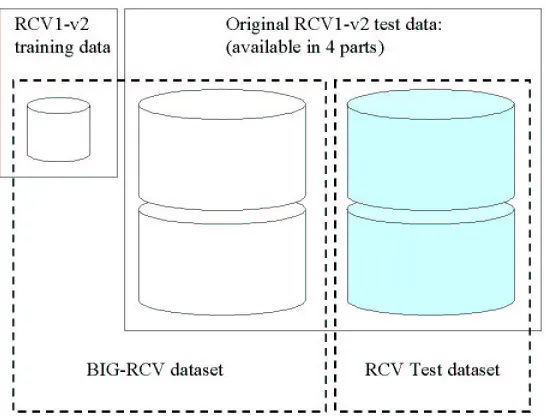
data (the test data is made publicly available in 4≈350 MB parts)—see Figure 5. We also use just
the training portion of RCV1-v2 in some experiments. RCV1-v2 training data set : d=47,236,
t=23,149 (the features in this data set are a particular subset of the features in BIG-RCV). Our
results are for a single topic “ECAT”, whether or not a document is related to economics.
7.1 Results
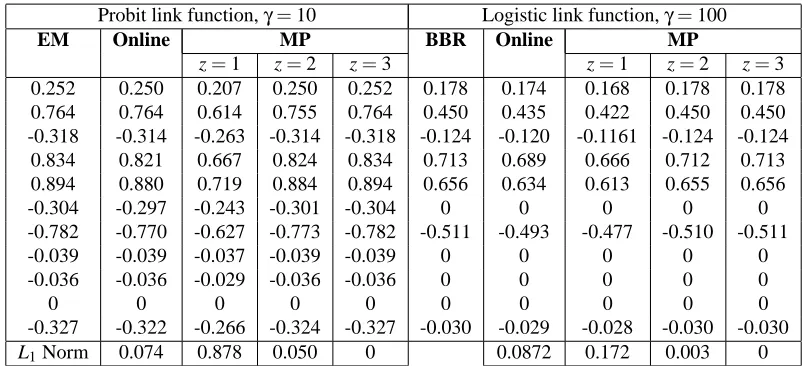
The low dimensional simulated data set highlights typical results we obtain with the Online algo-rithm and the MP algoalgo-rithm (the RMMP algoalgo-rithm is not of practical significance in this case). See
Table 2. Each column in the table is an 11-dimensional vector which is the MAPβestimate of the
Figure 5: Schematic showing the construction of the various RCV1-v2 based data sets used in the experiments. The solid line bordered rectangles show the data as publicly available, the dashed-line bordered rectangles show the data sets we assembled. The shaded portion of the data is used only during testing.
functions and over a wide range of settings for the regularization parameter,γ. To show this, the
tables report results for both too little regularization (γ=10, probit link) and too much
regulariza-tion (γ=100, logistic link) for this particular data set. As a guide to assessing convergence in this
and other tables that follow, we show the L1 norm of the difference between the batch algorithm
estimates (EM or BBR as appropriate) and the Online, MP or RMMP algorithm iterates (also as appropriate).
We next examine the first real data set, the training data for the ModApte split of
Reuters-21578 (Lewis et al., 2004). This is a moderate dimensional (d =21989 features) data set with
t=9603 labelled observations (we use the feature vectors that can be downloaded from the paper’s
appendix.). The features of this data set are weighted term occurrences and it is quite sparse, as is typical for text data. The batch EM algorithm for probit regression is prohibitively expensive on this data set as it involves inverting a high dimensional matrix, but we can run BBR to obtain batch logistic regression results. Hence we focus our results on logistic regression for this data set. We
examine two reasonable settings for the regularization parameter,γ=10 andγ=100. Forγ=10,
BBR returns 150 nonzero components and forγ=100, the MAPβBBR returns has 31 non-zero
components. Since the data set is sparse, and presents no memory limitations, we are able to apply the Online and MP algorithms in addition to the RMMP algorithm—see Tables 3 and 4.
Probit link function,γ=10 Logistic link function,γ=100
EM Online MP BBR Online MP
z=1 z=2 z=3 z=1 z=2 z=3 0.252 0.250 0.207 0.250 0.252 0.178 0.174 0.168 0.178 0.178 0.764 0.764 0.614 0.755 0.764 0.450 0.435 0.422 0.450 0.450 -0.318 -0.314 -0.263 -0.314 -0.318 -0.124 -0.120 -0.1161 -0.124 -0.124 0.834 0.821 0.667 0.824 0.834 0.713 0.689 0.666 0.712 0.713 0.894 0.880 0.719 0.884 0.894 0.656 0.634 0.613 0.655 0.656
-0.304 -0.297 -0.243 -0.301 -0.304 0 0 0 0 0
-0.782 -0.770 -0.627 -0.773 -0.782 -0.511 -0.493 -0.477 -0.510 -0.511
-0.039 -0.039 -0.037 -0.039 -0.039 0 0 0 0 0
-0.036 -0.036 -0.029 -0.036 -0.036 0 0 0 0 0
0 0 0 0 0 0 0 0 0 0
-0.327 -0.322 -0.266 -0.324 -0.327 -0.030 -0.029 -0.028 -0.030 -0.030
L1Norm 0.074 0.878 0.050 0 0.0872 0.172 0.003 0
Table 2: Table with columns showing values of the MAP estimates of β obtained by the batch
algorithms (EM on the left half, for probit regression and BBR on the right half for logistic regression), the Online algorithm and three successive iterates of the MP algorithm applied
to the simulated data set. The final row displays the L1 norm of the difference between
the batch algorithm estimates (EM or BBR as appropriate) and the Online/MP algorithm estimates. The results shown here are representative of those obtained for other values of γas well.
as expected. Forγ=100, the MP algorithm converges in about z=6 iterations to parameter values
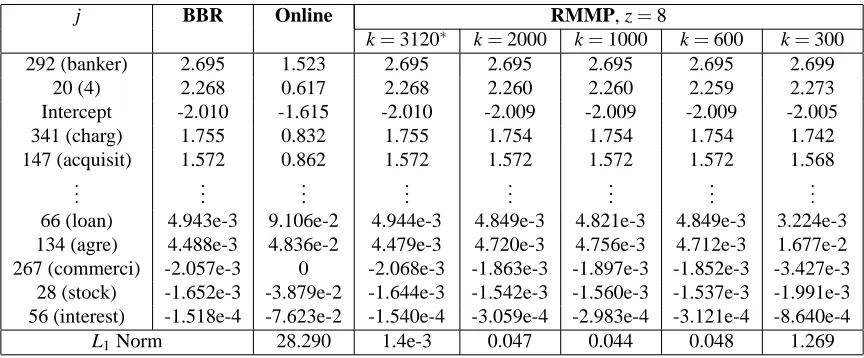
indistinguishable from BBR—see the left three columns in Table 3. We next applied the RMMP
algorithm to this data set. Examining the size of the first active set reveals setting k≈3000, would
give exactly the same results as the MP algorithm—see typical effects of changing k in Table 4 for
γ=10. We point out that this is a huge reduction in the worst case memory required, an
approx-imately 98% reduction (k=3000 vs. d =21989 originally). Note also that the size of k should
be compared relative to the nonzero components for MAPβ(150 and 31 for γ=10 andγ=100
respectively).
We further test the limits of the algorithm, by running it with k=300 forγ=100. The RMMP
algorithm performs very well, requiring about z=7 passes (only two more than the MP algorithm)
to converge to correct parameter values. Forγ=10, where k=300 is small (only twice the number
of non-zero components in the MAPβ), once again the same kind of results hold, with the MP
algorithm needing about 7 passes over the data set and the RMMP algorithm needing about 15
passes to converge to the batchβ.
Finally, we present results of application of the algorithms to the RCV1-v2 data sets. For the
RCV1-v2 training data (d =47,236, t =23,149), sparsity again enables application of BBR to
obtain the batch MAPβparameter values, as well as the Online and MP algorithms, although this is
quite cumbersome. See Table 5. Again, as expected (examining d vs. t for this data set), the Online estimates are not very good. The multi-pass algorithms have improved parameter estimates. For
γ=10 (a fairly high amount of regularization), we find essentially the same qualitative results as
j BBR Online MP RMMP, k=300
z=3 z=5 z=3 z=5 z=7 Intercept -1.588 -1.404 -1.527 -1.586 -1.451 -1.573 -1.588
9 (bank) 1.188 0.697 0.957 1.185 0.688 1.143 1.188
13 (share) 0.847 0.609 0.793 0.846 0.678 0.839 0.847
147 (acquisit) 0.813 0.562 0.795 0.813 0.696 0.812 0.813
31 (offer) 0.801 0.337 0.618 0.800 0.356 0.772 0.801
..
. ... ... ... ... ... ... ...
3 (pct) -2.264e-2 -2.259e-2 -2.127e-2 -2.240e-2 -3.247e-2 -2.062e-2 -2.264e-2 62 (plan) -1.757e-2 -1.430e-2 -2.840e-2 -1.779e-2 -3.346e-2 -2.045e-2 -1.757e-2 2 (dlr) 1.552e-2 6.932e-3 1.542e-2 1.548e-2 1.610e-2 1.525e-2 1.552e-2 12 (net) -1.467e-2 -6.671e-3 -1.956e-2 -1.480e-2 -1.415e-2 -1.643e-2 -1.467e-2
8 (ct) 1.277e-2 3.587e-2 2.870e-2 1.320e-2 2.915e-2 1.776e-2 1.278e-2
L1Norm 4.029 1.691 0.034 3.496 0.4027 3e-4
Table 3: Results obtained on the ModApte data set. The 5 highest and 5 lowest magnitude non-zero
coefficients of MAPβforγ=100 are shown. In table are the indices ofβ(and word stem
features they correspond to in brackets), coefficients from BBR, and the Online algorithm, those obtained after a particular number of passes over the data using the MP algorithm
(full memory) and parameters from the RMMP algorithm with k=300.
j BBR Online RMMP, z=8
k=3120∗ k=2000 k=1000 k=600 k=300
292 (banker) 2.695 1.523 2.695 2.695 2.695 2.695 2.699
20 (4) 2.268 0.617 2.268 2.260 2.260 2.259 2.273
Intercept -2.010 -1.615 -2.010 -2.009 -2.009 -2.009 -2.005
341 (charg) 1.755 0.832 1.755 1.754 1.754 1.754 1.742
147 (acquisit) 1.572 0.862 1.572 1.572 1.572 1.572 1.568 ..
. ... ... ... ... ... ... ...
66 (loan) 4.943e-3 9.106e-2 4.944e-3 4.849e-3 4.821e-3 4.849e-3 3.224e-3 134 (agre) 4.488e-3 4.836e-2 4.479e-3 4.720e-3 4.756e-3 4.712e-3 1.677e-2 267 (commerci) -2.057e-3 0 -2.068e-3 -1.863e-3 -1.897e-3 -1.852e-3 -3.427e-3 28 (stock) -1.652e-3 -3.879e-2 -1.644e-3 -1.542e-3 -1.560e-3 -1.537e-3 -1.991e-3 56 (interest) -1.518e-4 -7.623e-2 -1.540e-4 -3.059e-4 -2.983e-4 -3.121e-4 -8.640e-4
L1Norm 28.290 1.4e-3 0.047 0.044 0.048 1.269
Table 4: Results for the ModApte data set: Illustrating the effect of changing k. The 5 highest
and 5 lowest magnitude non-zero coefficients of MAPβfor γ=10 are shown. In table
are the indices ofβ(and word stem features they correspond to in brackets), coefficients
from BBR, the Online algorithm, and those obtained after 8 passes over the data using the
γ=10 γ=100, k=2500
β BBR Online RMMP, k=1500 β RMMP
index z=2 z=5 z=10 index z=10
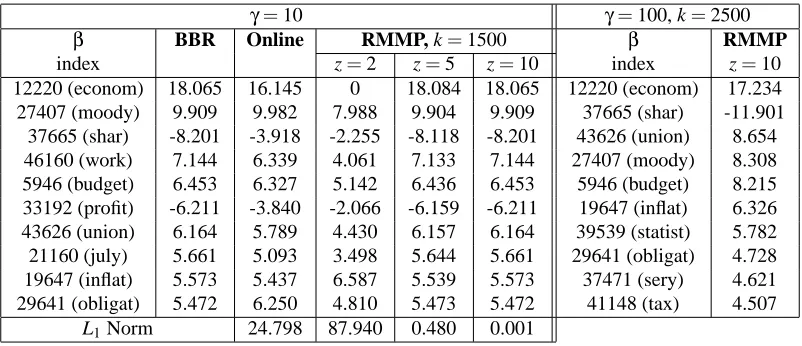
12220 (econom) 18.065 16.145 0 18.084 18.065 12220 (econom) 17.234 27407 (moody) 9.909 9.982 7.988 9.904 9.909 37665 (shar) -11.901
37665 (shar) -8.201 -3.918 -2.255 -8.118 -8.201 43626 (union) 8.654 46160 (work) 7.144 6.339 4.061 7.133 7.144 27407 (moody) 8.308 5946 (budget) 6.453 6.327 5.142 6.436 6.453 5946 (budget) 8.215 33192 (profit) -6.211 -3.840 -2.066 -6.159 -6.211 19647 (inflat) 6.326 43626 (union) 6.164 5.789 4.430 6.157 6.164 39539 (statist) 5.782 21160 (july) 5.661 5.093 3.498 5.644 5.661 29641 (obligat) 4.728 19647 (inflat) 5.573 5.437 6.587 5.539 5.573 37471 (sery) 4.621 29641 (obligat) 5.472 6.250 4.810 5.473 5.472 41148 (tax) 4.507
L1Norm 24.798 87.940 0.480 0.001
Table 5: RCV1-v2 results. Left portion RCV1-v2 training data set, right BIG-RCV data set.
parameter values as BBR (not shown in the table). The RMMP algorithm also gives excellent results
in about 10 passes, see the left portion of Table 5 with k=1500.
For the BIG-RCV data set (d =288,062, t =421,816) however, computational and memory
limitations made it impossible to run the batch algorithms on this data set (also the Online and MP algorithm). It is precisely for cases like this that the RMMP algorithm is useful, and we were able to obtain parameter estimates for reasonable settings of regularization—see for example, the right portion of Table 5.
Does training on the entire BIG-RCV data set actually result in improved predictive perfor-mance? To address this, we conducted the following experiment. We obtained the best possible predictive parameters using 10-fold cross-validation on the RCV1-v2 training data set with a batch algorithm. This is an expensive computation, involving many repeated BBR runs for different val-ues of the regularization parameter (we searched over γ=0.01,0.1,1,10,100). The final
cross-validation chosenβhas 1010 non-zero parameters.
We then trained a separate sparse logistic classifier on the BIG-RCV data set using the RMMP
algorithm with k=3000 andγ=40. Setting γ=40 results in 1015 non-zero MAPβcoefficients
which is approximately the same number of non-zero coefficients as the cross-validation chosen
β. Finally, we compare the predictive accuracy of both classifiers on the unused RCV test set
(comprising the unused two portions of the original RCV1-v2 test data).
The results, shown in Table 6, demonstrate that using the information in extra examples, the “un-sophisticated” classifier trained on the much larger data set outperforms the “optimized” classifier trained on a smaller data set.
8. Conclusions
state-“Optimized”βtrained “Naive”βtrained
on RCV1-v2 training data on BIG-RCV
Relevant Not Relevant Relevant Not Relevant
Retrieved 38,821 7,415 (83.96%) 40,655 6,017 (87.11%)
Not Retrieved 16,368 (70.34%) 319,994 14,534 (73.67%) 321,392
Table 6: This table shows confusion matrices for prediction results on the RCV Test data set. The
CVβ (trained on the RCV1-v2 training data set) results are on the left and the MAPβ
(trained on the BIG-RCV data set, withγ=30, k=3000) results are on the right. Also
shown are recall and precision percentages in bold and brackets. There are approximately 383,000 examples in the test data set.
of-the-art batch algorithms are impractical/cumbersome, and our results show that examining such data sets in their entirety can lead to better classifier performance.
Some areas of further research that this work opens up are: extension of the algorithms for a hi-erarchical prior model so that the choice of regularization is less important, the possible application of our methods to kernel classifiers, and applications to multi-class classification problems.
Acknowledgments
National Science Foundation grants IIS-9988642 and DMS-0505599 and the Multidisciplinary Re-search Program of the Department of Defense (MURI N00014-00-1-0637) supported this work. We are very grateful to David D. Lewis for detailed and insightful comments on an earlier draft of this paper.
Appendix A.
Here we show the Taylor expansions for the quadratic approximations to the log-likelihood function. To simplify notation, let c(β) =βTxiand ˆc=βTi−1xi. The link function (we will restrict analytical
results to the logistic and probit link functions) isΦ(z)as before and we denote its first and second derivative, with respect to z, byΦ0(z)andΦ00(z)respectively.
Consider the case where yi=1:
logΦ(c) ≈ logΦ(cˆ) + (c−cˆ)ΦΦ0(cˆ) (cˆ) +
(c−cˆ)2
2
Φ00(cˆ) Φ(cˆ) −
Φ0 (cˆ)
Φ(cˆ) 2!
∝ Φ0(cˆ) Φ(cˆ)c+
1 2
Φ00(cˆ) Φ(cˆ) −
Φ0 (cˆ)
Φ(cˆ) 2!
c2−cˆ Φ
00(cˆ) Φ(cˆ) −
Φ0 (cˆ)
Φ(cˆ) 2!
c
so that:
ai=
1 2
Φ00(cˆ) Φ(cˆ) −
Φ0 (cˆ)
and
bi= Φ0(cˆ)
Φ(cˆ) −cˆ
Φ00(cˆ) Φ(cˆ) −
Φ0 (cˆ)
Φ(cˆ) 2!
.
Analogously, when yi=0:
log(1−Φ(c))≈log(1−Φ(cˆ))−(c−cˆ) Φ0(cˆ)
1−Φ(cˆ)−
(c−cˆ)2
2
Φ00(cˆ)
1−Φ(cˆ)+ Φ0
(cˆ)
1−Φ(cˆ) 2!
so that:
ai=−
1 2
Φ00(cˆ)
1−Φ(cˆ)+ Φ0
(cˆ)
1−Φ(cˆ) 2!
and
bi=− Φ0(cˆ)
1−Φ(cˆ)+cˆ
Φ00(cˆ)
1−Φ(cˆ)+ Φ0
(cˆ)
1−Φ(cˆ) 2!
.
For the probit link function:
Φ(z) =
Z z
−∞
1
√
2πe
−x2/2 dx
Φ0(z) = √1
2πe
−z2/2
Φ00(z) = √−z
2πe
−z2/2
,
whereas for the logistic link function:
Φ(z) = e z
1+ez Φ0(z) = ez
(1+ez)2
Φ00(z) = (ez)(1−ez) (1+ez)3 .
These expressions then allow us to compute the ai,bi in the cases needed.
Appendix B.
In this appendix we derive the modified Shooting algorithm, Algorithm 1 and discuss its efficient implementation. We derive Shooting by analyzing the subdifferential of the system (Rockafel-lar, 1970). We need convex smooth analysis results because the regularization term is
non-differentiable at zero. Reviewing concepts very briefly, the subgradientξ∈R|x|, of a convex
func-tion f at x0is defined to be any vector satisfying:
f(x)≥ f(x0) +ξT(x−x0).
In words, any vector ξ, such that a plane through (x,f(x))with slope ξ contains f in its upper
f ). The subdifferential, ∂f , is just the set of all subgradients, ξ, at a particular point. This is a generalization of the gradient which collapses to the gradient, whenever f is differentiable. As
a simple example, the subdifferential of f(β) =|β|, the absolute value function (which is
non-differentiable atβ=0) is:
∂f =
{−1}, β<0 [−1,1], β=0
{1}, β>0.
As one expects, analogous to optimality conditions resulting from setting the gradient of a differen-tiable function to zero, optimality conditions for non-differendifferen-tiable functions result from restrictions on the subdifferential. In particular we appeal to the following result from non-smooth analysis (Rockafellar, 1970):
Theorem ˆβis a global minimizer of a convex function f(β)if and only if 0∈∂f(βˆ).
Now to our particular problem. We need to findβthat is a solution to:
max β
βTΨβ
+βTθ−γkβk1
.
The convexity of the problem allows us to make incremental progress towards the maxima coordinate-wise. Starting from some parameter vector, we compute the jth component of the subdifferential of the function (keeping all other components fixed):
∂ ∂βj(β
TΨβ) + ∂
∂βj(β Tθ)
−γ∂(∑d
j=1(|βj|)
= 2(Ψβ)j+θj−γ∂(|βj|)
= 2Ψj jβj+2(Ψ0β)j+θj−γ∂(|βj|)
where (Ψ0β)j is the j’th component of the vector Ψ0β andΨj j refers to the (j,j)’th element of
the matrixΨ(Recall thatΨ0 is defined to be the matrixΨwith diagonal entries set to zero). The
second equation follows from the first as the subdifferential of a univariate differentiable function
is just its derivative and since matrixΨis symmetric (it is just a weighted sum of outer products).
Now if we plug in the subdifferential of the non-differentiable absolute value function, and set
Ωj =2(Ψ0β)j+θj (and thus define the vector Ω to be the gradient of the purely differentiable
part of the objective function), we obtain the subdifferential of the objective function, whose j’th
component we denote by∂βj as:
∂βj =
{2Ψj jβj+Ωj +γ}, βj<0
[Ωj −γ,Ωj +γ], βj=0
{2Ψj jβj+Ωj −γ}, βj>0.
This is a piecewise linear function with fixed negative slope 2Ψj jand a constant jump of fixed size
2γatβj=0 (Ψj jcan be proven to always be negative by looking at the update formula forΨand
using the fact that∀i,ai<0). Using the optimality criteria (now for maximization since−|βj|is a
concave function) naturally leads to the modified Shooting algorithm, illustrated in Figure 6. Now to questions regarding the efficient implementation of the Shooting algorithm, used by the online, MP and RMMP algorithms. In the modified Shooting algorithm, after each component
update (change in βj) we need to modify Ω(the update Ωstep in the algorithm). This can be
implemented efficiently using the following result (similar to the trick detailed in Minka, 2001):
Ωnew=Ωold+2Ψ0
0
0 βj=0
Ωj + γ
Ωj − γ
βj ∂β
j
(a)
0 0
βj<0
Ωj + γ <0
Ωj − γ
βj ∂β
j
(b)
0 0
βj>0 Ωj + γ
Ωj − γ >0
β j ∂β
j
(c)
Figure 6: Illustration of cases occurring in the Shooting algorithm (a) If|Ωj| ≤γthe constant
por-tion of the subdifferential contains zero. In this case, setβj=0 (b) If instead,Ωj<−γ,
the optimality conditions will be satisfied by settingβj =−2γΨ−Ωj jj (c) The case analogous
where∆βj is the change in βj andΨ0(.j) is the j’th column of Ψ0. Thus each component update
of Shooting can be done in O(d)computational time. Now, if as before the maximum number of
non-zero components ofβalong the solution path to MAPβis m, only m such updates will need to
be made, giving a total time requirement per iteration of O(md).
Finally we detail how to carry out the Ωupdates efficiently for the RMMP algorithm,
Algo-rithm 3. Recall that since we are discussing a multi-pass algoAlgo-rithm, the location where we take the
quadratic approximation, βi−1, is constant throughout the pass through the fixed data set, Dt. We
exploit this fact to show that in this case, you don’t explicitly need the matrixΨ(or ˜Ψ) to determine
Ω. Indeed, after going through all the observations in the data set (pass z, say):
Ω=2Ψ0βz−1+θ=2
t
∑
i=1ai xixTi −diag(x2i)
! βz−1+
t
∑
i=1bixi,
which follows from the definitions ofΩ,θandΨ0. In the above equation, diag(x2
i)is a d×d matrix
zero everywhere except the diagonal entries, which consists of the elements of the vector xisquared
component-wise. This leads to the following equation forΩ:
Ω=2
t
∑
i=1ai(βTz−1xi)xi−2 t
∑
i=1ai(x2iβz−1) + t
∑
i=1bixi,
where(x2
iβz−1)is a vector whose entries are x2i multiplied byβz−1component-wise. Note the first
sum is just a weighted combination of the input data (βTz−1xi is a scalar). Thus, our final update
formula results:
Ωnew=Ωold+ (2a
iβTz−1xi+bi)xi−2ai(x2iβz−1).
As can be seen, computing this update per observation takes time and space O(d), and having
restricted the number of non-zero components ofβto k, a total computational cost per iteration of
Shooting to O(kd).
Appendix C.
We present a proof sketch for the convergence behavior of the online algorithm in the infinite data
limit. The intuition for is as follows: as t →∞, the Bayesian central limit theorems dictate that
the posterior distribution tends (in distribution) to a multivariate Gaussian with ever shrinking co-variance, (Bernardo and Smith, 1994). Thus, less and less information is required to encode the posterior distribution as more and more data is added—to a point. Indeed, in the limit, only the
vector of the maximum likelihood value of the parameters,βMLE, is required to completely describe
the posterior distribution.
Suppose now that the online algorithm converges to a particular fixed point. In the infinite data limit, an infinite number of term approximations are taken at this fixed point. Now, our Taylor polynomial based approximation preserves both the function value and its gradient, and an infinite number of approximations are jointly maximum at this fixed point. This implies the fixed point is an optima of the posterior distribution.
a theorem in Opper (1998). Even though Opper derives his results based on a Gaussian prior on
the parametersβ(corresponding to L2regularization), the general format of Opper’s theorem is still
applicable in our case because, in the infinite data limit, the prior is inconsequential.
References
J. M. Bernardo and A. F. M. Smith. Bayesian Theory. John Wiley and Sons, Inc., 1994.
S. S. Chen, D. L. Donoho, and M. A. Saunders. Atomic decomposition by Basis Pursuit. SIAM Journal on Scientific Computing, 20(1):33–61, January 1999.
B. Efron, T. Hastie, I. Johnstone, and R. Tibshirani. Least angle regression. The Annals of Statistics, 32(2):407–499, 2004.
E. Eskin, A. J. Smola, and S.V.N. Vishwanathan. Laplace Propagation. In Neural Information Processing Systems, 16. MIT Press, 2003.
M. A. T. Figueiredo and A. K. Jain. Bayesian learning of sparse classifiers. In Proceedings of the Computer Vision and Pattern Recognition Conference, volume 1, pages 35–41, 2001.
W. J. Fu. Penalized regressions: The Bridge versus the Lasso. Journal of Computational and Graphical Statistics, 7(3):397–416, 1998.
A. Genkin, D. D. Lewis, and D. Madigan. Large-scale Bayesian logisitic regression for text catego-rization. Technometrics, 49:291–304, 2007.
T. Hastie, S. Rosset, R. Tibshirani, and J. Zhu. The entire regularization path for the Support Vector Machine. Journal of Machine Learning Research, 5:1391–1415, 2004.
T. Jaakkola and M. Jordan. Bayesian parameter estimation via variational methods. Statistics and Computing, 10:25–37, 2000.
R. E. Kass and A. E. Raftery. Bayes factors. Journal of the American Statistical Association, 90: 773–795, 1995.
K. Koh, S.-J. Kim, and S. Boyd. An interior-point method for large-scale l1-regularized logistic
regression. Journal of Machine Learning Research, 8:1519–1555, 2007.
P. Komarek and A. Moore. Making logistic regression a core data mining tool: A practical in-vestigation of accuracy, speed, and simplicity. Technical Report TR-05-27, Robotics Institute, Carnegie Mellon University, Pittsburgh, PA, May 2005.
B. Krishnapuram, L. Carin, M. A. T. Figueiredo, and A. J. Hartemink. Sparse multinomial logistic regression: Fast algorithms and generalization bounds. IEEE Transactions on Pattern Analalysis and Machine Intelligence, 2005.
D. D. Lewis. Reuters-21578 text categorization test
collec-tion: Distribution 1.0 readme file (v 1.3)., 2004. URL
D. D. Lewis, Y. Yang, T. G. Rose, and F. Li. RCV1: A new benchmark collection for text catego-rization research. Journal of Machine Learning Research, 5:361–397, 2004.
D. J. C. MacKay. Probable networks and plausible predictions: a review of practical Bayesian methods for supervised neural networks. Network: Computation in Neural Systems, 6:469–505, 1995.
T. P. Minka. Expectation Propagation for approximate Bayesian inference. In Jack Breese and Daphne Koller, editors, Proceedings of the Seventeenth Conference on Uncertainty in Artificial Intelligence (UAI-01), pages 362–369, San Francisco, CA, August 2–5 2001a. Morgan Kauf-mann Publishers.
T. P. Minka. A Family of Algorithms for Approximate Bayesian Inference. PhD thesis, Massachusetts Institute of Technology, Dept. of Electrical Engineering and Computer Science, 2001b.
M. Opper. A Bayesian approach to on-line learning. In D. Saad, editor, Online Learning in Neural Networks, pages 363–378. Cambridge University Press, 1998.
M. R. Osborne, B. Presnell, and B. A. Turlach. A new approach to variable selection in least squares problems. IMA Journal of Numerical Analysis, 20(3):389–403, July 2000.
Y. Qi, T. P. Minka, R. W. Picard, and Z. Ghahramani. Predictive automatic relevance determination by Expectation Propagation. In Proceedings of Twenty-first International Conference on Machine Learning, Banff, Alberta, Canada, July 4-8 2004.
R. T. Rockafellar. Convex Analysis. Princeton University Press, Princeton, N.J, 1970.
S. K. Shevade and S. S. Keerthi. A simple and efficient algorithm for gene selection using sparse logistic regression. Bioinformatics., 19(17):2246–2253, 2003.
R. J. Tibshirani. Regression shrinkage and selection via the Lasso. Journal of the Royal Statistical Society, Series B, 58(1):267–288, 1996.
T. Zhang. On the dual formulation of regularized linear systems. Machine Learning, 46:91–129, 2002.
T. Zhang and F. J. Oles. Text categorization based on regularized linear classification methods. Information Retrieval, 4(1):5–31, 2001.