http://ijessr.com Page 170 21ST CENTURY LEARNING FRAMEWORK: USING CONTEXTUAL TEACHING AND
LEARNING TO ENHANCE STUDENT CRITICAL THINKING SKILLS
Siti Nur Hasanah, Widha Sunarno and Baskoro Adi Prayitno
Faculty of Teacher Training and Education, Sebelas Maret University, Solo, Indonesia
ABSTRACT
Innovation learning is needed to improve students' critical thinking skills. In the 21st century, critical thinking skills are one of the life skills that students must have to be ready to compete in the global world. This study aims to explore the potential of implementing contextual teaching and learning approaches to improve students' critical thinking skills. The result of the study showed that applying the CTL approach to learning could improve students' critical thinking skills, characterized by increased students' ability to identify problems, analyze, conclude, provide an in-depth explanation, evaluate, and self-regulation.
KEYWORDS: 21st Century Learning, Contextual Teaching & Learning, Critical Thinking
1. INTRODUCTION
Critical thinking skills are one of the skills that students must have in the 21st century. The 21st century is characterized by the rapid development of information and communication techno logy. It demands the world of education to prepare human resources with global competitiveness, namely the generations that are critical, creative, innovative, and communicative. Among these skills, critical thinking skills are basic skills that are essential for students to have before developing other skills.
Critical thinking skills can be integrated into school learning processes so that students are accustomed to using their critical thinking early on, not only to solve problems related to learning materials, but also to solve problems related to daily life. Students who are accustomed to using their critical thinking skills will be more sensitive to the problems surrounding them and try to find alternatives to solving those problems. Decision-making of solutions taken was also accompanied by strong reasons and proofs and have been considered good and bad.
Integrating aspects of critical thinking skills in learning will be easier through a precise learning approach. Contextual Teaching and Learning (CTL) is one of the learning approaches that can improve your critical thinking skills (Johnson, 2002). The study aims to analyze the relationship between contextual learning components and aspects of critical thinking skills that can be improved.
2. LITERATURE REVIEW
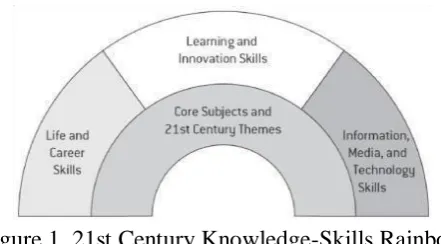
http://ijessr.com Page 171 regard, one of the challenges in education is to prepare quality human resources. To be a qualified generation, 21st-century generations must possess 21st-century skills. Trilling & Fadel (2009) describe 21st-century skills in a scheme called 21st-century Knowledge-skills rainbow. These three skills include (1) Life and career skills, (2) Learning and innovation skills, and (3) Information media and technology skills.
Figure 1. 21st Century Knowledge-Skills Rainbow Source: (Trilling & Fadel, 2009)
Further, Trilling & Fadel (2009) explain that through life and career skills, students are expected to adapt and establish good relations with the environment and surrounding communities. Through learning and innovating skills, students are expected to overcome problems using a critical, systematic, innovative, and creative way of thinking and being able to communicate and collaborate well. Through the mastery of technology and information media skills, students are expected to be able to utilize information and communication technology effectively and efficiently and be able to develop creative and innovative information and communication technology media. It is in line with the opinions of Osman, Hiong, & Vebrianto (2013) stating that the skills of the 21st century have five primary domains: digital literacy, intensive thinking, effective communication, high productivity, and spiritual and moral value. According to the Partnership for 21st Century Skills Framework, competencies that must be mastered by students include critical thinking skills, creative thinking skills, communication skills, and collaborative skills known as 4C Competence (Zubaidah, 2018).
http://ijessr.com Page 172 (1) interpretation, (2) analysis, (3) evaluation, (4) inference, (5) exportation, and (6) self-arrangement.
Picture 2. Core Critical Thinking Skills Source: (Facione, 2015)
Interpretation is a skill to understand and reveal the meaning of various experiences, situations, data, events, statements, rules, or criteria. Analysis is a skill to identify inferential relationships between statements, questions, concepts, and all forms of representation of data or events. The evaluation is a skill to assess the credibility of a statement or representation of a person's perception of an incident. Meanwhile, the inference is a person's skill to identify specific things needed as a basis for decision making. In addition, critical thinking skills are also characterized by a person's skill to provide a specific and thorough description or explanation of a thing, or so-called explaining/explanatory skills. Lastly, the level of students' critical thinking skills can be seen from his or her skills in monitoring his or her activities or called self-regulation (Facione, 2015).
Given the importance of critical thinking skills for students, learning at school should not only aim to improve cognitive learning outcomes but also aims to cultivate students' critical thinking skills. Synder & Synder (2008) state that critical thinking skills are a type of skill that can be learned. The ways to help improve students' critical thinking skills are through a learning strategy that invites active students to use their critical thinking skills, focus on the learning process, and use more challenging assessment techniques for students to think harder. Further, Burbach, Matkin, & Fritz (2004) add that students' critical thinking skills could be improved through active learning.
http://ijessr.com Page 173 to synthesize new knowledge (Hudson & Whisler, 2012). CTL is also a learning concept that helps teachers find relationships between learning materials and situations that occur in everyday life. In addition, through CTL, students are also more motivated to find the linkage between the knowledge they get in school with the experiences they have in everyday life (Sears, 2003).
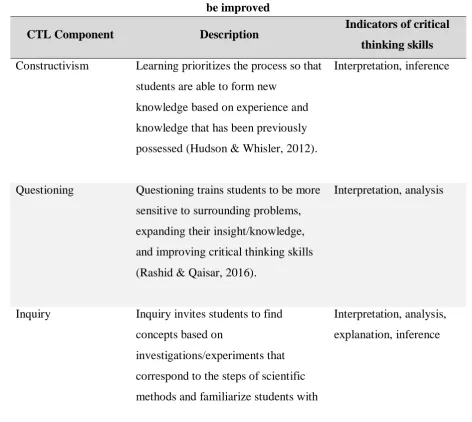
CTL can be used to improve critical thinking skills because CTL has components that, if implemented with strategic steps, then students' critical thinking skills can be increased (Johnson, 2002). The CTL components are constructivism, questioning, inquiry, learning community, modeling, reflection, and authentic assessment (Muslich, 2007). Each of these components can improve students' critical thinking skills on specific indicators. The linkage between the CTL component and the indicator of the critical thinking skills can be improved can be seen in Table 1 below.
Table 1. Linkages between CTL components and indicators of critical thinking skills that can be improved
CTL Component Description Indicators of critical
thinking skills
Constructivism Learning prioritizes the process so that
students are able to form new
knowledge based on experience and
knowledge that has been previously
possessed (Hudson & Whisler, 2012).
Interpretation, inference
Questioning Questioning trains students to be more
sensitive to surrounding problems,
expanding their insight/knowledge,
and improving critical thinking skills
(Rashid & Qaisar, 2016).
Interpretation, analysis
Inquiry Inquiry invites students to find
concepts based on
investigations/experiments that
correspond to the steps of scientific
methods and familiarize students with
Interpretation, analysis,
http://ijessr.com Page 174
CTL Component Description Indicators of critical
thinking skills
critical thinking (Suryant, Arifin, &
the Majesty, 2018).
Learning Community Learning community increases the
level of student thinking, storing
information longer, and is responsible
for the knowledge they possess
(Gokhale, 1995)
Analysis, explanation,
self-regulation
Modeling Modeling presents teachers, students,
media, or other learning resources, for
example, so that students can better
understand abstract concepts (Dance
& Rosana, 2019).
Interpretation, analysis
Reflection Reflection directs students to control
their learning activities, and their
abilities, also, recognizes
shortcomings and benefits during the
learning process (Sears, 2003).
Self-regulation,
evaluation
Authentic Assessment Authentic Assessment not only uses
diverse assessment techniques and
suits student activities but also
facilitates students to use high-level
thinking to solve more challenging
questions (Sears, 2003).
Evaluation, analysis,
http://ijessr.com Page 175
3. CONCLUSION
Based on the literature study above, it can be concluded that one of the skills in the 21st century that needs to be developed is a critical thinking skill. Contextual Teaching and Learning (CTL) is one of the learning strategies that can be applied at school to improve students' critical thinking skills through its seven components.
REFERENCES
Burbach, M. E., Matkin, G. S., & Fritz, S. M. (2004). Teaching critical thinking in an introductory leadership course utilizing active learning strategies: a confirmatory study. College Student Journal, Volume 38, Issue 3.
Changwong, K., Sukkamart, A., & Sisan, B. (2018). Critical Thinking Skill Development: Analysis of a New Learning Management Model for Thai High Schools. Journal of International Studies,11 (2), 37-48.
Ennis, R. H. (2011). The Nature of Critical Thinking: An Outline of Critical Thinking Dispositions and Abilities. Sixth International Conference on Thinking at MIT (page. 1-8). Cambridge: MIT Cambridge.
Facione, P. A. (2015). Critical Thinking: What It Is and Why It Counts. Hermosa Beach, CA: Measured Reasons LLC.
Gokhale, A. A. (1995). Collaborative learning enhances critical thinking. JTE Volume 7, Number 1. Hasanah, S. N., Rosana, D., & Susilowati. (2016). Development of LKPD IPA based contextual teaching and learning (CTL) Theme "The danger of cigarettes in the body" to improve critical thinking skills Class VIII students in SMP Negeri 2 Wonosari. Journal STUDENT UNY Volume 5 No 1.
Hudson, C. C., & Whisler, V. R. (2012). Contextual teaching and learning for practicioner. Systemic, Cybernetics, and Informatics Volume 6 Number 4, 54-58.
Johnson, E. B. (2002). Contextual Teaching and Learning: Wha It Is and Why It's Here to. USA: Corwin Press, Inc.
Muslich, M. (2007). KTSP: Competency-based and contextual learning. Jakarta: Bumi Aksara. Osman, K., Hiong, L. C., & Vebrianto, R. (2013). 21st Century Biology: An Interdisciplinary Approach of Biology, Technology, Engineering, and Mathematics Education. Procedia-Social and Behavioral Sciences, 188-194.
Rashid, S., & Qaisar, S. (2016). Developing critical thinking through questioning strategy among fourth grade student. Bulletin of Education ad Research, Vol 38, No. 2, 153-168.
Sears, S. (2003). Introduction to contextual teaching and learning. Bloomington: Phi Delta Kappa Educational Foundation.
Suryant, Arifin, I. S., & Baginda, U. (2018). The application of inquiry learning to train critical thinking skills on light material of primary school students. Journal of Physics: Conference Series, 1-7.
http://ijessr.com Page 176 Tari, D. K., & Rosana, D. (2019). Contextual teaching and learning to develope critical thinking and practical skills. Journal oF Physics: Conference Series, 1-7.
Trilling, B., & Fadel, C. (2009). 21st Century Skills: Learning for Life in Our Times. USA: John Wiley & Sons, Inc.
Wijaya, E. Y., Sudin, D. A., & Nyoto, A. (2016). Transformation of the 21st century education as a demand for human resources development in the Global Era. National Seminar on mathematics education (HAL. 263-278). Malang: University of Kanjuruhan Malang.