COMPUTER SCIENCE & TECHNOLOGY
www.computerscijournal.org
December 2015, Vol. 8, No. (3): Pgs. 241-246 An International Open Free Access, Peer Reviewed Research Journal
Published By: Oriental Scientific Publishing Co., India.
Hybrid Approach for Load Balancing in Cloud Computing
VINEET RICHHARIYA, RATNESH DUBEY
and ROzINA SIDDIqUI
Department of CSE, LNCT, Bhopal (M.P.) India.
(Received: September 11, 2015; Accepted: December 11, 2015)
ABSTRACT
Load balancing in the cloud computing environment has an important impact on the performance. Good load balancing makes cloud computing more efficient and improves user satisfaction. Load balancing with cloud computing provides a good efficient strategy to several inquiries residing inside cloud computing environment set. complete balancing must acquire straight into accounts two tasks, one will be the resource provisioning as well as resource allocation along with will be task scheduling throughout distributed System. Round robin algorithm can be via far the Easiest algorithm shown to help distribute populate among nodes.. Because of this reason it is frequently the first preference when implementing a easy scheduler. One of the reasons for it being so simple is that the only information required is a list of nodes. The proposed algorithm eliminates the drawbacks of implementing a simple round robin architecture in cloud computing by introducing a concept of assigning different time slices to individual processes depending on their are priorities.
Key words: Cloud computing, load balancing, Task Scheduling, Round Robin.
INTRODUCTION
Cloud computing comes throughout focus development of grid computing, virtualization as well as web technologies. Cloud computing is usually the world wide web based computing That presents infrastructure as service (IaaS), platform as service (PaaS), software as Service (SaaS). Throughout SaaS, software application form is usually created shown through the cloud provider. PaaS a good application development platform for the developer to Create a internet based application. within IaaS computing infrastructure can be sent to be a help towards the requester. In your current application form associated with Virtual Machine (VM).These model usually are developed viewable from a
a good high performance computing and also the Simplest process throughput. Scheduling manages availability involving CPU memory and good scheduling policy gives maximum utilization of resource.
LIterature Review
In this section, when i describe your own related operate ok job scheduling in cloud computing environment. your author connected with paper1 presented a great brief description involving
cloudSim toolkit AND his Functionality. CloudSim toolkit is really a platform through which you can test your operate earlier applied directly into true work, in the actual paper we learned Tips on how to simulate the work inside different approaches AND ALSO different scheduling policy.
In paper2 author proposed a great
approach for work scheduling algorithm In line with populate balancing inside cloud computing. the particular paper pointed out 2 level work scheduling based towards complete balancing. such career scheduling can\’t sole meet user’s requirement but in addition supply the high resource utilization. this paper presented the implementation of a efficient Quality of ASSISTANCE (QoS) based Meta-Scheduler AS WELL AS Backfill strategy based light The strain Virtual Machine Scheduler pertaining to dispatching jobs
The authors regarding paper3 presented
the optimized algorithm regarding career scheduling Based on genetic simulated annealing algorithm. the particular considers your current QoS Requirements similar to completion time, bandwidth, cost, distance, reliability involving various other type tasks. here annealing can be implemented after the selection, crossover AS WELL AS mutation, to help improve local search ability connected with genetic algorithm.
In paper7 a brand new VM fill up Balancing
Algorithm is actually Weighted Active Monitoring populate Balancing Algorithm applying CloudSim tools, due to the Datacenter to help efficiently load balance requests between ones exhibited virtual devices assigning the weight, in order to achieve far better performance parameters. here VMs associated with different processing powers along
with the tasks/requests usually are designated or perhaps issued on the all powerful VM and then on the lowest so on.
In paper8 author proposed a good
algorithm can be ant colony optimization that random optimization search approach is usually obtained pertaining to allocating your current incoming jobs on the virtual products your algorithm uses a great positive feedback mechanism AS WELL AS imitates ones behavior of true ant colonies throughout nature find meal AS WELL AS to Affiliate to help each other via pheromone laid from paths traveled.
Components of cloud system
A typical Cloud modeled applying CloudSim involves after four entities Datacenters, hosts, Virtual m/c in addition application form along with system Software which are shown in figure1.
Datacenter
Datacenter is set of hosts . This can be responsible regarding managing virtual models (VMs) (e.g., VM provisioning). It behaves similar to a IaaS provider from finding requests with regard to VMs via brokers.
Datacenter Broker
This class represents the broker acting on behalf of a user. It modifies a couple of mechanisms: ones mechanism for submitting VM provisioning requests to be able to data centers and mechanism with regard to submitting tasks to VMs.
Host
host executes actions regarding management of VMs (e.g., creation along with destruction) and update task processing to be able to VMs. a good host possesses the defined policy to provisioning memory, processing elements, and also bandwidth to virtual machines. a good host is associated for you to the data center. The idea can host virtual machines.
VM
physical machine. Each virtual machine divides your own resources received by the host among tasks working from it.
Cloudlet
The cloudlet class can be also known as being a task. CloudSim represents your complexity of the application in relation to their computational requirements. the class is managed through the scheduling policy that will be implemented inside Datacenter Broker Class.
Load balancing Algorithms
Since the job arrival pattern is not predictable and the capacities of each node in the cloud differ, for load balancing problem, workload control is crucial to improve system performance and maintain stability. Load balancing schemes depending on whether the system dynamics are important can be either static or dynamic. Static schemes do not use the system information and are less complex while dynamic schemes will bring additional costs for the system but can change as the system status changes. A dynamic scheme is used here for its flexibility.
Few exiting load balancing algorithms are as follows:
Token Routing
The main objective of the algorithm24
can be to minimize the process cost through transporting your own tokens In regards to the system. But inside a good scalable cloud technique agents are not able to have your current enough particulars regarding.
Round Robin
In the particular algorithm10, your current
processes tend to be divided between all processors. Each technique will be designated towards processor within an round robin order.
Randomized
Randomized algorithm can be of type static with nature. inside the particular algorithm11
the process can be handled by the Private node n which has a probability p. your current system allocation order is retained with regard to each
processor independent connected with allocation by remote processor.
Central queuing
The algorithm13 functions towards
principal regarding dynamic distribution. Each new activity arriving on the queue manager will be inserted into your current queue. Whenever ask a activity is actually acquired by the queue
Round Robin Algorithm
It is a static fill up balancing algorithm, that does not take the previous fill up state of an node for the day involving assigning jobs. This makes USE of your round robin scheduling algorithm regarding allocating jobs. The item selects your very first node arbitrarily and then, allocates jobs for you to just about all additional nodes in an round robin manner15. the actual algorithm is effective
from random menus of the virtual machines. the datacenter controller allocates your requests for you to a record of VMs with a good rotating basis. your current primary obtain can be assigned to an VM selected randomly by the group subsequently ones details Center controller assigns your requests in the circular order. soon after your own VM is actually allotted your request, your own VM is usually shifted towards end of a record13.
The round robin algorithm is as follows:
Step1: Set all the VM allocation is zero and record of each VM index by Round Robin load balancer.
Step2:
a. user request/task/cloudlet receives by data center receivers.
b. On the base of priority allocated virtual machine
c. Basis of priority load balancer allocate the time quantum to user request
Step 3: After the complete of task(cloudlets),VM are allocated to other user request.
Step4: Checks new /pending/waiting requests in queue by data center controller.
Step5: Go to step 2.
Proposed algorithm
Fig. 1: Block diagram of Components of Cloud
System Fig. 2: Round Robin Process
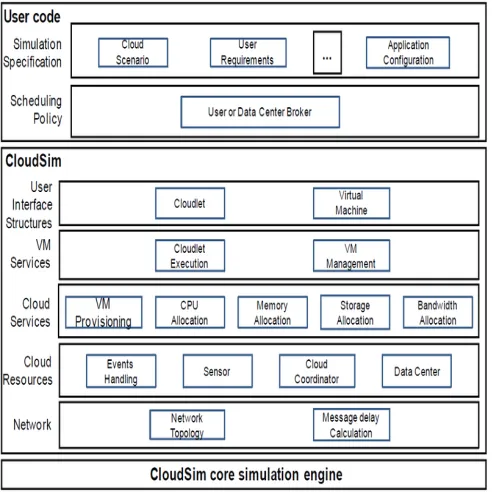
Fig. 3: CloudSim Architecture
architecture in cloud computing by introducing a concept of assigning different time slices to individual processes depending on their are priorities. The priority of a process is assigned by user externally. In the proposed architecture when a new process arrives in the system it is queued at a small processor. This small dedicated processor is used to calculate the time slices of each process, arranges the processes in ascending order of their
The Proposed round robin algorithm is as follows:
Step1: set all the VM allocation is zero and record of each VM index by Round Robin load balancer.
Step2:
a. user request/task/cloudlet receives by data center receivers..
b. On the base of priority allocated virtual machine and calculate range (R)
R=Max Burst Time+Min Burst Time
c. Basis of range and priority, load balancer allocate the time quantum to user request
Step 3: After the complete of task(cloudlets),VM are allocated to other user request..
Step 4: Checks new /pending/waiting requests in queue by data center controller.
Step 5: Go to step 2.
CloudSim
CloudSim12 is the many efficient tool you
can use with regard to modeling regarding Cloud. during your current lifecycle of an Cloud, CloudSim allows VMs for you to be managed coming from hosts that will inside turn are usually managed by datacenters.
CloudSim offers architecture inside four uncomplicated entities. these types of entities offer consumer to set-up the basic cloud computing environment as well as measure your effectiveness
involving fill up Balancing algorithms.. Datacenters entity features the responsibility of providing Infrastructure level solutions for the Cloud Users. They act as a home to help a lot of host Entities or maybe a lot of instances hosts’ entities aggregate to help application form the solitary Datacenter entity. hosts with Cloud are usually Physical Servers The idea have pre-configured processing capabilities. host is actually responsible regarding providing Software level SERVICE towards Cloud Users. hosts have their particular storage and memory. Processing features regarding hosts is usually expressed throughout MIPS (million instructions per second).
CONCLUSION
This paper presents a concept of Cloud Computing along with research challenges in load balancing. It also focus on merits and demerits of the cloud computing. Major thrust is given on the study of load balancing algorithm, followed by a comparative survey of these above mentioned algorithms in cloud computing with respect to stability, resource utilization, static or dynamicity, cooperative or non-cooperativeness and process migration. This paper aims towards the establishment of performance qualitative analysis on existing VM load balancing algorithm and then implemented in CloudSim and java language .
REFERENCES
1. Kaur s and Supriya Kinger2, “Analysis of Load Balancing Techniques in Cloud Computing”,
International Journal of Computers & Technology, 4(2): 737- 741 (2013).
2. Poojaand Mishra2, “Analysis of Variants in Round Robin Algorithms for Load Balancing in Cloud Computing”, (IJCSIT) International Journals of Computer Science and Information Technologies, 4(3): 416- 419 (2013).
3. Kunal Mahurkar1, Shraddha Katore2 and Suraj Bhaisade3, Pratikawale4, “Reducing Cost of Provisioning in Cloud Computing”,
International Journal of Advance in Computer Science and Cloud Computing, 1(2);: 6- 8 (2013).
4. Dr. Rakesh Rathi1, Vaishali Sharma2 and Sumit Kumar Bole3, “Round Robin Data Center Selection in Single Region for Service Proximity Service Broker in Cloud Analyst”, International Journal of Computer & Technology, 4 (2): 254- 260 (2013). 5. Bhatiya Wickremansinghe1, Rodrigo N.
Calheiros2and Dr. Rajkumar Buyya3, “CloudAnalyst: A CloudSim- based VisulModeller for Analysing Cloud Computing Environments and Applications”, IEEE Computer Society, pp. 446-452 (2010). 6. Pooja Samal1 and Pranati Mishra2, “Analysis
of Variants in Round Robin Algorithms for Load Balancing in Cloud Computing”,
Science and Information Technologies, 4(3), pg. no. 416- 419 (2013).
7. Kunal Mahurkar1, Shraddha Katore2 and Suraj Bhaisade3, Pratikawale4, “Reducing Cost of Provisioning in Cloud Computing”,
International Journal of Advance in Computer Science and Cloud Computing, 1(2): 6- 8 (2013).
8. Dr. Rakesh Rathi1, Vaishali Sharma2 and Sumit Kumar Bole3, “Round Robin Data Center Selection in Single Region for Service Proximity Service Broker in Cloud Analyst” , International Journal of Computer & Technology,4(2): 254- 260 (2013). 9. Bhatiya Wickremansinghe1, Rodrigo N.
Calheiros2and Dr. Rajkumar Buyya3, “CloudAnalyst: A CloudSim- based VisulModeller for Analysing Cloud Computing Environments and Applications”, IEEE Computer Society, pp. 446-452 (2010). 10. JaspreetKaur, “Comparison of load balancing
algorithm in a Cloud”, International Journal of Engineering Research and Applications (IJERA), 2(3): pp. 1169- 1173 (2012). 11. Syed Tauhid Zuheri1, Tamanna Shamrin2
and Rusia Tanbin3, Firoj Mahmud4, “An Efficient Load Balancing Approach in Cloud Environment by using Round Robin Algorithm”, International Journal of Artificial and Mechatronics, 1(5): pp 96-99 (2013). 12. B. Santosh Kumar1 and Dr. Latha Parthiban2,
“An Implementation of Load Balancing Policy for Virtual Machines Associated with a Data Centre”, International Journal of Computer Science & Engineering Technology (IJCSET), 5(3): pp. 253- 261 (2014).
13. Sonika Matele1, Dr, K James2 and Navneet Singh3, “A Study of Load Balancing Issue
Among Multifarious Issues of Cloud Computing Environment”, International Journals of Emerging Technolog Computational and Applied Science (IJETCAS),13- 142: 236- 241 (2013).
14. Subasish Mohapatra1, Subhadarshini2 and K. Smruti Rekha3, “Analysis of Different Varients in Round Robin Algorithms for Load Balancing in Cloud Computing”, International Journal of Computer Application, 69(22): 17-21 (2013).
15. Dr hemant S. Mahalle1, Prof Parag R. Kaver2 and Dr. Vinay Chavan3, “Load Balancing on Cloud Data Centres”, Internatinal Journal of Advanced Reserch in Computer Science and Software Engineering, 3(1): 1- 4 (2013). 16. Randles1, M Lamb2 and Taleb Bendiab3,
“A Comparative Studyinto Distributed Load Balancing Algorithm for Cloud Computing”, Advanced Information Networking and Application Workshop (WAINA) 2010. 17. Dr. RajkumarBuyya, “CloudSim: a toolkit for
modelling and simulation of cloud computing environments and evaluation of resource provisioning algorithm”, published online 24 august in Wiley Online Library 2010, pp. 23- 50
18. Prof Meenakshi Sharma1 and Pankaj Sharma2, “Performance Evaluation of Adaptive Virtual Machine Load Balancing Algorithm”, International Journal of Advanced Computer Science and Applications, 3(2): pp. 86-88 (2012).