I.Gurumurthy
et al
, International Journal of Computer Science and Mobile Applications,
Vol.2 Issue. 11, November- 2014, pg. 55-61
ISSN: 2321-8363
©2014, IJCSMA All Rights Reserved, www.ijcsma.com 55
A Technique for Mining Uncommon Causal
Relations and Its Submission in Finding
Adverse Drug Reaction Indication Pairs
I.Gurumurthy
1, R.Jayamma
21
PG Scholar in the Department of Computer Science and Engineering Madhira Institute of Technology
and Sciences, Kodad, Telangana India
2
Associate Professor Department of Computer Science and Engineering Madhira Institute of Technology
and Sciences, Kodad, Telangana India
Abstract
Data mining is the process of extracting or mining the information from large amount of data. It is used in
many tangible world applications. Mining the data from data set and examines the data for decision
making process. Several data mining algorithms are applied to improve the decision making process. To
discover the causal association from electronic patient datasets internment the causality among
uncommon events. The projected system to find the finest membership function of a fuzzy system using
subdivision swarm optimization. PSO has no evolution operators such as crossover and mutation. The
element swarm optimization concept consists of, at each time step, varying the velocity of each element
toward its and locations. All elements are moved to the test finest solution. These mining contrary drug
reaction indications are useful to discover patient critical condition and reduce the computational
complexity for drug safety professionals.
Keywords:Adverse Drug Reaction (ADR), Association Rules, Data Mining Algorithms, Recognition Primed Decision (RPD) model, Element Swarm Optimization (PSO) Algorithm
1. Introduction
I.Gurumurthy
et al
, International Journal of Computer Science and Mobile Applications,
Vol.2 Issue. 11, November- 2014, pg. 55-61
ISSN: 2321-8363
©2014, IJCSMA All Rights Reserved, www.ijcsma.com 56
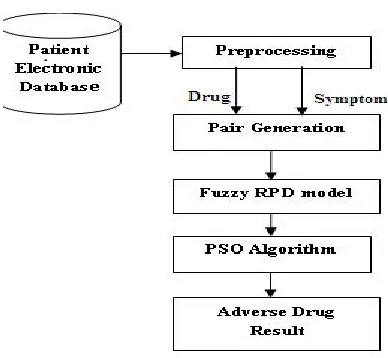
Figure 1: Mining causal association for adverse drug
Using the fuzzy recognition primed decision model is used to discover the Adverse Drug Reaction (ADR) pairs. The computational comp laxity is analyzed. They take maximum amount of time and the performance is less. The membership function has been tuned. All pairs are moved to the finding Adverse Drug React ions used by the Element Swarm Optimization (PSO). Optimized membership functions provide the better performance compare to the fuzzy model. The speed of research is very fast and the optimization of this process is improved.
To discover the causal association work summarized as follows:
To effectively reduce the undesirable effects caused by the infrequent evens using the measure of exclusive causal leverage measure.
The computational comp laxity is analyze. Applying the Fuzzy Recognition Primed Decision (RPD)
model.
For reducing the computational complexity developed the new measure is Element Swarm Optimization (PSO) technique.
2.
Related Work
The association between two events is discovered by the area of data mining. Normally the association rules is in the form of X -> Y, where X and Y are two event sets. The interestingness measures of support and confidence are projected for association rules [23]. Support in the association rules means X -> Y occurred at least once among the entire event sets. The association rules defined the confidence conf (X ->Y) = sup(X ->Y)/sup(X -> ) in the sequence that contain X. The minus and min conf contains a very small set, possibly accessing false associations. The causal association defined as first intrinsic asymmetric causal association when an event X causes event Y. Second the causality is based on time dependencies like the dose has taken its caused effect is some temporal time of period. They all are discovered the infrequent patterns.
I.Gurumurthy
et al
, International Journal of Computer Science and Mobile Applications,
Vol.2 Issue. 11, November- 2014, pg. 55-61
ISSN: 2321-8363
©2014, IJCSMA All Rights Reserved, www.ijcsma.com 57
patterns as a drug probably causing a symptom/condition can play a key role in the prevention or correction. Using the Adverse Drug Reaction (ADR) patterns, computerized systems can search health records to monitor adverse events to find patient groups at risk and to help general practitioners (GPs) ameliorate their diagnoses and prescriptions.
Some of the unknown Adverse Drug Reaction (ADR) in post marketing surveillance as early as possible is of great importance. The current approach to the post marketing surveillance is taken spontaneous report
3. Previous System
3.1 Data Preprocessing
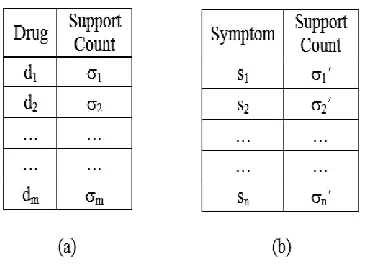
Collecting patient details from an electronic patient dataset. The two types of information need to preprocess the dataset. There are List of all drugs and List of all Symptoms and their support count. The preprocessing is avoided forming unnecessary pairs. This will reduce the computational complexity of the data mining algorithm.
3.2 Pair Generation and Evaluation
The pair will be generated from preprocessed dataset. After getting the list of drugs D, list of symptoms S all possible pairs are formed. The pairs are generated like Drugs Symptoms pair only not interested Drug-Drug pairs and Symptoms Symptoms pairs. Normalizing the dataset is used to reduce the computational complexity. The co mutational complexity is O(m×n) where m and n are the number of drugs and symptoms, respectively.
3.3 Fuzzy RPD Model
After forming the Drug-Symptom m pairs <X, Y>.calculate the Degree of Causality C<X,Y> by matching the cue values defined as the experiences. The experiences are work as cues, goals, actions, expectancies. Here to categorize the degree of causality such as possible, likely, unlikely, no effect by the cue values. Actions defined what the corresponding situation is. Goal is defined what will be achieve the aim of the project.
Expectancies are defined what is the next will occurred. All the cue values are extracted from the sequence by use a
vector V= (c1,c2,…ci,…c m).
4. projected System
4.1 Data Mining Algorithm To Mine The Causal Association
I.Gurumurthy
et al
, International Journal of Computer Science and Mobile Applications,
Vol.2 Issue. 11, November- 2014, pg. 55-61
ISSN: 2321-8363
©2014, IJCSMA All Rights Reserved, www.ijcsma.com 58
Figure 2: (a) Drug Hash Table (b) Symptom Hash Table
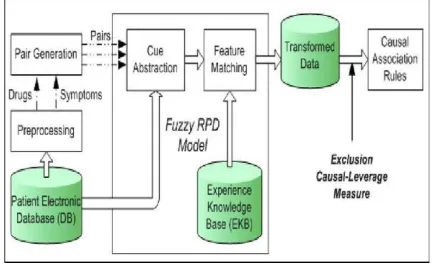
The reverse pairs <s, d> and the support count are evaluated as reverse causal leverage value. The Exclusive casual leverage value is calculated by subtracting the reverse causal leverage values from its normal casual leverage value. The min imu m support count is used to further reduce the number of pairs. The maximum support count pairs are evaluating the causal associations.
4.2 Find Adverse Drug Reaction
The causal associations of drug and symptom pairs will be extracted from possible set of pair values. These pairs are compared to the cue values V in the Experience Information Base (EKB). The similarity values are then normalized. The normalized ion is used to compute the causality C<X, Y> of the current patient condition. If the degree of causality C<X, Y> is greater than 0 it is added to the accumulated votes and the cases is increased by 1. Computing all the pairs of cases and it is ranked in decreasing order based on the cue values. The ranking decreasing ordered pair is according to the exclusive causal leverage values. The higher order value is exists in the causal association.
4.3 Element S warm Optimization
PSO is a computational method that robust optimization technique is based on moving to the best solution. PSO applies the concept of social interaction to solve the problem. Each element is treated as a point in N-dimensional space. PSO is trying to imp rove a candidate solution with regard to a given measure of quality. Each element is moved to the best known local position while collision will occurred and it is moved to the search space. Each element has the different velocity. These element dimensions represent a fuzzy membership function parameter value. This columns represents an input and output variables such as number. Complete rule -base was considered. A rule considered complete when all possible combinations of input membership functions of all the input variables participate in fuzzy rule-base formation. The global best position marked by represents the position yielding the lowest error amongst all the Pgd
During the iteration every element in the swarm is updated using the following two equations Where, Vid(t+1) and Vid (t) are the updated and current elements velocities.
Xid ( t + 1) and Xid (t)the updated and current elements positions.
I.Gurumurthy
et al
, International Journal of Computer Science and Mobile Applications,
Vol.2 Issue. 11, November- 2014, pg. 55-61
ISSN: 2321-8363
©2014, IJCSMA All Rights Reserved, www.ijcsma.com 59
Algorithm of PSO
Initialize population
Do
For k = 1 to Maximum Iteration Number K
For i = 1 to Population Size N
Update the personal best position
Update the global best position
For d = 1 to Dimension D
Update the velocity id v
Update the position id x
Next d
Next i
Next k
Until termination criterion is met. Each fuzzy membership functions has the parameter of mean and standard deviation. It starts with an initial set of parameters. After the parameters had been adjusted using optimization method, this parameter will be used to check the performance of the fu zzy logic. This process is repeated until the goal is achieved.
5. Established a New Measure Foe Discovery Adverse Signal Pairs
To analyze the patient database if the drug -symptom pairs are already occurred or not is based on the patient id (PID). If it is already occurred means it is updated for the hash table and their support count is increased by one. Otherwise it is avoided from the forming unnecessary signal pairs.
5.1 Exclusive causal leverage measure
The degree of casualty is neared by using the exclusive causal leverage measure. The degree of causality is calculated by matching the cue values. The vector V= (c1, c2… ci… cm) to represent the cue values extracted from the sequences. Where i is the cue values, m is the total number of cues. Pair of cue values ci and ci’ is to find the local similarity SL (ci, c i’). The similarity is calculated depend on the cue values
I.Gurumurthy
et al
, International Journal of Computer Science and Mobile Applications,
Vol.2 Issue. 11, November- 2014, pg. 55-61
ISSN: 2321-8363
©2014, IJCSMA All Rights Reserved, www.ijcsma.com 60
The global similarity is matched by the most matching the experiences with the cue values. The particular pair value from electronic patient database is abstracted from the patient cases using fuzzy ru les. Also find the degree of causality at complex position of finding ADR. The temporal association is used to find ADR. Temporal association means the dose taken particular period of time taken and it causes some of the diseases for the patient
Figure 4: Performance comparison of fuzzy and PSO
The figure 4 shows the number of drugs in x-axis and their support count in y-axis. While compare the performance between Fuzzy and PSO the performance of Fuzzy is less than the PSO as well as the accuracy, computation time, memory Fuzzy.
6. Conclusion
Mining the casual association can help us to discover the causality of type of events and avoid its potential adverse effect. Mining these associations is very difficultly when the events occur infrequently. In existing used a exclusive causal leverage measure based on Fuzzy Recognition Primed Decision model (RPD). Our new measure is element swarm Optimization (PSO) is better than the fuzzy RPD model. The problem of Fuzzy RPD model is lacking analytical technique.
References
[1] G Yanqing Ji, Hao Ying, Fellow, IEEE, John Tran, Peter Dews,Ayman Mansour, and R. Michael Massanari
Method for Mining Infrequent Causal Associations and Its Application in Finding Adverse Drug Reaction Signal Pairs”VOL. 25, NO. 4, APRIL 2013.
[2] Y. Ji, H. Ying, M.S. Farber, J. Yen, P. Dews, R.E. Miller, and R.M. Massanari, “A Distributed, Collaborative Intelligent Agent System Approach for Proactive Postmarket ing Drug Safety Surveillance,” IEEE Trans. Information Technology in Bio medicine,vol. 14, no. 3, pp. 826-837, Dec. 2010.
[3] H. Jin, J. Chen, H. He, G. Williams, C. Kelman, and C. O’Keefe,“Mining Unexpected Temporal Associations:
Applications in Detecting Adverse Drug Reactions ,” IEEE Trans. Information Technology in Bio medicine, vol. 12, no. 4, pp. 488-500, Ju ly 2008.
[4] Y. Ji, H. Ying, P. Dews, A. Mansour, J. Tran, R.E. Miller, and R.M.Massanari, “A Potential Causal Association Mining Algorith m for Screening Adverse Drug Reactions in Postmarketing Surveillance,”IEEE Trans. Information Technology in Bio medicine, vol. 15,no. 32, pp. 428 -437, May 2011.
[5] Y. Ji, H. Ying, P. Dews, M.S. Farber, A. Mansour, J. Tran, R.E.M iller, and R.M. Massanari, “A Fuzzy Recognition-Primed Decision Model-Based Causal Association Mining Algorithm for Detecting Adverse Drug Reactions in Postmarketing Surveillance,”Proc. IEEE Int’l Conf. Fu zzy Systems, 2010.
[6] Y. Ji, H. Ying, J. Yen, and R.M. Massanari, “A Fuzzy Logic -Based Co mputational Recognition-Primed
Decision Model,” InformationScience, vol. 77, pp. 4338-4353, 2007.
I.Gurumurthy
et al
, International Journal of Computer Science and Mobile Applications,
Vol.2 Issue. 11, November- 2014, pg. 55-61
ISSN: 2321-8363
©2014, IJCSMA All Rights Reserved, www.ijcsma.com 61
2004.[8] L.T. Kohn, J.M. Corrigan, and M.S. Donaldson, To Error is Human: Building a Safer Health System. Nat’l Academy Press, 2000.
[9] A.K.H. Tung, H. Lu , J. Han, and L. Feng, “Efficient Mining of Intertransaction Association Rules,” IEEE Trans. Information and Data Eng., vol. 15, no. 1, pp. 43-56, Jan./Feb. 2003.
[10] C. Marinica and F. Gu illet, “Information-Based Interactive Postmining of Association Rules Using Ontologies,” IEEE Trans. Information and Data Eng., vol. 22, no. 6, pp. 784-797, June 2010