Riss or Würm?
B y F. E . Z e u n e r , L o n d o nZ u s a m m e n f a s s u n g . Die Klimaschwankungen des jüngeren Pleistozäns w e r den anhand von drei unabhängigen Gruppen von Beobachtungsmaterial besprochen, nämlich von Schwankungen des Meeresspiegels, den Terrassenunterkanten der Themse und den fossilen Böden der Lößzone von Nordfrankreich bis Niederösterreich. Die gleiche Abfolge von Klimaphasen ergibt sich in jedem Falle. Das Letzte Interglazial weist in der Mitte eine leichte Schwankung auf und w a r zeitweilig s o m m e r - w ä r m e r als heute. Die folgende Kaltphase w a r kurz, aber intensiv (Meeresspiegel ca. —100 m ) , und auf sie folgte eine Warmphase mit durchaus gemäßigtem K l i m a (Halling-Stage der Themse), welche oft mit dem Letzten Interglazial verwechselt wird. Auf diese Phase folgt die Vereisungsgruppe Weichsel-Würm. Die vorausgehende Kaltphase wird oft als Jungriß bezeichnet, doch ist W ü r m I vorzuziehen, da das vorausgehende Inter glazial länger w a r als das Interstadial zwischen der fraglichen Phase und d e m jüngeren Würmkomplex.
S o m m a i r e . La succession des phases climatologiques du Pleistocene superieur est discute aux points-de-vue des occillations du niveau de la mer, des niveaux d'abrasion fluviatiles de la Tamise, et des sols fossiles qui se trouvent dans des coupes de loess du nord d e la France, du bassin de Mayence, la Boheme et l'Autriche. Ces temoignages etant d'accord, on obtient une succession generale comme suit: A p r e s l'avant -derniere glaciation, le dernier interglaciare avec une oscillation legerement froide au milieu, mais autrement tempere et m e m e plus chaud que le climat recent pendant l'ete. II suit une glaciation, la phase qu'on a appelee aux Alpes ou W ü r m I ou Jeune-Riss. Apres cette periode froide, une interstadiaire parfaitement tempere qui la separe du complexe würmien proprement dit. On a souvent pris cette phase interstadiaire (Hailing stage de la Tamise) pour le propre dernier interglaciaire. C'est comme ca qu'on est errive ä l'appellation Jeune-Riss au lieu de W ü r m I qui est preferable, l'interglaciaire entre Riss et la phase froide en question ayant ete plus long que l'interstadiaire qui le separe du Würmien plus recent.
In all areas w h e r e c o n d i t i o n s of o b s e r v a t i o n are f a v o u r a b l e , g e o l o g i s t s a g r e e that t h e f o u r m a j o r glaciations r e c o g n i z e d b y P E N C K c a n b e s u b d i v i d e d i n t o p h a s e s . T h i s applies in p a r t i c u l a r to t h e A l p s . C o r r e s p o n d i n g e v i d e n c e h a s c o m e f o r t h i n the p e r i g l a c i a l z o n e w h e r e b o t h r i v e r terraces a n d w e a t h e r i n g h o r i z o n s h a v e r e v e a l e d s e q u e n c e s of climatic fluctuations m o r e c o m p l i c a t e d t h a n the o r i g i n a l s c h e m e of P E N C K . T h i s m u l t i p l i c i t y o f c o l d p h a s e s has i n e v i t a b l y raised t h e p r o b l e m of their correct a s s i g n m e n t to m a j o r glaciations, a n d t h e c o n t r o v e r s y which h a s in the last f e w y e a r s d e v e l o p e d o v e r the a s s i g n m e n t of a certain g l a c i a l phase t o the Riss G l a c i a t i o n o r t h e W ü r m G l a c i a t i o n is m e r e l y an illustration of the dif
ficulties w h i c h are b o u n d to arise. S i n c e t h e f o r e l a n d s of the n o r t h e r n A l p s a r e
the t y p i c a l area f o r t h e s u b d i v i s i o n of the P l e i s t o c e n e glaciations, f o r it w a s h e r e that P E N C K defined t h e t e r m s G ü n z , M i n d e l , Riss a n d W ü r m , the u n c e r t a i n t y as t o w h a t s h o u l d b e c a l l e d Riss and w h a t W ü r m is a s e r i o u s m a t t e r .
T h a t this p r o b l e m is n o t confined to the A l p i n e s e q u e n c e is i n d i c a t e d b y s i m i l a r c o m p l i c a t i o n s t h a t h a v e arisen in o t h e r areas. O n t h e m a r g i n of t h e S c a n d i n a v i a n
ice-sheet, the c h r o n o l o g i c a l p o s i t i o n of the W a r t h e p h a s e has c a u s e d c o n s i d e r a b l e
difficulty. In D e n m a r k t h e c o n n e c t i o n of t h e S k ä r u m h e d e series w i t h b o u l d e r c l a y s is o p e n to discussion. In t h e loess z o n e o f w e s t e r n E u r o p e , a loess o c c u r s w h i c h has o c c a s i o n a l l y b e e n a s s i g n e d to the Y o u n g e r Loesses b y o n e g r o u p o f i n v e s t i g a t o r s a n d to the O l d e r L o e s s e s b y a n o t h e r , f o r instance at A c h e n h e i m i n A l s a c e ( Z E U N E R 1 9 5 2 , p . 1 5 7 , p . 4 0 7 ; 1 9 5 4 ) , In eastern E n g l a n d t h e r e is u n v e r t a i n t y a b o u t t h e L i t t l e Eastern G l a c i a t i o n o f S O L O M O N , a n d in the M e d i t e r r a n e a n b a s i n the r e l a t i o n of c e r t a i n eustatic t e r r a c e s w i t h interstadials o f Last G l a c i a t i o n a g e or w i t h t h e L a s t I n t e r g l a c i a l has b e e n w o r r y i n g s o m e i n v e s t i g a t o r s , as i l l u s t r a t e d
Riss or W ü r m ? 99
by C a t o n THOMPSON'S treatise o n the L e v a l l o i s i a n culture in N o r t h Africa. It w i l l take s o m e time b e f o r e a c o m m o n d e n o m i n a t o r c a n b e applied to these local o r r e g i o n a l chronologies, and b e f o r e an a g r e e m e n t is reached about the n o m e n c l a t u r e to b e used which is satisfactory to all. N e v e r t h e l e s s the A l p i n e p r o b l e m of „Riss o r W ü r m " being paralleled b y c o r r e s p o n d i n g p r o b l e m s e l s e w h e r e , other areas are l i k e l y to contribute information w h i c h m a y b e helpful in the solution of A l p i n e p r o b l e m s . B r o a d l y speaking the q u e s t i o n is one of the length and the d u r a t i o n o f the successive temperate phases separating the glacial phases. M o r e i n f o r m a t i o n about this is available in the periglacial and p l u v i a l zones than in the i m m e d i a t e vicinity o f the A l p i n e m o r a i n e s , and the present p a p e r is intended to v i e w the p r o b l e m in the light of such n o n A l p i n e evidence.
A t the outset it is essential to adopt a n o m e n c l a t u r e f o r the climatic phases of the Pleistocene w h i c h is n o t local. In o t h e r w o r d s , in this article (as in other w o r k s o f the writer) the terms Riss and W ü r m are restricted to the A l p i n e area, Saale and Weichsel b e i n g those a p p l i c a b l e t o the S c a n d i n a v i a n ice-sheet, and so forth, and in the general t e r m i n o l o g y , the t w o c o m p l e x e s of c o l d phases, w i t h the s e p a r a t i o n of which w e are concerned, are called Penultimate G l a c i a t i o n and Last G l a c i a t i o n . T h e e q u a t i o n W ü r m = W e i c h s e l = Last Glaciation is k n o w n to b e c o r r e c t in a broad sense, t h o u g h in detail m a n y controversial p o i n t s remain.
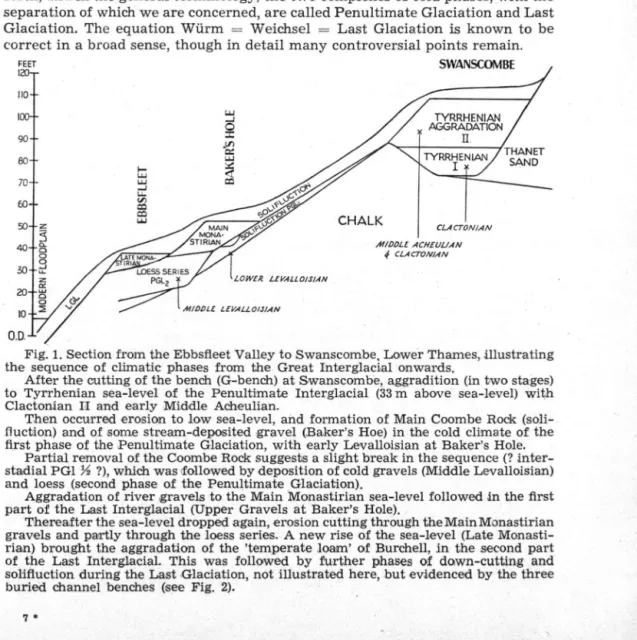
Fig. 1. Section from the Ebbsfleet Valley to Swanscombe, Lower Thames, illustrating the sequence of climatic phases from the Great Interglacial onwards.
After the cutting of the bench (G-bench) at Swanscombe, aggradition (in two stages) to Tyrrhenian sea-level of the Penultimate Interglacial (33 m above sea-level) with Clactonian II and early Middle Acheulian.
Then occurred erosion to l o w sea-level, and formation of Main Coombe Rock (soli fluction) and of some stream-deposited gravel (Baker's Hoe) in the cold climate of the first phase of the Penultimate Glaciation, with early Levalloisian at Baker's Hole.
Partial removal of the Coombe Rock suggests a slight break in the sequence (? inter stadial PG1 lA ?), which was followed by deposition of cold gravels (Middle Levalloisian) and loess (second phase of the Penultimate Glaciation).
Aggradation of river gravels to the Main Monastirian sea-level followed in the first part of the Last Interglacial (Upper Gravels at Baker's Hole).
Thereafter the sea-level dropped again, erosion cutting through the Main Monastirian gravels and partly through the loess series. A n e w rise of the sea-level (Late Monasti rian) brought the aggradation of the 'temperate loam' of Burchell, in the second part of the Last Interglacial. This was followed by further phases of down-cutting and solifluction during the Last Glaciation, not illustrated here, but evidenced by the three buried channel benches (see Fig. 2).
T h e s e q u e n c e of e v e n t s is p e r h a p s m o s t c o n c l u s i v e l y r e p r o d u c e d b y t h e t h a l a s -sostatic portion of t h e R i v e r T h a m e s , w h e r e the s e c t i o n s of S w a n s c o m b e a n d Ebbsfleet h a v e p r o v i d e d a n u n a m b i g u o u s starting point, w h i l s t an i n v e s t i g a t i o n of t h e l o n g i t u d i n a l profile of t h e terraces carried out b y t h e w r i t e r in c o n j u n c t i o n w i t h M r . D a y K I M B A L L h a s r e v e a l e d a n u m b e r of r h y t h m s of bench c u t t i n g a n d e s t u a r i n e a g g r a d a t i o n w h i c h can o n l y c o r r e s p o n d to fluctuations of t h e s e a - l e v e l . Briefly, t h e s e sections (fig. 1; discussed in Z E U N E R 1 9 5 2 , p. 1 9 3 , and 1 9 4 5 , p. 1 2 7 ) s h o w t h a t f o l l o w i n g t h e G r e a t I n t e r g l a c i a l t w o cold p h a s e s occurred, t h e s e c o n d of w h i c h w i t n e s s e d t h e d e p o s i t i o n of t h e m a j o r part of t h e loess in K e n t . F o l l o w i n g these cold phases c o u p l e d w i t h a l o w s e a - l e v e l , the s e a - l e v e l rose to a b o u t 1 8 m., t h e T h a m e s a d j u s t i n g itself to it b y t h e f o r m a t i o n of t h e T a p l o w T e r r a c e . A s e c o n d h i g h s e a - l e v e l is i n d i c a t e d b y t h e U p p e r F l o o d P l a i n T e r r a c e at a b o u t 7 . 5 m. T h a t t h e s e t w o c o r r e s p o n d to t h e M a i n a n d L a t e M o n a s t i r i a n s h o r e - l i n e s r e c o g n i z e d o n t h e coasts of the A t l a n t i c a n d M e d i t e r r a n e a n w i l l b e difficult to r e f u t e .
160
HENLEY WINDSOR KINGSTON CITY
OF LONDON DART-FORD 140 120 100 8 0 60 40 20 — —., vooe/o/o/n" -— 0 -20 -40 0 -20 -40 - 6 0 1 1 I 1 M I L E S
London Cloy /Chalk
0 10 20 30 40 50 6 0 70 80
Fig. 2 . The erosional benches of the Thames between Henley and Dartford. Each of these benches indicates a phase of l o w sea-level, i. e. a phase of climate colder than the present.
G: Swanscombe bench of Antepenultimate Glaciation 2 on which the Hornchurch boulder clay lies (probably equivalent of Elster Glaciation of Germany).
N: Taplow bench of Penultimate Glaciation 2 (probably Saale Glaciation of Germany).
This is followed by 5 benches of which the lowest 3 are the buried channel benches P, Q and R as indicated in Table 1, which correspond to the three phases of the Last Glaciation.
N o w , t h e l o w e r of t h e s e a g g r a d a t i o n s rests on a rock bench w h i c h has b e e n identified o v e r s o m e d i s t a n c e a l o n g t h e course of t h e r i v e r (fig. 2 ) . It is f o l l o w e d by t h r e e m o r e rock b e n c h e s all c o n t i n u i n g to a l o w s e a - l e v e l , the last b e i n g f o l l o w e d b y the rise of t h e s e a - l e v e l u p to its p r e s e n t - d a y h e i g h t . T h e s e a r e the w e l l k n o w n „ b u r i e d channel benches". T h a t there are t h r e e , confirms t h e o b s e r v a t i o n m a d e e l s e w h e r e that t h e L a s t G l a c i a t i o n h a d three c o l d phases. B u t t h e terraces of the T h a m e s p r o v i d e a d d i t i o n a l i n f o r m a t i o n of g r e a t interest. T h e a g g r a d a t i o n w h i c h rests on the first of t h e t h r e e b u r i e d channel b e n c h e s constitutes t h e L o w e r F l o o d P l a i n T e r r a c e w h i c h a l w a y s r e m a i n s a f e w f e e t a b o v e the m o d e r n flood piain. T h i s stage, t h e H a i l i n g S t a g e of K I N G & O A K L E Y ( 1 9 3 6 ) , o c c a s i o n a l l y a l s o
Riss or W ü r m ? 1 0 1
called the E y o t Phase, indicates a sea-level at a h e i g h t of something like 3 m a b o v e the present, t h o u g h because of the inevitable e r r o r of measurement and the tidal a m p l i t u d e an e x a c t figure cannot at present b e g i v e n . The fact that the sea-level rose as high as this suggests that the climate o f this phase was temperate.
T h e Hailing stage w a s f o l l o w e d b y t w o c o l d phases separated b y a less c o l d i n t e r v a l (Ponders E n d aggradation) during w h i c h the sea-level n e v e r rose to t h e
p r e s e n t h e i g h t ( Z E U N E R 1945, p. 130).
This e v i d e n c e f r o m the L o w e r Thames suggests that f o l l o w i n g the t w o M o n a stirian sea-levels, three cold phases occurred. T h e first and s e c o n d o f these w e r e separated b y a m i l d phase as temperate as the p r e s e n t day climate, in other w o r d s , cf a fully interglacial character. T h e oscillation b e t w e e n the s e c o n d and third, h o w e v e r , n e v e r l e d t o a deglaciation c o m p a r a b l e w i t h that of t h e Postglacial. It is unlikely, therefore, that during this s e c o n d m i l d phase the c l i m a t e assumed a t e m p e r a t e character.
A s a fossil shore-line, the Hailing stage has b e e n found in a l a r g e n u m b e r of places o n the south coast of w e s t e r n England. Its transgression p l a t f o r m o c c u r s at L a n n a c o m b e (South D e v o n ) f o r instance, w h e r e it is c o v e r e d w i t h thick s o l i fluction deposits p r o v i n g that this level cannot b e o f Postglacial age. It also o c c u r s in J e r s e y (Channel Islands), at Gibraltar, A r a b ' s G u l f (west of A l e x a n d r i a ) , the A t l a n t i c coast of M o r o c c o and e l s e w h e r e ( Z E U N E R 1953).
T h e climatic s e q u e n c e supplied b y this e v i d e n c e , therefore is as f o l l o w s : — 1) T w o phases o f the Penultimate Glaciation.
2) T h e Last Interglacial, w i t h t w o w a r m phases represented b y sea-levels at 18 a n d 7.5 m a b o v e the present and separated b y a slight oscillation.
T h e w a r m character of these t w o phases is e v i d e n c e d b y their Strovibus fauna in the M e d i t e r r a n e a n which corresponds t o t h e E e m fauna of the N o r t h Sea.
3) A c o l d phase w i t h l o w sea-level.
4) T h e Hailing phase with sea-level rising t o a b o u t 3 m a b o v e the present, of a temperate character.
5) T w o cold phases separated b y an o s c i l l a t i o n during w h i c h the sea-level remained b e l o w present height and the c l i m a t e o f which never b e c a m e t y p i c a l l y temperate.
6) T h e Postglacial.
T u r i n g n o w to the loess belt, it is remarkable that the same s e q u e n c e of c l i m a t i ; phases is e x h i b i t e d b y the Y o u n g e r Loesses, t h o u g h not e v e r y w h e r e . Three Y o u n ger Loesses h a v e b e e n established in the M a i n z basin, in Alsace, in C z e c h o s l o v a k i a and in L o w e r Austria. T o find them, therefore, it appears that o n e has to g o t o areas w h e r e the s u m m e r is c o m p a r a t i v e l y w a r m e r and w h e r e the climate h a s continental tendencies. Farther west, especially in France, the T h i r d Y o u n g e r Loess appears t o b e absent, which is not surprising, since during that last p h a s e of the Last Glaciation, which w a s the w e a k e s t of the three, the influence of t h e o c e a n m a d e itself most strongly felt. The d i v i s i o n b e t w e e n the S e c o n d and T h i r d phases o f the Last Glaciation, h o w e v e r , is e v i d e n c e d b y soils o c c u r i n g b e t w e e n solifluction levels in several French sites, as it is, incidentally, at the Petersfels in s o u t h e r n G e r m a n y .
T h e e v i d e n c e f r o m the M a i n z Basin has b e e n studied b y S C H Ö N H A L S (1950, 1951a, b ) f r o m the pedological point of v i e w . W h i l s t the Last Interglacial soil is usually a chernozem, the soil b e t w e e n the First a n d Second Y o u n g e r Loesses is a b r o w n e a r t h . S i m i l a r l y the soil b e t w e e n the S e c o n d and Third Y o u n g e r Loesses has b r o w n e a r t h characteristics, b u t it is t h i n n e r a n d less deeply w e a t h e r e d .
A t the prehistoric site of A c h e n h e i m situated o n the French side of the southern Rhine Rift, the p r e s e n c e of the three Y o u n g e r L o e s s e s has been suggested on t h e
N O M E N C L A T U R E S E A - L E V E L S T H A M E S North F R A N C E M A I N Z B A S I N A U S T R I A A L P S I N D U S T R I E S POSTG-LACIAL F L A N D R I A N T I L B U R Y S T A G E FORMATIO N D E SO L B R A U N E R D E W E A T H E R I N G W E A T H E R I N G M E S O L I T H I C L A S T G L A C I A T I O N 3 C. — 30 M . T H I R D B U R I E D C H A N N E L (R) FORMATIO N D E SO L J Ü N G E R E R L O S S III Y O U N G E R L O E S S III WÜR M M A G D A L E N I A N L. G L . 2/3 C — 10 M . P O N D E R S E N D A G G R A D A T I O N FORMATIO N D E SO L B R A U N E R D E P A U D O R F P H A S E WÜR M M A G D A L E N I A N L A S T G L A C I A T I O N 2 C — 70 M . SECOND ( P O N D E R S E N D ) B U R I E D C H A N N E L (Q) L O E S S R E C E N T II J Ü N G E R E R L Ö S S II Y O U N G E R L O E S S II WÜR M A U R I G N A C I A N G R A V E T T I A N L. G L . 1/2 EPI-M O N A S T I R I A N + 3 M . HALUNG STAGE, LOWER FL00DPLAIN TERRACE SOL B R A U N E R D E G Ö T T W E I G E R P H A S E T E M P E R A T E P H A S E M0USTERIAN BEING REPLACED BY UPPER PALAEOLITHIC L A S T G L A C I A T I O N 1 C. — 100 M . FIRST (HEDGE L A N E ) B U R I E D C H A N N E L (P) LOESS R E C E N T I J Ü N G E R E R L Ö S S I Y O U N G E R L O E S S I "JUNGRISS" MOU S T E R I A N LAS T INTERGLACIA L T E M P E R A T E L A T E M O N A S T I R I A N + 7-5 M . U P P E R F L O O D P L A I N T E R R A C E ARGIL E ROUG E SCHWARZERD E DEE P WEATHERIN G LAS T INTERGLACIA L LEVALLOISIA N TAYACIA N MICOQUIA N & UP . ACHEUL . LAS T INTERGLACIA L COOL L O W E R B E N C H O ARGIL E ROUG E SCHWARZERD E DEE P WEATHERIN G LAS T INTERGLACIA L LEVALLOISIA N TAYACIA N MICOQUIA N & UP . ACHEUL . LAS T INTERGLACIA L T E M P E R A T E M A I N M O N A S T I R I A N + 18 M . T A P L O W T E R R A C E A G G R A D A T I O N ARGIL E ROUG E SCHWARZERD E DEE P WEATHERIN G LAS T INTERGLACIA L LEVALLOISIA N TAYACIA N MICOQUIA N & UP . ACHEUL . P E N U L T I M A T E G L A C I A T I O N C. — 200 M . T A P L O W B E N C H (N) L O E S S A N C I E N
(PART) Ä L T E R E R L Ö S S OLDER L O E S S RISS L E V A L L O I S I A N
Riss or W ü r m ? 103
e v i d e n c e o f mechanical analysis b y D E F E R R I E R E a n d confirmed b y the w r i t e r . A g a i n the u p p e r intermediate soil is w e a k e r than the l o w e r .
In B o h e m i a and M o r a v i a a n u m b e r o f sections with three Y o u n g e r Loesses have b e e n d e s c r i b e d b y L A I S ( 1 9 5 1 ) and S C H Ö N H A L S ( 1 9 5 1 ) . O n e of these is S e d l e c , n e a r Prague, another D o l n i Vestonice in M o r a v i a . The w o r k o f L A I S (his m a n u s cript w a s c o m p l e t e d in 1 9 4 4 ) inspired B R A N D T N E R ( 1 9 5 0 ) t o search for similar e v i d e n c e i n L o w e r Austria, w h e r e the s o i l b e t w e e n Y o u n g e r Loesses I and II is called the G ö t t w e i g e r l o a m o r H o l l a b r u n n e r h u m u s zone, whilst that b e t w e e n Y o u n g e r Loesses II and I I I is k n o w n as t h e P a u d o r f horizon. These names w e r e c o i n e d b y B A Y E R and G Ö T Z I N G E R some t w e n t y years ago, w h i c h shows that the e v i d e n c e w a s there and o n l y waiting to b e c o r r e c t l y interpreted. L A I S , S C H Ö N H A I . S and B R A N D T N E R agree in r e g a r d i n g the t e m p e r a t e period b e t w e e n Y o u n g e r Loesses I and II as l o n g e r than that b e t w e e n Y o u n g e r Loesses II and III. Pollen-analytical e v i d e n c e has defined the difference b e t w e e n the t w o interstadials still further ( B R A N D T N E R 1 9 4 9 , 1 9 5 0 , p . 1 0 4 ) . The First Interstadial has s o far y i e l d e d pine, spruce, birch, w i l l o w , alder, hazel, elm, o a k a n d lime. This is an association representing a fully d e v e l o p e d temperate forest. In samples f r o m the P a u d o r f horizon, h o w e v e r , the m o r e o r less c o l d - r e s i s t i n g species dominate, whilst the climatically m o r e sensitive l i k e hazel, e l m and oak appear m o r e sporadically and the most w a r m t h requiring species, lime, is absent altogether. M o r e o v e r , density of the forest i n the G ö t t w e i g e r Interstadial w a s greater (herbaceous a n d grass pollen about 1 0 0 % ) than in the Paudorf Interstadial (non-tree p o l l e n nearly 3 0 0 % ) . This e v i d e n c e from t h e Mainz Basin a n d Rhine Rift, Czechoslavakia a n d L o w e r Austria proves that t h e three c o l d phases which f o l l o w e d the Last Inter glacial w e r e separated b y t w o interstadials, the first of which w a s fully temperate, whilst the s e c o n d did not attain such c o n d i t i o n , e x c e p t p o s s i b l y for a brief p e r i o d not n o r m a l l y recorded in g e o l o g i c a l e v i d e n c e . T h e r e is plenty o f other p e d o l o g i c a l e v i d e n c e w h i c h supports this conclusion, e s p e c i a l l y regarding the cool character
of t h e S e c o n d I n t e r s t a d i a l ( Z E U N E R 1 9 5 3 ) .
M o r e o v e r , w h e r e e x p o s e d , the soil o f t h e temperate phase preceding t h e f o r mation of t h e Three Y o u n g e r Loesses is thicker than any o f t h e soils that f o l l o w and tends t o b e climatically s o m e w h a t w a r m e r than that b e t w e e n Y o u n g e r Loesses I and II. In n o r t h e r n France, this L a s t Interglacial soil is w e l l k n o w n as a r g i l e r o u g e , because of its slightly r e d d i s h colour indicating temperatures s o m e w h a t h i g h e r than t h e present. Soils o f this type are n o w f o r m e d i n the
b r o w n e a r t h z o n e south o f t h e Loire, b u t n o t in north F r a n c e w h e r e a r g i l e r o u g e is c o m m o n in the basins of the S o m m e and Seine. In southern England, similar c o n d i t i o n s appear t o h a v e p r e v a i l e d as suggested b y the Last Interglacial soil o f Ebbsfleet, Kent ( Z E U N E R 1945, p . 1 2 8 ) . I n the Mainz Basin, the a r g i l e
r o u g e is r e p l a c e d b y a w e l l d e v e l o p e d c h e r n o z e m ( S C H Ö N H A L S 1 9 5 1 ) w h i c h is
consistent w i t h the continental character o f this area. This e v i d e n c e suggests that the „ w a r m " character of the Last I n t e r g l a c i a l was in the m a i n due to elevated s u m m e r temperatures as distinct from a h i g h e r annual mean.
N o w , it m u s t b e a d m i t t e d that t h e a g r e e m e n t of t h e climatic succession d e d u c e d independently f r o m the sea-level fluctuations on t h e o n e hand and f r o m weathering horizons o n t h e other, is s o c l o s e that it cannot b e ascribed to m e r e coincidence. F o l l o w i n g t h e Penultimate G l a c i a t i o n , both s e q u e n c e s p r o v i d e f o r
a Last Interglacial w i t h temperatures s o m e w h a t h i g h e r than present, a cold phase,
a p e r i o d o f fully t e m p e r a t e climate, another c o l d phase,
a p e r i o d w i t h climate o n l y m o d e r a t e l y temperate, a third c o l d phase,
f o l l o w e d b y the Late G l a c i a l and Postglacial.
F r o m the p o i n t of v i e w o f n o m e n c l a t u r e , the longest a n d warmest p e r i o d should b e r e g a r d e d as the Last Interglacial. T h e three c o l d phases that f o l l o w w o u l d then represent the three phases of the Last Glaciation which h a v e b e e n recognised b y m a n y w o r k e r s in the A l p i n e a n d periglacial areas.
A v e r y r e m a r k a b l e feature, h o w e v e r , is n o w emerging. T h e interstadial b e t ween the first and second phases of the Last Glaciation w a s fully temperate. T h o u g h shorter than the Last Interglacial, it w a s quite as temperate as the P o s t glacial. If, therefore, deposits b e l o n g i n g to the First Interstadial of the L a s t Glaciation are f o u n d unassociated with f o r m a t i o n s of the Last Interglacial, such deposits w i l l automatically b e interpreted as Last Interglacial b y most authors. Evidently the distinction b e t w e e n f o r m a t i o n s of the Last Interglacial and the First Interstadial is a difficult matter unless e x c e p t i o n a l l y c o m p l e t e sections a r e available. T o m a k e matters e v e n m o r e difficult, deposits of the First Interstadial of the L a s t Glaciation are l i k e l y to b e p r e s e r v e d frequently, since t h e y a r e y o u n g e r than those of the Last Interglacial. In m a n y districts, therefore, it m u s t be considered as a serious possibility that e v i d e n c e for the First Interstadial has been misinterpreted as Last Interglacial.
The facts briefly discussed in this paper t h r o w fresh light on the question o f what s h o u l d b e regarded as Riss and as W ü r m respectively in the A l p i n e area o f glaciation. In r e c e n t years s o m e investigators h a v e c o m m e n c e d to use the t e r m „Jungriss" f o r a glacial phase w h i c h they f o u n d to b e c o m p a r a t i v e l y well s e p a r a ted f r o m the later c o m p l e x of W ü r m m o r a i n e s . It n o w appears likely that this is the phase Last Glaciation I o f the general n o m e n c l a t u r e , its clear s e p a r a t i o n
being due to the temperate interstadial L G I 1 / 2 . Since, h o w e v e r , the mild p e r i o d
p r e c e d i n g the c o l d phase in question is k n o w n to have b e e n l o n g e r and w a r m e r than L G I 1 / 2 , it is inadvisable to transfer the term Last Interglacial to L G I 1 / 2 .
A great deal of confusion w o u l d thus b e caused. Whilst, to the best of m y k n o w ledge, n o b o d y has y e t suggested this in s o m a n y w o r d s , it is unfortunately i m p l i e d in the use o f the term J u n g r i s s . G e o l o g i s t s not acquainted with the p r o b l e m w o u l d i n e v i t a b l y take J u n g r i s s to m e a n that this phase w a s in time m o r e closely linked w i t h the Riss Glaciation and that it was f o l l o w e d b y the m a i n Last Interglacial. W h a t has h a p p e n e d is, of c o u r s e , m e r e l y that a glacial phase, the equivalent o f which in the periglacial z o n e has often b e e n called W ü r m I, has n o w p r o v e d to b e w e l l separated f r o m the A l p i n e W ü r m complex, t h o u g h even so it is closer to the W ü r m than to the Riss c o m p l e x . T h e r e appears to b e little enthusiasm a m o n g A l p i n e geologists f o r continuing to call this p h a s e W ü r m I, a term preferable to J u n g r i s s . T h e best w a y out m a y w e l l p r o v e to b e the i n t r o d u c t i o n of a c o m p l e t e l y n e w n a m e . The attached table is i n t e n d e d to s u m m a r i z e the e v i d e n c e as it stands, in the h o p e that it m a y p r o v e useful as a basis f o r discussion of the n o m e n c l a t o r i a l p r o b l e m . A s to the facts, I h a v e t h e impression that a large m e a s u r e of a g r e e m e n t already exists among the i n vestigators c o n c e r n e d , t h o u g h local details r e m a i n to be w o r k e d out.
R e f e r e n c e s
BRANDTNER, F . , 1 9 4 9 . Die bisherigen Ergebnisse der stratigraphisch-pollenanalytischen Untersuchung eines jungeiszeitlichen Moores von interstadialem Charakter aus der Umgebung von Melk a. Donau, N . - ö . - Archaeol. Austriaca, W i e n , 2, pp. 5 - 3 2 . - - 1 9 5 0 . Ü b e r die relative Chronologie des jüngeren Pleistozäns Niederösterreichs. - Archaeol. Austriaca, Wien, 2, pp. 1 0 1 - 1 1 3 . .
Riss or W ü r m ? 105
CATON-THOMPSON, G., 1946. T h e Levalloisian Industries of Egypt. - Proc prehist Soc. (n. s.) 12, pp. 57-120.
KING, W . B. R. & OAKLEY, K. P., 1936. The Pleistocene Succession in the Lower Part of the Thames Valley. - Proc. prehist. Soc. (n. s.) 2, pp. 52-76.
LAIS, R., 1951. Uber den jüngeren Löß in Niederösterreich, Mähren und Böhmen. - Ber. naturf. Gesells. Freiburg i. Br. 41 (2), pp. 119-178.
PENCK, A. & BRÜCKNER, E., 1909. Die Alpen i m Eiszeitalter. 1189pp., 31pls., 12 maps. -Leipzig.
SCHÖNHALS, E., 1950. Über einige wichtige Lößprofile und begrabene Böden im Rheingau. -Notizbl. hess. L . - A m t Bodenforsch. Wiesbaden 6 (1), pp. 244-59. - - 1951 (a). Über fossile Böden im nichtvereisten Gebiet. - Eiszeitalter und Gegenwart, Öhringen, 1, pp. 109-30. - - 1951 (b). Fossile gleiartige Böden des Pleistozäns im Usinger Becken und am Rand des Vogelsbergs. - Notizbl. hess. L . - A m t . Bodenforsch. Wiesbaden 6 (2), pp. 160-83.
SOLOMON, J . D., 1932. The Glacial Succession on the North Norfolk Coast. - Proc. Geol. Assoc. London 43, pp. 241-71, pi. 13.
ZEUNER, F. E., 1945. The Pleistocene Period. Its Climate, Chronology and Faunal Suc cessions. - 322pp. London (Ray Society) (See pp. 127, 130). - - 1952. Dating the Past. - 3rd edit, 495pp., 24pls., London. (See pp. 158, 193). - - 1953 (a). Notes on the Stratigraphy of the Magdalenian. - Rep. Univ. London Inst. Archaeol. 9, pp. 10-28. - - 1953 (b). The three Monastirian shore- lines. - Proc. 4th I N Q U A Congr. Rome 1953 (in the press). - - 1954. Loess balls from the Lower Mousterian of Achenheim (Alsace). - J. R. anthrop. Inst. London 83 (in the press).
Manuskr. eingeg. 1. 2. 1954. Anschrift des Verf.: Prof. Dr. F. E. Zeuner, Univ. of London, Institute of Archaeology, Inner Circle, Regent's Park, London N W 1.