34th Council on Forest Engineering, June 12-15, 2011, Quebec City (Quebec) 1
A MATHEMATICAL FORMULATION FOR THE LOCATION
OF LOGGING CAMPS
Sanjay Dominik Jena a, Jean-François Cordeau b, Bernard Gendron c
a Université de Montréal Email:[email protected]) b HEC Montréal) Email: [email protected]) c Université de Montréal)
Centre interuniversitaire de recherche sur les réseaux d'entreprise, la logistique et le transport Département d'informatique et de recherche opérationnelle
Université de Montréal
ABSTRACT
Logging activities within the forestry sector commonly take several seasons for each region. Throughout each season, the workers directly involved within the logging activities are hosted at an accommodation close to the current logging location. However, the next cities or villages are usually far away. A common solution to this problem is the construction of logging camps that contain the complete infrastructure to host the workers. Such logging camps are typically close to the logging regions, resulting in reasonable transportation times and costs. The bigger a camp, the lower the daily hosting costs per person. Hence, a small number of big camps results in lower accommodation costs than a large number of small camps. However, the fewer camps are available, the higher the transportation costs tend to be, because their geographic distribution is less flexible.
The problem studied in this paper consists in finding the optimal number, location and size of logging camps. Due to the complexity of the problem, a manual planning approach is not applicable. This work investigates the relevance and advantages of constructing additional camps for the accommodation of workers, expanding the capacities of existing camps and relocating entire camps from one region to another. A mathematical model, representing the cost structure on a very detailed level is presented. Results are given for a realistic five year harvest planning provided by FPInnovations and based on data from a Canadian logging company.
CONTEXT AND MOTIVATION
Log harvest planning in the forestry sector changed throughout the last decades. Both silviculture and harvesting became more sophisticated and include very complex and important decisions in order to get the most from the available regions and harvest cycles. Based on a complex variety of such considerations, a long-term planning is designed to determine the volume and regions for wood logging. Such decisions are commonly divided into smaller time periods.
34th Council on Forest Engineering, June 12-15, 2011, Quebec City (Quebec) 2 Logging activities and road construction within a single logging region typically take several months. Workers that are directly involved in such activities need appropriate accommodation. However, due to the vast extension of the country, logging regions in Canada are widely distributed and often located far from the next city or village. Accommodating the workers in the closest village or city is therefore rarely an attractive option, as the commuting time and transportation costs are too high. Furthermore, an additional salary is commonly paid when the transportation times exceed a certain threshold.
A common solution to this problem is the construction of logging camps in which the workers are accommodated. These logging camps are typically located close to the logging regions so that the transportation costs for the workers are reasonable. Workers are usually transported by pick-ups, using a given road network. The transportation costs are composed of the transportation and working time of the workers as well as the vehicle costs, i.e. renting and gas costs. Allocating each working crew to a camp, the accommodation costs are given by a cost per day per worker. In order to host all workers, the construction of new accommodations may be necessary. The bigger a camp, the smaller the daily cost per person. Hence, a small number of big camps results in smaller accommodation costs than a large number of small camps. However, the fewer camps are available, the higher the transportation costs tend to be, because their location is less flexible. The construction of a new camp may pay off in the long-term as the traveling costs to the logging regions may be much lower.
This work investigates the possibility of constructing additional camps for the accommodation of workers, considering the harvest planning for the next five years. The problem consists in finding the number of camps that have to be constructed, their size in terms of capacities and their location such that the total costs given by the accommodation and transportation costs are minimal. The interesting question is whether such an investment of camp constructions pays off, considering the operational planning of the next five years. It is assumed that all information about workers, logging regions and distances are given at the beginning of the planning and not subject to uncertainty. The problem was inspired by the needs of a Canadian logging company and will now be explained in detail.
PROBLEM DESCRIPTION
Based on an existing overall planning, the logging company provides a harvest plan for the next five years. Each year is divided into two seasons: winter and summer, each with a certain number of available working days. The winter season begins mid-November and ends mid-March, whereas the summer season typically begins mid-June and ends mid-November. Depending on the geographical location, some regions will be logged more in winter whereas other regions will be logged more in the summer season. Each region is defined by its estimated log volume (measured in m3) that is subject to harvesting (it may be part of the strategic decision that not the entire region will be harvested) within each season and the length of the road (measured in km) that has to be constructed in that region in order to transport the log.
34th Council on Forest Engineering, June 12-15, 2011, Quebec City (Quebec) 3
Working Crews, Demands and Hosting Capacities
There are two types of working crews: logging and road construction. Crews of the same type contain the same number of members. The members of a crew always stay together during work and are hosted at the same accommodation. For each logging region and season, a logging and road construction demand is given. Based on given productivity rates for the working crews one can compute the average number of crews necessary to cover the demand at each region for each season.
Example: A crew type works 100 days within a given season and cuts 120 m3 per day, i.e. 12,000 m3 within the season. A certain region holds a total demand of 30,000 m3 within the season. Throughout 50 days, three logging crews will be working (i.e. 3 x 50 x 120m3 = 18,000m3). The other 50 days, two cutting crews will be working (i.e. 2 x 50 x 120m3 = 12,000m3). This results in an average allocation of 30,000/12,000 = 2.5 logging crews within that season.
We can assume that the crews of each working type are flexible in respect to the days they work within each season. That is, if a crew works only a few days within a season, one may assume that it does not matter at which days the crew works within the season. In our case, it does not matter in which of the 100 days we use three crews and in which we use only two crews. In practice, a working crew may work a number of days in one region and then in another region in the same season. In order to determine the minimum capacity necessary to host all working crews allocated to a certain accommodation, consider the following example:
We decide to host the workers from two regions at the same camp. One region has an average demand of 1.4 logging crews and 0.7 road construction crew. The other region has an average demand of 1.2 logging crews and 0.5 road construction crews. So we have a total demand of 1.4 + 1.2 = 2.6 logging crews and 0.7 + 0.5 = 1.2 road construction crews. Hence, for 60% of the time during the season there will be ⌈2.6⌉ = 3 logging crews and 40% of the time there will be ⌊ 2.6⌋ = 2 logging crews. In the same way, 20% of the season there will be ⌈1.2⌉ = 2 road construction crews and the other 80% of the season there will be only ⌊1.2⌋ = 1 road construction crew. Assuming that a logging crew has six workers and a road construction crew has three workers, we will need an accommodation for ⌈2.6⌉ x 6 + ⌈1.2⌉ x 3 = 18 + 6 = 24 workers. To determine the minimum capacity of an accommodation, we can hence sum up all the average numbers of crews allocated to this accommodation and round up the sum to the next highest integer (for each crew type). Figure 1 illustrates such a scenario for two regions, each with an average demand of 1.5 crews. Transportation costs for commuting from the accommodations to the logging regions are given for each crew type for each pair of regions.
34th Council on Forest Engineering, June 12-15, 2011, Quebec City (Quebec) 4
Figure 1: Example of logging demands hosted at the same accommodation
Camps and Trailers
Certain accommodations for the workers already exist. These accommodations may be either hosting options within villages or cities (apartments, hotels, etc.) in reasonable distance to the logging regions, or camps that are usually located within the forest close to the logging regions. Accommodations vary in their capacity and their hosting costs. Camps include a number of trailers. A trailer contains the entire infrastructure to host a certain number of workers. In practice, trailers of different capacities are available. However, we may assume that the trailer with a capacity for twelve persons is the most common. Hence, we assume that all trailers have the same capacity. In addition to the trailers that host workers, a camp contains a number of additional trailers that provide complementary, but necessary infrastructure, such as a kitchen. The number of additional trailers directly depends on the number of hosting trailers, i.e., the total hosting capacity of the camp. In the following, we will measure the capacity of a camp by the number of hosting trailers. Hence, the construction costs for a number of hosting trailers already include the costs for the necessary number of additional trailers.
Trailers can be either open or closed. Only open trailers are available for use. Trailers that are not in use have to be closed, involving closing costs. Once a trailer is closed, it cannot be used in subsequent seasons until it is reopened, involving reopening costs. Such closing of an open trailer or reopening of a closed trailer can only be performed once a year before the summer season. Reopening and closing costs commonly involve economies of scale in the number of hosting trailers involved. This is not only due to the involved additional trailers, but also because they share common resources. The use of hosting trailers in order to accommodate workers involves two types of daily costs: fixed costs for each open trailer (including the cost for the trailer itself, its equipment, the cook, etc.) and variable costs (food, etc.) for each worker. The fixed costs are paid for each open trailer (in $) per day. Costs for closed trailers are so small that they do not have to be considered. Variable costs are paid for each worker hosted at the camp. If a trailer is open, its fixed costs have to be paid throughout the entire season, independent of its use. All costs may follow the principle of economies of scale, i.e. the bigger the quantity, the lower the price-per-worker/trailer. New camps can only be constructed at certain places from a given set of potential locations. It is very common that several logging regions are served by workers from the same accommodation. In the same way, one logging region may be served by workers from different accommodations.
Capacity Expansion and Camp Relocation
At certain points during the planning it may be interesting to increase the capacity of existing camps. Such capacity expansion is performed by adding new trailers. It is assumed that the cost of adding k trailers is the same as the construction of a new camp with k trailers. In contrast,
34th Council on Forest Engineering, June 12-15, 2011, Quebec City (Quebec) 5 permanently closing a part of a camp or even the entire camp is not considered. Hence, it is not possible to partially close (permanently) a camp and relocate the other part. Camps can only be relocated as a whole.
Logging regions are not equally logged in each year. That is, a camp may be close to logging regions with demands in certain years, but far away from logging regions that will be harvested afterwards. Instead of constructing a new camp, which involves high costs, camps can be relocated from one location to another. Relocations of camps can only be performed once a year: right after the winter season. The costs for relocating a camp from one location to another depend on the distance and the size of the camp (i.e. the number of trailers it includes). As the costs caused by the actual distance of the relocation are very low, one may not consider them within the model. All trailers have to be closed before relocating a camp. After the relocation, all trailers that are supposed to be in use have to be reopened again. In theory, camps from two distinct locations can also be joined to further reduce the costs per unit. Trailers from the same camp could also be relocated to distinct locations. In practice, none of these features are observed. Hence, we assume that camps can only be relocated as a whole and that we cannot join two different camps at the same location.
Objective
Given that all logging and road construction demands must be covered, we need to ensure that sufficient accommodations are available to host the workers. We want to minimize the total cost which is composed of two parts:
All costs involved in providing the necessary accommodations: Camp construction, maintenance for open trailers, closing and reopening of trailers, hosting costs for workers and camp relocation. The transportation costs between the accommodations and the logging regions. This includes the costs for using the vehicles and an additional salary for long transportation times.
A solution to the problem consists of the following information, given for each of the seasons within each of the years of the planning horizon:
Where to construct a new camp of which size.
For each accommodation: how many logging and road construction workers are hosted and at which region they work.
For each camp: the number of trailers that will be closed and reopened. For each relocation: the origin, destination and size of the relocated camp.
Throughout this work, we will refer this problem to the Camp Size and Location Problem
34th Council on Forest Engineering, June 12-15, 2011, Quebec City (Quebec) 6
MATHEMATICAL FORMULATION
Related Literature
The given problem belongs to the family of Facility Location Problems. It can be formulated as an extension of the Capacitated Facility Location Problem (CFLP). The CFLP aims at finding the optimal locations to construct an unknown number of facilities with capacity constraints. All customer demands have to be covered and the total costs, usually composed by costs for facility construction, production and transportation, are minimized. Within the last decades, many variations of the CFLP have been addressed in literature, containing different features such as multi-periods, multi-commodities, multiple capacity levels, multi-stages, capacity reduction, expansion and relocation. Many of such features can be found within the proposed CSLP.
Instead of reviewing all of these works, we list those that had the most influence on our model and note that the CSLP contains two features which, to the best of our knowledge, have not been addressed in the Facility Location literature:
Temporary deactivation of facility parts. Related features that have been considered in the
literature include capacity reduction, capacity relocation or complete facility shutdown. Partial and temporary deactivation (which is commonly less expensive than a complete shutdown) has not yet been considered.
Capacity constraints with round-up to the next highest integer. The sum of all average numbers
of working crews allocated to the same accommodation must be rounded up to the next highest integer (separately for each crew type) to determine the necessary capacity of the accommodation. Crew types can be seen as different commodities.
Closely related works include those of Shulman (1991), Peeters and Antunes (2001), Melo et al. (2005) and Troncoso and Garrido (2005).
Mathematical Model
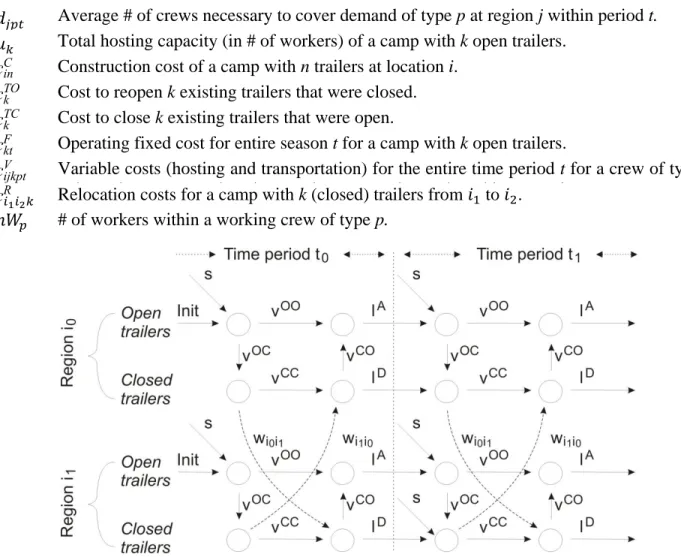
The mathematical model is an extension of the CFLP. A network flow structure is added in order to manage the dynamic aspects of the problem throughout the planning horizon: closing and reopening of trailers, construction of new trailers and relocation of trailers. The network structure is illustrated in Figure 2. For each time period, two nodes for open trailers and two nodes for closed trailers are used. Between these nodes, closing and reopening of trailers is possible. In addition, relocation is possible from one region to another.
All accommodations are modeled as camps. Existing accommodations such as hotels can be modeled as special cases of the camps with adapted costs and without the possibility of closing, adding or relocating trailers. It follows the input data for the mathematical model:
I Set of locations where new camps can be constructed.
J Set of logging regions which possess logging and/or road construction demands.
K Set of possible sizes for potential camps. .
34th Council on Forest Engineering, June 12-15, 2011, Quebec City (Quebec) 7
T Set of time periods, representing the different seasons within the different years.
Average # of crews necessary to cover demand of type p at region j within period t.
Total hosting capacity (in # of workers) of a camp with k open trailers.
Construction cost of a camp with n trailers at location i. Cost to reopen k existing trailers that were closed. Cost to close k existing trailers that were open.
Operating fixed cost for entire season t for a camp with k open trailers.
Variable costs (hosting and transportation) for the entire time period t for a crew of type
p, hosted at a camp at location i and transported to and working at region j.
Relocation costs for a camp with k (closed) trailers from to . # of workers within a working crew of type p.
Figure 2: Network model to manage open and closed trailers at each location
The model uses the following decision variables:
Total # of working crews of type p allocated from a camp at location i with k
open trailers to logging region j at time period t.
1, if the camp at location i has k open trailers at time period t. 0, otherwise. Maximum # of crews of type p working at the same time throughout period t
and assigned to a size k camp at location i.
1, if n trailers are constructed at location i right before period t. 0, otherwise.
# of open trailers at location i during time period t. # of closed trailers at location i during time period t.
# of open trailers that will not be relocated to from location i before period t. # of closed trailers that will not be relocated from location i before period t. # of open trailers at location i that are closed right before period t.
34th Council on Forest Engineering, June 12-15, 2011, Quebec City (Quebec) 8
1, if k closed trailers are reopened location i right before period t. 0, otherwise. 1, if k open trailers are closed at location i right before period t. 0, otherwise.
# of trailers that are relocated from location to right before period t.
1, if k trailers are relocated from location to right before time period t.
The mathematical model is given by:
min (1) + s.t. (2) (3) (4) (5) (6) (7) (8) (9) (10) (11) (12) (13)
34th Council on Forest Engineering, June 12-15, 2011, Quebec City (Quebec) 9 (14) (15) (16) (17) (18) (19)
The objective function (1) minimizes the total costs. (2-4) represent the demand and integer capacity constraints. (5) guarantees that we construct at most one camp at each location. (6) is a valid inequality to strengthen the bound given by the linear programming relaxation of the problem. Flow conservation within the network structure is represented by (7-10). In (7), represents the number of trailers that initially exist at location i at period t. (11) limits the maximum camp size. (12) sets the value of the y variables. (13-14) ensure that camps are only relocated as a whole. (15) says that two different camps cannot be joined to one camp at the same location. (16-18) link the binary decisions in order to enable modular capacity depended costs within the objective function. (19) determine the variable domains. Note that the arc variables for the network flow will have integer values due to the unimodularity property of the network flow matrix. In addition to these constraints we use additional valid inequalities in order to reduce the large integrality gap caused by the presence of the integer capacity constraints.
EXPERIMENTS
A real-world instance has been provided by FPInnovations. The instance includes 29 locations, each with logging and road construction demands. One location contains an existing hotel and four locations possess existing camps (# of trailers: 2, 3, 4 and 4). All locations allow for the construction of new camps. Demands are given for summer and winter seasons throughout five
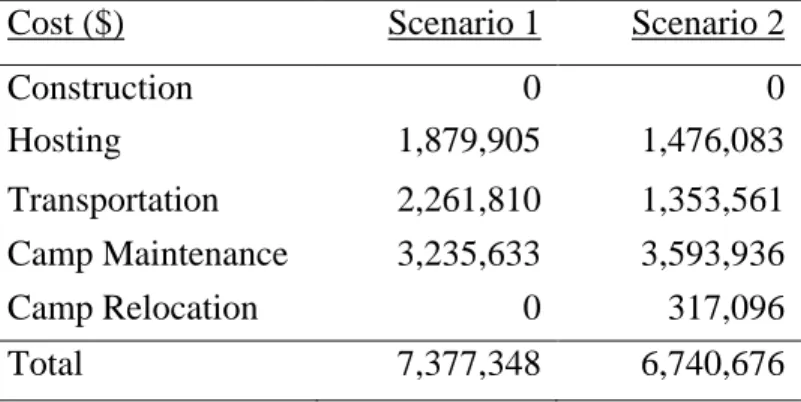
34th Council on Forest Engineering, June 12-15, 2011, Quebec City (Quebec) 10 years. Table 1 shows the cost allocation within the optimal solution for two scenarios: in the first scenario, we only use the existing accommodations and do not permit the relocation of camps. Within the second scenario, we allow the relocation of camps and the construction of new ones. The optimal solution for the second scenario suggests the relocation of a camp with four trailers to another location after the second year. The savings in transportation due to this camp relocation outweigh the relocation costs. This permits a saving of 8.6% of the total costs (representing over 600,000$) when compared with the first scenario.
Both scenarios described above have been solved by CPLEX12.0 within less than 30 minutes, using a single CPU of a 2GHZ Sony Vaio notebook with 4GB of memory. Based on the real-world instance, further instances have been generated with different properties and different sizes: (10/20), (10/50), (29/29), (50/50) and (50/100). The first number indicates the number of possible camp locations. The second number indicates the number of logging regions. The experiments showed that most of the instances with 50 possible camp locations could not be solved within a given time of 60 minutes.
Table 1: Cost distribution for scenarios without and with camp construction and relocation
Cost ($) Scenario 1 Scenario 2
Construction 0 0 Hosting 1,879,905 1,476,083 Transportation 2,261,810 1,353,561 Camp Maintenance 3,235,633 3,593,936 Camp Relocation 0 317,096 Total 7,377,348 6,740,676
CONCLUSIONS
We presented a mixed-integer model that investigates optimal locations for logging camps in the forestry sector. The model considers the partial and temporary closing of camps, i.e. trailers, camp expansion during the planning horizon and the relocation of camp from one location to another. Economies of scale are modeled in almost all types of cost. Experiments showed that the model grows large as we increase the number of possible camp locations and clients. Within short computing times, the MIP solver CPLEX cannot solve many of the instances generated. This suggests the investigation of more sophisticated solution techniques, such as mathematical decomposition.
ACKNOWLEDGEMENTS
We would like to thank Mathieu Blouin and Jean Favreau from FPInnovations for their valuable support throughout the development of the problem model and for providing the input data.
34th Council on Forest Engineering, June 12-15, 2011, Quebec City (Quebec) 11
LITERATURE CITED
Melo, M., S. Nickel and F. Saldanha-da Gama (2005). Dynamic multi-commodity capacitated facility location: a mathematical modeling framework for strategic supply chain planning.
Computers & Operations Research 33 (1), 181-208.
Peeters, D. and A. Antunes (2001). On solving complex multi-period location models using simulated annealing. European Journal of Operational Research 130 (1), 190-201.
Shulman, A. (1991). An Algorithm for Solving Dynamic Capacitated Plant Location Problems with Discrete Expansion Sizes. Operations Research 39 (3), 423-436.
Troncoso, J. and R. Garrido (2005). Forestry production and logistics planning: an analysis using mixed-integer programming. Forest Policy and Economics 7 (4), 625-633.