All Rights Reserved © 2017 IJSETR
517
TRIGGERING SYSTEM USE IN MARINE
MISSILE
Mr.VARUN DAS1 Student of Suman Ramesh Tulsiani Technical Campus(VIT Kamshet), Pune, Maharashtra, India Mr.SUSHIL PATIL2 Student of Suman Ramesh Tulsiani Technical Campus(VIT Kamshet), Pune, Maharashtra, India Mr.PUSHKAR DEVKATE3 Student of Suman Ramesh Tulsiani Technical Campus(VIT Kamshet),Pune,,Maharashtra,India Mr.MANGESH ZARKAR4 Student of Suman Ramesh Tulsiani Technical Campus(VIT Kamshet), Pune, Maharashtra, India Asst. Prof. TILEKAR SRIKANT5 Suman Ramesh Tulsiani Technical Campus(VIT Kamshet), Pune, Maharashtra, India
ABSTRACT:
In our marine, defense system a torpedo missile system plays major role. It used for firing the missile above sea water or as well as for firing under the water. It was also called an automotive, automobile, locomotive or fish torpedo. Torpedo system which uses a special nose cone to create the super cavitation envelope, allowing it to travel through the water at speeds of up to 200 knots (~230 mph, 370 kph) much, much faster than the standard torpedoes fielded by the US. In the torpedo system our unit EM-08 also plays major role for firing. The EM -EM-08 works on the principle of faraday‟s law of electromagnetic induction. This unit use for giving sudden pull to missile section. It‟s an individual part in missile section which is operated by separate stabilizer then after according to application it will adjust the load and stroke length also considerable. According to the faraday‟s law of electromagnetic induction state that when conductor placed in a varying magnetic field emf are induced in it and plunger start moving and this principle used in EM-08 for a sudden pull.
1. INTRODUCTION:
EM-08 works on the principle of faraday‟s law. This is used in missile firing system. Which give sudden pull effect to the missile has to be launch According to the load of application. This is mostly used in marine system. Torpedo is one of the examples of missile system. Em-08 unit consist of several parts like coil, plunger, cap, body electrical terminal, stabilizer, etc. For operating the torpedo missile there are many types of unit like EM-26, EM-30, EM-46, EM-76 and EM-81 but EM-08 is used for fire under sea water and also for above sea that‟s reason EM-08 is mostly preferred for marine defense system.
EM-08 whole working depends on faraday‟s law of electromagnetic induction. Faraday‟s law says that In Faraday's first experimental demonstration of electromagnetic induction, he wrapped two wires around opposite sides of an iron ring (torus) (an arrangement similar to a modern tropical transformer). Based on his assessment of recently discovered properties of electromagnets, he expected that when current started to flow in one wire, a sort of wave would travel through the ring and cause some electrical effect on the opposite side. He plugged one wire into a galvanometer, and watched it as he connected the other wire to a battery. Indeed, he saw a transient current (which he called a "wave of electricity") when he connected the wire to the battery, and another when he disconnected it This induction was due to the change in magnetic flux that occurred when the battery was connected and disconnected. Within two months, Faraday had found several other manifestations of electromagnetic induction.
For example, he saw transient currents when he quickly slid a bar magnet in and out of a coil of wires, and he generated a st eady (DC) current by rotating a copper disk near the bar magnet with a sliding electrical lead Although Faraday's law is always true for loops of thin wire, it can give the wrong result if naively extrapolated to other contexts. One example is the homopolar generator (above left): A spinning circular metal disc in a homogeneous magnetic field generates a DC (constant in time) EMF. In Faraday's law, EMF is the time-derivative of flux, so a DC EMF is only possible if the magnetic flux is getting uniformly larger and larger perpetually. But in the generator, the magnetic field is constant and the disc stays in the same position, so no magnetic fluxes are growing larger and larger. So this example cannot be analyzed directly with Faraday's law. This faraday‟s laws used in EM-08 are applicable for torpedo.
2. LITERATURE REVIEW :
Douglas J. Skinner and Richard G. Sloan [1] we demonstrate that growth stocks exhibit an asymmetrically large response to
negative earnings surprises. We further show that this asymmetric response to negative earnings surprises completely explains the return differential between „growth‟ and „value‟ stocks. Another way of stating this result is that the lower returns of growth. Our evidence also has implications for managers‟ financial reporting and disclosure strategies. If managers of growth firms are aware that their firms‟ stock prices suffer large downward adjustments when they report earnings disappointments, they have incentives to manage reported earnings and/or manage analysts‟ expectations of reported earnings to avoid negative earnings surprises.
All Rights Reserved © 2017 IJSETR
518
Luıs V. S. Sagrilo, Jose Renato M. de Sousa, Edison C. P. Lima, Elisabeth C. Porto, and Jane V. V. Fernandes [2] this
paper presents a study on the calibration of safety factors for the ultimate limit state design of torpedo anchors. One important aspect of this study is the availability of results from holding capacity tests of six torpedo anchors installed in Campos Ba sin, offshore Brazil these results made it possible to assess the model uncertainty statistics associated with the FE-based model proposed by de Sousa Both working stress design WSD and load and resistance factors design LRFD methodologies are investigated. Concerning the traditional WSD methodology, it is shown that, for the same actual design safety level of the traditional offshore piles, its single safety factor can be significantly lowered. However, the use of WSD design methodology results in designs with very scattered safety levels depending on the ratio of the functional and environmental load actions. Aiming at overcoming this drawback, a LRFD methodology calibration is also investigated in this paper. The results show that the structural safety levels of LRFD-based designs are more uniform than the WSD-based ones.
Kristina Zuza, José-Manuel Almudí, Ane Leniz, and Jenaro Guisasola [3] we introduced a teaching intervention involving a
series of problems and activities. The positive learning outcomes may be due to three features of the intervention. First, th e intervention integrates experimental phenomena via activities, with the explanatory theory models, such as understanding the Faraday‟s law or an explanatory model of EMI. Laws are used as tools to enhance the consistency of qualitative explanations for the interpretative models , while the teaching strategy aims to engage students in the essential characteristics of scientific methodology such as creating a hypothesis, empirical verification, capacity for prediction, and being universal, the teacher‟s guidance was not overlooked When the activities were completed, students were asked to argue ADDRESSING STUDENTS‟ DIFFICULTIES WITH … PHYS. REV. ST PHYS. EDUC. RES 10, 010122 (2014) 010122-11 their statements using the characteristics of scientific work
J.A. McNeil [4] In an attempt to improve learning of electromagnet. Setup for the “The Metal Detector” laboratory. The students
design, construct, install, and test the field and pick-up coils (center). The equipment shown (from left to right) consists of the function generator, oscilloscope, amplifier, and digital millimeter. The PVC forms for winding the coils are also shown. Students using their metal detector to locate hidden metallic samples. 12 THE PHYSICS TEACHER. Vol. 42, September 2004 netic concepts by engineering students, we have created an introductory electromagnetism laboratory that incorporates elements of engineering design. This paper describes one of these laboratories in which the concept of Faraday‟s law is illustrated and reinforced through the design and fabrication of one of the components of a metal detector. Anecdotal evidence suggests that engineering students retain a better understanding when the concepts are connected to something both concretely experienced and relevant to the practice of engineering
Abdalla Obeidat, Maen Gharaibeh, Manal Al-Ali, Akram Rousan [5] the simple current source-wire circuit has been studied
fractionally using direct and alternating current source. The results indicate that there was an evolution of the current until it reaches its saturation value which would have been expected as to be (immediately) reached. The evolution process starts to b e evident at higher values of α (> 0.75). The result may suggest that the wire acquires an inducting behavior as the current is initiated in it and gradually recovers its resisting behavior. The fact that the phenomenon is more pronounce at higher values of α is obvious from the fact that the saturation value of the current is shown to be reached after a time of the order of nanosecond. It was shown that the currents in wires take time (order of nanoseconds) to reach the expected constant value.
Igal Galili, Dov Kaplan, and Yaron Lehavi [6] In this paper we comment on some remarks given in the Feynman Lectures2 and
show that the integral form of Faraday‟s law explains the cases of motional emf that were presented as problematic. Faraday‟s disc was mentioned as an example of the failure of the “flux rule,” in which the emf of induction is created despite an “unchanged circuit.” Two rotating plates, touching at a point and creating a closed circuit located in a magnetic field, was given as an example of the creation of an insignificant emf following a big change of the linked magnetic flux. Faraday‟s law provides a good opportunity to illustrate Einstein‟s relativistic perspective on electromagnetic induction.3 In connection with motional emf, the idea of area change and change of orientation used in many textbooks,4 should be refined to reduce confusion. We illustrate our discussion with several examples that might be useful in teaching electromagnetic induction.
Eric A. Euteneuer [7] Supercavitating torpedoes are complex systems that require an active controller, which can ensure
stability and enable the torpedo to track a target. In addition, the control law design process requires a dynamic model that captures the physics of the problem. Existing public 6DOF models were not able to fully capture the dynamics of the torpedo a nd provide a good platform with which to design a feedback controller. This thesis was able to design such a model and it was shown that the complex nonlinear and simple linear model (used for control design) had matching dynamics via computer simulation. In addition, parameters within the model that are uncertain were identified and it was described how to incorporate them into the control law design process. By designing such a model, several interesting properties of the torpedo were discovered.
Rear Adm (Retd) NK Ramanarasaiah [8] to propel a heavy-weight torpedo at speeds necessary to combat very fast
submarines, a high degree of requirement is placed on the propulsion engines. The trend is towards using better fuels, more compact thermal engines and efficient propellers. The requirements that are to be met by the fuels used are
1. A fuel should be capable of giving very high thermat outputs.
2. It should not leave any toxic exhaust in the tubes of a submarine. After discharge, when these torpedoes are used in a submarine.
All Rights Reserved © 2017 IJSETR
519
4. It should be a mono-propellant.5. After combustion the fuel should have preferably an exhaust which is soluble in water to lessen the wake.
Peter J. K. Cameron [9] during the course of the research an experiment was designed, built, and tested that facilitates the study
of high level acoustic signals on the characteristics of the super cavity envelope around a free-flying projectile. A series of experiments were conducted using the apparatus to demonstrate the effect of a gated sinusoid at three different signal amplitudes and at three different frequencies. The purpose of the experiment was to investigate the potential use of the method as a countermeasure to supercavitating torpedoes. Relevant data was recorded and analyzed regarding the effects on the dynamics of the supercavitating body.
R.A. Meger, J. Neri, R.J. Allen, R.B. Hoffman, C.N. Boyer[10] The Naval Research Laboratory is poised to begin a focused
program on railgun materials. Real time and post-shot analysis will provide information about the rail armature interface. The information hopefully will lead to understanding as well as scaling relations for future rail guns.
Jeff Maniglia, Jordan Smiroldo, Alex Westfall, and Guy Zohar [11] it was found that with our current configuration the
EMRG could fire up to 650 m/s and potentially even more had it been charged to 450 Volts instead of 420V. While this is an exceptionally fast speed, it is not fast enough for orbital debris testing. However; the prototype that was designed, built, and tested served its purpose exactly as intended. It successfully tested all of the EMRG theories that are expected to use in the large scale test. A critical part of the prototype success was in the pulse forming network and the voltage drop before and after the test. A list Estimated Energy for Degradation of electrical components. The point contact diodes are most easily damaged and therefore used as baseline. Energy absorbed by electrical components at a distance perpendicular to the bore. American Institute of Aeronautics and Astronautics 17 examining the scorching in the rails, it was determined that the inductors succeeded in forming the pulse, which was also confirmed by the voltage drop from 420 to 30 volts across the test.
3. WORK MATERIAL:
General purpose steel and shafts. Often specified resistance. Available in bright bespoke size blocks
.
bars for machining, suitable for lightly stressed components including studs, bolts, gears where weldability is a requirement. Can be case-hardened to improve wear rounds, squares and flats, and hot rolled rounds. Can be supplied in sawn blanks, and
Table 1.0-Chemical composition of Mild Steel
Material C Mn Si S P
MS 0.16-0.18 % 0.70-0.90% 0.40% 0.040% 0.040%
3.1 Methodology
In this EM 08 unit we r using the concept of Faraday's law of electromagnetic induction the whole working is according to the Faraday's law The Faraday law says that, Faraday's law of induction is a basic law of electromagnetism predicting how a magnetic field will interact with an electric circuit to produce an electromotive force
Electromagnetic induction is the process by which a current can be induced to flow due to a changing magnetic field.In our article on the magnetic force we looked at the force experienced by moving charges in a magnetic field. The force on a current-carrying wire due to the electrons which move within it when a magnetic field is present is a classic example. This process also works in reverse. Either moving a wire through a magnetic field or (equivalently) changing the strength of the magnetic field over time can cause a current to flow.
All Rights Reserved © 2017 IJSETR
520
4. Details of Design:
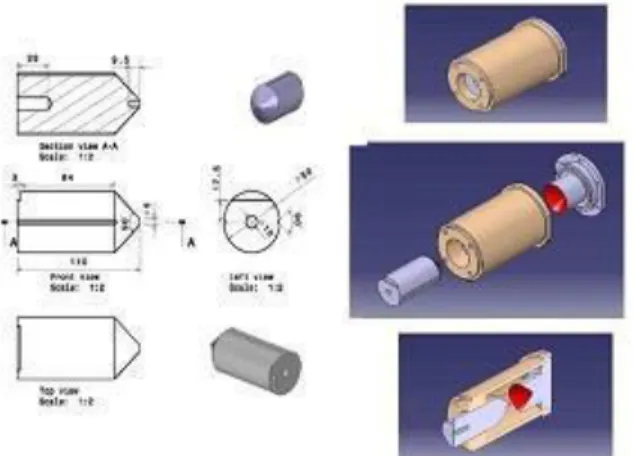
Fig 1.0
All Rights Reserved © 2017 IJSETR
521
5. PERFORMANCE TABLE:
Table 2.0
Voltage(volt) Length (mm) Weight (kg) Current(Amp)
28 25 30 10
28 20 32 10
28 10 35 10
6. RESULT:
After performing the operation on to the model of EM 08 it's use for getting sudden pull in the range of 30 kg ,32kg and 35kg according to their lengths 25mm ,20mm and 10 mm and this all are adjusted by the stabilizer
7. CONCLUSIONS:
From the all experimentation we have concluded that “this unit is used for firing the missiles in very short time within
various ranges. This unit is used for giving sudden pull to missile section.
Also if we reduce the weight of whole body of EM-08 this unit is helps to work smoothly in torpedo system and decreases some amount of weight of torpedo.
Corrosion is the main problem in front of us of this unit at the joining of main body and upper casted body hence we decreases the corrosion by applying different corrosion removing method on that joint. It helps to improve the life of EM-08 unit
8. REFERENCES:
1. P. Lorrain, D. L. Corson, and F. Lorrain, Fundamentals of Electromagnetic Phenomena (W. H. Freeman, New York, 2000).
2. R. Feynman, R. B. Leighton, and M. Sands, The Feynman Lectures on Physics, Electromagnetism and Matter (Addison-Wesley Reading, MA, 1964), Vol. 2
3. F. Munley, Challenges to Faraday’s flux rule, Am. J. Phys. 72, 1478 (2004).
4. R. Chabay and S. Sherwood, Restructuring the introductory electricity and magnetism course, Am. J. Phys. 74, 329 (2006)
5. Addressing student’s difficulties with faradays Law: a guided problem solving approach
6. Engineering accreditation commission, “criteria for accrediting engineering programs” (accreditation board for
engineering and technology Inc. 1999); http://www.abet.org
7. Ivan n. kirschner, et al.”Control strategies for supercavitating vehicles.” University of Minnesota graduate
seminar series(2001)
All Rights Reserved © 2017 IJSETR
522
9. Ahn, S. S., an integrated approach to the design of supercaviting underwater vehicles. Ph.D. dissertation, Georgia institute of technology, school of aerospace engineering, august 2007.
10. Research on high rail guns at the naval research of laboratory, Washington, dc 20375-5346
11. Design, fabrication, and testing of an electromagnetic rail guns for the repeated testing and simulation of orbital debris
impacts.