Volume 6, Issue 9, September2017, ISSN: 2278 -7798
NFC enabled Mobile Phone or NFC Mobile
and its Security
Vineela Malae,Dr.G.Chenchu Krishnaiah
Abstract - This paper reviews the additional value formed by adding other devices and contactless card functions to a mobile phone, a new intelligent method of data handling and transmission between devices (i.e., payments/tickets/medical records etc.…) along with addressing the applications and their secured strategies of processing data transmission. When the functions of a contactless card combined with the extra features of mobile phones, the card develops into a device whose resulting value is greater than been used both devices on their own. This newly defined device is called an NFC Enabled Mobile Phone or simply NFC Phone. It acts as an intelligent mobile network-enabled device that can connect with other NFC devices in close immediacy i.e. in its near field in a secured mode of data transfer.
Index Terms– NFC Mobile, Near Field Communication, Payments, Data transfer, Contactless cards, Security
I. INTRODUCTION
Near field communication, also known as NFC is a form of wireless communication technology has been emerged from the approved and matured standards of the existing technology, RFID which evolved few decades ago along with Smart Cards, for automatic identification and data transfer via radio waves introduced back in the years of 1970’s. It uses electromagnetic field induction to enable communication between two active devices which are in close proximity enabling at ease to exchange data. Within last decade the research in the Near Field Communications has expanded to great extent emerging into integrating computational logic into various kinds of essentials of our day-to-day life. NFC is a short-range wireless technology which enables mutual interaction of two electrical a/ppliances when they are in near field to securely /exchange small bits of information.
An NFC tag (RFID tag) consists of an antenna capable of receiving and transmitting the radio signal and an integrated circuit for processing and storing information and for modulating and demodulating the signal. The communication modes can be classified as 1) Peer to Peer mode: Device to device link level communication, 2) Read/Write mode: Allows applications to transfer forum defined messages and 3) NFC card emulation mode: Allows handset to behave as a
The Application of NFC tags considered as per the perspective of NFC operating modes along with the design artefacts which proposes composed applications or services operating in two or more modes.
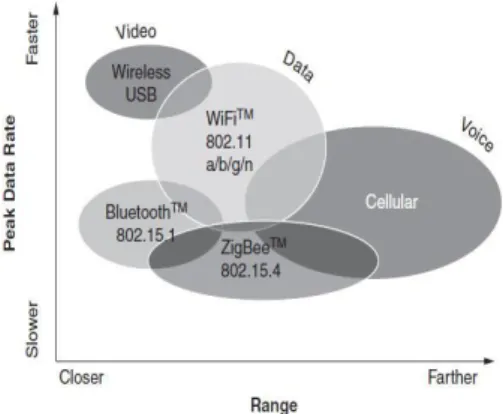
The following charts detail how NFC relates in range and speed with other wireless technologies such as WIFI, Bluetooth etc., can be used in a mobile phone. The lab tests demonstrate communication occurs when two NFC-compatible devices are fetched within about four or five centimetres of each other. By design, NFC requires close proximity and it offers instant connectivity, which provides a spontaneous end user experience.
Fig. 1 NFC accessibility - Range vs Speed/
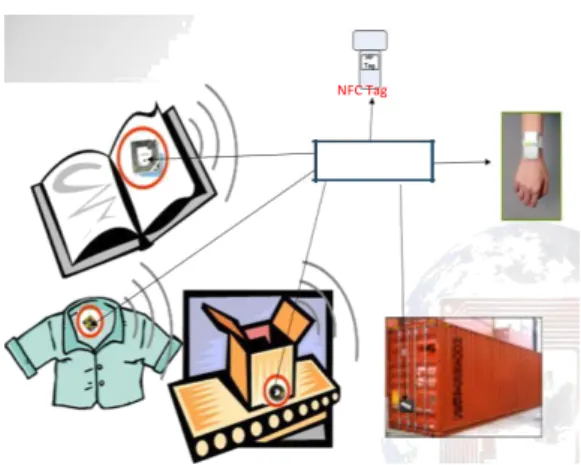
Fig. 2 NFC compatibility with other devices
II. NFC APPLICATION AND SECURITY
Volume 6, Issue 9, September2017, ISSN: 2278 -7798
NFC applications and to invest big in go-ahead of this technology. A tremendous work is involved in modelling a virtual wallet with NFC Enabled tags transforming a device, is the most significant and most likely trends in current world. The virtual wallet, will apparently result in the partial elimination of plastic payment cards, ID cards, coupons and other forms of tickets. And for future work, at some time, typical wallet items like driver-license, passports or national identity cards, location-based services or monitoring processes could be integrated into NFC smartphones/devices.
There are rising alarms about the security and safety of private stored information with media exposing major security breaches and the compromising of sensitive data due to the increased activity of hackers. In any industry or sector where NFC Enabled tag are combined with either Smart Phones or any other devices, the most effective and important concept of focus will always be the safety and security of the data transfer between the devices.
For the wireless channel communication, itself the NFC specifications do not ensure any secure encrypting mechanisms. To deal with the sensitive information such as patient’s medical log or credit/debit card numbers, banking details or any personalised information such as passwords and accesses of credentials must be taken great care of.
On higher layers, however, NFC applications can of course use industry-standard cryptographic protocols like SSL/TLS based methods to encrypt the data that is to be transferred over the air and that is stored in the Secure Element. Other possible NFC vulnerabilities involve the manipulation of NFC tags. The typical transmit power of radio frequency and the receive sensitivity of NFC readers that fulfil the ISO specifications are only strong enough to operate up to a range of a few centimetres (as shown above in figure). As a matter of fact, the NFC technology should be able to address the facts around Eavesdropping, Data Corruption and Manipulation, Interception Attacks, Theft, Data Skimming etc.
NFC has a lot of promise in terms of simplifying and unifying all sorts of technologies, from payments to network connection setups. Some possible security attacks and solutions are detailed below.
Data skimming: Is capturing and intercepting transferred data by a distant attacker. Such attack is basically accomplished via an attacker serving as a man-in-the-middle who will be forwarding transmitted data between a reader and a target transponder. A possible countermeasure for such
relay attack could be built upon a quite short timeout threshold that avoids transactions if the response time is too slow.
PIN Validation: PIN Entry in order to activate the phone’s NFC broadcast hardware and to activate the Secure Element that is storing all the sensitive data. The Wallet PIN also prevents unauthorized usage of the payment card in case the NFC phone is stolen.
Lock enabled devices: If a smartphone is stolen, the thief could theoretically wave the phone over a card reader at a store to make a purchase. By installing a password or other type of lock that appears when the screen is turned on, then the security wall will not permit to access sensitive information on the phone.
Data Corruption and Manipulation: Manipulating or interfering with data sent over the reader hewing it useless while it reaches the destination. One way to prevent this corruption is using secure channels for communications. And, NFC provides a methodology known as Listen for corrupted data identification, which further prevents it even before they can get messed during the transmit.
Eavesdropping: Another major concern during payments. To prevent it, use of the ultra-wideband (UWB) technology is implemented on a chip. UWB provides secure communication with higher bandwidth than Bluetooth. It transmits much shorter and sharper pulses that remain distinct across multiple paths of obstruction.
Cryptographic methods: There are three different basic encryption methods, each with their own
advantages. Hashing, Symmetric and
Asymmetric Methods of encryption or public-key cryptography which enables higher levels of security during data transmits.
Passive NFC Tags or URL spoofing: On a Smart Poster, spoofed tags that is modified NDEF messages or replacing the URI with a malicious URL to load the phishing website with the aim to steal user credentials. A countermeasure for such kind of attacks is manipulating the signed tag payload a signed NDEF message losing its integrity and getting recognised as non-trusted by the NFC mobile.
Volume 6, Issue 9, September2017, ISSN: 2278 -7798
NFC Tag
Fig. 3 NFC Mobile reading other NFC Tags
In general, one can summarize that NFC is not more insecure than other related technologies. It offers options for encrypting data on the application layer the same way as Wi-Fi or Bluetooth, but additionally provides safety through the requirement of very close physical proximity.
III. CASE STUDIES
NFC Tags (and enabled devices) are providing extremely great advantages in number of fields. For the case studies, 3 different sectors are well-thought-out in this paper. 1. Health Care 2. Payments 3. Travelling.
A. Case Study 1: NFC Enabled health care devices
NFC is an exceptional benefit to make the health care system easier for everyone. A Patient’s record can be tracked down in an outstanding way preventing every single risk of human error while recording every single detail of when doctors and other healthcare professionals visit a patient. In this sector, the highest importance is given to the security of the patient’s information, which NFC supports in an extra-ordinary way providing the advanced security needed to protect medical information. In the year 2010 NFC Forum Global Competition, Dr. Miguel A. Sánchez-Vidales presented PharmaFabula, an application that uses NFC and RFID to identify medicines and report to the patient critical information about the medicine in audio format.
In the past couple of years, a huge support to NFC devices for a program has been received as it benefits even in the low resource areas, and it won the 5,000 EURO Prize in 2015. All these great advantages demonstrate the essentiality of NFC in Health care field, enabling to reach the health programs to each single individual resulting into great care of every single record with a huge reduction in costs and resources.
The benefits using a NFC Tag (over physical records)
As per World Health organization, number of people with visual disabilities reached around 285 million in June 2012, in which 39 million are blind. Visual impairment is defined as the decrease in the volume of information collected by the eye from the environment, and it may range from low vision to total blindness. A cost-effective NFC indoor navigation system has been devised by Rosen Ivanov from Technical University, Gabrovo, Bulgaria, to aid blind people in traversing unknown buildings. It provides verbal commands for room-to-room navigation, verbal notification about current position, the name of a reached reference point, room dimensions, names reference points in the room, and navigational information required to reach a selected reference point.
Each NFC device (tag) not only provide medical professionals with information about what treatments a patient should receive, and keep track of when nurses and doctors have checked in with that patient. Each time the tag is scanned, the information about who scanned it and when can be transferred to a database. It helps doctors checking the medications been used and their results in long term before to prescribe them again.
A winner of last year’s NFC Forum’s 5,000 Euro prize was a program that helps track patients in low resource areas, and is currently being used in a pneumonia study of young children in Pakistan.
Tags designed specifically only to allow authorized personnel to accesses like medical cabinets or operating rooms, databases and files. Employee badges, smartphones, and other devices can be equipped with NFC for access privileges, NFC tags can track, log every entrance and exit.
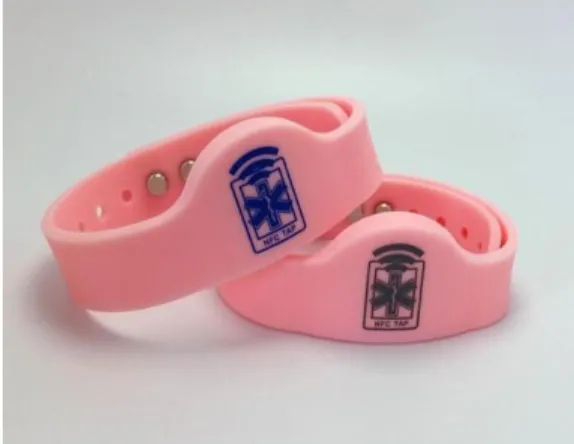
NFC tags and NFC-enabled wristbands can replace the traditional bracelets worn by patients, and can be updated with real-time information, such as when a medication was last given, or which procedure needs to be performed.
NFC lets track where people are, and who’s done what. Medical staff can know, in real time, where a patient is, when the nurse last visited, or what treatment a doctor just administered.
People with life-threatening conditions, can replace their metal “Medic-Alert” bracelets with
NFC-enabled wristbands that can provide greater detail to first responders in an emergency.
Volume 6, Issue 9, September2017, ISSN: 2278 -7798
Fig. 4 NFC-enabled wristbands
B. Case Study 2: NFC Enabled Mobile devices for Payments
NFC supporting apps demand is on continues increase in the recent years, as buyers and sellers are realizing the advantages and flexibility of keeping this technology handy. With the help of technological advancements and a keen interest in
the NFC mobile payment marketplace,
development of NFC payment apps is becoming a popular choice for mobile payments. The apps Google Wallet, MasterCard, PayPass, Visa payWave, PayPal, Square Wallet, Oyster card, DB Touch, NFriend Connector, TapToLogin platform, Vodaphone’s Virtual Shelf Shopping Wall etc. and more are on demand in current market.
The benefits using a NFC Mobile device (over a contactless card)
End User benefited a lot more with NFC-enabled mobile device while compared with smart cards, as contactless smart cards can hold electronic tickets to a limited range but not all, while NFC-enabled phones are great in replacing all paper tickets. Thus, Customer can manage all tickets in their phones, along with payment cards. However, with contactless smart cards, must carry several different physical cards in a wallet.
Either a default application can be set or an option be easily chosen from a drop-down menu with NFC Mobile, while smart cards would have to be physically collect from the pool of cards from the pocket/handbag to use with the risk of dropping it / not finding in time.
When the concept of Collision comes into existence, again NFC Mobiles are less susceptible while more than one contactless ticket/card present in the same wallet, the reader gets collision factor and can’t decide which one to read to open the barrier, resulting into barrier still closed and loosing time.
The Season tickets get automatically renewed over the air and can be done any time before
reaching the departure site, instead of physically visiting the office/at a computer/sale point to get renewed i.e. to pay or order or to collect a new ticket which in turn saves lot of time and hassle free.
Smart Posters are becoming more popular in the modern era. An NFC Mobiles again adds a lot of value while reading these posters, helping the End user reading the poster to directed towards the website page of targeted page of information instead of manually entering the address to access the website and going to the page of required info, which in turn saves lot of time for the consumer.
With a few additions/amendments to the settings of an NFC Phone as per the tickets bought of a tourism place, travellers can receive the relevant information and interesting attractions/places of interest near to the tourism place.
Sellers / Retailers can directly send updates of special offers to the Travellers with spot on deals helping tourists.
Fig. 5NFC Mobile payment authorisation
C. Case Study 3: NFC Enabled Mobile devices for Travelling & Barcodes
The benefits using a NFC Mobile device are (over a PC-Based): The Online websites provides great
help to the Consumers in doing online purchases of travel tickets etc. from a computer at the own comfort of home or from an internet centre. Either the tickets picked up from an office/entry gate/ticket machine as an electronic copy or downloaded and get printed. While,
Electronic copies of Ticket received on an NFC Mobile helps confirming correctness of details on the spot, and also in pre-planning for the travel with more comfort and ease.
Electronic copies of ticket of NFC Mobile saves environment due to less paper wastage in turn saving trees and saves time to the traveller as
Volume 6, Issue 9, September2017, ISSN: 2278 -7798
don’t have to remember to carry them physically and the risk of losing paper tickets reduced.
Tickets can be directly managed from anywhere and anytime as NFC mobile provide simple and fast access to internet services.
The benefits using a NFC Mobile device (over Barcodes)
2D barcode readings are read-only while NFC Phones are mutual communication giving more wide range of benefits
NFC ticketing is quite faster with the practise of a simple tap-and –go, so it doesn’t need the opening of an application to find the 2D barcode.
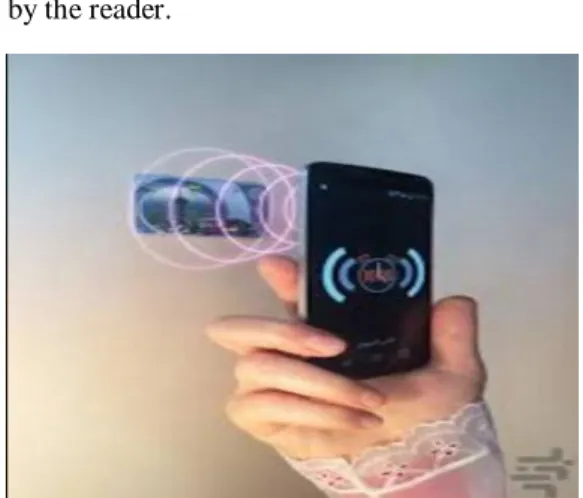
NFC-enabled phones can be read within a near filed range, avoiding the problem of repeated trial of reading the codes holding the phone just in right angle as in general happens with barcode reading. Barcode readers in a busy station can also get dirty, and optical barcodes must be clearly displayed on the phone and clearly seen by the reader.
Fig. 6 NFC Mobile Reading Posters
IV. CONCLUSION
In the world of mobility, NFC provides end users added functionality and simplest method of tap-and-go. With the rise of consumerisation, many NFC pilot schemes are consumer facing. Perhaps in the future, it will do a lot more than simply enable transactions to happen, it is predicted to be as a way to access critical systems and many other devices such Electric meters, Electric Readings, Appliances, TV and Microwave, to open the front door of a house or car. This actions that there will be low level of physical access to elements in turn increasing level of logical access. A research in this sector, forecasts that there will be 552 million handsets with NFC features empowered by the year 2016, sensing that it’s implausible to buy a smart phone without NFC features soon. The extent of definite standards for NFC services are still sought. The non-existence of a definitive and convincing
strategy for the development of NFC services leads in to a vital conflict between several involved key actors. A simple, dynamic and platform-independent framework is missing and difficult to realize in the current conditions. However, in a certain way though, a well-defined collaboration of key actors i.e., Banks, phone manufacturers and network operators, is needed to be gathered for developing sophisticated and usable NFC services. Banks in the direction of underlying wireless network infrastructure to control SMS-based remote over-the-air management capabilities to configure or renew NFC services on the handset. The mobile phone manufacturers on the other hand plan of NFC hardware or alternative forms of dedicated Secure Element chips are actually inserted in to handset. Competitors from Google Android, Apple and Microsoft indeed also broadcasted plans of smartphones with NFC tab embedded into in the near future.
Now, based on successful partnerships and collaborations between the mentioned stakeholders, applications with good user experience need to be published with a predefined and well agreed simple and yet dynamic framework. Having this accomplished, it is very likely that the NFC technology will play a big role in our future everyday life.
REFERENCES
[1] A. F. de Azevedo Figueiredo Cruz, “Nfc and mobile payments today,” november 2011, last visited on January 19th 2012. [Online]. Available:
http://www.di.fc.ul.pt/_nuno/THESIS/AndreCruz MSIT11.pdf [2] B. Beny ó, B. Sódor, L. Kovács, J. Homlok, G.
Fördős,‟Security issues of service installation on a multi application NFC environment” INES 2010 • 14th International Conference on Intelligent Engineering Systems • May 5–7, 2010 Las Palmas of Gran Canaria, Spain.
[3] Near Field Communication in Smartphones Simon Burkard Master Student, Dep. of Telecommunication Systems. [4] An NFC Ticketing System with a new approach of an Inverse Reader Mode by Felipe de Sousa Silva, Technische Univseritat.
[5] C. Mulliner, “Vulnerability analysis and attacks on nfc-enabled mobile phones,” in Availability, Reliability and Security, 2009. ARES ’09.International Conference on, march 2009, pp. 695 –700.
[6] Emir Husni,Sugeng Purwantoro E.S.G.S,‟Shopping Application System With Near Field Communication (NFC) Based on Android” International Conference on System Engineering and Technology September 11-12, 2012, Bandung, Indonesia.
[7] White papers NFC_in_Public_Transport, and NFC_Forum_Mobile_NFC_Ecosystem by NFC Forum. [8] H. Zhang and J. Li, “Nfc in medical applications with wireless sensors,” in Electrical and Control Engineering (ICECE), 2011 International Conference on, sept. 2011. [9] M. Reveilhac and M. Pasquet, “Promising secure element alternatives for nfc technology,” in Near Field Communication, 2009. NFC ’09. First International Workshop on, feb. 2009. [10] Stefano Levialdi Ghìron, Serena Sposato, Carlo Maria Medaglia, Alice Moroni,,NFC Ticketing: Workshop on ‟Near Field Communication prototype and Usability test of an NFC-based Virtual Ticketing application”
Volume 6, Issue 9, September2017, ISSN: 2278 -7798
[11] M. Roland and J. Langer, “Digital signature records for the nfc data exchange format,” in Near Field Communication (NFC), 2010 Second International Workshop on, april 2010.
VineelaMalae PhD Degree Scholar at Shri Venkateswara
University Gajraula, U.P.,India.
Dr. G. Chenchu Krishnaiah Prof & VicePrincipal of Gokula