Saumya Jain. Developing an Objective Framework for Measuring and Assessing the Implementation of Information Systems in a Healthcare Setting. A Master’s Paper for the M.S. in I.S degree. May, 2019. 87 pages. Advisor: Dr. Lukasz Mazur
This study aimed to examine the feasibility of developing an objective framework to evaluate and measure various aspects of the implementation of an Electronic Health Records (EHR) system. To measure the performance of the implementation in a holistic manner, three aspects were chosen - project management practices, readiness of users and the outcomes of the implementation. Documentation from a real-world EHR implementation project was analyzed to understand the landscape of implementation, and thereafter, a framework was proposed comprising these three aspects and their component factors. This framework was applied retrospectively to test if it could assess the said implementation realistically. The results demonstrate the feasibility of defining such a framework with which an implementation may be measured objectively. Additionally, the development of the framework revealed underlying component factors for each aspect which have a contributory effect to the success of EHR implementation.
Headings:
EHR System Implementation Evaluation of EHR Implementation
Project Management in EHR Implementation Readiness in EHR Implementation
Outcomes of EHR Implementation Success Factors for EHR Implementation Implementation Science
DEVELOPING AN OBJECTIVE FRAMEWORK
FOR MEASURING AND ASSESSING THE IMPLEMENTATION OF INFORMATION SYSTEMS IN A HEALTHCARE SETTING
by Saumya Jain
A Master’s paper submitted to the faculty of the School of Information and Library Science of the University of North Carolina at Chapel Hill
in partial fulfillment of the requirements for the degree of Master of Science in
Information Science.
Chapel Hill, North Carolina April 2019
Approved by
_______________________________________ Dr. Lukasz Mazur
Acknowledgement
At the outset, I am grateful to the faculty of School of Information and Library Science (SILS) at University of North Carolina at Chapel Hill (UNC), whom I have looked up to as mentors. Whether in the classroom or outside, my interactions with the ‘SILS family’ – faculty, staff and colleagues – have greatly influenced my outlook on work and life. For inspiring this study, I extend a note of sincere thanks to Dr. Donald Spencer, Dr. Tim Carey and Dr. Lawrence Marks, senior leaders at UNC Health Care. I am thankful to Ms. Julie Flood and Mr. Dave Bennet from UNC Health Care for sharing their invaluable in-sights, as well as the leadership and staff at Wayne Memorial Hospital and Nash General Hospital for their critical role in the data collection process for this study. I would also like to thank Dr. Sara Baker Stokes for helping me navigate the IRB approval process.
I would especially like to express my heartfelt gratitude to Prof. Lukasz Mazur who not only advised me on my Master’s paper but also walked with me through the entire process, ensuring the success of this project. Along each step of the way, Prof. Mazur's words and deeds motivated me to become a better researcher and encouraged me to strive for a higher academic and professional ethic. I have always been amazed and inspired by Prof. Mazur's infectious enthusiasm, crystal-clear vision and his expertise for explaining complex topics in a simple and intuitive manner. Working on this project under his guidance was an en-riching experience – academically, professionally as well as personally.
Table of Contents
1 Introduction ... 1 1.1 Background ... 1 1.2 Motivation ... 2 1.3 Impact ... 4 1.4 Purpose ... 4 1.5 Setting ... 6 1.6 Scope ... 7 1.7 Research Questions ... 8 2 Literature Review ... 10 3 Methods ... 12 3.1 Approach ... 12 3.2 Data Collection ... 15 3.2.1 Project Management (PM) ... 15 3.2.2 Readiness (RD) ... 20 3.2.3 Outcomes (OC) ... 23 3.3 Data Analysis ... 24 3.3.1 Project Management (PM) ... 24 3.3.2 Readiness (RD) ... 35 3.3.3 Outcomes (OC) ... 40 4 Results ... 43 4.1 Project Management ... 434.1.1 Effectiveness of Meetings (PM_ME) ... 44
4.1.2 Efficiency of Task Completion (PM_TC) ... 48
4.1.3 Overall Assessment of Project Management for GL 7 ... 55
4.2 Readiness ... 56
4.2.1 Environment (RD_EV) ... 58
4.2.2 Individual’s Mindset (RD_IM) ... 59
4.2.3 Individual’s Readiness (RD_IR) ... 60
4.2.4 Application (RD_AP) ... 61
4.2.5 Adoption (RD_AD) ... 62
4.3 Outcomes ... 64
4.3.1 Efficiency of Ticket Resolution (OC_TR) ... 65
4.3.2 Performance on Key Performance Indicators (OC_KPI) ... 66
5 Discussion ... 68
5.1 Contribution of this Study ... 68
5.1.1 Successful development of a measurement and assessment framework ... 68
5.1.2 Dashboard for the Framework... 70
5.1.3 Identifying Success Factors... 72
5.2 Limitations and Future Work ... 73
5.3 Conclusion ... 74
6 References ... 75
1 Introduction
1.1 Background
The advent of the 21st century has seen information systems permeating across all aspects of human life. In the field of healthcare, there has been a widespread implementation of health informatics systems, also known as a health information technology system. Implementation of a health information technology system in a healthcare setting, such as a hospital, is aimed towards multiple goals. One of the primary goals for such an imple-mentation is to have a real-time system for capturing and maintaining electronic health records (EHRs). For this reason, health information technology systems are also commonly known as EHR systems. In the following text, we will use the term EHR system to refer to a health information technology system.
Yet another goal for such an informatics system is to support the work processes of the entity and its sub-units. For example, the EHR system may allow the doctor or a nurse to request a laboratory test or any procedure for a patient through the system’s software in-terface, which can then be processed by the laboratory staff through their software interface provided by the system, and subsequently the billing department can add the procedure to the patient’s billing account using their own specialized software interface of the same system.
The EHR system supports the workflow of all these enterprise-centric, or business-centric activities, wherein the term business refers to the business of the healthcare entity in which the system is implemented. Such an EHR system can eliminate waste such as in terms of time and resources and contribute to process efficiencies and overall effectiveness of doing work.
Implementation of an EHR system requires a team of experts from various domains, such as process managers, project managers, and software developers. It is a task requiring not only software expertise but also people expertise, process expertise, and project manage-ment capabilities. In some scenarios, the EHR system may replace a traditional paper-based workflow while in another scenario a more modern EHR system may replace an older sys-tem, with newer workflow models and upgraded software features. Irrespective of the sce-nario of implementation, it can be broadly said the implementation of an EHR system is an exercise in change management.
1.2 Motivation
As discussed in the preceding section, the implementation of an EHR system is a complex task involving changes not only to processes and workflows but also to the mindset of the people who eventually will transition from a previous system to a new one.
Any given EHR implementation project usually comprises of multifaceted aspects, with each of these aspects the responsibility of different teams or groups. Such responsibility may be assigned either explicitly or implicitly, depending on the approach of the imple-mentation project. For example, there are always dedicated personnel to carry out project
management activities, such as planning all tasks, assigning resources to execute the plan, and then tracking the project in due course. There are also usually personnel who are re-sponsible to ensure readiness of the end users, such as by conducting training sessions, communicating upcoming changes, etc. Further, the leadership is also interested in know-ing the outcomes of the project, and usually there are personnel assigned to collect and track information along this aspect as well.
Each group of personnel, however they may be organized within the enterprise, usually have some tracking mechanisms by which they track the aspect of implementation for which they are responsible. For example, the training personnel may be tracking the user trainings and reporting out the completion to the leadership. Similarly, the project person-nel may be tracking the tasks and reporting completion status to the leadership. Once the project is implemented, outcomes are also tracked and reported.
However, it is seen that there is a need for an overarching framework within which the entire implementation of the project may be tracked in a holistic manner, combining vari-ous aspects into an overall view of the implementation. Further, in addition to tracking the completion and status of these various aspects, it is needed to have some way by which one could objectively measure the extent of progress, or lack thereof, with respect to the im-plementation. Thus, it is important to be able to objectively measure the phenomenon of the implementation in a holistic manner, so that the same may be examined and evaluated.
1.3 Impact
Development of a measurement and assessment framework for the implementation will help us not only to track the completion of the project from various aspects but also to view the overall health of the implementation project. It shall allow us to drill down to specific aspects and examine their health. Further, with the help of such a framework, one may understand the underlying factors that contribute to the success or failure of an implemen-tation and quantify the extent to which such contribution exists.
If a framework is so developed and implementation projects are measured using the same, it would enable objective comparison of different implementations, i.e. two different in-stances of implementation of an EHR system.
With a framework for objectively evaluating these phenomena made available, it would be possible to unravel and understand the linkage between the different aspects of an imple-mentation project, such as those previously mentioned in a preceding section, and allow us to comment on what works, what doesn't and what can be corrected mid-flight.
1.4 Purpose
The primary and immediate purpose of this study was to test the feasibility of creating an objective framework that can be used to quantify the various aspects of the implementation of an EHR system (EPIC ®). The distinct aspects that we set out to objectively assess were as follows:
• The project management aspect, i.e. the approach, plan, and execution of the pro-ject management principles used in the implementation of an EHR system.
• The readiness aspect, i.e. the different human, political and environmental factors involved in the implementation of an EHR system.
• The outcomes aspect, i.e. the result of the implementation of an EHR system, such as the user issues and tickets raised in the first few weeks post go-live of the imple-mentation, as well as the Key Performance Indicators (KPIs) of the departments and entities whose workflows are supported by an EHR system.
The aim was to conduct a pilot study of an actual EHR implementation project, collecting and analyzing data on all the above-mentioned aspects. It was anticipated that with the above study and data so collected and analyzed, it would become possible to define more specific measures for each of the three aspects further in an objective sense. These measures could be specified as an identified set of relevant variables that represent each of these aspects.
With the variables so defined, it would then be possible to assign a score to the variables at a given point of time during the implementation. Here the term score does not necessarily have to be a number, but it could be any means of measurement, such as ranking, or scale, that could be used to indicate the health of a specific aspect, or sub-aspect represented by the variable. These scores could then be aggregated over the aspects or sub-aspects and then suitably combined to arrive at a health measure of the overall implementation project at the given point of time.
Further, since the implementation could be scored at any given point of time, the frame-work could be used to score the project at regular intervals and see if the health of the project was improving or deteriorating over time. A deep dive of the evolving scores would reveal which aspects were scoring better and which ones were scoring worse and this would enable project managers and leadership to take specific, targeted remedial action as needed. Yet another advantage of this framework would be its ability to capture the evolving pro-ject’s implementation health on regular intervals. If such patterns were standardized then it would be theoretically possible to compare the patterns of one project with patterns of another and this would enable an objective, measurable and attributable comparison of projects.
Another purpose of this study was to help establish a prima facie case for future investiga-tions aimed at developing an understanding of the underlying dynamics that take place during EHR implementations.
1.5 Setting
In this study we have tested the feasibility of creating an objective framework to measure the three aspects of implementation of an EHR system, namely, project management for the implementation, readiness of individuals to absorb the proposed changes and overarch-ing outcomes (or key performance indicators) of the system.
To this end, we have looked at the implementation of EPIC, a popular and well-established EHR system. EPIC has been implemented across the United States of America in
commu-nity hospitals, children’s organizations, retail clinics, academic medical centers, rehab cen-ters and independent practices. According to their website, www.epic.com, more than 250 million patients have a current electronic record in one of their systems.
At the University of North Carolina at Chapel Hill (UNC), EPIC is being implemented across the UNC Health Care network of hospitals. The Information Services Division (ISD) of UNC Health Care is tasked with the objective to implement EPIC at different entities within the UNC Health Care network. Typically, these implementations are structured as different projects, each project being called a GL #N, such as GL1, GL2, GL3 and so on, where GL stands for ‘Go Live’. For every GL project, an identified entity, or entities are targeted for a complete transition from their existing systems to EPIC. During the entire duration of the project, typically between 12 to 18 months, a dedicated project management group from the ISD is the custodian of the implementation.
For this study, we looked at GL7, i.e. the implementation of EPIC at Nash General Hospital and Wayne Memorial Hospital in North Carolina, USA. We were in touch with two project managers from the ISD who oversaw the project from beginning to the end. In all, GL7 ran from July 2017 to December 2018, a period of 18 months.
1.6 Scope
The specific aim of this project was to conduct a pilot study of these implementations to see if it is possible to derive objective variables that can be quantitatively scored, thus rep-resenting a means to measure each of the aforementioned three aspects. This involved the investigation of each of the aspect in the following manner:
• The project management aspect: An analysis of project’s documentation (project plans, trackers, reports etc.) and gathering firsthand perspectives of key players in the project management team, vis-à-vis their evaluation of the implementation. • The readiness aspect: A survey of users of EPIC to gather their impressions on
the readiness of themselves, their departments, and their entities across the imple-mentation project.
• The outcomes aspect: A detailed analysis of post go-live issues reported for the implementation (relating to specific, or low level, outcomes of the project). Further, an assessment of KPIs at the individual, department, and entity level (relating to broad, or high level, outcomes of the project).
1.7 Research Questions
The primary research question which this study aimed to answer is given below. 1. How may we objectively measure the following
a. the project management aspect of implementation of an EHR in a healthcare set-ting, corresponding to project management practices, plans, tracking mechanisms etc.
b. the readiness aspect pertaining to the individual level, the department level, and the entity level for implementation of an EHR in a healthcare setting
c. the outcomes aspect of such an implementation project, corresponding to low level outcomes such as reported user issues and breakdowns during and after the imple-mentation, as well as high level outcomes such as the KPIs reflecting on the work-flows supported by an EHR system
In addition to the primary research question, a desirable outcome of the study was also the following
2. Through the development of such a measurement framework, may we establish a prima facie support for utilizing the framework to reveal the underlying factors that contribute to the success of the implementation
In the present study, we shall take real-world data pertaining to implementation of an EHR system and through conducting the present study, we shall examine the feasibility of es-tablishing such a measurement and evaluation framework to study the implementation of EHR systems.
2 Literature Review
With advancements in the technology and increasing exposure of society to information technological applications, Healthcare Information Technology systems, also commonly known as Electronic Health Record (EHR) systems, have become more complex and di-verse. Corresponding to this shift, the need to evaluate them has also increased, and so has the complexity of the evaluation task.
Andargoli et al. (2008) argued that rigorous evaluation is required to get the most benefits out of an EHR system [1]. Sun and Kantor (2006) postulated that effective evaluation is critical for further development and improvement of health information systems [2]. According to Ammenwerth et al. (2004), the evaluation of an implementation of an EHR system may be defined as “the act of measuring or exploring properties of an EHR (in planning, development, implementation, or operation), the result of which informs a deci-sion to be made concerning that systems in a specific context” [3].
Friedman and Wyatt (2006) connected such an evaluation to the human, technological and environmental aspects, and their interactions [4]. However, as observed by Klecun-Dabrowska and Cornford (2001), the evaluation of implementation of an EHR system is particularly challenging and complex, due to lack of consensus on what to measure, who to involve and how to evaluate [5]. Further, Ammenwerth et al. (2003) also argue there are many problems in conducting an evaluation, including the complexity, the lack of clarity,
the changing of evaluation goals during the study, influencing the users’ expectations and the evaluation of the motivations for evaluation [9].
There have been attempts to create frameworks for EHR evaluation of implementation ef-forts but as a general trend, they focus on various aspects of evaluation in a piecemeal manner. Yusof et al. [6] assert none of them provide a reproducible framework with an objective break-down of the key aspects of implementation which can be then used to eval-uate EHR systems across the board. Stockdale and Standing (2006) assert one of the critical challenges for information systems evaluation is to develop frameworks that are not only sufficiently generic to be applicable to a wide range of applications [12].
Most existing evaluations of EHR systems focus on solely on the technical aspects rather than addressing the implementation as a phenomenon. This leads to poor evaluation of these systems [1], [6], [8]. Coiera (2003) suggests the evaluation of EHR systems should consider not only how usable they are for those who use them but also how well they inte-grate into organization [13]. A good evaluation of EHR should be seen via socio-technical lens where the user of these systems is influenced by other users, and by the tasks they need to complete.
From the meta-analysis of healthcare information systems frameworks conducted by An-dargoli et al. (2016), it can be inferred that the various aspects to be considered in an eval-uation framework must encompass the following aspects - systems development lifecycle, behavioral, and social relationships. This has served as a guiding principle for our proposal to study the evaluation framework from the aspects of project management, readiness, and outcomes aspects.
3 Methods
3.1 Approach
This study was a retrospective data analysis from a completed implementation of EPIC ® at two entities, Nash General Hospital (Nash) and Wayne Memorial Hospital (Wayne), where the implementation project, code named GL7, ran for a period of 18 months, from July 2017 to December 2018.
The eventual goal of this research is to propose a framework for measurement and evalua-tion of the implementaevalua-tion of EHR systems. As a first step in this direcevalua-tion, this study aimed to examine the feasibility of developing such an objective framework, which can be used to get a holistic view of the entire implementation project, quantifying three different aspects of the implementation of an EHR system, namely Project Management, Readiness and Outcomes.
To this end, we set up our investigation as a pilot study to test if we could collect relevant data from the GL7 implementation, and further to test if it was possible through suitable analysis to arrive at a framework for the desired measurement and evaluation of GL7 ret-rospectively. As a result, we have identified specific data and methods that can be eventu-ally used to build a framework for measurement and evaluation of future EHR implemen-tation projects.
To collect the data from GL7, we partnered with the Project Manager of GL7 and Data Analyst whom supported the implementation. These two personnel were our key points of contact and our go-to sources for information about GL7.
A cadence of weekly meetings was set up, starting January 2019 until April 2019. The purpose of these meetings was to gather data and information pertaining to GL7, to discuss and seek clarity on our evolving understanding of the implementation and to gain the per-spectives of these project personnel on the health of the project during the various stages of implementation.
The meetings with the project personnel helped us to gain an understanding of the project and provided us with an opportunity to share with them the goals of our study. This was useful for aligning all parties and arrive at a common platform where we could collaborate on this research study in the context of GL7. With this, we were able to collectively identify the following methods for each of the implementation aspects.
• Project Management: Studying project documentation, such as project plans, sta-tus reports, and minutes of meetings to ascertain variables that quantify the effec-tiveness of meetings and completion of project tasks.
• Readiness: Surveying a sample of users of EPIC at Nash and Wayne who went through the transition from legacy systems to EPIC, to quantify different contribu-tors to the readiness before, during and after the implementation.
• Outcomes: Collecting and analyzing data pertaining to KPIs at the individual, de-partment, and entity level (high level, or broad, outcomes) and analyzing reports of
post go-live issues (low level, or narrow, outcomes) to develop variables that quan-tify the efficiency of closure of issues (tickets) post go-live and impact of the im-plementation on the performance (KPI).
Ideally such a study would be conducted across the entire breadth of the implementation, investigating all departments and all users at both the entities. However, there were a cou-ple of reasons due to which we had to scope down the study to limit our investigation to only certain departments. First, the time available for this study posed a significant con-straint in implementing the above defined approach for each of the aspects, especially with administering a survey across all EPIC users at Nash and Wayne, which would require coordination with multiple departments and result in substantial delays. Second, the two entities have a different organization structure, so to maintain equivalence, we wanted to identify those departments which were similar between both entities in context of EPIC implementation. To establish equivalence, we looked at certain characteristics, such as de-partments which were going to use the same EPIC applications at each entity, dede-partments having the same kind of functional requirement and work processes, and departments for which unit level data could be possibly obtained, since most of the data available was ag-gregated at the entity level. In identifying such common denominator departments, we also wanted to ensure that the chosen departments had a reasonable number of EPIC users who could be surveyed for Readiness aspect.
With the shared understanding and the benefit of the personnel’s experience with GL7, we were able to scope down the study and chose the Laboratory and Pharmacy departments. Both these departments were present in a similar, independent functioning manner at Nash
as well as at Wayne. The Laboratory department interfaced with the EPIC application called Beaker and the Pharmacy department interfaced with the EPIC application called Willow. At the project level, the Pharmacy was the only named department for which there were some KPI metrics available - all other KPIs were reported at a hospital level. Due to the independent nature of the interactions of these departments with EPIC, we chose to restrict the data collection and analysis of Readiness and Outcomes aspects to these depart-ments only, with them serving as a proxy for general EPIC implementation. It was also decided that the Project Management aspect would be studied at a GL level since it was not possible to untangle the Project Management aspect in context of specific departments. In the following sections we discuss in detail the data collection and analysis methodology.
3.2 Data Collection
3.2.1 Project Management (PM)
To understand the Project Management aspect of implementation, we collected a large set of documents from the project personnel, which we list below, grouped by category. Project Scope Documents: We received one document each for Nash and Wayne outlin-ing the scope of EPIC implementation at these entities. The scope covered information such as which EPIC applications would be deployed to replace existing applications, which EPIC applications would require interfacing with existing applications, which departments at the entity would require which applications from the EPIC ecosystem, which reports will be developed, and who will be key personnel in the implementation project.
These documents helped us in understanding the broad layout of EPIC and its interaction with the entity where it was to be implemented. It also helped us to appreciate the sheer magnitude of EPIC ecosystem as well as the complexity involved in the implementation.
Project Plan Documents: We received a single project plan for GL7, which included a work breakdown structure for all tasks to be undertaken at both entities. The plan had in-formation about the breakdown of the project into tasks and sub-tasks at multiple levels and along different workstreams. For each task, the plan document listed a unique Task ID, the planned start date, a planned finish date, planned duration, and the predecessors of the task.
From these documents, we learned about the organization of work of implementation and its breakdown into smaller units. Again, the ISD team had meticulously planned out the project down to the details and this document helped us appreciate the number of tasks and subtasks that needed to be executed during the implementation.
Task Tracking Report for GL7: The ISD personnel also shared with us a task report from Orion, the task tracking tool being used by the ISD team. The following lists some im-portant columns from the task report ‘Task Id’, ‘Owner’, ‘Application’, ‘Task Name’, ‘Ra-tionale’, ‘Notes’, ‘Start Date’, ‘Due Date’, ‘Status', ‘Estimated Hours’, ‘Actual Hours’, and ‘Completed Date’.
From this document, we learnt about the information being used to track the completion of tasks, such as the due date and the completion date. We also saw that a lot of meta-infor-mation was being captured in addition to just the tracking informeta-infor-mation. Since this was a retrospective study, all tasks were marked as complete, however we infer that in mid-flight,
this same report will contain not only completed tasks but also all planned tasks and their status.
Presentation Decks for Key Leadership Meetings: We received the presentation decks which were presented by the ISD personnel at two key milestone meetings, held 60 days before the go-live and 30 days before the go-live respectively, with separate files for each entity. The presentation decks contained information organized into sections titled ‘Project Assessment’ and ‘Operational Assessment’. Although these were summary decks, they went into quite a lot of detail for each section.
The ‘Project Assessment’ section consisted of a status slide about the key project elements, e.g. application, training, communication, downtime planning etc., and a status slide for each EPIC application being deployed. The status slides used a Green vs. Yellow color language to denote the status, where green indicated good health and yellow indicated pres-ence of risk, in context of go-live readiness. This was followed by articulation of risks and mitigation strategies, presented for each element or application.
The ‘Operational Assessment’ section had a status slide for each department of the entity, such as Nursing, Pharmacy, Laboratory, etc., and included details about completed activi-ties, upcoming activities and risks under the broad task focus areas of ‘Training Registra-tion’, ‘Downtime Procedure Review’, ‘Workflow/Policy Concern’ and ‘Readiness Up-date’.
From these documents, we were able to identify which information was most important from a reporting perspective while the ISD team tracked the project before go-live and
understand the way in which the ISD team chose to summarize, depict and communicate that information in their deck.
Presentation Decks for Operational Meetings with Local Entity Group: We received presentation decks which were presented by the ISD personnel to the leadership for each entity in communication meetings held fortnightly up until the date of go-live. The purpose of these meetings was to communicate a very high-level view of the project status to oper-ational teams at each entity, reviewing key activities, highlighting risks, and appraising the entity leaders about upcoming key activities at their entity. The nature and emphasis of these communications changed over time as the project neared the go-live date. Initial meeting slides covered more information about plans, then subsequent meetings were fo-cused on review of activities and upcoming activities and the later meetings were fofo-cused on readiness and risks.
From these documents, we understood the differing emphasis areas for communication with this audience, i.e. the leadership at the entity, and appreciated the evolution of the communication goals.
Presentation Decks for internal ISD Meetings: We received presentation decks which were presented internally by the ISD personnel to the project team meetings organized weekly during the entire project from kick-off to closure. The purpose of these meetings was to conduct a weekly review of the project execution. The presentation decks contained information organized into sections titled ‘Recap and General Information’, ‘Action Items’, ‘Team Updates’, ‘Risks/Issues’, ‘Training and Go-Live Support’, ‘Applica-tions/Systems’.
Detailed sections in the slides included information about the completion of tasks, identi-fying teams with overdue milestones, upcoming milestones, discussions on high risk items, status of training of users, status of migration from legacy systems to EPIC, and application wise status of implementation. In these meetings, just like for the communication meetings, we saw that focus of the project changed from initial months, to the date of go-live, and then again after go-live till closure.
From these documents, we were able to see the evolving project focus with time from the kick-off to completion.
Presentation Decks for Go-Live Executive Update Meetings: We received presentation decks which were presented by the ISD personnel to executive leadership in meetings held twice every day from date of go-live up to 14 days after go-live. Each deck contained post go-live status information for both entities. The presentation decks highlighted ‘Top Is-sues’, ‘Top Closed IsIs-sues’, ‘Announcements’ and ‘Incident Statistics’.
The 'Incident Statistics' included visual representation of number of issues by entity, num-ber of issues by status of resolution, and open issues by assigned category. Further, there were charts showing progress in number of issues closed by day from go-live. Interestingly, there were also comparative charts showing comparisons between GL4, GL5 and GL7 based on number of issues opened by day after go-live and number of issues in backlog by day after go-live.
From these documents, we were able to identify which information was most important from a reporting perspective while the ISD team tracked the project after go-live and un-derstand the way in which the ISD team chose to summarize, depict and communicate that information in their deck.
3.2.2 Readiness (RD)
To understand the Readiness aspect of implementation, we developed a survey for EPIC users which contained a questionnaire that captured their perspectives as participants in the implementation process and their experience as users who transitioned from legacy sys-tems to EPIC.
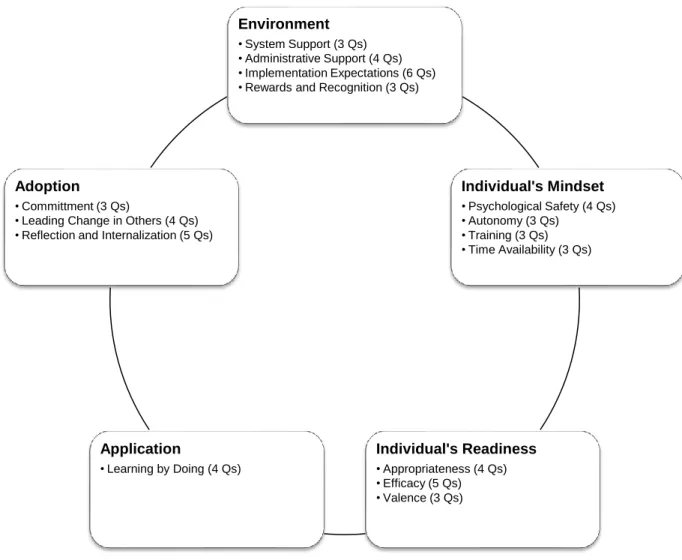
The survey questionnaire was adopted from Mazur et al (2017) who had conducted a sim-ilar study on the measuring the readiness of implementation of lean in a healthcare setting. After suitably adopting the questionnaire in the context of implementation of EHR systems, we organized the questions in the survey along the constructs of Environment, Individual’s Mindset, Individual’s Readiness, Application, and Adoption (See Figure 1). Within each construct, there were one or more themes, with each theme representing a group of ques-tions, as outlined below. (see Appendix A for survey items).
Under each of the themes, the survey questions were presented as statements and partici-pants were asked to select their level of agreement with the statement. We had provided 5 levels of agreement, i.e. ‘Strongly Disagree’, ‘Somewhat Disagree’, ‘Neither Agree nor Disagree’, ‘Somewhat Agree’ and ‘Strongly Agree’.
Figure 1 The Different Constructs of Readiness
The survey was administered to a sample of EPIC users at Nash and Wayne. As per the scope of the study, this sample consisted of all staff members in the Pharmacy and Labor-atory departments. Across both Nash and Wayne, there were a total number of 176 EPIC users who were invited to participate in the survey.
Since this research study involved human subjects, this came under the purview of a review by the Institutional Review Board (IRB). An application for IRB approval was submitted
Environment
• System Support (3 Qs) • Administrative Support (4 Qs) • Implementation Expectations (6 Qs) • Rewards and Recognition (3 Qs)
Individual's Mindset • Psychological Safety (4 Qs) • Autonomy (3 Qs) • Training (3 Qs) • Time Availability (3 Qs) Individual's Readiness • Appropriateness (4 Qs) • Efficacy (5 Qs) • Valence (3 Qs) Application • Learning by Doing (4 Qs) Adoption • Committment (3 Qs)
• Leading Change in Others (4 Qs) • Reflection and Internalization (5 Qs)
to the IRB at University of North Carolina’s office of Human Research Ethics. The appli-cation identified as Study # 19-0673 was eventually granted an IRB exemption within 2 weeks of submitting the application.
The survey was prepared and administered electronically using Qualtrics. Distribution of the survey was done via email using contact lists provided by each entity. The survey was completely anonymous in nature and no personal identifiable information was collected. However, we did ask demographic questions related to the participant’s role, years of ex-perience in the current role, years of association with the entity and two questions related to their engagement with EPIC implementation, namely, whether they had participated in trainings and whether they had raised an incident report on EPIC. This demographic infor-mation was collected in anticipation that we might be able to report results by demographic group.
The survey was released via email to the invitees using the Qualtrics platform. Participants took a mean time of 22 minutes to respond to the survey, with a standard deviation of 34 minutes. The Survey was made available for 1 week to the participants. In the first wave, we saw 11 responses within only a few hours but then only trickling activity till the next two days. Using the Qualtrics platform, we sent a reminder email to those invitees who had not filled up the survey. After the reminder email was sent, we also sent a request to the leadership at the entities, to encourage their staff to participate in the process. With the reminder and encouragement, we received 29 additional responses, bringing the total num-ber of responses to 40. Out of the 40 responses received, 6 survey responses were found to be incomplete, so the results were reported based on 34 responses.
3.2.3 Outcomes (OC)
To understand the Outcomes aspect of implementation, we collected the following docu-ments from the project personnel as listed below, grouped by category.
Incident Report for GL7: We received a summary report generated by a ticketing system used in EPIC post go-live. This ticketing system interfaced with the users, who could report issues on EPIC (as tickets), as well as with the ISD team, who could track the tickets to closure. Each ticket had a unique identifier, and the ticketing system recorded information such as name of the user who reported the issue, a description of the issue, and the date the issue was created. The other information stored against each ticket included, the priority assigned to each ticket (‘Critical’, ‘High’, ‘Moderate’, and ‘Low’), the category of the issue (‘Application’, ‘Hardware’, ‘System Software’, ‘Security’, ‘Network’, ‘Telecommunica-tions’, ‘Information’, and ‘Account Admin’), the EPIC implementation functional group to which the issue was assigned, and the date the issue was closed.
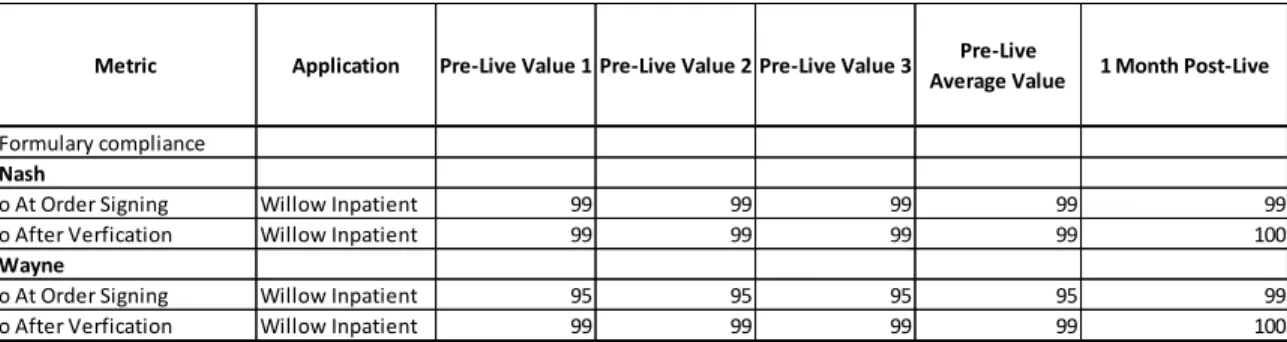
KPI Workbook: We received a KPI workbook which was used to track important KPIs by the ISD team. The KPIs were reported at various intervals which were available under pre-live and post-live headings. Most of the KPIs were reported at the entity level. How-ever, only two KPIs were available at the department level for Pharmacy and Laboratory, namely, Formulary Compliance at Order Signing and Formulary Compliance at Order Ver-ification. There were no specific KPIs available with the ISD team for Laboratory and within the time available for this project, this information, although sought, was not re-ceived. However, KPIs were known to be collected by respective entities and future
exten-sions of this work may find it usable to contact respective entities and ask for this infor-mation early so that any hindrances in receiving this inforinfor-mation may be resolved sooner in the study. For the present study we shall report data based on the one KPI received.
3.3 Data Analysis
3.3.1 Project Management (PM)
As reported in the preceding section, we looked at the following types of documents to understand the Project Management aspect of implementation
• Project Scope Documents • Project Plan Documents • Task Tracking Report for GL7
• Presentation Decks for Key Leadership Meetings
• Presentation Decks for Operational Meetings with Local Entity Group • Presentation Decks for Internal ISD Meetings
• Presentation Decks for Go-Live Executive Update Meetings
From these documents we were able to get a lay of the land from a project management perspective as far as the implementation of EPIC was concerned at both entities - Nash and Wayne. We were able to infer that the ISD team had been guided by best practices in pro-ject management and propro-ject execution and had conscientiously tracked various aspects of this complex process.
To synthesize the variables that could represent the project management aspect, we decided to focus on two critical components that are in the ambit of project management and which influence the effectiveness of the implementation. These two components are (a) effective-ness of meetings, and (b) completion of tasks from the project plan. These components were chosen since they will exist for all implementation projects irrespective of size and scope of the project.
Below we discuss the genesis and analysis of each Project Management variable.
3.3.1.1 Effectiveness of Meetings (PM_ME)
We defined a variable (PM_ME) to represent the effectiveness of each planned meeting. This variable was scored taking into consideration multiple factors that contribute to the effectiveness of a meeting, such as whether the meeting took place, how many participants were present, etc. The individual factors that contribute to the variable for meeting effec-tiveness were contingent on the nature and purpose of the meeting.
A proforma was created to capture information from the ISD team about the meetings. The proforma consisted of two sections, the first section captured information about the type of the meeting, and the second section captured information about each instance of that meet-ing type.
In the first section, the following information was collected about the type of meeting. • Entity: The entity for which the meeting took place
• Meeting Name: The name with which the meeting type was identified • Meeting Mode: Whether the meeting was in-person or online, or mixed
• Audience: The intended audience / participants for each meeting
• Purpose: A high level statement of purpose for organizing this meeting type • Cadence: The intended cadence of the meeting
In the second section, the following information was collected about each instance of the meeting type.
• Planned Date: The date on which a meeting instance was planned, as per the ca-dence
• Effectiveness Factor 1: Did the meeting take place: A Yes/No question to indicate if the meeting took place as planned
• Effectiveness Factor 2: Quality of attendance: A question that could be answered in terms of Poor, Average or Good, based on how many of the intended participants turned up at the meeting
• Effectiveness Factor 3, and beyond: A definition of effectiveness factor(s) specific to this type of meeting. The factor(s) were posed either as two-level questions (Yes/No) or three level questions (Low/Medium/High or Poor/Average/Good)
For this study, we analyzed four distinct types of meetings. With the help of the ISD per-sonnel, we arrived at several factors that influence the effectiveness of each type of meeting and defined these factors in the second part of the proforma for that meeting type. This is an important aspect of the analysis, since it allows the framework enough flexibility to accommodate more meeting types and more factors that may be decided as per the context of the project.
To illustrate the scoring methodology, we take an example of one meeting type: the Oper-ational Meetings with the Local Entity Group (LEG Meetings). The first part of the proforma for the LEG meetings was basic data collection about this meeting type. The second part of this proforma consisted of the following effectiveness factors.
• Effectiveness Factor 1: Did the meeting take place?
• Effectiveness Factor 2: What was the quality of attendance? • Effectiveness Factor 3: Was an impactful topic presented?
• Effectiveness Factor 4: Was a UNC ISD Leader (director of above) Present?
For scoring each effectiveness factor, we used the following methodology.
• 2-level questions, e.g. Yes/No questions: A ‘No’ was given a score of 0, a ‘Yes’ was scored as 1
• 3-level questions, e.g. Poor/Average/Good questions: A ‘Poor’ was assigned a score of 0, a ‘Average’ was given a score of 0.5 and a ‘Good’ was scored as 1
The numerical scores of each factor were then added to obtain a final score for each meet-ing instance. In the case of LEG Meetmeet-ings, we had three Yes/No questions and one Poor/Average/Good question, meaning that the total score ranged from 0 to 4. Based on this, we could assign the following interpretation to the aggregate score, and thereby score the meeting effectiveness variable for this meeting instance.
• An aggregated score greater than or equal to 3.0 implied a high effectiveness of this meeting instance, since getting this score requires a high value on a majority of the factors (i.e. at least three of the four factors). This aggregated score was regarded
as an overall score of ‘High’ and the meeting effectiveness variable (PM_ME) was scored as 1 for this meeting instance.
• An aggregated score greater than or equal to 0 but less than 2.0 implied a low ef-fectiveness of the meeting instance, since getting this score means attainment of high score on a minority of factors (i.e. on less than two factors out of the four factors). This aggregated score was regarded as an overall score of ‘Low and the meeting effectiveness variable (PM_ME) was scored as 0 for this meeting instance. • An aggregated score greater than or equal to 2.0 but less than 3.0 implied a medium effectiveness of this meeting instance, since getting this score requires a high value on at least half of the factors but not on a majority of factors (i.e. on at least two out of the four factors). This aggregated score was regarded as an overall score of ‘Me-dium’ and the meeting effectiveness variable (PM_ME) was scored as 0.5 for this meeting instance.
In another case, if we had an odd number of effectiveness factors, say five questions, then the score would have ranged from 0 to 5. Based on this, we could assign the following interpretation to the aggregate score, and thereby score the meeting effectiveness variable for this meeting instance.
• An aggregated score greater than or equal to 3.0 implied a high effectiveness of this meeting instance, since getting this score requires a high value on a majority of the factors (i.e. at least three of the five factors). This aggregated score was regarded as an overall score of ‘High’ and the meeting effectiveness variable (PM_ME) was scored as 1 for this meeting instance.
• An aggregated score greater than or equal to 0 but less than or equal to 2.0 implied a low effectiveness of the meeting instance, since getting this score means attain-ment of high score on less than a majority of factors (i.e. on maximum two factors out of the five factors). This aggregated score was regarded as an overall score of ‘Low’ and the meeting effectiveness variable (PM_ME) was scored as 0 for this meeting instance.
• An aggregated score greater than 2.0 but less than 3.0 implied a medium effective-ness of this meeting instance, since getting this score requires a high value on at least a minority of the factors but not on a majority of factors (i.e. a high value on at least two out of the five factors but not a high value on three out of five factors). This aggregated score was regarded as an overall score of ‘Medium’ and the meet-ing effectiveness variable (PM_ME) was scored as 0.5 for this meetmeet-ing instance.
As shown above, the meeting effectiveness variable (PM_ME) for each individual meeting can be assigned a score of 0, 0.5, and 1, corresponding to Low, Medium, and High, respec-tively. The numerical PM_ME scores of individual meetings was further aggregated by calculating a total PM_ME score across all meetings planned during a given time period, say a week, so that this aggregated score reflected the overall meeting effectiveness score for that week. After an aggregated score was computed for the week, we assigned the ag-gregated scores a level of Low, Medium, High, based on whether the number of meetings taken to compute the total was odd or even.
For an even number of meetings, say four meetings, the total score ranged from 0 to 4. Based on this, we could assign the following interpretation to the aggregate score, and thereby score the meeting effectiveness variable for the week as follows.
• An aggregated score greater than or equal to 3.0 implied a high effectiveness of meetings in the week, since getting this score requires a high value on a majority of the meetings (i.e. at least three of the four meetings). This aggregated score was regarded as an overall score of ‘High’ for the PM_ME variable for the week. • An aggregated score greater than or equal to 0 but less than 2.0 implied a low
ef-fectiveness of meetings in the week, since getting this score means attainment of high score on a minority of the meetings (i.e. on less than two meetings out of the four factors). This aggregated score was regarded as an overall score of ‘Low’ for the PM_ME variable for the week.
• An aggregated score greater than or equal to 2.0 but less than 3.0 implied a medium effectiveness of meetings in the week, since getting this score requires a high value on at least half of the meetings but not on a majority of meetings (i.e. on at least two out of the four meetings). This aggregated score was regarded as an overall score of ‘Medium’ for the PM_ME variable for the week.
In another case, if we had an odd number of meetings during the week, say five meetings, then the score would have ranged from 0 to 5. Based on this, we could assign the following interpretation to the aggregate score, and thereby score the meeting effectiveness variable for the week as follows.
• An aggregated score greater than or equal to 3.0 implied a high effectiveness of meetings in the week, since getting this score requires a high value on a majority of the meetings (i.e. at least three of the five meetings). This aggregated score was regarded as an overall score of ‘High’ for the PM_ME variable for the week. • An aggregated score greater than or equal to 0 but less than or equal to 2.0 implied
a low effectiveness of the meetings this week, since getting this score means attain-ment of high score on less than a majority of meetings (i.e. on maximum two meet-ings out of five). This aggregated score was regarded as an overall score of ‘Low’ for the PM_ME variable for the week.
• An aggregated score greater than 2.0 but less than 3.0 implied a medium effective-ness of the meetings in the week, since getting this score requires a high value on at least a minority of the meetings but not on a majority of meetings (i.e. a high value on at least two out of the five meetings but not a high value on three out of five meetings). This aggregated score was regarded as an overall score of ‘Medium’ for the PM_ME variable for the week.
3.3.1.2 Efficiency of Task Completion (PM_TC)
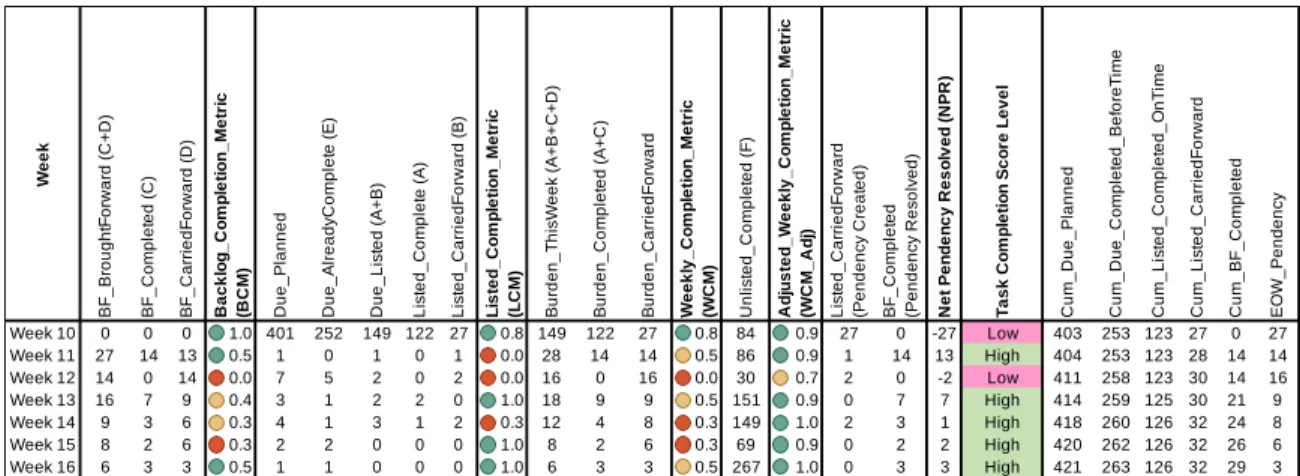
We defined a variable to represent the efficiency of task completion as per the project plan. This variable was scored taking into considerations the various aspects of task completion which was being tracked by the team. From the task tracking report, we found that we could bucket the tasks into various categories.
• Tasks that were due this week and could not be completed this week, and so will be carried forward to next week (B)
• Tasks that were brought forward from previous weeks and completed this week (C) • Tasks that were brought forward from previous weeks and could not be completed
this week, and so will be carried forward to next week (D)
• Tasks that were due this week but completed ahead of time in prior weeks (E) • Tasks that are due in the future but completed ahead of time in this week (F)
Based on these categories we identified scores to represent the performance on task com-pletion in each bucket. Each of the individual scores is a factor which effectively contrib-utes to the net score for the task completion effectiveness variable. The following lists the calculation of each factor for a given week.
• Backlog Completion Metric (BCM): This metric is a measure of the proportion of tasks which were completed this week out of all the tasks that were brought forward as backlog since last week. 𝐵𝐶𝑀 = 𝐶
𝐶+𝐷
• Listed Completion Metric (LCM): As we saw, there is a difference between the number of tasks due as per the plan at the beginning of the week, and the number of tasks actually due at the beginning of a week. This is because some tasks which were due this week may be completed ahead of time in the previous weeks, thus reducing the burden of tasks which are effectively due this week. We refer to this reduced burden as the number of listed tasks. The listed completion metric is a
measure of the proportion of tasks which were completed this week out of all the listed tasks for the week. 𝐿𝐶𝑀 = 𝐴
𝐴+𝐵
• Weekly Completion Metric (WCM): The weekly completion metric measures the proportion of the number of completed tasks in this week, out of the total listed as well as brought forward tasks for the week. Effectively, this represents the perfor-mance of the team on the total burden of the tasks presented to them in the begin-ning of the week. Here the denominator represents the effective tasks due for the week and the numerator represents how many of these were completed within the week. 𝑊𝐶𝑀 = 𝐴+𝐶
𝐴+𝐵+𝐶+𝐷
• Adjusted Weekly Completion Metric (WCM_Adj): We saw that in addition to com-pleting the tasks which were part of the burden at the beginning of the week (i.e. backlog and listed tasks) the team may also complete those tasks which were pend-ing in the future weeks as per the schedule. The weekly completion metric does not take into account the team’s effort on completion of tasks as an advanced measure. To account for such tasks, we adjust the Weekly Completion Metric by adding the number of these advanced completion tasks on both numerator and denominator. Effectively, this rewards the team for their extra effort in completion of future bur-den in advance. 𝑊𝐶𝑀_𝐴𝑑𝑗 = 𝐴+𝐶+𝐹
𝐴+𝐵+𝐶+𝐷+𝐹
• Net Pendency Resolved Score (NPR): This is a measure of the net result of the efforts for the week on the pending tasks in the project. 𝑁𝑃𝑅 = 𝐶 − 𝐵
Except for NPR, each of the other factors was defined as a percentage. Depending on the value of the factor, the percentage value was attributed to a High/Medium/Low level based on thresholds. E.g. the thresholds for BCM were 33% and 50% i.e. BCM was considered High if above 50% and Low if below 33%, and Medium if between these values. In plain English, to be considered High performance level for a given week, the number of backlog tasks must be reduced by 50%, and if at least 33% of the backlog is not being resolved in the week, then that means a Low performance level on the Backlog Completion Metric. The thresholds for BCM were set at 33% and 50%. For LCM, WCM and WCM_Adj, the thresholds were set as 50% and 75%, respectively, such that a value below 50% was con-sidered Low and a value above 75% was concon-sidered High and all scores between these values were considered Medium.
Although we have used the above threshold values for our analysis, these threshold levels are not set in stone, and the proposed framework anticipates that at the beginning of the project, these thresholds can be suitably adjusted with consensus from the relevant stake-holders in context of the project such as taking into consideration the timelines and re-sources available.
For NPR, the value was either positive (efforts of the week result in reduction of overall pendency, within the week) or negative (efforts of the week result in increase of overall pendency, within the week). A positive NPR score was considered High, and a negative NPR score was considered Low. A value of 0 for the NPR score was considered Medium.
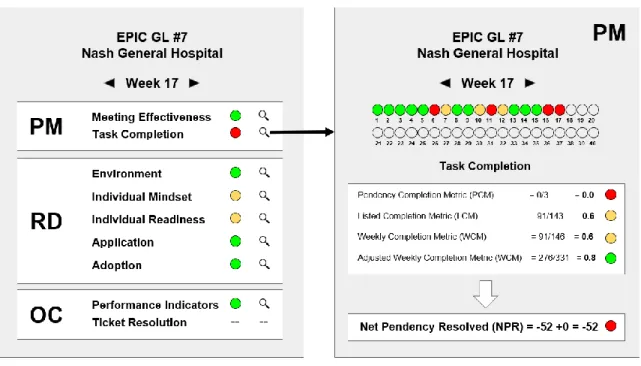
To get the effective score for the Task Completion Effectiveness Variable, we propose the use of the NPR score since it represents the net performance score for the efforts of the week in reducing the overall pendency of tasks in the project.
The completion performance score for each week serves as a score for the overall task completion effectiveness for that week. Extending this train of thought, with weekly task completion scores available, it becomes possible to analyze trends and compare these trends across projects.
3.3.2 Readiness (RD)
As reported in the preceding section, we conducted a survey of EPIC users at Nash and Wayne from the Pharmacy and Laboratory departments. The first part of the survey ques-tions was to capture relevant demographic information about the respondents in context of the implementation and the second part of the survey consisted of presenting the respond-ents with various statemrespond-ents that spoke to readiness with respect to EPIC implementation. To synthesize the variables that could represent the readiness aspect, we organized the questions into a two-level structure. The constructs at the top level were appropriately dis-tinct to serve as the variables to represent the readiness variable and quantify different tributors to the readiness before, during and after the implementation. Under each con-struct, questions were grouped into labelled themes. The organization of the constructs and themes can be seen in Figure 1 in the previous section on Data Collection. We understand that the constructs proposed herein shall exist for all implementation projects irrespective of size and scope of the project.
3.3.2.1 Environment (RD_EV)
The environment variable covers the following themes – System Support, Administrative Support, Implementation Expectation and Rewards & Recognition. It speaks to whether or not an environment conducive to the implementation existed. A conducive environment implied that there was support available for reporting and resolving issues, there was ad-ministrative push and support for EPIC implementation, and the staff (end users) felt mo-tivated by the leadership to use and learn EPIC.
3.3.2.2 Individual’s Mindset (RD_IM)
The individual’s mindset variable covers the following themes – Psychological Safety, Au-tonomy, Training, Time Availability. It speaks to whether or not the individual’s had a mindset to adopt EPIC at their workplace. Positive individual’s mindset implied that users felt safe to admit human errors while working on EPIC, they were given autonomy to en-gage with EPIC enhancing activities, they felt prepared to participate based on the trainings received, and that they were given appropriate time to learn EPIC in addition to their day to day work activities.
3.3.2.3 Individual’s Readiness (RD_IR)
The individual’s readiness variable covers the following themes – Appropriateness, Effi-cacy and Valence. This speaks to whether the users were ready to adopt EPIC, in terms of finding EPIC to be an improvement, feeling ready to use EPIC in their work, and to connect their use of EPIC to their job engagement and respect at the workplace.
3.3.2.4 Application (RD_AP)
The application variable covers the themes of Learning by Doing. This speaks to whether the user really engaged with EPIC on a day to day basis.
3.3.2.5 Adoption (RD_AD)
The adoption variable covers the following themes – Commitment, Leading Change in Others, and Reflection & Internalization. It speaks to the extent of the adoption users feel for EPIC, such as whether they use EPIC for improving their operations, do they encourage and educate others about EPIC, do they propagate their knowledge and support the organ-ization wide adoption of EPIC, and finally, whether they believe in EPIC.
The analysis for each of the variables was along the same lines, in the following manner. Each readiness variable represented a unique component that contributed to the readiness of the users, encompassing the different human, political and environmental factors in-volved in the implementation of an EHR system. Analogous to the variables defined for the project management aspect, each variable (i.e. each top-level class, or in other words, each construct) is further decomposed into one or more factors (i.e. second level classes, or in other words, themes). The themes are visualized as contributors to their respective variable. Each of the themes represents a group of questions on the survey.
For analysis, we first calculated the score for each question. The level of agreement pro-vided by each respondent was converted to a number. considering ‘Strongly Disagree’ as 1, ‘Somewhat Disagree’ as 2, ‘Neither Agree nor Disagree’ as 3, ‘Somewhat Agree’ as 4 and ‘Strongly Agree’ as 5. Then, for any given respondent, a score was calculated for every
construct and theme, by averaging the scores given by the same respondent for the ques-tions included in the construct / theme. After this exercise, we obtained, for a given re-spondent, an effective score for every construct and theme. We repeated this process to calculate the scores for each participant on all constructs and themes.
For analysis, we took each construct and theme, one by one, and calculated the Mean score across all respondents. This mean score value reflected the average response across all respondents to questions included in the respective construct / theme. In addition to calcu-lating the mean score for every construct / theme we also calculated the standard deviation (StdDev) of scores across all respondents, which showed the spread of scores across the respondents.
For each construct and theme, we then calculated the value of Mean ± StdDev to arrive at a range of numbers that reflected the central range of participants level of agreement with the statements posed as questions on the respective theme or construct.
The questions in the survey were posed as statements of an idealized scenario contributing to readiness, thus the level of agreement for each construct / theme expressed the overall view of the respondents to the extent they agreed that a given construct / theme was true for this implementation. E.g. If the mean score was close to 1, it meant that on an average, the participants had a strong disagreement with this construct / theme being applicable in GL7 and highlights a need for improvement along this construct / theme.
To assign an objective High / Medium / Low level to the construct and theme, we defined the following guidance rules. The rules look at the lower value in the central range calcu-lated above, i.e. they look at Mean – StdDev. Instead of looking just at the mean, we chose
to adjust the Mean by a value equal to the StdDev to accommodate for the spread while still excluding outliers.
• If the lower limit of the central range is more than 3 then assign a score of High, since even after accommodating for the spread, the overall central range lies above 3 implying most of the participants agreed with the statements included in this con-struct / theme.
• If the lower limit of the central range is less than 2.5 then assign a score of Low, since after accommodating for the spread, the overall central range lies below 2.5 implying that a significant number of participants did not agree with the statements included in this construct / theme.
• If the lower limit of the central range is more than 2.5, but less than 3.0 then assign a score of Medium as this is better than Low, but still worse than High.
In this manner, we were able to assign a High / Medium / Low score to each variable (construct) in the Readiness aspect.
We had initially planned to conduct a detailed analysis of the survey results, segregating results based on entity (Nash, Wayne), department (Pharmacy, Lab) and demographics (role, seniority, engagement, etc.). However, due to the small number of responses received we have only reported results for all 40 responses together.
This readiness scores in this study are based on a retrospective look on GL7. However, the survey can be adopted to make it a regular feature which can be administered on a regular basis, say quarterly. A shorter survey may even be implemented on a monthly cycle. The
readiness scores can then be reported on a more regular basis. Extending this train of thought, with regular readiness scores available, it becomes possible to analyze trends and compare these trends across projects.
3.3.3 Outcomes (OC)
As reported in the Data Collection section, we looked at the following types of documents to understand the Outcomes aspect of implementation
• Incident Report for GL7
• KPI Workbook
We used these documents to synthesize the variables that could represent the outcome as-pect of implementation. We wanted to focus on the outcomes at two levels (a) a low level, or narrow, focus on the efficiency of closure of issues post go-live, and (b) a high level, or broad, focus on the impact of the implementation on the performance of the users. Both levels of focus were envisaged as different variables that represent the outcomes aspect.
Below we discuss the genesis and analysis of each Outcome variable:
3.3.3.1 Efficiency of Ticket Resolution (OC_TR)
We defined a variable to represent the efficiency of closure of issues (tickets) post go-live. This variable was scored taking into consideration the factors that influence the process of receiving and resolving issues which are called tickets in information systems nomencla-ture. The underlying factors that lead to issue resolution are (a) the rate at which tickets are being created, and (b) the rate at which the tickets are being resolved. From the difference
between these rates, there arises a third factor, i.e. (c) the volume of the backlog of unre-solved tickets. These are tracked and reported by the ISD team already. We envision that the framework can adopt this tracking mechanism verbatim.
Together, as part of the framework, these three factors represent the effectiveness with which the issues are being closed.
From the project documentation, especially looking at the presentations for the meetings post go-live, we saw that for the first 14 days after go-live, ticket statistics were being tracked on a daily basis and were deemed very important information by the ISD team to be shared with the leadership team. From that perspective, we envisage the reckoning time duration for this variable should be 1 day. This means that this variable should be scored daily.
The issue closure score can be tracked over time and may be aggregated if needed to be reported weekly, monthly, or based on any period, by averaging the daily score values over the time period. This aggregated score can serve as a score for the overall issue closure effectiveness for that period, say a week. Extending this train of thought, with daily or weekly issue closure score available, it becomes possible to analyze trends and compare these trends across projects. In the case of comparing the issue closure score, we considered the period during which comparison were made. For example, if the period over which comparisons were made is in the vicinity of the go-live date, say within a month, then it made sense to compare daily scores, setting date of go-live as Day 0. For time periods sufficiently away from the go-live date, say beyond one month, then it made sense to make comparisons on a weekly basis.
3.3.3.2 Performance on Key Performance Indicators (OC_KPI)
Since there was only one particular Key Performance Indicator available to us in this study, there was not much analysis required. The KPI information was shared in a highly struc-tured format, that allowed tracking of KPIs on a regular basis. We believe the framework can absorb this tracking mechanism verbatim.





![Figure 9 Tickets Opened, Closed and Backlog for each day (since GoLive) [Reproduced from ISD Meeting Deck]](https://thumb-us.123doks.com/thumbv2/123dok_us/8329571.2209222/70.918.162.771.617.1035/figure-tickets-opened-closed-backlog-golive-reproduced-meeting.webp)