Abstract— Construction Industry is one of the very fast growing industries but it also faces many problems which impinge on the performance of their projects. The aim of this study is to identify the factors affecting the local construction projects and analyze them. A questionnaire is prepared from literature review. The questionnaire contains two parts; part A dealing with the general information of the company and the respondent and Part B is subdivided again into different factors like cost, time, health and safety, client satisfaction, community satisfaction factors, productivity factors and environmental factors. The questionnaire was distributed in Chennai, Kerala and Bangalore industries. Each respondent was asked to rank the factors in a range of one to five. The analysis of the response was done using the SPSS software. The top 5 factors affecting the performance of projects were identified as increase in material cost, inadequate supply of labour, incorrect planning, wrong method of estimation, and poor financial control on site.
Index Terms—analysis of performance factors, construction industry, performance indicators
I. INTRODUCTION
Construction industry plays foremost role in improvement and accomplishment of the target of society. Construction industry is one of the largest and it adds to about 10% of the gross national product (GNP) in industrialized countries. Construction industry is complex in its nature as it involves large number of parties such as clients, contractors, consultants, stakeholders, shareholders and regulators. Performance is associated with several factors such as time, cost, quality, client satisfaction, productivity and safety. There are other genuine reasons like closures, modification of drawings and changes of the design. Other grounds affecting construction projects performance are poor management and guidance; inapt participants; poor relations and coordination; lack of motivation, insufficient infrastructure, political problems, cultural problems and economic conditions .Faridi and [3]found that factors like inadequate leadership, poor site management, lack of manpower skills, lack and breakdown of equipment plays a very important pat in construction delays in United Arab Emirates
[4] recognized coordination among participants, leadership skills and coordination of project managers, project managers competence, support of the top management, economic and
Manuscript received April , 2015.
Melba Alias, Construction Engineering and Management, SRM University, Chennai, India.
Ms Dhanya R, Assistant Professor Civil Engineering Department, SRM University, Chennai, India.
Mr N.Ganapathy Ramasamy, Assistant Professor Civil Engineering Department, SRM University, Chennai ,India,
climatic condition, social condition, participants coordination, decision making as key factors.
In this study, factors affecting the performance of construction projects in the regions of Chennai, Kerala and Bangalore will be analyzed. Performance indicators are used to measure performance in construction projects. Then these indicators will be used for benchmarking purposes, and will be a key element of any organizations step in achieving best practice so as to conquer the performance problem. However, this study aims at identifying the factors which are affecting the performance of construction projects and the analysis of the factors using the SPSS Software and finding the means and ranking them accordingly.
II. AIM AND OBJECTIVE OF THE STUDY
The aim and objective of the study is to find the factors which affects the performance of the construction projects in and around the regions of Chennai, Kerala and Bangalore. 1. To find the factors affecting the performance of construction projects.
2. Analysis of the factors and ranking the factors according to the Mean
3. To give suggestions and recommendations to improve the performance of the industry.
III. PROBLEM OF PERFORMANCE IN THE CONSTRUCTION INDUSTRY
The breakdown of many of the construction industry is due to the poor performance of the industries. Some other related problems can be stated as issues with the shortages or lack of the industry infrastructure. Inadequate supply of the resources, problems occurring between the client and consultants or disappointments in contractors inadequacies. As per the previous studies the main performance problems can be also divided in to two groups, the first one being the unrealistic target setting; and the other group dealing with the causes originating from the actual construction. The traditional project performance is usually nonspecific. It depends on the data collection, which will be done at low frequency and so the quality of the data will be low.
IV. CONSTRUCTION PROJECTS AND PERFORMANCE Many previous research studies shows that the reasons for the poor performance of the industry as the badly chosen procurement system, financial stability, work progress, quality standards, health and safety, relation with clients,
Study and Analysis of Factors Affecting the
Performance of the Construction Projects
consultants, relationships with subcontractors, resources. Construction time is also important as it can serve as benchmark for assessment of the performance. Many researches came up with different indicators and reasons for poor performance in industry. For each project goals, one or more performance indicators are required.
V. MEASUREMENT OF PROJECT PERFORMANCE Key Performance Indicators are used to assess the performance of different construction projects. These Indicators can be used as a key element of any industry to attain the best practice and to overcome the problems of poor performance. The most important factors which will be studied in this will be as follows:
1. Cost 2. Time 3. Quality 4. Productivity 5. Client Satisfaction 6. Community Satisfaction 7. Health and Safety 8. Innovation and Learning 9. Environment
VI. METHODOLOGY
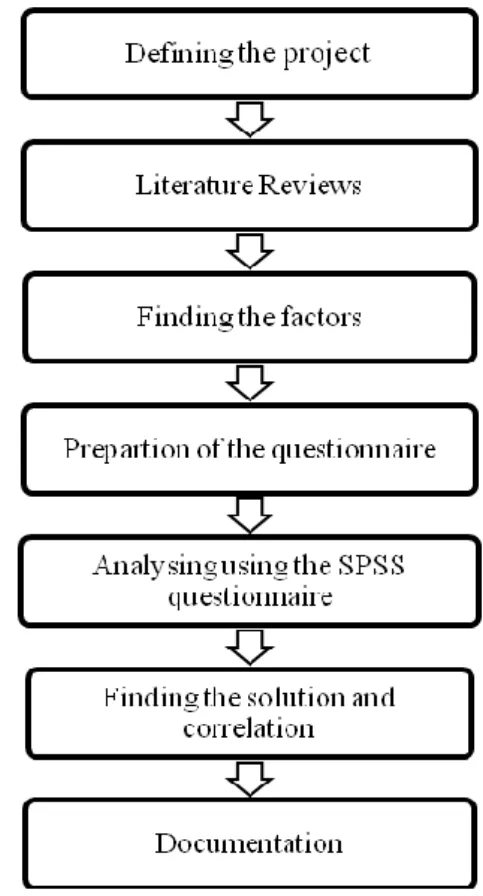
From the literature reviews, factors concerning the performance of the projects were collected and the questionnaire was prepared.
The questionnaire included questions from cost, time, quality, productivity, client satisfaction, regular and community satisfaction, people, health and safety, innovation and learning and environment.
The questionnaires were distributed to contractors, owners and consultants. Mainly the regions covered were Chennai, Kerala and Bangalore.
Respondents were asked to rank the questions from one to five based on their importance like very low, low, medium high and very high.
Based up on the responses received the questionnaire analysis was done in SPSS software v2.0.
Relative importance index was used to determine the relative significance and ranking of the causes.
Relative importance index RII is calculated as follows
RII =
Where W = weightage given to each factor by respondent and it ranges from 1 to 5. N = total number of respondents.
Fig 1.Chart showing the methodology
VII. DATACOLLECTION
The study was carried out by preparing the questionnaire from the previous studies. The questionnaire generally contained two parts
Part A: General information – It included the general information regarding the company and the respondent. Part B: It contained different factors that affect the performance of the projects. The respondent was asked to rank the factors on a scale of 1-5 according to the importance. Where scale of 1 showed very low importance and 5 very high importances.
A total of 40 questionnaires were distributed to companies in the regions of Chennai, Kerala and Bangalore. The Responses received were analyzed with Statistical Package for Social Science (SPSS) v2.0.
VIII. RELIABILITYTEST
The reliability test shows the consistency of the data collected. The Cronbach α coefficient is used to measure the inner consisitency.When the Cronchbach α is less than 0.3,the reliability is low level and it cannot be accepted. When The Cronbach α is more than 0.7 it indicates reliability is in high level. The Cronbach α for the distributed questionnaire was found to be 0.951 which shows high reliability.
Table 1 Reliability Statistics Cronbach's
Alpha
Cronbach's Alpha Based on Standardized Items
N of Items
IX. ANALYSISANDRESULTS A. Part A: General Information
Fig 2 shows the percentage of responses from the type of organization.
Fig 2: Chart showing percentage responses from organization About 53% of respondents were from the consultants firm,34% from the owner firms and 13% from the contractor firm. With reference to the response obtained 87% were from firms dealing with building projects. The fig # shows the chart of the responses from the type of projects the companies were handling.
Fig 3: Chart showing type of projects from which the responses were collected
Majority respondents were dealing with the building projects, that are 87% of the responses and 10% from roads and transportation sector.
Fig 4: Chart showing the jobtitle of respondents Fig 4 deals with the job title of the respondent. 63% were project managers, 23% from the site engineers, and 7% from the organization managers.
B. Analysis Of Factors Using SPSS Software
The main factors considered were Cost , Time, Quality, Productivity, Client satisfaction, Community Satisfaction, Environment Factors, Health and Safety, Innovation and learning Factors,
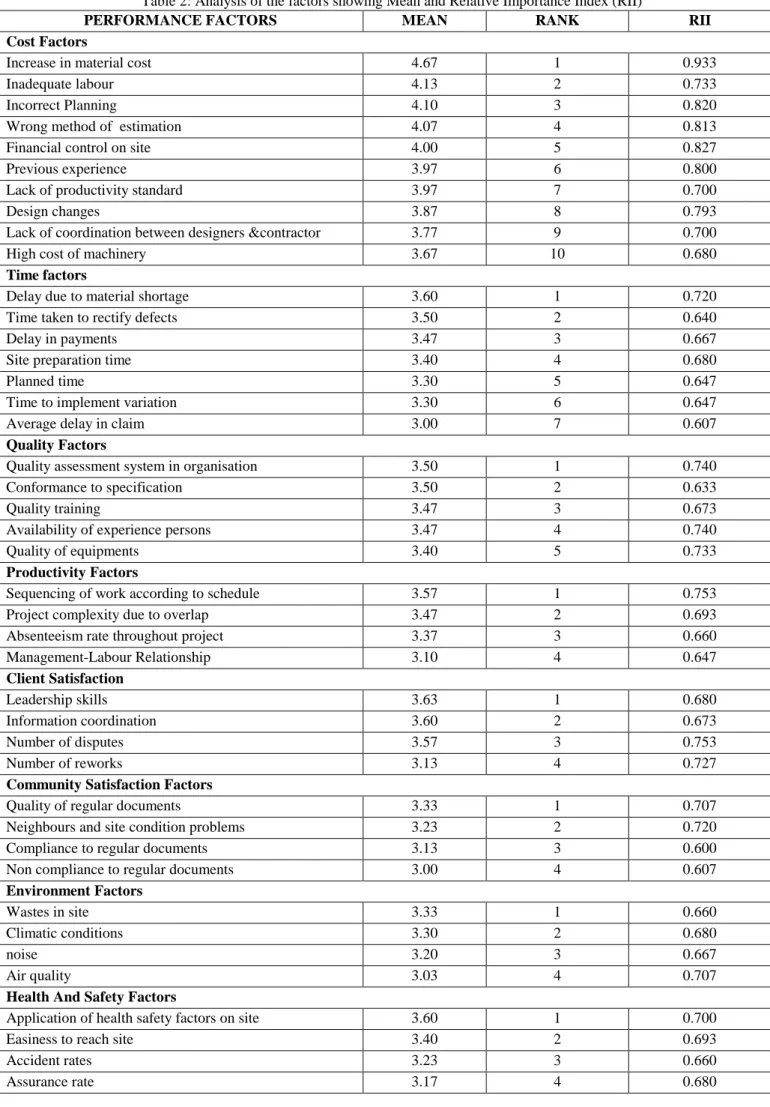
Cost factors : Increase in material cost have been ranked one in the category of cost with RII 0.933.
Time factors: Delay occurring due to material shortage stay as most important factor in time factor and it has an RII of 0.720
Quality factor : Need for a proper quality system in the organization have most importance in quality category.It has an RII of 0.740
Productivity: Sequencing of work according to schedule leads in productivity with RII of 0.753.
Client satisfaction : Leadership skills of the concerned persons ranks first in this group with an RII of 0.680 Community Satisfaction : Quality of regular documents has very high importance and it ranks top.
Environment Factor: Wastes in and around the site affects the performance of the projects.
Table 2: Analysis of the factors showing Mean and Relative Importance Index (RII)
PERFORMANCE FACTORS MEAN RANK RII
Cost Factors
Increase in material cost 4.67 1 0.933
Inadequate labour 4.13 2 0.733
Incorrect Planning 4.10 3 0.820
Wrong method of estimation 4.07 4 0.813
Financial control on site 4.00 5 0.827
Previous experience 3.97 6 0.800
Lack of productivity standard 3.97 7 0.700
Design changes 3.87 8 0.793
Lack of coordination between designers &contractor 3.77 9 0.700
High cost of machinery 3.67 10 0.680
Time factors
Delay due to material shortage 3.60 1 0.720
Time taken to rectify defects 3.50 2 0.640
Delay in payments 3.47 3 0.667
Site preparation time 3.40 4 0.680
Planned time 3.30 5 0.647
Time to implement variation 3.30 6 0.647
Average delay in claim 3.00 7 0.607
Quality Factors
Quality assessment system in organisation 3.50 1 0.740
Conformance to specification 3.50 2 0.633
Quality training 3.47 3 0.673
Availability of experience persons 3.47 4 0.740
Quality of equipments 3.40 5 0.733
Productivity Factors
Sequencing of work according to schedule 3.57 1 0.753
Project complexity due to overlap 3.47 2 0.693
Absenteeism rate throughout project 3.37 3 0.660
Management-Labour Relationship 3.10 4 0.647 Client Satisfaction Leadership skills 3.63 1 0.680 Information coordination 3.60 2 0.673 Number of disputes 3.57 3 0.753 Number of reworks 3.13 4 0.727
Community Satisfaction Factors
Quality of regular documents 3.33 1 0.707
Neighbours and site condition problems 3.23 2 0.720
Compliance to regular documents 3.13 3 0.600
Non compliance to regular documents 3.00 4 0.607
Environment Factors
Wastes in site 3.33 1 0.660
Climatic conditions 3.30 2 0.680
noise 3.20 3 0.667
Air quality 3.03 4 0.707
Health And Safety Factors
Application of health safety factors on site 3.60 1 0.700
Easiness to reach site 3.40 2 0.693
Accident rates 3.23 3 0.660
Innovation and Learning Factors
Coordination 3.70 1 0.773
Learning from own experience 3.70 2 0.733
Learning from others experience 3.67 3 0.687
Training HR 3.47 4 0.673
Reviews of failure and solve them 3.37 5 0.700
X.CONCLUSIONS AND DISCUSSIONS
The results of the analysis from SPSS software have been depicted in the Tables and Graphs shown previously.
It can be noted that
The increasing and high cost of machinery and materials have been ranked first factor in cost segment by the respondents and then inadequate labour and incorrect planning serves second and third ranks. Escalation of material prices affects the liquidity of the owners and the profit rates of contractors.
Average delay due to closures and material shortage, Time needed to rectify defects, Average delay in payments from owner to contractors have been ranked first second and third respectively under time factors.
In case of quality factors, quality assessment system have come of high importance to assess the performance of quality in the industry and conforming to the specifications, and giving quality training is the next two factors of importance
Sequencing of work according to schedule have been ranked first in productivity factors. This factor comes first since the work according to the schedule assists them to conduct the project in scheduled time for the successful completion of the project.
The leadership skill for project manager is of high importance when it comes to client satisfaction factor. If there is no proper leadership it affects the performance of the industry. The second factor is information coordination between project parties else there will be disputes in projects, so the coordination factor is of importance.
Quality and availability of regular documentation have been ranked first in community factors. Quality and availability of regular documentation affects the performance of the industry.
Concerning the environmental factors, waste around site have found to be a day to day problem and is of high importance. And climatic factors with no doubt stand right next.
Application of heath and safetyfactors in industry has been ranked as of high importance in health and safety factors. This is of primary importance because application of health and safety factors
will improve the overall performance of the industry.
Coordination among different work groups stands first in innovation and learning factors. Learning from own experience and past history is of second importance in the industry.
X1. RECOMMENDATIONS
The most important factors which were agreed by the owner contractor and the consultants were escalation of material prices, availability of resources, average delay due to closures which leads to material shortage, lack of personnel with high experience and qualifications and leadership skills for project managers.
Consultants should focus more on design cost by using multi criteria analysis and most economical criteria should be adopted so as to improve their performance and also to increase owner’s satisfaction.
Contractors should be aware of the business environment risks in their cost estimation. Enough contingency allowances should be there to guard against the increasing material prices.
Quality trainings and meetings should be done in order to improve cost time and quality performance.
The contractors should see that minimum amount of waste should be produced and also the site should be kept clean
They should be more interested in conformance to specifications to improve time and cost performance and also to overcome disputes in site.
There should be proper coordination and communication among various parties working on the project in order to improve management, control problems and reduce any avoidable delay.
X11. REFERENCES
[1] Chan, A. P. C, “Time-cost relationship of public sector projects in Malaysia”, International Journal of Project Management 19: 223–229,2001
[2] Dissanayaka, S. .; Kumaraswamy, M. M. 1,”Comparing contributors to time and cost performance in building projects”, Building and Environment 34: 31–42,May 1999
[3] Faridi, A.; El-Sayegh, S,”. Significant factors causing delay in the UAE construction industry”, Construction Management
[4] Iyer, K. C.; Jha, K.,” Factors affecting cost performance: evidence from Indian construction projects”, International Journal of Project Management 23: 283–295,November 2005
[5] Karim, K.; Marosszeky,,”Process monitoring for process re-engineering – using key performance indicators”, International Conference on Construction Process Reengineering, CPR 99, Sydney, 12–13 July.,1999
[6] Kuprenas, J. A.,”Project management actions to improve design phase cost performance”, Journal of Management in Engineering 19(1): 25–32, 2003
[7] Okuwoga, A. A,” Cost-time performance of public sector housing projects in Nigeria”, Habitat Intl. 22(4): 389–395, 1998
[8] Reichelt, K.; Lyneis, J.,”The dynamic of project performance: Benchmarking the drivers of cost and schedule overrun”, European Management Journal 17(2): 135–15, 1999
Melba Alias
M.tech in Construction Engineering and Management, SRM University, Chennai, India
Ms Dhanya R
Assistant Professor, Civil Engineering Department, SRM University, Chennai, India
Mr. N. Ganapathy Ramasamy
Assistant Professor, Civil Engineering Department, SRM University, Chennai, India