TRIGONOMETRIC SHEAR DEFORMATION THEORY FOR
THERMOELASTIC STRESS ANALYSIS OF THICK BEAM
P.H.Dinkar
1,G.R.Gandhe
2, D.H.Tupe
21
P.G. Student Department of Civil Engineering, Deogiri Institute of Engineering and Management Studies, Aurangabad (M.S)-431005, India.
2
Assistant Professor, Department of Civil Engineering, Deogiri Institute of Engineering and Management Studies, Aurangabad (M.S)-431005, India.
Abstract:-
A static flexural response of a simply supported thick isotropic beam along with non uniform thermal load is done by trigonometric shear deformation theory Temperature variation induces stresses in the structure, if the structure is restrained. This stresses vary with the magnitude of temperature changes. thermal loads are difficult to visualize and usually need to be determined by a thermal analysis By using TSDT theory we can calculate axial and
transfers displacements and bending
stresses due effect of non uniform thermal load on beam. Given theory fulfills the transverse shear stresses condition on top and bottom surface of beam. So, the theory do not requires shear correction factor. Use of constitutive relations is used for obtaining. Differential equations with great accuracy. The number of variables in the present TSDT theory is same as that in the first order shear deformation theory In this theory displacement field is expressed in terms of sinusoidal function in terms of thickness coordinate for representation of shear deformation effects. The principle of virtual work plays vital role for prevailing
governing differential equations and
boundary conditions. The thick simply supported isotropic beam along with non linear thermal loading are considered for numerical results for the efficiency of this theory.
Keywords-
Principle of virtual work, non linear thermal loading, Trigonometric shear deformation, thick beam.
I. INTRODUCTION
Improved mechanical properties of advanced composite materials have resulted in their use in structures which are acted due to thermal environment such structures are known as temperature structures having properties like high specific strength and stiffness, and low thermal coefficient. Theories of beams involve the reduction of a three dimensional problems of elasticity theory to a one- dimensional problems due to small thickness as compared to other dimensions of beam. Also some structural elements are being used in the aeronautical and aerospace industries as well as in the other fields of modern technology, primarily due to their high strength to weight ratio and stiffness to weight ratios. The transverse shear deformation effect plays an important role in the structural analysis of shear flexible structures. Beams are common structural elementsin most structures and they are analyzed using classical or refined shear deformation theories to evaluate static and dynamic characteristics. Main inventor of elementary theory of beam deflection theory is basic theory which is also known as Euler-Bernoulli hypothesis which is applicable for slender beams and not for thick or deep beams this theory underestimates deflections since it exclude the effect of shear deformation and stress concentration. Since it is based on assumption that the transverse normal to neutral axis remains normal before and after bending., also transverse shear strain is zero. Due to drawback of this elementary theory refined theories were proposed in those theories shear deformation
and rotator inertia were considered. Bresse [1], Rayleigh [2], and Timoshenko [3] were the main inventers for refined theories. The effect of transverse vibration of prismatic bars is then shown by Timoshenko hypothesis. This theory is now known as Timoshenko beam theory or first order sheardeformation theory (FSDT). In FSDT requires shear correction factor due to transverse shear strain distribution is assumed to be constant throughout the beam thickness represent the strain energy of deformation. Cowper [4] has given refined expression for the shear correction factor for different cross sections of beam. To remove the drawbacks in classical and first order shear deformation theories,modified shear deformation theories were developed and are available in the open literature for static and thermal analysis of beam.
Levinson [6], Bickford [7], Rehfield and Murty [8], Krishna Murty [9], Baluch, Azad and Khidir [10], Bhimaraddi and Chandrashekhara [11] presented parabolic shear deformation theories. These theories preclude the need of shear correction factor because it satisfy that top and bottom surfaces of beam having zero shear stress. There is another class of modified theories, which includes trigonometric functions to represent the shear deformation effects through the thickness. Vlasov and Leont’ev [17], Stein [18] explained refined shear deformation theories for thick beams are given by sinusoidal function in terms of thickness coordinate in displacement field. but, shear stress free boundary conditions are not satisfied at top and bottom surfaces of the beam with these theories. To overcome this problem, modified theory given by Ghugal and Shimpi [20] have given the research work along with static flexural analysis of thick beams using refined trigonometric and hyperbolic shear deformation theories are very scarce and is still inneed.
In this paper development of trigonometric theory and its application to thick simply supported beam with non linear thermal load is presented for calculating axial, and transfers displacement, axial/normal and shear stresses.
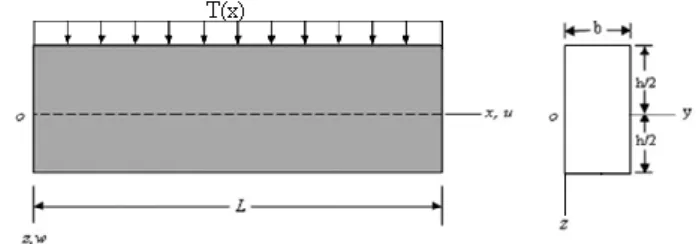
Figure 1: Simply supported beam
bending under x-zPlane
II.
Developement of ProblemConsider a isotropic and thick, simply supported beam of length L, Width b and depth h in x, y, z axis respectively as shown in Figure 1. . The beam is subjected to non linear thermal load of intensity T(x, z) on full length of beam.cross section of beam we get
/ 2
/ 2 0
x
L 0
y
b
h
z
h
1.1.Assumptions Made In the Present Theory
The following are assumptions for the present theory using theoretical formulation .
1. The stain is small due to small displacement as compare to its thickness. 2. The transverse displacement contains bending ( bw) and shear (sw) components.
3. The beam is subjected to thermal load only.
4. In this body forces are neglected.
1.2. The Displacement field
The displacement field in terms of trigonometric function is according to the shearing stress distribution through the thickness of beam of the present beam theory can be expressed as follows.
1. Axial Displacement=
( , ) dw / .sin( / ( ) [1] u x z z h z h x dx
2. Transverse Displacement =
w( , )
x z
w( ) [2]
x
Here (u, w) are the axial displacements along x, andz directions respectively, and
ᵠ is the rotation of
beam at neutral axis, which is an unknown function to be determined. 3. Normal Strain =
2
sin(
)
[3]
2
xd w
h
z
d
z
h dx
dx
4. Shear Strain =cos( z/ h) [4]
xz
Where u ,w are axial and transverse displacement in x, and z direction of the beam
1
( )
0 1( ) [5]
z
T x
T
T x
h
whereT0,T1(x) are thermal load
5 . Stress Strain Relationship=
1
[
( )] [6]
xE
xT x
Where-T x
1( )
T
0z
T x
1( )
h
Stresses:- The one dimensional Hooke s law is applied for isotropic material.
Therefore:- x
E
[
xT
0z
T x
1( )]
h
Shear stresscos( z/ h) [7]
xzG
where E is modulus of elasticity and G is modulus of rigidity of the beam . And αx and αy are the
coefficients of thermal expansion in x and y directions respectively thermal load across the thickness is assumed to be
III. Governing differential Equations and Boundary Conditions
Using the principle of virtual work, variationally consistent governing differential equations and
boundary conditions for the beam under consideration can be obtained.
Principle of virtual work=
/ 2
(
)
0
/ 2
( )
0 [8]
0
x x xz xzx
l z
h
b
dxdz
x
z
h
x
l
q x dwdx
x
Where δ = variational operator.
Applying Greens theorem in above Equation, and associated boundary conditions of the beam we obtain the coupled Euler-Lagrange equations which gives
Governing differential equations are as follows…
4
3
3
1.EI
24
/
4
3
2 1(x)
/
( )
0 [9]
2
d w
d
EI
dx
dx
T
EI h
q x
x
13
2
3
2
24
/
6
/
3
2
3
24
/
( ) /
/ 2
0 [10]
d w
d
EI
EI
dx
dx
EI
h T x
x GA
Following are the associated natural boundary conditions obtained as follows
along the edges x = 0 and x = L.
1( )
3
2
3
v
24
/
3
2
/
x0 or w is priscribed [11]
d w
d w
EI
EI
x
dx
dx
T
EI h
x
1( )
2
3
M
24
/
2
/ .
0
is priscribed [12]
x xd w
d
EI
EI
dx
dx
dw
EI h T
dx
1( )
2
24
6
3
2
2
24
0 is priscribed [13]
3
xEI d w
EI
M
s
dx
EI
hT
IV. The solution scheme
The boundary conditions for simply supported edges are
At x=0 x=L
0
,
0,
0v w
The following is the solution form v(x,z),w(x,z) ɸ (x,z)
for satisfies above boundary conditions exactly
0
w( , z) =
sin(
/ )
1
mx
w
m x a
m
0.sin(
/ l)
w
w
x
0(x, z) =
cos(
/ )
1
mm x a
m
0cos(
x
/ l)
1( ) 0sin(
/ )
1
x mT
T
m x a
m
1 0T (x)
T sin(
x
/ l)
m,n=1
Where
0( )
sin(
/ l)
q x
q
x
But Q0 =0 (Mechanical load is absent)
The maximum intensity of thermal load is T0. and for single non linear thermal load (m = n = 1), equations which can be written into a matrix form as follows:
0
.
{ f } [14]
0
w
K
.Where [K] is the stiffness matrix { f } is the force vector.From solution of above equations unknown coefficients {
w
0,
0 } can be obtained easily. After putting above values in above equation generalized displacements and rotations can be obtained and also in plane stresses and transverse stresses can be obtained.V. Illustrative example:
The following numerical examples are considered to prove the efficacy of the present theory The following material properties for steel beam are used having E = 210 GPa, μ = 0.3 and
α=12.e-6where E is the Young’s modulus and μ is the Poisons, α is coefficient of thermal expansionUnits Cross section of beam is as follows Given Data Length=3m, Width=0.23m, Depth=0.30m and subjected to non linear thermal load on it
Example 1 :Non linear thermal load on Simply supported beam
A Simply supported beam supported at x = 0 and x=L. The General expressions obtained for w(x) and ϕ(x) are as follows by using differential Equations and matrix method
4
3
3
1.EI
24
/
4
3
2 1(x)
/
( )
0 [15]
2
d w
d
EI
dx
dx
T
EI h
q x
x
1(x) 3
3
2
3
2
2. 24
/
6
/
3
2
24
/
/ 2
0 [16]
d w
d
EI
EI
dx
dx
T
EI
h
GA
x
Written in matrix form to get the unknown parameters 7 7 7 7 22970.8 12.421. 9.2. 0 16795.1322 9.2. 272.205. 0 w e e e e
By using Fourier series Theory
0.001825sin(
/ l) [17]
w
x
0.00000000253.cos( x/ l) [18]
After that ,Normal stress is calculated
xx
2
0.005730
/
sin(
/ )
0.00000000025 / sin(
/ )
[ sin(
/ )] [19]
z
l
x l
h l
z h
x l
Shear Stress is calculated by using relationship
0 [20]
x xzx
z
2 2
3
0.005730
/ 2
cos(
/ )
2
2
0.000000000253
/
cos(
/ )
[ cos(
/ h)] C [21]
1
xzz
l
x l
h
l
x l
z
Applying boundary conditions at z=h/2 ,
0
xz
2 3
1
0.0057303(
) / 8
cos(
/ )
C
h
L
x l
After putting values of C1 in equation [21]
2 2 ( ) 0.0057303 cos( / ) 3 2 ( ) 0.0057303 cos( / ) 3 8 2 0.00000000253( ) cos( / ) cos( / ) [22] z x l xz l h x l l h l x l z h
VI. Numerical results:
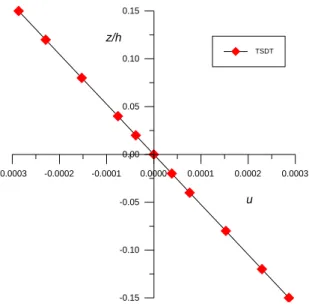
The numerical results for axial displacement, axial normal stress and transverse shear stress are presented in following form and the values are presented in.Values for Displacement, Normal stress and Shear Stress for different values of z from 0 to 0.3 Table 1- Z/h U ơx Ʈxz 0.15 -0.0002865 0.00029998 0 0.12 -0.0002292 0.0002399 0.00008474 0.08 -0.00015281 0.0001599 0.00001684 0.04 -0.000076066 0.00007997 0.000021866 0.02 -0.0000382 0.00003998 0.000023122 0 0 0 0.000023541 -0.02 0.0000382 -0.00003998 0.000023122 -0.04 0.000076066 -0.00007997 0.000021866 -0.08 0.00015281 -0.0001599 0.00001684 -0.12 0.0002292 -0.0002399 0.00008474 -0.15 0.0002865 -0.00029998 0
-0.0003 -0.0002 -0.0001 0.0000 0.0001 0.0002 0.0003 -0.15 -0.10 -0.05 0.00 0.05 0.10 z/h u TSDT
Figure1.Variation of axial displacement across the thickness(u) -0.0003 -0.0002 -0.0001 0.0000 0.0001 0.0002 0.0003 -0.15 -0.10 -0.05 0.00 0.05 0.10 0.15 TSDT z/h x
Figure 2. Variation of in plane normal stress across the thickness(σx)
0.000000 0.000005 0.000010 0.000015 0.000020 0.000025 -0.15 -0.10 -0.05 0.00 0.05 0.10 TSDT z/h zx
Figure 3. Variation of transverse shear stress (τxz)
VII. Concluding Remark
Through study of above theory gives following conclusions as follows .
1.Present theory is variation ally consistent and requires no shear correction factor.
2. The present theory gives good result for getting transverse displacements and shear stresses.
3. Transverse shear stresses obtained using above theory by constitutive relations satisfy shear free condition on the top and bottom surfaces of the beams.
4. The output of maximum axial displacement u obtained by present theory. The variation of u is presented as shown in Figure 1
5. The variation of maximum dimensional axial stresses σ x for a beam as shown
in Figure 2.
6. We get the maximum transverse shear stress taken out using present theory with the help of constitutive
Figures 3.
ABBRIVATIONS
ETB- Elementary Theory of Beam Bending FSDT- First-order Shear Deformation Theory HSDT Higher-order Shear Deformation Theory TSDT -Trigonometric Shear Deformation Theory
References
1. J. A. C. Bresse, Cours de Mechanique Applique, Mallet-Bachelier, Paris, 1859. 2. J. W. S. Lord Rayleigh, The Theory of
Sound, Macmillan Publishers, London, 1877.
3. S. P. Timoshenko, J. N. Goodier, Theory of Elasticity, Third International Edition, McGraw-Hill, Singapore. 1970.
4. G. R. Cowper, The shear coefficients in
Timoshenko beam theory, ASME Journal of
Applied Mechanic, vol33, no. 2, 1966, pp. 335-340.
5. G. R. Cowper, On the accuracy of
Timoshenko beam theory, ASCE J. of
Engineering Mechanics Division. vol.94, no. EM6, 1968, pp. 1447-1453,
6. M. Levinson, A new rectangular beam
theory, Journal of Sound and Vibration, Vol.
74, No.1, 1981, pp. 88 87.
7. W. B. Bickford, A consistent higher order beam theory, International Proceeding of Development in Theoretical and Applied Mechanics(SECTAM), vol. 11, 1982, pp. 137-150.
8. L. W. Rehfield, P. L. N. Murthy, Toward a new engineering theory of bending: fundamentals, AIAA Journal, vol. 20, no. 5, 1982, pp. 693-699.
beam theory, AIAA Journal, vol. 22, no. 6, 1984,pp. 811-816.
10. M. H. Baluch, A. K. Azad, and M. A.
Khidir, Technical theory of beams with
normal strain, ASCE Journal of Engineering Mechanics, vol. 110, no. 8, 1984, pp. 1233-1237.
11. A. Bhimaraddi, K. Chandrashekhara,
Observations on higher order beam Theory, ASCE Journal of Aerospace Engineering, vol. 6, no. 4, 1993,pp. 408-413.
12. Vlasov, V. Z., Leontev, U. N., Beams, plates and shells on elastic foundations, Moskva, Chapter1,18. Translated from the Russian by Barouch A.andPlez T., Israel Program for Scientific Translation Ltd., Jerusalem, 1966.
13. Ghugal Y. M. and Dahake A. G., Flexural Analysis of Deep Beam Subjected to Parabolic Load Using Refined Shear Deformation Theory, Applied and Computational Mechanics, 2012, 6(2),pp. 163-172.
14. Ghugal Y. M. and Sharma R. D., "A refined shear deformation theory for flexure of thick beams", Latin American Journal of Solids and Structures,2011, Vol:8 , pp. 183-195. 15. Dahake A. G. and Ghugal Y. M., Flexure of
Thick Simply Supported Beam Using trigonometric Shear Deformation Theory, International Journal of Scientific and Research Publications, 2012, 2(11), pp. 1-7. 16. Ghugal Y. M. and Dahake A. G., Flexure of
Simply Supported Thick Beams Using Refined Shear Deformation Theory, World Academy of Science, Engineering and Technology, International Journal of Civil, Architectural, Structural and Construction Engineering, 2013, Vol:7 No:1, pp. 82-91.
Displacement and Stresses for Thick Beam using New Hyperbolic Shear Deformation Theory, International Journal of Pure and Applied Research in Engineering and Technology, 2015, Vol. 3, Issue 9, pp. 120-130.
18. Chavan V. B. and Dahake A. G., A Refined Shear Deformation Theory for Flexure of Thick Beam International Journal of Pure and Applied Research in Engineering and Technology, 2015,Vol. 3, Issue 9, pp. 109-119.
19. Ghugal Y. M. and Shimpi R. P., "A Review of Refined Shear Deformation Theories for Isotropic and Anisotropic Laminated Beams",2001,Vol: 20, No:3, pp. 255-272. 20. Ghugal Y. M. and Dahake A. G., Flexure of
Thick Beams Using Refined Shear Deformation Theory, International Journal of Civil and Structural Engineering, 2012, 3(2), pp. 321-335.
21. G. R. Gandhe V. S. Kulkarni Y. M. Ghugal
Thermo elastic Stress Analysis Perfect Clamped Metallic Rod Using Integral Transform Technique, springer india 2015 .V.Matasagar(ed),Advanced in Structural engineering
22. Tupe D.H. and Dahake A.G Trigonometric Shear Deformation Theory For Thick Simply Supported Beams, International Journal of Re- search in Engineering and Technology, Vol. 4, No. 13, pp. 476-483, 2015.
23. Zhen W and Wanji C (2005). An efficient higher-order theory and finite element for laminated plates subjected to thermal loading. Journal of Composite Structures 73, pp. 99-109
(2007). Thermal stress analysis for laminated plates using actual temperature field. International Journal of Mechanical Science 49, pp. 1276– 1288.