R E S E A R C H A R T I C L E
Open Access
Prescribing patterns in dementia: a multicentre
observational study in a German network of CAM
physicians
Elke Jeschke
1, Thomas Ostermann
2*, Horst C Vollmar
3,4, Manuela Tabali
1, Friedemann Schad
1and Harald Matthes
1Abstract
Background:Dementia is a major and increasing health problem worldwide. This study aims to investigate dementia treatment strategies among physicians specialised in complementary and alternative medicine (CAM) by analysing prescribing patterns and comparing them to current treatment guidelines in Germany.
Methods:Twenty-two primary care physicians in Germany participated in this prospective, multicentre
observational study. Prescriptions and diagnoses were reported for each consecutive patient. Data were included if patients had at least one diagnosis of dementia according to the 10th revision of the International Classification of Diseases during the study period. Multiple logistic regression was used to determine factors associated with a prescription of any anti-dementia drug includingGinkgo biloba.
Results:During the 5-year study period (2004-2008), 577 patients with dementia were included (median age: 81 years (IQR: 74-87); 69% female). Dementia was classified as unspecified dementia (57.2%), vascular dementia (25.1%), dementia in Alzheimer’s disease (10.4%), and dementia in Parkinson’s disease (7.3%). The prevalence of anti-dementia drugs was 25.6%. The phytopharmaceuticalGinkgo biloba was the most frequently prescribed anti-dementia drug overall (67.6% of all) followed by cholinesterase inhibitors (17.6%). The adjusted odds ratio (AOR) for receiving any anti-dementia drug was greater than 1 for neurologists (AOR = 2.34; CI: 1.59-3.47), the diagnosis of Alzheimer’s disease (AOR = 3.28; CI: 1.96-5.50), neuroleptic therapy (AOR = 1.87; CI: 1.22-2.88), co-morbidities hypertension (AOR = 2.03; CI: 1.41-2.90), and heart failure (AOR = 4.85; CI: 3.42-6.88). The chance for a prescription of any anti-dementia drug decreased with the diagnosis of vascular dementia (AOR = 0.64; CI: 0.43-0.95) and diabetes mellitus (AOR = 0.55; CI: 0.36-0.86). The prescription ofGinkgo biloba was associated with sex (female: AOR = 0.41; CI: 0.19-0.89), patient age (AOR = 1.06; CI: 1.02-1.10), treatment by a neurologist (AOR = 0.09; CI: 0.03-0.23), and the diagnosis of Alzheimer’s disease (AOR = 0.07; CI: 0.04-0.16).
Conclusions:This study provides a comprehensive analysis of everyday practice for treatment of dementia in primary care in physicians with a focus on CAM. The prescribing frequency for anti-dementia drugs is equivalent to those found in other German studies, while the administration ofGinkgo biloba is significantly higher.
Background
The management of dementia is a key challenge in mod-ern health systems. The prevalence of dementia within people aged 65 years or older is 6.8% [1,2]. It increases with patient age and doubles every 5 years [3]. As the proportion of people aged 65 years or older rises from 16.8% in 2010 to 23.5% in 2050, the number of dementia
cases will also increase from 1.21 million people today to 2.62 million people in 2050 in Germany alone [2]. It is estimated that the number of sufferers from dementia worldwide will increase from 35.6 million today to 65.7 million by 2030 and 115.4 million by 2050 [3]. The raise in dementia patients is directly correlated with increasing costs in the health care systems. While 7.1 million euros were expended in Germany for treatment and care of dementia in 2002, the costs increased to 7.8 million euros in 2004, 8.6 million euros in 2006, and finally 9.4 million euros in 2008 [4].
* Correspondence: [email protected] 2
Center for Integrative Medicine, University of Witten/Herdecke, Gerhard-Kienle-Weg 4, 58313 Herdecke, Germany
Full list of author information is available at the end of the article
Alzheimer’s disease and vascular dementia are the two most common types of age-related dementia. Alzheimer’s disease accounts for more than 65% of dementia in the elderly [1]. At present no curative treatment is available. Interventions focus on slowing the course of the disease. Compared with placebo, pharmacological treatment with cholinesterase inhibitors and memantine has shown improvements in outcomes such as cognition and global
functioning in Alzheimer’s disease [5,6]. However,
the clinical relevance of these treatment effects seems marginal [7,8].
Some studies have indicated that complementary and alternative medicine (CAM) from the areas of phytother-apy, traditional Chinese medicine, or homoeopathy has potential in the treatment of dementia [9-11]. In particu-lar the phytopharmaceuticalGinkgo bilobais traditionally used quite frequently [12,13]. In Germany, in contrast to some other countries,Ginkgo bilobais available as pre-scription drug for the therapy of mild to moderate dementia. Although there is acceptable physiological compatibility and sufficiently proven safety, there is still an unclear picture of evidence [14,15]. According to the meta-analysis of Weinmann et al. the change of scores
for cognition were in favour ofGinkgo bilobacompared
to placebo, but they did not show a statistically signifi-cant difference from placebo for activities in daily living [16]. The German Institute for Quality and Efficiency in Health Care (IQWIG) found only a small benefit for the 240 mg preparation and criticised the heterogeneity of the study results [17]. In fact,Ginkgo biloba is not yet included in evidence-based dementia guidelines pub-lished in Germany.
The development, dissemination, and implementation of these dementia guidelines are a key strategy for improving the care of persons with dementia. In Germany one guide-line from the German Society of General Physicians (DEGAM) with a focus on family medicine was published in 2008 while another one from the German Society of Neurology and German Society of Gerontopsychiatry (DGN and DGPPN) mainly for specialists was finalised in 2009 [18,19]. Unfortunately both guidelines reveal differ-ent recommendations for the treatmdiffer-ent of demdiffer-entia, which might be due to the abovementioned inconsistent appraisal of clinical relevance from study results. The DEGAM guideline is much more cautious in the recom-mendation of cholinesterase inhibitors than the guideline of the DGN/DGPPN, and while memantine is recom-mended for Alzheimer’s disease in the guideline of the DGN/DGPPN, the DEGAM only recommends it as an individual approach for therapy [20].
In therapy for vascular dementia, recommended thera-pies focus on the treatment of cardio-vascular risk fac-tors, e.g. the prevention of prospective strokes. The treatment of vascular dementia with anti-dementia drugs,
until now, did not produce a reliable portfolio of evidence and thus the DEGAM does not give any recommenda-tions where the DGN/DGPPN allows for a selective ther-apeutic attempt in single cases. However, with respect to the high amount of elderly patients, guidelines mainly discuss the problems occurring with age-related co-mor-bidity and poly-pharmacy.
Apart from two concurrent German guidelines, an addi-tional barrier to guideline adherence is the difficulty faced by physicians in reconciling patient preferences with guideline recommendations [21]. According to studies in a variety of primary care settings, patient expectations and preferences can influence the health care provided to them [22-24]. This issue may be particularly salient in the setting of CAM, as patients seeking treatment from physi-cians specialised in this field are likely to expect to receive some form of alternative therapy. Furthermore, one should not underestimate the impact of the physician’s conviction on the prescription practice. In a survey of German GPs, ginkgo preparations for dementia were voted to be equally as effective as cholinesterase inhibitors and memantine [25].
The present study thus aims (a) to analyse prescribing patterns among primary care physicians specialised in CAM, b) to investigate conformity and variations in pre-scriptions according to the German dementia guidelines (DEGAM and DGN/DGNPP), c) to identify different treatment strategies in GPs and neurologists and d) pro-vide information of co-morbidities of patients with dementia visiting primary health care physicians specia-lised in CAM.
Methods
In total, 22 primary care physicians in Germany partici-pated in this prospective, multicentre observational study. All of them were members of the EvaMed Network, which aims to evaluate CAM remedies in usual care with regard to prescribing patterns, efficacy, and safety [26-28]. Physi-cians were recruited through the German National
Asso-ciation of Anthroposophic Physicians (Gesellschaft
dermatology, and gynaecology and were excluded from the study. Each of the remaining 22 physicians had practised for at least 5 years in addition to completing training in anthroposophic medicine.
The present study is based on secondary data provided by physicians for health insurance accounting. As such, the recommendations for good practice in secondary data analysis (e.g. anonymisation of data on prescriptions and diagnoses) developed by the German Working Group on the Collection and Use of Secondary Data [29] were applied in full.
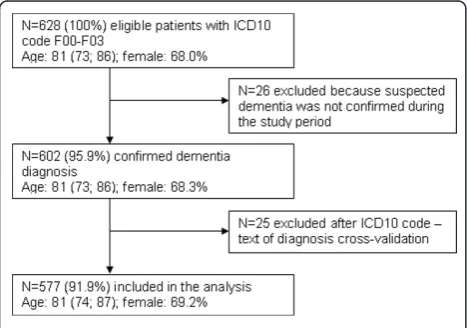
Data were included if patients had at least one diagno-sis of dementia according to the 10th revision of the International Classification of Diseases (ICD10: F00-F03) during the 5-year study period (01.01.2004-01.01.2009). Data were excluded if the diagnosis dementia was only a suspected diagnosis and not confirmed during the study period and if a cross-validation of the ICD10 code and text of diagnosis indicated an incorrect coding. Figure 1 shows the flow chart of the inclusion process.
During the study, physicians continued to follow their routine documentation procedures, recording diagnoses and all prescriptions for each consecutive patient using their existing, computerised patient documentation sys-tem. These data were exported to the QuaDoSta post-greSQL database hosted in each practice [30]. Physicians used a browser-based interface to match individual diag-noses with the corresponding drugs or remedies that had been prescribed. Prescribed drugs were documented using the German National Drug Code. Diagnoses were coded according to the 10th revision of the International Classification of Diseases (ICD-10).
Dementia was classified as‘Dementia in Alzheimer’s dis-ease’,‘Vascular dementia’,‘Dementia in Parkinson’s dis-ease’, and‘Unspecified dementia’. Co-morbidities were classified as hypertension, depression, heart failure, chronic
ischemic heart disease, cardiac arrhythmias, diabetes melli-tus, dyslipidemia, atherosclerosis, other cerebrovascular diseases, pressure ulcer, stroke, cerebral infarction, arthro-pathies, and dorsopathies. Multi-morbidity was considered if a patient had at least 2 co-morbidities.
Study investigators identified all drugs and remedies pre-scribed for dementia. Each substance was classified using the Anatomical Therapeutic Chemical Index (ATC) and anti-dementia drugs were clustered into cholinesterase inhibitors (i.e. donepezil, rivastigmine, galantamine), mem-antine,Ginkgo biloba, and older anti-dementia drugs (e.g. piracetam, nimodipine, and selegiline). Other medication was classified as antidepressants, anitpsychotics, benzodia-zepine, anti-Parkinson drugs, antiepileptics, and sedatives.
Statistical analysis was performed with SPSS 18.0 for Windows. Descriptive analysis was used to determine prescription rates. Means and standard deviations (SD) were calculated for continuous, normal data. In cases where data were not normally distributed, medians and interquartile ranges (IQR) were reported. Subgroup ana-lyses of prescribing rates were performed for patient age (under 60 years, 60-69 years, 70-79 years, 80-89 years, 90-99 years, 100 years and older), gender, and co-mor-bidities. The two-tailed Chi square test was used to ana-lyse differences in prescription rates. APvalue of less than 0.05 was regarded as indicating a statistically signifi-cant difference.
Adjusted odds ratios (AOR) and 95% confidence inter-vals (CI) were calculated using multiple logistic regressions to determine factors associated with a) a prescription of
any anti-dementia drug and b) a prescription ofGinkgo
bilobaversus cholinesterase inhibitors and/or memantine. Age, sex, physician specialization (neurologist vs. GP), year of prescription, type of consultation (first vs. follow up), type of dementia, multi-morbidity, co-morbidities, neuro-leptic, and antidepressant therapy were included as inde-pendent variables. Patient age was introduced in the model as a continuous variable. For the“best-fitting” logis-tic regression model, we employed the stepwise Akaike Information Criterion (AIC).
Results
Physicians
Of the 22 physicians, 17 were GPs (77%) and 5 were specialist GPs (23%). The participating physicians did not differ significantly from the overall population of physicians certified in anthroposophy in Germany (n = 362) in terms of age (mean = 49.4; SD = 6.3 years vs.
mean = 47.5; SD = 6.1 years; P = 0.709) or gender
(60.0% vs. 62.2% men;P= 0.917), and were only slightly younger and consisted of a similar percentage of women compared to all office-based physicians in Germany (mean 52.0 years; 61.2% men) [31].
Study population
During the 5-year study period, a total of 577 patients with dementia were included. The inclusion process is shown in Figure 1. 374 patients (64.8% of all patients) were treated by a GP and the remaining 203 patients were treated by a neurologist. 69.2% of the patients were female. The median age of the patients was 81 years (IQR: 74, 87). Altogether, 4.9% of the patients were under 60 years (n = 28), 10.1% were 60-69 years (n = 58), 27.2% were 70-79 years (n = 157), 41.4% were 80-89 years (n = 239), 16.1% were 90-99 years (n = 93), and 0.3% were 100 years or older (n = 2). Dementia was classified as unspecified dementia (57.2%), vascular
dementia (25.1%), dementia in Alzheimer’s disease
(10.4%), and dementia in Parkinson’s disease (7.3%).
Table 1 shows the sample of patients according to age, sex, and type of dementia.
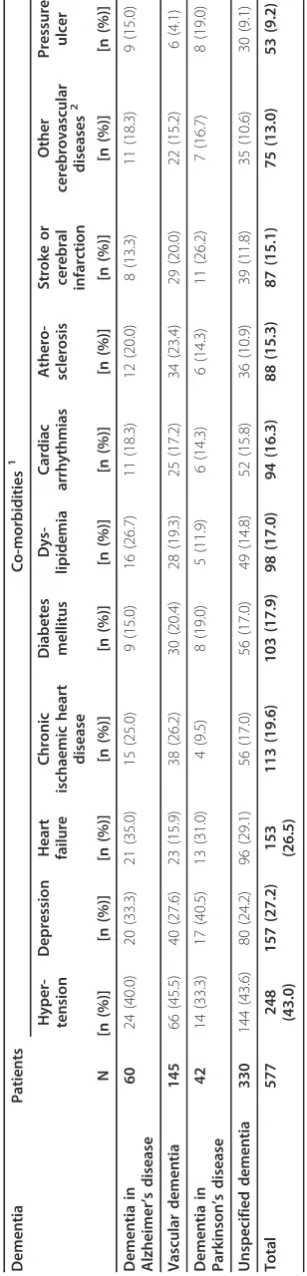
In total, 76.4% of all patients (n = 441) had two or more co-morbidities and were therefore classified as multi-mor-bid. The most frequent co-morbidities were hypertensive diseases (43.5% of all patients), other forms of heart dis-ease (38.8%), dorsopathies (30.3%), arthropathies (29.8%), mood [affective] disorders (27.7%), and ischemic heart dis-eases (23.1%). Table 2 provides a detailed overview of the most frequent co-morbidities of the participating patients according to type of dementia.
Anti-dementia drug therapy
In total, 25.6% of all patients (n = 148) were prescribed anti-dementia drugs (i.e. cholinesterase inhibitors, meman-tine, orGinkgo biloba). Table 3 gives a detailed overview of the included patients according to anti-dementia drugs and type of dementia. Most of the patients receivedGinkgo biloba(n = 99). 11.3% of all patients (n = 65) received an anti-dementia drug therapy with cholinesterase inhibitors or memantine. Cholinesterase inhibitors were prescribed for 40 patients. Donepezil was the most frequently pre-scribed cholinesterase inhibitor (n = 29), followed by galantamine (n = 10) and rivastigmine (n = 8). In total, 32 patients were prescribed memantine. Thirty patients were prescribed 2 or 3 different anti-dementia drugs,
mostly in combination withGinkgo biloba(memantine
andGinkgo biloban = 10; cholinesterase inhibitors and
Ginkgo biloban = 9; cholinesterase inhibitors and meman-tine n = 8, cholinesterase inhibitors, memanmeman-tine and
Ginkgo biloban = 4). Only 6 patients received older anti-dementia drugs like piracetam, nimodipine, and selegiline.
56.7% of patients with dementia with Alzheimer’s dis-ease received anti-dementia drugs, whereas less than 25% of patients with other dementia types were prescribed anti-dementia drugs (Table 3). Donepezil and memantine were prescribed mostly for patients with dementia with
Alzheimer’s disease. The phytotherapeutical Ginkgo
bilobawas prescribed for patients with dementia with Alzheimer’s disease, vascular dementia, and unspecified dementia in equal shares (16% - 20%). Patients with
vas-cular dementia were prescribedGinkgo biloba(15.9%
Ginkgo bilobavs. 2.0% of any other anti-dementia drug) nearly exclusively.
In total, 448 prescriptions of anti-dementia drugs for the 148 patients who received at least one of these drugs were
reported. The phytopharmaceuticalGinkgo bilobawas the
most frequently prescribed anti-dementia drug overall (67.6% of all anti-dementia drugs).
Prescriptions for dementia-related co-morbidities
The most frequent medication prescribed to patients for dementia-relevant co-morbidities were antidepressants (20% of all patients), antipsychotics (15%; thereof risperi-done 7%, butyrophenone 7%), and benzodiazepine (10%). Table 4 provides a detailed overview of these medications according to type of dementia. In total, 18 patients
received the antidepressant CAM remedyHypericum
per-foratum(14.6% of all patients with antidepressants). The antipsychotic risperidone was prescribed for 7 patients with dementia with Alzheimer’s disease, 7 patients with vascular dementia, 2 patients with dementia with Parkin-sons’s disease, and 24 patients with unspecified dementia. Of the 40 patients being prescribed cholinesterase inhibi-tors, only one received additional anticholinergic agents during the study period.
There were significant differences in the proportion of patients treated with an antidepressant (GP: 17.6%;
neurol-ogist: 28.1%;P= 0.003) and benzodiazepine (GP: 11.4%;
Table 1 Patients according to age, sex, and type of dementia
Dementia Patients Age [years] Sex [%]
Male Female
N Median (IQR) % %
Dementia in Alzheimer’s disease 60 79 (74.0; 85.0) 35.0 65.0
Vascular dementia 145 77 (69.5; 83.5) 33.1 66.9
Dementia in Parkinson’s disease 42 79 (74.5; 84.3) 38.1 61.9
Unspecified dementia 330 83 (76.5; 88.0) 28.1 71.8
neurologist: 6.4%;P= 0.039) according to physician’s spe-cialisation. No difference was found for the treatment with antipsychotics (GP: 15.8%; neurologist: 14.3%;P= 0.635).
Factors related to any anti-dementia drug therapy
Table 5 shows the adjusted odds ratio (AOR) for factors associated with the prescription of any anti-dementia drug. The AOR for receiving any anti-dementia drug was greater than 1 for the neurologists (AOR = 2.34; CI: 1.59-3.47), the diagnosis of Alzheimer’s disease (AOR = 3.28; CI: 1.96-5.50), hypertension (AOR = 2.03; CI: 1.41-2.90), heart failure (AOR = 4.85; CI: 3.42-6.88), and neu-roleptic therapy (AOR = 1.87; CI: 1.22-2.88). The odds for a prescription of any anti-dementia drug decreased with the diagnosis of vascular dementia (AOR = 0.64; CI: 0.43-0.95) and diabetes mellitus (AOR = 0.55; CI: 0.36-0.86). Patient age, sex, consultation type (first vs. follow up), multi-morbidity, and the year of prescription had no influence.
Factors related to the prescription ofGinkgo biloba
The prescription ofGinkgo biloba was associated with
sex, patient age, physician’s specialisation, and the type of dementia (Table 5). Older patients (AOR = 1.06; CI:
1.02-1.10) were more likely to receive Ginkgo biloba.
Female sex (AOR = 0.41; CI: 0.19-0.89), treatment by a neurologist (AOR = 0.09; CI: 0.03-0.23), and the diagno-sis of Alzheimer’s disease (AOR = 0.07; CI: 0.04-0.16)
rapidly reduced the odds of being prescribed Ginkgo
biloba, whereas co-morbidity, co-medication, consulta-tion type, and the year of prescripconsulta-tion had no influence.
Discussion
In this paper we present the results of a secondary data analysis of electronic health record data from the EvaMed Network, a German network of CAM-oriented physicians. Overall, 25.6% of the patients with dementia were prescribed anti-dementia drugs.
The prescription of any anti-dementia drug was posi-tively associated with physicians specialising in neurology, the diagnosis of Alzheimer’s disease, neuroleptic therapy, co-morbidities hypertension, and heart failure. The odds for a prescription of any anti-dementia drug decreased with the diagnosis of vascular dementia and diabetes mellitus.
In coherence with their orientation, the phytopharma-ceuticalGinkgo bilobawas the most frequently prescribed anti-dementia drug overall (67.6% of all anti-dementia
Table 4 Sample of patients with dementia subdivided according to medication prescribed for dementia relevant co-morbidities
Dementia Patients Medication1
Antidepressants Antipsychotics Benzodiazepine Anti-Parkinson drugs Antiepileptics Sedatives
N [n (%)] [n (%)] [n (%)] [n (%)] [n (%)] [n (%)]
Dementia in Alzheimer’s
disease
60 20 (33.3) 22 (36.7) 9 (15.0) 7 (11.7) 7 (11.7) 7 (11.7)
Vascular dementia 145 15 (10.3) 12 (8.3) 13 (9.0) 4 (2.8) 4 (2.8) 8 (5.5)
Dementia in Parkinson’s
disease
42 13 (31.0) 11 (26.2) 3 (7.1) 28 (66.7) 28 (66.7) 3 (7.1)
Unspecified dementia 330 75 (22.7) 43 (13.0) 32 (9.7) 6 (1.8) 6 (1.8) 27 (8.2)
Total 577 123 (20.2) 88 (15.3) 57 (9.9) 45 (7.8) 45 (7.8) 45 (7.8)
1
Double entries possible
Table 3 Sample of patients with dementia subdivided according to anti-dementia drugs
Dementia Patients Anti-dementia drugs1
Total Cholinesterase inhibitors Memantine Ginkgo
biloba
Donepezil Rivastigmine Galantamine
N [n (%)] [n (%)] [n (%)] [n (%)] [n (%)] [n (%)]
Dementia in Alzheimer’s disease 60 34 (56.7) 13 (21.7) 3 (5.0) 7 (11.7) 15 (25.0) 12 (20.0)
Vascular dementia 145 26 (17.9) 1 (0.7) - 1 (0.7) 1 (0.7) 23 (15.9)
Dementia in Parkinson’s disease 42 8 (19.0) 1 (2.4) 1 (2.4) 1 (2.4) 2 (4.8) 5 (11.9)
Unspecified dementia 330 80 (24.2) 14 (4.2) 4 (1.2) 1 (0.3) 14 (4.2) 59 (17.9)
Total 577 148 (25.6) 29 (5.0) 8 (1.4) 10 (1.7) 32 (5.5) 99 (17.2)
1
drugs) even though it has not been recommended in German dementia guidelines, while conventional anti-dementia drugs, such as cholinesterase inhibitors and memantine, ranged far behind. The prescription ofGinkgo bilobawas positively associated with patient age, whereas the chance for the prescription ofGinkgo bilobawas smal-ler than 1 for women, treatment by a neurologist, and the diagnosis of Alzheimer’s disease.
Study population
The median age of our study population was 81 years. Compared to the recently published study of Olsson et al. [32] conducted in nursing homes and special care units, our patient population was slightly younger due to the outpatient-character of this study but comparable with data from German health insurance provided by Koller et al. [33]. 69% of our patients were female, which is similar to the proportion of women in demen-tia patients in Germany (70% female) [34]. Considering the high age of our population the frequent number of co-morbidities is not surprising. Hypertension, conges-tive heart failure, and ischemic heart diseases are parti-cularly common in this age and are well known as primers for vascular dementia and thus their occurrence is an indicator for dementia in our population (see Table 2).
Anti-dementia drug therapy
In our study almost 26% of patients received anti-demen-tia drug therapy. According to the current ATC classifica-tion,Ginkgo bilobais listed in the group of anti-dementia drugs together with cholinesterase inhibitors and
meman-tine. Thus we countedGinkgo bilobaas an anti-dementia
drug although the literature is not consistent in this case. This has to be taken into consideration when comparing our results with other studies.
According to Formiga et al., 80.6% of the patients in a Spanish population received cholinesterase inhibitors or/ and memantine for Alzheimer’s disease [35]. In an Italian survey from 2007, Frisoni found a prescription rate of cho-linesterase inhibitors in 90% of patients with Alzheimer’s disease and 35-45% with vascular dementia. Other drugs, such asGinkgo biloba, were prescribed less frequently, except for vascular dementia (20%) [36]. For Germany, Stoppe et al. found that only 24% of patients with Alzhei-mer’s disease were prescribed cholinesterase inhibitors in 2004 [37], which is comparable to our study.
Although both the results of our study and those of Stoppe et al. [37] might be surprising at first, it has to be taken into account that especially the DEGAM guideline recommends a cautious and responsible handling of anti-dementia drugs in anti-dementia patients and thus the results are in line with both the guidelines and the experience of
Table 5 Factors associated with any anti-dementia drug andGinkgo biloba
Factor Adjusted OR (95% CI)
Any anti-dementia drug Ginkgo biloba
Sex
Male 1 1
Female 1.040 (0.748-1.448) 0.406* (0.186-0.887)
Age [years] 0.988 (0.972-1.005) 1.058* (1.018-1.100)
Physician specialisation
GP 1 1
Neurology 2.296* (1.557-3.384) 0.089* (0.034-0.232)
Type of dementia
Unspecified dementia 1 1
Dementia in Alzheimer’s disease 3.279* (1.959-5.496) 0.074* (0.035-0.156)
Vascular dementia 0.641* (0.433-0.948) 2.344 (0.701-7.837)
Dementia in Parkinson’s disease 0.856 (0.491-1.493) 1.003 (0.315-3.196)
Multi-morbidity
No 1 1
Yes 0.777 (0.497-1.214) 0.779 (0.403-1.504)
Hypertension 2.025* (1.413-2.901) 0.760 (0.334-1.732)
Heart failure 4.850* (3.419-6.880) 1.570 (0.684-3.603)
Chronic ischemic heart disease 0.822 (0.544-1.243) 0.751 (0.305-1.854)
Diabetes mellitus 0.553* (0.358-0.855) 2.549 (0.729-8.912)
Neuroleptic therapy 1.871* (1.217-2.876) 0.849 (0.393-1.833)
Antidepressant therapy 0.961 (0.649-1.422) 1.410 (0.655-3.038)
the family physicians [25]. In Parkinson’s disease, only one of 42 patients was mainly treated with rivastigmine which is recommended in the neurological guideline [19]. In 2006, a total of 50% of all prescribed anti-dementia drugs in Germany were cholinesterase inhibitors and memantine [13]. The most often prescribed anti-demen-tia drug in Germany was the cholinesterase inhibitor donepezil with 37% [38], which with a rate of 45% also plays a predominate role in our study. Traditional anti-dementia drugs like ergot alkaloids and piracetam, which are not recommended in the treatment guide-lines, have declined in their prescribing rates over in recent years and, with only 6 patients, also play a minor role in our setting.
In our study only 8 out of 148 patients (5.4%) were pre-scribed both cholinesterase inhibitors and memantines during the study period. This is comparable to Hoffmann et al. who found only one anti-dementia drug in over 90% of his patients and Truter who only reported 5.3% of patients that were prescribed more than one active
ingre-dient for Alzheimer’s disease during one year (mostly
donepezil or galantamine, and memantine) [38,39], whereas Formiga found combined therapy of choline-sterase inhibitors in 15.5% of patients [35]. While the DEGAM guideline disapproves combination therapies due to their low level of evidence, the DGN/DGPPN guideline refers to 2 RCTs and claims that an add-on therapy might be considered [18,19]. However, it has to be noted that in our study concomitant treatment with two drugs may also be a result of the course of therapy and might not reflect a factual combination therapy.
Factors related to any anti-dementia drug therapy
According to Formiga, lower Barthel Index scores predict fewer prescriptions of pharmcological therapy in Alzhei-mer’s disease [40]. Other factors like patient age, gender, co-morbidity, neuroleptic and antidepressant therapy, and hospital admission in the previous year show no sig-nificance after adjusting the multivariate logistic regres-sion model.
We found that type of dementia, physician specialisa-tion, co-morbidity, and neuroleptic therapy influenced the prescription of any anti-dementia drug (i.e.
cholines-terase inhibitors, memantine and/or Ginkgo biloba).
While odds ratios for Alzheimer’s disease are presumably higher than those for vascular dementia, it is in accor-dance with the results of Formiga and Frisoni [36,40]. Moreover, there are several hints of different prescribing patterns of neurologists and GPs [25,38]. Ruof et al. found that neurologists prescribed cholinesterase inhibi-tors to 44.6% of their Alzheimer patients, while GPs only treated 9.0% of their patients with cholinesterase inhibi-tors [41]. Thus, physician specialisation seems to be a reasonable indicator for the prescription of any
anti-dementia drug. A prescription of neuroleptics could indi-cate the presence of behavioural and psychological symp-toms of dementia (BPSD) and these sympsymp-toms are more common in the middle or severe stages of dementia.
Factors related to the prescription ofGinkgo biloba
The prescription ofGinkgo bilobawas positively associated with patient age, whereas the chance for the prescription ofGinkgo bilobawas smaller than 1 for women, patient treatment by a neurologist, and patient diagnosed with Alzheimer’s disease. Co-morbidities and antidepressant or neuroleptic therapy did not reveal a significant impact, which might be due to the small sample size. Our results at first oppose the results of Nahin [42], who found that use of herbal and dietary supplements in older people in the United States was associated with female sex, a higher income, and a higher MMSE score in multivariate analysis. Although a subgroup analysis of factors related to the use ofGinkgo bilobahad shown only race (white vs. nonwhite) as a significant factor, our results indicate that male patients are more likely to be prescribedGinkgo biloba. At first this seems to counter studies which show that females are more likely to use CAM. However, it has to be noted that in dementia patients, the spouse might be the com-munication counterpart of the physician, which in the majority of cases of male dementia patients can be assumed to be the women. Thus, the predilection for CAM might be transferred to the partner.
Most of the physicians who asked forGinkgo biloba,
according to van den Bussche [25], assumed the potential effectiveness ofGinkgo biloba: 85% of the neurologists and 59% of the GPs attribute a moderate to high effectiveness. Thus it is not surprising that in our surveyGinkgo biloba
was mainly prescribed by a neurologist. This is under-pinned by the survey of Hillmer [43] on prescribing prac-tices of Canadian family physicians with regards to Alzheimer’s disease. The survey found that perception and self-reported knowledge are the most important factors that significantly predict lower prescribing rates. In the case of vascular dementia, there is no recommendation in the guidelines. Compared to other forms of dementia and taking the results of Hillmer into account, one therefore would assume a higher application of ginkgo preparations, which indeed was given in our data.
Neuroleptics
of 2367 residents in 30 German nursing homes received neuroleptics and 23.6% were prescribed anxiolytic or hyp-notic medication, mostly butyrophenone [45]. These rates do not differ from the 56.4% antipsychotic drugs being prescribed to 888 residents in Munich nursing homes [46]. Similar results were obtained from Mann et al. 2009 in Austria (antipsychotics 45.9%) [47], while the 31% reported in Italy was slightly lower [36]. Our results of only 14% thus are comparably low and might be explained by the CAM-orientation of the physicians. However, it is striking that benzodiazepines were mainly prescribed by GPs, while there was no significant difference bet-ween GPs and neurologists in the administration of neuroleptics.
Concomitant use of anticholinergics and cholinesterase inhibitors
In recent years an intensive and still ongoing debate on the concomitant use of anticholinergics and cholinester-ase inhibitors has emerged. It is assumed that anticholi-nergics may attenuate the effects of cholinesterase inhibitors. Other studies suggest that anticholinergics are prescribed to palliate side effects of cholinesterase inhibi-tors [48]. Data from registers from Australia and the USA reveal a proportion of joint prescriptions between 20 and 47% [49-51]. Our sample is too low to draw con-crete conclusions about the concomitant use of anticholi-nergics and cholinesterase inhibitors; however, with only one of 40 patients being prescribed this combined treat-ment, one may assume that CAM-oriented physicians might be more cautions in the concomitant use of antic-holinergics and cholinesterase inhibitors.
Limitations
The present study has several important limitations which should be taken into account when interpreting the results. Firstly, additional data on the dementia diag-noses are lacking, such as a functional evaluation with the Barthel Index or an evaluation of the cognitive status with the Mini Mental State Examination (MMSE). The lack of objective tests for dementia massively increases the possibility of misclassification bias with respect to dementia type and severity. The proportion of Alzhei-mer’s disease on all types of dementia normally should be between 50% and 70%. This is not reflected in our study which only found a proportion of about 10%. One expla-nation might be that GPs mainly (57%) classified the dementia as“unspecific”. Secondly, although physician prescribing data were subjected to an internal review, coding inaccuracies cannot be ruled out entirely. Thirdly, data on subsequent medication use in patients who switched physicians were unavailable. Finally our study only presents data from a very small percentage of CAM physicians in Germany. The participation of 22 out of a
possible 362 possible physicians does not support a broad generalisability of our findings nor does it allow carrying out detailed subgroup analyses. Thus, this analy-sis as such, should be viewed as a first insight into this field. In addition the present study also lacks a direct comparison group. Further research on this subject therefore would benefit from including a broader sample of CAM physicians as well as a stratified comparison group of conventional primary care physicians.
Conclusions
The present study provides a systematic overview of every-day practice for treatment of dementia in primary care in physicians with a CAM focus. Both physicians and patients of our study are comparable to other studies, except for their CAM specification. We also found low prescribing rates of cholinesterase inhibitors and meman-tine, whileGinkgo bilobain contrast to the German guide-lines was prescribed quite often. Comparing CAM-GPs and CAM neurologists, it is remarkable that GPs more often prescribe the not recommended butyrophenone, while neurologists mainly prescribe anti-dementia drugs. The administration of neuroleptics in both groups of physicians is comparable and considerably lower than in other studies. Further analysis regarding co-medication, co-morbidity, and the occurrence of critical combinations are of high interest to health services research.
Acknowledgements
The EvaMed Network was supported by grants from the Software AG Foundation, Wala Heilmittel GmbH, and Weleda AG. The sponsors had no influence on the design or implementation of the study, the collection, management, or analysis of data or the preparation, review, or approval of the manuscript. We would also like to thank Katie Renaud for editing the English version of this manuscript. Finally, we would like to express our special gratitude to all physicians participating in the EvaMed Network.
Author details
1Havelhoehe Research Institute, Kladower Damm 221, 14089 Berlin, Germany.
2
Center for Integrative Medicine, University of Witten/Herdecke,
Gerhard-Kienle-Weg 4, 58313 Herdecke, Germany.3German Center for
Neurodegenerative Diseases (DZNE), Stockumer Str. 12, 58453 Witten,
Germany.4Institute for General Practice and Family Medicine, University of
Witten/Herdecke, Alfred-Herrhausen-Str. 50, 58448 Witten, Germany.
Authors’contributions
EJ participated in the design of the study, acquisition of data, performed the statistical analysis, and drafted the manuscript. TO made substantial contributions to the interpretation of data and statistical analysis. HCV helped with the interpretation of the data and drafting and critical revision of the manuscript. MT and FS helped with the drafting and critical revision of the manuscript. HM conceived of the study and participated in its design and coordination. All authors read and approved the final manuscript.
Competing interests
Dr. Vollmar was the first author of the DEGAM guideline for dementia. The other authors declare that they have no competing interests.
References
1. Ferri CP, Prince M, Brayne C, Brodaty H, Fratiglioni L, Ganguli M, Hall K,
Hasegawa K, Hendrie H, Huang Y,et al:Global prevalence of dementia: a
Delphi consensus study.Lancet2005,366:2112-2117.
2. Deutsche Alzheimer Gesellschaft e.V.: Die Epidemiologie der Demenz. [http://www.deutsche-alzheimer.de/fileadmin/alz/pdf/factsheets/ FactSheet01.pdf].
3. Wimo A, Prince M:World Alzheimer Report 2010: the global economic
impact of dementia.Alzheimer’s Disease International.2010 [http://www.alz. org/documents/national/World_Alzheimer_Report_2010_Summary(1).pdf]. 4. Krankheitskosten: Deutschland, Fachserie 12 Reihe 7.2. Statistisches
Bundesamt: Gesundheit; 2010 [http://www.gbe-bund.de/gbe10/owards. prc_show_pdf?p_id=13548&p_sprache=d&p_uid=&p_aid=&p_lfd_nr=1].
5. Birks J:Cholinesterase inhibitors for Alzheimer’s disease.Cochrane
Database Syst Rev2006, CD005593.
6. McShane R, Areosa Sastre A, Minakaran N:Memantine for dementia.
Cochrane Database Syst Rev2006, CD003154.
7. Raina P, Santaguida P, Ismaila A, Patterson C, Cowan D, Levine M, Booker L,
Oremus M:Effectiveness of cholinesterase inhibitors and memantine for
treating dementia: evidence review for a clinical practice guideline.Ann Intern Med2008,148:379-397.
8. Kaduszkiewicz H, Hoffmann F:Review: cholinesterase inhibitors and
memantine consistently but marginally improve symptoms of dementia.
Evid Based Ment Health2008,11:113.
9. May BH, Lit M, Xue CC, Yang AW, Zhang AL, Owens MD, Head R, Cobiac L,
Li CG, Hugel H, Story DF:Herbal medicine for dementia: a systematic
review.Phytother Res2009,23:447-459.
10. McCarney R, Warner J, Fisher P, Van Haselen R:Homeopathy for dementia.
Cochrane Database Syst Rev2003, CD003803.
11. Li XJ, Zhang HY:Potential anti-dementia agents in traditional Chinese
medicine.Nat Prod Commun2009,4:877-886.
12. Harms SL, Garrard J, Schwinghammer P, Eberly LE, Chang Y, Leppik IE:
Ginkgo biloba use in nursing home elderly with epilepsy or seizure disorder.Epilepsia2006,47:323-329.
13. Schwabe U:[Antidementiva].InArzneiverordnungsreport 2007.Edited by:
Schwabe U, Paffrath D. Heidelberg: Springer Medizin Verlag; 2008:313-316.
14. Birks J, Grimley Evans J:Ginkgo biloba for cognitive impairment and
dementia.Cochrane Database Syst Rev2007, CD003120.
15. Baurle P, Suter A, Wormstall H:Safety and effectiveness of a traditional
ginkgo fresh plant extract - results from a clinical trial.Forsch Komplementmed2009,16:156-161.
16. Weinmann S, Roll S, Schwarzbach C, Vauth C, Willich SN:Effects of Ginkgo
biloba in dementia: systematic review and meta-analysis.BMC Geriatr
2010,10:14.
17. Ginkgohaltige Präparate bei Alzheimer Demenz. Final-Report. IQWIG2008 [http://www.iqwig.de/download/A05-19B_Abschlussbericht_Ginkgohaltige_ Praeparate_bei_Alzheimer_Demenz.pdf].
18. Vollmar HC, Mand P, Butzlaff ME:[Demenz DEGAM-Leitlinie Nr.12].
Düsseldorf: Deutsche Gesellschaft für Allgemeinmedizin und Familienmedizin (DEGAM)2008 [http://leitlinien.degam.de/index.php?id=247].
19. Psychotherapie und Nervenheilkunde: S3- Leitlinie Demenzen. Deutsche Gesellschaft für Neurologie und Deutsche Gesellschaft für Psychiatrie 2009 [http://www.dgn.org/images/stories/dgn/leitlinien/ll_demenz/ll-demenz-lang-170210.pdf].
20. Vollmar HC, Abholz HH, Egidi G, Wilm S:[Quo Vadis Dementia? Similarities
and Differences Between Specialist and Family Medicine Guideline].
Zeitschrift für Allgemeinmedizin2010,86:41-53.
21. Cabana MD, Rand CS, Powe NR, Wu AW, Wilson MH, Abboud PA, Rubin HR:
Why don’t physicians follow clinical practice guidelines? A framework for improvement.JAMA1999,282:1458-1465.
22. Freeborn DK, Shye D, Mullooly JP, Eraker S, Romeo J:Primary care
physicians’use of lumbar spine imaging tests: effects of guidelines and practice pattern feedback.J Gen Intern Med1997,12:619-625.
23. Schers H, Wensing M, Huijsmans Z, van Tulder M, Grol R:Implementation
barriers for general practice guidelines on low back pain a qualitative study.Spine2001,26:E348-353.
24. Espeland A, Baerheim A:Factors affecting general practitioners’decisions
about plain radiography for back pain: implications for classification of guideline barriers–a qualitative study.BMC Health Serv Res2003,3:8.
25. van den Bussche H, Kaduszkiewicz H:[Prescription patterns and
effectiveness perception of anti-dementia drugs - A comparison
between General Practitioners, Neurologists and Psychiatrists].
Nervenheilkunde2005, 485-492.
26. Matthes H, Tabali M, Jeschke E:Ein Pharmakovigilanzsystem für
Arzneimittel der besonderen Therapierichtungen.EHK2008, 34-39.
27. Jeschke E, Ostermann T, Lüke C, Tabali M, Kröz M, Bockelbrink A, Witt MC,
Willich SN, Matthes H:Remedies Containing Asteraceae Extracts: A
Prospective Observational Study of Prescribing Patterns and Adverse Drug Reactions in German Primary Care.Drug Saf2009,32:1-16.
28. Jeschke E, Ostermann T, Tabali M, Bockelbrink A, Witt CM, Willich SN,
Matthes H:Diagnostic profiles and prescribing patterns in everyday
anthroposophic medical practice–a prospective multi-centre study.
Forsch Komplementmed2009,16(5):325-333.
29. Arbeitsgruppe Erhebung und Nutzung von Sekundärdaten der Deutschen
Gesellschaft für Sozialmedizin und Prävention, Arbeitsgruppe
Epidemiologische Methoden der Deutschen Gesellschaft für Epidemiologie, Deutschen Gesellschaft für Medizinische Informatik, Biometrie und Epidemiologie, Deutschen Gesellschaft für Sozialmedizin und Prävention.: [Good practice of secondary data analysis, first revision].
Gesundheitswesen2008,70:54-60.
30. Jeschke E, Schad F, Pissarek J, Matthes B, Albrecht U, Matthes H:[QuaDoSta
- ein frei konfigurierbares System zur Unterstützung multizentrischer Datenerhebungen in medizinischer Versorgung und Forschung].GMS Med Inform Biom Epidemiol2007,3:Doc10.
31. Kassenärztliche Bundesvereinigung: Grunddaten zur vertragsärztlichen Versorgung. 2008.[http://www.kbv.de/publikationen/2394.html].
32. Olsson J, Bergman A, Carlsten A, Oke T, Bernsten C, Schmidt IK, Fastbom J:
Quality of drug prescribing in elderly people in nursing homes and special care units for dementia: a cross-sectional computerized pharmacy register analysis.Clin Drug Investig2010,30:289-300.
33. Koller D, Eisele M, Kaduszkiewicz H, Schon G, Steinmann S, Wiese B,
Glaeske G, van den Bussche H:Ambulatory health services utilization in
patients with dementia - Is there an urban-rural difference?Int J Health Geogr2010,9:59.
34. [Die Demenzerkrankung - psychologische und medizinische Aspekte].
Landesverband der Alzheimer-Gesellschaften Nordrhein-Westfalen e.V.[http:// www.alzheimer-nrw.de/files/downloads/%DCbersicht%20Demenz.pdf].
35. Formiga F, Fort I, Robles MJ, Riu S, Sabartes O, Barranco E, Catena J:
Comorbidity and clinical features in elderly patients with dementia: differences according to dementia severity.J Nutr Health Aging2009,
13:423-427.
36. Frisoni GB, Canu E, Geroldi C, Brignoli B, Anglani L, Galluzzi S, Zacchi V,
Zanetti O:Prescription patterns and efficacy of drugs for patients with
dementia: physicians’perspective in Italy.Aging Clin Exp Res2007,
19:349-355.
37. Stoppe G, Pirk O, Haupt M:[Treatment of Alzheimer’s disease utilising the
best available evidence-based medicine–utopia?].Gesundheitswesen
2005,67:20-26.
38. Hoffmann F, van den Bussche H, Glaeske G, Kaduszkiewicz H:Eight-year
prescription trends of memantine and cholinesterase inhibitors among persons 65 years and older in Germany.Int Clin Psychopharmacol2010,
25:29-36.
39. Truter I:Prescribing of drugs for Alzheimer’s disease: a South African
database analysis.Int Psychogeriatr2010,22:264-269.
40. Formiga F, Fort I, Robles MJ, Rodriguez D, Regalado P:Lower barthel index
scores predict less prescription of pharmacological therapy in elderly patients with Alzheimer disease.Dement Geriatr Cogn Disord2010,
29:198-203.
41. Ruof J, Mittendorf T, Pirk O, von der Schulenburg JM:Diffusion of
innovations: treatment of Alzheimer’s disease in Germany.Health Policy
2002,60:59-66.
42. Nahin RL, Fitzpatrick AL, Williamson JD, Burke GL, Dekosky ST, Furberg C:
Use of herbal medicine and other dietary supplements in community-dwelling older people: Baseline data from the ginkgo evaluation of memory study.J Am Geriatr Soc2006,54:1725-1735.
43. Hillmer M, Krahn M, Pariser P, Naglie G:Prescribing patterns for Alzheimer
disease: survey of Canadian family physicians.Can Fam Physician2006,
52:208-209.
44. Windfuhr K, Turnbull P, While D, Swinson N, Mehta H, Hadfield K, Hiroeh U,
Watkinson H, Dixon C, Flynn S,et al:The incidence and associated risk
45. Meyer G, Köpke S, Haastert B, Mühlhauser B:Restraint use among nursing home residents: cross-sectional study and prospective cohort study.
Journal of Clinical Nursing2009, 981-990.
46. Molter-Bock E, Hasford J, Pfundstein T:[Psychopharmacological drug
treatment in Munich nursing homes].Z Gerontol Geriatr2006,39:336-343.
47. Mann E, Kopke S, Haastert B, Pitkala K, Meyer G:Psychotropic medication
use among nursing home residents in Austria: a cross-sectional study.
BMC Geriatr2009,9:18.
48. Defilippi JL, Crismon ML:Drug interactions with cholinesterase inhibitors.
Drugs Aging2003,20:437-444.
49. Mann JL, Evans TS, Taylor RD, Hettich LA, Kildsig N, Simcox D,
McKinley WM:The use of medications with known or potential
anticholinergic activity in patients with dementia receiving cholinesterase inhibitors.Consult Pharm2003,18:1042-1049.
50. Modi A, Weiner M, Craig BA, Sands LP, Rosenman MB, Thomas J:
Concomitant use of anticholinergics with acetylcholinesterase inhibitors in Medicaid recipients with dementia and residing in nursing homes.
J Am Geriatr Soc2009,57:1238-1244.
51. Robinson M, Rowett D, Leverton A, Mabbott V:Changes in utilisation of
anticholinergic drugs after initiation of cholinesterase inhibitors.
Pharmacoepidemiol Drug Saf2009,18:659-664.
Pre-publication history
The pre-publication history for this paper can be accessed here: http://www.biomedcentral.com/1471-2377/11/99/prepub
doi:10.1186/1471-2377-11-99
Cite this article as:Jeschkeet al.:Prescribing patterns in dementia: a
multicentre observational study in a German network of CAM physicians.BMC Neurology201111:99.
Submit your next manuscript to BioMed Central and take full advantage of:
• Convenient online submission
• Thorough peer review
• No space constraints or color figure charges
• Immediate publication on acceptance
• Inclusion in PubMed, CAS, Scopus and Google Scholar
• Research which is freely available for redistribution