BIS Papers
No 96
The price, real and financial
effects of exchange rates
BIS-HKMA Conference on “The price, real and financial effects of exchange rates”, 2829 August 2017, Hong Kong
Monetary and Economic Department
TheviewsexpressedarethoseoftheauthorsandnotnecessarilytheviewsoftheBIS.
This publication is available on the BIS website (www.bis.org).
© Bank for International Settlements 2018. All rights reserved. Brief excerpts may be reproduced or translated provided the source is stated.
ISSN 1609-0381 (print)
ISBN 978-92-9259-147-2 (print) ISSN 1682-7651 (online)
Contents
Foreword ... v Programme ... viii List of Participants ... xi
Opening remarks
Arthur Yuen ... 1
Contributed Papers
Revisiting exchange rate puzzles
Charles Engel and Feng Zhu ... 3 Discussion of Charles Engel and Feng Zhu’s paper
Michael Devereux ... 12 FX hedging and creditor rights
M S Mohanty and Suresh Sundaresan ... 19 Discussion of M S Mohanty and Suresh Sundaresan’s paper
Vidhan Goyal ... 37 Does the accumulation of foreign currency reserves affect risk-taking? An event study approach
Rasmus Fatum and James Yetman ... 41 Discussion of Rasmus Fatum and James Yetman’s paper
Hans Genberg ... 53 Breakdown of covered interest parity: mystery or myth?
Alfred Wong and Jiayue Zhang ... 57 Discussion of Alfred Wong and Jiayue Zhang’s paper
Yiping Huang... 79
Keynote address
Finding equilibrium: on the relation between exchange rates and monetary policy
Sebastian Edwards ... 81
Contributed Papers (cont)
Dollar invoicing, exchange rates and international trade
David Cook and Nikhil Patel ... 108 Discussion of David Cook and Nikhil Patel’s paper
Jian Wang ... 122 Discussion of Sebnem Kalemli-Ozcan, Xiaoxi Liu and Ilhyock Shim’s paper
Policy panel
Exchange rate challenges: how should policymakers respond? ... 130
Policy panel remarks
Grant Spencer ... 130Diwa Guinigundo ... 133
Sebastian Edwards ... 144
Foreword
A research conference on “The price, real and financial effects of exchange rates” was co-hosted in Hong Kong, on 28–29 August 2017, by the Hong Kong Monetary Authority (HKMA) and the Bank for International Settlements (BIS). This conference was the culmination of the BIS Asian Office’s two-year research programme on exchange rates, as endorsed by the Asian Consultative Council of the BIS in February 2016. The conference brought together senior officials and researchers from central banks, international organisations and academia.
Opening remarks at the conference were provided by HKMA Deputy Chief Executive Arthur Yuen. Sebastian Edwards (University of California, Los Angeles (UCLA)) delivered a keynote address. Six papers were presented, covering exchange rate puzzles; deviations from covered interest parity; devaluations and intraregional trade; exchange rates and corporate risk-taking; FX hedging and creditors’ rights; and a risk-taking channel of FX reserves accumulation.
Four main lessons emerged from the discussions. First, nominal exchange rate fluctuations drive the real exchange rate, although the policy implications of this are not clear-cut. Second, weaker bankruptcy laws are associated with reduced hedging of FX exposures by firms. Third, the appropriate policy response to exchange rate changes depends on the source of the exchange rate change. Finally, definitive estimates of equilibrium exchange rates continue to elude researchers, in part because exchange rates depend on so many factors and their complex interaction.
This volume is a collection of the speeches, papers and prepared discussant remarks from the conference. This foreword summarises the contents of the conference and provides a synopsis of the discussions for time-constrained readers.
In “Exchange rate puzzles: evidence from rigidly fixed nominal exchange rate systems”, Charles Engel (University of Wisconsin) and Feng Zhu (BIS) focus on six established exchange rate puzzles. They find that four of these (real exchange rates are too volatile and too responsive to real interest rate differentials, violate uncovered interest parity and are disconnected from fundamentals) are less puzzling under fixed nominal exchange rates, indicating the importance of nominal exchange rates in driving these puzzles. Some participants questioned whether the results indicated that fixed exchange rates are preferable over flexible ones, which most agreed to be a deeper question, going beyond the analysis of exchange rate puzzles.
The paper by Suresh Sunderasan (Columbia University) and Madhusudan Mohanty (BIS), “FX hedging and creditor rights”, explores firms’ incentives to hedge exchange rate exposures. Their empirical findings suggest that aggregate corporate credit spreads provide significant information on firms’ FX exposures and that such exposures are negatively related to the strength of creditor rights of the countries where the firms are domiciled. Using loan-level data, they find that the introduction of a new bankruptcy code in India in 2016 increased firms’ incentives to hedge FX exposures.
Alfred Wong and Jiayue Zhang (both HKMA) explore the question “Breakdown of covered interest rate parity: mystery or myth?” Their analysis suggests that the breakdown of CIP is no mystery as it reflects the new trading environment in which uncollateralised and collateralised transactions have ceased to be treated as equivalent (so that unsecured rates are no longer used to price secured transactions). Therefore, it is a myth that the breakdown of CIP reflects an unexploited arbitrage opportunity and market failure. Moreover, their analysis suggests that the breakdown of CIP was not purely a US dollar phenomenon but also appears in currency pairs without a US dollar leg, challenging the notion that it primarily reflects a dollar funding shortage or dollar strength.
The paper by David Cook (Hong Kong University of Science and Technology) and Nikhil Patel (BIS), “Dollar invoicing, exchange rates and international trade”, shows how the impact of monetary shocks on bilateral trade flows is mitigated if the two countries are involved in global value chains. The follow-up discussions focused on the need to understand the implications of these results for optimal monetary policy frameworks.
The final paper, by Sebnem Kalemli-Ozcan (University of Maryland), Xiaoxi Liu (Chinese University of Hong Kong) and Ilhyock Shim (BIS), focuses on “Exchange rate appreciations and corporate risk taking”.1 The authors use ORBIS firm-level
accounting data and the estimated firm-level FX debt for a sample of 10 Asian EMEs over 2002‒15 to show that exchange rate appreciations induce firms with higher FX debt to take on more risk in the form of higher leverage. They also find that such effects are stronger for firms in the non-tradable sector than those in the tradable sector.
In his keynote address entitled “Finding equilibrium: the urgency of an old question”, Sebastian Edwards (UCLA) asserted that, despite a long history of exploration and the continued relevance of the topic, the current state of models of equilibrium exchange rate determination is less than satisfactory. He identified several avenues for future research and expressed his preference for approaches to equilibrium exchange rate models that give a high weight to net international investment positions (NIIP) and the sustainability of current account balances.
The conference concluded with a panel discussion on “Exchange rate challenges: how should policymakers respond?” chaired by Grant Spencer (Reserve Bank of New Zealand). One issue related to the role of the flexible exchange rate as a shock absorber. While a flexible exchange rate, combined with inflation targeting, seemed to help economies to absorb external shocks, the impact depended crucially on the operation of the “financial channel” of the exchange rate, which can not only offset the traditional expansionary impacts of depreciation but also amplify them in the presence of large unhedged foreign currency debt. The development of local currency bond markets was not a panacea for insulating domestic monetary policy from external shocks in the context of currency and maturity mismatches in many EMEs.
A second issue was the extent to which central banks should respond to exchange rates, and whether the nature and the sources of shock should play a role in designing the response. There was a view that changes in exchange rates caused
1 The paper is not included in this volume, but has been published as BIS Working Paper no 710. The
Programme
Monday 28 August
09:00–09:15 Opening remarks by Arthur Yuen (Deputy Chief Executive, Hong Kong Monetary Authority)
09:15–09:30 Photo session
09:30–10:50 Paper 1: Exchange rate puzzles: evidence from rigidly fixed nominal exchange rate systems
Chair: Lillian Cheung (Hong Kong Monetary Authority) Authors: Charles Engel (University of Wisconsin) and Feng
Zhu (BIS)
Discussant: Michael Devereux (University of British Columbia)
10:50–11:10 Coffee break
11:10–12:30 Paper 2: FX hedging and creditor rights
Chair: Cheol Ho Choi (Bank of Korea)
Authors: Suresh Sundaresan (Columbia University) and
Madhusudan Mohanty (BIS)
Discussant: Vidhan Goyal (Hong Kong University of Science and Technology)
12:30–13:50 Lunch
13:50–15:10 Paper 3: Accumulation of foreign currency reserves and risk taking
Chair: Vachira Arromdee (Bank of Thailand)
Authors: Rasmus Fatum (University of Alberta School of Business) and James Yetman (BIS)
Discussant: Hans Genberg (The South East Asian Central Banks (SEACEN) Research and Training Centre)
15:10–16:30 Paper 4: Breakdown of covered interest parity: mystery or myth?
Chair: Eli Remolona (BIS)
Authors: Alfred Wong and Jiayue Zhang (Hong Kong Monetary Authority)
Discussant: Yiping Huang (Peking University) 16:30–17:00 Coffee break
17:00–18:00 Keynote address: Finding equilibrium: the urgency of an old question
Chair: Hyun Song Shin (BIS)
Tuesday 29 August
08:30–09:50 Paper 5: International price system, intermediate inputs and regional trade
Chair: Shinobu Nakagawa (Bank of Japan)
Authors: David Cook (Hong Kong University of Science and Technology) and Nikhil Patel (BIS)
Discussant: Jian Wang (Chinese University of Hong Kong - Shenzhen)
09:50–11:10 Paper 6: Exchange rate appreciations and corporate risk taking
Chair: Yoga Affandi (Bank Indonesia)
Authors: Sebnem Kalemli-Ozcan (University of Maryland),
Xiaoxi Liu (Chinese University of Hong Kong) and Ilhyock Shim (BIS)
Discussant: Filippo di Mauro (National University of Singapore)
11:10–11:30 Coffee break
11:30–12:50 Policy panel: Exchange rate challenges: how should policymakers respond?
Chair: Grant Spencer (Reserve Bank of New Zealand) Panelists:
Diwa Guinigundo (Bangko Sentral ng Pilipinas)
Sebastian Edwards (University of California, Los Angeles)
Yiping Huang (Peking University)
Hyun Song Shin (BIS)
List of Participants
Central Banks
Australia Reserve Bank of Australia
Michael Plumb
Deputy Head of Economic Analysis Hong Kong SAR Hong Kong Monetary Authority
Arthur Yuen
Deputy Chief Executive
Lillian Cheung
Executive Director
Alfred Wong
Senior Manager
Jiayue Zhang
Assistant Manager
Hong Kong Institute for Monetary Research
Hongyi Chen
Senior Manager
Indonesia Bank Indonesia
Yoga Affandi
Director
Japan Bank of Japan
Shinobu Nakagawa
Deputy Director-General
Ryota Kojima
Chief Representative, Hong Kong Representative Office
Korea Bank of Korea
Cheol Ho Choi
Director
Malaysia Central Bank of Malaysia
Abdul Rahman Hussein
Director
Azizul Sabri Abdullah
Manager
New Zealand Reserve Bank of New Zealand
Grant Spencer
Deputy Governor
Philippines Bangko Sentral ng Pilipinas
Diwa Guinigundo
Thailand Bank of Thailand
Vachira Arromdee
Assistant Governor, Financial Markets Operations Group
Academic and Other Institutions
Canada University of Alberta School of Business
Rasmus Fatum
Department Chair and Foote Professor in International Business
University of British Columbia
Michael Devereux
Professor
China Chinese University of Hong Kong (Shenzhen)
Jian Wang
Assistant Dean and Associate Professor
Peking University
Yiping Huang
Professor, National School of Development Hong Kong SAR Hong Kong University of Science and Technology
David Cook
Professor, Department of Ecomomics
Vidhan Goyal
Professor of Finance
Malaysia The South East Asian Central Banks (SEACEN) Research & Training Centre
Hans Genberg
Executive Director
Singapore National University of Singapore
Filippo di Mauro
Visiting Professor United States Columbia University
Suresh Sundaresan
Chase Manhattan Bank Professor University of California, Los Angeles
Sebastian Edwards
Henry Ford II Distinguished Professor of International Economics
University of Wisconsin
Charles Engel
Bank for International Settlements
Hyun Song Shin
Economic Adviser and Head of Research
Boris Hofmann
Principal Economist
Nikhil Patel
Economist
BIS Representative Office for Asia and the Pacific
Eli Remolona
Chief Representative
Madhusudan Mohanty
Head of Economics and Financial Markets for Asia and the Pacific
James Yetman
Principal Economist
Ilhyock Shim
Principal Economist
Feng Zhu
Opening remarks
Arthur Yuen1
Good morning ladies and gentlemen. It is my great pleasure to welcome you to this one-and-a-half-day conference, jointly organised by the Bank for International Settlements (BIS) and the Hong Kong Monetary Authority (HKMA). I would especially like to thank our international guests, who have travelled a long way to be with us today.
The annual research conference of the BIS’s Asian Office showcases high-quality papers resulting from the collaborative efforts of leading academics and BIS economists. The HKMA is honoured to host this important and interesting event and we would also like to take the opportunity to present our own work and to participate in the discussion.
The theme of today’s conference is “The price, real and financial effects of exchange rates”. Since the collapse of the Bretton Woods System of fixed exchange rates in the early 1970s, the importance of understanding exchange rate movements and their international spillovers has increased enormously. Cross-border trade and capital flows have surged in recent decades, driven by globalisation and capital account liberalisation.
In line with these trends, our understanding of the role and nature of exchange rates has evolved substantially since the 1970s. Exchange rates were initially thought of as reflecting and responding to changes in macroeconomic fundamentals, such that they act as a buffer when external shocks hit the economy. Through this lens, the exchange rate was initially perceived to be like an automatic stabiliser, responding and adjusting to external shocks and imbalances, rather than itself being a source of instability. Unfortunately, we have since repeatedly seen wild swings, herding behaviour and persistent misalignments of exchange rates. These experiences, together with numerous currency crises, ranging from speculative attacks against Asian currencies in 1997 to the collapse of the Icelandic krona in 2008, have led to a re-think of the nature and role of exchange rates, away from being just a shock absorber.
The idea that the exchange rate itself can be a source of exogenous and destabilising effects on the economy means that it is also important to understand how exchange rate movements are transmitted to the real economy, and with what results. In the rapidly changing global macro-financial environment, our thinking on the transmission channel and effects of exchange rates has indeed evolved from the relatively simplified perspectives of impact through trade, capital flows and uncovered interest parity (reflecting interest rate differentials) to the recent more sophisticated view of transmission through financial channels, for example, through balance sheet effects and risk-taking behaviour.
Today, the increasingly integrated global financial markets, abundant global liquidity since the Great Financial Crisis (GFC), and large and volatile international capital flows mean that our understanding of such financial transmission channels is particularly important for thinking about the macro-financial vulnerabilities that have
built up in recent years. We should also try to better understand the benefits of using prudential measures to address at least some of those vulnerabilities, particularly in emerging Asian economies.
Following the GFC, Asian emerging market economies (EMEs) have seen large capital inflows and currency appreciation as well as a rapid build-up in leverage and credit. To what extent do these financial imbalances have the effect of loosening domestic financial conditions, for example, through the balance sheets of borrowers with foreign currency liabilities? This would have implications for how far the eventual capital outflows and the associated currency depreciation might amplify the unwinding of leverage and credits in the region.
If large capital outflows eventually lead to volatile exchange rate movements, then is there a role for some form of policy action, be it prudential measures, capital controls or foreign exchange market interventions that could mitigate both the build-up and the unwinding of imbalances? Answers to these questions would carry significant economic and policy implications in the face of current global economic challenges. At this 10thanniversary of the GFC, and with global financial conditions beginning to normalise, this conference provides a timely opportunity for policymakers to think about our understanding of the role of exchange rates as well as the potential policy challenges.
Revisiting exchange rate puzzles
Charles Engel and Feng Zhu1
Abstract
Engel and Zhu (2017) revisit a number of major exchange rate puzzles and conduct empirical tests to compare the behaviour of real exchange rates among pairs of economies that have rigidly fixed nominal exchange rates with their behaviour among pairs of economies under floating rates. They find that some of these puzzles become less puzzling for countries within the euro area, and regions in China and Canada, than for the non-euro-area OECD economies. Their results may have implications for exchange rate modelling.
Keywords: consumption correlation puzzle; excess volatility, exchange rate disconnect, exchange rate regime, real exchange rate, purchasing power parity, uncovered interest rate parity.
JEL classification: E43, F31.
1 Charles Engel: Department of Economics, University of Wisconsin at Madison. E-mail:
1. Introduction
The literature has named several exchange rate puzzles and has offered many potential explanations for these puzzles.2 This paper summarises our recent work
(Engel and Zhu (2017)), which focuses on six major exchange rate puzzles and investigates whether the nature of these puzzles differs under fixed and under free-floating exchange rate regimes. These puzzles include the excess volatility of real exchange rates; their excess reaction to the real interest rate differentials; the uncovered interest rate parity (UIP) puzzle; the excess persistence of real exchange rates; the exchange rate disconnect puzzle; and the consumption correlation puzzle.
We study which of the puzzles may be significantly different under rigidly fixed exchange rates versus floating exchange rates. We compare the degree to which the puzzles hold among pairs of economies with floating exchange rates (eg among the pairs of OECD member countries that are not in the euro area) with pairs of economies which have rigidly fixed exchange rates (such as Hong Kong SAR vis-à-vis the United States and country pairs within the euro area). We also extend the analysis to intra-national data, such as for US states and Canadian and Chinese provinces, and examine at least some of these propositions, depending on data availability. Within the national borders, nominal exchange rates are irrevocably fixed, providing the best example of fixed exchange rates.
Engel and Zhu (2017) suggest that, under a rigidly fixed nominal exchange rate regime, the excess volatility puzzle of real exchange rates practically disappears or becomes minor for the vast majority of the fixed-rate economies; there is less evidence for an excess reaction of the real exchange rate to the real interest rate differential; there is less disconnect between the real exchange rate and the economic fundamentals; and uncovered interest rate parity appears to hold more frequently in these economies. However, real exchange rates are as persistent in these economies as in the floating-rate economies, and the evidence for risk-sharing shows little difference among countries with fixed versus floating nominal exchange rates. This evidence may provide clues to the types of model that are useful for resolving the puzzles – and therefore, the types of model that are most useful for open-economy macroeconomic analysis.
The rest of this summary is organised as follows. Section II describes the six major exchange rate puzzles and our tests. In Section III, we present the empirical results. Section IV concludes.
2. Six exchange rate puzzles
A vast literature exists on each of the six exchange rate puzzles we examine. A key focus of Engel and Zhu (2017) is the behaviour of such puzzles under a rigidly fixed nominal exchange rate regime. There are many open-economy macroeconomic models in which there is stickiness in nominal prices or wages of varying degrees. In these models, the behaviour of the nominal exchange rate does matter for the real
2 Obstfeld and Rogoff (2001) list six challenging puzzles in international macroeconomics, namely the
exchange rates, and the real exchange rate behaves very differently under fixed than it does under floating nominal exchange rates.
Engel and Zhu (2017) study six major exchange rate puzzles under different nominal exchange rate regimes. Define the real exchange rate
Q
t as*
t t tt
S P
Q
P
where
S
t is the nominal exchange rate (the price of the foreign currency in home currency or the amount of the home currency that can be bought with one unit of foreign currency),P
t is the consumer price level in the home country, and *t
P
is the consumer price level in the foreign country. The real exchange rate is the price of the consumer basket in the foreign country relative to the price in the home country. Using lower case letters to denote the logs of variables written in upper case letters, we have*
t t t t
q
s
p
p
(1)A rise in
q
t then indicates a real depreciation of the home currency. Note that under a rigidly fixed nominal exchange rate regime, the real exchange rate becomes the relative foreign-to-home price, ie
*
t t t
q
p
p
.One of the main puzzles of real exchange rate behaviour is the “excess volatility” of real exchange rates (see, for example, Rogoff (1996) and Evans (2011)). We define real exchange rate volatility as var
qt or var
qtqt1
, ie the variance of the log of the real exchange rate and the variance of the change in the log of the real exchange rate, respectively. Write:
, 1 ,
t N N t N T t
p p p
where
p
N t, andp
T t, are the log of the prices of non-traded and traded goods in the home country, respectively, and
N is the weight of traded goods in the consumption basket. Then,
* * *
, , ,
, , , ,
t T t T t T t N N t T t N t T t
q
s
p
p
p
p
p
p
(2)Under the assumption of no home bias in consumption and no pricing-to-market for traded goods, since
N
1
, we must have
* *
, , , ,
var
q
t
var
p
N t
p
T t
p
N t
p
T t , and
* *
, , , ,
var
q
t
var
p
N t
p
T t
p
N t
p
T t
(3)Besides (3), Engel and Zhu (2017) propose three alternative tests of excess volatility, one of which is derived based on a simple version of the Harrod-Balassa-Samuelson model.
under uncovered interest parity (UIP), the covariance of the real interest rate differential with the real exchange rate should be equal to that with the real exchange rate consistent with the UIP assumption. Yet for many floating-rate economies, there tends to be excess co-movement between the real exchange rate and the real interest rate differential. We compare these two covariances by estimating the UIP-consistent real exchange rates from VAR models, in terms of both levels and first differences.
The third, uncovered interest rate parity puzzle can be illustrated in the well known Fama (1984) regression:
*1
0 0 0, 1
t t t t t
s
s
i i
u
(4)where
i
t and * ti
are nominal interest rates in the home and foreign countries. The UIP relationship postulates that*
1
t t t t t
i
E s
s
i
(5)Under UIP, the null hypothesis is that
0
0
and
0
1
. Yet, in practice, for many pairs of economies under a floating exchange rate regime, the empirics actually suggest that
0
1
and frequently
0
0
, hence the UIP puzzle.Engel (2014, 2016) points out that most models offered as explanations for the UIP puzzle, particularly those based on foreign exchange risk premiums, actually account for the co-movement of the excess return with the real interest rate differential. In practice, the existing models present theories constructed on real exchange rates in order to explain the UIP puzzle based on returns expressed in nominal terms. But under a fixed nominal exchange rate, the only source of variation in the real exchange rate resides in inflation movements.
Recognising that the countries that have fixed nominal exchange rates do not fit the paradigm of the literature which assumes that each bond pays off a riskless return in units of the bond-issuing country’s consumption basket, we modify the UIP regression. Given the fixed nominal exchange rates, the change in the real exchange rate is simply the different between foreign and home inflation rates, that is
* * *
1 1 1 1 1 1 1, 1
t t
i E
t t ti
tE
t tu
t
(6)For country pairs with rigidly fixed nominal exchange rates, the risk characteristics of the two bonds should be identical. Even for risk-averse investors, the two bonds should have equal expected real rates of return. This implies that UIP should hold ex ante. That is, we should find
10 and
11. We test the null hypothesis of
11.three to five years for floating-rate countries, “seemingly far too long to be explained by nominal rigidities”. Indeed, measures of price stickiness suggest that the half-life of nominal price levels is closer to nine months.
For economies under a rigidly fixed nominal exchange rate regime, one direct test of excess persistence is to examine whether the half-life of real exchange rates is closer to nine months. Alternatively, we compare the half-life of real exchange rates to that of the difference between foreign and domestic relative prices of non-tradable to tradable goods.
The fifth, the exchange rate disconnect puzzle relates to the seemingly rather weak relationship between the exchange rate and any economic fundamentals. Engel and Zhu (2017) consider two different expressions for the fundamentals. The first approach, based on a simple Harrod-Balassa-Samuelson model, is to study the short-run and long-short-run relationship between real exchange rates and relative non-traded-to-traded productivity, by estimating an error correction model.
Alternatively, we examine the correlation between the real exchange rate
q
t and IPt
q
, the rate that is consistent with UIP, which captures the effect of measurable economic fundamentals on the real exchange rate. That is, factors such as monetary policy, fiscal policy, productivity changes, or indeed anything that affects the real exchange rate through the real interest rate channel rather than through the deviations from UIP.The sixth, the consumption correlation puzzle relates to the earlier literature on whether financial markets deliver risk-sharing across countries. In the presence of financial integration and some capital mobility, one would expect some degree of consumption-smoothing across countries, implying higher correlation in the growth in real consumption than that in output growth. Yet Backus et al (1992) find lower consumption growth correlation relative to output growth correlation. Engel and Zhu (2017) instead examine the correlation of the income available for consumption, ie total income minus investment and government spending in the home country, with that in the foreign country. These variables represent income made available for private consumption in the home and foreign countries, if they were closed.
But even with complete financial markets, we might not see high consumption correlation across countries, because financial assets are denominated in currencies, not in units of aggregate consumption. Assuming a constant relative risk-aversion utility function, if PPP does not hold, then relative consumption growth rates should be perfectly positively correlated with the growth rate of the real exchange rate. However, a fairly large empirical literature, including Backus and Smith (1993), has found that, among pairs of countries with floating nominal exchange rates, the correlation is actually low and negative, hence the consumption correlation puzzle or consumption-real-exchange-rate anomaly.
3. Empirical results
We summarise our results on the exchange rate volatility puzzle in Table 1, based on the variance bound tests (3). For the economies under a fixed nominal exchange rate arrangement, including 19 euro area countries, the variance bound (3) in levels are satisfied in 154 out of 172 cases, but only 42 out of 423 cases for the non-euro area OECD economies with floating rates.3 The difference in terms of the changes in the
real exchange rate is even more striking. Clearly, excess real exchange rate volatility is much less an issue for the economies under a rigidly fixed nominal exchange rate regime, but it remains a puzzle in those economies with floating exchange rates. The same analysis on intra-national data for 10 provinces in Canada, 31 provinces in China and 27 metropolitan areas in the United States further strengthen the outcome we obtained from the international comparisons.
The results for the alternative variance bounds are similarly striking and suggest a broadly similar picture to the patterns we observe in Table 1. The excess volatility puzzle of real exchange rates practically disappears or becomes minor for the vast majority of the economies which have adopted a rigidly fixed nominal exchange rate arrangement. The puzzle remains for most of the countries with floating nominal exchange rates such as the non-euro area OECD economies.
Empirical results are similar for the puzzle of excess reaction to the real interest rate differential. Both in levels and changes, our covariance bound is satisfied for the
3 In the latter calculation, we group together the “both floating” and the “fixed vs floating” countries,
since in fact the exchange rate floats between all country pairs in both groups. Excess volatility of real exchange rates: variance bounds (3)1
Table 1
Pairs of economies with rigidly fixed exchange rates
In levels In changes
Both fixed2 Both
floating3 floatingFixed vs 4 Both fixed
2 Both
floating3 floatingFixed vs 4
Within the bound 154 3 39 172 0 31
Above the bound 18 116 265 0 119 273
Total of pairs 172 119 304 172 119 304
Regions in Canada, China and the United States5
In levels In changes
Canada6 China7 US8 Canada6 China7 US8
Within the bound 41 411 293 45 454 351
Above the bound 4 54 58 0 11 0
Total of pairs 45 465 351 45 465 351
1 Variance of real exchange rates relative to the variance of relative prices. 2 For the 19 euro area countries, there are a total of
(19 * 19 – 19)/2 = 171 pairs. In addition, we have the US-HK pair. 3 Four of the 19 non-euro area OECD countries (Australia, Israel, Korea
and New Zealand) have incomplete data. Hence, we have (15 * 15 – 15)/2 = 105 pairs. Plus 14 pairs with HK. 4 With data for 19 euro area
countries and 14 non-euro area OECD countries, there are a total of 19 * 15 = 285 pairs. Plus 19 pairs with HK. 5 Based on regional data
for Canada, China and the United States. 6 For the 10 Canadian provinces, there are a total of (10 * 10 – 10)/2 = 45 pairs. 7 For the 31
Chinese provinces, there are a total of (31 * 31 – 31)/2 = 465 pairs. 8 For the 27 Metropolitan area pairs, there are a total of (27 * 27 –
27)/2 = 351 pairs.
vast majority of country pairs within the euro area for which we have data, but for only a small fraction of floating exchange rate pairs. This implies that there is an excess reaction of the real exchange rate for most floating-rate pairs, while the puzzle largely dissipates for the economies with rigidly fixed nominal exchange rates.
To analyse the UIP puzzle, Engel and Zhu (2017) estimate the coefficients
1 and 1
in regression (6). Table 2 summarises the test results for the null hypothesis of 11
. For the 12 euro area economies with fixed exchange rates, the null can be rejected in 27 out of 66 cases at the 1% significance level and in 31 cases at the 10% significance level. Even though the estimated coefficients are close to one, the standard errors of the coefficient estimates tend to be very small for the countries with fixed exchange rates, leading to rejection of the null at the 10% level in nearly half the country pairs. The null can be rejected in 186 out 312 country pairs at a 1% significance level and in 267 cases at the 10% significance level among the floating rate pairs.Because the estimated slope coefficients are much smaller than for the fixed nominal exchange rate country pairs, and the rejection of the null is much more frequent, we can conclude that there must be something else driving the rejections of UIP among country pairs that have floating nominal exchange rates.
To examine the PPP puzzle or excess persistence of real exchange rates, Engel and Zhu (2017) follow Rogoff (1996) and compute the half-life of real exchange rates based on the estimates of the AR(1) coefficients for the rates. Their results suggest that the real exchange rate is quite persistent under both fixed and floating nominal exchange rates, but it is not any more persistent than the relative foreign-to-home and non-tradable-to-tradable prices.
We study the exchange rate disconnect puzzle by estimating the cointegrating relationship between the real exchange rate and the relative productivity variables, focusing on pairs of countries for which we have at least 15 years of data. We find that, proportionally, far more pairs of euro area countries have the correct positive sign than those country pairs with floating exchange rates. In addition, for those country pairs that have the correct positive sign, estimated error correction models suggest that the speed of adjustment is actually lower in the euro area countries on average.
Uncovered interest rate parity puzzle, null H0:1 1 Table 2
Both fixed1 Both floating1 Fixed vs floating3
10% 5% 1% 10% 5% 1% 10% 5% 1%
Do not reject H0:11 35 37 39 18 31 55 27 39 71
Reject H0:11 31 29 27 102 89 65 165 153 121
Total 66 120 192
Note: the numbers indicate the counts of observations for which the p-values are greater than 0.10, 0.05 and 0.01, respectively.
1 For the 12 euro area countries, there are a total of (12 * 12 – 12)/2 = 66 pairs. 2 Three of the 19 non-euro zone OECD countries (Iceland,
Israel and Korea) have incomplete data. Therefore, we have (16 * 16 – 16)/2 = 120 pairs. 3 With data for the 12 euro area countries and
We find that
q
t and qtIP are very highly correlated in the country pairs with rigidlyfixed nominal exchange rates, both in levels and first differences, but much less for the floating-rate countries. With both measures of fundamentals, there appears to be less disconnect between the real exchange rate and the economic variables under rigidly fixed nominal exchange rates than under floating rates.
In terms of the consumption correlation puzzle, a key result is that the primary difference does not involve the nominal exchange rate system, but rather country borders. While there appears to be evidence of some risk-sharing for about half of the euro area pairs and OECD country pairs, consumption correlation is higher than income correlation for all 45 Canadian provinces, whether we look at total income or income available for consumption.
In addition, we compare the correlation between relative consumption growth rates and the growth rate of the real exchange rate for pairs of countries with fixed exchange rates, to that of floating-rate pairs. Across countries, whether within the euro area, or among floating-rate pairs, the average and median correlation is close to zero. In contrast, the real exchange rates among Canadian provinces are mostly positively correlated with the relative consumption growth.
Comparing the correlation of nominal domestic and foreign consumption with the correlation of nominal and foreign domestic available consumption, we find strong evidence of risk-sharing by consumers among different countries and regions, whether or not exchange rates are floating.
4. Conclusion
Engel and Zhu (2017) examine six exchange rate puzzles focusing on countries within the euro area, regions in China and Canada, and Hong Kong SAR vis-à-vis the United States. Their empirical tests yield results which suggest that some of these puzzles are less “puzzling”, ie less severe, under a rigidly fixed exchange rate regime, while other puzzles remain. This evidence may provide clues to the types of model that would be useful for resolving the puzzles – and therefore, the types of model that are most useful for open-economy macroeconomic analysis.
References
Backus, D, P Kehoe and F Kydland (1992): “International real business cycles”, Journal of Political Economy, vol 100, no 4, pp 745–75.
Backus, D and G Smith (1993): “Consumption and real exchange rates in dynamic economies with non-traded goods”, Journal of International Economics, vol 35, no 3, pp 297–316.
Engel, C (2014): “Exchange rate stabilization and welfare”, Annual Review of Economics, vol 6, pp 155–77.
——— (2016): “Exchange rates, interest rates, and the risk premium”, American Economic Review, vol 106, pp 436–74.
Evans, M (2011): Exchange-rate dynamics, Princeton Series in International Economics, Princeton University Press.
Fama, E (1984): “Forward and spot exchange rates”, Journal of Monetary Economics, vol 14:3, pp 319-338.
Feldstein, M and C Horioka (1980): “Domestic saving and international capital flows”,
Economic Journal, vol 90, no 358, pp 314–29.
Obstfeld, M and K Rogoff (2001): “The six major puzzles in international macroeconomics: is there a common cause?”, NBER Macroeconomics Annual 2000, vol 15, pp 339–412.
Discussion of Charles Engel and Feng Zhu’s paper
Michael B Devereux1
1. Introduction
This is a creative and thought-provoking paper. In many ways, it covers familiar ground for students of open economy macroeconomics, but the contribution of the paper is to uncover some surprising and novel empirical findings within this terrain. What the paper does is to explore a series of exchange rate “puzzles” that have been widely recognised and studied in the literature, but it then asks whether these puzzles appear equally perplexing when there is no nominal exchange rate movement; ie under pegged exchange rate regimes. After all, if money was completely neutral and monetary policy irrelevant, we should see no difference in the behaviour of goods and assets prices between fixed and flexible regimes.
Of course, at least since Mussa’s celebrated article (1986), it is well known that real exchange rates are much more volatile under a flexible relative to a fixed exchange rate regime. This suggests the presence of price stickiness in domestic currencies. There has been a huge follow-up literature on this question. Baxter and Stockman (1989) were the first to point out that sticky prices alone may not solve the puzzle, since when we compare fixed relative to floating regimes along other dimensions, such as output or consumption volatility, we find little difference between the two policy regimes. Flood and Rose (1995) and Jeanne and Rose (2003) pursue the mystery further by noting that excess volatility of real exchange rates seems to simply appear under floating exchange rates, without any clear fundamental drivers. A parallel literature, originated by Engel and Rogers (1996), and Engel (1999), noted that real exchange rate changes do not lead to large changes in internal relative prices. Much or most real exchange rate movement is associated with deviations in prices of the same goods across borders. The more recent literature has assembled these ideas into a “meta-puzzle” under the term “exchange rate disconnect”, an expression first used in Obstfeld and Rogo (2001) (for a recent treatment, see Itskhoki and Mukhin (2016)).
What does this paper do? Essentially, it looks at the Mussa puzzle (or more generally, the exchange rate disconnect puzzle) in reverse. It asks whether real exchange rates without nominal exchange rates display a series of puzzles that have been outlined in the recent literature. The answer is ambiguous. In some cases, we can clearly establish that the anomalies in the data are due to flexible exchange rates, and do not appear under exchange rate pegs. In other cases, the results do not differ greatly between fixed and flexible exchange rates.
Aside from the details of the results for different cases, I see this paper as asking a really important question, and one that is often overlooked in the international macro literature. That is, do exchange rate economics need to be more cognisant of the nominal exchange rate? The clear answer from the paper is yes.
My comments below are organised roughly along the same lines as the paper. But one general comment I have concerns the interpretation. What do the authors want to emphasise as the main “takeaway”? One perspective is the question of
whether exchange rate puzzles endure under fixed exchange rates. In this vein, one would take the message of the paper to say that, for many of the key anomalies found in the data, we should be looking more closely at the determinants of nominal exchange rates. But along different lines, one could see the paper as an attempt at a more insightful structural modelling of real exchange rates, untainted by volatility in nominal exchange rates. Both perspectives are interesting and potentially fruitful lines of inquiry. But they take us in different directions.2
The paper is long and comprehensive. It explores the whole range of anomalies that have been found in the exchange rate literature –the excess volatility of exchange rates, the uncovered interest parity puzzle, the exchange rate disconnect puzzle, the PPP puzzle, and the consumption correlation puzzle. My comments will mostly concern the excess volatility, exchange rate disconnect, and the PPP puzzle.
2. Detailed comments
2.1 Excess volatility
The first main result of the paper is that excess volatility in real exchange rates is particularly an attribute of floating exchange rate regimes. Of course this idea in itself is not new, but the paper provides a fresh perspective by deriving a various bound test of real exchange rate determination, based on the assumption that real exchange rates should be driven by the relative price of non-traded goods to traded goods. I am quite convinced by these results. They mirror previous work by Engel and others, although the particular test performed is different. Here I wish to give a theoretical interpretation of the results, and ask whether conventional open economy models can explain the different results under fixed and flexible exchange rates.
First, note that, following the decomposition in the paper, we can define the real exchange rate in logs as the sum of the nominal exchange rate and relative CPIs
*
q s p p
which in turn, following the decomposition of Engel (1999) gives
* * *
T T N N T N T
q p s p p p p p
This says that the real exchange rate is the sum of the relative price of traded goods and the relative price of non-traded to traded goods across countries, weighted by the (assumed equal) share of non-traded goods in the CPI.
But tradable goods usually contain a non-traded component, (for instance distribution services may require non-traded goods as inputs). Assume the share of the fully traded good (which designated with a hat) is . Then we can write the traded good decomposition as
* * * * * * * * * ˆ ˆ ˆ ˆ ˆT T N
T N T
T N T
p p p
p p p
p p p
1 1 1
Putting all this together, for the home and foreign countries, gives the real exchange rate
* * *
ˆT ˆT N N T N T
N
q p s p p p p p
1 1
where and are implicitly defined.
The real exchange rate is decomposed into two components; the first due to the deviation from the law of one price in traded goods, the other due to movements in the internal relative price of traded to non-traded goods across countries. The question is how do the two terms behave under alternative exchange rate regimes? The various bounds tests in the paper focus exclusively on . But in order to understand the difference between flexible and fixed exchange rate regimes from the viewpoint of a theoretical model, we also need a theory for .
We can break down into “pricing to market” and local currency pricing (LCP). Pricing to market is defined as a situation where firms deliberately set prices in order to exploit different conditions in different markets, for instances differences in demand elasticities in different countries could lead to markup differences. We can interpret these as differences in expected .3 In this case we would have E
0 .An alternative perspective is that may fluctuate because of local currency pricing (LCP) and unexpected movements in exchange rates. Then variations in exchange rates would be coming from the term E
. Many recent New Keynesian open economy models exhibit variations in real exchange rates arising from LCP. The paper finds that volatility of is systematically greater than volatility of q for fixedexchange rate countries, but significantly less than the volatility of q for flexible
exchange rate countries. According to our above decomposition, this should imply that much of q in flexible regimes is driven by – either by pricing to market or LCP. This is quite consistent with Engel (1999) – where in fact all of q is driven by .
Now take a two-country model with productivity shocks, Calvo pricing, non-traded goods, and endogenous terms of trade, allowing for productivity shocks to traded goods. Then, I ask whether in this model we can we reproduce the variance bounds results in the data. In the model, all variation in is due to LCP. I calibrate so that
N . 1
1 5 .
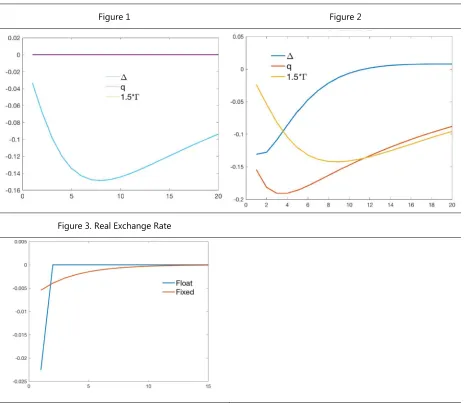
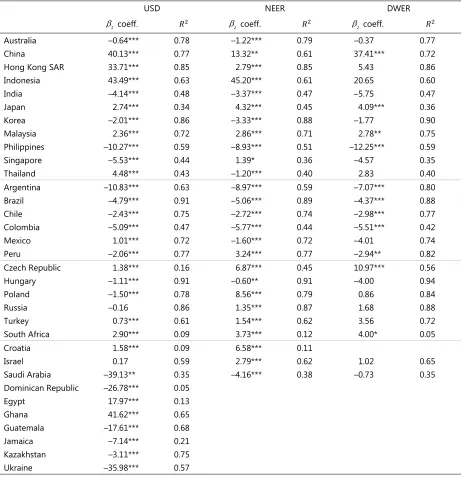
Figures 1 and 2 illustrate the response to a productivity shock in the traded goods sector, under fixed and flexible exchange rates, while Table 1 reproduces the theoretical variances implied by the model. Figure 1 shows that the full response of
q is attributed to under the fixed exchange rate regime. By definition of the model, 0 in this case. The real exchange rate appreciates in response to the productivity shock. Figure 2 shows that under a flexible exchange rate regime, the response of
3 Many papers have developed models of pricing to market. See Dornbusch (1987), and Atkeson and
is approximately the same, but now falls, so we do get an “excess volatility” in the real exchange rate.
Can the model explain the variance bounds findings of the Engel and Zhu paper? Table 1 shows that the fixed exchange rate regime satisfies exactly the condition
. *
q
1 5 .4 Under flexible exchange rates, the volatility of is almost the same,
while now the volatility of increases to about the same size as . We now find that
.
q
2 9 and 1 5. 2 2 , so that. q 1 5. *. So we obtain “excess volatility”, in the
sense that we get the same ranking of volatilities as in the paper. But the magnitude is not large. The reason is that, while is volatile, , and are negatively correlated (as can be seen from Figure 2). So while the results do accord with the paper’s variance bounds results, they do not nearly explain the data. To see this more clearly, Table 2 reports the same objects in European data (taken from Berka et al (2017)), where we compare the within-euro zone exchange rates to the floating exchange rate European countries, using Eurostat data for prices. We see that the European data do accord with the findings of the Engel-Zhu paper, notably that the variance bounds test is
4 I use standard deviations rather than variances for ease of interpretation.
Figure 1 Figure 2
satisfied (just) for the euro zone, but not for the floating countries. But the difference between these data and the model is that the increase in volatility of q, and in comparing the euro zone with the floating regimes is much greater in the data than in the model. Thus, we are left with a puzzle in explaining excess volatility under flexible exchange rates.
2.2 Real exchange rate modelling and exchange rate disconnect
One implication one could draw from the results of the paper is that understanding and modelling real exchange rates is likely to be more successful when we focus on real exchange rates among fixed exchange rate countries. As we saw above, the theoretical variance bounds tests are generally satisfied for countries that have bilaterally fixed exchange rates. This is an intriguing hypothesis, and deserves to be followed up. The obvious framework to test is the Balassa-Samuelson model. The paper finds evidence for the real exchange rate-productivity link within a variance bounds limit test. But it is worth a deeper investigation, using structural models of the real exchange rate. Some evidence for the usefulness of the Balassa-Samuelson model for the euro zone is presented in Berka and Devereux (2013), who find a tight link between real exchange rates and real GDP per capita, both in cross section and time series, for the euro zone countries, and Berka, Devereux and Engel (2017), who find strong support for an amended version of the Balassa-Samuelson model among euro zone countries using measures of sectoral productivity (again both in time series and cross section). With the expanded availability of sectoral and micro price data for many countries, this approach is likely to be further developed over time.
2.3 The PPP puzzle
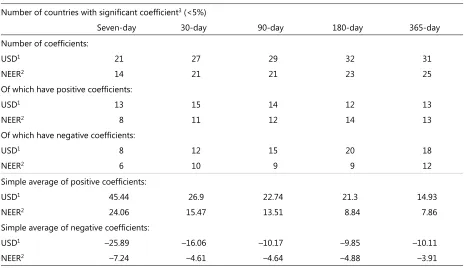
An interesting finding of the paper is that real exchange rate persistence is no less under fixed rates than under flexible exchange rates. At first glance, this seems surprising. Most reading of the literature would suggest that the driving force of both excess volatility and persistence in real exchange rates comes from movements in nominal exchange rates. But it is important to note that persistence in relative prices is quite different from excess volatility. One could make the case that, in a theoretical sense, persistence in real exchange rates should be greater under fixed exchange rates. This is because real exchange rate adjustment in fixed exchange rate areas can take place only via slow movement in relative prices across regions, while the same adjustment can in principle be achieved much more quickly within a flexible exchange rate arrangement. Figure 3 shows an example of this, comparing adjustment under fixed and flexible exchange rates with a temporary government spending shock within the model described in the previous section. We see indeed that, while the amplitude of the real exchange rate response to a government spending shock is substantially greater in a flexible exchange rate regime, the persistence is greater under a fixed exchange regime. Fixed exchange rates embody intrinsic persistence that is not necessarily a characteristic of a flexible regime.
Model Table 1 Data Table 2
Case q 1 5. Case q 1 5.
Fixed 2.3 0 2.3 Fixed (EZ) 3.3 2.8 3.2
Persistence in relative prices can also be driven by large heterogeneity in speeds of price adjustment. This point is extensively explored in Carvalho and Nechio (2011). To see this, take two sectors 1 and 2, with two regions E and W. Say that the real exchange rates are among E and W are driven by AR(1) processes as follows.
,
,
q q u
q q u
1 1 1 1
2 2 2 1
Then the overall real exchange rate is defined as:
q q
q 1 2
2
Carvalho and Nechio (2011) show that the aggregate real exchange rate will be an ARMA(2,1) process, as follows
q
q q q u u
1 2
2 1 1 2 2 2 1
Then, persistence in the real exchange rate will be driven by the largest root (most persistent sector) of the underlying sectoral real exchange rates. Again however, this will not depend on the nominal exchange rate. Persistence within countries could be just as great as that across countries.
2.4 Consumption risk-sharing
An interesting finding of the paper is that consumption risk-sharing does not seem to be linked to the nominal exchange rate. For the most part, risk-sharing seems to be similar across countries within fixed exchange rate systems as across flexible exchange rate systems, even when one explicitly accounts for the role of real exchange rate movements in risk-sharing (ie the Backus-Smith condition). This is a surprising finding, and seems to be at variance with the results of Hadzi-Vaskov (2008), Hess and Shin (2008), and Devereux and Hnatkovska (2013). It is not clear to me what is driving the difference in results. It will be interesting to explore further the different specifications.
3. Conclusions
This paper has set out a series of interesting results on the properties of real exchange rates under fixed exchange rate regimes. One the one hand, it suggests an agenda for exploring and testing models of real exchange rates without being “contaminated” by nominal exchange rates. On the other hand, it underscores the importance of nominal exchange rates in any theoretical approach to understanding real exchange rate anomalies. In this respect it seems to accord well with an idea often associated with the BIS. That is, that monetary economies are very different from standard theoretical general equilibrium models.
References
Atkeson, A and A Burstein (2008): “Trade costs, pricing-to-market, and international relative prices”, American Economic Review, vol 98, no 5, pp 1998–2031.
Berka, M and M Devereux (2013): “Trends in European real exchange rates”, Economic Policy, vol 28, pp 195–242.
Berka, M, M Devereux and C Engel (2012): “Real exchange rate adjustment in and out of the euro area?”, American Economic Review: Papers and Proceedings, vol 102, pp 179–85.
——— (2016): “Real exchange rates and sectoral productivity in the euro area?”, Working Paper, University of Wisconsin.
Carlos, C and F Nechio (2011): “Aggregation and the PPP puzzle in a sticky-price model”, American Economic Review, vol 101, pp 2391–424.
Devereux, M and V Hnatkovska (2014): “Borders and nominal exchange rates in risk sharing”, Working Paper, Department of Economics, University of British Columbia. Dornbusch, R (1987): “Exchange rates and prices”, American Economic Review” vol 77, pp 93–106.
Engel, C (1999): “Accounting for US real exchange rate changes”, Journal of Political Economy, vol 130, no 3, pp 507–38.
Engel, C and J Rogers (1996): “How wide is the border?”, American Economic Review, vol 86, pp 1112–25.
Hadzi-Vaskov, M (2008): “Does the nominal exchange rate explain the Backus-Smith puzzle? Evidence from the euro area?”, Utrecht School of Economics, Tjalling C Koopmans Research Institute, Discussion Paper Series, no 07-32.
Hess, G and K Shin (2010): “Understanding the Backus-Smith puzzle: It’s the (nominal) exchange rate, stupid?”, Journal of International Money and Finance, vol 29, pp 169– 180.
Itskhoki, O and D Mukhin (2016): “Exchange rate disconnect in general equilibrium”, Working Paper, Princeton University.
Jeanne, O and A Rose (2002 “Noise trading and exchange rate regimes”, Quarterly Journal of Economics, vol 117, pp 537–69.
Flood, R and A Andrew (1995): ”Fixing exchange rates: a virtual quest for fundamentals”, Journal of Monetary Economics, vol 35, pp 3–37.
Mussa, M (1986): Nominal exchange rate regimes and the behavior of real exchange rates: Evidence and implications”, Carnegie-Rochester Conference Series on Public Policy, vol 25, pp 117–214.
FX hedging and creditor rights
M S Mohanty and Suresh Sundaresan1
Abstract
The paper draws on Mohanty and Sundaresan (2018) to explore the effects of bankruptcy laws on the ex ante incentive for firms to hedge FX exposures. We use a simple model in which the bankruptcy code may result in deadweight losses, and may allow equity holders a share of residual value of the firm’s assets in the bankruptcy proceedings. The paper predicts that, while value-maximising firms promise to hedge a higher fraction of the value of their FX exposure when the debt is issued, they may renege subsequently and take on some FX exposures at the expense of foreign creditors. To preclude this, strong and enforceable loan/bond covenants must be in place. Furthermore, the model predicts that FX exposure affects credit spreads, and that thin FX hedging markets lead to greater FX exposure, and a higher probability of default. The paper tests these theoretical predictions and shows that unhedged corporate FX exposures at the country level are indeed negatively associated with the strength of creditor rights and the depth of hedging markets. Using loan-specific data from the Reserve Bank of India, and exploiting recent changes in the bankruptcy law, the paper uncovers a clear connection between the creditor rights and the hedging behaviour of non-financial firms.
Keywords: foreign currency exposure; corporate hedging; creditor rights. JEL classification: F31, G13, G28.
1 Mohanty is with the Bank for International Settlements, Representative Office for Asia and the Pacific,
1. Introduction
“Original sin” refers to the practice of a country borrowing in foreign currency (Eichengreen and Hausmann (1999)). The most recent evidence points to a global tendency to engage in currency and maturity mismatches due to central bank policies. For instance, BIS (2017) reports that between 2009 and 2016, US dollar credit to non-bank borrowers outside the United States expanded by 50% to USD 10.5 trillion, and that to emerging market non-bank borrowers more than doubled to USD 3.6 trillion. Rajan (2014) argues that large-scale asset purchases by the Federal Reserve precipitated a worldwide “competitive easing” of monetary conditions, causing excessive build-up of leverage in emerging market economies (EMEs): this is the central bank channel through which dollarisation occurs for non-dollar-domiciled borrowers. Similarly, Bruno and Shin (2017) show that very low US interest rates have encouraged emerging market firms to engage in financial exposures that have attributes of a US dollar carry trade.
In this paper, we explore how far firms might wish to take on FX exposure: we consider a firm with dollar debt, generating domestic currency cash flows. An important motive for FX hedging, or more generally hedging, is that firms face bankruptcy costs, and to avoid costly bankruptcies due to increased volatility of unhedged revenues and costs, firms may hedge even though shareholders may be fully diversified, and may not care whether the firms are hedged or not. This motive is strong at the time the firm issues dollar debt. Subsequent to the issuance, however, equity holders have an incentive to take on some FX exposure at the expense of foreign creditors. To preclude this, strong and enforceable loan/bond covenants must be in place. This presumes that contract enforcement mechanisms such as the bankruptcy laws are efficient. In countries with a weak bankruptcy code and creditor protection, this argument is much less persuasive. In such countries, dollar debt may be priced to reflect such enforcement problems, and we may see firms taking on greater FX exposure.
We develop a simple theoretical framework in which a firm with domestic currency cash flows issues FX (USD) debt. This stark setting, without any natural currency hedge, helps us to focus on FX exposure and the circumstances under which the firms may hedge that exposure. The firm operates under a bankruptcy legal framework in which default can result in deadweight losses. The equity holders choose the optimal default boundary to maximise their value, and will internalise any inefficiencies in the bankruptcy code, by adjusting their default decision. We use this setting to develop propositions that link (a) the firm‘s credit spreads to its FX exposure; (b) the cost of hedging to FX exposure and the probability of default; (c) the value-maximisation objective to the optimal hedge; and (d) the conflicts of interest between equity holders and creditors in hedging exposure after the issuance of debt.
we supplement our cross-country analysis through a quasi-natural experiment by focusing on India’s recent introduction of a new bankruptcy code in May 2016. Using granular loan-level information from the Reserve Bank of India (RBI) and combining this with the firm-level data, we attempt to identify the unique effect of this new law on the hedging behaviour of firms.
Consistent with the predictions of our model, we present evidence supporting a strong association between the credit spreads of firms and FX rates, after controlling for the sovereign spreads. This evidence is based on country-level data, wherein the corporate spreads are calculated at a portfolio level. Nearly three fifths of economies in our sample have a negative exposure to a dollar appreciation, and these dollar short positions tend to be concentrated in countries with sizeable current account deficits.
Our cross-country evidence supports the main intuition behind the theoretical model that there exists a negative relationship between the corporate sector’s exposure to the exchange rate and the legal rights enjoyed by the creditors in the country where the firms are domiciled. We find that countries that score high on World Bank’s strength of creditors’ legal rights tend to benefit from lower degrees of currency mismatches on their corporate balance sheets. Among other factors, we also find strong evidence in favour of the incomplete market hypothesis that FX exposures are negatively associated with the degree of depth of the hedging markets (lower depth implying higher costs of hedging), implying that deeper FX markets may encourage firms to hedge a larger fraction of their FX exposures.
Our quasi-natural experiment based on India confirms most of the findings obtained in the context of the cross-country analysis. Employing a probit model and dividing firms according to their ratio of foreign currency debt in total debt, we find a robust positive association between the new bankruptcy code and the probability of currency hedging by firms with a high share of foreign currency debt. Relative to the pre-new bankruptcy regime, the probability of these firms issuing loans on a currency-hedged basis rises by about 13%. Having said that, our results also point to significant differences in the behaviour of state-owned firms that are relatively insulated by the implicit government support and widely held public listed companies that are likely to face the full brunt of the new bankruptcy code.
Stepping outside our theory, we find that among the fundamental factors playing a role in hedging decisions is the availability of a natural hedge through export revenues. We find that firms that have a larger fraction of their sales in foreign currencies are more likely to issue unhedged loans. We also find that firms’ growth opportunities have a significant effect on their hedging decisions, suggesting that firms that are higher in market value do tend to capitalise on that strength by hedging more of their currency and interest rate exposures, as suggested by the underinvestment theory of hedging.
The rest of the paper is organised as follows. Section 2 briefly surveys the relevant literature. In Section 3, we develop our main theoretical intuitions, which provides us with some testable implications. Section 4 contains our empirical analysis. Section 5 concludes.