M A T E R I A L S S C I E N C E
Uncovering
-relaxations in amorphous
phase-change materials
Si-Xu Peng1*, Yudong Cheng2*, Julian Pries2, Shuai Wei2†, Hai-Bin Yu1†, Matthias Wuttig2,3†
Relaxation processes are decisive for many physical properties of amorphous materials. For amorphous phase-change materials (PCMs) used in nonvolatile memories, relaxation processes are, however, difficult to characterize because of the lack of bulk samples. Here, instead of bulk samples, we use powder mechanical spectroscopy for powder samples to detect the prominent excess wings—a characteristic feature of -relaxations—in a series of amorphous PCMs at temperatures below glass transitions. By contrast, -relaxations are vanishingly small in amorphous chalcogenides of similar composition, which lack the characteristic features of PCMs. This conclusion is corroborated upon crossing the border from PCMs to non-PCMs, where -relaxations drop substantially. Such a dis-tinction implies that amorphous PCMs belong to a special kind of covalent glasses whose locally fast atomic motions are preserved even below the glass transitions. These findings suggest a correlation between -relaxation and crys-tallization kinetics of PCMs, which have technological implications for phase-change memory functionalities.
INTRODUCTION
Phase-change materials (PCMs) can be switched rapidly and reversibly between their amorphous and crystalline states by Joule heating with electrical or optical pulses (1–4). The accompanying strong optical and electrical contrast between the two states can be used for phase-change nonvolatile memory devices (e.g., encoding “0” and “1”). While an extremely fast phase transition on a nanosecond or even picosecond time scale is required for fast read and write speeds, the amorphous state must also be stable at ambient temperature long enough for data retention (1, 4). Typical PCMs are compounds situ-ated on the GeTe-Sb2Te3 pseudobinary line such as Ge2Sb2Te5 and GeTe (5) or consist of doped Sb2Te alloys such as Ag4In3Sb67Te26 (AIST) (1). Some of these compositions have already been used in optical storage devices like DVD or Blu-ray discs. Presently, major industry players and others are developing advanced PCM-based nonvolatile memory devices that are supposed to operate up to 1000 times faster than current flash disks if heated to elevated temperatures (3, 6). At the same time, the amorphous phase should be stable at room temperature for more than 10 years to ensure data integrity. This implies that the temperature dependence of crystallization has to be very pronounced to achieve a change of speed by more than 17 orders of magnitude upon a temperature increase of about 400 to 500 K. In the last decade, a number of studies have tried to unravel the atomistic origin of this temperature dependence (7–10).
These studies have revealed a number of marked differences be-tween PCMs and other non-PCM chalcogenides. PCMs—such as GeTe, Ge2Sb2Te5, and AIST—which are used for rewriteable optical and electrical data storage, show a pronounced difference of their properties between the amorphous and crystalline state. This pro-nounced property contrast has been attributed to a difference in bonding mechanism between both phases (11, 12), again a feature not encountered in non-PCMs, such as GeSe, Ge15Te85, and GeSe2. While the amorphous state of these PCMs has properties that are
compatible with ordinary covalent bonding, this is not the case for crystalline PCMs. Crystalline PCMs use an unusual property port-folio, including a high optical dielectric constant, a large Born effective charge, a high Grüneisen parameter for transverse optical modes, and an effective coordination number incompatible with the 8-N rule, which has been attributed to a novel bonding mechanism coined “metavalent bonding” (11, 12). The very same compounds that show unusual properties in their crystalline states are also very bad glass formers and, hence, crystallize rapidly at elevated temperatures (5). By contrast, non-PCMs are much better glass formers and crystallize too slow for memory applications (13). These non-PCM chalcogenides (such as GeSe) also lack property contrast between their amorphous and crystalline phase and do not show those unconventional prop-erties in their crystalline phase, unlike PCMs. While these findings help characterize and identify potential novel PCMs, these do not yet offer an atomistic perspective on the unusual kinetics. To reach this goal, a better understanding of atomic rearrangement processes in the amorphous state would be highly beneficial.
In any glassy state, the structure relaxes toward lower-energy states accompanied by changes in structure and almost all physical properties such as entropy, density, and electrical resistivity (14). For example, relaxation dynamics have been recognized to be crucial for the drift of electrical resistance with time that needs to be sup-pressed to realize multilevel data storage applications (15). Theoretical calculations of the amorphous PCM GeTe have shown that the struc-tural relaxation is associated with an increase in chemical order as well as the magnitude of the Peierls-like distortion (15–17).
In general, glassy materials inherently feature diverse relaxation dynamics, ranging from picoseconds for fast processes to thousands of years for aging and densification (14, 18–22). Among these relax-ation processes, a particularly relevant process is the so-called Johari- Goldstein (secondary or -) relaxation (23), which depicts local fast atomic motions involving a group of atoms in the slow-mobility matrix. It is the major source of glass dynamics when the primary (-) relaxation (i.e., the dynamic process that is arrested below the glass
transition during cooling if crystallization is avoided) is “frozen-in” below the glass transition temperature Tg (23–26). In the last dec-ades, -relaxations have been extensively studied in polymeric (25), molecular (23), and metallic glasses (27, 28). These studies revealed that -relaxations are crucial to a number of processes and properties,
1Wuhan National High Magnetic Field Center and School of Physics, Huazhong
University of Science and Technology, Wuhan 430074, Hubei, China. 2I. Institute of
Physics (IA), RWTH Aachen University, 52074 Aachen, Germany. 3JARA-Institute Green
IT (PGI-10), FZ-Jülich, 52428 Jülich, Germany. *These authors contributed equally to this work.
†Corresponding author. Email: [email protected] (S.W.); haibinyu@hust. edu.cn (H.-B.Y.); [email protected] (M.W.)
Copyright © 2020 The Authors, some rights reserved; exclusive licensee American Association for the Advancement of Science. No claim to original U.S. Government Works. Distributed under a Creative Commons Attribution NonCommercial License 4.0 (CC BY-NC).
on September 17, 2020
http://advances.sciencemag.org/
such as the ductility and toughness of polymeric and metallic glasses, the conductivity of ionic liquids, and the stability of glassy pharma-ceuticals and biomaterials (26).
Recently, -relaxations in metallic glasses have been found to be responsible for the fastest atomic diffusion in glassy states (29). They promote accelerated aging and rapid crystallization (30, 31). These phenomena are of particular interest for memory applications of PCMs. Both amorphous PCMs and group IV–, group V–, and group VI– based non-PCM alloys (e.g., GeSe, Ge15Te85, and GeSe2) are common-ly considered as covalent glasses. Yet, both groups of chalcogenides differ tremendously in properties such as liquid fragilities (7, 13), glass-forming abilities (13), crystallization rates (32), and optical contrast (33). While PCMs are poor glass formers, most of the covalent chalcogenides have a good glass-forming ability (13). Hence, the ques-tion arises, how the relaxaques-tion dynamics in the glassy state of PCMs differ from those of non-PCMs consisting of similar chemical elements. Exposing these potential differences may enrich our understanding about the unique aging, crystallization, and physical properties of amorphous PCMs. Until now, neither the existence of -relaxations
in PCMs nor their potential role in crystallization kinetics has been investigated because of technical difficulties in probing them. In non-conductive materials, dielectric spectroscopy is a standard tool to study the relaxation behavior (34), but amorphous PCMs usually
have high conductivity (1, 3), rendering dielectric spectroscopy not feasible. Alternatively, dynamical mechanical spectroscopy (DMS), widely adopted for metallic and polymeric glasses (26), could be a useful tool for PCMs, as it measures the viscoelastic properties. Yet, DMS measurements require macroscopic samples of a few centimeters in size with a regular geometry and sufficient mechanical stiffness. These strict requirements are unfortunately hard to meet for PCMs, as most of them are prone to crystallize if the cooling rate from the melt does not exceed 109 K/s (5, 35). Usually, PCMs can only be vitrified in thin films (nanometer to micrometer thickness). Further-more, they are usually too brittle to be deformed. Consequently, mechanical relaxations, especially -relaxations, in PCM glasses are still largely unknown.
To overcome these difficulties, we thus propose to use powder mechanical spectroscopy (Fig. 1A and Methods), which bypasses the constraints of sample geometry and mechanical stiffness and consumes only a few tens of milligrams of material. It provides sufficient in-formation on the mechanical response in terms of loss modulus to identify -relaxations. Our results will disclose the existence of these -relaxations in PCMs and how they differ from those in chalcogenide- based non-PCMs. The difference is rooted in the structure and bonding character of glassy PCMs, which is absent in conventional covalent glasses.
400 420 440 460
0 50 100 150 200 250 300
T* (K)
E'
(a.u.
)
10 20 30 40 50 60
Freq. (Hz) 1 2 4 8
E''
(a.u.)
Powder Ge15Te85
380 400 420 440
−60 −40 −20 0 20
0.5 1 2 4 8 16
T (K)
E'
(G
Pa
)
Bulk Ge15Te85
0 2 4 6 8 10 12
E''
(GPa
)
A B
C D
2.2 2.3 2.4 2.5 −1
0 1 2 3
Bulk Powder Powder (T-cali)
Ge15Te85
m= 51 ± 3
Ln
(f
)
(Hz
)
T-cali
1000/T (K−1)
E″(
10
3)(
a.u.)
E′
(10
3) (
a.u.)
Freq. (Hz)
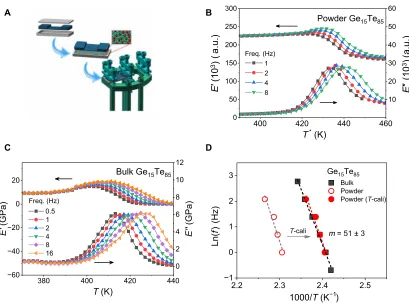
Fig. 1. Powder mechanical spectroscopy. (A) Schematic drawing of the experimental setup with powder samples inside the holder. (B) The storage modulus E′ and the
loss modulus E″ of Ge15Te85 using powder mechanical spectroscopy. T* represents the temperature before the calibration. a.u., arbitrary units. (C) The storage modulus E′ and
loss modulus E″ of bulk Ge15Te85 samples measured using conventional DMS. (D) Comparison of peak temperatures in E″ for a range of frequencies between bulk and
powder samples. Solid dots represent the data for powders after temperature calibration by subtracting 18 K to match the values found by conventional DMS. The fragility
m can be extracted from the measurements of powder and bulk samples. The same information about the shape of E″(T) and temperatures can be derived from powder
mechanical spectroscopy as from conventional DMS.
on September 17, 2020
http://advances.sciencemag.org/
RESULTS
As a typical example, Fig. 1B shows the results of powder mechani-cal spectroscopy for amorphous Ge15Te85. Similar to conventional DMS (Fig. 1C), our powder mechanical spectroscope measures the storage (E′) and loss (E″) modulus as a function of temperature at a given frequency of sinusoidal stress (see Methods). Specifically, E′ measures the stored energy, representing the elastic portion of the mechanical deformation; E″ measures the energy dissipated as heat, representing the viscous or the damping portion. One can see that for temperatures below 420 K, both E′ and E″ change only slightly with temperature. However, above 420 K, E′ and E″ change rapidly with temperature, indicating enhanced viscoelastic changes in the sample. At about 420 K, the values of E′ drop in a sigmoidal manner, while E″ develops a pronounced peak, which represents the primary
-relaxation process (26). Since Ge15Te85 is a good glass former, we
can measure the same properties for bulk samples using conven-tional DMS and obtain the same temperature dependence of E′ and
E″ (Fig. 1C) as for the powder samples (Fig. 1B). Quantitatively, we
find that there is a temperature difference of 18 K between powder and bulk samples, possibly resulting from the thermal lag due to the powder holder and poor thermal transport of the powders. There-fore, a temperature calibration of −18 K is necessary for powder mechanical spectroscopy and is applied to all following results for PCMs and non-PCMs.
Figure 1D shows the frequency dependence of the peak tempera-ture for both powder and bulk samples, which yields approximately the same fragility values [defined as m = dlog(1/f)/(Tg/T) at T = Tg],
m = 51 ± 3 for both bulk and powder samples. It is in good
agree-ment with the fragility of m = 49 ± 4 determined by differential
scanning calorimetry (DSC) scans (36). Further comparisons be-tween powder mechanical spectroscopy and DMS are presented in figs. S2 to S3 using bulk metallic glasses as standard samples. These analyses show that powder mechanical spectroscopy can qualita-tively provide the same information about relaxation dynamics as DMS. Note that the absolute values of E′ and E″ for the powder samples carry no physical meanings, as they depend on the amount and compactness of the powder samples. Our subsequent analysis thus relies only on the relative changes in the temperature depen-dence of E″.
Powder mechanical spectroscopy provides a unique opportunity to access the mechanical relaxation dynamics of well-known PCMs such as GeTe, Ge2Sb2Te5, and AIST (Fig. 2, D to F) and the non-PCM chalcogenides Ge15Te85, GeSe, and GeSe2 (Fig. 2, A to C) in their amorphous states. The compositions of the non-PCMs are se-lected on the basis of the same groups IV and VI of the periodic table as the PCMs. Despite their chemical similarity, non-PCMs differ from PCMs in terms of a number of important properties in their crystalline phases, as mentioned earlier (12). Yet, for these same properties, the difference between amorphous PCMs and non-PCMs is very modest. However, a pronounced difference in crystallization kinetics is observed. Non-PCMs are characterized by slow crystalli-zation kinetics (13) and good glass-forming abilities in terms of the Turnbull parameter Tg/Tl ≥ 0.6, where Tg and Tl are the glass tran-sition temperature at a conventional rate (e.g., 20 K/min) and the liquidus temperature, respectively. Turnbull (37) showed that Tg/Tl close to 2/3 is the criterion for good glass formers [Tg/Tl = 0.6 for GeSe (38), 0.61 for Ge15Te85 (39), and 0.68 for GeSe2 (40)]. On the contrary, PCMs have Tg/Tl ~ 0.5, indicative of poor glass-forming
0 10 20
400 500 600 700 800
0.0 0.1 E'' ( 10 3) ). u. a( 9% Tg GeSe2
Heat flow (W
g
−1)
T (K)
2.0 2.5 3.0 3.5
350 400 450 500 −0.2 0.0 E'' ( 10 3) ). u. a( 47% Tex GeTe Tx
Heat flow (W
g
−1)
T (K)
2 3 4
360 400 440
−0.1 0.0 E'' ( 10 3) ). u.
a( Ge2Sb2Te5
Tex
Tx
31%
Heat flow (W g −1)
T (K)
1 2 3 4
320 360 400 440 −0.10.0 0.1 E'' ( 10 3) ). u. a( AIST Tex Tx 44%
Heat flow (W g −1)
T (K)
0 10 20 30
320 360 400 440
−0.10.0 0.1 E'' ( 10 3) )u.
a( Ge15Te85
6%
Heat flow (W
g
−1)
T (K) Tg 0
10 20
400 500 600
0.0 0.2 E'' ( 10 3) ). u. a( GeSe 9%
Heat flow (W
g
−1)
T (K)
Tg
Tx
A B C
D E F
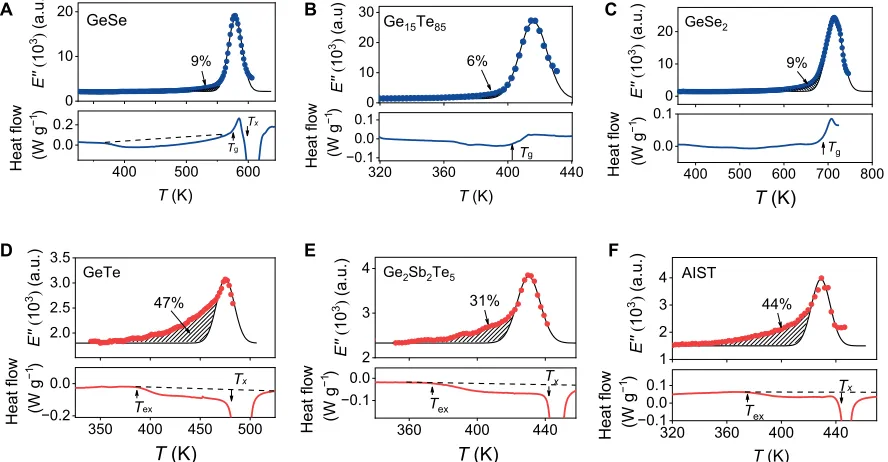
Fig. 2. Identification of -relaxations in the non-PCMs (GeSe, Ge15Te85, and GeSe2) and PCMs (GeTe, Ge2Sb2Te5, and AIST) using powder mechanical spectroscopy.
The loss modulus E″ is measured as a function of temperature at 1 Hz (top panels in each sub-figure) at a heating rate of 3 K/min. The corresponding DSC scans at a heating rate of 20 K/min are shown below each E″ curve. The non-PCMs GeSe (A), Ge15Te85 (B), and GeSe2 (C) exhibit a symmetric peak in E″, which can be modeled well with a
Gaussian peak function (solid line). No clear excess wing is present in non-PCMs. By contrast, the PCMs GeTe (D), Ge2Sb2Te5 (E), and AIST (F) show a clear asymmetry in
the E″ peak with a pronounced excess wing on the low-temperature flank of the main peak. The solid lines represent a Gaussian peak function fitting to the symmetric part of the main peak. The shadowed area visualizes the excess wings, indicating the presence of -relaxations in PCMs. By contrast, the excess wing is vanishingly small for chalcogenide- based non-PCM glasses.
on September 17, 2020
http://advances.sciencemag.org/
abilities (35, 38). Good glass formers crystallize slowly, which is un-favorable for memory device applications at elevated temperatures. We find an interesting difference in E″(T) between PCMs and non-PCMs: The non-PCMs exhibit a symmetric peak, reflecting the primary stress relaxation process (i.e., -relaxation), whereas the
technolog-ically important PCMs show a clear asymmetry in the E″ peak via a pronounced additional contribution on the low-temperature flank of the main peak. In glass physics, this is called an excess wing, which would develop to an additional peak characteristic for -relaxation,
if not eclipsed by the -relaxations (26). The symmetric shape of
-relaxation peak in non-PCMs can be fitted well by a Gaussian peak
function, as shown in Fig. 2 (A to C). Using a Gaussian function to fit the main peak of -relaxation in PCMs (Fig. 2, D to F), we can
quantify the amount of the excess wings with respect to the Gaussian peak of the -relaxation. As shown in Fig. 2 (D to F), the E″(T) of
PCMs substantially deviate from the Gaussian shape because of the excess wings.
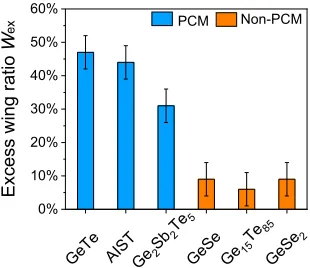
In Fig. 3, we use the ratio of excess wing to the total area under the E″(T) curve, Wex = Aw/(Aw + Agau), as a measure of the excess wing. We found that amorphous PCMs have excess wing ratios greater
than ~30%. By contrast, for non-PCMs, this value is less than 9%, indicating that -relaxation is negligible.
In addition, Fig. 2 (bottom panels in each sub-figure) shows an exothermic process (also called sub-Tg enthalpy relaxation) on the DSC scans before the onset of glass transition Tg (or crystallization
Tx), which is typical for fast-quenched glasses (41, 42), where a large amount of enthalpy is trapped upon vitrification. The excess wings in PCMs investigated occur at temperatures much lower than the reported calorimetric glass transition temperature (35, 38). Note that the -relaxation peak in E″ depends on the stress frequency and the experimental technique used. Early studies showed that most of the characteristic time scales defined and measured for the different relaxation processes differ (43). This provides an explanation for the difference in the temperature of the -relaxation peak for the mechanical relaxation, T, and the calorimetric Tg.
To gain further insight into -relaxations in amorphous PCMs, we study a series of binary alloys of (GeTe)1−x(GeSe)x (see Fig. 4A). The two compounds GeTe and GeSe are isoelectronic and feature p-electron–bonded atomic configurations. However, GeTe is a PCM, featuring a pronounced difference of properties between the amor-phous and crystalline phase, while this is not the case for GeSe. Along the pseudobinary line between GeTe and GeSe, we observe a clear trend; the excess wing ratio remains at around 45% upon in-creasing GeSe content up to about 60%, followed by a sudden de-crease (Fig. 4B). This demonstrates that alloying tunes the strength of -relaxations in this material system. Electrical conductivity data show a similar trend. While a continuous decline is found up to 60% GeSe content, a sudden decrease in electric conductivity is also ob-served above (Fig. 4C). The origin of the -relaxation in amorphous
PCMs is rooted in their microscopic structure and bonding charac-ter, which will be discussed in detail in the following.
DISCUSSION
The results presented above establish the existence of -relaxations
in amorphous PCMs. This provides evidence that -relaxation can
0% 10% 20% 30% 40% 50% 60%
Non-PCM
GeSe 2 Ge15
Te85 GeSe Ge2Sb
2Te 5
AIST GeTe
Excess wing ratio
W
ex PCM
Fig. 3. The ratios of the excess wing area to the entire area are compared for PCMs (blue columns) and non-PCMs (orange columns).
300 400 500 600 700 0
1 2 3 4 5 6 7 8 9
E″
de
zil
a
mr
o
N
T (K)
x = 0
x = 0.125
x = 0.25
x = 0.375
x = 0.5
x = 0.562
x = 0.625
x = 0.75 (GeTe)1−x(GeSe)x
x = 1
A B
0.0 0.2 0.4 0.6 0.8 1.0 0%
15% 30% 45% 60%
gni
w
ss
ec
x
E
oit
ar
Wex
x
(GeTe)1−x(GeSe)x
0.0 0.2 0.4 0.6 0.8 1.0
10−5
10−4
10−3
10−2
173°C 200°C 225°C 250°C
yti
vit
cu
dn
o
C
mc
S(
−1)
x
(GeTe)1−x(GeSe)x
C
Fig. 4. -Relaxations as a function of composition. (A) Normalized loss modulus E″ at 1 Hz along the pseudobinary line (GeTe)1−x(GeSe)x (0 ≤ x ≤ 1). (B) The excess wing
ratio remains nearly the same with increasing GeSe content until about 60%, where a sudden drop in excess wing ratio is observed. With higher GeSe content, the excess wing diminishes. (C) Electrical conductivity of amorphous solids at different temperatures along the same pseudobinary line decreases with increasing GeSe content. The solid dots represent data of this work; the open symbols represent the data taken from (60).
on September 17, 2020
http://advances.sciencemag.org/
also exist in covalently bonded glasses. Previous studies of -relaxations
were limited to molecular (23), polymer (25), protein in sugar glass (44), and metallic glasses (27–29, 45). In light of our findings, it can now be concluded that in all classes of glassy materials mentioned above, there are some members that show -relaxations. While -relaxations in other types of glasses exhibit as either peaks, broad humps, or excess wings (26), the -relaxation in PCMs appears as an
excess wing that partially merges into -relaxations.
At high temperature, the dynamics of a viscous liquid are char-acterized by the coupling of time scale of - and -relaxations follow-ing the same temperature dependence (Fig. 5) (46). As the temperature is lowered and approaches Tg, rattling particles escape from “cages,” leading to the bifurcation of - and -relaxation times (discrepancy
between red and blue lines in Fig. 5) (47). While -relaxation un-dergoes further viscous slowdown, -relaxation exhibits a weaker
temperature dependence of relaxation time. It thus retains a faster structural relaxation process involving local atomic motions at shorter time scales, as illustrated in Fig. 5. Therefore, in PCMs, such a fast process (i.e., -relaxation) remains even at the kinetically frozen-in
glassy state and provides a source of high-mobility atoms. By contrast, the -relaxation of chalcogenide non-PCMs is experimentally
indis-tinguishable from the -relaxation, suggesting a strong coupling of their - and -relaxation modes (dashed blue line overlapping the
red line in Fig. 5) and the absence of local faster atomic motions. Note that none of the PCMs investigated shows a separate -relaxation peak, suggesting that these -processes are close to -processes in
temperature, compared to those typical -relaxations in other materials, e.g., La-MG and Pd-MG (illustrated as a dot-dashed line in Fig. 5).
Microscopically, the excess wings in PCMs indicate that the atomic motions in some local regions can be substantially faster than other regions (19, 48). Given the local structure-dynamics correlation, this implies that PCMs have local less ordered or loosely caged regions (48, 49), where the collective motion of atoms can be more easily executed and could possibly presage -relaxations. This is in stark
contrast to the case of non-PCMs, where the covalently bonded net-work constrains the atomic motions, resulting in a close correlation of the motions on different length scales (inset of Fig. 5). In this sense, amorphous PCMs appear to be a special kind of covalent glasses enabling locally fast atomic motion through local relaxation processes.
-Relaxation is a major source of glass dynamics. It plays an im-portant role in facilitating crystallization, as documented well for metallic glasses (30). Ichitsubo et al. (30) showed that the accumu-lation of atomic jumps associated with -relaxation can be stochastically
resonant with the ultrasonic vibrations, leading to an about 10 times faster crystallization in metallic glasses. For PCM applications, GeTe,
Local β-relaxation with fast atomic
motion Constraint
atomic motion Covalent
network glass Amorphous PCMs
Fig. 5. A schematic illustration for - and -relaxation behaviors in PCM and non-PCM covalent glasses. The -relaxation time (red line) shows a typical Vogel-Fulcher- Tammann (non-Arrhenius) temperature dependence in the supercooled liquid regime (T > Tg) and an Arrhenius behavior in the glassy state (T < Tg). -Relaxation represents
a secondary faster relaxation process, which is structurally distinct from the slower -relaxation at lower temperatures and remains fast even in the glassy state. Inset: In non-PCM glasses, atomic motions are spatially constrained within the covalently bonded network. In amorphous PCMs, the local relaxation processes (i.e., -relaxation) associated with the faster atomic motion (orange circles) are readily available.
on September 17, 2020
http://advances.sciencemag.org/
Ge2Sb2Te5, and AIST crystallize on a time scale of nanoseconds (~10 to 100 ns) at elevated temperatures (5, 10). By contrast, non-PCMs like Ge15Te85, GeSe, and GeSe2 crystallize much more slowly (36, 40), rendering them unsuitable for phase-change memory ap-plications. According to the classical theory of nucleation and growth, the nucleation rate Is and crystal growth velocity u can be respec-tively expressed as (50–52)
I s = A ⋅ D eff ⋅ exp [ − 16 3 / (3 G 2 k B T ) ]
u = f ⋅ D eff { 1–exp [ − G / ( k B T ) ] }
where is the interfacial energy and G is the Gibbs free-energy
difference between the amorphous and the crystalline phases (driv-ing force) (50–52). Both Is and u depend on the kinetic factor Deff, which is a measure of atomic mobility (50, 51, 53). The atomic mo-bility can be described by several quantities, including the diffusivity, inverse viscosity, and inverse relaxation times (51, 53). Yu et al. (29), measuring atomic hopping frequencies of metallic glasses us-ing nuclear magnetic resonance, demonstrated that the occurrence of diffusion of the fastest atoms coincides with -relaxations. The activation energy of the fastest constituent atoms is nearly equal to that for -relaxations. As an analog, assuming that the fastest atoms are also responsible for the -relaxation in PCMs, they would en-hance the kinetic factor Deff and facilitate fast crystallization through both faster nucleation and faster growth in PCMs below the bifur-cation temperature of - and -relaxation (illustrated in Fig. 5). This conclusion is valid for both nucleation-dominated materials (e.g., Ge2Sb2Te5) and growth-dominated compounds (such as AIST) (54) since both Is and u rely on Deff. The decreasing strength of -relaxation along the GeTe-GeSe compositional line (see Fig. 4) should hence be accompanied by a slowdown of crystallization and an increase in amorphous phase stability (55).
Last, we note that the marked difference in the strength of - relaxation between amorphous PCMs and non-PCMs is reminiscent of the pronounced difference in the property portfolio of their crystal-line phases. Crystalcrystal-line PCMs have a high optical dielectric constant (ϵ∞ > 15), a high Born effective charge, a measure of the bond polariz-ability (Z* = 4 to 6), and a high Grüneisen parameter, which charac-terizes the solids’ anharmonicity (|TO| > 3) in marked contrast to
significantly lower values of non-PCM chalcogenides (ϵ∞ = 5 to 15,
Z* = 2 to 3, and |TO| = 0 to 2) (11). The transition from crystalline PCMs to non-PCMs is accompanied by a pronounced change in bond breaking, as observed by atom probe tomography (33). The above-mentioned properties do not show any remarkable difference be-tween amorphous phases of PCMs and related non-PCMs. Yet, the relaxation dynamics exhibit an essential difference. In particular, the kink in the excess wing ratio around 60% GeSe content in amorphous GeTe-GeSe coincides with the drop of the dielectric constant of its crystalline phases at nearly the same composition (33). This raises the question whether there is a common origin of the differences that distinguishes PCMs from non-PCMs governing the behavior of both crystalline and amorphous phases.
Upon the transition from PCM to non-PCM compositions, the conductivity drops by typically about six to seven orders of magnitude in crystalline phases (11, 12). A drop is also observed for the amor-phous phases (Fig. 4C), albeit with much smaller magnitude. In crystalline phases, the lower conductivity in non-PCMs is caused by electron localization in their covalently bonded network. In
amor-phous phases, the corresponding mechanism is less clear. Yet, it was noted that in non-PCMs, a metal-semiconductor transition usually occurs above Tm, whereas in PCMs, it occurs at lower temperatures below Tm, usually obscured by crystallization (13, 56, 57). This is indicative of a correlation between electrical conductivity and atomic rearrangement processes. However, it is not yet understood if and how the mobility and density of the charge carriers are related to the atomic mobility responsible for -relaxation.
There is a second marked similarity between amorphous and crystalline PCMs. The corresponding undercooled liquids are char-acterized by high liquid fragilities (7) not encountered by their non- PCM counterparts. This is usually interpreted as evidence for a rugged potential energy landscape. A similar conclusion has recently also been derived for crystalline PCMs, where the propensity for local distortions leads to a very shallow energy landscape with different minima (58). While the origin of the complex landscape and its potential link to elec-tron localization for amorphous PCMs are yet to be unraveled, the ob-servation of -relaxation, which can be attributed to the barrier- crossing processes between neighboring minima as suggested by Stillinger and others (19, 59) [or, alternatively, the metabasin transitions as suggested by a recent neutron scattering study (48)], is highly plausible.
CONCLUSIONS
Using powder mechanical spectroscopy, we have shown that amor-phous PCMs exhibit -relaxations manifested as the excess wing in mechanical spectra, while the non-PCMs, constituting of chemically similar components, show only a vanishingly small sign, if any, of
-relaxation. We demonstrate an approach to control the strength
of -relaxations by tuning the composition crossing the border from PCMs to non-PCMs. The amorphous PCMs appear to be a special kind of covalent glasses, where the local relaxations associated with fast atomic motion are readily available. As a major source of glass dynamics, -relaxations provide a fast, local atomic rearrangement process persisting even below the glass transition. The resulting atomic mobility might constitute a significant contribution to the fast crystal-lization kinetics in PCMs. Hence, -relaxations provide an
oppor-tunity to understand the unusual kinetics of amorphous PCMs. Furthermore, the findings presented here invite future studies to unravel the correlation between -relaxation and processes such as fragility, diffusivity, and aging. Such correlations are already well documented in other classes of materials. Our findings also demon-strate the potential of probing the relaxation dynamics of amorphous materials by using powder mechanical spectroscopy, where other mechanical techniques are not suitable.
METHODS
Sample preparation
The powder samples of Ge2Sb2Te5, AIST, GeTe, Ge15Te85, and GeSe were produced by dc magnetron sputtering (background pressure, 3 × 10⁻⁶ mbar; Ar flow, 20 standard cubic centimeters per minute; and sputtering power, 20 W) with stoichiometric targets of 99.99% purity. To facilitate the exfoliation of thin films, Si substrates were spin-coated with a thin layer (~4 m) of photoresist, which can easily
dissolve in acetone. After sputtering, the as-deposited films (~7 m) were exfoliated from Si substrates by a soak in acetone for 12 hours. Then, the exfoliated films were carefully milled into powders to perform subsequent analysis. For (GeTe)1−x(GeSe)x (0 < x < 1), samples were
on September 17, 2020
http://advances.sciencemag.org/
sputtered on thin metal sheets in codeposition mode, where the power was adjusted according to the desired stoichiometry of the samples. Then, the powders were scraped off. The bulk amorphous GeSe2 and Ge15Te85 were prepared using water quenching from the melt. The bulk GeSe2 glass was then milled into powder form. In addition, amorphous phase was checked by x-ray diffraction (Panalytical X’Pert Pro diffractometer) and DSC (Metello DSC2).
Powder mechanical spectroscopy
The relaxation behaviors of the PCMs were studied using the TA Q800 dynamical mechanical analyzer (DMA) together with a custom- designed powder kit (Fig. 1A). The powder materials were put into a slot and pressed with a cover. Then, they were mounted on the DMA and measured in a single-cantilever mode. The apparent stor-age modulus E′ and loss modulus E″ were obtained. We note that the absolute values of E′ and E″ for the powder were not meaningful, but their relative changes when responding to temperature and fre-quencies were appropriate. We used several metallic glasses for testing and calibrations. Two types of measurements were used for calibrations: (i) metallic glasses ribbons were measured in a tensile-deformation mode; (ii) bulk metallic glasses (2 mm in diameter and 50 mm in length) were measured in a single-cantilever deformation mode. On the other hand, they were turned into powders and measured by the powder mode as described above. Details about the justification of our method are presented in the Supplementary Materials. We used a heating rate of 3 K/min for all the mechanical measurements.
Electrical conductivity measurements
The sheet resistances Rs were measured at a custom-made four-point Van der Pauw tester as a function of temperature from room tempera-ture to 350°C. All measurements were performed in argon atmosphere at a pressure of 950 mbar with a heating rate of 5 K/min. The electrical conductivity can therefore be calculated by 1/ = Rs·thickness, where
the layer thicknesses were determined using a commercially available profilometer DektakXT from Bruker.
SUPPLEMENTARY MATERIALS
Supplementary material for this article is available at http://advances.sciencemag.org/cgi/ content/full/6/2/eaay6726/DC1
Section S1. X-ray diffraction
Section S2. Comparison between powder and conventional mechanical spectroscopy Section S3. Storage modulus E′ and loss modulus E″ measured using powder mechanical analyzer Fig. S1. X-ray diffraction results of as-deposited samples.
Fig. S2. Testing powder mechanical spectroscopy using Y58Ni30Al12 metallic glasses.
Fig. S3. Temperature-dependent DMS of Zr46Cu42Al8Ag4 metallic glasses with the testing
frequency of 1 Hz.
Fig. S4. Full scans of the non-PCMs (GeSe, Ge15Te85, and GeSe2) and PCMs (GeTe, Ge2Sb2Te5,
and AIST) using powder mechanical spectroscopy.
REFERENCES AND NOTES
1. M. Wuttig, N. Yamada, Phase-change materials for rewriteable data storage. Nat. Mater. 6, 824–832 (2007).
2. M. Wuttig, H. Bhaskaran, T. Taubner, Phase-change materials for non-volatile photonic applications. Nat. Photonics 11, 465–476 (2017).
3. S. W. Fong, C. M. Neumann, H.-S. P. Wong, Phase-change memory—Towards a storage-class memory. IEEE Trans. Electron Devices 64, 4374–4385 (2017). 4. W. Zhang, R. Mazzarello, M. Wuttig, E. Ma, Designing crystallization in phase-change
materials for universal memory and neuro-inspired computing. Nat. Rev. Mater. 4, 150–168 (2019).
5. N. Yamada, E. Ohno, K. Nishiuchi, N. Akahira, M. Takao, Rapid-phase transitions of GeTe-Sb2Te3 pseudobinary amorphous thin films for an optical disk memory.
J. Appl. Phys. 69, 2849–2856 (1991).
6. T. Tuma, A. Pantazi, M. Le Gallo, A. Sebastian, E. Eleftheriou, Stochastic phase-change neurons. Nat. Nanotechnol. 11, 693–699 (2016).
7. J. Orava, A. L. Greer, B. Gholipour, D. W. Hewak, C. E. Smith, Characterization of supercooled liquid Ge2Sb2Te5 and its crystallization by ultrafast-heating calorimetry.
Nat. Mater. 11, 279–283 (2012).
8. J. Hegedüs, S. R. Elliott, Microscopic origin of the fast crystallization ability of Ge-Sb-Te phase-change memory materials. Nat. Mater. 7, 399–405 (2008).
9. S. Wei, Z. Evenson, M. Stolpe, P. Lucas, C. A. Angell, Breakdown of the Stokes-Einstein relation above the melting temperature in a liquid phase-change material. Sci. Adv. 4, eaat8632 (2018).
10. M. Salinga, E. Carria, A. Kaldenbach, M. Bornhöfft, J. Benke, J. Mayer, M. Wuttig, Measurement of crystal growth velocity in a melt-quenched phase-change material. Nat. Commun. 4, 2371 (2013).
11. M. Wuttig, V. L. Deringer, X. Gonze, C. Bichara, J. Y. Raty, Incipient metals: Functional materials with a unique bonding mechanism. Adv. Mater. 30, e1803777 (2018). 12. J.-Y. Raty, M. Schumacher, P. Golub, V. L. Deringer, C. Gatti, M. Wuttig,
A quantum-mechanical map for bonding and properties in solids. Adv. Mater. 31, 1806280 (2018).
13. S. Wei, G. J. Coleman, P. Lucas, C. A. Angell, Glass transitions, semiconductor-metal transitions, and fragilities in Ge−V−Te (V=As, Sb) liquid alloys: The difference one element can make. Phys. Rev. Appl. 7, 034035 (2017).
14. C. A. Angell, K. L. Ngai, G. B. McKenna, P. F. McMillan, S. W. Martin, Relaxation in glassforming liquids and amorphous solids. J. Appl. Phys. 88, 3113–3157 (2000). 15. J. Y. Raty, W. Zhang, J. Luckas, C. Chen, R. Mazzarello, C. Bichara, M. Wuttig, Aging mechanisms in amorphous phase-change materials. Nat. Commun. 6, 7467 (2015). 16. M. Le Gallo, D. Krebs, F. Zipoli, M. Salinga, A. Sebastian, Collective structural relaxation
in phase-change memory devices. Adv. Electron Mater. 4, 1700627 (2018). 17. F. Zipoli, D. Krebs, A. Curioni, Structural origin of resistance drift in amorphous GeTe.
Phys. Rev. B 93, 115201 (2016).
18. C. A. Angell, Formation of glasses from liquids and biopolymers. Science 267, 1924–1935 (1995).
19. P. G. Debenedetti, F. H. Stillinger, Supercooled liquids and the glass transition. Nature 410, 259 (2001).
20. P. Lunkenheimer, U. Schneider, R. Brand, A. Loid, Glassy dynamics. Contemp. Phys. 41, 15–36 (2000).
21. B. Ruta, Y. Chushkin, G. Monaco, L. Cipelletti, E. Pineda, P. Bruna, V. M. Giordano, M. Gonzalez-Silveira, Atomic-scale relaxation dynamics and aging in a metallic glass probed by x-ray photon correlation spectroscopy. Phys. Rev. Lett. 109, 165701 (2012). 22. M. Micoulaut, Relaxation and physical aging in network glasses: A review.
Rep. Prog. Phys. 79, 066504 (2016).
23. G. P. Johari, M. Goldstein, Viscous liquids and the glass transition. II. Secondary relaxations in glasses of rigid molecules. J. Chem. Phys. 53, 2372–2388 (1970). 24. S. Capaccioli, M. Paluch, D. Prevosto, L.-M. Wang, K. L. Ngai, Many-body nature
of relaxation processes in glass-forming systems. J. Phys. Chem. Lett. 3, 735–743 (2012). 25. K. L. Ngai, M. Paluch, Classification of secondary relaxation in glass-formers based
on dynamic properties. J. Chem. Phys. 120, 857–873 (2004).
26. H. B. Yu, W. H. Wang, H. Y. Bai, K. Samwer, The -relaxation in metallic glasses. Natl. Sci. Rev. 1, 429–461 (2014).
27. H. B. Yu, R. Richert, K. Samwer, Structural rearrangements governing Johari-Goldstein relaxations in metallic glasses. Sci. Adv. 3, e1701577 (2017).
28. Z. Evenson, Z. Evenson, S. E. Naleway, S. Wei, O. Gross, J. J. Kruzic, I. Gallino, M. Possart, M. Stommel, R. Busch, relaxation and low-temperature aging in a Au-based bulk metallic glass: From elastic properties to atomic-scale structure. Phys. Rev. B 89, 174204 (2014). 29. H. B. Yu, K. Samwer, Y. Wu, W. H. Wang, Correlation between relaxation and self-diffusion
of the smallest constituting atoms in metallic glasses. Phys. Rev. Lett. 109, 095508 (2012). 30. T. Ichitsubo, E. Matsubara, T. Yamamoto, H. S. Chen, N. Nishiyama, J. Saida, K. Anazawa,
Microstructure of fragile metallic glasses inferred from ultrasound-accelerated crystallization in Pd-based metallic glasses. Phys. Rev. Lett. 95, 245501 (2005). 31. Y. Sun, H. Xi, M. D. Ediger, L. Yu, Diffusionless crystal growth from glass has precursor
in equilibrium liquid. J. Phys. Chem. B 112, 661–664 (2008).
32. J. Orava, A. L. Greer, Handbook of Thermal Analysis and Calorimetry, vol. 6 of Recent Advances, Techniques and Applications, S. Vyazovkin, N. Koga, C. Schick, Eds. (Elsevier Science B.V., 2018), pp. 685–734.
33. M. Zhu, O. Cojocaru-Mirédin, A. M. Mio, J. Keutgen, M. Küpers, Y. Yu, J.-Y. Cho, R. Dronskowski, M. Wuttig, Unique bond breaking in crystalline phase change materials and the quest for metavalent bonding. Adv. Mater. 30, 1706735 (2018).
34. P. Lunkenheimer, A. Loidl, Dielectric spectroscopy of glass-forming materials:
-Relaxation and excess wing. Chem. Phys. 284, 205–219 (2002).
35. J. Kalb, F. Spaepen, M. Wuttig, Calorimetric measurements of phase transformations in thin films of amorphous Te alloys used for optical data storage. J. Appl. Phys. 93, 2389–2393 (2003).
on September 17, 2020
http://advances.sciencemag.org/
36. S. Wei, P. Lucas, C. A. Angell, Phase change alloy viscosities down to Tg using
Adam-Gibbs-equation fittings to excess entropy data: A fragile-to-strong transition. J. Appl. Phys. 118, 034903 (2015).
37. D. Turnbull, Under what conditions can a glass be formed? Contemp. Phys. 10, 473–488 (1969).
38. J. Pries, S. Wei, M. Wuttig, P. Lucas, Switching between crystallization from the glassy and the undercooled liquid phase in phase change material Ge2 Sb2 Te5. Adv. Mater. 31,
e1900784 (2019).
39. S. Wei, M. Stolpe, O. Gross, W. Hembree, S. Hechler, J. Bednarcik, R. Busch, P. Lucas, Structural evolution on medium-range-order during the fragile-strong transition in Ge15Te85. Acta Mater. 129, 259–267 (2017).
40. P. Lucas, G. J. Coleman, M. Venkateswara Rao, A. N. Edwards, C. Devaadithya, S. Wei, A. Q. Alsayoud, B. G. Potter Jr., K. Muralidharan, P. A. Deymier, Structure of ZnCl2 melt.
Part II: Fragile-to-strong transition in a tetrahedral liquid. J. Phys. Chem. B 121, 11210–11218 (2017).
41. L.-M. Wang, S. Borick, C. A. Angell, An electrospray technique for hyperquenched glass calorimetry studies: Propylene glycol and di-n-butyl phthalate. J. Non Cryst. Solids 353, 3829–3837 (2007).
42. Y. Yue, C. A. Angell, Clarifying the glass-transition behaviour of water by comparison with hyperquenched inorganic glasses. Nature 427, 717–720 (2004).
43. B. Jakobsen, T. Hecksher, T. Christensen, N. B. Olsen, J. C. Dyre, K. Niss, Communication: Identical temperature dependence of the time scales of several linear-response functions of two glass-forming liquids. J. Chem. Phys. 136, 081102 (2012).
44. M. T. Cicerone, J. F. Douglas, -Relaxation governs protein stability in sugar-glass matrices. Soft Matter 8, 2983–2991 (2012).
45. Y. H. Liu, T. Fujita, D. P. B. Aji, M. Matsuura, M. W. Chen, Structural origins of Johari-Goldstein relaxation in a metallic glass. Nat. Commun. 5, 3238 (2014). 46. K. L. Ngai, Relaxation and Diffusion in Complex Systems (Springer Science & Business
Media, 2011).
47. H.-B. Yu, M. H. Yang, Y. Sun, F. Zhang, J. B. Liu, C. Z. Wang, K. M. Ho, R. Richert, K. Samwer, Fundamental link between relaxation, excess wings, and cage-breaking in metallic glasses. J. Phys. Chem. Lett. 9, 5877–5883 (2018).
48. M. T. Cicerone, M. Tyagi, Metabasin transitions are Johari-Goldstein relaxation events. J. Chem. Phys. 146, 054502 (2017).
49. V. K. de Souza, D. J. Wales, Energy landscapes for diffusion: Analysis of cage-breaking processes. J. Chem. Phys. 129, 164507 (2008).
50. A. Masuhr, T. A. Waniuk, R. Busch, W. L. Johnson, Time scales for viscous flow, atomic transport, and crystallization in the liquid and supercooled liquid states
of Zr41.2Ti13.8Cu12.5Ni10.0Be22.5. Phys. Rev. Lett. 82, 2290–2293 (1999).
51. W. L. Johnson, J. H. Na, M. D. Demetriou, Quantifying the origin of metallic glass formation. Nat. Commun. 7, 10313 (2016).
52. M. D. Ediger, P. Harrowell, L. Yu, Crystal growth kinetics exhibit a fragility-dependent decoupling from viscosity. J. Chem. Phys. 128, 034709 (2008).
53. D. Turnbull, J. C. Fisher, Rate of nucleation in condensed systems. J. Chem. Phys. 17, 71–73 (1949).
54. G. F. Zhou, Materials aspects in phase change optical recording. Mater. Sci. Eng. A
304–306, 73–80 (2001).
55. K. Ren, M. Zhu, W. Song, S. Lv, M. Xia, Y. Wang, Y. Lu, Z. Ji, Z. Song, Electrical switching properties and structural characteristics of GeSe–GeTe films. Nanoscale 11, 1595–1603 (2019). 56. S. Wei, P. Lucas, C. A. Angell, Phase-change materials: The view from the liquid phase
and the metallicity parameter. MRS Bull. 44, 691–698 (2019).
57. P. Zalden, F. Quirin, M. Schumacher, J. Siegel, S. Wei, A. Koc, M. Nicoul, M. Trigo, P. Andreasson, H. Enquist, M. J. Shu, T. Pardini, M. Chollet, D. Zhu, H. Lemke, I. Ronneberger, J. Larsson, A. M. Lindenberg, H. E. Fischer, S. Hau-Riege, D. A. Reis, R. Mazzarello, M. Wuttig, K. Sokolowski-Tinten, Femtosecond x-ray diffraction reveals a liquid–liquid phase transition in phase-change materials. Science 364, 1062–1067 (2019). 58. T. Matsunaga, N. Yamada, R. Kojima, S. Shamoto, M. Sato, H. Tanida, T. Uruga, S. Kohara,
M. Takata, P. Zalden, G. Bruns, I. Sergueev, H. C. Wille, R. P. Hermann, M. Wuttig, Phase-change materials: Vibrational softening upon crystallization and its impact on thermal properties. Adv. Funct. Mater. 21, 2232–2239 (2011).
59. F. H. Stillinger, A topographic view of supercooled liquids and glass formation. Science
267, 1935–1939 (1995).
60. S. Y. Shin, R. Golovchak, S. Lee, B. K. Cheong, H. Jain, Y. G. Choi, Structural basis of temperature-dependent electrical resistance of evaporation-deposited amorphous GeSe film. Scr. Mater. 86, 56–59 (2014).
Acknowledgments: We are grateful for discussion with P. Lucas. Funding: S.W. acknowledges
support from the Feodor-Lynen Return Fellowship of the A.v. Humboldt Foundation, the Place-to-be RWTH Start-Up fund, and the SFB 917 of the Deutsche Forschungsgemeinschaft (DFG). Y.C. acknowledges support from the China Scholarship Council. M.W. also acknowledges support from the SFB 917 of the DFG. H.-B.Y. acknowledges support from the Fundamental Research Funds for the Central Universities (2018KFYXKJC009) and the National Thousand Young Talents Program of China. Author contributions: S.W., H.-B.Y., and M.W. initiated the project. S.-X.P., Y.C., and J.P. performed experiments. Y.C., S.-X.P., S.W., and H.-B.Y. analyzed the data. S.W., Y.C., H.-B.Y., and M.W. wrote the manuscript with specific contributions from J.P. and S.-X.P. Competing interests: The authors declare that they have no competing interests.
Data and materials availability: All data needed to evaluate the conclusions in the paper are
present in the paper and/or the Supplementary Materials. Additional data related to this paper may be requested from the authors.
Submitted 9 July 2019 Accepted 11 November 2019 Published 10 January 2020 10.1126/sciadv.aay6726
Citation: S.-X. Peng, Y. Cheng, J. Pries, S. Wei, H.-B. Yu, M. Wuttig, Uncovering -relaxations in amorphous phase-change materials. Sci. Adv. 6, eaay6726 (2020).
on September 17, 2020
http://advances.sciencemag.org/
DOI: 10.1126/sciadv.aay6726 (2), eaay6726. 6
Sci Adv
ARTICLE TOOLS http://advances.sciencemag.org/content/6/2/eaay6726
MATERIALS
SUPPLEMENTARY http://advances.sciencemag.org/content/suppl/2020/01/06/6.2.eaay6726.DC1
REFERENCES
http://advances.sciencemag.org/content/6/2/eaay6726#BIBL
This article cites 58 articles, 5 of which you can access for free
PERMISSIONS http://www.sciencemag.org/help/reprints-and-permissions
Terms of Service
Use of this article is subject to the
is a registered trademark of AAAS. Science Advances
York Avenue NW, Washington, DC 20005. The title
(ISSN 2375-2548) is published by the American Association for the Advancement of Science, 1200 New Science Advances
License 4.0 (CC BY-NC).
Science. No claim to original U.S. Government Works. Distributed under a Creative Commons Attribution NonCommercial Copyright © 2020 The Authors, some rights reserved; exclusive licensee American Association for the Advancement of
on September 17, 2020
http://advances.sciencemag.org/