Published online January 17, 2015 (http://www.sciencepublishinggroup.com/j/jeee) doi: 10.11648/j.jeee.s.2015030201.12
ISSN: 2329-1613 (Print); ISSN: 2329-1605 (Online)
Proper communicative protocols in building management
system
Fereshteh Kheirabadi
1, Seyyed Reza Talebiyan
21
Islamic Azad University, Science and Research Branch of Khorasan Razavi, Neyshabour, Iran
2
Imam Reza International University, Computer and Electronics School, Mashhad, Iran
Email address:
[email protected] (F. Kheirabadi), [email protected] (S. R. Talebiyan)
To cite this article:
Fereshteh Kheirabadi, Seyyed Reza Talebiyan. Proper Communicative Protocols in Building Management System. Journal of Electrical and Electronic Engineering. Special Issue: Research and Practices in Electrical and Electronic Engineering in Developing Countries.
Vol. 3, No. 2-1, 2015, pp. 6-11. doi: 10.11648/j.jeee.s.2015030201.12
Abstract:
Increasing energy consumption, finite energy resources, negative effects of excessive use of energy on environment, and increasing energy price forces administrators and consumers to look for different ways of saving and accurate consumption. Implementing smart systems and managing energy consumption in buildings are examples of applying modern technology. Implementing this technology not only reduces energy consumption, but also provides appropriate situation and increase the welfare of residents. This research studies the concept of Building Management System (BMS) in construction industry, especially reviews some communicative protocols in building management system, and after comparing and analyzing them, proposes X-10 protocol in home automation from cost, time consuming and simplicity of installation aspects.Keywords:
Building Management System (BMS), Energy Management, Communicative Protocols1. Introduction
Due to the increasing development of implementing modern technologies in the field of construction, competition in producing more modern buildings, and some issues including reducing energy consumption, saving in strategic expenses of building, and increasing the level of residents’ welfare, the implementation of a combination of various technologies under the title of “Building Automation”, “Smart Building”, and/or “Building Management System (BMS)” are increased [1]. From a different dimension BMS can be explained as: “Energy + Information = less energy” [2]. In designing the high buildings, engineers and managers look at BMS as a real need, but not as a luxurious technology. Constant increase in the price of energy and the need for having access to accurate and integrated information justify using BMS by building investors. Comparing with the old standard controlling system, the advantage of BMS is that optimum integrated managerial and technical control is possible. In economic calculation for implementing this system, one must pay attention to this point that about 80% of equipment price in heating and cooling controlling systems which are used jointly, are also expense in common
and old systems. Another important point in choosing this system is the permanent supporting system by producer or its local representative. Hardware and software capabilities of BMS is nearly the same among the international producers, but the important point is that the art of using this capabilities is in the process of designing, programming, installing and especially setting up the system. The above mentioned advantages for this system, specially optimizing energy consumption, reducing maintenance expense, managing heating-cooling and electric facilities, and increasing the level of residents’ comfort directly depend on the quality and design of programming and maintaining it, and also it has a direct relation with the scientific level of BMS operator engineers in information analysis [3].
choosing an appropriate communicative protocol in building smart management system. Finally, it reviews the impact of BMS on energy consumption, fund return, as well as environment.
2. The Concept of Applying Building
Management System (BMS)
Since monitoring the accuracy of any controlling system in industrial, commercial, office and residential environment separately requires time, energy and presence of manpower in the place, it is necessary to implement an integrated management system which is able to display information and arrange all smart controlling systems in short time. BMS as a unique and modern way to fulfill this need have been applied in most of developed countries and it has proven its abilities in the field of managing all kinds of smart controlling systems applying in industrial and non-industrial environments.
Smart controlling systems are a collection of equipment including controllers, I/Os, and field devices which are connected with various building’s mechanical and electrical plants (air generators, air conditioners, chillers, cooling towers, boilers, pumps, heat exchangers, high voltage and low voltage switchgears, lightings, alarm systems, CCTV, lifts and escalators, etc.). It also carries out a set of performance and controlling scenarios (temperature, humidity, pressure, liquid level, monitoring values, status and pictures, register alarms, issuing commands to open/close, active/inactive, and on/off for mechanical, electrical, audio, and video equipment and lighting lines, defining schedule, compensating change in external temperature, summer/winter function, etc.) to make efficient the consumption of energy and provide safety and security of the buildings stand alone [4].
The building management system actually is a network of local control systems connected to a central (server) and lateral (user stations) computer which aims to aggregate, monitor, and integrate information and change data values or status of remote smart controlling systems. This system eliminates the users’ need to refer to the local controlling system scattered in different parts of building. Implementing building management systems leads to saving in time and being aware, quickly and timely, of the latest changes in data and performance of local controlling systems and plants, and also ordering the requirements when necessary.
All energy consumption control scenarios are merely implemented in the local smart controlling systems and these systems actually are a series of building management systems which will continue their operations if any error occurs and BMS grid gets out of circuit [3].
Nowadays, building management systems are developed based on web; its best feature is taking advantage of World Wide Web and controlling building through common communication systems in the world. For this purpose, after constructing a site for the building and entering the user
name and password, you can control your building from anywhere. In these buildings, it is possible to install an electronic display panel in especial places to display various information from the building controlling system; it will be joyful for the residents.
The most important purposes of applying BMS in buildings are using the economic advantages, reducing energy consumption, and creating a secure and comfortable environment inside them. The general advantages of applying BMS are as follows:
Creating a secure and comfortable environment for the residents;
Optimal use of equipment and increasing their useful life;
Providing controlling system capable to schedule the operation;
Reducing maintenance expenses; Optimizing and energy saving;
Not needing a permanent building contractor;
Providing the facility to monitor and control all under control points through a PC, cell phone or internet; Eliminating the possibility of interference, by integrating installation and system management; Setting energy consumption priorities smartly, in the case of necessity;
Removing operator’s errors;
Providing statistic reports from facilities and their operation to optimize consumption and operation [3]. A smart building has a dynamic and economic environment by integrating four key elements, i.e. systems, structure, services and management.
A smart building provides its facilities through smart control systems. These systems are as follows:
Gas leaking alarm system; Fire alarm system; Theft alarm system; Earthquake waning system; lighting control system; calling telephone system;
control via remote control, digital key, inside home phone, cell phone and internet;
scenario description;
Integrated controlling system [5].
3. Elements of Building Smart
Management
Like the other controlling systems, BMS is consisted of three parts namely: Sensors, Controllers, and Actuators. These three parts are connected through a connection mechanism which is consisted of two important parts a) Conductor such as wire, fiber optics, radio waves and b) Communication protocol or spoken language of components.
3.1. Different Kinds of Protocols
Protocol is a series of common language rules to communicate signals. The important advantage of applying BMS according a standard protocol is increasing the rate of compatibility among different elements of system’s control equipment. Protocols have different types; each has its own advantages and disadvantages, such as:
3.1.1. KNX
KNX is an international building standard (ISO/IEC 14543). Applying information technology, KNX connects different equipment such as sensors, operations, controllers and terminals, and supports different net mediators, including TP, PL and wireless solution which are called KNX_RF. This protocol is created by combining three European technologies –EHS, BatiBUS, and EIB- to control a building or a house [7].
Advantages:
Its protocol is open (it is possible to communicate with other supplier of BMS);
Its life cycle in mechanical relay is up to 3 million times and other electrical equipment’s is up to 1 million operations;
The size of keys are standard;
The network is secure (network cable can pass by power cable);
It is controllable by computer graphic software, in which all places are shown graphically;
It is highly safe to use it (there is just 29V electricity in the place of controlling keys);
There is no noise taking and noise putting, because it uses separated and shielded cable;
There is a microprocessor for each sensor (so system is flexible when a sensor is replaced another one);
It is possible to control the weather condition, humidity, electric current consumption, lighting keys, and heating-cooling system [7].
3.1.2. X-10
X-10 is one of the most efficient open standards which is designed and produced for wiring communication in home automation. The main feature of X-10 protocol is sending controlling commands to appliances through the city’s power supply network, in this way there is no need to rewiring or manipulating the situation of home electricity. To design a smart home by this protocol, you must connect your appliance by a medium to the outlet available at home. In his way, you are able to turn the appliance on and off by a sender adaptable with this protocol, according the set code.
Advantages and disadvantages: It is cheap to develop it completely; It is adaptable with all brands;
X-10 remotes are active by RF protocols;
The maximum number of appliances controllable with X-10 is 256.
This protocol is noise putting for some systems like TV and radio, and it is noise taking of systems which have
electric engine; to reduce the noise several filter must be used.
3.1.3. LON Works (Local Operating Networks)
LON Works is an open protocol on the basis of LON Talk protocol. The Advantages of this protocol are as follow: Its standard is based on ISO-14908; Installation of this protocol’s controlling grid is more simple than normal grids; It has high capacity for cooperation; It reduces the installation expenses (comparing with X-10, it is more expensive); One can choose the connection interfaces freely; Radio waves, optical fibers, coaxial, infrared, etc. can be placed in the using physical layer [8].
3.1.4. ZigBee
This standard uses the series of protocols for wireless communication in short distances. This protocol is two sided which connects the electrical devices with low energy and low expense. By this technology, all parts of home can be controlled, such as adjusting temperature, humidity level, etc.
Advantages:
This standard is under IEEE 802.15.4;
Home and industrial automation and any kind which needs a controlling grid can use this technology; Its board, expense, electricity consumption and data transfer rate is low;
It supports more than 65635 devices in each network; It transfers data confidently, due to solid and self-constructed combinational gridding [9].
3.1.5. BACnet (Building Automation Control Network)
BACnet is an open protocol of building automation control network. The distinguishing point of this protocol is its exclusive structure for building automation. As it is highly sensitive, much attention is paid for applying in fire alarm system (using in large networks) [3].
3.1.6. S-BUS
S-BUS is a closed protocol which has no valid international standard. The advantages and disadvantages of this protocol include:
It has just one producer (consumer is depended on producer and its products);
The life cycle of devices is 300000 times (10 times less than KNX);
There are limited options.
3.1.7. Z-Wave
Z-Wave is a two sided wireless protocol which is designed for limited power and band width. It is mostly efficient in home automation. The advantages of Z-Wave are:
It is a good choice for temperature sensors and controlling devices, as its energy consumption is low, its expenses is low, its transmission is two sided, it has MESH technology and it is supported via battery to battery.
The hardware size is really small, so it is suitable to combine with other devices;
3.1.8. Bluetooth
Bluetooth technology is entirely determined as a short distance wireless communication. The main idea of this technology is to minimize the interfaces incompatibility of the different devices. A range of the Bluetooth devices is about from ten to hundred meters with line of sight contact between devices. At used indoors the range decreases depending on the surrounding factors. Bluetooth operates in the unlicensed frequency band 2.4 GHz. Because this frequency band is also used by another wireless systems (IEEE 802.11), it's necessary to prevent the interactions in-band.
A carrier frequency is changed according to the selection scheme and it's determined by a Bluetooth address and clock of a control device. The data is transferred using time division duplex method (TDD) in packets inside of a short time interval (time slot). A packet format is exactly defined. The communication proceeds in certain kind of a personal local network called piconet. The maximum number of the active Bluetooth devices can be 8 in the piconet. The maximum data rate doesn't exceed 723 kbit per second.
Advantages of Bluetooth are as follows:
It removes the interfaces incompatibility of different types of the Bluetooth devices;
Between devices, there isn't required straight visibility (advantage against IrDA);
Mutual communication of different types of the Bluetooth devices (PC, mobile phone, PDA, notebook, headset, printer, modem, ...);
It is easy to establish connection;
Relative high range (up to 200 meters) beyond a low transmitting powers (it depends on a class device); Resistance in the face of interference (a system with spread spectrum);
Small size of a radio chip and small size of a Bluetooth module;
Technology can be implemented into optional equipment [11].
3.2. Comparing Protocols
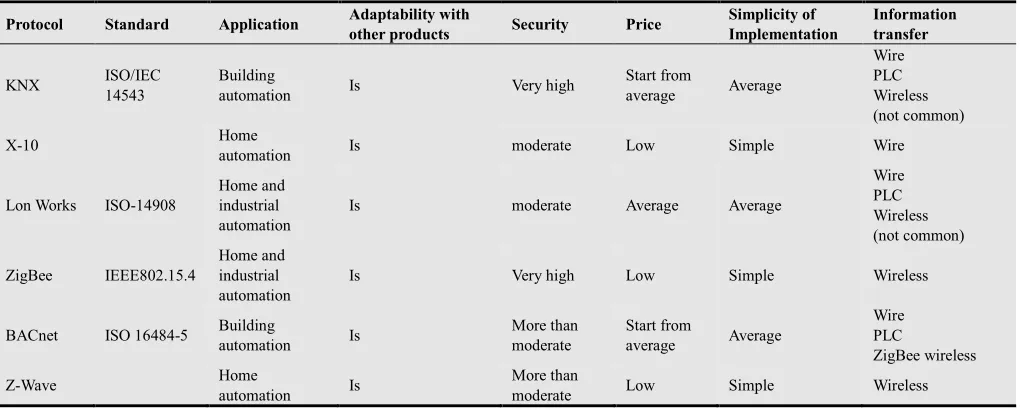
In table 1, some valid protocols for making buildings smart are briefly compared.
KNX is the most prominent building (residential, commercial, office, industrial, hotel) automation protocol. In addition to the above mentioned important points in the table, this protocol has different communicative media (RF, PL, TP) and a wide range of choices in configuration modes (S, E, A) [7].
As they are highly safe and adaptable with other products, Lon Works and BACnet protocols are frequently used in building automation. Applying these protocols, building owners are able to choose the best technology and services provided by each company, without concerning the adaptability of selected systems with previous one [8].
X-10 is the most popular protocol in home automation, as it does not need rewiring in building, so installation cost and time are minimum.
In wireless applications ZigBee and Wave are used. Z-Wave protocol is mostly used in Home Automation and Sensor Network.
Table 1. Comparing some protocols.
Protocol Standard Application Adaptability with
other products Security Price
Simplicity of Implementation
Information transfer
KNX ISO/IEC
14543
Building
automation Is Very high
Start from
average Average
Wire PLC Wireless (not common)
X-10 Home
automation Is moderate Low Simple Wire
Lon Works ISO-14908
Home and industrial automation
Is moderate Average Average
Wire PLC Wireless (not common)
ZigBee IEEE802.15.4
Home and industrial automation
Is Very high Low Simple Wireless
BACnet ISO 16484-5 Building
automation Is
More than moderate
Start from
average Average
Wire PLC
ZigBee wireless
Z-Wave Home
automation Is
More than
moderate Low Simple Wireless
4. Other Important Points in BMS
4.1. Accessing and Controlling Facilities in Smart Building
To access and control facilities in smart building, there are different ways, including:
Central control panel;
Radio wave control (controlling via RF technology, as it doesn’t need direct vision, it is efficient in long distances);
Remote control (via SMS and internet) Scenario (team work by pressing one key)
automatically) [5].
5. BMS System’s Strategies to Reduce
Energy Consumption
The most common strategies applied by BMS designers are as follows:
Turning the equipment on and off according the function schedule;
Looking out equipment if necessary;
Utilizing minimum of allowed capacity in utilizing the equipment;
Limiting demand which causes electricity cut off in equipment if loading is more than limited rate;
Monitoring equipment situation by trained operators and utilizing data to solve their problems and review their efficient functions [3].
5.1. Fund Returning
Expenses and executive levels of making a building smart depend on the type of utilization (residential, office, commercial, etc.), area, dimensions of spaces, the number of stories, and the number of units. The main purpose of implementing BMS system in a building is to save energy and true and optimum consumption of facilities. So the fund invested for implementation of BMS will return.
5.2. Building and Environment
As a main consumer of electricity, buildings consume about 70% of electricity consumption (in Europe) [12]. For example, in the US building sector consumes 40% of energy and it is responsible for producing 45% of greenhouse gas. For efficient management of building, some mechanisms must be applied to reduce the level of energy consumption and greenhouse gas production, without any change in comfortable living standards [13]. For this purpose we propose green buildings [14].
5.3. Failed BMS Project
The advantages of building management system are achieved, when the system is installed and maintained appropriately. Otherwise, 4 problems lead the projects to failure:
Neglecting the duties
Neglecting some effective factors Hiding information
Neglecting the real world.
6. Discussion and Conclusion
As the technology moves toward creating a smart network, the need for smart buildings and the related systems will become important. During last decades, important changes have been occurred in building designing, controlling, and implementing and their related systems [2].
By emergence of microprocessors, computerized controlling systems have the vital role in the most societies and building industries. When systems operate appropriately and save energy, their reliability will increase.
This paper investigated different protocols and finally proposed that KNX, LonWork and BACnet protocols are appropriate for building automation, because of their high safety, adaptability with other products, rational prices and simple installation.
Internet, in this process, has a major role, and now is the best time to be ready for a future with efficient communication.
References
[1] Jan Bozorgi. A., Ghannad. Z., Building Smart System, Kaison Quarterly, 43, winter 2009.
[2] Lawrence. T., Thomas M. Lawrence, Richard T. Watson, Marie-C. Boudreau, Kyle Johnsen, Jason Perry, Lan Ding, A new paradigm for the design and management of building systems, Elsevier, 51, 56-63, 2012.
[3] Sinopoli. J., Smart building systems for Architects, Owners, and Builders, Butterworth-Heinemann: USA, 2010.
[4] Yin. Hang, Building Management System to Support Building Renovation, Department of Civil and Environmental Engineering, UCC, Snapshots of Doctoral Research, University College Cork, 2010.
[5] Sripan. Meensika; Xuanxia Lin; Ponchan Petchlorlean; Mahasak Ketcham, Research and Thinking of Smart Home Technology, International Conference on Systems and Electronic Engineering (ICSEE'2012) Phuket (Thailand), 2012. [6] Abiodun. Iwayemi; Wanggen Wan; Chi Zhou, Energy
Management for Intelligent Buildings, Energy Management Systems, Dr Giridhar Kini (Ed.), ISBN: 978-953-307-579-2, InTech, 20011.
[7] KNX Association, KNX handbook for home and building control, ZVEI & ZVEH: 2013.
[8] Merz, Hermann, James Backer, Viktoriya Moser, Thomas Hansemann, LeenaGreefe, ChristofHübner, Building Automation: Communication systems with EIB/KNX, LON and BACnet, Berlin: Springer, 2009.
[9] Pankaj. Jadhav; Amit Chaudhari; Swapnil Vavale, Home Automation using ZigBee Protocol, Department of Computer Engineering, University of Pune, India, 2014.
[10] John Robles. Rosslin; Tai-hoon Kim, Applications, Systems and Methods in Smart Home Technology: A Review, International Journal of Advanced Science and Technology, Vol. 15, February, 2010.
[11] Mikeska, Zdenek, Radio Specification of the Bluetooth System, Institute of Radio Electronics, Faculty of Electrical Engineering and Communication, Brno University of Technology, 2009.
[13] Ko-Yang Wang; Lin, G.; Chou, P.; Chou, A. Leverage smart system services technology for smart green building management, Institute for Information Industry, IEEE, Berlin, 2012.