Copyright © 2017 by Academic Publishing House Researcher s.r.o.
Published in Slovak Republic
European Journal of Economic Studies
Has been issued since 2012.ISSN: 2304-9669 E-ISSN: 2305-6282
2017, 6(2): 115-123
DOI: 10.13187/es.2017.6.115
www.ejournal2.com
Enablers of Successful Knowledge Sharing Behavior: KMS, Environment and Motivation
Alparslan Özlen a , *
a Gebze Technical University, Turkey
Abstract
Knowledge sharing is suggested as a key element for Knowledge Management in sustaining organizational competitiveness. This work investigates the relationships proposed by a knowledge sharing model implying that knowledge sharing practices contribute to organizational and individual performance as a result of (a) qualified Knowledge Management Systems, (b) suitable knowledge sharing environment and (c) organizational knowledge sharing motivation. The proposed model is tested by using the data obtained from surveying various private and public Bosnian enterprises. At the end of data collection period, 207 usable surveys are achieved. According to the results, Knowledge Management in Bosnia is still developing yet. Model test suggests advanced Knowledge Management Systems, suitable knowledge sharing environment and high organizational knowledge sharing motivation influence knowledge sharing and successful knowledge sharing increases the performance of both individuals and the organization. The results suggest that successful knowledge sharing can be achieved through considering technical (KMS), social (environment) and the individual (motivation).
Keywords: knowledge management implementation, knowledge sharing, individual performance, organizational performance
1. Introduction
Dynamic and competitive Knowledge-based economy requires ability to transform knowledge resources to organizational survival and competitiveness. This encourages researchers and practitioners to analyze the organizational ability in identifying, capturing, creating, sharing and accumulating knowledge (Nonaka, Takeuchi, 1995) as knowledge management processes. Knowledge Management (KM) fundamentally aims to maximize the flow of existing knowledge through individuals and organizations which are strongly dependent upon individuals’ knowledge sharing (KS) behavior (Bock et al., 2005). Successful knowledge sharing is supposed to contribute to the organizational performance (Argote et al., 2000) and organizational effectiveness (Alavi, Leidner, 2001).
The literature reports few Knowledge Management studies for Bosnia and Herzegovina concentrated more on the implementation level of Knowledge Management and its adoption. They report weak knowledge management understandings of Bosnian organizations (Handzic, Lagumdzija, Celjo, 2007; Biloslavo, Kljajic-Dervic, 2011; Bartlett et al., 2012; Ozlen et al., 2012)
* Corresponding author
and suggest more to enhance Knowledge Management for those organizations in terms of measurement and technology (Handzic et al., 2007), Knowledge Management strategies (Ozlen et al., 2012). However, the literature is weak in providing about knowledge sharing behavior of Bosnian enterprises. This study aims to strengthen existing KM literature by evaluating some enablers of successful knowledge sharing behavior for Bosnian enterprises.
The proposed knowledge sharing model suggest that successful knowledge sharing leverages organizational and individual performance as a result of (a) qualified Knowledge Management Systems (KMS), (b) appropriate knowledge sharing environment and (c) high organizational knowledge sharing motivation. In order to test the model, the data is collected by surveying Bosnian public and private enterprises.
Further sections provide the relevant literature, the research model, the research methodology, the findings and the discussion of the findings.
2. Discussion
Knowledge Sharing Environment
Knowledge sharing practices are extremely important in keeping and enhancing gained valuable intellectual capital and therefore organizational success. Hence, the identification of influencing factors and the outcomes of these practices is necessary. The literature suggests culture, structures, and technology as the environmental antecedents of knowledge sharing (Alavi et al., 2006).
KM is determined by social (Ribiere, Sitar, 2003) and/or technical (Tsui, 2003) elements in enhancing knowledge processes and therefore working knowledge and finally advanced performance. Social factors are identified to have greater importance than technical factors to enhance organizational knowledge management (Handzic, 2011).
The literature suggests organizational culture as one of the main determinants of knowledge sharing (Alavi, Leidner, 1999). Modern technologies for open communication and knowledge acquisition require networked structures (Handzic, 2011). Moreover, individualistic cultures are suggested for knowledge acquisition, while cooperative cultures are necessary for high knowledge sharing (Alavi, Leidner, 1999). Effective organizational management creates an enabling environment for knowledge generation and supports collaboration and knowledge sharing (Fink, 2000). A variety of measures such as rewards and incentives, and ensured management commitment are necessary in developing a knowledge sharing culture (Handzic, 2011). Development of a knowledge sharing culture as the best strategy for KM program are encouraged through (1) leading by example; (2) branding KM through incentives such as kind messaging, formal communications, and rewards and recognition and (3) making KM fun (O'Dell, Hubert, 2011).
Therefore, a supportive organizational culture as a knowledge sharing facilitator is required to be satisfied in leveraging the interactions among knowledge workers. In this research, we use the term knowledge sharing environment instead of supportive organizational culture.
The literature also suggests information technology as an important factor for establishing a knowledge sharing platform (Hahn, Subramani, 2000). Supportive technical environment increases the collaboration among the people (O'Dell, Hubert, 2011). Knowledge Management Systems (KMS) (a type of information systems) are supportive technologic knowledge sharing instruments. A flexible corporate infrastructure is necessary for enterprise-based knowledge management systems for instant, ad hoc and intensive collaborations (Liu et al, 2005). Furthermore, KMS is recommended as an enabler for KMS use (Jennex, Olfman, 2004, 2005, 2006; Jennex, 2008) in increasing knowledge sharing.
Final antecedent variable is the motivation for sharing knowledge which needs to be evaluated for successful knowledge sharing (Gu, Gu, 2011). Motivators and demotivators are influential for organizational knowledge sharing (Oye et al, 2011).
Task routineness and open communication improve only mandatory sharing behaviors and solidarity sharing is enhanced by voluntary sharing behaviors (Teng, Song, 2011).
(d) individuals’ knowledge sharing behavior is influenced by intention to share knowledge. Intrinsic motivation and joint relationships and interpersonal interactions among employees are suggested to facilitate successful knowledge sharing (The, Yong, 2011).
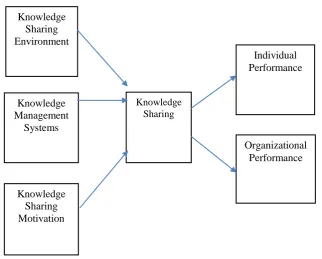
Consequently, this study employs knowledge sharing environment, Knowledge Management Systems and knowledge sharing motivation as the determinants of superior Knowledge Sharing.
Knowledge sharing
Vygotsky’s (1978) socio-cultural theory of learning suggests knowledge sharing and social interaction by the social/individual and the public/private mechanisms for knowledge acquisition and representation. Learning is supposed to be started on the social environment through the interactions between learners and the expert knowledge holders (Vygotsky, 1978). Individual learners take the concepts and strategies to other contexts and meanings and interpret them with social interactions. Consequently, learning starts in the public through the use of knowledge. Therefore, individuals understand, adjust, and implement the learned knowledge in their private domain.
As a result of Polanyi’s (1966) conceptualization, SECI model (Socialization, Externalization, Combination, and Internalization) is proposed by Nonaka and Takeuchi (1995) in order to explain tacit and explicit knowledge sharing in creating knowledge. After knowledge sharing processes, organizational knowledge is transformed into individual or group knowledge through internalization and socialization while individual and group knowledge are transformed into organizational knowledge through externalization and combination.
The literature reports that knowledge sharing is suggested as a fundamental knowledge-centered activity through which employees can mutually exchange their knowledge and contribute to knowledge application and ultimately the competitive advantage of the organization (Wang, Noe, 2010). This research uses knowledge sharing as the central variable for the proposed research model.
Performance Variables
Knowledge sharing has been extensively evaluated for the organizational KM including KS effectiveness in knowledge networks (Hansen, 2002), on individual performance (Teigland, Isko, 2003) and on organizational performance (Argote et al., 2000).
Wang and Wang (2012) suggest that both explicit and tacit knowledge sharing practices enhance performance and innovation by contributing to firm performance. According to their results, while explicit knowledge sharing is found to be more significantly influencing innovation speed and financial performance, tacit knowledge sharing is observed to have more significant effect on innovation quality and operational performance. KMS use (knowledge sharing with knowledge sharing instruments) is considered as the influencing factor of success in KMS success literature (Jennex, Olfman, 2004, 2005, 2006; Jennex, 2008).
According to Wang and Wang (2012), there are few studies measuring the direct relationship between knowledge sharing and firm performance. This study evaluates success variables (individual performance and organizational performance) as an outcome of knowledge sharing (KMS use).
Proposed Knowledge Sharing Model
Fig. 1. Knowledge Sharing Model
Therefore, the following hypotheses can be asserted for the research model in Figure 2.
H1. “Social Environment” is positively influential on “Knowledge Sharing”.
H2. “Knowledge Management Systems” is supposed to enhance “Knowledge Sharing”. H3. “Knowledge Sharing Motivation” has a positive contribution on “Knowledge Sharing”. H4. “Knowledge Sharing” positively affects “Individual Performance”.
H5. “Knowledge Sharing” increases “Organizational Performance”.
3. Data and Methodology
In order to collect the data to empirically analyze the proposed research questions and to verify the constructed research model, a survey study is employed. While constructing the questionnaire a seven-point Likert scale (1 for the negative end point as “strongly disagree” and 7 for the positive end point as “strongly agree”) is used and the survey is distributed both on English and Bosnian language.
For data collection, convenience sampling is preferred by considering the availability of the respondents. The survey targets individual knowledge workers (respondents) in Bosnian public and private enterprises. Peter Drucker popularizes the term ‘knowledge worker’ in 1968 (Drucker, 1968). He suggests knowledge workers as in the main focus point where they produce ideas, concepts, and information rather than a manual skill or muscle. He suggests knowledge as today’s main cost, investment, and product. According to Drucker, knowledge increasingly becomes the main exchange matter on knowledge based economy.
Mainly high status employees in organizational chart such as supervisors, presidents, executive committee members, auditors and CEOs are targeted. A response rate of 69 % (207/300) is achieved from distributed surveys.
Performed analyses include (1) descriptive statistics for the strength of the factors and the demographic information and (2) factor analysis, reliability test and regression analyses for testing the relationships and the reliability and the validity of the constructs. SPSS 18 software program is used for all tests.
Knowledge Sharing Environment
Knowledge Sharing
Individual Performance
Organizational Performance Knowledge
Management Systems
4. Results
Demographic Information
The respondents are mainly from operational (35,3 %), administrative (26,6 %) and educational (17,4 %) departments. Their positions within the organizations are as follows: clerical workers (42 %), managers (28,5 %), university lecturers (21,7 %) and so on. Males and females are almost equally represented (52,7 % vs. 47,3 % respectively).
Table 1. Respondents’ Departments
Respondents According to
Their Departments Frequency Percent
Administration 55 26,6
Auditing 7 3,4
Education 36 17,4
Finance 11 5,3
Human Resources 1 ,5
Law 10 4,8
Marketing and Sales 9 4,3
Operations 73 35,3
Research and Development 5 2,4
Total 207 100,0
KM Implementation
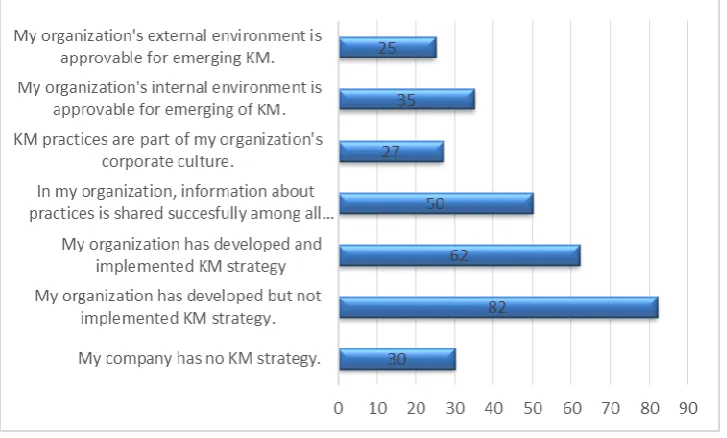
The respondents are also asked to evaluate their organizations by considering the implementation levels of knowledge management. According to the results, very few organizations (30/207) have no KM strategy. Most organizations have as at least a KM strategy (82/207). 62 respondents stated that their organizations have an implemented KM strategy. Moreover, 50 respondents rated their organizations as successful in knowledge sharing. 27 reflect that KM practices are a part of their organizational culture. 35 considered their organizational internal environment is approvable for emerging of KM. And finally, 25 respondents measured their organizational external environment is approvable for emerging of KM (Figure 2).
Research Model Test
Factor Analysis (FA) is employed using Varimax rotation in SPSS in order to evaluate whether the used items point the proposed factors. It is identified that all items show the proposed dimensions as seen in Table 4. The sample size is found to be suitable for FA, since KMO results change between 0,713 and 0,867. The factors with those items are observed to be reliable (Cronbach's Alpha values are between 0,767 and 0,884). In terms of construct validity, item loadings are identified to be quite high. The mean values for all dimensions are also calculated and it is observed that they are all just above average (change between 4,405 and 4,853).
Table 3. FA and Reliability Results
Factor Items N of Mean
Item-Factor
Correlations Adequacy Sampling Reliability Statistics Interval for Item
Loadings KMO Measure Cronbach's Alpha Knowledge
Sharing 4 4,636 0,732-0,835 0,764 0,767
Knowledge Management
Systems 4 4,607 0,773-0,875 0,713 0,844
Organizational Knowledge
Sharing Motivation
7 4,405 0,543-0,803 0,860 0,869
Knowledge Sharing
Environment 4 4,555 0,736-0,814 0,780 0,772 Individual
Performance 6 4,853 0,698-0,829 0,867 0,850 Organizational
Performance 6 4,691 0,741-0,857 0,862 0,884
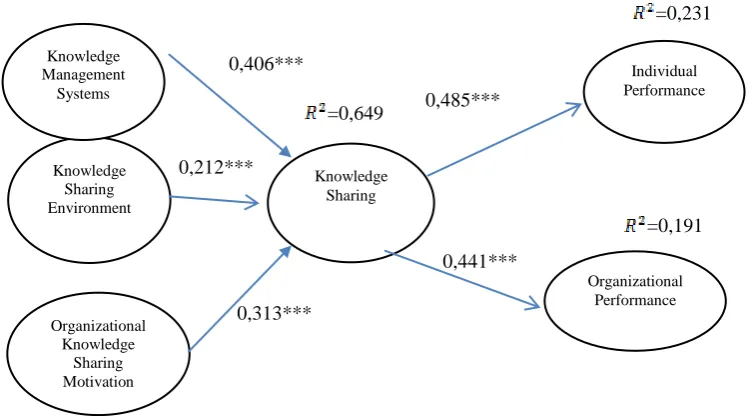
After measuring the strengths of dimensions, proposed model is tested and the results are provided in Table 5. According to the table, all relationships are found to be significant. While the influencing factors of Knowledge Sharing are explained well ( =0,649) by the model,
performance variables are weakly ( =0,231 and =0,191) explained.
Table 4. Regression Results
Relations Adjusted
R Square Standardized Coefficients Sig. Dependent Independent
Knowledge Sharing Environment
Knowledge
Sharing ,649
,212 ***
Knowledge Management
Systems ,406 ***
Knowledge Sharing
Motivation ,313 ***
Knowledge Sharing
Individual
According to the results (Figure 2), Knowledge Sharing is influenced by KMS moderately (0,406); by Organizational Motivation well (0,313); and by Knowledge Sharing Environment weakly (0,212). When the performance variables are considered, knowledge sharing has moderate influence on both individual performance (0,485) and organizational performance (0,441).
Fig. 3. Model Test Results (***: p<0.001)
5. Conclusion
This study empirically test a knowledge sharing model which implies knowledge sharing practices enhance both organizational and individual performance through (a) qualified KMS, (b) suitable knowledge sharing environment and (c) organizational knowledge sharing motivation.
According to the results, it is identified that KM implementation in BiH is poor. Some of the surveyed organizations are found to have no KM strategy. While some others have in initial stages, very few of them has implemented KM practices as a part of their organizational strategy.
According to the results, all the assumed relationships are verified meaning that advanced KMS, suitable knowledge sharing environment and high organizational knowledge sharing motivation leverage knowledge sharing and successful knowledge sharing increases individual performance and the organizational performance.
The mean values of dimensions advise that Bosnian enterprises have simple KMS, weak knowledge sharing environment and organizational knowledge sharing motivation which are the proposed enablers of knowledge sharing. Knowledge sharing dimension is also detected to be weak. Moreover, both individuals and organization do not seem to have satisfactory performance as a result of knowledge sharing. Low KM implementation level may be the reason for these weak values.
Given that all hypotheses are significantly supported by the collected data, the structured models and the relationships are not so strong. Low KM implementation and therefore low mean results may be the reason for these consequences. According to the results, only 50 (out of 207) respondents assume that their organizations are successful in knowledge sharing. Therefore, it may be expected that the respondents are not well aware of knowledge sharing enablers and possible outcomes of successful knowledge sharing in individual and organizational levels.
The identified relationships among knowledge sharing, knowledge sharing environment and performance can assist the companies in order to get better performance through knowledge sharing. Therefore, future research may reflect the strategies and programs to leverage firm performance.
In this study, the concentration is on Bosnian managerial practices. The study is quite unique in that the knowledge sharing literature is weak in Bosnian environment. Therefore, the study provides valuable theoretical and practical insights since the collected data represents the leading companies in BiH.
Knowledge Sharing Environment
Knowledge Sharing
Individual Performance
0,212***
0,441*** 0,485***
Organizational Performance
Organizational Knowledge
Sharing Motivation Knowledge Management
Systems
=0,649
=0,231
=0,191 0,406***
Future research may evaluate different types of KS (such as solicited and voluntary) and include additional antecedent variables and characteristics of learning organizations to further explain knowledge sharing behavior in KM.
References
Alavi, Leidner, 1999 – Alavi, M., Leidner, D. (1999). Knowledge Management System: Issues, Challenges and Benefits. Communications of the Association for Information System, 1(7), 2-41.
Alavi, Leidner, 2001 – Alavi, M., Leidner, D. (2001). Knowledge Management and Knowledge Management Systems: Conceptual Foundations and Research Issues. MIS Quarterly, 25(6), 95-116.
Alavi et al., 2006 – Alavi, M., Kayworth, T. R., Leidner, D. E. (2006). An empirical examination of the influence of organizational culture on knowledge management practices.
Journal of Management Information System, 22(3), 191-224.
Argote et al., 2000 – Argote, L., Ingram, P., Levine, J. M., Moreland, R. L. (2000). Knowledge Transfer in Organizations. Organisational Behavior and Human Decision Processes, 82(1), 1-8.
Bartlett, Čičić, Ćulahović, 2012 – Bartlett, W., Čičić, M., Ćulahović, B. (2012). A Survey of Knowledge Management Adoption in Public Administration. Bilgi Ekonomisi ve Yönetimi Dergisi, 7(1), 199-224.
Biloslavo, Kljajic-Dervic, 2011 – Biloslavo, R., & Kljajic-Dervic, M. (2011). Survey of Possibilities of Applying the Model of Knowledge Management in Enterprises with Regard to the Bosnia and Herzegovina Market. MIC 2011: Managing Sustainability? Proceedings of the 12th
International Conference (s. 1143-1163). Portoroz: University of Primorska, Faculty of
Management Koper.
Bock, Zmud, Kim, Lee, 2005 – Bock, G.-W., Zmud, R. W., Kim, Y.-G., & Lee, J.-N. (2005). Behavioral intention formation in knowledge sharing: Examining the roles of extrinsic motivators, social-psychological forces, and organizational climate. MIS Quarterly, 29(1), 87-111.
DeLone, McLean, 1992 – DeLone, W., McLean, E. (1992). Information Systems Success: The Quest for the Dependent Variable, Journal of Information System Research, 3(1), 60-95.
DeLone, McLean, 2003 – DeLone, W., & McLean, E. (2003). The DeLone and McLean Model of Information Systems Success: A Ten-Year Update, Journal of Management Information
Systems, 19(4), 9-30.
Drucker, 1968 – Drucker, P. F. (1968). The age of discontinuity: Guidelines to our changing society. London: Transaction Publishers.
Fink, 2000 – Fink, S. (2000). Crisis Management Planning for the Inevitable. AMACOM, New York.
Gu, Gu, 2011 – Gu, Q., Gu, Y. (2011). A Factorial Validation of Knowledge-Sharing Motivation Construct. Journal of Service Science and Management, 4 (1), 59-65. doi: 10.4236/jssm. 2011.41009
Hahn, Subramani, 2000 – Hahn, J., Subramani, M.R. (2000). A Framework of Knowledge Management Systems: Issues and Challenges for Theory and Practice. Proceedings of the Twenty-first International Conference on Information Systems, Brisbane, Australia, December 10-13, pp. 302-312, Paper 28, available at http://aisel.aisnet.org/icis2000/28.
Handzic et al., 2007 – Handzic, M., Lagumdzija, A., Celjo, A. (2007). A Survey of Knowledge Management Adoption in Public Administration. Journal of Information & Knowledge
Management (JIKM), 6(3), 219-230.
Handzic, 2011 – Handzic, M. (2011). Integrated Socio-Technical Knowledge Management
Model: An Empirical Evaluation. Journal of Knowledge Management, 15(2), 198-211.
Hansen, 2002 – Hansen, M. T. (2002). Knowledge networks: Explaining effective knowledge sharing in multiunit companies. Organization Science, 13: 232–248.
Jennex, Olfman, 2006 – Jennex, M., Olfman, L. (2006). A Model of Knowledge Management Success, International Journal of Knowledge Management, 3(2), 51-68.
Jennex, 2008 – Jennex, M. (2008). Exploring System Use as a Measure of Knowledge Management Success. Journal of Organizational and End User Computing (JOEUC), 20(1): 50-63.
Liu, Olfman, Ryan, 2005 – Liu, S.C., Olfman, L., & Ryan, T. (2005). Knowledge Management System Success: Empirical Assessment of a Theoretical Model, International Journal of
Knowledge Management, 1(2), 68-87.
Nonaka, Takeuchi, 1995 – Nonaka, I., Takeuchi, H. (1995). The knowledge creating company: How Japanese Companies create the dynamics of innovation. Oxford University Press Inc., New York.
O’Dell, Hubert, 2011 – O’Dell, C., Hubert, C. (2011). The New Edge in Knowledge: How Knowledge Management is Changing the Way We Do Business (1st ed.). Wiley.
Oye et al., 2011 – Oye, N.D., Mazleena, S., Noorminshah, A. (2011). Knowledge Sharing in Workplace: Motivators and Demotivators. International Journal of Managing Information
Technology, 3(4), 71-84.
Ozlen et al., 2012 – Ozlen, K., Mahmutović, Z., Mekić, E., Herić, E. (2012). KM Applications in Bosnian Managerial Practices. ISSD 2012, Sarajevo, BIH.
Polanyi, 1966 – Polanyi, M. (1966). The Tacit Dimension, London, UK: Routledge and Kegan Paul.
Ribiere, Sitar, 2003 – Ribiere, V.M., Sitar, A.S. (2003). Critical role of leadership in nurturing a knowledge-supporting culture. Knowledge Management Research & Practice, 1, 39-48.
Teh, Yong, 2011 – Teh, P.L., Yong, C.C. (2011). Knowledge sharing in is personnel: organizational behavior's perspective.Journal of Computer Information Systems, 51 (4). pp. 11-21. ISSN 0887-4417.
Teigland, Wasko, 2003 – Teigland, R., Wasko M. (2003). Integrating Knowledge through Information Trading: Examining the Relationship between Boundary Spanning Communication and Individual Performance. Decision Sciences, 34(2), 261-286.
Teng, Song, 2011 – Teng, J.T.C., Song, S. (2011). An exploratory examination of knowledge-sharing behaviors: solicited and voluntary. Journal of Knowledge Management, 15 (1), 104-117.
Tsui, 2003 – Tsui, A. B. (2003). Understanding expertise in teaching: Case studies of ESL teachers. New York: Cambridge University Press.
Vygotsky, 1978 – Vygotsky, L. (1978). Mind in society: The development of higher psychological processes. Cambridge: Harvard University Press.
Wang, Noe, 2010 – Wang, S., Noe, R.A. (2010). Knowledge Sharing: A Review and Directions for Future Research, Human Resource Management Review, 20, 115-131.