DEVELOPMENT AND VALIDATION OF NEW ANALYTICAL
METHODS FOR IMPURITY PROFILING OF DRUGS AND
PHARMACEUTICALS
SYNOPSIS
SUBMITTED TO FACULTY OF SCIENCE
OSAMNIA UNIVERSITY, HYDERABAD
FOR THE DEGREE OF
Doctor of Philosophy
In Chemistry
By
M V N KUMAR TALLURI, M.Sc
ANALYTICAL CHEMISTRY DIVISION
INDIAN INSTITUTE OF CHEMICAL TECHNOLOGY
HYDERABAD-500 607 INDIA
The need to develop new analytical methods for assurance of quality, safety and efficacy of drugs and pharmaceuticals is quite important because of their use not only as health care products but also life saving substances. The analytical methods assume of great importance due to i) development of new drugs ii) continuous changes in manufacturing processes for existing drugs and iii) setting up of threshold limits for individual and total impurities of drugs by regulatory authorities. Keeping this in view, an attempt was made in the present investigation to develop new analytical methods for some of the important drugs and pharmaceuticals of α1-adrenergic receptor antagonist,
antidepressants, cardiovascular agents, antioxidants and tuberculostatics in nature. All the methods described in the thesis are simple, rapid, reliable and validated. The methods could be used not only for quality control but also for process development of bulk drugs. The work carried out in the present investigation was described in six chapters.
Chapter 1
Impact of Impurities on Quality and Safety of Drugs and Pharmaceuticals
Chapter 1 gives a brief introduction to quality, safety and efficacy of drugs and pharmaceuticals. Examples of aspirin, hydrochlorothiazide, etc. were discussed. The origin of impurities, types of different impurities in drugs and pharmaceuticals, impurity profiling of drugs, identification of impurities by analytical techniques such as HPLC, LC-MS, GC-MS etc., were discussed. The pharmacopoeial status, regulatory aspects and analytical methodologies were presented. Statement of the problem, aims and objectives of the present investigation were given at the end of the chapter. All the experimental details were described in the respective chapters.
Chapter 2
Liquid Chromatographic Studies on Development of Impurity Profiles of Tamsulosin, a Selective Alpha-Adrenoceptor Antagonist
tamsulosin has greater specificity for α1 receptors in the human prostate and does not affect
receptors on blood vessels. It is the most frequently prescribed medication for the treatment of lower urinary tract symptoms suggestive of BPH. Determination of its quality is important for the benefit of the patients who ultimately are treated for BPH. A through literature search has revealed that no method for determination of the impurities either in bulk drugs or pharmaceuticals has been reported. Thus there is a need for development of analytical methods, which will be useful to monitor the levels of impurities in the finished products of tamsulosin during process development.
In the present study, a reverse phase high performance liquid chromatographic (RP-HPLC) method for separation and determination of tamsulosin and its process related impurities was developed and validated. The process related impurities of {2-[2-(2-ethoxy-phenoxy)-ethylamino]-propyl}-2-methoxy-benzenesulfonamide TAM (V) viz., 5-(2-amino-propyl)-2-methoxy-benzenesulfonamide (I), benzene-1,2-diol (II), 2-methoxy-5-(2-oxo-propyl)-benzenesulfonamide (III), 2–methoxy–5 -[ 2 - (1– phenyl -ethylamino)– propyl] - benzenesulfonamide (IV), 4-methoxy benzaldehyde (VI),1-(4-methoxy-phenyl)-propan-2-one (VII), 1-ethoxy-2-(2-iodo-ethoxy)-benzene (VIII), 1-(2-bromo-ethoxy)-2-ethoxy-benzene (IX) as shown in Fig. 1 were separated and determined by HPLC.
Attempts were made to separate tamsulosin from its process related impurities on different commercial C18 columns. The chromatographic conditions were optimized by
studying the effects of temperature of the column, concentration and pH of ammonium acetate buffer. The optimum HPLC conditions developed were as follows; mobile phase: A: 10 mM ammonium acetate, pH 6.5 and B; acetonitrile was pumped at a flow rate of 1.0 ml/min according to gradient elution program: 0 min. 5% B, 0-10 min. 20% B, 10-25 min. 60% B, 25-30 min. 80% B, 30-35 min. 100% B, 36-45 min. 5% B. A typical chromatogram showing the separation of 10% (w/w) of each of the related substances spiked to V at the specified relative concentration of 500 µg/ml is shown in Fig. 2. The optimized conditions were used to determine the impurities present in different batches of tamsulosin. Three impurities were detected and identified. In order to characterize the impurities ESI-MSn was used. The MS analysis was carried out in positive ion mode using
O
SO2NH2
H N
O
O
not match with any of the process intermediates studied in present investigation. It showed m/z 349 with stable daughter ions at 228, 200. It was identified as compound (X). Another impurity at 21.69 perfectly matched with fragmentation pattern of (IV), which showed m/z 349 with daughter ions at 245, 228, 200. In positive ion mode tamsulosin had shown a protonated molecular ion at m/z at 409. Its further ESI-MSn fragmentation showed
daughter ions 271, 228, 200.
The method was validated with respect to precision (inter and intra day assay of TAM, R.S.D < 1%), accuracy (98.65- 99.29 with RSD 0.53-1.36 for TAM and
95.10-103.36 % with R.S.D 0.36-3.92% for impurities), linearity (range 50 to 500 g/ml with r2
0.9999 for TAM and 0.5-5.0 g/ml with r2 0.9989 for impurities), limits of detection
(LOD) and limits of quantitation (LOQ) and specificity.
The developed method was found to be selective, sensitive, and precise. The method could be of use for process development as well as quality assurance of tamsulosin in bulk drugs as well as pharmaceutical formulations.
i) Active ingredient
ii) Related substances
(I) (II) (III) (IV)
(V) (VI) (VIII) (IX)
(X)
Fig.1 Chemical structures of tamsulosin (V) and its process related impurities
O
NH2
SO2NH2
HO
HO O
O
SO2NH2
O SO2NH2
NH
CHO
O O
O
O CH3
O
I
O CH3
O
Fig. 2 Typical chromatograms of tamsulosin (V) spiked with impurities
Chapter 3
Separation of Stereoisomers of Sertraline and its Related Enantiomeric Impurities on
CYCLOBOND I 2000 DMby High Performance Liquid Chromatography
Depression, anxiety and obesity are some of the most common and serious health problems of the people today. Development of therapeutic agents to treat these disorders is of significant interest of recent times. Sertraline HCl or cis-(1S, 4S)-4-(3,4-dichlorophenyl)-1, 2, 3, 4-tetrahydro-N-methyl-1-nanphthalenamine hydrochloride (SRT) is one of the novel drugs belonging to the group of selective serotonin reuptake inhibitors (SSRI) in brain. It is useful not only in treating all types of depression but also panic disorders, social phobia, obesity, or obsessive-compulsive disorders. SRT increases the neurotransmitter serotonin by inhibiting its reuptake into the presynaptic cell, there by increases available serotonin to bind the postsynaptic receptor. The most important advantage of SRT is that it lacks the side effects of tricyclic antidepressants. The molecule of SRT contains two stereogenic centers and it is quite likely that cis-(1R,4R) – 4-(3,4– dichlorophenyl)- 1,2,3,4-tetrahydro-N-methyl-1-nanphthalenamine hydrochloride, trans-(1S,4R)-4-(3,4-dichlorophenyl)-1,2,3,4-tetrahydro-Nmethyl-1-nanphthalenamine
therapeutic efficacy and safety. Thus the development of a chiral active pharmaceutical ingredient of SRT requires techniques that can quickly asses the enantiomeric purity of the drug during the development and manufacturing processes.
The present work describes a reversed phase chiral liquid chromatographic separation of SRT and its related enantiomer impurities on a CYCLOBOND I 2000 DM column. The chromatographic conditions were optimized by studying the effects of temperature of the column and concentration and pH of TFA buffer. The effect of pH, buffer concentration as well as nature of organic modifier, flow rate and temperature on enantioselectivity was investigated. Methanol, acetonitrile, isopropanol and ethanol were tried as organic modifier. Concentration (0.1 to 0.5%) and pH (3.0 to 7.0) of trifluoro
acetic acid (TFA) buffer and temperature of column (20 to 40C), flow rate (0.4 to 1.2 mL/min) on retention and resolution were studied to optimize the chromatographic conditions. Fig. 4 represents the typical chromatogram of a mixture of SRT and its related substances.
Optimum chromatographic conditions:
Mobile phase : 0.4 %Trifluoro acetic acid -acetonitrile (80:20 v/v). The mobile phase was filtered through a Millipore membrane filter (0.2 µm) and degassed before use.
Column : Astec CYCLOBONDTM I 2000 DM (Supleco, PA, USA.) (25 cm ×
4.6mm id, partical size 5µm), Flow rate : 0.8 ml/min
Detector : Photo diode array (PDA)
Wavelenght (max) : 225 nm
Injection volume : 20 l Column temperature : 30oC
dichloro trans (III, IV). The chromatographic separations were characterized in terms of the performance parameters retention, selectivity and resolution. The conditions affording the best resolution were optimized and the method was validated as per ICH guidelines. The developed method was found to be selective, sensitive, precise, linear, accurate and reproducible in determining the sertraline and its potential impurities, which may be present at trace level in the finished products. The method could be used in the quality control and purity testing of sertraline as it was sensitive, precise and accurate.
(I) (II) (III) (IV) (V)
(VI) (VII)
(VIII) (IX)
Fig.4. Typical chromatogram of a mixture of sertraline and its related substances under the optimum conditions.
Chapter 4
Continuous Counter Current Extraction, Isolation and Determination of Solanesol in
Nicotiana tobacum L. by Non-Aqueous Reversed Phase High Performance Liquid
Chromatography
Solanesol a naturally occurring trisesquiterpenoid (C45) alcohol of tobacco is one of
the important precursors of the tumorigenic poly nuclear aromatic hydrocarbons (PAHs) of tobacco smoke. Reduction of its levels in tobacco, leads to safe smoking products due to reduced PAH levels in cigarette smoke. It is also the starting material for many high-value biochemicals, including coenzyme Q10 and Vitamin-K analogues as a starting material for
Q10, it is used in treatment of different cancers. Coenzyme Q10 is well known not only to
reduce the number and size of tumors but also improve cardiovascular health. Solanesol itself could be used as an antibiotic, cardiac stimulant and lipid antioxidant. At present clinical trails are under progress to explore its use as an anticancer drug. There is a great demand for solanesol for production of Q10 and other uses. Thus its isolation not only
reduces the risks of PAH from tobacco smoke but also makes use of it as a starting material in synthesis of several value added products such as Q10 and other analogues.
Therefore isolation of solanesol from tobacco is great importance in recent years.
In the present investigation an economical and efficient protocol for isolation of solanesol from tobacco using counter current extraction, followed by column chromatography, saponification and recrystallisation was described. High-purity of 95-98% solanesol was produced using common laboratory chemicals. The continuous counter current extraction is more suitable for isolation of solanesol on a large scale. In addition, a simple and rapid method for separation and determination of solanesol from tobacco using non-aqueous RP-HPLC in an isocratic elution mode and using UV detector at 215nm was developed. The non-aqueous reverse-phase mode has definite advantages over other methods due to the use of most popular C18 column with UV detection is often preferred
extracts of tobacco. The HPLC chromatograms of solanesol purified by different methods are shown in Fig.6
Fig.5. Flow sheet
of procedures
followed for
purification
of solanesol
from the crude
Fig. 6. HPLC profiles of (A) crude extract; (B) saponified; (C) saponified and acetone recrystallisation; (D) silica gel column and hexane recrystallisation.
Chapter 5
Simultaneous Separation and Determination of Co-enzymeQ10 and its Process related
impurities by Non-Aqueous Reversed Phase High Performance Liquid Chromatography
Coenzyme Q10 (CoQ10) is an essential vitamin-like nutrient for cell respiration and
electron transfer to control the production of energy in the cells of heart. It acts as a powerful antioxidant and membrane stabilizer in preventing cellular damage resulting from normal metabolic processes. It is naturally synthesized and occurs in all cells in the human body, but its rate of production falls with age. It is found in food, especially meat, but in very small amounts as thermal processing destroys it. The use of CoQ10 as a dietary,
nutraceutical supplement has increased dramatically in the last decade. It has potential preventive and therapeutic effects in many diseases like cancer, cardiovascular and neurodegenerative disorders, acquired immunodeficiency syndrome (AIDS) and Parkinson’s disease. It is also known to be an energy booster and immune system enhancer. Recently, the commercial formulations containing coenzyme Q10 have gained
increasing popularity in health management.
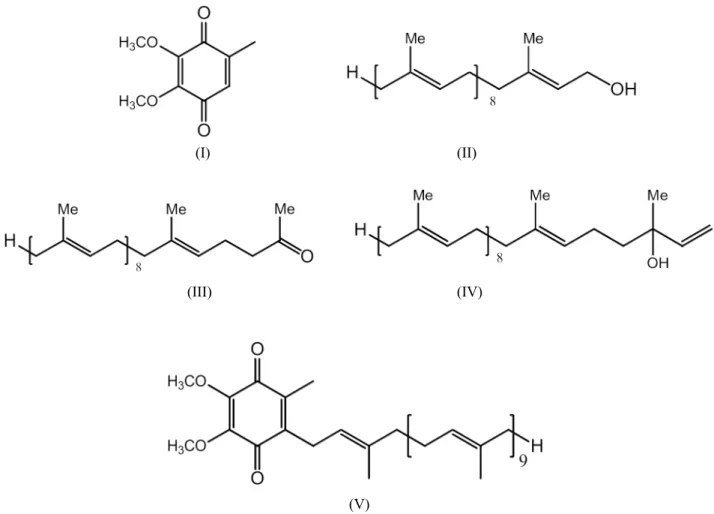
Literature search revealed that no method for determination of its impurities has been reported either in bulk drugs or pharmaceuticals. Thus there is a great need for analytical methods, which will be helpful to monitor the levels of impurities in the finished products of CoQ10 during process development. The chemical structures of CoQ10 and its
(I) (II)
(III) (IV)
(V)
Fig. 7. Chemical structures of CoQ10 (V) and its related substances (I)
2,3-Dimethoxy-5-methyl-p-benzoquinone (II) Solanesol (III) Solanesyl acetone (IV) Isodecaprenol.
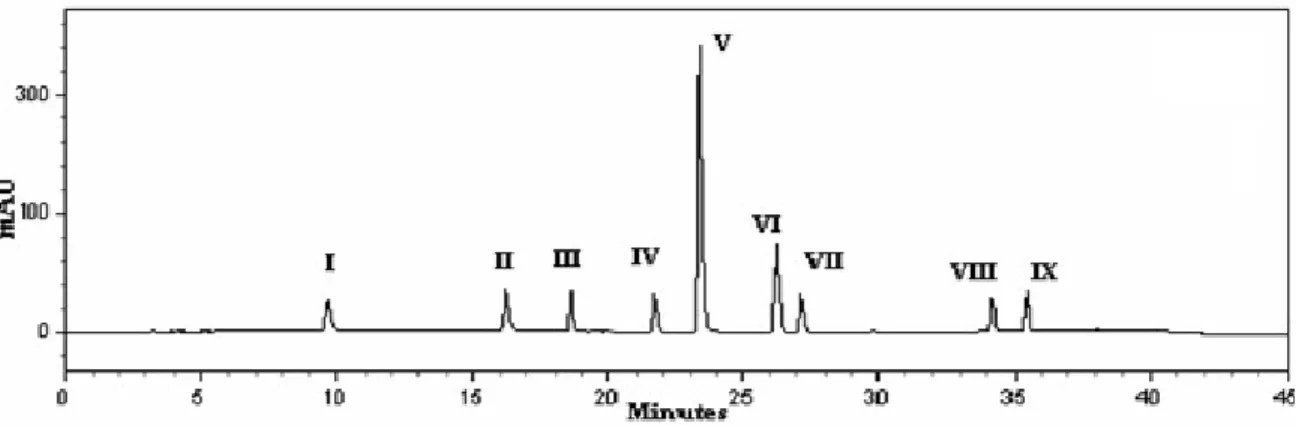
In the present study, the separation and determination of its process related impurities was examined by non-aqueous reverse phase high performance liquid chromatography (NARP-HPLC) using a C8 column connected to a PDA detector set at 210
nm. The related substances were identified by APCI-MS. Different batches of CoQ10 (V)
were analyzed. A typical chromatogram showing the separation of each of related impurities spiked to CoQ10 at the specified relative concentration and some commercial
613 (M-H2O) with daughter ions at 577, 219 was identified as (II). Impurity at 15.21 min,
matches with retention time and shows its molecular ion at m/z 671, it conforms the impurity as III. Another peak at 17.75 showed m/z at 681(M-H2O), and supported the
impurity as IV. In positive ion mode CoQ10 had shown as a molecular ion at m/z at 863. Its
daughter ions found at 663, 391, 253.
The developed method is selective, sensitive, accurate and precise. The method is also capable of detecting process related impurities, which may be present at trace level in the finished products.
Fig.8. Typical chromatograms of Coenzyme Q10 (V) (A) spiked with related substances
and (B, C) two different commercial formulations.
Chapter 6
Determination of Inorganic Impurities in Drugs and Pharmaceuticals by Inductively Coupled Plasma-Mass Spectrometry (ICP-MS)
respond to the test by yielding different colours viz., white, yellow, orange, black and dark brown. Based on colour as a parameter, it is difficult to give the identity for the ion responsible for the colour. The procedure lacks specificity, sensitivity and is time consuming with no information about the recoveries. Several attempts were made to improve the procedure but not of much advantage, the main disadvantages being their suitability for few elements and unequal sensitivity.
Though the toxicity of the trace metals like Hg, As, Pb is known but their limits in pharmaceutical products have not been defined clearly. Some of the heavy metals are also required as micronutrients, but above the necessary range, they cause toxicity. It is, therefore, necessary to look at suitable methods for monitoring of the metals at very low concentration levels (ppm to ppb) either for single metal or mixtures.
AAS, ICP-AES and ICP-MS are suitable techniques for this purpose. Among these techniques ICP-MS is the most suitable for multielemental analysis. ICP-MS finds extensive application due to very low detection limits (ppb, ppt) for the most of the elements in the periodic table. The mass spectra of elements are simple and therefore can provide quick access for qualitative, semi-quantitative and quantitative analysis. Equipment cost and non availability of standard reference materials (SRM’s) for pharmaceutical products for ascertaining the accuracy are the main disadvantages of ICP-MS analysis. Considering the importance of trace elemental analysis in pharmaceutical products, four nitrogen containing drugs viz., dicyclomine, ethambutol, pyrazinamide and furazolidone (Fig.9) were selected and screened by ICP-MS.
The heavy metal contents in drugs were determined by inductively coupled plasma-mass spectrometry (ICP-MS). The compounds were chosen on the basis of their ability to bind metal ions present in contamination. The drugs were analysed for Ti, Cr, Mn, Fe, Co, Ni, Cu, Zn, Cd, Hg, Pb etc., metals by selecting a suitable isotope. Cr, Fe, Ti and Cu were observed to be highest in dicyclomine, ethambutol, pyrazinamide and furazolidone respectively. Ni and Hg were absent in all the four drugs, while traces of Cd were present in ethambutol and pyrazinamide. Analytical results showed that ICP-MS method is useful for monitoring inorganic impurities present in drugs and pharmaceuticals.
The work presented in chapters 1-6 of the thesis describes the development and validation of new analytical methodologies for separation and determination of trace level organic, inorganic and enantiomer impurities of some popular α1-adrenergic receptor