Development and performance evaluation of rotary drum
grader for tomato
P. Preetha* , R. Pandiselvam, J. Deepa and N. Varadharaju
Department of Food and Agricultural Process Engineering, Tamil Nadu Agricultural University, Coimbatore, India *Corresponding author: [email protected]
Paper No. 422 Received: 15 August 2015 Accepted: 4 February 2016
Abstract
Grading is one of the most important unit operations in packing houses by which it enables to obtain a good and appealing packing system. To standardize the tomatoes for export or marketing in local markets the rotary drum grader was developed in Tamil Nadu Agricultural University. It consists of a drum in which the holes are made based on the standard size of tomatoes. It is manually operated using a handle fitted to the shaft which is mounted on the main frame using a wooden block. The performance evaluation was done to optimizing the peripheral speed, inclination angle and feed rate. As the tomatoes are fed through the hopper into the rotating drum, it gets separated according to size. It is portable and can be used in the field. By conducting different study the efficiency of grader was found to be 80% at 16º inclination angle, 175 kg.h–1 feed rate and 15 rpm peripheral speed.
Highlights
• Rotary Drum grader for tomato were developed in TamilNadu Agricultural University. • Grader is used for local markets to grade tomato according to its size
• Based on size, tomato fetch higher prices in market.
Keywords: Tomato, grader, sorter, degree of grading, fraction yield, peripheral speed, inclination angle DOI Number: 10.5958/2230-732X.2016.00020.6
©2016 New Delhi Publishers. All rights reserved
Tomato is one of the most important “protective foods” because of its nutritive value. It is one of the most versatile vegetable with wide usage in Indian culinary tradition. PKM 1 is the most popular variety grown in Tamil Nadu due to suitability for all seasons and yields around 32 tonnes/ha. The tomato producing areas in Tamil Nadu are
Salem, Coimbatore, Dharmapuri, Trichy, Erode and Krishnagiri. Depending on their internal and
external characteristics of tomatoes are extensively used for the preparation of many products and it can also be processed and preserved in the form of puree, paste, ketchup, sauce and other ready-to-eat products. It is also used as a salad vegetable. It has good domestic and export markets.
Grading is one of the most important unit operation for fruits and vegetables in marketing (Mangaraj et al. 2006). Grading may not only standardize fruit
product but also promote management of the fruit tree in orchard and product quality (Haisheng
Gao, 2003; Lite Li et al. 2003).Grading and sorting
of vegetables and fruits ensures that derived products meet the defined grade requirements for sellers, and the expected quality for buyers (Heinemann et al. 1996). It is important for tomatoes
because the size, shape and color depend greatly on environmental conditions and handling, and is performed primarily by human labor who assess the tomato based on “color” or “size” denote a
particular quality attribute. However, there are some
disadvantages to using human labor, including inconsistency, short supply of labor, and the expense of the large amounts of time and money is required due to the huge volume of production and there may be a chance for improper grading
and cross contamination. (Narvankar and Jha 2005).
Automated systems in most cases are faster and
more precise (Narendra and Hareesh 2010).
Both the consumers and farmers are benefited, if
the tomato is sold with standard grade. Factors such
as size, uniformity, shape, color, firmness, disease,
cut surfaces and moisture content determine the
final grade of a tomato.Grading of fruits enables
to sell the fruits or vegetables in a good appealing manner through uniform packages (Varshney et al., 2002). Product experts characterize tomato
defects and diseases based on size, color and shape features, and thus mechanical grader may improve grading results and be able to take over the visually intensive grading work from human labor. New
trends in marketing as specified by World Trade Organization (WTO) demand high quality graded
products. Farmers are looking forward to having an appropriate agricultural produce-grading machine in order to alleviate the labor shortage, save time
and improve graded product’s quality (Londhe et al. 2013). In view of the above considerations,
the mechanical fruit grader is a useful option that maintains uniformity of product and adds value to
the final product (Kachru et al., 1986). Mechanical
grading of the fruits and vegetables is done based on weight, shape and size.Hence an economical and simple size based mechanical grader for tomato is the need of hour for the tomato growing farmers. The objective of this present investigation was to develop a grader for tomato and evaluate its performance.
Materials and methods
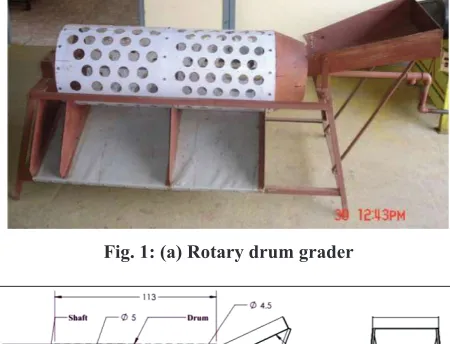
The rotary drum grader consisted of a frame,
transmission system, circular sieves, central shaft,
hopper, collector and cover as shown in Figure 1
(a) and (b).
Frame
Frame is the important component of any machine which has the capability of resisting all the forces acting over it and protects the other fragile components of the machine from breakage or
damage. The dimension of the frame is 133×45 cm. The height of the frame is 56 cm on the hopper side and 53 cm on the other side. This denotes that the drum is placed at an appropriate angle based on the angle of repose of the tomatoes. The other side of the
stand has a length of 60 cm and breadth of 45 cm.
Fig. 1: (a) Rotary drum grader
Fig. 1: (b) Front and side view of rotary drum grader
Transmission system
It is hand operated machine in which a handle is fitted to the main central shaft. The handle was
connected to the centre shaft made up of mild steel.
It diameter is about 2.5 cm.
Circular sieves
The circular holes were made on the poly carbonate
sheets. The first chamber has a hole of about 4.5 cm
diameter and second chamber has the holes of 5 cm diameter. A single drum is bifurcated into two sections by means of a thin strip of mild steel sheet.
The first chamber has totally 99 numbers of holes
and arranged alternatively with 6 holes in one row and 5 holes in other row. In the second section have 72 holes and alternatively arranged with 5 holes as one row and 4 holes as other row. The diameter of
the drum is 38 cm. The length of the drum is 113
Central shaft
The central shaft is a mild steel rod whose length is about 169 cm which consist of flights at three
positions at the two ends and in place separating the drum into two chambers. The drum is rotated
by means of the shaft which runs through the entire
length of the drum. It is mounted on the frame by
mean of wooden piece of dimension 15.5 x 5 x 8 cm.
Hopper
Hopper is constructed for easy handling of tomatoes into the drum. The dimension of the hopper is 57×51×11 cm. It is made of mild steel sheet supported on the frame by means of the mild steel
flat of length 7 cm on both side. It is also supported by two more mild steel flat. The slope of the hopper is fixed on the basis of angle of repose of the tomato.
For efficient grading the height from which the tomato is feed was optimized based on the height of the hopper from the base, thereby the angle was also varied accordingly. The hopper is placed at an
angle of 10º.
Collector
Three collectors are used in the grader. The first collector has a dimension of 40×71 cm which collects
the 1st grade tomatoes of less than 4.5 cm size. The second collector has a dimension of 44×71 cm to
collect the next grade of size 5 cm and the final
collector is 13.5×71 cm to collect the rest of the grade i.e, 3rd grade of size greater than 6 cm. It is covered by smooth PVC sheet which enables free falling of the tomatoes.
Cover
A circular cover made of PC sheet of 0.8 cm is
provided. It is used to cover the drum. On this Polycarbonate cover the holes were made.
Performance evaluation of the grader
Method of operation
Grader was placed on the leveled ground. Tomatoes were weighed and its size was measured manually. It is fed through the hopper into the rotating drum. The drum was rotated at a required speed manually. As the tomato pass through the drum the desired sized tomatoes were collected in the
desired collector. The final weight and number of
tomatoes in each grade was noted. This experiment was repeated for three times.
Speed of the drum
The grading was performed by varying the speed
as 10, 15 and 20 rpm. The optimum speed for the effective grading was evaluated.
Angle of the drum
The angle at which the drum has been inclined to the frame is measured. In this the angle formed between the base line and the height of the drum from the base is calculated as 15º and the grading of tomatoes were performed by varying the angle as 15º, 16º and 17º.
Determination of feed rate
The known quantity of tomato was taken and fed in to the feed hopper. The machine was operated and the time taken for complete grading of the sample
was noted for different feed rate and finally the feed
rate of the machine per hour is calculated as
Feedrate (kg/h) = QT (1)
Where, Q is quantity of the sample in kg and t is
time taken in h
Effectiveness test
A known quantity about 5 kg of tomato were taken. The mass of the individual fractions of the material corresponding to the sizes of the holes at 4.5 cm,
5 cm and greater than 5 cm were analyzed as W1,
W2 and W3 respectively. The individual fractions were mixed and fed into the grader and the handle was rotated. The time taken for grading was noted down.
After grading the feed material let the mass of the
products obtained through the outlets are taken as
Q1, Q2 and Q3. Thus,
W1+W2+W3=WT (2)
Q1+Q2+Q3=WT (3)
manually and their masses were separately found as q1, q2 and q3.The purity of the product obtained at
different outlets after grading was found out using
the following relation
P1 = Q1 – q1
Q1 (4)
P2 = Q2 – q2
Q2 (5)
P3 = Q3 – q3
Q3 (6)
Where,
P1 = purity of the product obtained in the outlet 1 P2 = purity of the product obtained in the outlet 2 P3 = purity of the product obtained in the outlet 3
Q1 = fraction of the feed material through the outlet 1
Q2 = fraction of the feed material through the outlet 2
Q3 = fraction of the feed material through the outlet 3
q1 = fraction of the material other than the desired size in outlet 1
q2 = fraction of the material other than the desired size in outlet 2
q3 = fraction of the material other than the desired size in outlet 3
The fraction yield was calculated as follows:
F1 = Q1
QT (7)
F2 = Q2
QT (8)
F3 = Q3
QT (9)
Where,
Fr1 = fraction yield at outlet 1 Fr2 = fraction yield at outlet 2 Fr3 = fraction yield at outlet 3
WT = total mass of feed to be graded
The fractions of each size corresponding to the holes in the total feed was calculated by,
a1 = W1
WT (10)
a2 = W2
WT (11)
a3 = W3
WT (12)
Where,
a1 = raction of each size corresponding to the grade 1 in total feed
a2 = fraction of each size corresponding to the grade 2 in total feed
a3 = Fraction of each size corresponding to the grade 3 in total feed
W1 = mass of individual fractions of feed material in grade 1
W2 = mass of individual fractions of feed material in grade 2
W3 = mass of individual fractions of feed material in grade 3
The degree of grading which is the ratio of the amount of the component in the yield fraction to the amount of the same component in the initial mixture is given by
Ex1 =P1Fr1
a1 (13)
Ex2 =P2Fr2
a2 (14)
Ex3 =P3Fr3
a3 (15)
Where,
Ex1 = degree of extraction of grade 1
Ex2 = degree of extraction of grade 2
Ex3 = Degree of extraction of grade 3
Overall efficiency
(16)
The experiments were carried out with different feeds rates and peripheral speed. The effectiveness
Results and discussion
Effect of peripheral speed on the efficiency
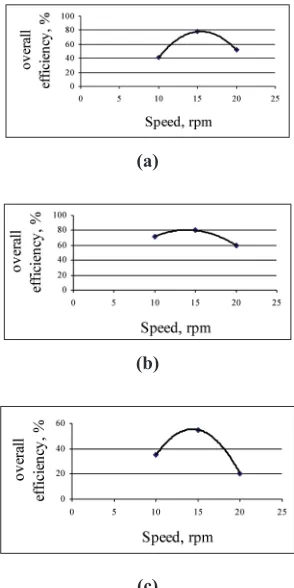
The grading efficiency mainly depends on the
peripheral speed of operation. Figures 2 (a), (b) and (c) shows the effect of peripheral speed on the overall efficiency of the grader at 15º, 16º and
17º inclination angle respectively. The maximum
efficiency of the grader observed at the peripheral
speed of 15 rpm at an inclination angle of 15º, 16º
and 17º for 78, 80 and 55% respectively. From the
Figures also observed that as the peripheral speed
increases the efficiency increases initially and then decreases. With increase in speed, the grading efficiency decreases since smaller tomatoes may
move faster into bigger holes. Also the increase in speed increases the damage of tomato.
(a)
(b)
(c)
Fig. 2: Effect of peripheral speed on the overall efficiency
of the grader at 15o (a), 16o (b) and 17o inclination angle (c)
Effect of peripheral speed on the feed rate
Figures 3 (a), (b) and (c) shows the effect of
peripheral speed on the feed rate of the grader at 15º, 16º and 17º inclination angle respectively. If the peripheral speed increases the feed rate also increase. Hence maximum feed rate obtained for an
inclination angle 15º, 16º and 17º at the peripheral
speed of 20 rpm was found to be 100, 200 and 320
kg/h respectively. It is evident from the graph that as the peripheral speed increases the feed rate also increases and the time consumed for the completion of the process is less which ultimately resulted in increased feed rate. Tomato is a delegate vegetable it is prone to many damages during grading process. Proper care is required while rotating.
(a)
(b)
(c)
Fig. 3: Effect of peripheral speed on the feed rate of the grader at 15º (a), 16º (b) and 17º (c) inclination angle
Effect of inclination angle on efficiency
In this graph is drawn for three peripheral speeds
as 10, 15 and 20 rpm related with overall efficiency (Fig. 4) at 15º, 16º and 17º inclination angle. The maximum efficiency is obtained at an inclination
angle 16º. The inclination angle increases as 15º, 16º
and 17º the efficiency was found to be 49, 71 and 45
per cent respectively. Increase in slope or inclination
angle, the overall efficiency increases initially and then start decreases. Lower slope resist the flow of
(a)
(b)
(c)
Fig. 4: Effect of peripheral speed on the overall efficiency
of the grader at 15o (a), 16o (b) and 17o inclination angle (c)
Effect of peripheral speed on damage
Figure 5 shows the effect of peripheral speed on the
tomato damage. If the peripheral speed ranges from
10, 15 and 20 rpm the damage percentage was found
to be 3.2, 2.4 and 4 per cent respectively. Thus, due
to the speed increases the damage first decreases
and then slightly increases. Also the damage percentage decreases initially and then increases as the slope increases. The peripheral speed of 15 rpm at 16º inclination angle the damage percentage was found to be less.
Fig. 5: Effect of peripheral speed on the tomatoes damage at 16o inclination angle
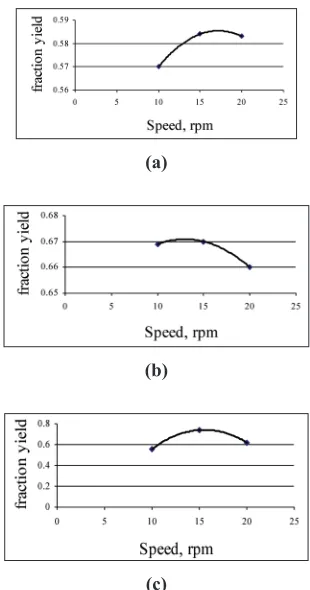
Effect of peripheral speed on the fraction yield Figure 6 shows the relationship between peripheral
speeds on fraction yield at an angles 15º (a), 16º (b) and 17º (c). For the peripheral speed ranges from
10, 15 and 20 rpm the fraction yield at angles 15º, 16º and 17º was found to be 0.58, 0.67 and 0.64
respectively. It was found that as the peripheral speed increases the fraction yield also increases and then slightly decreases. As the speed increases the yield as per the required size gets reduced since some higher peripheral speed is required to perform
the required grading. The efficiency optimized at 15
rpm and 16 º inclination angle.
(a)
(b)
(c)
Fig. 6: Effect of peripheral speed on the fraction yield of the grader at 15o (a), 16o (b) and 17o inclination angle (c)
Effect of inclination angle on fraction yield Figure 7 shows the relationship between inclination angle and fraction yield.The fraction yield at an inclination angle 15º, 16º and 17º for the peripheral
speed 10, 15 and 20 rpm was found to be 0.6, 0.67 and 0.62 respectively. From these graphs observed
that as the angle in creases the fraction yield also increases initially and then decreases. An optimum fraction yield is obtained at 16º inclination angle.
(b)
(c)
Fig. 7: Effect of inclination angle on the fraction yield at 10 (a), 15(b) and 20 rpm (c) peripheral speed
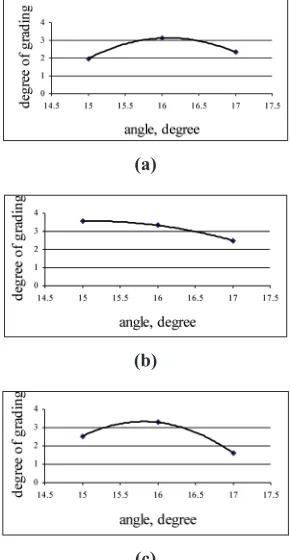
Effect of inclination angle on degree of grading Figure 8 shows the effect of inclination angle on
degree of grading.The fraction yield at angle 15º,
16º and 17º for the peripheral speeds 10, 15 and 20
rpm was found to be 1.9, 3.2 and 2.3 respectively. From these graphs it is also observed that as the inclination angle is increases the degree of grading increases initially and then decreases. From the
figures optimum degree of grading was found to
be 16º.
(a)
(b)
(c)
Fig.8: Effect of inclination angle on degree of grading at 10 (a), 15 (b) and 20 rpm (c) peripheral speed
Effect of peripheral speed on degree of grading Figures 9 (a), (b) and (c) shows the relationship
between peripheral speed and degree of grading at 15, 16 and 17º inclination angle respectively.For this
the peripheral speed 10, 15 and 20 rpm the degree
of grading at an inclination angles 15º, 16º and 17º was found to be 2.52, 3.3 and 1.6 respectively. It was found that as the speed increases the degree of grading increases initially and then slightly decreases. As the speed increases the degree of grading get reduced due to the corresponding
change in the fraction yield. But the grading should require some external force. Hence the efficiency
is optimized at 15 rpm and 16º inclination angle.
(a)
(b)
(c)
Fig. 9: Effect of peripheral speed on degree of grading at 15 (a), 16(b) and 17o (c) inclination angle
Conclusion
Grading of fruits is a very important unit operation as it fetches high price to the grower and improves packaging, handling and brings an overall improvement in marketing system. It could reduce handling losses during transportation. Vegetable grader is used to solve these problems. The developed rotary grader for tomato operated with perfection, accuracy, faster rate of grading and less labor requirement. The cost of grading of tomato
References
Haisheng, G. 2003. Pursuing breakthrough in storage of fruit and vegetables in China. China Food Newspaper 7.7(A4). Heinemann, P.H., Pathare, N.P. and Morrow, C.T. 1996. An
automated inspection station for machine-vision grading of potatoes. Machine Vision and Applications 9: 14–19. http://dx.doi.org/10.1007/BF01246635
Kachru, R.P., Bist, B.S., Srivastava, P.K. and Ojha, T.P. 1986. 100 Bankable Post harvest equipment developed in India, Central institute of Agricultural Engineering, Bhopal. Londhe, D., Ganesh Pawar, S.N., Atkari, V. and Wandkar, S.
2013. Grader: A review of different methods of grading for fruits and vegetables. AgricEngInt: CIGR Journal
15(3): 217-230.
Li, L., Wang, J. and Dan, Y. 2003. State and new technology on storage of fruit andvegetables in China. Journal of Wuxi University of Light Industry 22(3): 106-109.
Mangaraj, S. and Varshney, A.C. 2006. Fruit grading in India – A review. Indian Food Industry 25(3).
Narvankar, D.S. and Jha, S.K. 2005. Development of rotating screen grader for selected orchard crops. Journal of Agricultural Engineering 42(4).
Narendra, V.G. and Hareesh, K.S. 2010. Quality Inspection and Grading of Agricultural and Food Products by Computer Vision-A Review International Journal of Computer Applications 2(1): 43-65. http://dx.doi. org/10.5120/612-863