R E S E A R C H
Open Access
Improved production of a recombinant
Rhizomucor miehei
lipase expressed in
Pichia
pastoris
and its application for conversion of
microalgae oil to biodiesel
Jinjin Huang
1, Ji Xia
1, Zhen Yang
1, Feifei Guan
2, Di Cui
1, Guohua Guan
1, Wei Jiang
1and Ying Li
1*Abstract
Background:We previously cloned a 1,3-specific lipase gene from the fungusRhizomucor mieheiand expressed it in methylotrophic yeastPichia pastorisstrain GS115. The enzyme produced (termed RML) was able to catalyze methanolysis of soybean oil and showed strong position specificity. However, the enzyme activity and amount of enzyme produced were not adequate for industrial application. Our goal in the present study was to improve the enzyme properties of RML in order to apply it for the conversion of microalgae oil to biofuel.
Results:Several new expression plasmids were constructed by adding the propeptide of the target gene, optimizing the signal peptide, and varying the number of target gene copies. Each plasmid was transformed separately intoP. pastorisstrain X-33. Screening by flask culture showed maximal (21.4-fold increased) enzyme activity for the recombinant strain with two copies of the target gene; the enzyme was termed Lipase GH2. The expressed protein with the propeptide (pRML) was a stable glycosylated protein, because of glycosylation sites in the propeptide. Quantitative real-time RT-PCR analysis revealed two major reasons for the increase in enzyme activity: (1) the modified recombinant expression system gave an increased transcription level of the target gene (rml), and (2) the enzyme was suitable for expression in host cells without causing endoplasmic reticulum (ER) stress. The modified enzyme had improved thermostability and methanol or ethanol tolerance, and was applicable directly as free lipase (fermentation supernatant) in the catalytic esterification and transesterification reaction. After reaction for 24 hours at 30°C, the conversion rate of microalgae oil to biofuel was above 90%.
Conclusions:Our experimental results show that signal peptide optimization in the expression plasmid, addition of the gene propeptide, and proper gene dosage significantly increased RML expression level and enhanced the enzymatic properties. The target enzyme was the major component of fermentation supernatant and was stable for over six months at 4°C. The modified free lipase is potentially applicable for industrial-scale conversion of microalgae oil to biodiesel.
Keywords:Rhizomucor miehei, Lipase, Heterologous expression,Pichia pastoris, Microalgae oil, Biodiesel
* Correspondence:[email protected]
1State Key Laboratories for Agro-biotechnology and College of Biological
Sciences, China Agricultural University, 2#,Yuanmingyuan West Road, Beijing 100193, China
Full list of author information is available at the end of the article
Background
A fungal lipase (Rhizomucor miehei lipase; RML) from
R. mieheiis a highly versatile biocatalyst used in labora-tory and commercial/ industrial applications [1]. RML is a single-chain α/β type protein, MW of approximately 31.6 kDa, comprised of 269 amino-acid residues [2]. Its high resolution three-dimensional structure has been determined, and the catalytic triad is Ser144, His257, Asp203 [3]. RML is synthesized as a precursor that includes a 70 amino-acid propeptide before the 269 amino-acid residues of the mature enzyme [4]. The crystal structure at 1.9 Å resolution and theoretical analysis of RML activation have been reported [3,5].
Two forms of the enzyme (Palatase 2000 L in free form and Lipozyme RM IM in immobilized form) are currently commercially available from Novozymes (Novo Nordisk A/S Corp, Hillerod, Denmark) [6]. Because of its strong specificity, RML has been widely used in ester hydrolysis, ester synthesis, and transesterification reac-tion such as producreac-tion of structured lipids [7], synthesis of butyl butyrate (pineapple flavor) [8], and synthesis of monoglyceryl esters from chiral and prochiral acid me-thyl esters [9]. Despite this wide applicability, cost re-mains a major obstacle to large-scale industrial use of RML [10]. Enhanced activity and reduced production cost of the enzyme are important goals.
Pichia pastoris is the most frequently used yeast sys-tem for heterologous protein production [11]. One ad-vantage of this expression system is that its ability to perform eukaryotic post-translational modifications of heterologous proteins, such as glycosylation N-linked glycosylation is the most commonly when expressed he-terologous proteins in Pichia pastoris, it was found that N-linked glycosylation also played an essential role in protein secretion [12,13]. To date, over 350 recombinant proteins have been expressed inP. pastorissystems, with protein production of more than 10 g/L in some cases [14]. High-level expression inP. pastoriscan be affected by factors such as nucleotide sequence properties, gene copy numbers, mRNA transcription, promoter choice, secretion signals, and protein folding in the endoplasmic reticulum (ER); these factors cannot be regulated solely through control of the fermentation process [15,16]. Some studies have been successful in improving protein expression levels through regulation of the above factors [15,17,18].
There is increasing research and industrial interest in
‘biodiesel’as a replacement for petroleum-derived diesel fuel [19]. Microalgae have many advantages as a source of biodiesel in comparison with food crops and non-food crops, and may be the only source that can be sus-tainably developed in the future [20,21]. Previous studies have focused on the culture of microalgae and enhanced lipid content of microalgae cells [22-25], and conversion
of microalgae oil to biodiesel [26-29]. The chemical con-version of microalgae oil to biodiesel using an acid or al-kaline catalyst involves high energy consumption and pollution. Enzyme-catalyzed conversion reactions have obvious advantages and are a‘hot’research topic. Various studies have attempted to improve reaction efficiency through the discovery of new types of enzymes [30], mo-lecular enzyme modification [31-33], and reaction process optimization [34,35].
We previously cloned the gene of 1,3-specific RML from R. miehei and expressed it in P. pastoris strain GS115 (RML-GS115). The enzyme was used to catalyze methanolysis of soybean oil and displayed strong pos-itional specificity. However, the enzyme activities ob-tained were only 50 U/mL in a flask with medium Buffered Glycerol-complex Medium (BMGY) and Buffered Methanol-complex Medium (BMMY) and 550 U/mL in a 7.5-L fer-menter [34]. In order to increase RML activity and obtain recombinants with maximal expression capacity, we con-sidered factors such as propeptide, codon usage of signal peptide, and gene dosage of target protein in the present study. We significantly enhanced enzyme activity by chan-ging the expression system to P. pastoris strain X-33 and vector pPICZaA, adding one propeptide to RML, and selecting the optimal gene dosage.
Results
Addition of the propeptide of the target gene
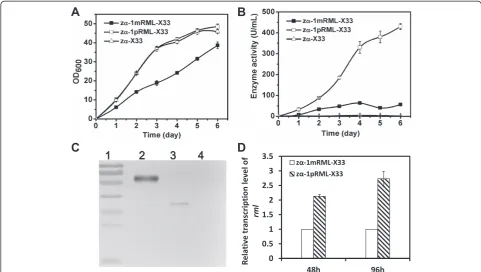
Quantitative real-time RT-PCR (qPCR) results con-firmed that adding the propeptide resulted in upregula-tion of target gene expression (Figure 1D) at 48 and 96 hours. The propeptide evidently plays a promoting role in lipase activity and heterologous protein secretion.
Optimization of the signal peptide codons
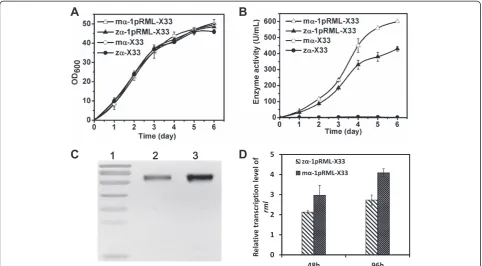
The original expression plasmid (pPICZαA) and the modified signal peptide plasmid (pPICMαA) were kindly provided by Drs Yijun Huang and Jia Ban. We compared their effects on target enzyme activity and protein secre-tion. The nucleotide sequence of the modified signal peptide (mα) is shown in Additional file 1: Figure S1. We successfully constructed modified codons of the sig-nal peptide recombinant strain (termed mα-1pRML-X33) and the original recombinant strain (termed zα -1pRML-X33). Each strain contained one copy of the target gene. Flask fermentation of the two strains is compared in Figure 2. Cell growth was essentially the same in mα -1pRML-X33, zα-1pRML-X33, and two control strains without the target gene (mα-X33, zα-X33); they all reached OD600≈50 (Figure 2A). However, the enzyme
activity of mα-1pRML-X33 (600 U/mL) was higher than that of zα-1pRML-X33 (430 U/mL; Figure 2B). Optimiza-tion of the signal peptide codons resulted in a 1.4-fold in-crease in enzyme activity. The target protein was also detected by Western blotting. The amount of extracel-lular target protein (0.22 mg/mL) from mα-1pRML-X33 (Figure 2C, lane 3) was higher than that (0.16 mg/mL) from zα-1pRML-X33 (lane 2). Target gene transcription level was evaluated by qPCR. For a given dosage of the target gene in the cells, optimization of the signal pep-tide clearly increased enzyme activity and the amount of extracellular target protein. The transcription level of the target gene was 1.4-fold higher following optimiza-tion of the signal peptide codons (Figure 2D). These findings indicate that optimization of codons in the signal peptide to make it more suitable for transcription in host cells promoted expression and secretion of target heterologous protein.
Optimization of the target gene dosage
We next investigated the effects of target gene copies on protein expression. We successfully constructed
recombinants with 1, 2, 4, and 8 copies of the prml gene, termed respectively as mα-1pRML-X33, mα -2pRML-X33, mα-4pRML-X33 and mα-8pRML-X33. These recombinants were tested by qPCR. The standard curves of glyceraldehyde-3-phosphate dehydrogenase gene (gap; used as a reference gene) andrmldetected by qPCR are shown in Additional file 2: Figure S2. C(t) values of the target gene (prml) and reference gene (gap) and copy numbers were calculated using the formula given in the Materials and Methods section ‘Screening for target transformants’, and results are shown in Additional file 3: Table S1.
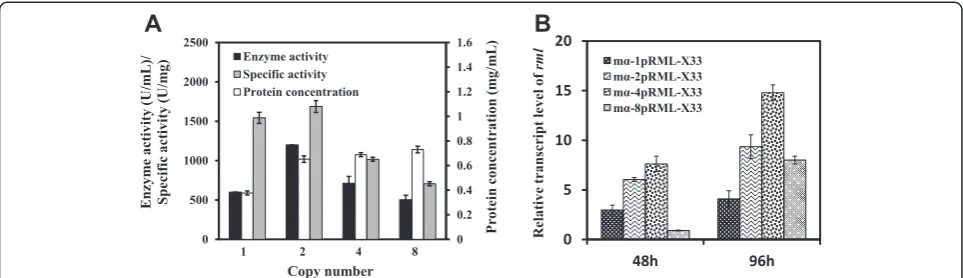
The differential effects of the four recombinants on enzyme activity in flask fermentation are summarized in Figure 3A. When the target gene copy number was in-creased from 1 to 2, enzyme activity was doubled (from 600 to 1,200 U/mL) and extracellular protein content also increased approximately 2-fold (from 0.38 to 0.770 mg/mL). When copy number increased from 4 to 8, extracellular protein content was essentially unchanged (0.69 versus 0.73 mg/mL) and enzyme activity decreased from 713 to 503 U/mL. As copy number increased from
1 to 2, enzyme specific activity increased slightly from 1543 to 1684 U/mg, and then decreased for copy num-ber 4 (1018 U/mg) and 8 (707 U/mg). The lower propor-tion of target protein in total protein may account for the reduced enzyme activity and specific activity for tar-get gene copy numbers 4 and 8 in comparison with copy number 2. These findings indicate that 2 is the optimal copy number for prml expression in strain X-33. The 2-copy recombinant strain had the highest enzyme activ-ity, extracellular protein content, and specific activity. Although qPCR analysis showed the highest target gene transcription level for the 4-copy strain (Figure 3B), our experiments showed that this strain did not have the maximal enzyme activity. Possible reasons for the ad-vantage of the 2-copy strain over the 4-copy or 8-copy strain in terms of protein modification, transport pathways, and unfolded protein response (UPR)-rela-ted genes are considered in the ‘Discussion’ section. In conclusion, the lipase with maximal enzyme activity was secreted by the 2-copy strain (mα-2pRML-X33). This enzyme was termed Lipase GH2 and used in subsequent experiments.
Figure 2Cell growth and protein production of recombinant strain with modifiedα-factor signal peptide (mα-1pRML-X33), strain with originalα-factor signal peptide (zα-1pRML-X33), and two control strains (mα-X33 and zα-X33). A: OD600of the recombinants in flask fermentation. Cell growth did not differ notably among the four strains.B: Enzyme activity of the recombinants during fermentation. Activity of mα-1pRML-X33 (600 U/ml) was higher than that of zα-1pRML-X33 (430 U/ml). Activity increased 1.4-fold after optimization of signal peptide codons.C: Extracellular protein expression in fermentation supernatant detected by Western blotting. Lane 1: protein markers (same as in Figure 1). Lane 2: recombinant strain containing originalα-factor signal peptide. Lane 3: strain containing modifiedα-factor signal peptide. The concentration of extracellular target protein for mα-1pRML-X33 (0.22 mg/mL) was higher than that for zα-1pRML-X33 (0.16 mg/mL).D: The transcription level ofprml
Enzymatic characterization of Lipase GH2
Detection of glycosylation
Bioinformatics analysis indicated glycosylation sites in the propeptide region of the target gene. We therefore evaluated glycosylation level of the protein. zα -mRML-X33 (mRML) and mα-2pRML-X33 (pRML; Lipase GH2) were selected for the deglycosylation reaction. The extra-cellular target protein was analyzed by Western blotting. Because of the addition of its propeptide a broad molecu-lar weight (MW) of 55 to 70 kDa was found for Lipase GH2 (Additional file 4: Figure S3, lane 2). Deglycosylation of Lipase GH2 by Endo Hf resulted in MW of appro-ximately 43 kDa (Additional file 4: Figure S3, lane 3). The same MW is seen in lanes 4 and 5 of Additional file 4: Figure S3 because the enzyme (mRML) lack the propep-tide; there is no effect on MW regardless of the deglyco-sylation treatment for the proteins.
Enzyme properties
Various properties (optimal temperature and pH, tempe-rature and pH tolerance, methanol and ethanol tolerance) were compared among two of the newly constructed strains (mα-mRML-X33, mα-2pRML-X33) and a previ-ously constructed strain (RML-GS115). The results are shown in Table 1. The most striking difference was the lower optimal temperature of Lipase GH2 (35°C) as com-pared with mRML (45°C). Lipase GH2, in comparison with mRML, also had approximately 2-fold higher values of temperature tolerance (0 to 70°C versus 0 to 40°C), methanol tolerance (0 to 40% versus 0 to 20%, v/v), and
ethanol tolerance (0 to 20% versus 0 to 10%, v/v). These findings indicate adding the propeptide caused gly-cosylation that results in improved enzyme thermo-stability and ability to tolerate adverse environmental factors.
Conversion of microalgae oil to biodiesel using Lipase GH2
Microalgae (Chlorella vulgaris) powder was kindly pro-vided by Dr Peng Pu (State Key Laboratory of Catalytic Material and Reaction Engineering, Research Institute of Petroleum Processing, SINOPEC, Beijing, China). We extracted total lipids from the powder by the method of Tran et al. [36] and analyzed the fatty acid compos-ition by gas chromatography [37]. Results are shown in Additional file 5: Table S2. The microalgae oil extracted from 1 g microalgae powder contained 508.26 mg fatty acids, of which C16 to C18 fatty acids comprised 487.52 mg (96% of the total). Therefore, microalgae oil is a poten-tially useful substrate for preparation of biodiesel.
We previously described a practical design for the con-version of soybean oil to biodiesel using a combination of two enzymes [34]. In the present study, we used two treatment strategies for the conversion of microalgae oil to biodiesel using Lipase GH2: (1) Lipase GH2 as a catalyst; (2) combined catalysis using two enzymes (Lipase GH2 and a non-specific mono/diacylglycerol lipase (MDL)) in a single reaction. The reaction conditions are described in the‘Materials and Methods’section. Gas chromatography (GC) and thin-layer chromatography (TLC) were used for product detection.
Table 1 Enzymatic properties ofR. mieheilipase expressed in three forms Optimal
temperature (°C)
Temperature tolerance (°C)
Optimal pH pH tolerance Methanol tolerance (%)
Ethanol tolerance (%)
Lipase GH2 (X-33) 35 0-70 6.0 4-10 0-40 0-30
mRML (X-33) 45 0-40 8.6 4-10 0-20 0-10
RML (GS115) 50 0-50 8.0 4-9 0-30 0-20
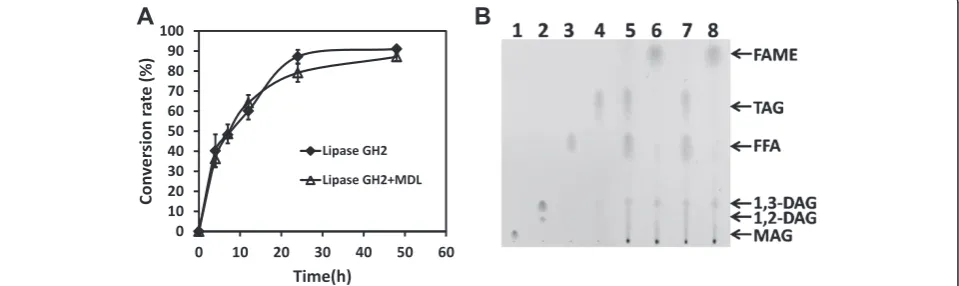
Substrate changes detected by GC at various times dur-ing methanolysis reaction of microalgae oil are shown in Figure 4A. For treatments 1 and 2 as above, substrate con-version rates after 24 hours reaction at 30°C were 91% and 89%, respectively. Most of the substrate (microalgae oil) was converted to biodiesel, and there was no significant difference between treatments 1 and 2.
Similar results were obtained for each sample by TLC (Figure 4B). Standard samples (shown in lanes 1 to 4) were monoacylglycerol (MAG), diacylglycerol (DAG), free fatty acid (FFA) and triacylglycerol (TAG). Fatty acids are the major components of microalgae oil. Substrates (FFA and TAG) prior to esterification reaction are shown in lanes 5 and 7. After the final reaction (24 hours at 30°C), the substrates were almost completely converted to fatty acid methyl esters (FAME; lanes 6 and 8), and there was no significant difference between treatment 1 (lanes 5 and 6) and treatment 2 (lanes 7 and 8).
In conclusion, Lipase GH2 can be used as an effective catalyst for the conversion of microalgae oil to biodiesel with no requirement for a second enzyme as an auxiliary factor.
Discussion
Adding propeptide induced protein glycosylation and improved enzyme tolerance
Heterologous protein expression is affected by numerous factors, including the expression vector, host strain, gene structure, signal peptide, gene dosage, and culture condi-tions for recombinants [38,39]. In this study, we success-fully constructed a high-expressing recombinant strain through propeptide addition, optimized codon usage of the signal peptide, and optimized gene dosage. Glycosyla-tion has been shown to promote enzyme stability [40]. In the case of subtilisins, the 77-residue propeptide acts as an intramolecular chaperone that organizes the correct
folding of its own protease domain; the occurrence of a mutation (Ile (−48)-to-Val) in the propeptide results in two subtilisins differing in secondary structure, thermos-tability, and substrate specificity [41]. Based on these previous findings, we hypothesized that the 70-residue propeptide of R. miehei lipase (RML) may also have af-fected the enzyme folding or post translational modifica-tion. An advantage ofP. pastorisas an expression system is its ability to undergo eukaryotic post-translational mod-ifications, including glycosylation of heterologous proteins [12]. We found that the broad MW of Lipase GH2 ob-served on Western blotting is a result of glycosylation. Amino acid sequence analysis revealed two potential N-glycosylation sites (Asn-Xaa-Ser/Thr), both located in the propeptide sequence; they were identified by NetNGlyc 1.0 Server analysis (www.cbs.dtu.dk/services/NetNGlyc) at the 8thposition with the NST(Asn-Ser-Thr) motif and the 58th position with the NAT(Asn-Ala-Thr) motif. Glycosy-lation enhanced the ability of Lipase GH2 to tolerate temperature, methanol, and ethanol, and to catalyze the enzymatic conversion of microalgae oil to biodiesel. Thus, in the case of Lipase GH2, addition of heterologous gene propeptide provides a dual benefit: it enhances enzyme tolerance and increases enzyme activity.
Why are two target gene copies better than four copies?
In secretory pathways, cells use specialized quality con-trol systems to ensure that only properly folded and modi-fied proteins are secreted into the extracellular space; unfolded or incorrectly folded (misfolded) proteins are reverse-transported to the cytoplasm by the ER degrad-ation system or the lysosomal degraddegrad-ation system [42]. Correct folding of heterologous proteins is crucial in that it determines enzyme activity and functions.
How does integration of different numbers of target gene copies in recombinant strains affect protein transcription
levels, folding, and secretion? We used qPCR detection to study expression of genes previously reported to be involved in protein folding, modification, and trans-location pathways in yeast (see Additional file 6: Table S3). We focused onprmlgene expression to examine the effect of target gene copy number.
We observed an association of four unfolded protein response (UPR)-related genes that have been described previously [43]. PDI, located in the ER membrane, en-codes protein disulfide isomerase which is responsible for protein disulfide bond formation. ERO1, located in the ER membrane, is an ‘assistant’ of PDI, responsible for the glycoprotein required for oxidative protein fold-ing in the ER.KAR2,located in the ER lumen, is a major Hsp70 chaperone. HAC1, located in the nucleus, is a transcription activator that regulates the UPR via UPRE (UPR element) binding and membrane biogenesis. Stress to the ER triggers increased expression of these genes and possible relief of the stress through the gene products.
Results for detection of these genes in strains zα -1mRML-X33 (not optimized) and mα-2pRML-X33 (op-timized) are shown in Figure 5A. Transcriptional levels of all four genes were higher in zα-1mRML-X33 than that in mα-2pRML-X33. These findings suggest that some mRMLs may be expressed with abnormal struc-ture or misfolded proteins, thereby inducing ER stress and initiating UPR.
After finding that enzyme activity and target gene transcription level were lowest for the 1-copy and 8-copy recombinant strains (see Results -‘Optimization of the target gene dosage’), we compared target gene ex-pression in the 2-copy and 4-copy strains (Figure 5B). In the 4-copy strain, the transcriptional levels of four UPR-related genes were all higher than that of 2-copy strain, it seems that protein folding generated obstacles and was unable to improve enzyme activity or protein secre-tion. Thus, although the 4-copy strain (mα-4pRML-X33) had a higher transcription level of the target gene than did the 2-copy strain, the abnormal protein resulted in
ER stress, abnormal protein assembly and modification, and triggering of UPR (upregulation of UPR-related genes). However, the UPR did not relieve the ER stress. These findings illustrate why 2 target gene copies in the host are better than 4 copies.
It is important to note that there was no positive cor-relation between gene dosage and the target protein yield in construction of a heterologous protein expres-sion system. Rather, the bearing capacity of the host cell must be considered. Abnormal protein folding and a var-iety of stress factors may interfere with protein polyme-rization in the ER lumen, leading to accumulation of unfolded or misfolded proteins and consequent ER stress [44-46]. If the stress is too high, it cannot be relieved by upregulation of UPR-related genes.
Lipase GH2 is a useful catalyst for biodiesel synthesis
Lipase can be used in free or immobilized form in the biodiesel preparation process. The immobilized form in-creases the chances of re-usability of biocatalysts, pre-serving enzyme activities over several reaction cycles and can be removed easily from the mixture and can be reused in future. While the free enzyme (fermentation supernatant) in reaction process can be directly used which to avoid the cost of immobilized enzyme [47-49]. We previously described two successful methods for conversion of soybean oil to biodiesel catalyzed by free lipase: (i) a two-step reaction using Yarrowia lipolytica lipase which can be used by 25 cycles to produce fatty acid ethyl ester [35], and (ii) a one-step reaction using a combination of RML and MDL to produce FAME [34]. Soybean oil consists primarily of TAG. The RML lipase (RML-GS115) is 1,3-specific and cannot break a two-ester bond. MDL is able to break a two-two-ester bond, and the two enzymes are able to cooperate in the transesteri-fication reaction. Use of soybean oil as substrate in a re-action system for biodiesel synthesis involves both hydrolysis reaction (hydrolysis of fat into fatty acids and glycerol) and esterification reaction (synthesis of fatty
acids and methanol into FAME). Use of the new expres-sion system (mα-2pRML-X33) constructed in this study resulted in a more than 20-fold increase in target protein expression. The enzymatic properties of the new system (improved temperature, methanol, and ethanol toler-ance) are more suitable for application in biodiesel prep-aration. Microalgae oil consists of FFA, TAG, DAG, and MAG, with FFA being the major component. Biodiesel preparation requires methyl esterification by lipase, for which the newly constructed Lipase GH2 is suitable. The glycosylated protein strongly retains its enzyme ac-tivity; when we kept the fermentation supernatant at 4°C and sampled the lipase activity twice per month, we found no reduction in the activity after six months. For microalgae oil as substrate, the fermentation supernatant (free lipase) functions as a direct catalyst in the esterifi-cation and transesterifiesterifi-cation reaction, and achieves good results. This design has the advantages of simplify-ing the production process, savsimplify-ing time, and avoidsimplify-ing the expense of immobilized enzyme.
The use of Lipase GH2 as a catalyst in methanolysis of microalgae oil for biodiesel synthesis is economical for industrial applications and has great potential. Our on-going studies are focused on further improvement and optimization of enzyme quality, reaction conditions, re-action rate, and industrial applicability.
Conclusions
Various strategies are available for improving the effi-ciency of heterologous protein production byP. pastoris. Integration of too many copies of the target gene in the host genome may lead to increased ER stress and re-duced protein production. In this study, we significantly increased the RML expression level and modified en-zymatic properties through optimal expression plasmid with signal peptide, addition of the target gene propep-tide, and optimal exogenous gene dosage. Lipase GH2, the major component of the fermentation supernatant, is stable for over six months at 4°C and is an effective enzyme for catalytic conversion of microalgae oil to bio-diesel. Further studies will lead to improved industrial productivity.
Materials and Methods
Gene cloning and construction of multimersin vitro
The prml and mrmlgenes were cloned from R. miehei lipase (GenBank accession number A02536.1) cDNA using two pairs of primers. R. miehei pro-mature lipase gene (prml) was amplified using the primer pairs pRML-f (5′-CCGGAATTCGTGCCAATCAAGAG-3′, EcoRI site) and RML-r (5′-CTAGTCTAGA GTACAGAGGCCTGTG-3′, Xba I site). Mature lipase gene (mrml) was ampli-fied using the primer pairs mRML-f (5′-CCGGAATT
CAGCATTGATGGTGG-3′, EcoR I site) and RML-r
(5′-CTAGTCTAGAGTACAGAGGCCTGTG-3′, Xba I site). The italics indicate the enzymatic restriction sites. Two vectors were used: pPICZαA (Invitrogen; Carlsbad, California, United States), and pPICMαA (a pPICZα A-derived plasmid). The only difference between the two vectors is that theα-factor codons of pPICMαA are opti-mized, without change of the amino acid sequence. The sequences of the original and modified signal peptide were kindly provided by Dr Jia Ban; their differences are shown in Additional file 1: Figure S1. Single-copy recombinant plasmids pPICZa-1prml, pPICMa-1prml, and pPICZa-1mrml were constructed. pPICMaA plasmids containing various gene dosages (pPICMa-2prml, pPICMa-4prml, and pPICMa-8prml) were constructed as described by Menendez et al. [17]. The plasmids and strains used in this study are listed in Table 2.
Screening for target transformants
The recombinant plasmids were transformed into X-33 and screened with Yeast Extract Peptone Dextrose Me-dium with Sorbitol (YPDS) meMe-dium as described by Hu
et al. [50], except that the multi-copy recombinant plas-mids could not be linearized before transformation into X-33 by electroporation. For each transformation, 50 positive transformants were selected by tributyrin flat screening. Eight strains were selected for each transfor-mant based on the size of the transparent circle in fer-mentation. Positive transformants were flask-cultured in BMGY/BMMY medium as described by Hu et al. [50]. Every day, 1% methanol (Sinopharm Chemical Reagent Beijing Co., Ltd, Beijing, China) was used to induce pro-tein expression and activity and production were mea-sured for each strain.
Absolute quantification of target gene copies was performed by qPCR using SYBR Green I Mix (Roche, Mannheim, Germany). qPCR was conducted in a LightCy-cler 480 RT-PCR System(Roche, Mannheim, Germany) using LightCycler 480 SYBR Green I Master Kit (Roche). Specific primers purified by HPLC (Invitrogen) were de-signed to yield 100 to 250 bp products. All primers (rml and gap) used for qPCR are listed in Additional file 6: Table S3. Genomic DNA of P. pastoris was used as template. The genomic DNA of the single-copy strain was used to establish the standard curve (Additional file 2: Figure S2). The C(t) values of the target gene (prml) and reference gene (gap) are shown in Additional file 3: Table S1. The numbers of target gene copies were calcu-lated by absolute quantification as described by Abad
et al. [51], using the following formula:
Transcription levels of genes related to various steps in protein expression, modification, and secretory pathways
There were a total of 14 genes related to the target lip-ase, UPR, protein transport, and protein secretion. RNA extraction and relative qPCR analysis were performed as described by Wang et al. [52]. The primers used for qPCR are listed in Additional file 6: Table S3.
Western blotting and glycosyl chain detection
The recombinant lipase was tested by Western blotting as described by Shenet al. [16]. sodium dodecyl sulfate polyacrylamide gel electrophoresis (SDS-PAGE) was performed using 5% stacking gel and 12% resolving gel. Monoclonal mouse-anti-His-Tag antibody (Tiangen, Beijing, China) was used as the primary antibody and goat anti-mouse IgG antibody conjugated to alkaline phosphat-ase (Sigma-Aldrich, St. Louis, Missouri, United States) as the secondary antibody. The membrane was applied to a BCIP/NBT Chromogenic reagent kit (Tiangen) according to the manufacturer’s instructions.
Protein concentration was quantified by Bradford as-say [53] using Bovine Serum Albumin (BSA) as a stand-ard. Glycosyl chains in pRML were removed by Endo Hf (New England Biolabs; Beverly, Massachusetts, United States) according to the manufacturer’s instructions.
Enzyme characterization
Lipase hydrolysis activity was measured as described in our previous study [35], except that we used the condi-tions 0.1 M sodium dihydrogen phosphate/citric acid, pH 6.0, 35°C for Lipase GH2 and 0.1 M CHES, pH 8.6, 45°C for mRML. Optimal pH values for Lipase GH2 and mRML were determined under standard conditions. The buffers used were 0.1 M sodium dihydrogen phosphate/ citric acid (pH 3.12 to 8.17), 0.1 M Trihydroxymethyl aminomethane- hydrochloric acid (Tris-HCl) (pH 8.02-9.03), 0.1 M N-Cyclohexyl-2-aminoethanesulfonic acid (CHES) (pH 8.6-9.5), and 0.1 M
N-Cyclohexyl-3-aminopropanesulfonic acid (CAPS) (pH 10.0-11.0). pH stability was determined at pH values ranging from 1.0 to 12.7 for 90 minutes, and residual activity was mea-sured. Optimal temperatures were determined under standard conditions in the range 0 to 60°C. Thermostabil-ity was determined for 90 minutes at temperatures ran-ging from 0 to 80°C, and residual activity was measured.
Biodiesel preparation and detection
Lipids were extracted from microalgae powder as de-scribed by Tran et al. [36], except that chloroform/ methanol (1:2 v/v) (Sinopharm Chemical Reagent Beijing Co., Ltd, Beijing, China) was used as solvent. Oil extrac-ted from microalgae powder was used as a substrate to produce biodiesel using the organic solvent n-hexane (Sinopharm Chemical Reagent Beijing Co., Ltd, Beijing, China). Production conditions were: 0.1 g of microalgae oil/30 μL methanol, 1 mL n-hexane, 55 μL Lipase GH2 (2-copy recombinant strain) (1200 U/mL) and 5μL MDL (1500 U/mL) (for Lipase GH2 alone, MDL was replaced by H2O), incubation at 30°C and shaking at 150 rpm for
24 hours.
FAME in the reaction mixture were analyzed using a GC system (model 7890A, Agilent Technologies (Santa Clara, California, United States) equipped with a capil-lary column (CP-FFAP CB; 25 m × 0.32 mm × 0.3 μm; Agilent Technology). Sample preparation and detection conditions were as described by Renet al. [54]. TLC was performed as in our previous study [35].
Additional files
Additional file 1: Figure S1.Sequence alignment of original signal peptide (zα) and modified signal peptide (mα) using DNAMAN program (Lynnon Corporation, United States). 46 codons in the modified signal peptide were optimized, resulting in changes of 50 nucleotides. G + C content increased from 41.1 to 47.0%. The modified signal peptide showed 82.5% identity with the original signal peptide (zα) after averaging the distribution of both the G + C content and the optimized codons.
Table 2 Plasmids and strains used in this study
Description Source
Plasmids
pPICZαA Secretion expression vector withα-factor fromS. cerevisiae Donated by Dr Yijun Huang
pPICMαA pPICZαA withα-factor optimized codons Donated by Dr Jia Ban
Strains
X-33 Host strain (WT Mut+) Donated by Dr Yijun Huang
zα-1mRML-X33 One copy mRML of the lipase without propeptide expressed in X-33 using pPICZαA This study
zα-1pRML-X33 One copy pPML of the lipase with propeptide expressed in X-33 using pPICZαA This study
mα-1pRML-X33 One copy pRML expressed in X-33 using pPICMαA This study
mα-2pRML-X33 Two copies pRML expressed in X-33 using pPICMαA This study
mα-4pRML-X33 Four copies pRML expressed in X-33 using pPICMαA This study
Additional file 2: Figure S2.Standard curves ofgapandrmldetected by qPCR.
Additional file 3: Table S1.Target gene copy number in four recombinant strains.
Additional file 4: Figure S3.Detection of glycosylation of lipases. Deglycosylation treatment using Endo Hf showed that pRML (Lipase GH2) was a glycosylated protein, whereas mRML had no glycosylation. Lane 1: protein markers (top to bottom: 100, 70, 55, 40, 35, 25, 15 kDa). Lane 2: Lipase GH2 without Endo Hf (no deglycosylation). Lane 3: Lipase GH2 with Endo Hf (with deglycosylation). Lane 4: mRML with Endo Hf (with deglycosylation). Lane 5: mRML without Endo Hf (no deglycosylation).
Additional file 5: Table S2.Fatty acid analysis of microalgae oil by HPLC.
Additional file 6: Table S3.Genes and primers used for qPCR.
Abbreviations
1,2-DAG:1,2-diacylglycerol; 1,3-DAG: 1,3-diacylglycerol; FAME: fatty acid methyl ester(s); FFA: free fatty acid; MAG: monoacylglycerol; TAG: triacylglycerold.
Competing interests
The authors declare that they have no competing interests.
Authors’contributions
YL and JJH designed the study. JJH, JX, ZY, and FFG carried out molecular genetic studies. JJH, JX and DC performed the experiments of enzymatic properties. JJH and JX carried out the conversion of microalgae oil to biodiesel. GHG and WJ assisted with analysis and discussion of the results. JJH and YL wrote the manuscript. All authors read and approved the final manuscript.
Acknowledgments
This study was supported by the Chinese High Technology Research and Development Program (Grant No. 2013AA065802), Chinese Scientific and Technical Supporting Programs (2013BAD10B01) and the Undergraduate Innovation Program of China Agricultural University (2013 to 2014). The authors are grateful to Drs Yijun Huang and Jia Ban for providing strain X-33 and plasmid pPICZαA, Professor Dehua Liu (Tsinghua University) for useful suggestions and help with product detection, and Dr S Anderson for English editing of the manuscript.
Author details
1State Key Laboratories for Agro-biotechnology and College of Biological
Sciences, China Agricultural University, 2#,Yuanmingyuan West Road, Beijing 100193, China.2Present address: Key Laboratory of Human Disease Comparative Medicine, Ministry of Health, Institute of Laboratory Animal Science, Chinese Academy of Medical Sciences & Comparative Medical Center, Peking Union Medical College, 5#, Panjiayuannanli Street, Beijing 100021, China.
Received: 18 March 2014 Accepted: 9 July 2014 Published: 4 August 2014
References
1. Rodrigues RC, Fernandez-Lafuente R:Lipase fromRhizomucor mieheias a biocatalyst in fats and oils modification.J Mol Catal B: Enzym2010,
66:15–32.
2. Stobiecka A:Acrylamide-quenching ofRhizomucor mieheilipase. J Photochem Photobiol B2005,80:9–18.
3. Brady L, Brzozowski AM, Derewenda ZS, Dodson E, Dodson G, Tolley S, Turkenburg JP, Christiansen L, Hugejensen B, Norskov L, Thim L, Menge U:
A serine protease triad forms the catalytic center of a triacylglycerol lipase.Nature1990,343:767–770.
4. Boel E, Huge-Jensen B, Christensen M, Thim L, Fiil NP:Rhizomucor miehei triglyceride lipase is synthesized as a precursor.Lipids1988,
23:701–706.
5. Norin M, Olsen O, Svendsen A, Edholm O, Hult K:Theoretical-studies of Rhizomucor-mieheilipase activation.Protein Eng1993,6:855–863.
6. Rodrigues RC, Fernandez-Lafuente R:Lipase fromRhizomucor mieheias an industrial biocatalyst in chemical process.J Mol Catal B: Enzym2010,
64:1–22.
7. Palla CA, Pacheco C, Carrin ME:Production of structured lipids by acidolysis with immobilizedRhizomucor mieheilipases: selection of suitable reaction conditions.J Mol Catal B: Enzym2012,76:106–115. 8. De Diego T, Lozano P, Abad MA, Steffensky K, Vaultier M, Iborra JL:On the
nature of ionic liquids and their effects on lipases that catalyze ester synthesis.J Biotechnol2009,140:234–241.
9. Acosta A, Filice M, Fernandez-Lorente G, Palomo JM, Guisan JM:Kinetically controlled synthesis of monoglyceryl esters from chiral and prochiral acids methyl esters catalyzed by immobilizedRhizomucor mieheilipase. Bioresour Technol2011,102:507–512.
10. Huang DF, Han SY, Han ZL, Lin Y:Biodiesel production catalyzed by Rhizomucor mieheilipase-displayingPichia pastoriswhole cells in an isooctane system.Biochem Eng J2012,63:10–14.
11. Gasser B, Prielhofer R, Marx H, Maurer M, Nocon J, Steiger M, Puxbaum V, Sauer M, Mattanovich D:Pichia pastoris: protein production host and model organism for biomedical research.Future Microbiol2013,
8:191–208.
12. De Pourcq K, De Schutter K, Callewaert N:Engineering of glycosylation in yeast and other fungi: current state and perspectives.Appl Microbiol Biotechnol2010,87:1617–1631.
13. Tian B, Chen Y, Ding SJ:A combined approach for improving alkaline acetyl xylan esterase production inPichia pastoris, and effects of glycosylation on enzyme secretion, activity and stability.Protein Expr Purif
2012,85:44–50.
14. Yu MR, Wen S, Tan TW:Enhancing production ofYarrowia lipolyticalipase Lip2 inPichia pastoris.Eng Life Sci2010,10:458–464.
15. Sha C, Yu XW, Li F, Xu Y:Impact of gene dosage on the production of Lipase fromRhizopus chinensisCCTCC M201021 inPichia pastoris. Appl Biochem Biotechnol2013,169:1160–1172.
16. Shen Q, Wu M, Wang HB, Naranmandura H, Chen SQ:The effect of gene copy number and co-expression of chaperone on production of albumin fusion proteins inPichia pastoris.Appl Microbiol Biotechnol2012,
96:763–772.
17. Menendez C, Martinez D, Trujillo LE, Mazola Y, Gonzalez E, Perez ER, Hernandez L:Constitutive high-level expression of a codon-optimized beta-fructosidase gene from the hyperthermophileThermotoga maritima inPichia pastoris.Appl Microbiol Biotechnol2013,97:1201–1212.
18. Wang J, Wang D, Wang B, Mei ZH, Liu J, Yu HW:Enhanced activity of Rhizomucor mieheilipase by directed evolution with simultaneous evolution of the propeptide.Appl Microbiol Biotechnol2012,96:443–450. 19. Taher H, Al-Zuhair S, Al-Marzouqi AH, Haik Y, Farid MM:A review of
enzymatic transesterification of microalgal oil-based biodiesel using supercritical technology.Enzyme Research2011,2011:1–25. 20. Ahmad AL, Yasin NHM, Derek CJC, Lim JK:Microalgae as a sustainable
energy source for biodiesel production: a review.Renew Sust Energ Rev
2011,15:584–593.
21. Demirbas MF:Biofuels from algae for sustainable development. Appl Energy2011,88:3473–3480.
22. Hong-Yu R, Bing-Feng L, Chao M, Lei Z, Nan-Qi R:A new lipid-rich microalgaScenedesmussp. strain R-16 isolated using Nile red staining: effects of carbon and nitrogen sources and initial pH on the biomass and lipid production.Biotechnol Biofuels2013,6:143.
23. Zaimes GG, Vikas K:Microalgal biomass production pathways: evaluation of life cycle environmental impacts.Biotechnol Biofuels2013,6:88. 24. Caroline C, Boris M, Hoa Mai N, Audrey B-A, Séverine B, Stéphan C, Fred B,
Gilles P, Yonghua L-B:Development of a forward genetic screen to isolate oil mutants in the green microalgaChlamydomonas reinhardtii.Biotechnol Biofuels2013,6:178.
25. Leonardo Brantes Bacellar M, Alane Beatriz V:Allelopathy as a potential strategy to improve microalgae cultivation.Biotechnol Biofuels2013,6:152. 26. Aguirre AM, Bassi A:Investigation of biomass concentration, lipid
production, and cellulose content inChlorella vulgariscultures using response surface methodology.Biotechnol Bioeng2013,110:2114–2122. 27. Dillschneider R, Steinweg C, Rosello-Sastre R, Posten C:Biofuels from
microalgae: photoconversion efficiency during lipid accumulation. Bioresour Technol2013,142:647–654.
29. Prathima DM, Swamy YV, Venkata MS:Nutritional mode influences lipid accumulation in microalgae with the function of carbon sequestration and nutrient supplementation.Bioresour Technol2013,142:278–286. 30. Qing P, Xue Z, Meng S, Xu W, Guili W, Bingxue L, Guohua G, Ying L,
Youshao W:A novel esterase gene cloned from a metagenomic library from neritic sediments of the South China Sea.Microb Cell Fact2011,
10:95.
31. Xiao-Wei Y, Chong S, Yong-Liang G, Rong X, Yan X:High-level expression and characterization of a chimeric lipase fromRhizopus oryzaefor biodiesel production.Biotechnol Biofuels2013,6:29.
32. Helge Jans J, Alexander S:Fatty acid synthesis inEscherichia coliand its applications towards the production of fatty acid based biofuels. Biotechnol Biofuels2014,7:7.
33. Korman TP, Bobby S, Charbonneau DM, Huang GL, Marc B, Bowie JU:
Dieselzymes: development of a stable and methanol tolerant lipase for biodiesel production by directed evolution.Biotechnol Biofuels2013,6:70. 34. Guan FF, Peng P, Wang GL, Yin T, Peng Q, Huang JJ, Guan GH, Li Y:
Combination of two lipases more efficiently catalyzes methanolysis of soybean oil for biodiesel production in aqueous medium.Process Biochem2010,45:1677–1682.
35. Yonghong M, Guili W, Na Y, Zhiqi Z, Yuejuan L, Xiaomei L, Jinnan C, Ying L, Jilun L:Two-step synthesis of fatty acid ethyl ester from soybean oil catalyzed byYarrowia lipolyticalipase.Biotechnol Biofuels2011,4:6. 36. Tran DT, Yeh KL, Chen CL, Chang JS:Enzymatic transesterification of
microalgal oil fromChlorella vulgarisESP-31 for biodiesel synthesis using immobilizedBurkholderialipase.Bioresour Technol2012,108:119–127. 37. Li ZS, Yuan HL, Yang JS, Li BZ:Optimization of the biomass production of
oil algaeChlorella minutissimaUTEX2341.Bioresour Technol2011,
102:9128–9134.
38. Gasser B, Sauer M, Maurer M, Stadlmayr G, Mattanovich D: Transcriptomics-based identification of novel factors enhancing heterologous protein secretion in Yeasts.Appl Environ Microbiol2007,73:6499–6507. 39. Idiris A, Tohda H, Kumagai H, Takegawa K:Engineering of protein
secretion in yeast: strategies and impact on protein production. Appl Microbiol Biotechnol2010,86:403–417.
40. Potvin G, Ahmad A, Zhang Z:Bioprocess engineering aspects of heterologous protein production inPichia pastoris: a review.Biochem Eng J2012,64:91–105.
41. Shinde UP, Liu JJ, Inouye M:Protein memory through altered folding mediated by intramolecular chaperones.Nature1997,389:520–522. 42. Trombetta ES, Parodi AJ:Quality control and protein folding in the
secretory pathway.Annu Rev Cell Dev Biol2003,19:649–676. 43. Anelli T, Sitia R:Protein quality control in the early secretory pathway.
EMBO J2008,27:315–327.
44. Pelham HRB:Control of protein exit from the endoplasmic reticulum. Annu Rev Cell Biol1989,5:1–23.
45. Kaufman RJ:Stress signaling from the lumen of the endoplasmic reticulum: coordination of gene transcriptional and translational controls.Genes Dev1999,13:1211–1233.
46. Ma Y, Hendershot LM:The unfolding tale of the unfolded protein response.Cell2001,107:827–830.
47. Xu WD, Jing Z, Dehua Liu Y:Conversion of soybean oil to biodiesel fuel using lipozyme TL IM in a solvent-free medium.Biocatal Biotransfor2004,
22:45–48.
48. Poppe JK, Garcia-Galan C, Matte CR, Fernandez-Lafuente R, Rodrigues RC, Ayub MAZ:Optimization of synthesis of fatty acid methyl esters catalyzed by lipase B fromCandida antarcticaimmobilized on hydrophobic supports.J Mol Catal B-Enzym2013,94:51–56. 49. Zhang B, Weng Y, Xu H, Mao Z:Enzyme immobilization for biodiesel
production.Appl Microbiol Biotechnol2012,93:61–70.
50. Hu H, Gao J, He J, Yu B, Zheng P, Huang Z, Mao X, Yu J, Han G, Chen D:
Codon optimization significantly improves the expression level of a keratinase gene inPichia pastoris.PLoS One2013,8:3.
51. Abad S, Kitz K, Hormann A, Schreiner U, Hartner FS, Glieder A:Real-time PCR-based determination of gene copy numbers inPichia pastoris. Biotechnol J2010,5:413–420.
52. Wang Q, Liu JX, Zhang WJ, Zhang TW, Yang J, Li Y:Expression patterns of key iron and oxygen metabolism genes during magnetosome formation inMagnetospirillum gryphiswaldenseMSR-1.FEMS Microbiol Lett2013,
347:163–172.
53. Bradford MM:Rapid and sensitive method for the quantitation ofmicrogram quantities of protein utilizing the principle of protein-dye binding.Anal Biochem1976,72:248–254.
54. Ren HJ, Du W, Lv LL, Liu DH:Study on free lipase-catalyzed ethanolysis for biodiesel preparation in an oil/water biphasic system.J American Oil Chem Soc2011,88:1551–1555.
doi:10.1186/1754-6834-7-111
Cite this article as:Huanget al.:Improved production of a recombinant
Rhizomucor mieheilipase expressed inPichia pastorisand its application for conversion of microalgae oil to biodiesel.Biotechnology for Biofuels 20147:111.
Submit your next manuscript to BioMed Central and take full advantage of:
• Convenient online submission
• Thorough peer review
• No space constraints or color figure charges
• Immediate publication on acceptance
• Inclusion in PubMed, CAS, Scopus and Google Scholar
• Research which is freely available for redistribution