An Evaluation of Radial Distribution Function g(r) of
Two–dimensional Liquid
3He Interacting through
Aziz Potential at Various Densities
S. K. CHOUDHARY* and L. K. MISHRA
Department of Physics,
Magadh University, Bodh-Gaya, Bihar, India. ABSTRACT
Using theoretical formalism of Chung–In Um et.al. the radial
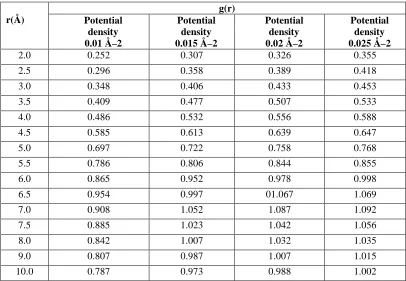
distribution function g(r) for two–dimensional liquid 3He interacting with Aziz potential has been evaluated for various densities. Our theoretical result indicates that g(r) increases with r and attains some maximum value and then becomes almost constant.
INTRODUCTION
In an earlier paper1,2 we have evaluated the radial distribution function g(r) and ground state energy of two–dimensional liquid 4He interacting with Aziz potential and Leannard–Jones potentials using theor-etical formalism of Chung–In Um et. al.3 In this paper, using the same formalism3, We have evaluated the radial distribution function of g(r) of two dimensional 3He interacting through the Aziz potential at various densities.
For many years, physicist have used hypernetted chain (HNC) and Fermi hypernetted chain (FHNC) theories to investigate the properties of highly correlated interacting boson and fermion systems such as liquid 4He and normal
liquid 4He, that is, the equilibrium density of the former is 0.0166 Å–1 while that of the latter is 0.02185 Å–3 in a three–dimensional system, effects of three–body correlations in ³He are rather small compared to those in
4
He. At equilibrium density, they make up about half the difference between the Jastrow results and experimental energy in a liquid ³He system and lower the Jastrow ground–state energy by about 10 % in liquid ³He.1
A trial ground–state wave function including three–body correlation functions in addition to two–body correlation effects can be constructed in the form
where f2 (rij) is the two–body correlation
function which describes spatial correlations and depends only upon the spatial distance rij between two particle f3 (rij, rjk, rKi) is a
three–body correlation function, and | Φ〉 is the anti-symmetric product of non– interacting single–particle plane waves normalized in the system's area Ω with N fermions, which becomes simply unity for boson systems.
In addition to the three–body correlation functions in the ground–state wave function, one should take into account the contributions coming from the elementary diagrams as well as effects of the HNC/FHNC equations to obtain better results. Unfortunately, there does not exist a general closed expression for the elementary diagrams and therefore one must calculate each diagram individually, which is very
time consuming. During the last two decades, two approximations for the estimation of the elementary diagrams have been developed. One is known as the scaling approximation,6 and the other is the interpolating equation approximation.7 Both techniques have shown their efficiency for central two–body correlations, providing similar results for the total ground–state energy to those of the variational Monte Carlo simulation. The scaling approximation uses the fact that successive contributions of the five, six and higher order elementary diagrams are approximately proportional to and have very similar spatial behaviour to the four–body elementary diagrams,6 so that one can represent the total elementary diagram contribution by means of the readily calculable four–body elementary diagrams. The interpolating equation approximation determines a parameter such that it gives the same value for the classical isothermal compressibility obtained from both the HNC/FHNC equations and Percus–Yevick8 equations using the classical pressure derivative or the compressibility integral. In this paper, one uses the scaling approximation to calculate the contribution of the elementary diagrams.
Many works have been reported regarding the properties of three– dimensional 4He and 3He systems using the variational HNC/FHNC methods, the variational Monte Carlo method
8
and the Green's function Monte Carlo method (GFMC),
9
there are few papers on two– dimensional systems. Using the Jastrow wavefunctions and solving an Euler– Lagrane equation within the HNC ψ r r r
r r rN rij r r r F i i
N
ij jk ki i j k
N
1, ,...2 ƒ2 ƒ3 , ,
b
g
=d i
d
i
=< < <
approximation. Hatzikonstinou10 studied the ground–state of two–dimensional liquid 4He interacting through a Lennard–Jones potential and explained the long–range and short–range behaviours of the correlation function to a certain extent. However, since he ignored the effects of the three–body correlation and elementary diagrams. His results give ground state energies too high compared to the GFMC11 and diffusion Monte Carlo (DMC) results.12 Chang calculated the ground–state energy and structure functions of two–dimensional 4He in liquid density ranges13 by taking the same potential as an interatomic potential and using a self–consistent paired–phonon analysis. He included the effects of the three–body correlation in the ground–state wavefunction, but did not consider the elementary diagrams at all. Therefore, though he obtained very optimized liquid structure functions and radial distribution functions, his results for the ground state energy are still higher and the equilibrium density is lower than those of the GFMC and DMC calculations.
For the 3He system, Novaco and Campbell
14
obtained theoretically the ground–state energy of quasi–two– dimensional helium absorbed on graphite by introducing a trial wavefunction which has only two–body correlations, finite extent orthogonal to the substrate, and the same translational symmetry as the substrate. Furthermore, they considered the effects of Fermi Dirac statistics to only the lowest– order correction, which is the energy of the Fermi sea. Using a variational calculation and the quantum theorem of corresponding
states, Miller and Nosanow analysed properties of the two–dimensional 3He system.15 Recently Brami et. al.16 investi-gated two–dimensional 3He system absorbed on graphite through variational Monte Carlo calculations considering a one– body wavefunction to describe a z– delocalization of helium atoms in addition to planar correlations in the total wavefunction which has only two–body terms.
MATHEMATICAL FORMULAE USED IN THE EVALUATION
The Hamiltonian for the considered system is given by
(1) where V(r) is the interatomic interaction. A popular potential used in theoretical investigations is that of Lennard–Jones, which has two parameters, i.e., the hard– core radius and the well depth, and can be written as
,
ε = 10.22 K, = 2.556 Å (2) However, VLJ(r) includes only the dipole–dipole interaction and does not take into account multiple interactions. A more physically realistic potential which accounts for the self–consistent field Hartree–Fock repulsion and multiple interactions is the HFDHE2 potential of Aziz et. al.
12
presented as
H T V T V
m V r r
i i
ij i j
i
i i j
i i
= + =
∑
+∑
= −∑
∇ +∑
−< <
h 2 r r
c
h
V r
r r
LJ
b g
=F
HG
I
KJ
−F
HG
I
KJ
L
N
M
M
O
Q
P
P
4
12 6
(3) where
(4) The values of the constants are
A = 0.54485 × 10⁶, ε*/kB = 10.8 α = 13.353384, C6 = 1.3732412 C8 = 0.4253785, C10 = 0.178100 D = 1.241314, rm = 2.9673 Å
It is well known from the Green's function Monte Carlo simulations and other variational calculations that the Aziz potential gives closer results to experiments than VLJ in three dimensions. One uses both potentials and compare the results with those in two dimensions.
The n–particle distribution function is represented as
(4) where r1 denotes the spatial coordinates of
the i–th particle and v is the spin degeneracy of the system (2 for this system). In the homogeneous system, as N →∞ and Ω→∞, the single–particle distribution function reduces to the density of the system so that the radial distribution function can be expressed interms of the density and two– particle distribution function p2(r) as
(5) One uses the FHNC approximation to sum the diagrams arising from the cluster properties of g(r). In this scheme, g(r) can be decomposed as
(6) where dd, de and ee represent terms in which both i and j are not exchanged, only j is exchanged, and both i and j are exchanged, respectively. The components of g(rij) are given by
(7)
where
(8) (9) kF is the Fermi momentum of the system,
and j1(x) is the Bessel's function of the first
kind of order 1. Nmm represent sums of the
nodal diagrams and Enm sums of the
elementary diagrams. The equation gee(rij)
denotes the terms in which both i and j are exchanged in an incomplete exchange loop,
V r A r
r c r r LJ m m
b g
=F
−HG
I
KJ
−F
HG
I
KJ
+R
S
|
T|
L
N
M
M
ε* exp α 6 6
c r
r c
r
r F r
m m
b g
F
HG
I
KJ
+F
HG
I
KJ
U
V
|
W|
O
Q
P
P
8 8 1 0 1 0F r Dr r r r D
r r D
m m
m
b g
= −b
−g
≤<
R
S
|
T|
exp / /
/ 1
1
2
pn = rr rrn = nN N− N−
1,... 1... 1
b
g
νb
g b
g
×
z
ψ+ ψ +ψ ψ
r r r r r r
r1,...rn r1,...r drn n1...drN
|
b
g b
g
g r
b g
= pb g
r = N Nb
−g
F
HG
I
KJ
1 1 2 2 2 ρ ν ρ r rn r r drn drNb
g b
g
z
+2
1 1 3
ψ ψ
ψ ψ
r r r r r r
,... ,... ... |
g r
d i
ij =gddd i
rij +2gded i
rij +geed i
rijgdd
d i
rij = expu r2d i
ij +Nddd i
rij +Eddd i
rij gded i
rij =gddd i
r Nij ded i
rij +Eded i
rijg ree
d i
ij =g rddd i d i
ijL
NM
−L rij +N reed i
ij +E reed i
ij +e
N reed i
ij +E redd i
ijj
O
QP
2 2
/ν
gee
d i
rij =gddd i d i
r L rij ij /νL r
d i
ij = −l k rd
F iji
+νe
Need i
rij +Eeed i
rijj
and Nee(rij) and Eee(rij) are sums of the nodal
diagrams and the elementary diagrams in which i and j belong to the same permutation loop, respectively.
The sums of nodal diagrams are given by the following integral equation:
(10)
(11)
(12)
(13) where is the convolution integral of xik and ykj defined as
(14) where the sum over each is over all allowed combination of x, y, z, z', y' and z' which form proper exchange, and the sums of the Abe contributions in the FHNC approximation are neglected. The Abe contributions will be taken into consideration when we include the elementary diagrams through the scaling approximation. To include three body correlation effects, one replace Nnm (rij) +
Enm (rij) in Eqs. (7) and (8) by Nnm (rij) + Enm
(rij) + Cmn (rij). Here Cmn (rij) are diagrams
dressed with chains due to the three body correlation functions, represented as
(16)
(17) (18) (19) where
(20) For numerical calculations, one adopt the McMillan type function as a trial two body correlation function, which is widely used in variational and Monte Carlo calculations for liquid and solid helium systems :
(21) where b is a variational parameter chosen to give an optimised radial distribution function at a given density. To obtain more precise results, one include three body correlation effects in the following forms:
(22) where
(23)
where cyc denotes the cyclic permutation among the three particle coordinates, i, j and k and is a unit vector along the line Ndd
d i
rij =Γ2b
gdd+gde−Ndd−Nde−1g b
ik, gdd−1g
kj+
Γ
2b
g
dd−
N
dd−
1
g b
ik,
g
de kjg
Nde rij gdd gde Ndd Nde g ik de kj
d i
=Γ2b
+ − − −1g b
, −1g
+
Γ
2b
g
dd−
N
dd−
1
g b
ik,
g
ee kjg
Nee
d i
rij =Γ2b
gde+gee−Nde−Nee ikg b g
, gde kj+
Γ
2b
g
de−
N
de ikg b
,
g
ee kjg
N
eer
ijg
eeN
eeg
ik ee kj
d i
=
Γ
2b
−
+
1/
ν
g b g
,
Γ
x
ik,
y
kiΓ2
3
xik,ykj d r x rk ik y rki
d
i
=ρz
b g b g
C
dd=
Γ
3b
g
dd−
2
g
de ikg b
,
g
dd kjg
Cde =Γ3
b
gee−gde ikg b
, gdd kjg
+Γ3b
gde ikg b
, gde kjg
C
ee=
Γ
3b
2
g
de−
g
de ikg b
,
g
de kjg
C
ee= Γ
3b
g
ee ikg b
,
g
ee kjg
Γ3 2
3 2
1
xik,yki d rk ƒ r rij, jk,rki x rik y rkj
b
g
=ρz
d
i
−b g d i
u r b
r
2
5
b g
= −F
HG
I
KJ
u r rij ik rki r r r r
cyc
ij ik ij ik 3
d
, ,i
=∑
ηd i b gd
η $ .$i
η λ
ω
r r r r
l
b g
= − −F
HG
I
KJ
L
N
M
M
O
Q
P
P
1
1 2
exp
$
Table T1
An evaluated result of g(r) as a function of r(Å) for two dimensional liquid 3He interacting through Aziz Potential at various densities
r(Å)
g(r) Potential
density 0.01 Å–2
Potential density 0.015 Å–2
Potential density 0.02 Å–2
Potential density 0.025 Å–2
2.0 0.252 0.307 0.326 0.355
2.5 0.296 0.358 0.389 0.418
3.0 0.348 0.406 0.433 0.453
3.5 0.409 0.477 0.507 0.533
4.0 0.486 0.532 0.556 0.588
4.5 0.585 0.613 0.639 0.647
5.0 0.697 0.722 0.758 0.768
5.5 0.786 0.806 0.844 0.855
6.0 0.865 0.952 0.978 0.998
6.5 0.954 0.997 01.067 1.069
7.0 0.908 1.052 1.087 1.092
7.5 0.885 1.023 1.042 1.056
8.0 0.842 1.007 1.032 1.035
9.0 0.807 0.987 1.007 1.015
10.0 0.787 0.973 0.988 1.002
connecting particles i and j. Since it was first used in a variational Monte Carlo calculations,12 this form for the three body correlations is generally used in variational HNC/FHNC methods.13 The above parameters λ1, r1 and ω1 can be determined
through a variational procedure also. In the three dimensional calculations, the value of the parameters from the Monte Carlo simulations are used, but one should determine these parameters for a two dimensional system through a variational procedure and HNC scheme because they are different in the two systems and the
Monte Carlo results do not exist in two dimensions. They depend very weakly on the density, so that one use values at the equilibrium density for all density ranges. DISCUSSION OF RESULTS
In this paper, we have evaluated the radial distribution function g(r) as a function of r for two dimensional liquid 3He interacting through Aziz potential at various densities. The evaluation has been performed with the help of Chung–In–Um
indicates that g(r) increases with r and attainis some maximum value at some value of r and thereafter it becomes almost a constant value. This behaviour is something different from g(r) of liquid 4He in which g(r) increases and attains some maximum value and then decreases.
REFERENCES
1. S.K. Singh and L.K. Mishra, ACTA CIENCIA INIDCA, Pragati Prakashan, Meerut.
2. Ibid.
3. Chung–In Um et. al., J. Low Temp.
Phys. (JLTP) 108, 283 (1998).
4. Krotscheek E, Phys. Rev. B 33, 3158 (1986); Q.N. Usmani, S. Fantoni and V.R. Pandharipande, Phys. Rev. B 26, 6123 (1982).
5. Arias de Saavedra F. and Buendia E,
Phys. Rev. B 42, 6018 (1990).
6. Manousakis E. Fantoni S, Pandhar-ipande V. R. and Usmani Q.N., Phys.
Rev. B 28, 3770 (1983)
7. Q.N. Usmani, Friendman B. and Pandharipande, V.R., Phys. Rev. B 25, 4502 (1982).
8. A. Fabrocini and Rosati S, Nuovo Cimento, D1, 567 (1982).
9. J.K. Percus and Yevick G.J., Phys. Rev. 110, 1 (1958).
10. K.S. Liu, M.H. Kalos and Chester G.V., Phys. Rev. B 13, 1971 (1976); K.E. Kürten and J.W. Clark, ibid, 30, 1342 (1984).
11. P.A. Whitlock, D.M. Ceperley, G.V. Chester and M.H. Kalos, Phys. Rev. B 19, 5198 (1979).
12. Hatzikonstantinou P., J. Phys. 18, 2393 (1985).
13. P.A. Whitlock, G.V. Chester and M.H. Kalos, Phys. Rev. B 38, 2414 (1988). 14. A.D. Novaco and C.E. Campbell, Phys.
Rev. B 11, 2525 (1975).
15. M.D. Miller and L.H. Nosanow, J. Low
Temp. Phys. (JLTP) 32, 145 (1978).
16. B. Brami, P. Joly and C. Lhuilliar, J.