C A S E S T U D Y
Open Access
Challenges to Indian micro small scale
and medium enterprises in the era of
globalization
Sonia Mukherjee
Correspondence:
Symbiosis Law School, Symbiosis International (Deemed University), Survey No 227, Plot No. 11, Rohan Mithila, Opp. Pune Airport, New VIP Road, Viman Nagar, Pune, Maharashtra 411014, India
Abstract
Introduction:With the onset of the globalization process, the Indian Micro Small and Medium Enterprises (MSMEs) are lagging behind the rival firms. The rival firms originate from the neighboring countries in terms of export competitiveness. The main reason attributed behind this is lack of use of updated technology and other notable reasons. Hence, this calls for urgent action.
Case description:We analyze the case of Indian Coir Industry, a traditional export oriented industry facing tough competition from the other synthetic products produced by its rivals. The export value has not witnessed a huge increase which is evident from the export trend from the last 5 years. Technology can enhance competitiveness. Some theoretical insights on technology and export competitiveness, and technology transfer channels have been elaborated.
Discussion and evaluation:Absence of appropriate technology will reduce the potential of MSMEs, lower the demand for the product (lower sales), switching to superior quality (from rivals) and lower profit margin (sometimes loses). There should be a strong focus on implementing the new age technology, through better awareness, adopting of best practices, developing (indigenous technology) as well as technological collaboration with global partners. The Government of India has been launching several MSME schemes related to technology from time to time. However, more needs to be done.
Conclusion:More efforts in the form of higher investment in advanced technology and research and development, higher usage of digital and technology enabled platform, transfer of technology, more investment in human resources, improved access to finance, reduced infrastructural gaps, lesser stringent business regulations can help in improving the competitiveness of the MSMEs.
Keywords:Micro, Small and medium enterprises, Competitiveness, Technology, Exports
Background
The past decade have observed a quick globalization of economic activity and this globalization process has increased the significance of cross-border cooperation in terms of innovation. The innovation activity is being done in terms of obtaining inputs for innovation (ideas, finance, skills, technologies) from overseas and in take advantage of its outputs (products and services, patents, licenses, etc.) in overseas markets.
A collective number of firms, countries and other economic actors are taking part in today’s international economy. Globalization is proving to be a boon in a more efficient allocation of resources across countries, including increase in productivity, efficiency, average incomes, wages, greater competition, lower prices, increased product variety and quality. Globalization is providing organizations with a superior competitive pos-ition and lowering the operating costs. Lastly, globalization has led to diversification of resources, creation of new investment opportunities by opening up additional markets, and accessing new raw materials and resources.
Against this backdrop, the Brazil, Russia, India, China, South Africa (BRICS) coun-tries have become significant players in the world market. In the context of the Indian Economy, the Indian MSMEs are desperately wanting to enter the global market and establish a key position for their products.
Background of Indian MSME
The Indian MSME are recognized as a major contributor in the economic growth. It is said to be the backbone of the Indian economy. It has provided resilience to ward off global economic shocks and adversities. Nearly, 20% of the Indian MSME are based out in the rural areas of India and continues to provide employment opportunities to nearly 40% of the India’s labor force. According to Reserve Bank of India (2017), in the year 2015–16, the MSME sector comprised of more than 51 million enterprises employing more than 117 million persons.
The MSMEs manufacture more than 8000 products. This encompasses a wide range from the traditional products to sophisticated products (in terms of high-tech items). Within the MSME sector, the Coir Industry in India is the largest coir producer in the world. It accounts for more than 80% of the total world production of Coir Fibre. It encompasses a diverse range of people involving households, cooperatives, manufac-turers and exporters.
(Annual Report, Micro, Small and Medium Enterprises, (2017–18), Government of India) The Report of the Working Group on Micro, Small and Medium Enterprises (MSMEs) growth for 12th 5 year Plan (2012–17), unveils that the sector accounts for 45% of the manufacturing output and 40% of the total exports of the country. Further the Ministry of MSME’s (2017), highlights that the MSMEs accounted for 30.74% of GDP in the year 2014–15. Current economic forecast or survey interprets that with the Indian Economy growing at an average of 7% per annum, it is likely to become a $5 trillion economy by the year 2025. Hence, the development of the MSME sector is becomes essential as it is considered to be the backbone of India.
However, in spite high growth rate and good prospects, the Indian MSMEs have been subject to certain constraints. The most notable barriers are lack of timely credit, Pro-curement of raw materials at competitive cost, inadequate infrastructure facilities including power, water, & road, and lack of skilled manpower for manufacturing, ser-vices, marketing, etc. The most important constraints faced till date are technological backwardness.
entrepreneurial knowledge and technology-intensive education to run a competent MSME. This type of problem normally prevails in the rural-based areas. It is said that Information Communication and Technology (ICT) can play a bigger role for MSMEs as they face stiffer competition from their rival neighboring countries (China, Indonesia, Philippines and Thailand). Hence, the need of the hour is upgradation of technology. For Indian MSME’s to become competitive, it has to adopt the best inter-national practices and constantly upgrade its technology. It is often found that the main challenge for many Small and Medium Enterprises (SMEs) is to cultivate right skills and management practices for establishing and integrating knowledge created by exter-nal partners with in-house practices and innovation processes (OECD2013).
Rationale for technology upgradation
(i) The SMEs engaged in developing countries normally produce traditional items (inferior quality) accompanied with low productivity. They mainly cater to the small local markets. Hence, an accelerated technical change within a short span of time making the SMEs difficult to establish a competitive advantage in the global market.
(ii)International technology markets are imperfect, and finding the right technology in the right manner is quite a cumbersome task. Also mastering of a new technology involves acquiring new skills, materials and methods which can uncertain and a costly process.Adopting and innovating technology are critical to the success of SMEs in the process of internationalization. SMEs needs to be use the latest technologies to generate efficient and high-quality production, and compete in the global market. The new concepts such as cloud computing,1which enable coopera-tive sharing of resources, will help smaller firms to leverage on the advanced tech-nologies. Such arrangements free up critical resources of MSMEs, and lead to more focusing on the core activities.
(iii)Lack of access and investment in technology hinders the ability of MSMEs to compete in global markets. Technology is a key differentiator for the MSME sector to remain globally competitive. With the ongoing global trend, Indian MSMEs has their own set of challenges related to technology adoption and scale of operations.
The other compelling reasons behind adoption of new/advanced technology are re-quirement to adhere to regulatory norms related to (i) effluent discharge norms, (ii) product quality certifications (domestic/exports) etc. may be a pre-requisite for MSMEs to continue supplying to global markets with strict regulatory rules, policy support and numerous schemes implemented by Government bodies in aiding technology upgrada-tion, necessity for upgradation of technology and withdrawal of maintenance support for existing technology may force MSMEs to adopt new technology, and lastly, lack of availability of requisite level of skills among the labor force even for normal jobs a prominent reason behind MSMEs for rapid technology adoption.
cost of production, informational bottlenecks, inadequate strategy for marketing and advertising.
Globalization normally results in free movement of goods and services across the borders. High tariff walls (i.e. Import tax, quotas or voluntary export restraints) im-posed by the importing nations, may prevent the MSMEs to compete in the global market. Again, there may be situations where MSMEs producing textile goods face a tough competition with their rivals producing synthetic products. The rival may capture a higher market share with the use of higher level of technology and skilled man-power. The Indian MSME may fail to compete in such situations. However, in this study we begin with the assumption that the Indian MSMEs are exporting to those nations having a high demand for Indian MSME products. Trade with those partners are free from all form of major restrictions in the form of tariffs and non-tariff barriers. The study mainly focuses on how the Indian MSMEs can improve their position in the global market through technological improvement and the measures which can be adapted to solve the problems of the Indian MSMEs. The paper is sub-divided into a number of sections. Section “Literature Review” discusses the Literature Review. Section “Case Study: Indian Coir Industry” discusses the Case Study of Indian Coir In-dustry where it discusses the theoretical insights and Channels of Technology Transfer. Section “Discussion” discusses the Discussion and Evaluation, Section “Other Chal-lenges faced by the MSMEs” summarizes the other challenges faced by the Indian MSMEs. Section“Measures taken to promote the Indian MSME in the Global Market”
summarizing the Measures taken followed by recommended future measures in Section
“Conclusion and Future Measures”.
Literature review
There has been a number of studies which talk about the role of MSMEs in a competi-tive environment. Some of them are briefly discussed below.
restrictions affecting MSMEs are access to credit, technology and red tapism and concluded that the key matters should be removed to make the MSMEs perform better. Harvie (2010) emphasizes that SMEs need to improve their international competitiveness, particularly in terms of Research & Development, improved qual-ity control, and skills. He also argues that governments should promote the devel-opment of local parts and supplier industries. This is likely to be an effective strategy to expand the domestic content of Multinational Company operating in a country. The development of networks of domestic suppliers, along with access to and availability of finance, together with increased linkages between SMEs and large firms, are critical. Asian Development Bank (2009) highlighted a few con-straints such as limited access to finance, scarce medium and long-term finance, restricted connectivity to markets, insufficient physical infrastructure, underprivil-eged women entrepreneurs, and absence of credit rating information system for SME borrowers in context of MSMEs. Lastly, Das and Joseph (2013), discussed that India is a home to a number of natural industrial clusters mainly dominated by SMEs and subcontracting has been promoted through a number of measures such as learning, innovation and competitive building systems. However, the real outcome is yet to come.
Case description and evaluation: Indian Coir Industry Indian coir industry
Coir is a coarse fibre extracted from husk outer shell of coconut. The Indian Coir Industry is an agro-based traditional industry which originated in the state of Kerala and proliferated to other coconut producing states like Tamil Nadu, Karnataka, Andhra Pradesh, Odisha, West Bengal, Maharashtra, Assam, Tripura etc. It is mainly a trad-itional export oriented industry and labor intensive one. It has great potential to en-hance its exports through value addition mainly through technological interventions and upgradations.
In India, mainly the coastal regions of Kerala produces 55% of the total world supply of white coir fibre. Tamil Nadu is the leading brown fibre producer in India. Lastly, India is the major coir exporter in the world. However, modernization of the Coir Industry with State of the art production, techniques, machinery and implements are the need of the hour. There is a stiff competition for coir in the area of floor covering material products such as Coir Pith, Coir Geo-Textile and Coir Wood offers a plethora of opportunities in the developing world. Even though it enjoys supremacy in the world markets, the products of this industry are facing tough competition from the other synthetic products especially synthetic products which are not environmental friendly and originate from countries such as China. The only feasible solution is to spread awareness about its product and modernize its product through new technological applications, so that it benefits the coir industry in the long run.
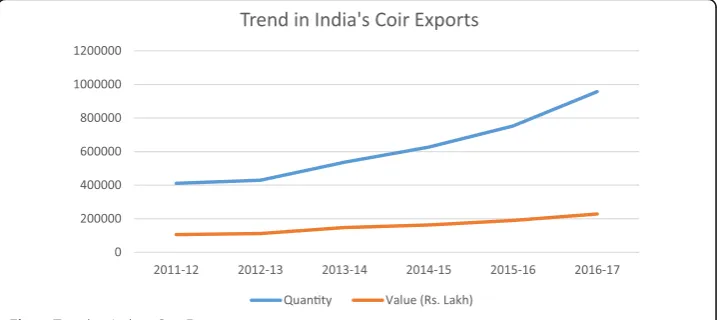
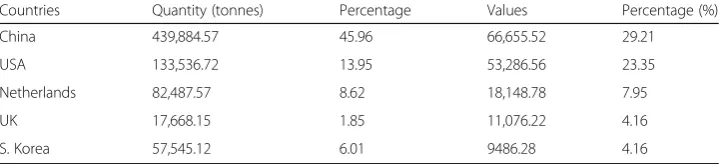
Table1and Fig.1gives a brief details of the export volume of the Indian Coir Indus-try. Table2gives the major export destinations of Indian Coir Industry.
China). To improve the export earning further, need of up-to-date technology is a must. Table 2 shows that the major export destination is China followed USA, Netherlands, UK and South Korea. To diversify its product further, it needs to invest in updated technology and also adequate market promotion (through selling, distribution and advertising).
Research and Development (R&D)
Various R&D activities for modernization in the country are carried out by research institutes of Coir Board, viz., Central Coir Research institute at Allopey in Kerala and Central Institute of Coir Technology at Bangalore in Karnataka. The R&D efforts of the Board have resulted in the development of different machinery items with high productivity, eco-friendly production processes, new end as applications product development etc.
Theoretical insights: How technology can boost Indian coir industry exports
Technology is increasingly seen as business enabler and is a vital tool for bringing in process efficiencies and higher degree of standardization. In order for MSMEs to develop a competitive advantage to venture into the international market and operate there, the Indian MSME needs to establish themselves in the domestic market. There should be a strong focus on implementing the new age technology, developing Table 1Export Volume of Indian Coir Industry
Year Quantity Value (Rs. Lakh)
2011–12 410,853.90 105,262.54
2012–13 429,500.92 111,602.74
2013–14 537,040.38 147,603.84
2014–15 626,666.60 163,033.77
2015–16 752,020.00 190,142.52
2016–17 957,045.00 228,164.82
2017–18 (31.12.18) 254,039.00 58,129.85
Source: Annual Report, MSME, 2017–18
(indigenous technology) as well as technological collaboration with global partners to play a crucial role. The Technology plays a pivotal role for MSMEs to help them stand up to the stiff competition from large enterprises and imports. A strong technology-en-abled sector levels the playing field to a great extent between MSMEs and their estab-lished counterparts globally.
Business are becoming more and more agile and technologies such as social media mobility, analytics and cloud computing are coming together to unleash the great value and opportunity. This convergence is also called Social Media, Mobility, Analytics (SMAC) and Cloud Computing and will emerge as a key business enabler over the next few years. In this context, the Indian MSMEs are gradually adopting the SMAC (higher among the urban enterprises). The other leading factors which will assist the MSMEs in establishing themselves in the global market are MSMEs government support, usage of external services, sufficient access to finance and use of human skills & resources.
The Indian MSMEs entering the international market have to incur a specific cost known assunk costs. Apart from this,they also need to know the taste and preference of
the consumers demanding their product in the international market. MSMEs producing
a substandard product of inferior quality using obsolete technology will not be able to compete in the global market. Customers are normally well aware of the products avail-able in the market. The demand for the product will be minimal if there is lesser amount of marketing, advertising and awareness. With the help of superior technology, significant amount of selling and advertising expenditure, and marketing, the Indian MSME can offer a superior quality of product and sustain itself in the competitive global market. For the Indian Coir Industry, such strategies including market promo-tion strategies can help it to sustain in the long run. This will further help in differenti-ating the Indian products from the other rival firm’s products.
The functional form of usage of technology by an Indian MSME and helping it getting differentiated from the other countries take the following form
Exit¼F Techð it;HRit;LPit;SKit;SERit;CAPit;EXit‐1Þ ð1Þ
Where,Exitis the export propensity of the Indian MSMEs.Techitis the technological usage by the Indian MSMEs,LPitIs the labor productivity of the Indian MSMEs,SKitis the use of advanced knowledge and skills, HRit is the availability of superior human resources,SERitis the usage of essential services like advertising, selling, marketing and distribution to differentiate the product in the market and also boost the sales,CAPit,is the availability of sufficient credit and finance and lastly EXit-1 is the previous year’s exports performance of the MSME.
Table 2Major Export Destinations of Indian Coir Industry
Countries Quantity (tonnes) Percentage Values Percentage (%)
China 439,884.57 45.96 66,655.52 29.21
USA 133,536.72 13.95 53,286.56 23.35
Netherlands 82,487.57 8.62 18,148.78 7.95
UK 17,668.15 1.85 11,076.22 4.16
S. Korea 57,545.12 6.01 9486.28 4.16
After discussing the significance and role of technology for MSME exports, this sec-tion discusses the several channels through which technology can be transferred.
Channels of technology transfer
The immediate solution for technological advancement may be achieved through tech-nology transfer, through either horizontal or vertical transfer. However, given the nature of scale of operation of Indian MSMEs, it is difficult to incur a higher expend-iture on R&D activities. It is also difficult to acquire an advance level of manufacturing technology due to their high costs (Government of India2010).
There are numerous channels for technology to be transferred both internationally and domestically. The main international technology transfer channels are through foreign direct investment (FDI) done through mergers and acquisitions, technical licensing contracts between overseas and native firms, imports of intermediate and capital goods, project contracts, technical consultancies by overseas companies and consultancy firms. All these technology transfer mechanisms tend to impact only the urban-based and bigger to medium sized enterprises.
The main transfer technology mechanisms include (i) Technology Licensing2through which the parties that give and take the execution and usage rights enter into a licens-ing contract, and on the premise of the specified conditions includlicens-ing payment of tech-nical fees for a specified period etc. the permission for the execution and usage rights is given, (ii) Technology sale: By technology sale complete control and administration is handed over to the buyer who pays the price (sales price), (iii) Technology Transfer with capital management, (iv) Technology transfer using technical person as the medium includes invitation and deployment of technical personnel, resolution of technological issues through the employment of technical personnel etc., (v)Technology Transfer involving sale of technology data such as plans, drawings etc. which is typic-ally more relevant for small scale projects used to simplify technological solutions.
Discussion
Absence of appropriate technology will reduce the potential of MSMEs and they will lag behind the other rivals in the global market. The other disadvantages will be lower demand for the product, substitution to other superior quality products produced by rival firms and lower profit margin (sometimes losses leading to shutdown).
Technology is increasingly seen as business enabler and is a vital tool for bringing in process efficiencies and higher degree of standardization. In order for MSMEs to develop a competitive advantage to venture into the international market and operate there, the Indian MSME needs to establish themselves in the domestic market. There should be a strong focus on implementing the new age technology, developing (indi-genous technology) as well as technological collaboration with global partners to play a crucial role. Technology is a key differentiator for the MSME sector to remain globally competitive.
the global market. With the GOI launching several MSME schemes,3small enterprises in the rural areas are yet to take full advantage of the best practices available at the technological front. Technology as a game changer and better assistance in doing further business is yet to be realized. With the increase of technology related schemes, there has been a rise in technology adoption.
Other challenges faced by the MSMEs
With agility and dynamism, the Indian MSME sector has shown admirable innovation and adaptability to the recent economic downturn and recession. For example, the GOI, have recently adopted the clustering and networking approach to help these MSMEs to improve their competitiveness in the toughest times. Indian MSMEs are also implementing new and innovative information and communication technologies on a large scale like Software as a Service, and Infrastructure as a Service to cope up with difficult situations. In spite of these measures the Indian MSMEs are facing great chal-lenges in the era of globalization and liberalization. Some of the notable chalchal-lenges are listed below:
[1]High cost of credit: Access to adequate and timely credit at a reasonable cost is the most critical problem faced by this sector. Recent studies on this area by researchers (Levy1993, Basu2004, Seshasayee2006, Das2008and Nagpal et al.
2009) indicate the Indian SMEs are hindered by constraint of poor credit
availability. The major reason for this has been the high risk perception among the banks about this sector and the high transaction costs for loan appraisal. Further, players in MSME sector are not in a position to provide collateral in order to avail loans from banks and hence denied access to credit.
[2]Procurement of raw materials at a competitive cost: The availability of appropriate economic resources is important for business development (Tustin
2003: 126, Goodall2000a: 15, Czinkota and Ronkainen2003:49).4The necessary expertise and raw materials to put entrepreneurial ideas into practice, to be competitive, survive during unfavorable conditions and to grow (Robertson et al.
2003:313; Wickham2001: 71).5This is a growing challenge faced by this sector as procurement for raw materials is carried out within local territory due to their financial constraints and procurements are much smaller in scale as compared to industry at large.
[3]Inadequate infrastructure facilities, including power, water, roads, etc.Lack of power/electricity infrastructures negatively affect the productivity and
profitability of manufacturing SMEs (Adelekan2005; Akinwale2010; Doe and Asamoah2014). To ensure competitiveness of the MSMEs, it is essential that the availability of infrastructure, technology and skilled manpower are in tune with the global trends. MSMEs are either located in industrial estates set up m any decades ago or are functioning within urban areas or have come up in an unorganized manner in rural areas. The state of infrastructure, including power, water, roads, etc. in such areas is poor and unreliable.
[4]Lack of skilled manpower for manufacturing, services, marketing, etc
expertise in marketing and human resources (Ligthelm and Cant2002). Although India has the benefit of a big pool of human resources, the industry persistently faces deficit in manpower with skills set required for manufacturing, marketing, servicing, etc.
Measures taken to promote the Indian MSME in the global market
The strategies taken to improve the manufacturing ability of the MSME sector is expected to improve the competitiveness of their products and enhance the exports. Measures such as higher value addition, cluster development, skill development and training, thrust on standardization and quality, access to affordable credit, impetus for innovation would be essential measures to promote the competitiveness of the Indian MSMEs.
Cluster development
The Ministry of MSME has adopted the cluster development6approach as a key strat-egy for enhancing the productivity and competitiveness as well as capacity building of MSMEs and their collectiveness in the country. The objective is to access the latest tools, technology, design, and testing facilities for such enterprises, upgrade infrastruc-tural facilities. The promotion of clusters has become a popular means of promoting competitiveness in MSMEs and this has been encouraged through existing or potential agglomerations by provision of suitable infrastructure, promotion of linkages among SMEs and with large firms, encouragement of local support institutions.
Access to credit
In terms of timely access to adequate credit has been accorded a high priority for the MSMEs. To address this problem, more coverage have been made under Credit
Guar-antee Fund Scheme. The units under the category of Micro and Small Enterprises can
now avail collateral free loans up to Rs. 2.00 crore through select financial institutions. Numerous start-ups in the working capital space are also trying to make it convenient for SMEs to access credit without much difficulty. Recently, the introduction of
MUDRA as a specialized window with the aim of targeting the micro enterprises is a
major intervention made for broad basing finance. The MUDRA loans are considered as a significant broad bases financial structure.
Technological development
enable it to establish 15 New Technology Centers (TCs) under Technology Center Systems Project to improve the overall productivity of the MSMEs. Additionally, there is also aCredit Linked Capital Subsidyscheme.7
Government schemes
A host of other initiatives such as Make-In-India, Digital India, Start-Up India and
Skill India for the holistic growth of the Indian MSME sector have been taken by the
Government of India (GOI). The Make-In India was launched in September, 2014 and is a wider set of nation building initiative. The main objective was to transform India into a global design and manufacturing hub. The Make in India is a different kind of campaign. It provides framework for a vast amount of technical information on 25 industry sectors and reach out to a vast local and global audience via social media and constantly keep them updated about opportunities, reforms etc. TheDigital India revo-lution provides an ample opportunity for promotion of MSME and also greater partici-pation of MSME in the Information, Communication and Telecommunication (ICT) sector. Digital enabled technologies can further allow SMEs to develop their own mar-ket intelligence, spread scale without mass and access global marmar-kets and knowledge networks at relatively low cost. The digital transition facilitates the emergence of“born global” small businesses and provide new opportunities for SMEs to augment their competitiveness in local and global markets, through either product or service innovation. The use of digital technologies can also ease SME’s access to skills and talent, through better job recruitment sites, outsourcing and online task hiring, as well as connection with knowledge partners (OECD 2017f). Skill India campaign was launched by Prime Minister on 15th July 2015 to train over 40 crore people in India in different skills by 2022. There are several initiatives under this campaign such as National Skill Development Mission, National Policy for Skill Development and Entre-preneurship, 2015, Pradhan Mantri Kaushal Vikas Yojana, Skill Loan Scheme, and Rural India Skill. UK has entered into a collaboration with India under the skill India programme.
Adopting corporate governance practices
Weak corporate governance of small firms, burdened further with poor availability of crucial inputs, has made these firms extremely vulnerable. Good governance practices in SMEs will help them grow or attract additional investors. Raising capital has, for a long time, been seen as the major challenge facing SMEs. The absence of good corpor-ate governance practices makes it difficult for them to access finance from banks or investors. Adoption of corporate governance8 framework by SMEs in India is indis-pensable for taking this sector to a high growth trajectory.
Development of human and natural resources
SMEs and the lower skill levels of the SME workers. The human resource constraints have been affecting both the efficiency and productivity of Indian SME sector.
Government of India measures
The GOI taken several initiatives in the field of Intellectual Property Rights (IPR), including modifications in patent laws and innovation of the IPR / Patent Offices, as a strategic response to the globalization of the economy. In a product patent regime, Indian firms will need to relook for newer sources of growth. Improving awareness on IPR amongst businesses, particularly MSMEs, means that they will be able to make informed decisions for protecting their ideas and business strategies. The Ministry of Micro, Small & Medium Enterprises (MSME) in India is conducting workshops on various aspects of WTO, Anti-dumping seminars, IPR, etc. to sensitize the Medium and Small Enterprise (MSEs) entrepreneurs and other stakeholders about the likely impact of liberalization and globalization.
Recently, the Finance Minister of India in the upcoming budget proposed to reduce the tax rate of MSMEs reporting turnover of less than Rs. 50 crore to 25% from the existing 30%. He declared that this benefit will cover 96% of Indian companies filing income tax returns in India. Also, in a drive to promote digital way of doing business, a lower tax rate of 6% has been proposed to small Indian companies having turnover of less than Rs. 2 Crore. To enlarge the existing market size of MSME, it was proposed that the Ministries and Departments of Central Government shall procure 20% of goods and services from Micro and Small Scale Enterprises as a part of Public Procure-ment Policy, MSE order 2012. The GovernProcure-ment of India is further firming up its exist-ing policies through various new announcements and initiatives. For example, a part of the Ease of Doing Business and to formalize the MSME sector, Udyog Aadhar Memo-randum (UAM) was notified in September, 2015. The system offered page single point registration to avoid delays and is considered to be one of the path-breaking initiative. With the announcement of the ‘One Nation One Tax’ approach under Goods and Service Tax, Indian MSME can definitely unleash their real potential. For enhancing the competitiveness of the Indian MSMEs, National Manufacturing Competiveness Programme has been launched. The objective of the scheme is to enhance the value chain of the MSME sector and make it more efficient and competitive in the global market. Lastly, the GOI have launched schemes/programmes for technology upgrada-tion, development of clusters of such industries, making collateral free bank credit available up to US$ 1, 25,000, creating awareness among these industries regarding export-related issues, etc.
Launching of the IPR proposal
Separate umbrella organization
A centralized umbrella organization focused on the development of the Indian MSME sector, may seek more attention of the policy makers. The Ministry of MSME, Reserve Bank of India, and Small and Industrial Development Bank of India have always provided numerous initiatives in the advancement, financing and growth of Indian MSMEs. However, an umbrella organization is always welcome which will provide additional support including technological support, design output, facilitating raw material supplies, marketing support, etc. for the Indian MSMEs.
Low value addition
The average technology value-addition in manufactured products exported by the Indian Industry is around 8%. It is comparatively low when compared to other develop-ing nations. The low value addition is especially found in sectors such as Gems and Jewellery, where value addition is negligible. Goods such as engineering goods and leather goods also lag behind in terms of value addition. Hence there is a need to in-crease their value addition in the future.
Memorandum of understanding
To exploit the potential of MSME, the Ministry of MSME have entered into long term agreements, Memorandum of Understanding, Joint Action Plan with 19 countries such as Tunisia, Romania, Rwanda, Mexico, Uzbekistan, Lesotho, Srilanka, Algeria, Sudan, Cote d Ivore, Egypt, Republic of S.Korea, Botswana, Indonesia, Vietnam, Mauritius, Sweden, UAE and others. The Ministry of MSME and NSIC have also hold discussions with foreign delegations for enhancement of bilateral cooperation for the mutual bene-fits of MSMEs of two countries.
To compete in the global market, International Cooperation (IC) Scheme is being slowly implemented by the Ministry of Micro, Small and Medium Enterprises (MSME). It’s an ongoing scheme since the Ninth Plan and has continued in the twelfth Plan with an earmarked outlay of Rs. 24.50 crore. The main objective of the scheme is technology infusion, modernization and promotion of exports. Under the financial year 2015–16, Rs. 4 crore has been allotted for the purpose of modernization and boosting of exports. Given the vital link between technological innovation and international competitive-ness, a challenge for the future policy maker is to incorporate the innovation system concerns with the links related to the area of trade and investment framework.
Conclusion and future measures
the time is a viable solution to promote the coir product in the global market. In is generally seen, that technological development helps to differentiate a product from its competitors/rivals product. The GOI has taken several measures from time to time for technological development of the Indian MSMEs so that it can improve its competi-tiveness in the international market. To counter the other challenges too, new schemes and programs such as Make-In India, Skill India and Digital India have been launched over the years.
The findings indicate that in spite of focusing in the development of technology based products the other important challenges also needs to be addressed simultan-eously. Challenges such as access to credit, development of adequate infrastructure (power, electricity), supply of raw materials and training of laborers to be hired by the MSMEs also do exist. Hence, all these challenges are required to be addressed simul-taneously for the overall success of Indian MSMEs in the export market. Lastly, the study will guide the MSMEs who are yet to enter the global market as to what are the tentative challenges, how they can be overcome and how can the GOI assist them in entering the global market in the long run.
To remain competitive and increase the share in the globalized world, the Indian MSMEs need to consistently upgrade their technology in the ever-changing globalized world. The Indian MSMEs may employ external consultants or resort to other mea-sures on a continuous basis. Indian MSMEs can also opt for technology transfer such as vertical technology transfer10 or horizontal technology transfer.11 The horizontal technology transfer is the most common phenomenon among the MSMEs since it can accomplish multiple tasks through the horizontal technology transfer. Therefore, it is expected that through diversified use of technology apart from using the other import-ant factors of production, the MSMEs can enhance their productivity, reduce their costs, expand their scale of production, resort to new product development, increase their product sales and market share and most important penetrate into the global or international market. Lastly, if the Indian Economy is to sustain a growth rate of 8 to 10% in the coming decade, a strong and vibrant MSME sector is vehemently required. Indian MSMEs have the potential to become global enterprises. Constant efforts in various forms and active GOI support/schemes should definitely boost the Indian MSMEs to become international players in the coming decade.
India should increasingly embrace a network of innovation and increase their part-nership with other research institutions, universities and other organizations. The MSME, are not coming forward for adopting IPR as a business strategy and a means for enhancing competitiveness and becoming an efficient player in the global. There is widespread lack of consciousness about IPR as a tool for creating a competitive edge in the trade & technology market and for value addition to the business. The Indian MSME sector needs more information, orientation and facilities for protecting their intellectual powers and show a positive approach towards creation, protection and management of IPR to compete in the global market and experience a business growth. This will further motivate and enable towards the launching of the IPR proposal in the Indian Economy.
impediments to the use of such funds by the MSMEs should serve this purpose.
Ven-ture/ Risk capitalcould be other alternative option to finance the MSMEs.
According to studies conducted, very few organizations or clusters under the MSME sector use ICT to their advantage. MSMEs need to understand that the benefits outweigh the costs of ICT adoption. ICT adoption can help introduce greater process efficiency in MSMEs and help to focus on the core focus areas of innovation. The development of an efficient ICT infrastructure as well as improved interoperability and standards are important to access global markets as they facilitate information exchange and communication as well as participation in e-commerce platforms (BIAC, B20 China, World SME Forum, SME Finance Forum2016; OECD2017a).
Developing countries are investigating significantly in their education (mainly basic) and training systems. However, linkages between education and training strategies and SME enterprise development strategies are still weak. The education and training systems influence the level of entrepreneurial activity. There should be an increase in training programmes by the industry associations to upgrade the skills of the workers on a daily basis with introduction of new technology. Further, labor laws should also be simplified.
There is also an urgent need to administer and invest in the Human resource (HR) function12within the Indian MSMEs. The Indian MSME need to significantly invest in HR functions to compete in the global market. The role of human resources in enhan-cing firm efficiency and effectiveness is well established. According to the resource based view of management, irrespective of the firm size, employees are strategically important and indispensable resources to achieve an organization’s objective.
Lack of critical infrastructure and poor supporting facilities and inadequate access to important services like water, power supply, and road & rail connectivity have increased the operational costs of MSME making them less competitive. Use of solar or renew-able energy needs to be encouraged in rural areas. To upgrade the infrastructural facilities, the Ministry (MSME) has adopted the cluster development approach as a key strategy for improving competitiveness of Indian MSME.
The Indian tax system has been criticized along several lines as to be deemed undesirable for the business environment, number of payments required, and proced-ure for filing payments and non-uniformity across states associated with taxation (Ease of Doing Business Index, International Finance Corporation, World Bank 2014). The Ease of Doing Business13 has significantly improved from 131st position among 190 countries to 130th position in 2018. The improvement of the Ease of doing business can be indicated as a good indicator for the conducive performance of Indian MSME.
Lastly, the Government of India is fully aware of the challenges of globalization and has taken appropriate measures for preparing the MSME to meet the challenges of liberalization and globalization. All these combined future measures will help the Indian MSMEs get improved access in the global markets.
(Information Technology professionals, advertising and marketing expenditure) can be collected. Lastly, an econometric exercise could be done to examine the likely impact of the variables on the competitiveness of the Indian MSMEs. In future, a more empir-ical exercise with minimal data limitations could be a possible extension of this study.
Endnotes
1
Cloud Computing is an Information Technology paradigm which enables ubiquitous access to shared pools of configurable system resources and high level services that can be rapidly provisioned with minimal management effort, often over the internet. Basic-ally, cloud computing relies on sharing of resources to achieve coherence and econ-omies of scale as similar to public utility.
2
License is a method of permit to execute, and a system wherein the holder of the technology rights gives permission to another party in relation to the execution rights of the relevant technology based on a contract.
3
International Cooperation Scheme, Marketing Assistance, Micro-finance programme, Entrepreneurial and Managerial development of SMEs through Incubators, Enabling Manufacturing Sector to be Competitive through Quality Management standards, and Quality Technology Tools, Building awareness on Intellectual Property Rights, Technol-ogy and Quality Upgradation for support to MSMEs etc.
4
Chapter 2:Factors affecting SME’s success, https://repository.up.ac.za/bitstream/han-dle/2263/24173/02chapter2.pdf
5
Chapter 2:Factors affecting SME’s success, https://repository.up.ac.za/bitstream/han-dle/2263/24173/02chapter2.pdf
6
Under the scheme of cluster development, the benefit of a whole variety of interven-tions, ranging from exposure to skill development, from credit and marketing, and from technological improvements to better designs and products is given to concentra-tions of enterprises in a contiguous belt. With the government funding and participation of cluster actors, developmental interventions are carried out for a period of 3–5 years to enhance the competitiveness and collective efficiency of the clusters and to integrate them with the global economy and global supply chain.
7
The scheme for functional upgradation of existing technology used by the MSME. The Scheme provides an up-front subsidy of 15% subject to a maximum of 15 lakh for modernization of plant and machinery used by the MSME.
8
The lack of corporate governance is mainly due to lack of awareness about corporate governance practices and its impact on corporate performance. Thus, there is need to educate SMEs about the benefits of adopting sound corporate governance practices. There is also a need to implement SMEs corporate governance code.
9
The main objective of the Intellectual Property Rights (IPR) is to enable the Indian MSME to make up-to-date decisions about guarding their ideas and business policies, operational utilization of IPR tools for further technology advancement, promoting competitiveness, and providing access to technical amenities and knowledge for value addition to their trade and business.
10
11
In case of horizontal technology transfer, the transfer occurs when technology used in one place, organization or context is transferred to another place, organization and context.
12
HR functions are defined where all the roles, tasks and responsibilities from the staffing process to the training and development via the performance planning and appraisal to remuneration and other rewards to finally the termination of employment
13
The Ease of Doing Business is composed of 10 indicators, a majority of them being associated with regulatory norms automatically drawing attention to the potentially adverse effect of these norms on the general business environment and subsequently on the performance of MSMEs.
Abbreviations
BRICS:Brazil, Russia, India, China and South Africa; FDI: Foreign direct investment; GOI: Government of India; HR: Human resource; IC: International Cooperation; ICT: Information Communication and Technology; IPR: Intellectual Property Rights; MSE: Micro and Small Enterprises; MSME: Micro Small and Medium Enterprises; OECD: Organization for Economic Cooperation and Development; R&D: Research and development; SMAC: Social Media, Mobility, Analytics; SMEs: Small and Medium Enterprises; SMEs: Small and Micro Enterprises; SSI: Small Scale Industries; UAM: Udyog Aadhar Memorandum; WTO: World Trade Organization
Acknowledgements
I acknowledge my parents Mr.Sree Kumar Mukherjee and Mrs. Rakhi Mukherjee for offering me full support towards working on this paper. My Institution, Symbiosis Law School, Pune, including my Director, Dr. Shashikala Gurpur, Director and Dean of Symbiosis Law School, Pune, offered her full support to complete my paper in time.
Availability of data and materials
All data cited in this paper are taken from the Ministry of Small Scale and Medium Enterprises (MSME) Annual Report, 2016–17, 2017–18, Government of India.
The following links are the applicable hyperlinks to the Annual Report (MSME), 2016–17 and 2017–18.
Annual Report 2017–18, Government of India, Ministry of Micro, Small and Medium Enterprises.https://msme.gov.in/ sites/default/files/MSME-AR-2017-18-Eng.pdf
63rd Annual Report, 2016–17, Coir Board, Ministry of MSME, Government of India.https://msme.gov.in/sites/default/ files/Coir_Board_Annual_Report_2016-17-Final_Approved.pdf
The other reading material used in the documents are taken from google scholar, Jstor, planning commission and science direct.
Author’s contribution
I, Dr. SM is the sole author of this study“Challenges to Indian Micro Small Scale and Medium Enterprises in the Era of Globalization”. The author read and approved the final manuscript.
Competing interests
The author declares that she has no competing interests.
Publisher’s Note
Springer Nature remains neutral with regard to jurisdictional claims in published maps and institutional affiliations.
Received: 5 June 2018 Accepted: 12 September 2018
References
Adelekan, I. O. (2005). Gender, economic policy and domestic energy use in Nigeria.Ibaden Journal of the Social Sciences, 3(1), 1–16.
Akinwale, A. A. (2010). The menace of inadequate infrastructure in Nigeria.African Journal of Science, Technology, Innovation and Development, 2(3), 207–228.
Asian Development Bank (2009),“Enterprise in Asia: Fostering dynamism in SMEs”.https://www.adb.org/sites/default/files/ publication/27727/ki2009-special-chapter.pdf
Basu P (2004),“Providing better access to finance for SMEs in India”, access finance, issue 2. December, 2004.
BIAC, B20 China, World SME Forum, SME Finance Forum (2016), Financing Growth; SMEs in Global Value Chains.http://biac. org/wp-content/uploads/2016/06/Financing-Growth-SMEs-in-GlobalValue-Chains.pdf.
Czinkota, M. R. Ronkainen, I. A. (2003) An International Marketing Manifesto. Journal of International Marketing: Spring 2003, Vol. 11, No. 1, pp. 13–27.
R. Vani, M. C. (2013). The impact of globalization on micro, small and medium enterprises with special reference to India. Innovative Journal of business and management, 2(05) September,-October, 2013. Retrieved fromhttp://innovativejournal. in/index.php/ijbm/article/view/8.
Das, K. (2008).‘SMEs in India: Issues and Possibilities in Times of Globalisation’, in Lim, H. (ed.), SME in Asia and Globalization, ERIA Research Project Report 2007-5, pp. 69–97. Available at:http://www.eria.org/SMEs%20in%20India_
Issues%20and%20Possibilities%20in%20Times%20of%20Globalisation.pdf.
Das, K., & Joseph, K. J. (2013). On learning, innovation and competence building in India’s MSMEs: The challenge ahead. In A. C. Arrio & M. Serri (Eds.),Innovation in SMEs: The BRICS experience. New Delhi: Routledge.
Doe, F., & Asamoah, E. S. (2014). The effect of electric power fluctuations on the profitability and competitiveness of SMEs: A study of SMEs within the Acera Business District of Ghana.Journal of Competitiveness, 6(3), 32–48.
Ghatak, S. (2009), Micro, Small and Medium Enterprises (MSME) in India: An Appraisal.http://www.geasiapacifico.com/ documents/MiPymes%20en%20la%20India.pdf
Goodall, B. 2002a. Small business is engine of growth. Sowetan 28 January:15.
Government of India. (2010).Report of prime Minister’s task force on micro, small and medium enterprises. New Delhi: Prime Minister’s office, Government of India.
Grant Thornton and FICCI (2013), Integrating MSMEs with the Global Value Chain. http://ficci.in/spdocument/20249/Grant-Thornton-FICCI-report.pdf
Harvie C (2010),“SMEs and Regional Production Networks”,https://pdfs.semanticscholar.org/1fa9/ 99afc6850facc571d33cbb1fa6e7d8c73fd8.pdf
Hwang WG (2007),“Changing Business Environment of SMEs in the Era of Globalization”,http://www.apec-smeic.org/ newsletter/newsletter_read.jsp?SEQ=506.
IBEF report on MSME (2013a), SME’s Role in India’s Manufacturing Sector. https://www.ibef.org/download/SMEs-Role-in-Indian-Manufacturing.pdf
IBEF report on MSME, (2013b), MSMEs and Growing role of Industrial Clusters,http://www.ibef.org/download/MSME-040213.pdf. Lahiri, R. (2012), Problems and prospects of Micro, Small and Medium Enterprises (MSMEs) in India in the era of Globalization.
https://www.rtc.bt/Conference/2012_10_15/6-RajibLahiri-MSMEs_in_India.pdf
Levy, B. (1993). Obstacles to Developing Indigenous Small and Medium Enterprises: An Empirical Assessment.The World Bank Economic Review, 7(1), 65-83. Retrieved fromhttp://www.jstor.org/stable/3989871.
Ligthelm, A. A., & Cant, M. C. (2002). Business success factor of SMEs Gauteng: A proactive entrepreneurial approach. Bureau of Market Research, University of South Africa
Mali, D. D. (1998),“Development of micro, small and medium Enterprises of India: Current Scenario and Challenges’, SEDME Vol. 25, No. 4, December.
Ministry of MSME’s. (2017).Annual Report 2016/17. New Delhi: Government of Indiahttps://msme.gov.in/sites/default/files/ MSME%20ANNUAL%20REPORT%202016-17%20ENGLISH.pdf.
Mukherjee, N. (2001). World Trade Organization and small and medium enterprises from a developing Country’s perspective: A study of Indian small scale industries.The Economic Journal, 48(2), 18–29.
V.P Nagpal, Monica Saini and Shivani Gupta (2009),“Problems faced by Small and Medium enterprises”, SME in transitional economics-challenges and opportunities, Deep and Deep publications 2009, pp. 566–57
Naik, S.D. (2002), Small scale industries: Preparing for WTO challenges. The Hindu business line, July 2002.https://www. thehindubusinessline.com/2002/07/12/stories/2002071200110800.htm
OECD (2004),“Promoting Entrepreneurship and Innovation SMEs in a Global Economy: Towards a More Responsible and Inclusive Globalization”.https://www.oecd.org/cfe/smes/31919590.pdf
OECD. (2013).Skills development and training in SMEs, OECD Skill Studies. Paris: OECD Publishing.https://doi.org/10.1787/ 9789264169425-en.
OECD. (2017a). Small, medium, strong. InTrends in SME performance and business conditions. Paris: OECD Publishing. OECD(2017f), Key Issues for Digital Transformation in the G20, Report prepared for a joint G20 German presidency/OECD
conference, Berlin. 12 January 2017.
Rathod, C. B. (2007). contribution of Indian small scale entrepreneurs to economic growth in India: Opportunities and challenges in global economy.Prabandh- Journal of Management and Research, 23, 1–12.
RBI. (2017).Handbook of statistics on Indian economy. Mumbai: Reserve Bank of Indiahttps://rbidocs.rbi.org.in/rdocs/ Publications/PDFs/0HANDBOOK2017C9CF31D4B78241C9843272E441CD7010.PDF.
Robertson, M. Collins, A. Medeira, N. Slater, J. (2003) "Barriers to start‐up and their effect on aspirant entrepreneurs", Education + Training, Vol. 45 Issue: 6, pp. 308–316,https://doi.org/10.1108/00400910310495950.
Savrul, M., et al. (2014). The potential of E-commerce for SMEs in a globalizing business environment.Procedia- Social and Behavioral Sciences, 150, 35–45.
R. Seshasayee (2006),“Financing SMEs: An industry perspective”, CAB calling. July–September, 2006.
Shastri, R. K., Tripathi, R., & Ali, M. (2011). Liberalization and its impact on small scale industries.International Journal of Vocational and Technical Education., 2(7), 81–87.
Sonia, & Kansai, R. (2009). Globalization and its Impact on Small Scale Industries in India., 1(2), 135–146.
Subrahmanya, M. B. (2004a). Small Industry and Globalization: Implications, Performance and Prospects.Economic and Political Weekly, 39(18), 1826–1834.
Subrahmanya, M. H. (2004b). Small industry and globalization: Implications, performance and prospects.Economic and political weekly, XXXIX(18), 1826–1834.
Sudan, F. K. (2005). Challenges in Micro and Small Scale Enterprise Development: Some Policy Issues.Synergy: I.T.S. Journal of IT and Management, 3(2), 67–81.
Tustin, D.H. 2003. Small business skills audit in peri-urban areas of Northern Tswane. UNISA. Bureau of Market Research. Research Report number 315. Faculty of Economic and Management Science.
Wickham, 2001. Wickham(2001), Strategic entrepreneurship, 2nd edition, Prentice Hall.