4 (3), Fall 2012, Ser. 68/4 ISSN: 2008-8191. pp. 127-145
The Effects of Collaborative Versus Non-collaborative Massed and Distributed Presentation on the
Comprehension and Production of Lexical Collocations
A. A. Zarei
Assistant Professor Imam Khomeini International
University, Qazvin email: [email protected]
M. Tavakkol
M.A., TEFL
Islamic Azad University, Takestan
email: [email protected]
Abstract
To investigate the effect of massed and distributed collaborative and non-collaborative presentation on L2 learners’ comprehension and production of lexical collocations, 105 participants at Takestan Islamic Azad University in 4 groups were assigned to four different treatment conditions (massed; collaborative-distributed; massed; and noncollaborative-distributed presentation of collocations). Participants were given recognition and production posttests. To compare the participants' comprehension of collocations, a two-way ANOVA was used. Results indicated that the differences among the types of presentation and method were not statistically significant. Another two-way ANOVA was used to compare the learners' production of collocations, which showed that there was no significant difference between types of presentation- massed and distributed. The differences between methods of teaching- collaborative and non-collaborative- were not statistically significant either. However, the results indicated that the interaction effect of method and presentation of lexical collocations was statistically significant in the production of collocations. The findings of
–––––––––––––––––––––––––––––––––––––––– Received: 01/23/2012 Accepted: 07/02/2012
Corresponding author
the present study can have theoretical and practical implications for teachers and learners of English.
Keywords: collaboration, collocation, lexical collocations, massed and distributed presentation
1. Introduction
Collocations are amongst the most stimulating and, at the same time, intriguing aspects of vocabulary learning. Over the past few decades, collocations have attracted a surge of interest from educators, researchers, teachers, and even learners. "Collocations are linguistic phenomena that occur when two or more words appear together more often than by chance and whose meaning often cannot be inferred from the meanings of its parts" (Petrovic, Snajder & Basic, 2009, P. 388).
This study aims to study the effects of collaboration on the learning of collocations. Collaborative learning (CL) seems to help both learners and teachers. In this approach, learners work in groups. It is claimed to be more interesting and useful than the traditional view to teaching and learning. Altinay and Paraskevas (2007) hold that the traditional view to teaching in which the teacher is a lecturer and the student is a passive listener appears to be inadequate. Collaborative learning also enhances interaction among students. It also gives students the opportunity of self and other-evaluation before teacher-evaluation. Ghaith (2001) asserts that learners in cooperative learning feel responsible for their own learning and get equal opportunities to demonstrate their learning.
learning. However, few studies (if any) have focused on these variables together. The present study, therefore, aims to address the following research questions:
1. Are there any significant differences among the effects of massed and distributed collaborative and non-collaborative presentation on second language learners’ comprehension of lexical collocations?
2. Are there any significant differences among the effects of massed and distributed collaborative and non-collaborative presentation on second language learners’ production of lexical collocations?
2. Review of Literature
The past 20 years have witnessed a large body of second language research targeting vocabulary learning. A number of scholars accentuate the importance of learning vocabulary (Celce-Murcia, 2001; McCrosstie & Hsu, 2007). McCrosstie and Hsu (2007) state that acquiring a huge and varied vocabulary is vital for communicative purposes. Yet, Celce-Murcia (2001) argues that although vocabulary is central to language acquisition, it has never been known as a priority in the EFL classroom.
One of the most important and difficult aspects of word knowledge is collocations. According to McCrosstie and Hsu (2007), the word collocation was first brought up by Palmer in 1933and later introduced to the field of theoretical linguistics by Firth in 1957. Collocations seem to be a crucial part of vocabulary development in every language, mostly for communication. Shin (2007) argues that using collocations can expand learners’ language fluency. Every language contains many collocations, combinations of words that are unlikely to co-occur more
often than expected by accident. Why do we say ‘break the ice’,
‘exercise caution’, ‘take advantage of something’ and ‘make a charge
against somebody’? The reason is collocation.
Collocations have an essential role in the successful and native-like performance of second language learners. According to Shin (2007), "learning collocations is one way to ensure native-like selection"(p. 2). He also states that learners can make their speaking and writing native-like by using native-native-like collocations.
Despite their importance, collocations are a problematic area of second language learning. Nesselhauf (2003) points out that collocations are both crucial and problematic for language learners. Similarly, Koosha and Jafarpoor (2006) believe that the majority of Iranian EFL learners are good at grammar and vocabulary, but have serious problems with the production of English collocations.
The term collocation has been defined in a number of ways. Mongkolchai (2008) defines collocations as the occurrence of words and phrases which occur together more often than expected. He believes that collocation is "the way in which words co-occur in a natural text in statistically significant ways"(p.16). Durrant (2008) defines collocation as a "psychological association between words which is merely evidenced by their occurrence together in corpora more often than random distribution "(p.10). Walsh (2005) uses collocation in two major senses, "collocation in a very broad sense refers to all patterns permeating language distinct from those determined by sentence or clause grammatical structure; the second sense is that of specific predictable word combinations as fixed, idiomatic, or ‘natural’ via linguistic convention" (p.1).
Mongkolchai (2008, p. 20) gives the following characteristics of collocations:
1. Collocations are frequent co-occurrences of items between which no
word can be added. For example, in knife and fork, it is very unusual to
add a word to this collocation like,* knife, spoon and fork.
2. Collocations consist of components that cannot be replaced by a
synonym or word of similar meaning. For example: John makes a cake;
but not*John makes a pancake.
3. Collocations are binomials that cannot be reversed. The order of the
parts of a collocation is more or less fixed. For example, bread and
4. Some collocations are predictable; for example, if a person hears the
collocations apply... and shrug..., s/he automatically expects that for and
shoulder will follow, respectively.
Jing (2008, p. 2) describes collocations as groups of words (a) which almost frequently co-occur; (b) which are grammatically structured; (c) which are greatly adjacent; (d) whose meanings are more apparent than idioms; (e) which are relatively lexically fixed; and (f) which are approximately conventionalized.
3. Categories of Collocations and Lexical Collocations
Scholars categorize collocations into grammatical and lexical
collocations (MartyNska, 2004; Walsh, 2005). Mongkolchai (2008) refers
to the following categories for grammatical collocations:
Table 1. Grammatical collocations
Grammatical collocations Pattern Examples 1.noun + preposition blockade against 2.adjective + preposition pleased with
3.preposition + noun by accident
Durrant (2008) gives the following categories of lexical collocations.
Table 2. Durrant's (2008) categorization of lexical collocations
MartyNska (2004) classifies lexical collocations into seven
categories. He gives the following categories for lexical collocations:
Table 3. Lexical collocations given by MartyNska (2004)
Lexical collocations Examples
1. verb +
noun/pronoun/prepositional phrase
e.g. come to an agreement, launch a missile
2. verb (which means
eradication/cancellation) + noun
e.g. reject an appeal, crush resistance
3. [adjective + noun] or [noun used in an e.g. strong tea, a crushing defeat,
Lexical collocations Examples 1.noun + noun traffic accident
2.verb + adverb smile broadly
attributive way + noun] house arrest, land reform
4. noun + verb e.g. bombs explode, bees sting
5. quantifier + noun e.g. a swarm of bees,
6. adverb + adjective e.g. hopelessly addicted, sound asleep
7. verb + adverb e.g. apologize humbly
A number of studies have investigated collocations and the problems that second language learners and even non-native teachers have with them. Higuchi (1999) investigated the collocational problems of a group of Japanese students aged about 18 to 20 who received formal instruction for about seven years. Their general proficiency level was evaluated as high-beginning to lower-intermediate. He gathered samples of his student's written texts (short essays and personal letters). He divided all errors and problems into three classes: grammatical errors, word-choice errors and collocational problems. Results indicated that 68 percent of the errors belonged to the wrong choice of grammar, 23 percent to word-choice and 9 percent to collocations.
Zinkgräf (2008) analyzed nonstandard collocations existing in the written production of Spanish-speaking university students of English. His study was based on a manually-compiled corpus of V+N miscollocations. His findings showed that negative transfer from the students' native language had substantial effect on their use of English collocations. It was also found that the semantic overlap between appropriate forms and possible synonyms of either the base or the collocate was another source of error.
Shin (2007) attempted to investigate predictability of English collocations in Korean Language for preparing practical and valuable materials for Korean learners. He listed 4,698 English collocations and analyzed their predictability. The author assumed that learning collocations becomes easier by applying the criterion of predictability in L1. The results indicated that the criterion of predictability in L1 was helpful in decreasing the number of collocations to focus on. It was found that one third of the most frequent 500 collocations were unpredictable in Korean language.
The present study intends to look into the effects of collaborative and non-collaborative teaching on the learning of lexical collocations. A brief look at the principles and characteristics of collaborative learning, therefore, will not be irrelevant.
4. What is Collaborative Learning?
The term collaboration has been variously defined in the relevant literature. Yeok- Hwa (1998) points out a number of principles that are common to any group learning approach: 1) Shared learning goals and outcomes are essential aspects of designing a group-learning task. 2) Groups of between 3-5 students are small-group learning. 3) trust-building activities, joint planning, and an understanding of team support conduct seem to be cooperative behavior. 4) Positive interdependence is developed through setting mutual goals; and 5) Individual accountability, role fulfillment, and task commitment are expected of students.
Biström (2005) states that collaborative learning is changing the lines of teaching methodology where the teacher is not a lecturer or just a supervisor and the students are not passive in the teaching process, but search the knowledge and share it in group tasks. By collaborative learning, he means that groups of students work together to discuss specific subjects to solve or assess problems. Everyone in the group cooperates to discuss and share their ideas. Thus, the collaborative approach to second language learning is a kind of group work task. However, not all group works are considered as collaboration.
students to reconsider their understanding of concepts so that they can clearly explain information to others".
Many scholars believe that the collaborative approach can be beneficial to learning and teaching a second language. Biesenbach-Lucas
(ibid.) states that “Collaborative learning, grounded in socio-cultural and
socio-cognitive theory, has been a mainstay of American education for decades. Its effectiveness as a teaching approach has been well documented" (p. 156).
Many teaching and learning approaches just focus on the product. However, the collaborative learning approach focuses on the process of tasks. Yeok- Hwa (1998) argues that the collaborative learning approach to teaching a second language prepares learners for the kind of teamwork and critical interchange which they will need in their communities and workplace in the future in order to be effective participants. He contends that collaborative learning develops critical thinking skills that include the ability to reflect and improve on their own learning.
Biström (2005) admits that collaborative learning can be used to activate students and to prepare them for the challenges in working life. He further believes that learning by discussion and problem solving and doing tasks in groups is much more advantageous than learning passively by listening to lectures.
Willis (2007) studied the effects of this kind of learning through neuroimaging and brain mapping. Neuroimaging evidence showed that when students engage in the learning process, parts of their brain are stimulated actively. He believed that when students work in well-designed, supportive cooperative groups, their brain scans show facilitated passage of information from the intake areas into the memory storage regions of the brain. He found evidence of brain and neurochemical activity that supported the positive results of the cooperative approach to learning. He also found that the collaborative approach increases neural activity in relational and emotional memory connections and long-term memory storage.
collaborative learning on enhancing drill-and-practice skills and critical thinking skills. He concluded that the concept of collaborative learning is the grouping and pairing of students at various performance levels for working together in small groups to achieve an academic goal. In this case, students monitor and evaluate their own and other students' progress in the learning process. He also claims that the active exchange of ideas among the students not only increases their interest but also fosters critical thinking. He sought to investigate the effect of achievement on a test comprising of 'drill-and practice' items between students learning individually and students learning collaboratively and to see the effect of achievement on a test comprising of 'critical-thinking' items between students learning individually and students learning collaboratively. The population for the study consisted of undergraduate university students. There were two treatment groups: individual and collaborative learning groups. The treatment included two parts: lecture and worksheet. It was concluded that collaborative learning fosters the development of critical thinking through discussion, sharing ideas, clarification of ideas, problem solving and evaluation of others’ ideas.
5. Massed and Distributed Presentation of Words
One of the other factors affecting vocabulary learning is the massed versus distributed manner of presentation. In massed presentation, the collocates of a word are taught together, and in distributed presentation, different collocates of a word are presented separately in different contexts.
Underwood (1951) attempted to investigate the effect of stage of practice in serial learning. He employed 24 participants who learned 4 serial lists of 14 adjectives, with 2 seconds between each trial. He also used a similar group who learned the same lists with 30 seconds between each trial. Students just learned one list each session. He concluded that learning by distributed practice constantly occurred faster. Simply, in early stages a greater amount of errors appeared on distributed practice.
When practice is distributed or spaced, a given amount of practice is divided across multiple sessions. For example, once students have learned to solve mathematics procedure, the corresponding practice problems can be massed into one assignment or distributed across multiple assignments (p. 1209)
Furthermore, Rohrer and Taylor (ibid.) investigated how the
retention of a mathematics procedure was affected by variations in the temporal distribution of practice or the total amount of practice. For this reason, they carried out two experiments. Participants of their study were 216 college students. In Experiment 1, 10 problems were massed in one session or distributed across two sessions with an interval of one week. Distributed practice was not effective among students who were tested one week later, but it was enormously successful among students tested 4 weeks later. In Experiment 2, three to nine practice problems were completed in one session by students. It turned out that distributed practice enhanced long-term retention.
Another study that examined the effects of massed and distributed practice was conducted by Hovland (1939). His participants were 32 students who learned both serial and paired-associate lists on uninterrupted days by massed and distributed practice. As a result, in the case of serial materials, learning by distributed practice led to a decrease in the number of examinations essential for mastery. But, in the case of paired associates, there was no significant difference between distributed and massed practice.
The aim of the present study is to investigate the effect of massed and distributed collaborative and non-collaborative presentation on L2 learners’ comprehension and production of lexical collocations.
6. Method 6.1 Participants
English course. There were 4 groups of participants, each of which was randomly assigned to a different treatment condition to receive instruction through a different technique of presentation.
6. 2 Materials and instruments
The data collection instruments utilized in this study included the following:
1) The vocabulary sub-test of a Michigan language proficiency test,
containing 30 items in the multiple-choice format, was used to homogenize the participants and to validate the posttests.
2) A pretest including 147 selected collocations was administered to
ensure that the participants had no prior knowledge of the target collocations. The items which remained unanswered were included in the post tests.
3) Two post tests with the following characteristics were also used: 1. A multiple-choice test of collocational knowledge, containing 19
items, was administered to the participants to measure the comprehension of various collocational patterns.
2. A fill-in-the-blank test, which consisted of 36 items, was also administered to gauge the participants' production of lexical collocations.
Since both post-tests were designed by the researchers, their validity and reliability had to be established. The validity of the tests was checked against the vocabulary subtest of the Michigan test. The validity index of the multiple-choice and fill-in-the-blanks tests of collocations turned out to be .69 and .71, respectively. Using the KR21 method, the reliability index of the receptive and productive post-tests turned out to be .77 and .93, respectively.
7. Procedures and Data Analysis
analysis. Then, the multiple choice pre-test was given to the participants to measure their knowledge of the target collocations and to make sure that the participants had no prior knowledge of the target collocations. Then, the participants were divided into 4 groups, to receive different presentations of collocations. The distribution of the participants in the four groups was as follows:
A: massed, collaborative (23 participants) B: massed, non-collaborative (31 participants) C: distributed, collaborative (27 participants) D: distributed, non- collaborative (24 participants)
Each of the above-mentioned groups received 10-15 new collocations every session. The participants had time to review the new collocations after presentation. The members of the non-collaborative groups worked on the collocations individually. However, collaborative groups worked on the collocations in groups. They received two kinds of score- individual and collaborative. So, they knew that their performance affected the other members' scores.
The treatment lasted for seven sessions. Having administered the post-tests, the results were then subjected to statistical analysis to investigate the effect of massed and distributed collaborative and non-collaborative presentation on L2 learners’ comprehension and production of lexical collocations.
To answer the research questions, two separate two-way ANOVA procedures were used, one to measure the comprehension of collocations and the other to gauge the production of collocations.
8. Results and Discussions
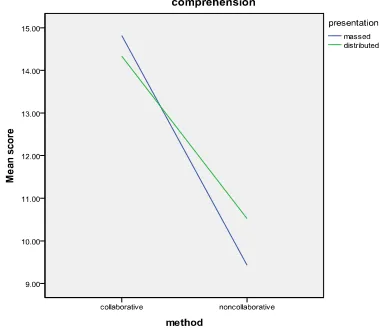
Table 4. Descriptive statistics for the ANOVA on lexical collocations
Method Presentation Mean Std. Deviation
N
Collaborative
massed 14.81 3.94 22 distributed 14.33 2.11 27 Total 14.55 3.04 49
Non-collaborative
massed 9.42 3.58 28 distributed 10.52 3.43 23
Total 9.92 3.52 51
Total
massed 11.80 4.58 50 distributed 12.58 3.36 50 Total 12.19 4.02 100
A glance at Table 4 shows that there are no substantial differences between massed and distributed presentation in collaborative and non-collaborative groups. However, it seems that the mean score of the participants in the collaborative teaching group is higher than that of the non-collaborative group. But this table also makes it clear that distributed presentation in non-collaborative group is noticeably better than the massed presentation. It also appears that massed presentation in collaborative group is more effective than distributed presentation. The graphic representation of the results (Graph 1) illustrates the differences among the groups more conspicuously.
In order to see whether or not the observed differences are statistically significant, the two-way ANOVA procedure was used, yielding the following results:
Table 5. Two–way ANOVA on the comprehension of collocations
Source Type III
Sum of Squares
df Mean Square
F Sig. Partial Eta Squared
Method 523.62 1 523.62 33.99 .108 .971
Presentation 2.28 1 2.28 .149 .766 .129
Method * presentation
15.40 1 15.40 1.408 .238 .014
As it can be seen in Table 5, since the F-value is not statically significant (sig = 0.108), method is not effective in the comprehension of lexical collocations. Neither does presentation affect the comprehension of collocation (sig= 0.766). Moreover, the interaction of method and presentation is not statistically significant (sig = 0.238).
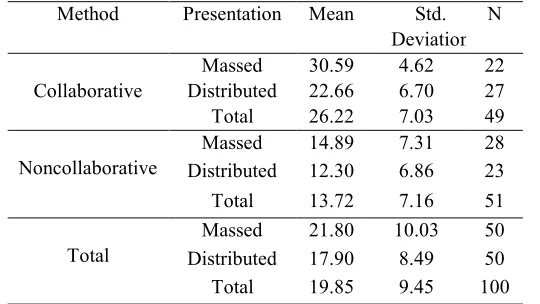
The aim of the second question was to investigate the effects of massed and distributed collaborative and non-collaborative presentation on second language learners’ production of collocations. To this end, another two-way ANOVA was used. Table 6 contains the descriptive statistics:
Table 6. Descriptive statistics for the production two-way ANOVA
Method Presentation Mean Std. Deviation
N
Collaborative
Massed 30.59 4.62 22 Distributed 22.66 6.70 27 Total 26.22 7.03 49 Noncollaborative
Massed 14.89 7.31 28 Distributed 12.30 6.86 23 Total 13.72 7.16 51
Total
Massed 21.80 10.03 50 Distributed 17.90 8.49 50 Total 19.85 9.45 100
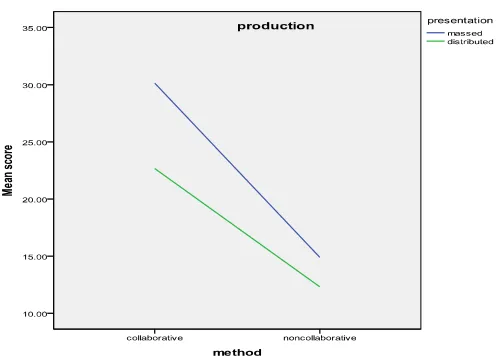
that massed presentation is better than distributed presentation. There are also differences in the mean scores of the participants of the massed and distributed presentation groups in collaborative and non-collaborative methods of teaching. The collaborative-massed group participants have the highest mean followed closely by collaborative-distributed, and the collaborative massed group. The participants of the non-collaborative distributed group have a noticeably lower mean. The graphic representation of the results (Graph 2) shows the differences among the groups more conspicuously.
Figure2: Learner's performance on the production test
The two-way ANOVA was utilized to see the extent to which the observed differences between the means were statistically significant. The results are presented in Table 7.
Table 7. Two-way ANOVA on the Learners' Production of Lexical Collocation
Source Type III Sum of Squares
df Mean
Square
F Sin. Partial Eta Squared
Method 4200.43 1 4200.43 23.85 .129 .960
Presentation 683.54 1 683.54 3.88 .299 .795 method
*presentation
176.08 1 176.08 4.12 .045 .041
is clear that the interaction effect of method and presentation of lexical collocations is statistically significant (sig. =.045). This means that teaching collocations using massed and distributed presentation differs in collaborative and non-collaborative methods of teaching. Table 7 shows that massed presentation is significantly more effective on the learners' production in the collaborative method. Additionally, partial eta squared indices indicate that method of teaching and type of presentation explain about 96% and 79% of the total variance, respectively.
The results of the present study differ in some ways from previous studies (Yeok- Hwa, 1998; Biesenbach-Lucas, 2004; Biström, 2005; Willis, 2007) which support the efficacy of collaborative method of teaching a second language in comparison with non-collaborative methods. The present study did not show any significant difference between collaborative and non-collaborative methods of teaching. However, there was a trend that collaborative method is better than the non-collaborative one. One of the possible reasons for the above difference may be partially attributable to the different linguistic backgrounds of the participants in this research in comparison with other studies. Another possible reason could be the differences in the culture of the participants in this study in comparison with other studies. It might be argued that the ability to work within a collaborative framework depends, at least to some extent, on the cultural context. It could further be argued that certain cultures may not particularly encourage cooperative learning, especially if the basic orientation is to foster competition among learners. Homogeneity of the participants can possibly be another reason for the observed dissimilarity between the findings of this study and those of other similar studies. Another factor might be the small sample size. A larger sample might have produced a different result.
There might be intuitive support for such a result. The nature of the collaborative-massed method requires that learners work in groups and share their ideas. Learners discuss the different collocates of a word. Each member may know some collocates of a word. Working together, they can make a list of collocations for that word. So, learners can learn the details of collocations better than learners who work in the non-collaborative distributed groups.
8. Conclusion
Based on the results reported above, it can be concluded that there are no substantial differences between massed and distributed presentation in collaborative and non-collaborative groups. However, it seems that generally, collaborative teaching is more effective than non-collaborative teaching. Nonetheless, massed and distributed presentations have no significant effect on the comprehension of collocations. Furthermore, there is no interaction between method and presentation in the comprehension of collocations. On the other hand, based on the obtained results, it can be concluded that although neither type of presentation nor method of teaching has any significant effect on collocational productivity, the interaction effect of method and presentation of lexical collocations is statistically significant in the production of collocations.
References
Altinay, L. & Paraskevas, A. (2007). A computer-supported collaborative
learning (CSCL) approach in teaching research methods. Science
Journal, 26, 623–644.
Biström, J. (2005). Peer-to-peer networks as collaborative learning environments. Johnny Helsinki University of Technology. Retrieved April 23, 2010, from http://www.tml.tkk.fi/Publications/C/18/Biström.pdf Biesenbach-Lucas, S. (2004). Asynchronous web discussions in teacher
training courses: Promoting Collaborative Learning or not? AACE
Journal, 12(2), 155-170.
Celce-Murcia, M. (2001). Teaching English as a second or foreign
language. (3th Ed.) USA: Dewey publishing services.
Durrant, P. (2008). High frequency collocations and second language learning. Retrieved April 5, 2010, from http://etheses.nottingham.ac.uk/622/1/ final_ thesis.pdf
Ghaith, G. (2001). Learners' perceptions of their stand cooperative
experience. Elsevier Journal, 29, 289-301.
Gokhale, A. A. (1995). Collaborative learning enhances critical thinking.
Journal of Technology Education, 7(1), 22-30.
Higuchi, M. (1999). Collocational problems in EFL learning. Retrived September 5, 2009 from http://bambi.u-shizuoka-ken.ac.jp
Hovland, C.I. (1939). Experimental studies in rote-learning theory. V. Comparison of distribution of practice in serial and paired-associate
learning.Journal of experimental psychology, 6(25), 622-633.
Hsu, J. M. (2007). Lexical collocations and their relation to the online
writing of Taiwanese college English majors and non-English majors.
Electronic journal offoreign language teaching, 4,192-209.
Jing, M. (2008). Erroneous collocations caused by language transfer in
Chinese EFLwriting.US-China Foreign Language journal, 9, 57-61.
Jukneviciene, R. (2008). Collocations with High-Frequency Verbs in Learner English: Lithuanian Learners versus Native Speakers.
Kalbotyra, 59(3), 119-127.
Koosha, M. & Jafarpour, A. (2006). Data-driven learning and teaching
collocation of prepositions: The Case of Iranian EFL Adult Learners.
Asian EFL Journal, 8,192-209.
McCrostie, J. (2007). Examining learner vocabulary notebooks. ELT journal,3, 246- 254.
MartyNska, M. (2004). Do English language learners know collocations?
Investigationes linguisticae journal, 5, 60-371.
Murray, S. R. & Udermann, B. E. (2003). Massed versus distributed
practice: which is better? Cahperd Journal, 1, 19-22.
Nesselhauf, N. ( 2003 ).The Use of collocations by advanced learners of
English and some implications for teaching. Applied linguistics, 24(2),
223-242.
Petrovic, S. &, Snajder, J. & Basic, B. D. (2009). Extending lexical
association measures for collocation extraction .Elsevier journal, 24,
383–394.
Rohrer, D. & Taylor, K. (2006). The effects of over learning and distributed
practice on the retention of mathematics knowledge. Applied cognitive
psychology journal, 20, 1209–1224.
Shin, D. (2007). What collocations would be unpredictable for Korean EFL
learners?Korean journal of applied linguistics, 23, 83-98.
Underwood, B. J. (1961). Ten years of massed practice on distributed
practice. Journal of Psychological Review, 4, 229-247.
Willis, J. (2007). Cooperative learning is a brain turn-on. Middle school
journal. Retrieved April 20, 2010, from http://www.eric.ed.gov/ERICWebPortal/search/ detailmini.jsp
Walsh, M. (2005). Collocation and the Learner of English. Retrieved April 25, 2010, from: http://www.cels.bham.ac.uk/resources/essays/Walsh Lexis.pdf
Yeok-Hwa, k. (1998). Enhancing student thinking through collaborative
learning. ERIC Digest. Retrieved November 15, 2009, from
http://clte.asu.edu/active/ tipsforclimset.pdf
Zarei, A. (2002). What is wrong with collocations? An Investigation of the Iranian Advanced Learners' Problems with English Collocations.
Journal of Humanitis of University of Sistan and Balouchestan, 7(18), 240-280.
Zinkgräf, M. (2008). V+N miscollocations in the written production of
university level students. ELIA, 8, 91-116.
Zengin, B. (2009). Benefit of Google search engine in learning and teaching
collocations. Egitim Arastirmalari-Eurasian Journal of Educational