
RESEARCH
Trichoderma reesei
complete genome
sequence, repeat-induced point mutation,
and partitioning of CAZyme gene clusters
Wan‑Chen Li
1,2,3†, Chien‑Hao Huang
3,4†, Chia‑Ling Chen
3, Yu‑Chien Chuang
3, Shu‑Yun Tung
3and Ting‑Fang Wang
1,3*Abstract
Background: Trichoderma reesei (Ascomycota, Pezizomycotina) QM6a is a model fungus for a broad spectrum of physiological phenomena, including plant cell wall degradation, industrial production of enzymes, light responses, conidiation, sexual development, polyketide biosynthesis, and plant–fungal interactions. The genomes of QM6a and its high enzyme‑producing mutants have been sequenced by second‑generation‑sequencing methods and are pub‑ licly available from the Joint Genome Institute. While these genome sequences have offered useful information for genomic and transcriptomic studies, their limitations and especially their short read lengths make them poorly suited for some particular biological problems, including assembly, genome‑wide determination of chromosome architec‑ ture, and genetic modification or engineering.
Results: We integrated Pacific Biosciences and Illumina sequencing platforms for the highest‑quality genome assem‑ bly yet achieved, revealing seven telomere‑to‑telomere chromosomes (34,922,528 bp; 10877 genes) with 1630 newly predicted genes and >1.5 Mb of new sequences. Most new sequences are located on AT‑rich blocks, including 7 centromeres, 14 subtelomeres, and 2329 interspersed AT‑rich blocks. The seven QM6a centromeres separately consist of 24 conserved repeats and 37 putative centromere‑encoded genes. These findings open up a new perspective for future centromere and chromosome architecture studies. Next, we demonstrate that sexual crossing readily induced cytosine‑to‑thymine point mutations on both tandem and unlinked duplicated sequences. We also show by bioin‑ formatic analysis that T. reesei has evolved a robust repeat‑induced point mutation (RIP) system to accumulate AT‑rich sequences, with longer AT‑rich blocks having more RIP mutations. The widespread distribution of AT‑rich blocks correlates genome‑wide partitions with gene clusters, explaining why clustering of genes has been reported to not influence gene expression in T. reesei.
Conclusion: Compartmentation of ancestral gene clusters by AT‑rich blocks might promote flexibilities that are evo‑ lutionarily advantageous in this fungus’ soil habitats and other natural environments. Our analyses, together with the complete genome sequence, provide a better blueprint for biotechnological and industrial applications.
Keywords: Trichoderma reesei, Complete genome sequence, Repeat‑induced point mutation, AT‑rich block, Centromere, Centromere‑encoded gene, CAZyme gene cluster
© The Author(s) 2017. This article is distributed under the terms of the Creative Commons Attribution 4.0 International License
(http://creativecommons.org/licenses/by/4.0/), which permits unrestricted use, distribution, and reproduction in any medium,
provided you give appropriate credit to the original author(s) and the source, provide a link to the Creative Commons license, and indicate if changes were made. The Creative Commons Public Domain Dedication waiver (http://creativecommons.org/
publicdomain/zero/1.0/) applies to the data made available in this article, unless otherwise stated.
Background
Trichoderma is a fungal genus found in many different natural habitats including—among others—mushroom
caps, rotting wood, and soil. Trichoderma reesei (syn. Hypocrea jecorina) is a widely used model organism for plant cell wall degradation and industrial enzyme production. The natural strain QM6a (ATCC13631) was first isolated from the Solomon Islands during the Second World War [1]. High enzyme producers (e.g., QM9414 and RUT-C30) were artificially generated from
Open Access
*Correspondence: [email protected]
QM6a for industrial applications over the last 70 years [2–6].
Trichoderma reesei undergoes a heterothallic repro-ductive cycle and generates fruiting bodies (stromata) containing linear asci with 16 ascospores [7]. These 16 ascospores are generated via meiosis and two rounds of postmeiotic mitosis [8]. When placed under favora-ble conditions, ascospores germinate to form vegetative mycelia and produce asexual spores (i.e., conidia). Sex-ual development of the T. reesei CBS999.97 wild-isolate strain produced two haploid strains, CBS999.97(MAT1-1, F/X) and CBS999.97(MAT1-2, M/33). The two ances-tral scaffolds (M and 33) in CBS999.97(MAT1-2, M/33) underwent an unequal translocation to form two new scaffolds (F and X) in CBS999.97(MAT1-1, F/X) [8]. Like CBS999.97(MAT1-2, M/33), QM6a has a MAT1-2 mating-type locus and two ancestral scaffolds M and 33. Due to chromosome heterozygosity and meiotic recom-bination, sexual crossing of CBS999.97(MAT1-1, F/X) with CBS999.97(MAT1-2, M/33) or QM6a often (>90%) generates segmentally aneuploid (SAN) progeny [8]. The CBS999.97 wild-isolate strain is also an excellent fungal model for light responses since light variation greatly affects its sexual development and conidiation [7, 9, 10]. Constant light promotes conidiation and completely inhibits stromata formation, whereas total darkness causes a slowdown of the growth of stromata [10].
The genomes of several Trichoderma species have been sequenced and are publicly available from the Joint Genome Institute (JGI) of the US Department of Energy. The QM6a-v2.0 draft genome (33.4 Mb) contains 87 scaffolds and 9129 predicted genes [11]. The RUT-C30-v1.0 draft genome (32.7 Mb) has 182 scaffolds and 9852 predicted genes [12]. The genomes of Trichoderma atroviride and Trichoderma virens were thought to be larger than QM6a-v2.0, with sizes of 36.1 and 38.8 Mb, respectively, versus 34.1 Mb for QM6a, both encoding more than 2000 additional predicted genes [4, 13]. These genomes have been used to identify key genes involved in some important biological processes [4, 13–15], e.g., the transcriptional factors and transporters that con-trol induction and expression of carbohydrate-active enzymes (CAZymes) and the plant cell wall degradation enzymes. Using QM6a as a reference, it has also been reported that QM9414 and RUT-C30 might carry mul-tiple alternations, including rearrangements, point muta-tions, insermuta-tions, and deletions [12, 16]. Recently, a group of Trichoderma researchers have collectively annotated and compared ~30% genes in the JGI genomes of T. ree-sei, T. atroviride, and T. virens [4].
To reveal gene order and dynamic gene expression at the chromosome level, a genome-wide chromosome conformation capture method (referred herein as “HiC”)
had been applied to close the gaps between the QM6a-v2.0 scaffolds. The HiC draft genome revealed seven superscaffolds and four short contigs [17]. Druzhinina et al. [18] then applied the QM6a-HiC draft to annotate 9151 (not 9194) predicted genes. A third of the putative CAZyme genes occurred in loose clusters that also con-tained a high number of genes encoding small-secreted cysteine-rich proteins (SSCPs). Five CAZyme gene clus-ters are located close to chromosomal ends. These sub-telomeric areas are also enriched in genes involved in conidiation, iron scavenging, and interactions with other fungi, such as secreted protease genes, amino acid trans-porter genes, gene clusters for polyketide synthases (PKS), non-ribosomal peptide synthase (NRPS), and PKS–NRPS fusion proteins. The QM6a-HiC annotation (http://trichocode.com/index.php/t-reesei) became pub-licly available in January, 2017 and the expectation values (E) for the BLAST sequence alignments are not available, but claimed to be at least <e−75 [18].
Strictly speaking, the HiC draft genome is far from equivalent to a complete genome sequence. We noticed that both the QM6a-v2.0 and QM6a-HiC drafts lack several evolutionarily conserved genes that are ubiqui-tously expressed in almost all studied eukaryotic organ-isms, including the recA family protein Rad51 and the DNA repair protein Rad50. Therefore, we applied both second- and third-generation sequencing (SGS and TGS) platforms to resequence the QM6a genome. The single molecule real-time (SMRT) sequencing method developed by Pacific BioSciences (PacBio) offers much longer reads of up to 60 kb [19]. After error correction with short and high-quality Illumina MiSeq sequencing reads, the PacBio long reads were assembled into seven telomere-to-telomere chromosomes. Our high-quality genome sequence provides a large quantity of new infor-mation to facilitate functional and comparative studies of this industrially important workhorse fungus.
Results
Resequencing the QM6a genome
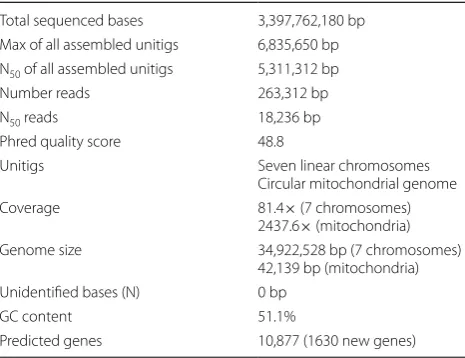
For error correction, the Illumina MiSeq 300 bp paired-end reads (6.8 Gb) were collected and trimmed. Reads (67.85%) with a quality score threshold (Q) greater than 30 were retained (Additional file 1: Tables A2, A3). The final assembly data contain a circular mitochondrial genome (42,139 bp) and seven unitigs (34,922,528 bp) (Additional file 1: Table A3). We highlight that there were no sequence ambiguities or unidentified bases (Ns) (Table 1). In contrast, the QM6a-v2.0 draft genome was 33,453,791 bp and had 48,252 Ns, whereas the HiC draft was 33,395,328 bp and had 42,879 Ns.
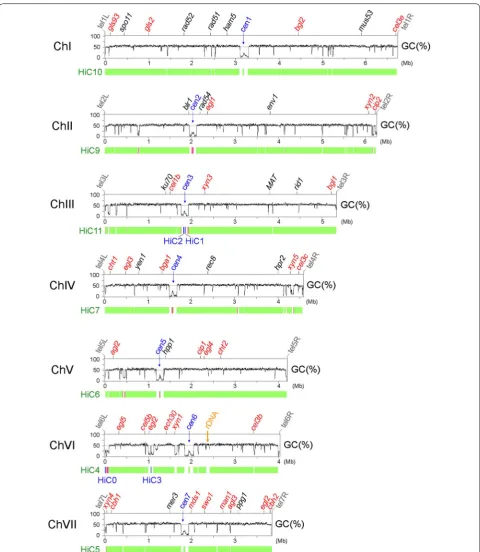
The seven superscaffolds closely match (if not being completely identical to) the full-length chromosomes because all of their termini capture typical telomeric sequences (i.e., TTAGGG at 3′-termini and the reverse complement CCCTAA at 5′-termini) [11] with up to 14 repeats (Additional file 1: Table A3). We categorized these telomere-to-telomere chromosomes with Roman numerals (ChI–ChVII), from largest to smallest. Geneti-cally defined linkage groups were designated alphabeti-cally (A–G), and linkage group arms are designated L for the short (left) arm at 5′ termini and R for the long (right) arm at 3′ termini (Fig. 1). The complete QM6a genome sequences have been submitted to NCBI (Accession Number CP016232–CP016238).
The complete QM6a genome compared to two earlier draft genomes
By mapping the MiSeq reads to the QM6a-v2.0 draft, we found that ten scaffolds in the QM6a-v2.0 draft were not genuine T. reesei sequences (Additional file 1: Tables A5). For this reason, 16 previously annotated genes (Additional file 1: Tables A6) in v2.0 and QM6a-HiC might not be authentic QM6a genes. In addition, there were numerous sequencing and assembly errors
in QM6a-v2.0. The most prominent assembly error was the first and longest scaffold, wherein the 5′ por-tion (~2.46 Mb) was mapped to ChV and the 3′ portion (~1.79 Mb) to ChIV (Additional file 1: Table A7).
Our complete QM6a genome sequence also covers all seven superscaffolds and the four short contigs of QM6a-HiC [17]. QM6a-HiC contains a large quantity of sequence and/or assembly errors, particularly those sequences (e.g., telomeric repeats) close to both termini of the seven superscaffolds. The four short HiC contigs are all located at chromosome regions with low guanine (G)–cytosine (C) contents. HiC0 is located close to tel6L (the left telomere of ChVI), HiC1 and HiC2 at cen3 (the centromere of ChIII), and HiC3 in an interspersed AT-rich block on the right arm of ChVI. There were at least 18 inversion errors in the HiC draft genome (Fig. 1; Addi-tional file 1: Table A8). Eight of these inversion errors could account for the failure to connect these four short contigs to the corresponding superscaffolds during the HiC experiments [17].
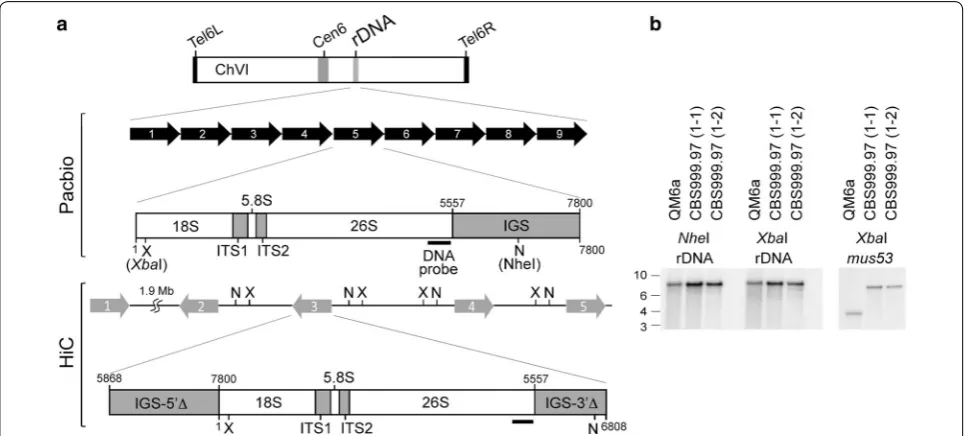
The HiC experiments also resulted in incorrect assem-bly at the rDNA locus. Using Southern hybridization, we confirmed that the right arm of ChVI harbors the large rDNA locus with nine tandem “head-to-tail” repeats. Each repeat contains an 18S-5.8S-26S rRNA gene clus-ter and a non-transcribed inclus-tergenic spacer (IGS) (Fig. 2; Additional file 1: Table A9). This result approaches the theoretical limit for mapping results using Illumina MiSeq short reads, i.e., 200–260× coverage at the rDNA locus versus 25–30× coverage along the entire chromo-some (Fig. 3). It is worth noting that there are 175–200 copies of the large rDNA tandem repeats in Neurospora crassa [22].
Thus, the complete QM6a genome sequence has uncovered many sequencing and assembly errors in QM6a-v2.0 and QM6a-HiC. We suggest that caution should be exercised in applying HiC or the chromo-some conformation capture method for gap-closing draft genome sequences produced by SGS technology and for other genomic analyses involved in AT-rich and repeti-tive sequences.
QM6a compared to high enzyme producers
The high-quality QM6a genome sequence we provide here is a better scaffold to order and orient contigs of other Trichoderma draft genomes previously generated by SGS technologies. It has been reported that there might be five or eleven potential translocations in RUT-C30 [12, 16]. A BLAST search revealed that there are only three promising translocations in RUT-C30: ChV to ChII (the first scaffold of RUT-C30), ChIII to ChI (the second scaffold of RUT-C30), and ChIII to ChIV (the fifth scaffold of RUT-C30). Theoretically, these three
Table 1 Summary of the QM6a genome sequencing and assembly results
Total sequenced bases 3,397,762,180 bp Max of all assembled unitigs 6,835,650 bp N50 of all assembled unitigs 5,311,312 bp Number reads 263,312 bp
N50 reads 18,236 bp
Phred quality score 48.8
Unitigs Seven linear chromosomes Circular mitochondrial genome Coverage 81.4× (7 chromosomes)
2437.6× (mitochondria) Genome size 34,922,528 bp (7 chromosomes)
42,139 bp (mitochondria) Unidentified bases (N) 0 bp
GC content 51.1%
translocations in RUT-C30, together with the one trans-location we identified in CBS999.97(MAT1-1, F/X), are sufficient to account for the large quantity of invi-able SAN ascospores generated from sexually crossing
RUT-C30 with CBS999.97(MAT1-1, F/X) [8, 23]. There are also three short ectopic insertions in RUT-C30 including the second scaffold (34 bp), the fifth scaffold (231 bp), and the ninth scaffold (2655 bp) (Additional
Fig. 2 The rDNA locus. a Organization of the rDNA locus. The top panel illustrates the nine tandem “head‑to‑tail” repeats revealed by the PacBio RSII platform. Each repeat contains an 18S‑5.8S‑26S rRNA gene cluster and a full‑length non‑transcribed intergenic spacer (IGS). The bottom panel shows the five repeats in the HiC draft genome. Each repeat has an 18S‑5.8S‑26S rRNA gene cluster and two truncated IGSs (IGS‑5′Δ and IGS‑3′Δ). The locations of restriction enzymes XbaI (X) and NheI (N) are indicted. b Southern hybridization. Genomic DNA (1 μg) was isolated from three different wild‑isolate strains: QM6a, CBS999.97(1‑1) and CBS999.97(1‑2). After digestion with XbaI (X) or NheI (N), the genomic DNA was subjected to agarose gel electrophoresis, Southern blotting, and hybridization with a 28S rDNA probe (a) or a mus53 probe (as the DNA loading control). The mus53 gene encodes the DNA ligase IV protein, and there is only one copy of the mus53 gene in the Trichoderma reesei genome [78]
file 1: Table A10). These three ectopic insertions are more likely due to sequence duplication or assembly errors.
Genome reannotation
We applied four different approaches to genome rean-notation (“Methods”), including the use of all (28,748)
T. reesei proteins from National Center for Biotechnol-ogy Information (NCBI), QM6a-v2.0, RUT-C30-v1.0, and two publicly available transcriptome datasets [24, 25]. We annotated 1630 newly predicted QM6a genes, including 70 tRNA genes and 23 5S-rDNA genes (Addi-tional file 2: Tables B1, B2). The average length of all 10,876 QM6a genes is 1579 bp. Their average GC con-tent (56.5%) is ~5.5% higher than that of the entire QM6a genome. Among 1515 new protein-encoding genes, 679 have been annotated in RUT-C30-v1.0. Most of them encode novel or hypothetical proteins, and only 120 and 285 newly predicted genes encode protein products that have homologs in Saccharomyces cerevisiae and
N. crassa, respectively. It is worth noting that we anno-tated several essential or biologically important genes, including six DNA repair genes (rad50, sae2/com1,
rad51, rad57, srs2, rrm3, and pif1), an essential compo-nent of sister chromatin cohesion complex (smc1), a key autophagy gene (atg11), two cell division cycle genes (cdc4 and cdc15), and two mitochondrial genes (sod2
and tom7) (Additional file 1: Table A11, Additional file 2: Tables B2, B3). These evolutionarily conserved genes had never been annotated in QM6a-v2.0 or QM6a-HiC [4, 11, 18]. Since our annotation results are compared well with those annotated recently by Schmoll et al. [4] and Druzhinina [18] (Additional file 2), the complete genome sequence and set of genes we provide here can serve as a better guide for further experiments, especially for global approaches to evolution, biological functions, and indus-trial applications.
We categorized all QM6a genes with a non-italicized uppercase letter, a number, and a letter: Tr (for T. reesei); A, B to G (for chromosome I, II through VII); a number corresponding to the order of the transcripts (count-ing from the left telomere); and W or C to designate the Watson or Crick strand (the Watson strand is 5′→3′ left telomere-to-right telomere); for example, the 100th gene from the left telomere of chromosome I is TrA0100C. For previously annotated QM6a and RUT-C30 genes [11, 12], their JGI’s gene identity number and standard names are also provided along with the systematic names (Addi-tional file 2).
Comparative transcriptome analysis
Next, we applied TopHat—a bioinformatic sequence analysis package tool—to map and count the SGS reads of all annotated genes and then to determine the values
of transcripts per kilobase million (TPM) [26]. Compared to reads per kilobase million (RPKM) and fragments per kilobase million (FPKM), TPM is a stable and reli-able RNA-seq expression unit across experiments [27]. All reads mapped to the rRNA and tRNA genes were excluded before calculating TPMs (Additional file 2: Table B1).
Our results confirmed those reported by [24] that 35 CAZyme genes and 27 non-CAZyme genes were highly induced (≥20-fold) by straw substrate in QM6a (Addi-tional file 3: Table C1). In addition, straw also upregu-lated (≥20-fold) 210 previously annotated genes in QM6a-v2.0, including xylanase regulator 1 (xyr1; ≥ 100-fold), 38 CAZyme genes, 1 NRPS gene, the mating-type gene mat1-2-1 [7], and hybrid-type peptide pheromone precursor 1 (hpp1) [28] (Additional file 3: Table C2). Many straw-induced genes in QM6a [24] were shown to be differentially regulated in response to cellulose and sophorose in QM9414 [25] (Additional file 3: Tables C1, C2).
Among the 1535 new protein-encoding genes, there are 39 straw-induced (≥20-fold) genes in QM6a and 2 cellulose-induced genes (≥20-fold) in QM9414 (Addi-tional file 3: Table C3). One hundred and forty-four new QM6a genes are also significantly upregulated (5- to 20-fold) by straw (Additional file 3: Table C4). For exam-ple, TrC1345C, a new straw-induced gene, encodes the homolog of S. cerevisiae Cat8 zinc-cluster transcription factor. Cat8 is involved in gluconeogenesis, the glyoxylate cycle, and ethanol utilization, and it is necessary for dere-pression of a variety of genes under non-fermentative growth conditions (e.g., diauxic shift and sporulation) [29]. Further research on this transcriptional factor might help to enhance cellulolytic enzyme production. We also identified nine new genes with TPM values in QM6a that are much higher than those in QM9414 (Additional file 3: Table C5). These genes are likely mutated or even deleted in QM9414.
Wide distribution of AT‑rich blocks along seven QM6a chromosomes
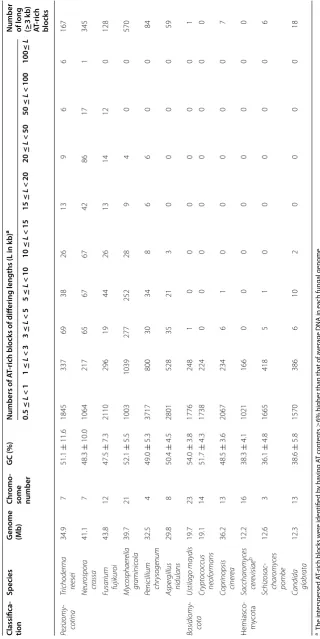
To establish the link between DNA sequence and chro-matin architecture, the local GC contents along each chromosome were calculated using a 0.5 kb sliding win-dow. We identified 2349 AT-rich chromosome blocks with GC contents ≥12 and ≥6% lower than the average GC content of the all predicted genes (56.5%) and the entire QM6a genome (51.1%), respectively (Table 2).
The most prominent or longest AT-rich blocks in each chromosome are the centromeres, ranging from 162.5 kb (cen2) to 208.5 kb (cen6) (Fig. 4 and Additional file 3: Table A2). The longest AT-rich blocks in each N. crassa
Table
2
Siz
e distribution of A
T-rich blo cks in diff er en t w ell-sequenc
ed fungal genomes
a T
he in
terspersed A
T-r
ich blocks w
er e iden tified b y ha ving A T c on ten ts ≥
6% higher than tha
t of a
ver
age DNA in each fungal genome
b I
n Sac char om yc es c er evisiae , A T-r
ich blocks (almost all
≤ 3 k b) ar e k no wn t
o be w
ell c
or
rela
ted with the in
ter
genic r
eg
ions tha
t bind t
o the sist
er chr oma tin c ohesion c omple xes . T her e ar
e no or only a f
ew longer A
T-r
ich
blocks (
≥
3 k
b) in the genomes of
Sac char om yc es c er evisiae , Schiz osac char om yc es p omb e , Candida glabr ata , Ustilago may dis , Cr ypt oc oc cus neoformans , and Coprinopsis ciner ea Classifica ‑ tion Species G
enome (Mb)
Chr
omo
‑
some number
GC (%)
Numbers of A
T‑
rich blocks of diff
ering lengths (L in k
b)
a
Number of long (≥3 k
b) AT ‑rich blocks 0.5 ≤ L < 1 1 ≤ L < 3 3 ≤ L < 5 5 ≤ L < 10 10 ≤ L < 15 15 ≤ L < 20 20 ≤ L < 50 50 ≤ L < 100 100 ≤ L Peziz omy -cotina
Trichoderma reesei
34.9 7 51.1 ± 11.6 1845 337 69 38 26 13 9 6 6 167 Neur ospor a cr assa 41.1 7 48.3 ± 10.0 1064 217 65 67 67 42 86 17 1 345
Fusarium fujik
ur oi 43.8 12 47.5 ± 7.3 2110 296 19 44 26 13 14 12 0 128 M yc osphaer ella gr aminic ola 39.7 21 52.1 ± 5.5 1003 1039 277 252 28 9 4 0 0 570
Penicillium chr
ysogenum 32.5 4 49.0 ± 5.3 3717 800 30 34 8 6 6 0 0 84 Asper gillus nidulans 29.8 8 50.4 ± 4.5 2801 528 35 21 3 0 0 0 0 59 Basidiomy -cota Ustilago may dis 19.7 23 54.0 ± 3.8 1776 248 1 0 0 0 0 0 0 1 Cr yptoc oc cus neoformans 19.1 14 51.7 ± 4.3 1738 224 0 0 0 0 0 0 0 0
Coprinopsis ciner
ea 36.2 13 48.5 ± 3.6 2067 234 6 1 0 0 0 0 0 7 Hemiasco ‑ m ycota Sac char omy ces cer evisiae b 12.2 16 38.3 ± 4.1 1021 166 0 0 0 0 0 0 0 0 Schiz osac -char omy ces pombe 12.6 3 36.1 ± 4.8 1665 418 5 1 0 0 0 0 0 6
Candida glabr
revealed that the seven QM6a centromeres collectively harbored 24 conserved sequences (≥90% identity; maxi-mum length 8625 bp and minimaxi-mum length 4847 bp) with a copy number per chromosome ranging from one to five (Additional file 4). These conserved sequences are cen-tromere-specific and highly AT-rich, perhaps represent-ing centromeric repeats.
The seven QM6a centromeres also separately encode 13 previously annotated genes and 24 newly predicted genes (Additional file 3: Table C6). Centromere-encoded transcripts are known to be integral components of the genomes of mammals, higher plants, and the fission yeast Schizosaccharomyces pombe [31–34]. Copy num-bers of these 37 centromere-encoded transcripts were relatively low; their expression (TPM > 0) could only be
detected in QM9414, but not in QM6a (Additional file 3: Table C6). The QM9414 transcriptomic data from the Illumina HiSeq 2000 platform [25] apparently had bet-ter sequencing depth than the QM6a transcriptomic data from the SOLiD platform [24]. It will be of importance to investigate whether these 24 centromeric repeats and 37 centromere-encoded genes are involved in centromere integrity and chromosome segregation fidelity in T. reesei.
The AT-rich chromosomal blocks next to the 14 tel-omeres are subteltel-omeres, with the shortest being ~1 kb and the longest up to 87 kb (Additional file 1: Table A3). Other than centromeres and subtelomeres, there are 2328 interspersed AT-rich blocks (Table 2). On aver-age, there are only five genes between two neighboring
interspersed AT-rich blocks. The biological relevance of these interspersed AT-rich blocks remains to be eluci-dated (see below). It is worth noting that both the 5′ and 3′ flanking sequences of the rDNA locus contain a 2 kb AT-rich block (Fig. 3). We postulate that these two AT-rich blocks might be involved in regulating nucleolar organization, rRNA transcription, rDNA copy homeo-stasis, and prevention of repeat-induced point mutation (RIP) (see below).
Comparative genomic analyses of chromosome architectures
Next, we compared the QM6a genome with 11 pub-licly available and well-assembled fungal genomes for their AT-rich blocks. We highlight that all these fungal genomes contain ≤0.11% unresolved or unknown bases (Ns) (Additional file 1: Table A12). Unresolved bases jeopardize the integrity of in silico genomic analysis.
All of these 12 fungal genomes have many short AT-rich blocks with lengths of 0.5–3 kb (Table 2). In S. cer-evisiae, these short AT-rich blocks correlate with the convergent intergenic regions and the pericentromeres that associate with cohesin (an evolutionarily conserved protein complex that functions to hold a pair of sister chromatids during mitosis and meiosis). The average dis-tance between neighboring cohesin-binding sites along yeast chromosome arms is 10–15 kb, which is compatible with the observed localized oscillations in base composi-tion [35–37]. It has been suggested that sister chromatid connections via cohesin complexes occur preferentially at the chromosome axes, the bases of intrachromosomal loops, or topologically associated domains (TADs) [35, 38–40]. Expression of genes within TADs is somewhat correlated [41–45]. Intriguingly, the average distance between the neighboring AT-rich blocks along QM6a chromosomal arms is ~13 kb. We suggest that these AT-rich blocks might be functionally associated with chro-mosomal loading of cohesin in T. reesei.
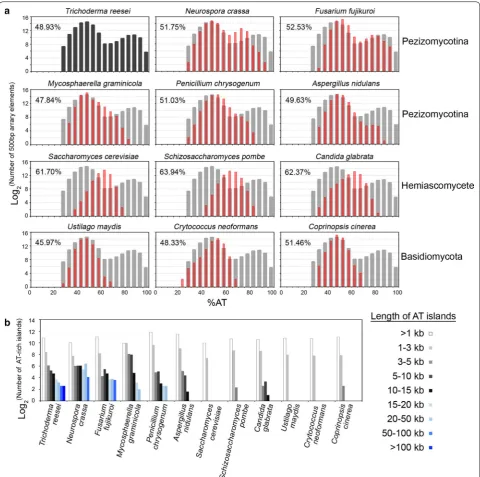
We were able to categorize these 12 fungal genomes into three different groups according to (1) the average AT content, (2) the genome-wide distribution of local AT content, and (3) the number of long (≥3 kb) AT-rich blocks. For example, in the QM6a genome, there were 167 AT-rich blocks of length ≥3 kb (Table 2; Fig. 6).
The Group I fungi consist of six filamentous asco-mycetes (Pezizomycotina), including QM6a, N. crassa
(OR74A), Penicillium chrysogenum (P2niaD18),
Mycosphaerella graminicola (IPO323), Fusarium fujik-uroi (IMI 58289), and Aspergillus nidulans (FGSC A4). Their genomes not only have similar average AT contents (~50%) but also display biphasic local AT content distri-butions due to the presence of many longer (≥3 kb) AT-rich blocks (Table 2; Fig. 6a, top two panels). In N. crassa,
AT-rich blocks are DIM-3 (importin α)-dependent con-stitutive heterochromatins with transposon relicts and trimethylated histone 3 at lysine 9 (H3K9me3). Genome organization in N. crassa nuclei is largely defined by con-stitutive heterochromatins via strong intra- and inter-chromosomal contacts [46, 47].
Group II are three basidiomycetes, i.e., Ustilago maydis
(521), Coprinopsis cinerea (Okayama 7#130), and Cryp-tococcus neoformans (JEC21). Their average AT contents are ~50%, similar to those of Group I fungal genomes (Table 2). The Group II fungal genomes display relatively normal local AT content distribution (Fig. 5a, the low-est panel) due to the absence of longer AT-rich blocks (Fig. 5b).
Group III are three hemiascomycete yeasts, S. cerevi-siae (S288C), S. pombe (972h-), and Candida glabrata (CBS138). Their average AT contents (62–64%) are 12–14% higher than those of Group I and Group II fungi (Table 2). These three yeast genomes also display a rela-tively normal distribution of AT local content (Fig. 5a, the second lowest panel) and have no or very few longer AT-rich blocks (Fig. 5b).
Repeat‑induced point mutation (RIP) is identified
in Trichoderma reesei
The high number of long AT-rich blocks in the Group I fungal genomes might be correlated with RIP: a phe-nomenon originally discovered in N. crassa at a premei-otic stage during sexual development [46]. The process of RIP requires a specialized cytosine methyltransferase gene rid-1 (RIP-defective) and induces cytosine-to-thy-mine (C-to-T) point mutations in a homology-dependent manner [48, 49]. Several previous studies found no evi-dence of RIP in any of the Group II or Group III fungi we investigated here [50–52]. RIP has been documented in P. chrysogenum [53], F. fujikuroi [54], M. graminicola [55], and A. nidulans [56], but it has never been experimen-tally demonstrated in any Trichoderma species [18, 57]. Intriguingly, the QM6a complete genome encodes almost all proteins known to be involved in RIP and DNA meth-ylation in N. crassa, including rid1 (TrC1298W/37515)
[57], dim2 (TrB0908W/34985; DNA
methyltrans-ferase), dim3 (TrE0517W/73508; importin α), dim5 (TrB0159C/111216; H3K9 methyltransferase) [13], dim7 (TrD0784W/74397), dim8 (TrG0915W/56582), dim9 (TrC0267C/108263), and hpo (TrB1406W/109088; HP1) (Additional file 2: Tables B1, B2).
[58, 59]. Higher values of TpA/ApT and lower values of [(CpA+TpG)/(ApC+GpT)] indicate stronger RIP responses [60, 61]. We found that the hierarchy for RIP in QM6a is the mating-type gene MAT1-2-1 < all predicted genes < the whole QM6a genome < the large rDNA tandem repeats (18S-5.8S-26S) < 5S rDNAs. It
has been reported that the large rDNA tandem repeats and the 5S rDNAs in N. crassa survived RIPs due to either nucleolar sequestration [62] or their smaller size [60], respectively. The RIP indices of the mating gene (MAT1-2-1 or MFa), all predicted genes, and the whole genome suggest that the RIP responses in QM6a are
as robust as those in N. crassa (Additional file 1: Table A13). Thus, we suggest that T. reesei has evolved an RIP system similar to that of N. crassa. Our results also reveal that the longer the AT-rich blocks, the greater the extent of RIP mutations in QM6a (Additional file 1: Table A13), consistent with RIP mutations accumulat-ing in AT-rich sequences.
Next, we carried out sexual crossing tests between four parental (F0) strains, including wild-type CBS999.97 [7],
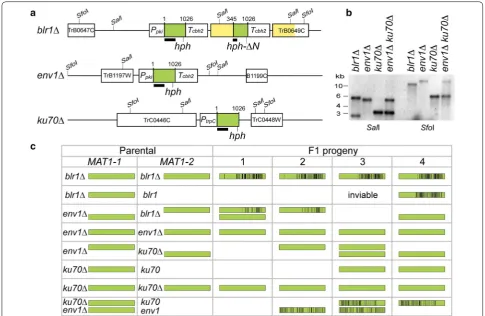
blr1Δ, env1Δ [9, 10], and ku70Δ [63], and then tested their F1 progeny for mutations in the full-length hygro-mycin-resistant (hph) genes present in the selection marker construct used for deletion of the corresponding
T. reesei genes [10]. All progeny were isolated using the hexadecad dissection technique [8]. No hph sequence is
present in the wild-type CBS999.97 F0 strains, whereas
env1Δ and ku70Δ each carries one copy of full-length
hph. In contrast, the blr1Δ mutant contains two tandem head-to-tail hph sequences resulting in repeats: one is a full-length hph and the other an N-terminal truncated
hph-ΔN (Fig. 6a). All of the hph and hph-ΔN alleles in the corresponding parental strains were confirmed first by genomic PCR and Sanger sequencing (see Additional file 5 for their nucleotide sequences) and then by South-ern hybridization (Fig. 6b).
After sexual crossing (n = 10), the F1 progeny dis-played numerous C-to-T point mutations in all cases where two similar sequences were present in one mat-ing partner before crossmat-ing, i.e., in progeny of blr1Δ
(hph and hph-ΔN), but not in progeny of ku70Δ or env1Δ Fig. 6 RIP in Trichoderma reesei. a Schematic diagram of the gene deletion cassettes in the three mutants. Each cassette consists of three com‑ ponents: the dominant hygromycin B‑resistant marker open reading frame (hph; green box), flanked by an upstream promoter (Ppki or PtrpC), and/
or a downstream terminator (Tcbh2). The full‑length hph gene has 1026 bps. A truncated hph-ΔN304‑1026‑Tcbh2 cassette was spontaneously gener‑
ated in blr1Δ during transformation. The dark line underneath hph represents the DNA probe used for Southern hybridization. The upstream and downstream neighboring genes of the deleted gene are indicated by white boxes and their protein identity numbers. In blr1Δ, there are two identical 12960 fragments (in yellow) and two copies of Tcbh2 (in white). b Southern hybridization. Genomic DNA of indicated strains was digested by
that comprise only one copy of full-length hph in their genome (Fig. 6c; Additional file 1: Table A14).
To determine whether RIP could operate between two genetically unlinked hph alleles, we generated a
ku70Δenv1Δ double mutant that had one deletion on ChII (env1Δ) and the other on ChIII (ku70Δ). Our data revealed that sexual crossing (n = 10) between
ku70Δenv1Δ and a wild-type mating partner also resulted in C-to-T point mutations in progeny of these crosses (Fig. 6c; Additional file 5).
In N. crassa, sequences mutated by RIP showed skewed dinucleotide frequencies because of the sequence pref-erence of RIP (CpA>CpT>CpG>CpC) [64]. By compar-ing the nucleotide sequences of the hph alleles in all F1 progeny (Additional file 5: Appendix A4), we found that
T. reesei displayed a different sequence preference of RIP, i.e., CpA≈CpG≫CpT>CpC (Additional file 1: Table A14).
We conclude that T. reesei, like N. crassa, exhibits high homology pairing and RIP activities at a premei-otic stage before premeipremei-otic DNA synthesis. Our results are thus of tremendous importance for industrial strain improvement.
Repetitive features
The completeness of the QM6a and other 11 high-qual-ity fungal genomes also allowed us to accurately survey genome-wide repetitive features and their correlation to RIP using the RepeatMasker search program (http:// www.repeatmasker.org/). We were able to identify almost all Ty elements along the 16 chromosomes of S. cerevi-siae [65, 66] (Additional file 1: Table A15). Our results also confirm that the genome of N. crassa accumulates fragmented and rearranged transposon relics, in particu-lar gypsy-LTRs (long terminal repeats) and Tad-LINEs (long interspersed repeat elements) [30]. The fungal wheat pathogen M. graminicola has a high copy number of gypsy-LTRs, copia-LTRs, and Tad-LINEs [55]. gypsy-LTRs are highly overrepresented in the genomes of S. pombe [67], C. neoformans [68], and C. cinerea [69]. The
Candida glabrata CBS138 genome contains very few (~0.4%) repetitive sequences ( http://www.candidagen-ome.org/) (Additional file 1: Table A16).
Intriguingly, the QM6a genome has the fewest trans-poson sequences among the six Group I fungal genomes (Additional file 1: Table A16). The majority of copia-LTRs (6/8), gypsy-copia-LTRs (9/10), CMC-EnSpm (6/6), and MULE-MuDR (13/21) are located in longer AT-rich blocks. In contrast, most LINEs (16/18) are located in non-AT-rich regions (Additional file 1: Table A17). Nei-ther centromeres nor telomeres show a preponderance of any particular type of transposable element (Additional file 1: Table A17). According to their RIP indices (Addi-tional file 1: Table A13) and smaller size (Additional file 1:
Tables A17, A18), we conclude that almost all transposon sequences in QM6a are fragmented or rearranged trans-poson relics.
The copy numbers of transposon sequences in QM6a we report here (Additional file 1: Table A16) are much lower than those reported by Kubicek et al. [13] using the QM6a-v2.0 draft. Both we and Kubicek et al. used the RepeatMasker search program to search for repetitive sequences. It is important to point out that the limita-tion of this widely used program is that it often generates many false-positive results. This is why we first applied it to the S. cerevisiae genome to determine the optimum parameters for filtering the preliminary RepeatMasker data (see “Methods”). The number and locations of five different Ty elements in all of that 16 yeast’s chromo-somes had been determined before [65, 66].
Partitioning of gene clusters by AT‑rich blocks
A hallmark of the QM6a-v2.0 draft genome is that a third of the 228 CAZyme genes are non-randomly distributed and form several CAZyme gene clusters. Several of the regions of high CAZyme gene density also contain genes encoding proteins involved in secondary metabolism. Accordingly, it has been proposed that gene clustering and/or coexpression might be evolutionarily advanta-geous for T. reesei in its competitive soil habitat or other natural environments [11, 70]. Using the QM6a-HiC draft genome as a reference, 20 CAZyme gene clusters and 42 SSCP gene clusters were identified in the QM6a-HiC genome draft [18]. All these gene clusters consisted of only 3–6 CAZyme and/or SSCP genes but, surpris-ingly, gene clustering did not influence gene expression.
To gain a better insight, we re-examined all these 62 CAZyme and SSCP gene clusters in QM6a-HiC [18]. Due to sequencing and assembly errors, some gene clusters are overlapped or even duplicated. The original 62 gene clusters locate to 46 chromosomal blocks in the com-plete QM6a genome. The majority of these gene clusters also contain new QM6a genes we annotate in this study (Additional file 2: Table B4). One gene cluster even con-tains a counterfeit gene (QM6a-v2.0 gene number 71245) [18].
nitrate reductase genes (nit3, TrB1975W/81955; nit2, TrB1974C/69210; nit6, TrB1973C/69291); transcripts of these genes were barely detectable (TPMs < 0.5) under glucose for 48 h, then in straw for 24 h, and finally with the addition of glucose for 5 h. The second compart-ment comprises a sole nitrate transporter gene (nit10, TrB1972C/111724); nit10 was slightly induced by straw and then repressed by the addition of glucose. The third compartment contains a β-mannosidase gene, a member of glycoside hydrolase family 2 (GH2, TrB1971C/69245) and a hypothetical gene (TrB1970W/69181). Com-pared to nit10, this β-mannosidase gene exhib-ited ~fivefold greater induction by straw. The fourth compartment has only a β-1,4-glucuronan lyase gene (trgL, TrB1969W/69189). Like the nitrate reductase genes, trgL did not respond to glucose or straw sub-strate. Finally, the last (or leftmost) compartment har-bors two CAZyme genes and a hypothetical protein gene (TrB1966/111717). The two CAZyme genes are the glucuronoyl esterase cip2 (TrB1968W/123940) and a GH30 endo-β-1,4-xylanase (TrB1967C/69276) (Fig. 7a). These two genes were highly induced by straw and then repressed by the addition of glucose (Additional file 1: Table A19A).
The second example is a CAZyme gene cluster on ChIV with 22 genes. It is divided by eight AT-rich blocks
into seven smaller compartments (C1–C7). The four CAZyme genes are located in different compartments: a GH31 α-glucosidase (TrD1393W/82235) in C1, cel3c
(TrD1398C/82227) in C3, and a GH28 polygalacturonase (TrD1411C/70186) and pgx1 (TrD1412C/112140) in C6 (Fig. 7b). These four CAZyme genes were differentially regulated by straw and the addition of glucose (Additional file 1: Table A19B).
The third example is the CAZyme gene cluster close to
tel7R. Six AT-rich blocks partitioned this gene cluster into four smaller compartments (C1–C4). The four CAZyme genes were allocated to three different compartments: the
egl2/cel5 endo-β-1,4-glucanase (TrG1193W/104060) in C1, GH79 β-glucuronidase (TrG1202W/72568) and rham-nogalacturonyl hydrolase (TrG1204W/57179) in C2, and the cbh cellobiohydrolase (TrG1206C/72567) in C4. Only
cbh was highly induced by straw in QM6a (Additional file 1: Table A19C).
Together, these results might explain why it was previ-ously reported that gene clustering did not influence gene expression [18]. We propose that these smaller compart-ments are structurally and functionally similar to intra-chromosomal loops or TADs.
It should be noted that occurrence of intergenic AT-rich blocks did not always result in differential gene expression. For example, a gene cluster with three con-tiguous CAZyme genes—the acetyl xylan esterase gene axe1 (TrE0669C/73632; acetyl xylan esterase), the cellulose-induced protein cip1 (TrE0670C/73638), and the β-1,6-N-acetylglucosaminyl transferase gene
egl4 (TrE0671C/73643)—resides in the middle of ChV. These three CAZyme genes are separated by four AT-rich blocks into three smaller compartments, but they were all highly induced by straw and then repressed by the addition of glucose (Additional file 1: Table A19D). In this case, each gene becomes a partitioned functional unit (see “Discussion”). Simultaneous expression of the axe1–cip1–egl4 triad might be independently controlled by other determinants, e.g., common transcription fac-tors and/or similar chromosomal conformation.
Discussion
Trichoderma reesei QM6a and its derivatives have been widely used for nearly four decades to produce plant cell wall-degrading enzymes and heterologous recombinant proteins. In this study, we have obtained a high-quality complete genome sequence of QM6a. We readily uncov-ered many sequencing, assembly, and gap-closing errors in earlier draft genomes. The seven telomere-to-telomere QM6a chromosomes can be used as better scaffolds for comparative genomic analyses, not only with indus-trial strains but also other T. reesei wild isolates (e.g., CBS999.97) and other species in the same genus (e.g., T. Fig. 7 Partitioning of gene clusters by AT‑rich blocks. The tracks
atroviride and T. virens). Our results also revealed much new genomic information never provided by earlier draft genomes, including 7 centromeres, 14 telomeres, 2328 AT-rich blocks, 1630 newly predicted genes, 37 centromere-encoded genes, and 24 centromeric repeats. Therefore, our complete QM6a genome sequence pro-vides a comprehensive roadmap for further studies of this economically important fungus, including industrial strain improvements and elucidation of the functional relationships between sequences, gene products, and genome organization.
The central finding of this study is that T. reesei has evolved a robust RIP system. Firstly, the QM6a genome contains the lowest overall copy number of transposons among six studied filamentous ascomycetes (includ-ing N. crassa). Secondly, as in N. crassa, sexual crossing readily induced C-to-T point mutations on both tandem and unlinked duplicated sequences in T. reesei. Thirdly, almost all 2349 AT-rich blocks in QM6a were predicted by the RIPCAL software program to be affected by RIP. Considerable evidence suggests that AT-rich blocks establish a link between DNA sequence and chromatin architecture. In N. crassa, AT-rich blocks form constitu-tive heterochromatins and mediate intra- and inter-chro-mosomal contacts [46, 47]. In S. cerevisiae, AT-rich blocks constitute the chromosome axes or the bases of chromosomal loops or TADs [35, 38–40]. In mamma-lian interphase chromosomes, the spatial distribution of AT-rich blocks (e.g., lamina-associated domains, LADs) and GC-rich blocks (e.g., TADs or chromosomal loops) are evolutionarily conserved. LADs preferentially inter-act with other LADs, whereas TADs exhibit more local-ized chromosomal domains [71]. Intriguingly, our results reveal that the rDNA locus of QM6a is surrounded by two interspersed AT-rich blocks. It would be of interest to further investigate whether and how these two inter-spersed AT-rich blocks are involved in preventing rDNA from being affected by RIP as well as in regulating nucle-olar organization, rRNA transcription, and rDNA copy homeostasis.
From the results of this study, we postulate that RIP does not function solely as a genome defense mechanism to diminish the potentially deleterious effects caused by the spread of transposable elements. It may also have important roles in reshaping the T. reesei genome. We demonstrate that the widespread interspersed AT-rich blocks lead to genome-wide partitioning of the gene clusters in QM6a. Our findings can readily account for why gene clustering does not affect gene expression in
T. reesei. Mechanistically, RIP-mediated C-to-T muta-tions presumably can transform duplicated sequences in a CAZyme gene cluster into interspersed AT-rich blocks, thus dividing an ancestral gene cluster with multiple
CAZyme or SSCP genes into multiple smaller compart-ments or TADs. Intriguingly, it has been reported pre-viously that many pathogenic fungi (Leptosphaeria maculans, Magnaporthe oryzae, Fusarium spp.) com-prise AT-rich blocks with RIP-affected effector genes and transposable elements [72, 73] and that RIP is a poten-tial factor in L. maculans in creating the rapid sequence diversification (i.e., of the effector genes) needed for selection pressure [74] and concerted epigenetic regula-tion of their expression [75]. Partitioning of gene clusters by AT-rich blocks may also help to control simultaneous expression of the rDNA locus (Fig. 3) and of the three partitioned functional units in the axe1–cip1–egl4 triad (Additional file 1: Table A19D). Further research will reveal how RIP provides evolutionary advantages to T. reesei and other filamentous ascomycetes ( Pezizomyco-tina) to survive in natural environments and pathogenic conditions.
Conclusion
The earlier genome drafts of QM6a and other T. ree-sei industrial strains have been useful in identifying key genes involved in several important biological processes. However, due to numerous sequencing and assembly errors, they are not suitable for several other studies, e.g., genome-wide determination of gene order, chromosome architecture, and expression dynamics as well as chro-mosome engineering for genetic modification(s). The complete QM6a genome sequence provides an unprec-edented opportunity to overcome those obstacles associ-ated with earlier draft genomes. To avoid the limitations of working with incomplete datasets and the false leads that can come from trying to work with imperfect data, more caution should be exercised in utilizing the draft genome sequences solely determined by SGS and/or HiC for functional and comparative analyses.
Methods
Fungal growth, DNA preparation, and pulsed‑field gel electrophoresis (PFGE)
ice-cold ethanol to precipitate the genomic DNA. The pellet was dissolved in 10× TE with 0.6 mg/mL RNase H at 37 °C for 1 h and then in 0.4 mg/mL proteinase K at 65 °C for 1 h. The genomic DNA was purified with the phenol:chloroform:isoamyl alcohol (25:24:1) method and then recovered by standard precipitation with ethanol. Next, the quality of high molecular weight genomic DNA for Illumina MiSeq and PacBio sequencing was validated by PFGE. The genomic DNA was separated in a 1% aga-rose gel in 0.5× TBE buffer, using a CHEF DR II (Biorad) with 0.5× TBE running buffer, continuously refrigerated at 14 °C and 6 V/cm (current 110–125 mA) for 18 h. The Lambda DNA-Mono Cut Mix (New England Biolabs, N3019S) was used as size marker. Visualization was per-formed after staining with ethidium bromide after the electrophoresis.
DNA sequencing and de novo assembly
Illumina MiSeq sequencing was carried out at the DNA sequencing facility in the Institute of Molecular Biology, Academia Sinica (Taipei, Taiwan) in May 2016 (sequenc-ing was coordinated by the author SYT). A shotgun paired-end library (average size of 550 bp) was prepared using the Illumina TruSeq DNA nano Sample Prep Kit. The Illumina library (including PCR amplification and quantification) was prepared automatically by the Neo-Prep Library Neo-Prep System, and then sequenced on the MiSeq platform (300 cycles, paired-end sequencing) with the MiSeq Control software version 2.5.1 and Sequenc-ing Analysis Viewer version 1.8.20. SequencSequenc-ing data were sent to Illumina BaseSpace automatic analysis during running. For report version 2.2.9 with MiSeq 600 cycler V3 chemistry, 96.16% of clusters passed the filter and 78.32% of bases qualified higher than Q30 at 2 × 300 n.
For PacBio continuous long-read sequencing, high-quality genomic DNA was submitted to the Ramaciotti Centre for Genomics (University of New South Wales, Sydney, Australia). Sequencing was coordinated by Car-olina Correa and Tonia Russel. High molecular weight DNA was sheared with g-TUBE (Covaris PN 520079), aiming at DNA fragments of about 20 kb. The library was constructed with a 20 kb size-selected protocol using DNA Template Prep Kit 2.0 (PN 001-540-726), purified, and further selected for long insert size with a 0.35×
AMPure (AMPure PB PN 100-265-900) bead size selec-tion. The library was sequenced on a PacBio RSII device using the reagents DNA/Polymerase Binding Kit P4 (PN 100-236-500), DNA Sequencing Reagent 2.0 PN (100-216-400), SMRT®Cell V3 (PN 100-171-800), and Mag-Bead (PN 100-133-600), loading at 200 pM on the plate. Data were collected with Stage Start and 180 min movies. Seven SMRT®Cell cells were used to generate 263,312 reads and 3,397,762,180 bases.
The PacBio data were assembled with the SMRT Anal-ysis Software v2.3.0 ( http://www.pacb.com/products-and-services/analytical-software/smrt-analysis/). The assembly was performed with HGAP (3.0 protocol) with the following parameters: (1) PreAssembler Filter v1 (minimum sub-read length = 500 bp, minimum poly-merase read quality = 0.80, minimum polymerase read length = 100 bp); (2) PreAssembler v2 (minimum seed length = 10,000 bp, number of seed read chunks = 6, alignment candidates per chunk = 10, total alignment candidates = 24, min coverage for correction = 6); (3) AssembleUnitig v1 (Genome Size 34,000,000 bp, tar-get genome coverage = 30, overlap error rate = 0.06, minimum overlap = 100 bp and overlap k-mer = 22); (4) BLASR v1 mapping of reads for genome polishing with Quiver (max divergence percentage = 30, minimum anchor size = 12). The final assembly contained nine unit-igs (seven telomere-to-telomere chromosomes, a circular mitochondrial genome, and a 1870 bp short sequence) with a total 34,993,035 bp and approximately 87×
genome coverage. N50 was 5,311,312 bp and max was 6,835,650 bp. The per-base quality value (QV) is higher than 45 and a little less than 50 (99.999% accuracy; aver-age 48.8). A BLASTN search revealed that the circular mitochondrial genome (42,130 bp) was completely identi-cal in nucleotide sequence with the QM9414 mitochon-drial genome (Accession: NC_003388.1) [21]. The shortest unitig (1870 bp) is likely contaminating DNA because no Illumina MiSeq reads were mapped to its sequence.
Mapping of Illumina reads over three different genomic drafts
of the chromosome sequences. We defined a threshold = 2 to identify low coverage regions. For low coverage regions (i.e., threshold ≥2), sequences from the Illumina MiSeq platform were used to construct the consensus sequence.
The seven telomere-to-telomere chromosomes were categorized with Roman numerals (ChI–ChVII), from the largest to the smallest. Artemis was used to deter-mine the percentage of G+C in 500 bp non-overlapping windows. The centromere of each chromosome was their longest interspersed AT-rich block. The EMBOSS revseq software tool (v6.5.7; http://www.bioinformat-ics.nl/cgi-bin/emboss/revseq) was used to reverse and complement the nucleotide sequences of ChII, ChIV, and ChVI, respectively, so that all seven chromosomes had a shorter (left) arm at 5′ termini and a longer (right) arm at 3′ termini. The final sequences were first compared to the original version using BLAST searches (Additional file 1: Table A4) before being submitted to NCBI (Accession Numbers CP016232–CP016238).
Genome reannotation
The MAKER v2.31.8 (http://www.yandell-lab.org/software/ maker.html) genome annotation pipeline [74] was applied for genome reannotation. Firstly, all (28748) T. reesei protein sequences from NCBI were used for ab initio gene predic-tions. Secondly, the Augustus v3.0.3 gene prediction software (http://augustus.gobics.de/) [75] was also used to predict new genes. All proteins from Neurospora spp. and Fusarium
spp. were used for Augustus training to impose constraints on the predicted gene structure, including splice sites, trans-lation initiation sites, and stop codons. Thirdly, we isolated QM6a poly(A) RNA and performed a MiSeq RNA sequenc-ing experiment. The resultsequenc-ing mRNA reads (trimmsequenc-ing qual-ity = 30, min length = 20 bp) were applied to Trinity (v2.0.6; https://github.com/trinityrnaseq/trinityrnaseq/wiki) for de novo transcriptome assembly. The expressed sequence tag (EST) results predicted by “Maker” were used to identify new genes. Finally, we integrated all the ESTs and protein sequences from the two publicly available databases (QM6a-v2.0 and RUT-C30-v1.0; at JGI) as well as all the ESTs assem-bled from two published transcriptome datasets [24, 25].
A. QM6a‑v2.0
(http://genome.jgi.doe.gov/Trire2/Trire2.home.html) TreeseiV2_FilteredModelsv2.0.transcripts.fasta TreeseiV2_FilteredModelsv2.0.proteins.fasta
B. RUT‑C30‑v1.0
( http://genome.jgi.doe.gov/TrireRUTC30_1/Trire-RUTC30_1.home.html)
TrireRUTC30_1_GeneCatalog_transcripts_20110526. nt.fasta
TrireRUTC30_1_GeneCatalog_proteins_20110526. aa.fasta
C. The Illumina HiSeq 2000 sequencing reads from QM9414 treated with cellulose (24, 48, and 72 h), sophorose (2, 4,
and 6 h), and glucose (24 and 48 h) [25]
GSE53629 (http://www.ncbi.nlm.nih.gov/geo/query/ acc.cgi?acc=GSE53629)
SRR1057947: QM9414 Cellulose replication 1 SRR1057948: QM9414 Cellulose replication 2 SRR1057949: QM9414 Cellulose replication 3 SRR1057950: QM9414 Sophorose replication 1 SRR1057951: QM9414 Sophorose replication 2 SRR1057952: QM9414 Sophorose replication 3 SRR1057953: QM9414 Glucose replication 1 SRR1057954: QM9414 Glucose replication 2
SRR1057955: QM9414 Glucose replication 3
The Illumina-HiSeq.sra files were converted into fastq using the fastq-dump program of the SRA Toolkit. Trim-momatic v0.32 [76] was used to trim and remove reads that fell below a quality score threshold of 30 (Q30) and that were shorter than 10 bp. The Cufflinks pipeline tools (http://cole-trapnell-lab.github.io/cufflinks/) were downloaded for transcriptome assembly and differen-tial expression analysis, including bowtie2-build (bowtie v2.2.3), tophat2 (v2.0.13), and cufflinks (v2.2.1). For read alignment, the parameters of tophat2 were as follows: (1) min-intron-length: 20 bp; (2) max-intron-length: 5000 bp (to reflect introns and splicing elements of five diverse fungi); and (3) no transcript GTF (Gene Trans-fer Format) file was provided to guide assembly. There were ~95% trimmed paired reads that could be aligned to the QM6a complete genome. After each QM9414 RNA-seq raw dataset was assembled into transcripts, the cuffmerge program was used to merge all GTF files into one. The gffread program was used to extract transcript sequences.
D. The SOLiD sequencing reads from QM6a grown first in glucose for 48 h, then in straw for 24 h, and finally with the
addition of glucose for 5 h [24]
GSE44648 (http://www.ncbi.nlm.nih.gov/geo/query/acc. cgi?acc=GSE44648 )
SRR764963: QM6a Glucose 48 h replication 1
SRR764964: QM6a Glucose 48 h replication 2 SRR764965: QM6a Glucose 48 h replication 3 SRR764966: QM6a Straw 24 h replication 1 SRR764967: QM6a Straw 24 h replication 2 SRR764968: QM6a Straw 24 h replication 3
The SOLID.sra files were converted into csfasta and QV.qual using the abi-dump program of the SRA Toolkit. For transcriptome assembly and quantification, bowtie-build (bowtie v1.1.0), tophat2, and cufflinks were used. All parameters were as for the QM9414 dataset, except the colorspace option was used for the bowtie1 pro-gram. There were ~33% reads that could be aligned to the QM6a complete genome.
Next, we performed gene filtering to finalize all pre-dicted protein sequences, the filtering order was all T. reesei protein sequences from NCBI > Neurospora spp. and Fusarium spp. (Augustus v3.0.3) > de novo assem-bly QM6a-RNA (Trinity v2.0.6) > QM6a v2.0 + RutC-30 v1.0 + QM6a-RNA (SOLiD) + QM9414-RNA (Illumina HiSeq 2000).
We also manually integrated almost all the annotation results reported by the Trichoderma research community [4, 18, 24, 25]. We annotated 10786 predicted genes that covered almost all previously annotated genes in QM6a-v2.0 (9105 out of 9129) and RUT-C30-v1.0 (9717 out of 9852), respectively. Of these predicted QM6a genes, 904 were previously considered to be RUT-C30-specific. We successfully annotated several evolutionarily conserved DNA repair genes, including rad50, sae2/com1/CtIP, rad51, rad57, srs2, and pif1 (Additional file 2: Tables B1, B2). These genes were not annotated in QM6a-v2.0 (JGI), RUT-C30-v1.0 (JGI), and QM6a-HiC [18].
Finally, the BLASTP program was applied to compare our final predicted protein sequences to several pub-licly available protein databases, including NCBI non-redundant (nr) database, Universal Protein Resource (UniProt) Prot v2.0, N. crassa database (Broad Insti-tute), F. fujikuroi (JGI), Sordaria macrospora (NCBI), S. cerevisiae (SGD), and S. pombe (PomBase and NCBI). The e-values of all BLAST results were <1.0 × 10⁻⁵. The Retrieve/ID mapping tool (UniProt) was used to map gene ID (UniProt sprot v2.0 and NCBI BLAST result) and to determine gene ontology (GO) (Additional file 2: Table B2).
Next, the bowtie–tophat program was used to align all QM6a (SOLiD) and QM9414 (Illumina MiSeq) RNA reads with the following parameters: (1) min-intron-length: 20 bp; (2) max-intron-min-intron-length: 5000 bp (because it was reported previously that the ranges of intron length in S. cerevisiae, A. nidulans, and N. crassa are 52–1002, 27–1903, and 46–1740 bp, respectively [76]); and (3) a transcript GTF (Gene Transfer Format) file was pro-vided. To calculate read counts for each transcript, we applied featureCounts [77]. The values of TPM [26] were used as expression values: TPM = (individual gene RPK/ the sum of all RPKs) × 106, whereas reads per kilobase (RPK) = (read counts/transcription length) (Additional file 2: Table B1, Additional file 3).
RepeatModeler and RepeatMasker
Novel repeat elements were identified by RepeatMod-eler-1.0.4 (http://www.repeatmasker.org/RepeatModeler. html) with default parameters. RepeatMasker (version 4.0.6) and the Repbase Library ( http://www.repeatmas-ker.org) were used to scan 12 different fungal genomes for interspersed repeats and low complexity DNA sequences. The output of the program is a detailed annotation of the repeats that are present in the query sequence, as well as a modified version of the query sequence in which all the annotated repeats have been masked (default: replaced by Ns). To obtain high-confidence data, we first analyzed the genome sequences of S. cerevisiae because the number and location of five different Ty elements in all its 16 yeast chromosomes had been reported previ-ously [65, 66]. When the preliminary RepeatMasker data were filtered with two parameters (length ≥140, Smith–
Waterman local similarity scores ≥450), the final data
(Additional file 1: Table A15) were quite consistent with the known results [65]. The same parameters were then applied to scan all other studied fungal genomes (Addi-tional file 1: Table A16).
RIP and RIPCAL
The latest RIPCAL program (https://sourceforge.net/ projects/ripcal/) was downloaded [58, 59]. An ini-tial analysis was done to predict if the complete QM6a genome sequence had been mutated by RIP. All strains used in this study had been previously described [10]. The methods for sexual crossing, single ascospore isola-tion, and preparation of genomic DNA have also been described before [8, 10]. The full-length hph cassettes in all F0 parental strains and representative F1 progeny were amplified by PCR and analyzed by Sanger sequenc-ing technology. All the nucleotide sequences of primers and the hph cassettes are listed in Additional file 1: Table A9 and Additional file 5, respectively. The RIPCAL dinu-cleotide frequency and EMBOSS compseq tool were used to determine the values of two RIP indices TpA/ApT and [(CpA+TpG)/(ApC+GpT)], respectively.
Additional files
Additional file 1: Table A1. Preliminary assembly results obtained by the Hierarchical Genome Assembly Process (HGAP 3.0). Table A2. Error corrections of the seven PacBio unitigs using the Illimina‑MiSeq reads.
Table A3. Characteristics and assembly of the seven QM6a chromo‑
Authors’ contributions
WCL and CLC isolated the fungal genomic DNA for sequencing and con‑ ducted the sexual crossing experiments. CHH, WCL, and YCC carried out bio‑ informatic analyses. SYT performed Illumina MiSeq sequencing experiments. TFW conceived and designed the experiments, and analyzed the data. TFW and WCL wrote the paper. All authors read and approved the final manuscript.
Author details
1 Taiwan International Graduate Program in Molecular and Cellular Biology, Academia Sinica, Taipei 115, Taiwan. 2 Institute of Life Sciences, National Defense Medical Center, Taipei 115, Taiwan. 3 Institute of Molecular Biology, Academia Sinica, Taipei 115, Taiwan. 4 Institute of Genome Sciences, National Yang‑Ming University, Taipei 112, Taiwan.
Acknowledgements
We thank Paul Hsu at the IMB Bioinformatics Service Core, Yu‑Tang Huang at the IMB Computer Room and the IMB Genomics Core for technical support, and John O′Brien for English editing. TFW would like to thank Frédérique Bidard‑Michelot (IFP Energies Nouvelles, Paris, France) for personal communi‑ cations on unpublished results of RUT‑C30 genome assembly and a common consensus for QM6a chromosome numbering, ordering, and orientation.
Competing interests
The authors declare that they have no competing interests.
Availability of data and materials
All data generated or analyzed during this study are included in this published article and its Additional files 1, 2, 3, 4, and 5. Data deposition: BioProject (PRJNA325840), BioSample (SAMN05250858), QM6a genomic DNA illumina MiSeq (SRR4417032), QM6a Poly(A) RNA illumina MiSeq (SRR5229930), and the nucleotide sequences of seven complete QM6a chromosomes (CP016232–CP016238).
Ethical approval
This study needed no ethical approval and had no experimental research on humans.
Funding
TFW received supports from Academia Sinica, Taipei, Taiwan. The funding body was not involved in the design of the study and collection, analysis, and interpretation of data and in writing the manuscript.
Publisher’s Note
Springer Nature remains neutral with regard to jurisdictional claims in pub‑ lished maps and institutional affiliations.
Received: 15 November 2016 Accepted: 22 May 2017
References
1. Reese ET. History of the cellulase program at the U.S. army Natick Devel‑ opment Center. Biotechnol Bioeng Symp. 1976:9–20.
2. Peterson R, Nevalainen H. Trichoderma reesei RUT‑C30–thirty years of strain improvement. Microbiology. 2012;158:58–68.
3. Glass NL, Schmoll M, Cate JH, Coradetti S. Plant cell wall deconstruction by ascomycete fungi. Annu Rev Microbiol. 2013;67:477–98.
4. Schmoll M, Dattenbock C, Carreras‑Villasenor N, Mendoza‑Mendoza A, Tisch D, Aleman MI, Baker SE, Brown C, Cervantes‑Badillo MG, Cetz‑Chel J, et al. The genomes of three uneven siblings: footprints of the lifestyles of three Trichoderma Species. Microbiol Mol Biol Rev. 2016;80:205–327.
5. Bischof RH, Ramoni J, Seiboth B. Cellulases and beyond: the first 70 years of the enzyme producer Trichoderma reesei. Microbial Cell Fact. 2016;15(1):106.
6. Druzhinina IS, Kubicek CP. Familiar stranger: ecological genomics of the model saprotroph and industrial enzyme producer Trichoderma reesei
breaks the stereotypes. Adv Appl Microbiol. 2016;95:69–147. 7. Seidl V, Seibel C, Kubicek CP, Schmoll M. Sexual development in
the industrial workhorse Trichoderma reesei. Proc Natl Acad Sci. 2009;106:13909–14.
8. Chuang YC, Li WC, Chen CL, Hsu PW, Tung SY, Kuo HC, Schmoll M, Wang TF. Trichoderma reesei meiosis generates segmentally aneuploid progeny with higher xylanase‑producing capability. Biotechnol Biofuels. 2015;8:30.
9. Seibel C, Tisch D, Kubicek CP, Schmoll M. ENVOY is a major determinant in regulation of sexual development in Hypocrea jecorina (Trichoderma
reesei). Eukaryot Cell. 2012;11:885–95.
10. Chen CL, Kuo HC, Tung SY, Hsu PW, Wang CL, Seibel C, Schmoll M, Chen RS, Wang TF. Blue light acts as a double‑edged sword in regulating sexual development of Hypocrea jecorina (Trichoderma reesei). PLoS ONE. 2012;7:e44969.
RUT‑C30‑v1.0 draft genome. Table A11. Gene Ontology of some newly‑ predicted genes. Table A12. Sequencing quality of 18 different fungal genomes. Table A13. RIP indices of various sequences in QM6a and
Neurospora crassa.Table A14. Repeat‑induced C‑to‑T mutations observed
in the hph alleles in all F1 progeny. Table A15.Saccharomyces cerevisiae
Ty elements by chromosome. Table A16. Transposable elements in 12 well‑assembled fungal genomes. Table A17. Repetitive sequences in different chromosomal regions. Table A18. Repetitive sequences in seven QM6a chromosomes. Table A19. Partitioning of four gene clusters by the AT‑rich islands. The TPM values in glucose (48 hrs), in straw (24 hrs) and in straw (24hrs) then glucose (5 hrs) are shown [24].
Additional file 2: Table B1. Genome annotation of the complete QM6a genomes, including AT‑rich blocks, predicted genes, repetitive features, gene ontology (GO), gene names in T. reesei, Saccharomycetes cerevisiae
and Neurospora crassa, as well as gene identity numbers in QM6a‑v2.0
and RUT‑C30‑v1.0. (Columns A-H) All the genes that were not annotated in QM6a‑v.20 and Rut‑C30‑v1.0 are highlighted with yellow background, whereas those only annotated in Rut‑C30‑v1.0 are highlighted with yellow‑green background. (Columns O-AE) Comparative transcrip‑ tomic analysis of all QM6a genes in different carbon sources using two published transcriptome datasets: (1) The SOLiD sequencing reads from QM9a grown first in glucose for 48 hours, then in straw for 24 hours and finally with the addition of glucose for 5 hours [24]; (2) The Illumina HiSeq 2000 sequencing reads from QM9414 treated with cellulose (24, 48 and 72 hours), sophorose (2, 4 and 6 hours) and glucose (24 and 48 hours) [25]. The TPM values are shown. Table B2. Annotation of the complete QM6a genome. All the annotated QM6a genes are compared to those in QM6a‑v2.0, Rut‑C30‑v1.0, all Trichoderma reesei proteins from NCBI, the QM6a‑HiC annotation results by Druzhinina et al. [18], the annotation results by Schmoll et al. [4], as well as the BLAST results from Uniprot, NCBI non‑redundant (nr) database, Fusarium fujikuroi (JGI), Sordaria macros-pora (NCBI), Saccharomyces cerevisiae (SGD) and Schizosaccharomyces
pombe (PomBase and NCBI). The e‑values of all BLASTP results were <
1.0 x 10‑5. Table B3. TPM values of all new QM6a genes revealed by two publicly‑available transcriptome datasets [24, 25]. Table B4. Locations of 62 previously identified CAZyme and SSCP gene clusters [18] in 42 chro‑ mosomal blocks of the complete QM6a genome. All previously annotated QM6a‑v2.0 or QM6a‑HiC genes in these gene clusters are indicated in blue. AT‑rich islands in these 42 chromosomal blocks are indicated in red. All new QM6a genes we identified in the complete QM6a genome are indicated in darkgreen.
Additional file 3: Table C1. Straw‑induced QM6a‑v2.0 genes identified by Ries et al. [24] and their TPM values. Table C2. Straw‑induced QM6a‑ v2.0 genes not identified by Ries et al. [24] and their TPM values. Table C3. New QM6a genes that are highly induced (≥ 20‑fold) by straw and their TPM values. Table C4. New QM6a genes that are significantly induced (5‑20‑fold) by straw and their TPM values. Table C4. Two new QM6a genes that are highly induced by cellulose and their TPM values. Table C5. Nine new genes having higher TPM values in QM6a than in QM9414.
Table C6. Centromere‑encoded genes and their TPMs in QM9414.
Additional file 4. Sequence alignments of the 24 centromeric repeats.

![Table A19C).Together, these results might explain why it was previ-ously reported that gene clustering did not influence gene expression [18]](https://thumb-us.123doks.com/thumbv2/123dok_us/439742.2041765/13.595.57.291.85.297/table-results-explain-previ-reported-clustering-influence-expression.webp)