Patient Experience Journal
Volume 2 | Issue 2
Article 13
2015
Improving process and enhancing parent and
therapist satisfaction through a coordinated intake
approach
Sharla Piecowye
Alberta Health Services, [email protected]
Devona Gibson
Alberta Health Services, [email protected]
Janis Carscadden
Alberta Health Services, [email protected]
Kayla Ueland
Red Deer College, [email protected]
Gregory Wells
Red Deer College, [email protected]
See next page for additional authors
Follow this and additional works at:
https://pxjournal.org/journal
Part of the
Health and Medical Administration Commons
,
Health Policy Commons
,
Health
Services Administration Commons
,
Health Services Research Commons
,
Occupational Therapy
Commons
,
Pediatrics Commons
,
Physical Therapy Commons
,
Social Work Commons
, and the
Speech Pathology and Audiology Commons
This Article is brought to you for free and open access by Patient Experience Journal. It has been accepted for inclusion in Patient Experience Journal by an authorized editor of Patient Experience Journal.
Recommended Citation
Piecowye, Sharla; Gibson, Devona; Carscadden, Janis; Ueland, Kayla; Wells, Gregory; and Oddie, Scott (2015) "Improving process and enhancing parent and therapist satisfaction through a coordinated intake approach,"Patient Experience Journal: Vol. 2 : Iss. 2 , Article 13.
Improving process and enhancing parent and therapist satisfaction
through a coordinated intake approach
Authors
Sharla Piecowye, Devona Gibson, Janis Carscadden, Kayla Ueland, Gregory Wells, and Scott Oddie
Patient Experience Journal
Volume 2, Issue 2 – Fall 2015, pp. 96-103
Patient Experience Journal, Volume 2, Issue 2 - Fall 2015
© The Author(s), 2015. Published in association with The Beryl Institute and Patient Experience Institute
Downloaded from www.pxjournal.org 96
Processes & Measures
Improving process and enhancing parent and therapist satisfaction through
a coordinated intake approach
Sharla Piecowye BSW,
Alberta Health Services, [email protected]
Devona Gibson MS,
Alberta Health Services, [email protected]
Janis Carscadden MS,
Alberta Health Services, [email protected]
Kayla Ueland BA,
Red Deer College, [email protected]
Gregory Wells PhD,
Red Deer College, [email protected]
Scott Oddie PhD,
Alberta Health Services, [email protected]
Abstract
Recent research indicates that, in Canada, approximately one in five children entering school are not meeting age appropriate milestones in physical, social, language, or cognitive development. Even where support services are available families often face barriers in accessing these. With the goals of improving access to programs, reducing barriers and increasing consistency and efficiency, a new Coordinated Intake Approach (CIA) was developed for families accessing Children’s Rehabilitation Services. It was expected that the CIA would result in 1) parents finding the intake process more satisfactory and easier to complete, 2) therapists feeling more supported and satisfied and 3) a decrease in wait times from the date referrals were received to initial contact with families. Initial data was collected prior to CIA implementation through parent telephone interviews and therapist surveys. This data was then compared with telephone interviews, therapist surveys and chart reviews completed following implementation. Results were consistent with expectations, suggesting that a family centered, CIA contributed to increased parent and therapist satisfaction as well as improved process efficiency. CIA successes and areas for improvement are identified. Possible directions for further process enhancements are also discussed.
Keywords
Patient engagement, patient experience, patient- and family-centered care, parent satisfaction, healthcare, coordinated intake
Introduction
In Canada, fewer than five percent of children across every socioeconomic level are born with known limits to their development. However, by school age more than 25 percent of children are behind where they should be in their physical, social, language, or cognitive development. In other words, almost all children are born with a strong potential to grow, learn, and thrive but by school age approximately one in five have lost ground. 1, 2
The Early Childhood Development Mapping Project (ECMap) has been gathering data since 2009 regarding Alberta children’s readiness for Kindergarten. The project has used the Early Development Instrument (EDI) created by McMaster University to measure development in five different areas: physical health and wellbeing, social competence, emotional maturing, language and thinking
skills, and communication skills and general knowledge. The findings of this study are concerning. The project’s final report identifies that twenty nine percent (29%) of kindergarten aged children in Alberta are experiencing great difficulty in one or more of the five areas of
Improving process and enhancing parent and therapist satisfaction, Piecowye et al.
97 Patient Experience Journal, Volume 2, Issue 2 - Fall 2015
Although assistance and support are available for children with developmental delays and their families, research has identified many barriers that families face when trying to access health services. These barriers include difficulty in accessing programs due to time constraints, as well as transportation and parking issues. Incorrect or incomplete information being shared with parents and a lack of system navigation support causes confusion for caregivers. Additional barriers include parents’ frustrations with repeating their child’s story multiple times and completing many forms. 4,5,6,7 The identification of barriers to services
is important when assisting clients to resolve those obstacles. An initial needs assessment, including barrier identification, is a critical first step towards
comprehensive, Family-Centered Care.
Important elements of Family-Centered Care include collaboration, coordination, and accessibility.8, 9 Inclusion
of parents in the decision process of child healthcare is the foundation of Family-Centered Care. Family-Centered Care focuses on the everyday needs of children and gives families the extra support needed in carrying out their roles as care-givers.10 Family-centered services lead to
increases in parents’ emotional well-being and in
satisfaction with services, while decreasing stress related to accessing services and the number of resources needed by families.11,12 In Family-Centered Care, assistance is offered
to clients and their families in resolving barriers to care and navigating through health systems.13, 14, 15, 16, 17 Health
care navigators have assisted with locating financial support, arranging for transportation and childcare, scheduling appointments, coordinating care among providers, and advocating for patients. Developing a similar role within a coordinated intake system may increase perceptions of social support, mental health, provision of information about various services including community services, and patient participation in ongoing care, as well as decrease negative health behaviours.13, 14, 15, 17
A new coordinated intake approach for CRS
Children’s Rehabilitation Services (CRS) is a
multidisciplinary program offering rehabilitation services to children with developmental delays in central Alberta. The CRS therapy team includes Physical Therapists, Occupational Therapists, and Speech-Language Pathologists. In the recent past, CRS showed significant variance in how services were accessed. Within the zone, six different programs operated under their own individual names, used assorted forms, and had various disciplines (including Administrative Assistants, Speech-Language Pathologists and Social Workers) complete intake services. In order to increase accessibility to programs and to make value added changes, a needs assessment was conducted to gather information from team members (via online surveys) and parents (via telephone interviews). The
themes that resulted from the needs assessment were consistent among participants and included the need to: 1) make it easier for families to find and access services, 2) improve communication and provide accurate information to parents, 3) assist families to better navigate services within and outside health services, 4) identify and problem solve barriers to accessing services, and 5) ensure that the staff were assigned tasks appropriate to their skill set.
As a result of the needs assessment, CRS made changes to intake within their programs. A Coordinated Intake Approach (CIA) was created to bring more consistency and efficiency across the zone. Programs all used a single name, parent-completed paperwork was eliminated, intake processes and staff paperwork were made consistent across the zone and toll-free telephone numbers were implemented. Tasks were re-assigned according to best use of staff skill sets including removing therapists from intake roles so that their time could be spent offering treatment to children. Social Workers became the initial contact resource for all parents. Social Workers offered assistance with complex consent issues and barrier reduction. They were also available to identify other community supports outside of the scope of CRS services. Parents were informed that they could contact the Social Work team at any time with questions or concerns. The CIA was developed with the goals of increasing accessibility to programs, improving communication with families, providing support to therapists, and increasing program efficiency.
The purpose of the current study was to examine whether there were positive changes in parent and therapist perspectives following implementation of the newly created CIA. It was anticipated that: 1) parents would feel more informed, would find the intake process easier to complete, and would be more satisfied with the intake experience, 2) therapists would feel more supported and would be more satisfied, and 3) wait times from referral to initial contact with families would decrease.
Methods
ParticipantsParticipants were 32 parents/guardians (2M, 30F, aged 22 – 44 years) of children who accessed CRS following implementation of the new CIA and 79 therapists working at CRS. Although the latter participants were not asked to provide demographic information, therapists in the program are a diverse group in terms of age and years of experience.
Materials
Parent Interview Questions. To examine parent perspectives of the new CIA a set of interview questions, to be
Improving process and enhancing parent and therapist satisfaction, Piecowye et al.
Patient Experience Journal, Volume 2, Issue 2 - Fall 2015 98
from referral to intake, 2) adequacy of information received from CRS and 3) overall satisfaction with the intake process. Most items were forced-choice yes/no questions (e.g., “Were you provided information about other services or programs in the community that might be helpful to you or your child?”). Two items included multiple response options. One of these asks parents to estimate wait time from referral to initial contact, with six response options ranging from immediately to more than two weeks. The other asks parents to rate their degree of agreement with the statement, “Overall, I was satisfied with the intake process”, on a 5-point scale ranging from strongly agree to strongly disagree. Finally, three open-ended items: “Please describe what part of the intake process was difficult for you”, “Please describe what part of the intake process was helpful to you.” and, “Can you please describe any changes to the intake process that would have made it better for you?” are included. The telephone interview questions were adapted in part from those used in the earlier needs assessment described above. Responses to relevant questions from this earlier instrument served as pre-CIA data for comparison with that obtained in the current study via telephone interviews. Therapist Survey. To examine therapist perspectives on the new CIA a six-item online survey was developed. The first question was demographic, indicating region of service provision. Questions two through five were multiple response option questions targeting hours spent connecting families to other agencies, current practice in connecting family to outside supports, level of support felt in handling complex referrals, and level of satisfaction with information received from CIA respectively. Questions two through four were similar items to those of an earlier survey administered by CRS that gathered information to support the development of the new CIA. Responses to these earlier questions served as the pre-CIA data for comparison with post-CIA therapist perspectives. The final question was open-ended, asking participants to share any additional comments regarding Coordinated Intake. Since all CRS therapists were invited to participate in the survey and CRS has a relatively low staff turnover rate, many therapists would have completed both surveys.
Procedure
Parent Interview Procedure. During the new intake process, parents/guardians were asked if they could later be contacted by telephone to participate in a brief interview to share perspectives about their experience with CRS. Only one parent declined. Of the parents who agreed to an interview, ten either declined when contacted or wanted to reschedule and were then no longer available. Once informed consent was obtained, questions were read to participants from a script and responses were recorded. The total duration of telephone interviews was no longer than 10 minutes. Verbatim transcripts of the recorded parent/guardian responses to the telephone interview questions were then created for the purpose of analysis.
Therapist Survey Procedure. An e-mail was sent out to all therapists working for CRS (N=90) requesting their participation. The email contained a link to the online survey. There was an 88% response rate (N=79). The survey began with an informed consent statement and took approximately ten minutes for therapists to complete.
Design & Analysis
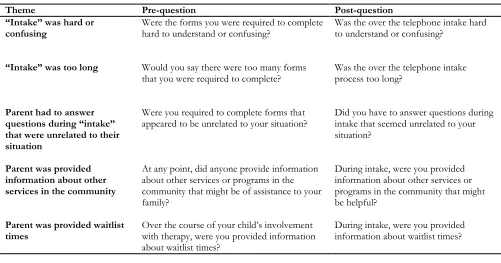
Parent Perspectives. In addition to a descriptive summary of participant responses, an independent groups design was used to compare existing data from the interviews completed with parents prior to the CIA (N=82) to responses to the telephone interviews conducted post-CIA (N=32). Variables included in this analysis were the parent perceptions that intake took too long, that intake was hard to understand or confusing, that they had to answer questions unrelated to their situation, that they were provided information about other services in the community, and that they were provided information about waitlist times to see a therapist. As questions were dichotomous nominal level variables, chi-square analyses were used for comparisons, with Fischer’s Exact Test used when the assumption of minimum five cases per cell was not met. As the wording of pre- and post-questions was somewhat different, for the purpose of illustration, pre- and post-test items are re-coded into shared themes in Table 1 below. Verbatim transcripts of the recorded parent/guardian responses to the telephone interview questions were created. Transcripts of parent perspectives were then reviewed and categorized into the following areas: 1) perceived difficulty navigating through intake, 2) identified information needs at intake, 3) effectiveness of the CIA, and 4) possible improvements to the CIA process. Transcripts were analyzed for recurring themes using a grounded theme analysis technique.
Therapist Perspectives. In addition to a descriptive summary of participant responses, an independent groups design was used to compare post-CIA therapist responses to existing data from the earlier pre-CIA survey (N=78). Mann-Whitney U tests were computed to test the prediction that therapists (post CIA) would report increased feelings of support and decreased time spent connecting families to external agencies.
Retrospective Chart Review
Improving process and enhancing parent and therapist satisfaction, Piecowye et al.
99 Patient Experience Journal, Volume 2, Issue 2 - Fall 2015
Data collected from charts was anonymized.
Demographics such as type of service and location of service were recorded. Two dates were also recorded from charts, the first being the initial date that CRS staff recorded as receiving a referral and the second being the date that initial contact was attempted from staff to parent/guardian. This second date includes situations in which a message would be left for an unavailable parent and does not capture all contact attempts made with the family. The chart review assessed whether or not the time from referral to initial contact with parents had been reduced following implementation of the new CIA.
Results
Parent Perspectives
Post-CIA Descriptive Results. Thirty-two parents/guardians (two males, 30 females aged 22 – 44 years old) of children who experienced the new CIA were interviewed. Parent reports of wait times between referral and first contact with a Social Worker varied considerably. Forty-eight percent of parents indicated that they had telephone contact within a week of referral, an additional 13% of parents reported being contacted within two weeks, and 39% reported a wait of over two weeks. In terms of receiving needed information, the vast majority of parents reported that they knew whom to contact if they had questions prior to being contacted by a therapist (90%), and reported having enough information about the next steps to receiving therapy for their child (84%). While slightly less than half of parents (47%) reported receiving
information about other services or programs in the community, only one parent reported wanting more information about such services or programs.
Ratings of satisfaction with intake were very high. Overall, 97% of parents either agreed or strongly agreed that they were satisfied with the intake process. Qualitative responses also reflected high satisfaction. One parent reported that intake “was really easy… I’ve been super happy with the whole process”. Additionally, the vast majority of parents reported that the CIA was helpful (88%) and not difficult (91%) (for a summary of results refer to Table 2). When asked what part of intake was helpful for them, parents responded that Social Workers were “willing to answer any questions I had [and] had all the information…” and that Social Workers “listened to my concerns and [were] very helpful with any advice”. Many parents reported a preference for being able to talk to someone via telephone instead of having, “to fill out a bunch of papers”.
A key challenge also emerged from the analysis of parent responses to the open-ended questions. It was found that, even given the high satisfaction rates with CIA, some parents continued to feel overwhelmed with the complexity of services that their child was receiving. Roughly one in four parents reported that they were not sure “where they were at” in regards to next steps in receiving therapy services for their child. Some parents also reported experiencing confusion when trying to coordinate services across multiple systems: “so much information from different people, the school, the hospital. I’m trying to keep track of where I am, but [there is so much] information”.
Table 1. Shared themes used to compare pre-CIA questions to post-CIA questions from the parent survey
Theme Pre-question Post-question
“Intake” was hard or
confusing Were the forms you were required to complete hard to understand or confusing? Was the over the telephone intake hard to understand or confusing?
“Intake” was too long Would you say there were too many forms
that you were required to complete? Was the over the telephone intake process too long?
Parent had to answer questions during “intake” that were unrelated to their situation
Were you required to complete forms that
appeared to be unrelated to your situation? Did you have to answer questions during intake that seemed unrelated to your situation?
Parent was provided information about other services in the community
At any point, did anyone provide information about other services or programs in the community that might be of assistance to your family?
During intake, were you provided information about other services or programs in the community that might be helpful?
Parent was provided waitlist
times Over the course of your child’s involvement with therapy, were you provided information about waitlist times?
Improving process and enhancing parent and therapist satisfaction, Piecowye et al.
Patient Experience Journal, Volume 2, Issue 2 - Fall 2015 100
Pre-CIA, Post-CIA Comparison. Fischer’s Exact tests indicated that, consistent with expectation, there was a significant positive change in opinions regarding ease and efficiency of intake. One hundred percent of parents in the post-CIA group said they did not think intake was too long, compared to 80% of parents in the pre-CIA group (p=.003). Similarly, significantly fewer parents (0%) found intake hard or confusing post-CIA compared to pre-CIA (14%; p=.022). Significantly fewer parents also identified not having to answer unrelated questions post-CIA (0%) compared to pre-CIA (14%; p=.031).
A chi-squareanalysis revealed that, following CIA, a greater proportion of parents (65%) reported being provided with information about how long they would wait for contact from a therapist than before CIA (44%), although this was only marginally significant 2 (1, N=110)
= 3.638, p=.056. Perceptions of the amount of
information provided about other community services did not significantly differ from pre- to post-coordinated intake. 2 (1, N=109) = .013, p=.911.
Therapist Perspectives
Post-CIA Descriptive Results. Seventy nine therapists
completed the post CIA survey. Analysis showed that 68% of therapists agreed or strongly agreed that “the
information contained in the intake package is helpful during initial contact with a family and child”, whereas only 15.2% of therapists disagreed or strongly disagreed with this statement. The open-ended question that allowed therapists to provide additional comments about the CIA yielded encouraging results with a significant majority of participants providing positive feedback. Positive themes that emerged included a reduced initial workload, better
information being provided to the therapists prior to their initial contact with parents/guardians and social work assistance with family and consent complexities. Comments included that: “central intake has greatly reduced my initial workload at the intake point”; “I spend much less time ‘chasing paper’”. CIA was also reported to have “saved therapists a lot of time with booking and having to find information”. Other reported benefits included the specialized knowledge of Social Workers, and having someone “who can immediately answer all [of parents’] questions”.
Two directions for process improvement were identified from theme analysis of therapist responses. The first, representing about a third of comments, was the perceived lack of consistency in information being recorded during coordinated intake. In general, the perception was that some key sections in the intake package were left blank or marked as “none”, when these sections should be including information regarding barriers facing families. Examples of information that therapists reported as being inconsistently provided included the primary concerns of parents, family dynamics (such as parents’ relationship or knowledge of siblings), and the labelling of telephone numbers (e.g. home vs. cell). Even in light of the many positive changes reported, a third of respondents shared the perception that the CIA seemed inefficient. Some therapists were concerned that families (of preschool children in particular) were being overwhelmed and that some families were now waiting longer than previously to receive therapy for their child.
Pre-CIA, Post-CIA Comparison. A significant difference was found between the levels of support felt by therapists in handling new referrals of a complex nature, U= 2138.5,
Table 2. Frequencies of Indicators of Wait Times, Information Received, and Satisfaction with CIA (N=31)
Question Topic Parent Responses
Reported wait times for initial contact (N=31) < 1 Week: 48% >1 Week: 52 %
Intake provided information on who to contact
with questions while waiting Yes: 90% No: 10%
Intake provided information about next steps Yes: 84% No: 16%
Intake provided information on community
programs Yes: 47% No: 53%
Intake was helpful Yes: 88% No: 12%
Intake was difficult Yes: 9% No: 91%
Improving process and enhancing parent and therapist satisfaction, Piecowye et al.
101 Patient Experience Journal, Volume 2, Issue 2 - Fall 2015
p< .001, where, pre-coordinated intake, the most common response was, “I have support but it is not always
accessible to me”, and post-CIA the most common response was, “I feel very supported and access my intake support people whenever needed”. In response to the question, “In a typical month, please estimate the number of hours that you are spending assisting families with connections to other agencies, case conferencing, consent, and barrier reduction”, no significant difference was found between the pre- and post-CIA (Mdn = 1-4 hours per month each), U= 2626.5, p= .062. For the question, “Please choose the response that best describes your current practice in connecting families with other
resources in the community” chi-square analysis revealed a significant increase in responding, “I currently have intake support that will connect families with community resources for me when needed” from pre-CIA (3%) to post-CIA (24%), 2 2 (1, N=157)= 16.13, p= .001.
Retrospective Chart Review
Of the one hundred and four charts reviewed, thirteen of the pre-intake charts and two of the post-intake charts did not include wait time data and so were not included in analysis. Six additional pre-intake charts were also
excluded from analysis due to apparent errors on recorded chart information. Three of these reported a contact date earlier than the date of referral (an impossibility), and three reported a wait time between referral and the initial contact attempt of over 120 days (4 months) which was deemed extremely unlikely by CRS staff. An independent samples t-test indicated that wait times were significantly shorter following CIA (refer to Table 3 for means and standard deviations), t (52.4) = 3.53, p< .001.
Discussion
As was anticipated, switching to an intake process based on a Family-Centered Care approach 10, 12, 13, 14 was
associated with a higher degree of parent and therapist satisfaction. Resulting data from the newly implemented Coordinated Intake Approach (CIA) is consistent with research on Family-Centered Care in health settings and provides support for the direction that Children’s Rehabilitation Services has embarked upon. The findings here are broadly applicable to other parents seeking and regions offering similar services. Family-Centered Care research has found that the inclusion of family
participation, navigation assistance and the existence of a contact person for families, results in better outcomes and patients reporting an increased feeling of support 10, 15.
The new CIA contributed to a significant reduction in wait time. Additionally, redesigning a client referral system with the goals of increasing consistency in the client experience and ensuring that the right people are doing the right job has increased efficiency. Approximately half of parents reported that they were contacted by Intake within a week of their child’s referral being made. This result reinforces that families are being contacted in a timely manner under the new CIA. Where parents reported a wait time of over two weeks for contact from intake, it is possible that parents were using different criteria in estimating that wait time. One possibility is that parents may be reporting time from when they agreed to a referral with the referral source (not when the referral was received in CRS) to when they actually spoke to an Intake Social Worker (not when a Social Worker left them the first message). The chart review data showed a clear reduction in wait time post CIA.
Despite parents overall satisfaction with the CIA process, roughly one in four parents did report ongoing feelings of confusion when trying to access services for their children. Many of these parents identified that their child was involved in multiple systems both within health (e.g. community health centres, hospitals, physician appointments) and outside of health (e.g. schools, support/funding programs). To lessen this confusion, a possible solution may be to increase Social Work support for families, outside of the intake role, when children present with complex needs or circumstances. In these situations, Social Workers could assume the role of case managers, both assisting families with clarifying roles and helping them to liaise with other systems. It could be expected that the additional support offered to parents would assist in relieving some of the stress and parent burnout that the literature confirms accompanies caring for a child with developmental delays or disabilities.18, 19
While placing Social Workers in an increased coordination role with families is highly desirable, it is also recognized that this would require increased staffing to be achievable. Slightly less than half of parents reported receiving information on community programs from the CIA team. However, only a marginal number of parents stated that they felt like this information was both needed and missed
Table 3. Means and Standard Deviations of Wait Times Before and After Implementation of Coordinated Intake
Wait Times (in days)
N Mean (SD)
Pre-coordinated intake 36 19.6 (21.0)
Improving process and enhancing parent and therapist satisfaction, Piecowye et al.
Patient Experience Journal, Volume 2, Issue 2 - Fall 2015 102
during CIA. It is important to note that not all
families/referrals require this information – some referrals do not indicate this need and other families are already well connected. It does however indicate the need to review and ensure consistent practice among Social Workers.
Consistent with expectations, therapists reported feeling supported and satisfied with the new CIA process. The majority of therapists agreed or strongly agreed “the information contained in the Intake package is helpful during initial contact with a family and child.” The feedback received from the open-ended questions both clarified areas of strength and identified a couple of areas in need of further development within the CIA. Most therapists who responded to the open-ended questions provided positive feedback. A key strength was increased efficiency with therapists reporting that, “Coordinated Intake has greatly reduced my initial workload” and that “I spend much less time chasing paper.”
One area for further development identified by the therapy team was a perceived lack of consistency between intake packages completed by different Social Workers, with sections of the intake forms sometimes being incomplete. This feedback speaks to the need for the development of Social Work assessment directives to increase consistency and establish a baseline for data collection including form completion. Second, a few therapists identified concerns that inefficiencies exist within the CIA and stated that families of preschool children were waiting longer to complete intakes than prior to the CIA. In spite of the therapist perceptions, the file review clearly showed a significant decrease in wait time for initial contact with parents. Although this initial contact was often a telephone message, that would be consistent with contact attempts made prior to CIA where therapists also left messages for parents. In order to minimize therapist misperceptions, a
time tracking activity is planned to identify any possible process/work flow issues that could lead to further improvements.
Prior to CIA, there were multiple programs with varied processes resulting in inconsistencies in the intake experience for families. Following the implementation of CIA, a unified single program was developed that provides consistency to the client’s experience. It should be noted that many of the staff surveyed have had numerous work changes over the last several years both pre and post-CIA. These changes have been significant, including structure reorganizations and school delivery model shifts. It is believed that change fatigue20, 21 may be impacting
therapist perceptions/opinions.
Conclusion
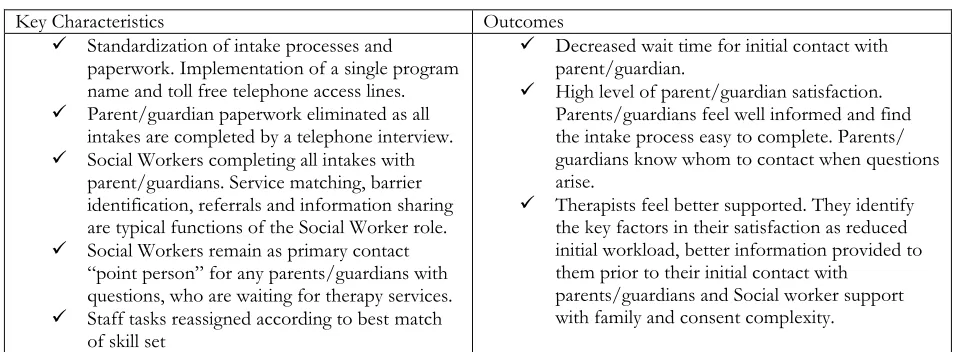
Results suggest that the new CIA has resulted in: 1) parents feeling well informed, finding the intake process easy to complete, and being satisfied, 2) therapists feeling better supported and satisfied, and 3) decreased wait times between referral receipt and initial contact with families. Further quality improvement initiatives such as focus groups, time tracking activities and the creation of Social Work assessment directives have been identified in order to increase consistency and to further improve the family experience. These findings will help to inform initiatives in other health systems looking to improve accessibility to services through increasing supports in a Family-Centered Care approach. An overview of CIA characteristics and outcomes are presented in Table 4.
Table 4. Key Characteristics and Outcomes of the CIA
Key Characteristics Outcomes
Standardization of intake processes and paperwork. Implementation of a single program name and toll free telephone access lines.
Parent/guardian paperwork eliminated as all intakes are completed by a telephone interview.
Social Workers completing all intakes with parent/guardians. Service matching, barrier identification, referrals and information sharing are typical functions of the Social Worker role.
Social Workers remain as primary contact “point person” for any parents/guardians with questions, who are waiting for therapy services.
Staff tasks reassigned according to best match of skill set
Decreased wait time for initial contact with parent/guardian.
High level of parent/guardian satisfaction. Parents/guardians feel well informed and find the intake process easy to complete. Parents/ guardians know whom to contact when questions arise.
Therapists feel better supported. They identify the key factors in their satisfaction as reduced initial workload, better information provided to them prior to their initial contact with
Improving process and enhancing parent and therapist satisfaction, Piecowye et al.
103 Patient Experience Journal, Volume 2, Issue 2 - Fall 2015
References
1. Janus M, Offord D. Development and psychometric properties of the Early Development Instrument (EDI): A measure of children’s school readiness. Canadian Journal of Behavioural Science. 2007; 39(1): 1-22. Available at
http://www.offordcentre.com/readiness/files/PUB.8 .2006_Janus-Offord.pdf
2. Alberta Health Services: Health Plan 2011-15. Unpublished manuscript. 2011. Available at
http://www.albertahealthservices.ca/Publications/ah s-pub-2011-2015-health-plan.pdf
3. How are our young children doing? Final report of the Early Child Development Mapping Project (ECMap). Unpublished manuscript. 2014. Available at https://www.ecmap.ca/ECMAP%20Reports/ECMa p_Final_ Report_20141118.pdf
4. Ravenscroft E. Navigating the health care system: insights from consumers with multi-morbidity. Journal of Nursing and Healthcare of Chronic Illness. 2010 June: 215-225. doi:10.1111/j.1752-9824.2010.01063.x 5. Hertzman C. Making early childhood development a
priority: Lessons from Vancouver. Canadian Centre for Policy Alternatives. 2004, May. Available at http://www.policyalternatives.ca/sites/default/files/ uploads/ publications / BC_Office_
Pubs/early_childhood.pdf
6. Sobo E, Seid M, Reyers Gelhard L. Parent-identified barriers to pediatric health care: A process-oriented model. Health Services Research. 2006; 41(1): 148-172. doi:10.1111/j.1475-6773.2005.00455.x
7. McLennan J, Caza M, Boyle M, et al. The integration of health and social services for young children and their families. Unpublished manuscript. 2003 December. Available at http://www.cfhi-fcass.ca/Migrated
/PDF/ResearchReports/OGC/mclennan_final.pdf 8. Drotar D. Promoting comprehensive care for
children with chronic health conditions and their families: Introduction to the special issue. Children’s Services: Social Policy, Research and Practice. 2001; 4(4): 157-163.
9. Alsem MW, Siebes RC, Gorter JW, Jongmans MJ, Nijhuis BGJ, Ketelaar M. Assessment of family needs in children with physical disabilities: Development of a family needs inventory. Child care, Health and Development. 2013; 1-9. doi: 10.111/cch.12093. 10. Jarvikoski A, Harkapaa K, Martin M, Vasari P,
Autti-Ramo I. Service characteristics as predictors of parents’ perceptions of child rehabilitation outcomes. Journal of Child Health Care. 2013: 1-12. doi: 10.1177/ 1367493513503579.
11. King G, King S, Rosenbaum P, Goffin R. Family-centered caregiving and well-being of parents of children with disabilities: Linking process with
outcome. Journal of Pediatric Psychology. 1999; 24(1): 41-53. doi: 10.1093/jpepsy/24.1.41.
12. Trute B, Hiebert-Murphy D, Wright A. Family-centered service coordination in childhood health and disability services: The search for meaningful service outcome measures. Child: Care, Health and Development. 2008; 34(3): 367-372. doi:
10.1111/j.1365-2214.2008.00819.x.
13. Battaglia TA, Roloff K, Posner K, Freund KM. Improving follow-up to abnormal breast cancer screening in a urban population. Cancer. 2006; 109(2): 359-367. doi:10.1002/cncr.22354.
14. Bradford JB, Coleman S, Cunningham W. HIV system navigation: An emerging model to improve HIV care access. AIDS Patient Care and STDs. 2007; 21(1): 49-58. doi 10.1089/apc.2007.9987.
15. Rodgers JT, Purnell JQ. Healthcare navigation service in 2-1-1 San Diego: Guiding individuals to the care they need. American Journal of Preventative Medicine. 2012; 43(6): 450-456.
doi:http://dx.doi.org/10.1016/j.amepre. 2012.08.012 16. Plant N, Mallitt K, Kelly PJ, et al. Implementation and
effectiveness of ‘care navigation’, coordinated management for people with complex chronic illness: Rationale and methods of a randomised controlled trial. Health Services Research. 2013; 13(1): 1-6. doi:10.1186/1472-6963-13-164
17. Ell K, Vourlekis B, Muderspach L, et al. Abnormal cervical screen follow-up among low-income Latinas: Project SAFe. Journal of Women’s Health and Gender-Based Medicine. 2002; 11(7): 639-651.
doi:10.1089/15246 0902760360586.
18. Shyam R, Govil K, Govil D. Stress and Family Burden in Mothers of Children with Disabilities. International Journal of Interdisciplinary and Multidisciplinary Studies. 2014; 1(4): 152-159. Available at
http://www.ijims.com/
uploads/8893bccf455694be30252014424.pdf 19. McManus B, Carle A, Acevedo-Garcia D, Ganz M,
Hauser-Cram P, McCormick M. Modeling the social determinants of caregiver burden among families of children with developmental disabilities. American Association on Intellectual and Developmental Disabilities. 2011; 116(3): 246-260. doi: 10.1352/1944-7558-116.3-246
20. Bernerth JB, Walker HJ, Harris SG. Change fatigue: Development and initial validation of a new measure. Work and Stress. 2011; 25(4): 321-337. doi:
10.1080/02678373.2011.634280