1 | P a g e
Asian Journal of Pharmaceutical Science & Technology
e-ISSN: 2248 – 9185
www.ajpst.com
Print ISSN: 2248 – 9177MICROSPONGES: A NOVEL APPROACH
Supriya T. Garud*, Kundan Tiwari
Department of Pharmaceutics, S.M.B.T. Institute of D. Pharmacy, Nandi-Hills Dhamangon, Nashik, Maharashtra-422403, India.
ABSTRACT
Microsponge technology has been introduced in topical drug products to facilitate the controlled release of active drug into the skin in order to reduce systemic exposure and minimize local cutaneous reactions to active drugs. It is a patented, highly cross-linked, porous, polymeric microspheres polymeric system (10-25μ) consisting of porous microspheres particles consisting of a myriad of inter connecting voids within non-collapsible structures with a large porous surface that can entrap wide range of actives (cosmetics, over-the-counter (OTC) skin care, sunscreens and prescription products) and then release them onto the skin over a time and in response to trigger. Conventional preparations have some disadvantages like unpleasant odour, greasiness and skin irritation. These problems are overcome by microsponge delivery system. Microsponge based drug delivery system produces controlled released, site specific and target organ action. One of the best feature of microsponge is it is self-sterilizing. Conventional preparations have some disadvantages like unpleasant odour, greasiness and skin irritation. These problems are overcome by microsponge delivery system. They are mostly used for topical use and have recently been used for oral administration.
Key words: Microsponge, Topical, Conventional, Controlled release, Polymeric.
INTRODUCTION
Drug delivery systems that can specifically control the release rates and target drugs to a specific site of body had a vast impact on the health care system. Various consistent and predictable (conventional) systems were developed for systemic drugs delivered through skin under the title of transdermal delivery system (TDS). It has enhanced the safety and efficacy of several drugs that may be administered through skin however, TDS is unrealistic for the delivery of drugs whose ultimate aim is skin itself [1]. There is no efficient vehicles have been developed for controlled as well as localized delivery of drugs into the stratum corneum and not beyond the
Epidermis [2] Furthermore, the significance of topical drugs suffer from various problems i.e. ointments, which are frequently unappealing, greasiness, stickiness etc which in turn leads to lack of patient compliance. These vehicles necessitate high concentrations of active agents for successful therapy because of their less efficiency of delivery system resulting into irritation and allergic reactions in significant users. Additional potential limitations of topical formulations are unpleasant odor, uncontrolled evaporation of active ingredient and incompatibility of drugs with the vehicles. Conventional topical formulations are intended to work on the superficial
layers of the skin. Normally, upon application such products release their active ingredients and producing a highly concentrated layer of active ingredient that is quickly absorbed. Therefore, need exists for a system to increase the amount of time that an active ingredient is present either on skin surface as well as within the epidermis, at the same time, minimizing its transdermal penetration in the body.
Microsponge
A Microsponge drug delivery system (MDDS) is a patented, highly cross-linked, porous, polymeric microspheres polymeric system (10-25 μ) consisting of porous microspheres particles consisting of a myriad of inter connecting voids within non-collapsible structures with a large porous surface that can entrap wide range of actives (cosmetics, over-the-counter (OTC) skin care, sunscreens and prescription products) and then release them onto the skin over a time and in response to trigger. A typical 25μm sphere can have up to 250000 pores and an internal pore structure equivalent to 10ft in length providing a total pore volume of about 1ml/g. The microsponge technology was developed by Won in 1987, and the original patents were assigned to Advanced Polymer Systems, Inc. This company developed a large number of variations of the
2 | P a g e
procedures and those are applied to the cosmetic as well asover-the- counter (OTC) and prescription pharmaceutical products [3-5].
Microsponge do not pass through the skin ,rather they collect in the tiny nooks and crannies of skin and slowly release the entrapped drug, as the skin needs it. The microsponge system can prevent excessive accumulation of ingredients within the epidermis and the dermis. These products are typically presented to the consumer in conventional forms like creams, gels or lotions and they contain relatively high concentration of active ingredients. Microsponges are polymeric delivery systems consisting of porous microspheres that can entrap a wide range of active ingredients such as emollients, fragrances, essential oils, sunscreens, and infective, fungal, and anti-inflammatory agents [6, 7].
HYPOTHETICAL MECHANISM OF ACTION
The active ingredient is added to the vehicle in an entrapped form. As the microsponge particles have an open structure (i.e., they do not have a continuous membrane surrounding them), the active is free to move in and out from the particles and into the vehicle until equilibrium is reached, when the vehicle becomes saturated. Once the finished product is applied to the skin, the active that is already in the vehicle will be absorbed into the skin, depleting the vehicle, which will become unsaturated, therefore, disturbing the equilibrium. This will start a flow of the active from the microsponge particle into the vehicle, and from it to the skin, until the vehicle is either dried or absorbed. Even after that the microsponge particles retained on the surface of the stratum corneum will continue to gradually release the active to the skin, providing prolonged release over time. This proposed mechanism of action highlights the importance of formulating vehicles for use with microsponge entrapments. For these conventional systems it is normally recommended to maximize the solubility of the active in the vehicle. When using microsponge entrapments, some solubility of the active in the vehicle is acceptable, because the vehicle can provide the initial loading dose of the active until release from the microsponge is activated by the shift in equilibrium from the polymer into the carrier. Another way to avoid undesirable premature leaching of the active from the microsponge polymer is to formulate the product with some free and some entrapped active, so the vehicle is pre-saturated. In this case there will not be any leaching of the active from the polymer during compounding. The rate of active release will ultimately depend not only on the partition coefficient of the active ingredient between the polymer and the vehicle (or the skin), but also on some of the parameters that characterize the beads. Examples of these include surface area and primarily, mean pore diameter. Release can also be controlled through diffusion or other triggers such as moisture, pH, friction or temperature [8, 9].
Characteristics of Microsponges
Microsponge formulations are stable over range of pH 1 to 11;
Microsponge formulations are stable at the temperature up to 130oC;
Microsponge formulations are compatible with most vehicles and ingredients;
Microsponge formulations are self sterilizing as their average pore size
Is 0.25μm where bacteria cannot penetrate;
Microsponge formulations have higher payload (50 to 60%), still free flowing and can be cost effective [10].
Characteristics of actives that is entrapped into microsponges
Active ingredients that are entrapped in microsponges can then be incorporated into many products such as creams, gels, powders, lotions and soaps. Certain considerations are taken into account while, formulating the vehicle in order to achieve desired product
It should be either fully miscible in monomer as well as capable of being made miscible by addition of small amount of a water immiscible solvent.
It should be inert to monomers and should not increase the viscosity of the mixture during formulation.
It should be water immiscible or nearly only slightly soluble.
It should not collapse spherical structure of the microsponges.
It should be stable in contact with polymerization catalyst and also in conditions of polymerization.
The solubility of actives in the vehicle must be limited. If not, the vehicle will deplete the microsponges before the application.
Not more than 10 to 12% w/w microsponges must be incorporated into the vehicle in order to avoid cosmetic problems.
Payload and polymer design of the microsponges for the active must be optimized for required release rate for given period of time [11].
ADVANTAGES
It can also improve efficacy in treatment.
They have better thermal, physical and chemical stability.
These are non-irritating, non-mutagenic, non-allergenic and non-toxic.
MDS allows the incorporation of immiscible products.
They have superior formulation flexibility.
Microsponges can absorb oil up to 6 times its weight without drying.
MDS can improve bioavailability of the drugs.
3 | P a g e
Liquids can be converted in to powders improving material processing.
It has flexibility to develop novel product forms.
Improved product elegancy.
Lessen the irritation and better tolerance leads to i-proved patient compliance.
In contrast to other technologies like microencapsulation and liposomes, MDS has wide range of chemical stability, higher payload and are easy to formulation [12].
METHOD OF PREPARATION
Liquid-liquid suspension polymerization method
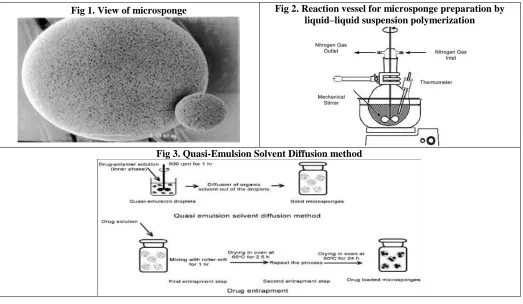
Microsponges are prepared by suspension polymerization process in liquid-liquid systems (one-step process). Firstly, the monomers are dissolved along with active ingredients (non-polar drug) in an appropriate solvent solution of monomer, which are then dispersed in the aqueous phase with agitation. Aqueous phase typically consist of additives such as surfactants and dispersants (suspending agents) etc in order to facilitate the formation of suspension. Once the suspension is established with distinct droplets of the preferred size then, polymerization is initiated by the addition of catalyst or by increasing temperature as well as irradiation. The polymerization method leads to the development of a reservoir type of system that opens at the surface through pores. During the polymerization, an inert liquid immiscible with water however completely miscible with monomer is used to form the pore network in some cases. Once the polymerization process is complete, the liquid is removed leaving the microsponges which is permeate within preformed microsponges then, incorporates the variety of active substances like anti fungal, rubefacients, anti acne, anti inflammatory etc and act as a topical carriers. In some cases, solvent can be used for efficient and faster inclusion of the functional substances9. If the drug is susceptible to the condition of polymerization then, two-step process is used and the polymerization is performed by means of alternate porogen and it is replaced by the functional substance under mild conditions [13, 14, 16].
Quasi-Emulsion Solvent Diffusion method
The microsponges can also prepared by a quasi-emulsion solvent diffusion method by two step process (top-down approach) using an external phase of containing distilled water and polyvinyl alcohol (PVA) 72000. The internal phase, which comprised of drug, ethyl alcohol, polymer and tri-ethyl citrate (TEC), is added at an amount of 20% of the polymer in order to facilitate the plasticity. At first, the internal phase is prepared at 60°C and thereafter added to the external phase at room temperature. After emulsification, the mixture is continuously stirred for 2 hours. Then the mixture is filtered to separate the mi-crosponges. The product is washed and dried by vacuum oven at 40°C for 24 hours [15, 16].
CHARACTERIZATION OF MICROSPONGE Particle size analysis
Particle size determination of loaded as well as blank microsponges can be carried out by laser light diffractometry or any other appropriate method. Values can be expressed for all the formulations in terms of mean size range. It can be studied by plotting cumulative % drug release from microsponges of different particle size against time to study effect of particle size on drug release. Particles having sizes bigger than 30 μm can impart grittiness and thus particles having sizes between 10 and 25 μm are favored to be use in final topical formulation [17].
Determination of entrapment efficiency and production yield
The entrapment efficiency (%) of the microsponges can be calculated according to the following equation [18].
Entrapment efficiency (%) =
………….(1)
The production yield of the microsponges can be obtained by calculating accurately the initial weight of the raw materials and the last weight of the microsponge obtained.
Production yield =
………(2)
Morphology and surface topography of microsponges
The internal and external morphology and surface topography can be studied by scanning electron microscopy (SEM). Prepared microsponges can be coated with gold– palladium under an argon atmosphere at room temperature and then SEM images of microsponges were recorded at the required magnification. SEM of a fractured microsponge particle can also be taken to illustrate its ultra structure [18].
Characterization of pore structure
Pore volume and pore diameter are critical in controlling the intensity as well as duration of effectiveness of the active ingredient. Pore diameter can also affects the passage of active ingredients from microsponges into the vehicle in which the material is dispersed. The effect of pore diameter as well as volume with rate of drug release from microsponges can be studied by mercury intrusion porosimetry. Porosity parameters of microsponges such as intrusion–extrusion isotherms, total pore surface area, pore size distribution, average pore diameters, shape and morphology of the pores, bulk and apparent density can also be determined by using mercury intrusion porosimetry [20]
Determination of true density
4 | P a g e
Polymer/ Monomer composition
Various factors such as microsphere size, polymer composition and drug loading govern the drug release from microspheres. Polymer composition can also influence the partition coefficient of the entrapped drug between the microsponge system and the vehicle and thus have direct affect on the rate of release of entrapped drug. Drug release from microsponge systems of different polymer compositions can be studied by plotting cumulative % drug release against time. The choice of monomer is dictated both by the vehicle into which it will be dispersed and characteristics of active ingredient to be entrapped. Polymers with varying degrees of hydrophobicity or lipophilicity or electrical charges may be prepared to give flexibility in the release of active ingredients. A variety of probable monomer combinations will be screened for their appropriateness with drugs by studying their drug release profile [20].
Compatibility studies
Fourier Transform Infra-red spectroscopy (FT-IR) and thin layer chromatography (TLC) was performed to study the compatibility of drug with reaction adjuncts. Effect of polymerization on crystallinity of the drug can be studied by powder X-ray diffraction (XRD) and Differential scanning colorimetry (DSC). For DSC, approximately 5mg samples can be weighed accurately into aluminum pans, then sealed and can be run at a heating rate of 15°C/min over a temperature range 25–430°C in atmosphere of nitrogen [20].
Resiliency
Viscoelastic properties (resiliency) of microsponges can be tailored to create beadlets which is softer or firmer according to the requirements of the final formulation. Increased crosslinking tends to slow down the release rate. Therefore, resiliency of microsponges will be performed and optimized as per the prerequisite by considering release as a function of crosslinking with time [21].
In-vitro release studies
In-vitro release studies have been carried out using dissolution apparatus USP XXIII equipped with a modified basket consisted of 5μm stainless steel mesh. Dissolution rates were measured at 37°C under 150 rpm rotor speed. The dissolution medium is selected while considering solubility of active ingredients to ensure sink conditions. Sample aliquots were withdrawn from the dissolution medium and analyzed by suitable analytical method (UV spectrophotometer) at regular intervals of time [22].
Kinetics of release
To determine the drug release mechanism and to compare the release profile differences among microsponges, the drug released amount versus time was
used. The release data were analysed with the following mathematical models:
Q = k 1
t n
or
logQ = log k
1 + n log t ………(3)
Where Q is the amount of the released at time (h),
n is a diffusion exponent which indicates the release mechanism, and
k
1 is a constant characteristic of the drug–polymer interaction.
From the slope and intercept of the plot of log Q versus log t, kinetic parameters n and k
1 were calculated.
For comparison purposes, the data was also subjected to Eq. (4), which may be considered a simple, Higuchi type equation.
Q = k 2t
0.5
+ C ……….(4)
Eq. (4), for release data dependent on the square root of time, would give a straight line release profile, with k
2 presented as a root time dissolution rate constant and C as a constant.[4]
APPLICATIONS OF MICROSPONGES
Microsponge delivery systems are used to enhance the safety, effectiveness and aesthetic quality of topical prescription, over-the-counter and personal care products. Microsponges can be used in variety of applications. It is used mostly for topical and recently for oral administration. Several patents have reported that it can be used as an excipient due to its high loading capacity and sustained release ability. It offers the formulator a range of alternatives to develop drug and cosmetic products. Microsponges are designed to deliver a pharmaceutical active ingredient efficiently at the minimum dose and also to enhance stability, reduce side effects and modify drug release. Over-the-counter products that incorporate microsponge drug delivery system include numerous moisturizers, specialized rejuvenated products, and sunscreens [23].
For Topical Delivery
5 | P a g e
production phase to obtain spheres that are tailored tospecific product applications and vehicle compatibility. Microsponge systems are made of biologically inert polymers. Extensive safety studies have demonstrated that the polymers are irritating, mutagenic, non-allergenic, non-toxic and non-biodegradable. As a result, the human body cannot convert them into other substances or break them down. Although they are microscopic in size, these systems are too large to pass through the stratum corneum when incorporated into topical products. Benzoyl peroxide (BPO) is commonly used in topical formulations for the treatment of acne, with skin irritation as a common side effect. It has been shown that controlledrelease of BPO from a delivery system to the skin could reduce the side effect while reducing percutaneous absorption. Therefore, microsponge delivery of Benzoyl peroxide was developed using an emulsion solvent diffusion method by adding an organic internal phase containing benzoyl peroxide, ethyl cellulose and dichloromethane into a stirred aqueous phase containing polyvinyl alcohol and by suspension polymerization of styrene and divinyl benzene. The prepared microsponges were dispersed in gel base and microsponge gels are evaluated for anti-bacterial and skin irritancy. The entrapped system released the drug at slower rate than the system containing free BPO. Topical delivery system with reduced irritancy was successfully developed [22-29].
In oral drug delivery
A microsponge system offers several advantages for oral drug delivery such as
1. Preserve the active ingredients within a protected environment and offer oral controlled delivery to the lower part of the gastrointestinal tract (GIT).
2. Microsponge systems improve the solubility of poorly soluble drugs by entrapping these drugs in their porous structure.
3. As the porous structure of the microsponge is very small in size, the drugs entrapped will be reduced to microscopic particles with higher surface area, and consequently improved rate of solubilization.
4. Maximize the amount of drugs to be absorbed, as the time it takes the microsponge system to pass through the intestine is considerably increased.
In oral applications, the microsponge system has been shown to increase the rate of solubilisation of poorly watersoluble drugs by entrapping such drugs in the microsponge system's pores. As these pores are very small, the drug is in effect reduced to microscopic particles and the significant increase in the surface area thus greatly increases the rate of solubilisation. Controlled oral delivery of ibuprofen microsponges is achieved with an acrylic polymer, Eudragit RS, by changing their intraparticle density. Sustained release formulation of chlorpheniramine maleate, using powder-coated microsponges, is prepared by the dry impact blending method, for oral drug delivery.
Controlled oral delivery of Ketoprofen prepared by quasi-emulsion solvent diffusion method with Eudragit RS 100 and afterwards tablets of microsponges were prepared by the direct compression method. Results indicated that compressibility was much improved in the physical mixture of the drug and polymer; due to the plastic deformation of the sponge-like microsponge structure, producing mechanically strong tablets. Colon-specific, controlled delivery of Flurbiprofen was conducted by using a commercial Microsponge 5640 system. In vitro studies exhibited that compression-coated colon-specific tablet formulations started to release the drug at the eighth hour, corresponding to the proximal colon arrival time, due to addition of the enzyme, following a modified release pattern, while the drug release from the colon-specific formulations prepared by pore plugging the microsponges showed an increase at the eighth hour, which was the point of time when the enzyme addition was made [22-29].
For Bone And Tissue Engineering Bone-Substitute
Bone-substitute compounds were obtained by mixing pre-polymerized powders of polymethyl methacrylate and liquid methylmethacrylate monomer with two aqueous dispersions of a-tricalcium phosphate grains and calciumdeficient hydroxyapatite powders. The final composites appeared to be porous and acted as microsponges. The basic fibroblast growth factor (bFGF) incorporated in a collagen sponge sheet was sustained released in the mouse sub-cutis according to the biodegradation of the sponge matrix, and exhibited local angiogenic activity in a dosedependent manner. Intra-muscular injection of collagen microsponges incorporating bFGF, induced a significant increase in the blood flow, in the murine ischemic hind limb, which could never have been attained by the bolus injection of bFGF. These results suggest the significance and therapeutic utility of the type I collagen as a reservoir of bFGF. A biodegradable graft material containing the collagen microsponge was developed for cardiovascular tissue grafting, as it would permit the regeneration of the autologous vessel tissue. A thin biodegradable hybrid mesh of synthetic poly (DL-lactic-co-glycolic acid) (PLGA) and naturally derived collagen was used for a three-dimensional culture of human skin fibroblasts. The hybrid mesh was constructed by forming web-like collagen microsponges in the openings of a PLGA-knitted mesh. A tissue-engineered patch made of our biodegradable polymer and collagen-microsponge provided good in situ regeneration at both the venous and arterial wall, suggesting that this patch could be used as a novel surgical material for the repair of the cardiovascular system [22-29].
PATENT INFORMATION
6 | P a g e
method to deliver an active ingredient by controlledtime release using a novel delivery vehicle that can be prepared by a process utilizing the active ingredient as a porogen [30].
In September 8, 1992, Won R (Palo Alto, CA) of Advanced Polymer Systems, In (Redwood City, CA) received (United States Patent 5,145,675) for developing a two-step method for the preparation of controlled release formulations [31]
Advanced Polymer Systems, Inc. and subsidiaries ("APS" or the "Company") is using its patented microsponge® delivery systems and related proprietary technologies to increase the safety, aesthetic quality and effectiveness of topical prescription, over-the-counter ("OTC") and personal care products like Vitamin- A, tretinoin and 5- fluorouracil etc.
As on July 23, 2006, the Company has a total of 10 issued U.S. patents and an additional 92 issued foreign patents. 21 patent applications are pending worldwide. Dean JR et al received US patent no. 4863856 for the development of weighted collagen microsponges having a highly cross-linked collagen matrix that is suitable for use in culturing organisms in motive reactor systems. The microsponges have an open to the surface pore structure, pore volumes and pore sizes suitable for immobilizing a range of bioactive materials [32].
MARKETED FORMULATIONS
MDS is best for skin and personal care products.
They can take up large amounts of excess of skin oil while retaining an elegant feel on the surface of skin. This technology is presently employed in approximately number of products sold by leading cosmetic and toiletry companies worldwide. Among these products include moisturizers, skin cleansers, deodorants, oil control lotions, conditioners, razors, lipstick, powders, makeup and eye shadows which offers various advantages including improved physical and chemical stability, greater available concentrations, reduced skin irritation and sensitization and controlled release of the active ingredients and unique tactile qualities.
Recent Advances in Microsponge Drug Delivery System
Various advances were made by modifying the methods to form Nanosponges, nanoferrosponges and porous micro beads. β - CD nanosponges were also developed that can be used for hydrophobic as well as hydrophilic drugs, in contrast to polymeric micro or nanosponges. These advanced systems were studied for oral administration of dexamethasone, Flurbiprofen, doxorubicin hydrochloride, itraconazole and serum albumin as model drug. These nanosponges were developed by cross- linking the β CD molecule by reacting the β-CD with biphenyl carbonate. Some researchers also observed the nanosponges as good carrier for the delivery of gases. Researchers also observed that incorporating a cytotoxic in a nanosponge carrier system can increase the potency of the drug suggesting that these carriers can be potentially used for targeting the cancerous cells [33, 34].
Fig 1. View of microsponge Fig 2. Reaction vessel for microsponge preparation by liquid–liquid suspension polymerization
7 | P a g e
Table 2. List of Marketed Products using Microsponge Drug Delivery System
Product name Advantages Manufacturer
Retin-A-Micro 0.1% and 0.04% tretinoin entrapped in MDS for topical treatment of acne vulgaris. This formulation uses patented methyl methacrylate/ glycol dimethacrylate cross-polymer porous microspheres to enable inclusion of the active ingredient, tretinoin, in an aqueous gel.
Ortho-McNeil Pharmaceutical, Inc.
Carac Cream Carac Cream contains 0.5% fluorouracil, with 0.35% being incorporated into a patented porous microsphere (Microsponge) composed of methyl methacrylate / glycol dimethacrylate cross-polymer and dimethicone. Carac is a once-a-day topical prescription product for the treatment of actinic keratosis (AK), a common pre-cancerous skin condition caused by over-exposure to the sun.
Dermik Laboratories, Inc. Berwyn, PA 19312 USA
Line Eliminator Dual Retinol Facial Treatment
Lightweight cream with a retinol (Vitamin A) in MDS, dual-system delivers both immediate and time released wrinkle-fighting action. Visibly diminishes appearance of fine lines, wrinkles & skin discolorations associated with aging.
Avon
Retinol cream, Retinol 15 Night cream
A night time treatment cream with Microsponge technology using a stabilized formula of pure retinol, Vitamin A. Continued use of Retinol 15 will result in the visible diminishment of fine lines and wrinkles, a noticeable improvement in the skin discolorations due to aging, and enhanced skin smoothness.
Biomedic, Sothys
EpiQuin Micro The Microsponge® system uses microscopic reservoirs that entrap hydroquinone and retinol. The microsponges release these ingredients into the skin gradually throughout the day. This provides the skin with continuous exposure to hydroquinone and retinol over time, which may minimize skin irritation. EpiQuin Micro is a prescription moisturizing fading cream that reduces the impact of these conditions known as melasma, post inflammatory hyper pigmentation or solar lentigines. Also help in Age spots, Sun spots, Facial discoloration.
SkinMedica Inc
Sportscream RS and XS
Topical analgesic-anti-inflammatory and counterirritant actives in a Microsponge® Delivery System (MDS) for the management of musculoskeletal conditions.
Embil Pharmaceutical Co. Ltd.
Salicylic Peel 20 & 30
Deep BHA peeling agent for (professional use only): Salicylic acid 20%, Microsponge Technology, Excellent exfoliation and stimulation of the skin for more resistant skin types or for faster results. Will dramatically improve fine lines, pigmentation, and acne concerns. Salicylic Acid moves easily through the pores, clearing them out while reducing inflammation. This treatment effectively combats acne, leaving a wonderfully smooth and clear complexion.
Biophora.
Micro Peel Plus /Acne Peel
The MicroPeel ® Plus procedure stimulates cell turnover through the application of salicylic acid in the form of microcrystals using Microsponge ® technology. These microcrystals target the exact areas on the skin that need improvement. The MicroPeel Plus aggressively outperforms other superficial chemical peels by freeing the skin of all dead cells while doing no damage to the skin.
Biomedic
Oil free matte block spf20
This invisible oil-free sunscreen shields the skin from damaging UV sun rays while controlling oil production, giving you a healthy matte finish. Formulated with microsponge technology, Oil Free Matte Block absorbs oil, preventing shine without any powdery residue.
Dermalogica
Oil Control Lotion
A feature-light lotion with technically advanced microsponges that absorb oil on the skin's surface during the day, for a matte finish. Eliminate shine for hours with this feature-weight lotion, formulated with oil-absorbing Microsponge technology. The naturally- antibiotic Skin Response Complex soothes inflammation and tightness to promote healing. Acne-Prone, oily skin conditions.
8 | P a g e
Lactrex™ 12%Moisturizing Cream
Lactrex™ 12% Moisturizing Cream contains 12% lactic acid as the neutral ammonium salt, ammonium lactate. Microsponge® technology has been included for comfortable application and long lasting moisturization. Lactrex™ also contains water and glycerin, a natural humectant, to soften and help moisturize dry, flaky, cracked skin.
SDR Pharmaceuticals, Inc., Andover , NJ , U.S.A. 07821
Dermalogica Oil Control Lotion
A feather-light lotion containing microsponges to absorb oil on the skin’s surface, helping to combat shine and maintain an all-day matte finish. Niacinamide, Zinc Gluconate, Yeast Extract, Caffeine and Biotin purify and inhibit overactive sebaceous gland activity while soothing irritation. Salicylic Acid clears congested follicles to minimize future breakout activity, while Enantia Chlorantha Bark Extract controls over-active oil glands, helping to reduce oily shine on skin’s surface.
John and Ginger Dermalogica Skin Care Products
Aramis fragrances 24 Hour High Performance Antiperspirant Spray Sustained release of fragrance in the microsponge. The microsponge comes in the form of an ultra light powder, and because it is micro in size, it can absorb fragrance oil easily while maintaining a free-flowing powder characteristic where release is controlled due to moisture and temperature.
Aramis Inc.
Ultra Guard Microsponge system that contains dimethicone to help protect a baby's skin from diaper rash. The new wipe contains a skin protectant that helps keep wetness and irritants from the baby's skin. The solution is alcohol-free, hypoallergenic and contains dimethicone, an ingredient found in baby creams, lotions and skin protectants.
Scott Paper Company
CONCLUSION
Microsponge Delivery System consist of micro-porous beads, have entrap wide range of active ingredients and then controlled release of actives onto the skin over a time and in response to other triggers such as pressure, ambient skin temperature and moisture. MDS was originally developed for topical delivery. But as per the literature surveyed, it may be concluded that various innovative applications with a programmable release makes microsponge drug delivery system unique, novel and versa-tile and extremely attractive in cosmetic world for delivery of drugs and also expands its application in oral, bio-pharmaceutical drug delivery & tissue engineering. It can also used for controlled oral delivery using bio-erodible
polymers, especially for colon specific delivery. MDS holds promising applications in various pharmaceutical applications in the coming years as they have unique properties like extended release, reduced irritancy, small size, self sterilize and compatible with most of vehicles and ingredients, so flexible to develop novel product forms. Thus, MDS is a very emerging field which needs to be extensively researched.
ACKNOWLEDGMENTS
Nil
CONFLICT OF INTEREST
No interest
REFERENCES
1. Kydonieus A, Berner B, Transdermal delivery of drugs. Boca Raton, CRC Press, 1987, 299.
2. Chowdary K, Rao Y. Mucoadhesive microspheres for controlled drug delivery. Biol Pharm Bull, 27, 2004, 1717-1724. 3. Shivani N, Mandeep K, Nikhil S, Sahil N. Microsponge drug delivery system: an overview. World Journal of Pharmacy and
Pharmaceutical Sciences, 2(3), 2011, 1032-1043.
4. Ammar H, Ghorab M, Mohamoud AA, Makram TS, Noshi SH. Topical liquid crystalline gel containing lornoxicam/cyclodextrin complex. Journal of inclusion phenomena and macrocyclic chemistry, 73(1), 2012, 161-175. 5. http://www.microsponge.com/images/microspongeparticle.jpg
6. Poornima P, Vikas J, Mahajan S. A Review: Microsponge Drug Delivery System. International Journal of Biopharmaceutics, 4(3), 2013, 225-230.
7. Parikh BN, Gothi GD, Patel TD, Chavda HV, Patel CN. Microsponge as a novel topical drug delivery system. J. Global Pharm. Tech, 2010, 17-29.
8. Embil K, Nacht S. The Microsponge delivery system (MDS): A topical delivery system with reduced irritancy incorporating multiple triggering mechanims for the release of actives. J Microencapsul, 13, 1996, 575-88.
9 | P a g e
10. Mohite P, Khanage SG, Harishchandre VS, Shirsath Y. Recent Advances In Microsponges Drug Delivery System. Journal ofCritical Reviews, 3(1), 2016, 9-16.
11. Kawashima Y, Niwa T, Takeuchi H, Hino T, Itoh Y. (1992). Control of prolonged drug release and compression properties of ibuprofen microsponges with acrylic polymer, eudragit RS, by changing their intraparticle density. Chem Pharm Bull, 40, 1992, 196-201.
12. Vyas S, Khar R. Targeted and controlled drug delivery- Novel carrier system. CBS Publication, New Delhi, Edition 1, 2002, 453.
13. Hainey P, Huxham IM, Rowatt B, Sherrington DC. Synthesis and ultrastructural studies, of styrene divinyl benzenepolyhipe polymers. Macromolecules, 24, 1991, 117-121.
14. Jain N, Sharma P, Banik A. Recent Advances On Microsponge Delivery System, 2011, 13-23
15. Tansel C¸ Omoglu N¸ In G, Tamer B. The effects of pressure and direct compression on tablet-ting of microsponges. International Journal of Phar-maceutics, 242, 2002, 191–195.
16. Orlu M, Cevher E, Araman A. Design and evaluation of colon specific drug delivery system containing flurbiprofenmicrosponges. Int J Pharm, 318, 2006, 103-17.
17. Martin A, Swarbrick J, Cammarrata A. Physical pharmacy: Physical chemical principles in pharmaceutical sciences, 3rd Edn, Lea & Febiger (Philadelphia) publisher, 1983, 664.
18. Kilicarslan M, Baykara T. The effect of the drug/polymer ratio on the properties of verapamil Hcl loaded microspheres. Int J Pharm, 252, 2003, 99–109.
19. Emanuele A, Dinarvand R. Preparation, characterization and drug release from thermo responsive microspheres. Int J Pharm, 118, 1995, 237-242.
20. Barkai A, Pathak YV, Benita S. Polyacrylate (Eudragit retard) microspheres for oral controlled release of nifedipine. Formulation design and process optimization. Drug Dev Ind Pharm, 16, 1990, 2057-2075.
21. Dsouza JI. The microsponge drug delivery system: For delivering an active ingredient by controlled time release. Pharmainfo.net, 6, 2008, 62.
22. Dsouza JI. In-vitro antibacterial and skin irritation studies of microsponges of benzoyl peroxide. Indian Drugs, 38, 2001, 361-362.
23. Sarat CPM, Ajay M, Nagendra BB, Prathyusha P, Audinarayana N, Bhaskar RK. Microsponge Drug DeliverySystem A Review. J. Pharm. Res, 4(5), 2011, 1381-1384.
24. Wester R, Patel R, Natch S, Leyden J, Melendres J, Maibach H. Controlled release of benzoyl peroxide from a porous microsphere polymeric system can reduce topical irritancy. J. Am. Acad. Derm, 24, 1991, 720-726.
25. John I, Jagdish K, Suresh G, Harinath N. More Design and Evaluation of Benzoyl Peroxide Microsponges to Enhance Therapeutic Efficacy in Acne Treatment, Accepted for presentation in 20th FAPA Congress, Bangkok , Thailand , 2004, 28. 26. Jain V, Singh R. Dicyclomine-loaded eudragit based microsponge with potential for colonic delivery Preparation and
characterization. Tropical Journal of Pharmaceutical Research, 9(1), 2010, 67-72.
27. Mine O, Erdal C, Ahmet A. Design and evaluation of colon specific drug delivery system containing Flurbiprofen microsponges. International Journal of Pharmaceutics, 318, 2006, 103–117.
28. Shaheen SZ, Bolla K, Vasu K & Singara CMA. Antimicrobial activity of the fruit extracts of Coccinia indica. African Journal of Biotechnology, 8(24), 2009, 7073-707.
29. Park W, Lee J. Antimalarial Activity of a New Stilbene Glycoside from Parthenocissus tricuspidata in Mice. Antimicrobial Agents and Chemotherapy, 52(9), 2008, 3451–3453.
30. Won R. Method for delivering an active ingredient by controlled time release utilizing a novel delivery vehicle which can be prepared by a process utilizing the active ingredient as a porogen, US Patent 4690825, 1987.
31. Won R. Two step method for preparation of controlled release formulations, US Patent 5145675, 1992.
32. Dean JR, Robert C, Frederick H, Richard A, Philip G, Runstadler JR. Weighted collagen microsponge for immobilizing bioactive materials, US Patent 4863856,1989.
33. http://www.pharmainfo.net/reviews/microsponge