Copyright © The Author(s). All Rights Reserved. Published by American Research Institute for Policy Development DOI: 10.15640/jea.v6n1a11 URL: https://doi.org/10.15640/jea.v6n1a11
Evaluation of Design Approaches for Wellbeing in Interiors
Valeria Minucciani
1& Nilufer Saglar Onay
2Abstract
Interior spaces have a great effect on human wellbeing because of their role as the follower of life. This work aims to evaluate a series of design approaches that can be used in order to create interior design proposals that can promote human wellbeing. This paper initially discusses the importance of wellbeing in spatial design by proposing a framework of design criteria, which can be used to systemize the design input concerning the multi-dimensional structure of wellbeing in living environments. Afterwards, the decision of the appropriate design approach that can guide the designer towards meaningful solutions was discussed through the evaluation of four different design approaches that can be used during the design process. The efficacy of these approaches was measured according to the basic design criteria defined in the wellbeing framework for interiors. After the theoretical assumptions, further research will focus on the practical evaluation of living environments realized using these different approaches in order to understand their capacity to support wellbeing in everyday spatial experiences.
Keywords: Subjective Wellbeing, Interior Design Approach, Human Centered Design, Biophilic Design,
Biomimetic Design, Generative Design. 1. Introduction
As wellbeing is intended for human, the main point of departure should be understanding human needs and feelings. In this sense wellbeing is always subjective; very difficult, almost impossible to measure. On the other hand designers may explore this subjectivity with a balanced methodology in order to understand the changing range of criteria that build up wellbeing. Desmetand Pohlmeyer (2013) define well-being as a broad concept that represents an individual‘s overall quality of life. According to Naci and Ioannidis (2015), wellness refers to diverse and interconnected dimensions of physical, mental, and social wellbeing that extend beyond the traditional definition of health. It includes choices and activities aimed at achieving physical vitality, mental alacrity, social satisfaction, a sense of accomplishment, and personal fulfillment. Wellbeing research in general is concerned with several different disciplines, principally psychology, sociology, medicine and health. During the last decades wellbeing started to be one of the most important objectives also in all design practices. It has been accepted that our living environments can have a significant effect on our wellbeing. Lyubomirsky, Sheldon, and Schkade (2005) discuss that three major factors contribute to people‘s levels of wellbeing:
1) Happiness set point (i.e., the genetically determined stable level of happiness, which has been shown to account for approximately 50% of the variance in individual differences in well-being),
2) Life circumstances (e.g., factors such as income, marital status, or religiosity, which are typically found to account for roughly 10% of individual differences in well-being), and
3) Positive cognitive, behavioral, and goal-based activities (which have the potential to account for a significant portion up to 40% of individual differences in well-being).
While we consider these three components, we see that the third one can highly be affected by the environment that we live in.
1 Assistant Professor, Politecnico di Torino, POLITO Department of Architecture and Design, VialeMattioli 39, Torino. 2Associated Professor, Istanbul Technical University, ITU Faculty of Architecture, 34437, Taksim, Istanbul.
As all the activities that take place in our living environments are supported and guided by spatial experience, wellbeing is directly and considerably affected by the decisions taken by the designers that shape the indoor environment. Moreover spatial experience and fulfillment of goal-based activities can be regarded as the wellbeing component, which is more manageable than other wellbeing components such as genetic factors and life circumstances. Therefore, the designer‘s role in defining appropriate interiors is the most concrete contribution to human wellbeing. In this sense, wellbeing in interiors needs to be handled with specific attention concerning both design criteria and design approach.
2. Methodology
Like every design activity, interior design also requires certain design input to be evaluated during the design process. As interior design is concerned with creating spaces that support human activities and wellbeing, the design input is closely related to the human factor as well as potentials of the existing natural and built environment. Therefore at the beginning of the process the designer needs to define the design criteria including contextual and human related criteria. Then during the design process, he needs to choose a design approach to handle the design criteria with a holistic understanding. As the outcome of the process, interior environments become generators of human wellbeing (Figure 1). In this sense, the issue of wellbeing in interiors needs to be examined especially in terms of design criteria and design process proposing a methodological framework that can help the designer during these two vital steps.
Figure 1. Interior design process leading to wellbeing
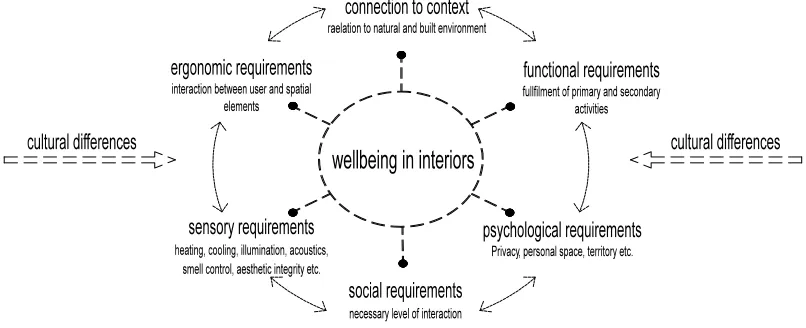
Wellbeing in living environments can be defined with certain requirements that are all in relation to each other (Figure 2).These requirements are different from general requirements of design for wellbeing as they are strongly connected to space and context. Moreover most of these requirements can also be affected by cultural differences. According to Tov and Diener (2007), cultures should differ in subjective wellbeing to the extent that they provide people with different levels of autonomy, meaning, and relationships. In this sense the spatial reflections of wellbeing should also be considered together with cultural aspects. On the other hand, studies on the relation between culture, environment and subjective wellbeing are very rare.
Figure 2. Wellbeing framework for interiors
In this paper, 4 different design approaches will be discussed in terms of their potential in defining interior design solutions that can increase user‘s wellbeing. Among these approaches, human centered design is chosen because of its focus on human needs. Biomimetic design and biophilic design are discussed as they are both regarded as approaches that can promote wellbeing because of their connection to natural systems and processes. The last approach, generative design, is examined because of its capacity to create alternatives and flexible solutions that can overcome the issue of subjectivity in wellbeing. All four approaches will be examined by defining the specific design process in relation to design requirements, effects and tools. Then all the approaches will be evaluated in terms of their capacity to fulfill the basic requirements of wellbeing, which are defined above in the wellbeing framework (Figure 2).
3. Design Approaches for Wellbeing in Interiors
A design approach is about the way the design input is evaluated and processed. During the design process, the designer needs to decide on his priorities and create a certain hierarchy between the design criteria. Mostly, the design approach also affects the field studies and data collection process. For example while considering human centered design, field research is mostly concerned with users and their activities, opinions and preferences. In this part of the study, design approaches with different priorities and focuses will be theoretically discussed in terms of their design process. The number of approaches to be examined can be increased. Here the selection of studied approaches, except generative design, depends on their common use in literature to fulfill wellbeing requirements. On the other hand generative design is more deeply discussed because of its potential to be used for wellbeing studies. 3.1. Human Centered Design
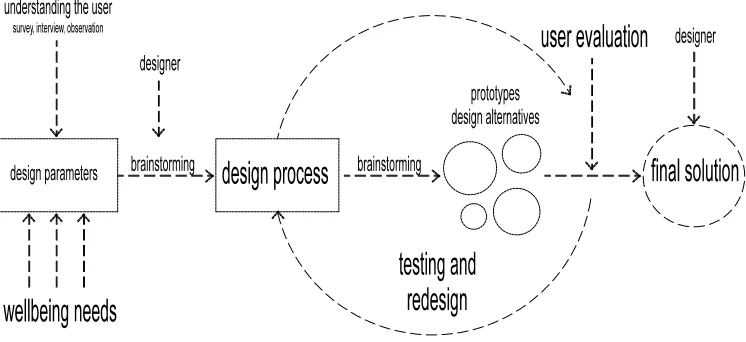
While we consider living environments, wellbeing is strongly related to the needs and cultural backgrounds of users. If the users are already known, an in-depth study about their expectations and requirements is the basic input for user satisfaction. At this point we can say that human centered design is an approach that can contribute to wellbeing of users as it is based on the physical and psychological needs of the users, enabling them to function at the highest level possible. Human-centered design is not a design style, but is an approach, a process for designing and developing buildings, products, and communities that is grounded in information about the people who will be using them—utilizing research findings and data on cognitive abilities, physical abilities and limitations, social needs, and task requirements in order to provide living-environment solutions that enable all users to function at their highest capacity—regardless of age or ability (Greenhouse, 2012).
Figure 3. Human centered design process 3.2. Biomimicry
For a long period, nature has been outclassed by human technology, but after the Second World War a specific attention to the role of nature has been observed in the design process. Relation between nature and human wellbeing could be intuitive, but design approaches related to nature and the inspirations that can be derived from it vary considerably.
In the last decades the nature was again looked at not only as a possible source of inspiration but also as a guide. This is just the case of biomimicry, term originated from the work of scientist Otto Schmitt, that literally means the imitation of life. According to Kennedy‘s (2004) definition, biomimicry ―refers to studying nature‘s most successful developments and then imitating these designs and processes to solve human problems‖, while Michael Pawlyn (2011) defines biomimicry as ―mimicking the functional basis of biological forms, processes and systems to produce sustainable solutions‖, Julian Vincent(1990) as ‗the abstraction of good design from nature‖ and Janine Benyus (1997) as ‗the conscious emulation of nature‘s genius‘.
Biomimicry is the examination of nature models, systems, processes and adaptations as answers to specific functions, mechanical and structural problems - and consequently their adoption in architecture, generating individual products (―organs‖) or systems and processes (―organisms‖).Thus it usually means the creative implementation of biological concepts into design process. Nevertheless, often it is simply intended as direct copying of nature, and actually some scientists preferred the term ‗biomimetics‘. But biomimetics in this sense cannot be juxtaposed, from an architectural perspective, to ‗biomorphism‘ that is mainly interested to biological forms by replicating them, while biomimicry is specifically focused on developing sustainable solutions, and its final solution may or may not look organic, or visually resemble the organism from which the lesson came.
Obviously, biomimicry cannot automatically produce good architecture, especially if it encompasses a purely scientific approach to design. Human wellbeing calls into question also the emotional, spiritual, even historical dimensions. In interior architecture, the common, formalistic use of biology as a library of shapes has to be overcome by understanding the rules governing the natural forms instead of simply replicating them. Another term related to this trend is ‗bio-utilization‘ that refers to the direct use of nature to achieve positive effects on buildings (e.g. incorporating plants to gain evaporative cooling).
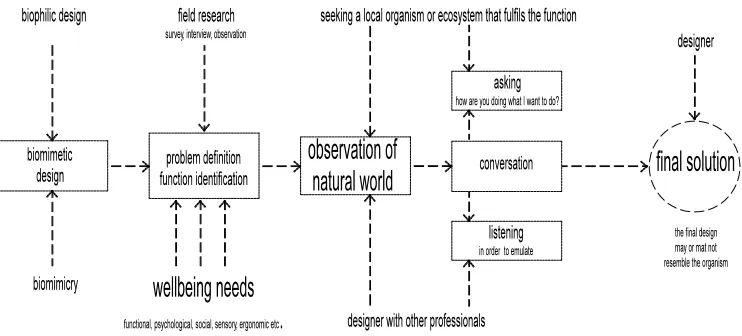
Figure 4. Biomimetic design process
Nevertheless, Biomimicry approach could be adopted also to solve wellbeing needs: its design process starts from the observation of natural world - seeking out a local organism or ecosystem that fulfills the function- then ―talking‖ with it, asking and listening to it in order to emulate its design and process. If we realize that nature is able to respond to the basic needs of creatures, not only simply solving problems, then we can also acknowledge that wellbeing needs can be met by drawing inspiration from nature and above all by observing it: in fact, this approach implies a careful capacity of observation and deep understanding of the vital processes.
3.3 Biophilic Design
Following E.O. Wilson‘s (1984) definition of Biophilia as ―the innate tendency to focus on life and lifelikeprocesses‖ still undervalued, R. Kellert states that this human inclination ―to relate with life and natural process is the expression of a biological need‖, encompassing an ethic attitude toward the world and being biologically based. He suggests that human identity and personal fulfillment somehow depend on our relationship to nature.‖ (Kellert- Wilson 1993).
This human need for nature affects our emotional and cognitive development: consequently, Biophilia is strictly related to human performance and wellbeing.
Even if some scholars consider Biophilia as a branch of biomimicry, they are quite different approaches. While biomimicry focus on practical solutions inspired by natural forms, processes and systems, Biophilia describes humans‘ connection with nature and biophilic design is replicating experiences of nature into the design process to reinforce this connection. Biomimicry‘s goal is achieving better performance, while biophilic design aims to improve health and wellbeing. Biomimicry is more heavily used in technology and product development, while Biophilia is mostly concerned with interior design, as well as architecture and urban design. Thus, these two concepts address nature in different ways, Biomimicry recognizing the innovation potential of natural solutions, Biophilia recognizing the health and wellbeing benefits of connectedness with nature.
Biophilic Design aims to create healthy and productive habitats supporting wellbeing as a whole: ―Biophilic design is the deliberate attempt to translate an understanding of the inherent human affinity to affiliate with natural systems and processes—known as Biophilia —into the design of the built environment‖ (Kellert- Wilson 1993). Thus, it is an innovative way of designing living environments, going beyond green architecture that focuses on decreasing the environmental impact of buildings, but this is insufficient to benefit to wellbeing nor to reconnect us to the natural world.
According to R. Kellert, our species is biologically related to natural world based on nine different valuations of nature: utilitarian, naturalistic, ecologistic-scientific, aesthetic, symbolic, humanistic, moralistic, dominionistic, negativistic. These cover very different approaches, from emotional attachment to alienation – encompassing very different functions, from mental development to peace to security: but, although in different ways, our relationship with nature remains therefore unavoidable.
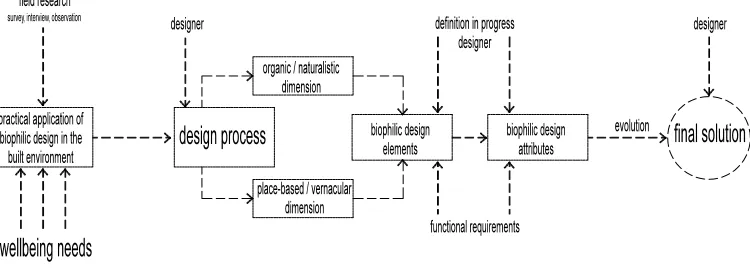
Biophilic design approach and its practical application is summarized in the figure below: two basic dimensions (naturalistic and vernacular), six biophilic design elements (from natural shapes to light to human-nature relationships) and about seventy biophilic design attributes that focus on effects, details, concepts. In fact, these are very heterogeneous, as biophilic design cannot follow mechanistic approaches.
Figure 5.Biophilic design process 3.4. Generative Design as an Emerging Design Approach
Generative Design can be regarded as one of the most important emerging design approaches. The added value of generative approach is the possibility to create a group of efficient solutions or alternatives rather than only one solution. In multi-criteria design problems where the needs, users and expectations can vary, generative approach can enrich the set of possible solutions. Thus, Generative systems offer a new insight into both the conceptualization of design processes and the study of design through dynamic processes and outputs. In literature genetic algorithms have been used in the field of design, optimization of designs, spatial arrangement and architectural form search. (Gu, Singh and Merrick,2010).McCormack, Dorin and Innocent (2004), define the properties of generative Design as follows:
The ability to generate complexity
The complex and interconnected relationship between organism and environment.
The ability to self-maintain and self-repair
The ability to generate novel structures, behaviors, outcomes or relationships
On the other hand the process of generative design is characterized by four main steps (McCormack, Dorin and Innocent 2004):
Establishing requirements
Designing alternatives
Prototyping
Evaluating
The designer‘s aesthetic sense then determines the ‗fittest‘ designs of those displayed, and these are ‗bred‘ with one another to produce a new population of designs that inherit the traits of their successful parent (Dorin 2001). In this sense, both computer and designer have an important role in generative approach. While the computer generates alternatives, the designer guides the selection giving the direction towards more successful generations. According to Rosenman (1997) and Carranza (2005) generative systems help to achieve not optimal, but satisfactory results according to the criteria determined by the designer.
A common way of using generative design approach is to code fitness functions into the evolutionary system. The designer can simply code the properties that he desires or he can define some restrictions, which can guide the evolution process. According to McCormack and Dorin (2001), design using generative methods involves the creation and modification of rules or systems that interact to generate the finished design autonomously. Hence, the designer does not directly manipulate the produced artifact, rather the rules and systems involved in the artefact‘s production. Correspondingly Meibodi (2016) discusses that the design process is automated and carried out by the computer, while the designer becomes a part of the productive apparatus, defining links and assigning directions of links between mediating artefacts.
According to Caldas (2001), the generative design approach is open-ended, as it leaves the final decision-making to the designer. The generative system is then used to generate whole building geometries, departing from abstract relationships between design elements and using adaptation to evolve architectural form. The shape-generation experiments are performed for distinct geographic locations, testing the algorithm's ability to adapt buildings shape to different environments.
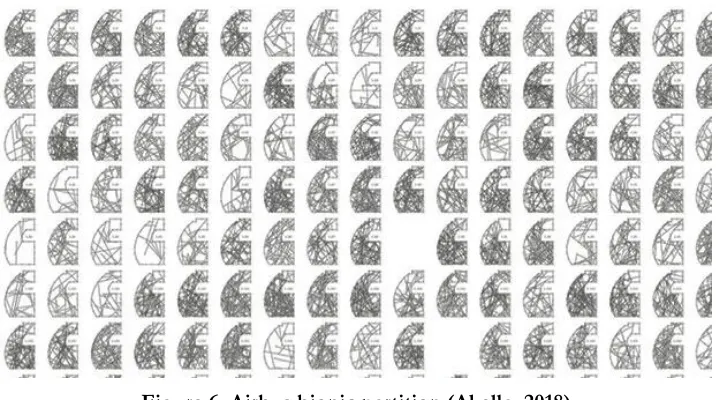
Akella (2018)discusses that using artificial intelligence (AI) software, generative design enables engineers to create thousands of design options by simply defining their design problem - inputting design parameters (such as materials, size, weight, strength, manufacturing methods, and cost constraints) into generative design software and the software explores all the possible combinations of a solution, quickly generating hundreds or even thousands of design options. With the emerging production methods such as 3D printing, generative design gives the possibility to create extremely strong, efficient and lightweight shapes. The interior partition for Airplane Manufacturer Airbus was designed to be lighter in order to reduce overall weight of the plane leading to the reduction of fuel consumed and carbon dioxide emitted when applied across its fleet of planes. The resulting partition was 45 percent lighter than the previous one as all the unnecessary inner filling material was removed (Figure 6).
Figure 6. Airbus bionic partition (Akella, 2018)
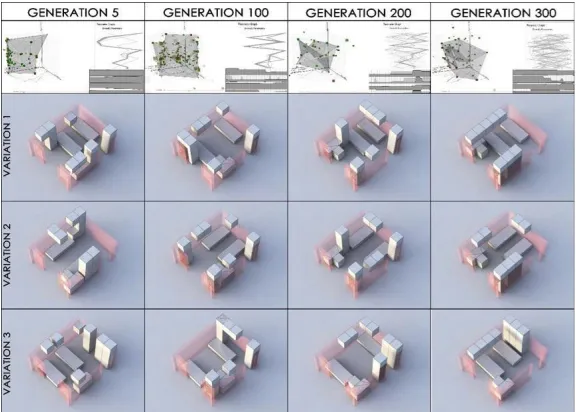
The genetic algorithm worked with the Grasshopper Octopus plug-in to produce alternatives. In the first phase, the alternatives that did not meet the fitness functions described as ―unsuccessful‖ were eliminated. Ideal alternatives developed during the first phase were left to evolve and produce ―successful‖ alternatives. At the lateststage, a certain number of alternatives selected by the designer formed the ―most successful‖ solution set. In Figure 7, the alternativesproduced by the Octopus extension are represented as cubes in the graphic ―Pareto Front‖ (Saglar Onay, Garip and Garip, 2017).
Figure 7. Fitness functions represented as cubes in the “Pareto Front” graphic (Saglar Onay, Garip and Garip, 2017).
The X, Y, and Z axes in the Pareto Front graph indicate which alternatives better match with which fitness function. At this point, it can be said that the centrally located cubes are design solutions optimized for multiple fitness functions. The red cubes represent the alternatives that are eliminated as unsuccessful and the gray area indicates the range of evolutions. As satisfactory results begin to be produced the gray are a approaches the center. Figure 12 shows the process applied to one of the bedrooms. The matrix is created by selecting three alternatives from the designs evolving 5,100, 200 and 300 times respectively (Figure 8). The furnishings in the matrix are represented as solid geometries.
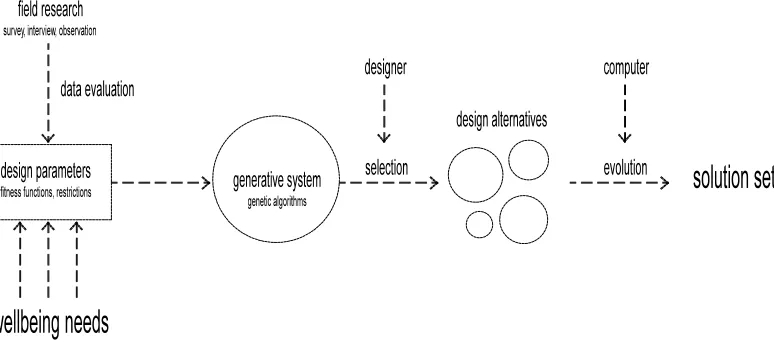
Figure 9. The use of Generative Design to generate wellbeing in interiors
The potential of Generative Design in solving multi criteria design problems is to be evaluated and tested in order to generate wellbeing in interior living environments. In this case the determination of design parameters plays a very important role. Therefore the parameters to be coded in the generative system can be defined in order to fulfill wellbeing needs outlined in the wellbeing framework together with the data collected from field studies. For various wellbeing requirements such as functional, ergonomic, sensory etc., the wellbeing parameters are to be determined. This can be achieved by the definition of appropriate fitness functions that fulfill wellbeing criteria as well as restrictions that will eliminate generation of possible inappropriate alternatives (Figure 9).
4. Evaluation of Design Approaches
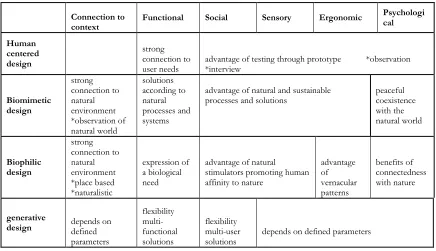
Design approaches with particular focus on natural world have the advantage of creating strong ties with context, which eliminate the sense of placelessness. If elaborated correctly, natural sources as water, air, light etc. have also great potential to stimulate positive sensory responses as well as psychological ones. While biophilic design focuses on place based and naturalistic dimensions of the surrounding environment, aiming to achieve wellbeing in a holistic perspective, biomimetic design focuses on local natural systems to fulfill the design requirements in sustainable way. Thus, biophilic design is really wellbeing-centered and biomimetics aims to reach a peaceful coexistence with natural world in a long-term perspective. Human centered design becomes more advantageous for answering to functional requirements. But the prototyping and testing processes also give the possibility to enhance ergonomic, psychological social and even sensory aspects with the feedback from users.
Table 1. Evaluation of design approaches according to wellbeing requirements
Connection to context Functional Social Sensory Ergonomic
Psychologi cal Human centered design strong connection to
user needs advantage of testing through prototype *observation *interview
Biomimetic design strong connection to natural environment *observation of natural world solutions according to natural processes and systems
advantage of natural and sustainable
processes and solutions peaceful coexistence with the natural world Biophilic design strong connection to natural environment *place based *naturalistic expression of a biological need
advantage of natural
stimulators promoting human affinity to nature
advantage of vernacular patterns benefits of connectedness with nature generative
design depends on defined
parameters flexibility multi-functional solutions flexibility multi-user solutions
depends on defined parameters
5. Conclusion and Further Research
Undoubtedly many different design approaches can be used to achieve wellbeing in interiors. As the described examples show, a really holistic approach to the project is very challenging to achieve, and research can only be heuristic. This study aims to underline the need for a design methodology that can overcome the complexity of multi-criteria design tasks regarding wellbeing in interiors. Further research need to exemplify the use of different design approaches and evaluate their efficiency through real-world design problems. Among all the discussed approaches, generative design can be regarded as the most encouraging one because of its potential to solve complex design problems by proposing multiple and flexible solutions.
References
Akella, R. (2018). What Generative Design Is and Why It's the Future of Manufacturing, http://www.newequipment.com/research-and-development, retrieved 9 May 2018 Benyus, J. (1997) Biomimicry. Innovation inspired by Nature, New York, Harper Collins
Caldas, L.G. (1999). An Evolution-Based Generative Design System: Using Adaptation to Shape Architectural Form, PhD Thesis, Massachusetts Institute of Technology
Carranza, P.M. (2001). Self-design and Ontogenic Evolution. Stockholm, Interactive Institue.
Desmet, P. M. A., &Pohlmeyer, A. E. (2013). Positive design: An introduction to design for subjective well-being. International Journal of Design, 7(3), 5-19.
Dorin, A. (2001). Aesthetic Fitness and Artificial Evolution for the Selection of Imagery from the Mythical Infinite Library, in Kelemen, J. & P. Sosík(eds), Advances in Artificial Life, Proceedings of the 6th EuropeanConference on Artificial Life, vol. LNAI2159, Prague: Springer-Verlag,pp. 659-668.
Greenhouse, E. S. (2012). Human centered Design, Livable New York Resource Manual http://www.aging.ny.gov/LivableNY/ResourceManual/Index.cfm
Kellert, R., Wilson, E.O. (1993) The Biophilia Hypothesis, Washington D.C., Island Press
Kellert, R. (2005) Building for life: designing and understanding the human-nature connection, Washington D.C., Island Press
Kennedy, S. (2004) Biomimicry/biomimetics. General principles and practical examples, in The Science Creative Quarterl‖, Issue 6, August
Lyubomirsky, Sheldon, and Schkade (2005). Pursuing Happiness: The Architecture of Sustainable Change, Review of General Psychology, Vol. 9, No. 2, 111–131
McCormack, J., Dorin, A. and Innocent, T. (2004). Generative Design: a paradigm for design research, in Redmond, J. et. al. (eds) Proceedings of Futureground, Design Research Society, Melbourne.
McCormack, J. &Dorin, A. (2001). Art, Emergence and the Computational Sublime' in Dorin, A. (ed), Second Iteration: a conference on generative systems in the electronic arts, CEMA, Melbourne, Australia, pp. 67-81. Naci, H,IoannidisJ. P. A. (2015). Evaluation of Wellness Determinants and Interventions by Citizen Scientists, JAMA.
2015;314(2):121-122.
Pawlyn, M. (2011) Biomimicry in Architecture, London, R IBA Publishing
Rosenman, M. A. (1997). The generation of form using an evolutionary approach, in Evolutionary Algorithms in Engineering Applications, Eds D Dasgupta, Z Michalewicz, Berlin: Springer, pp 69-85.
Saglar Onay, N., Garip, B., Garip, E. (2017). A Flexible User Centered Design Model for Social Housing Units, Tafter Journal, N.97.
Tov, W.,Diener, E. (2007). Culture and subjective well-being. In S. Kitayama& D. Cohen (Eds.), Handbook of cultural psychology (pp. 691-713). New York: Guilford.