Volume 4, Issue 4, 2017
34 Available online at www.ijiere.com
International Journal of Innovative and Emerging
Research in Engineering
e-ISSN: 2394 - 3343 p-ISSN: 2394 - 5494
ACCIDENT DETECTION USING ANDROID
APPLICATION
1
Om Deshmukh,
2Ninad Hajare,
3Ashutosh Katageri,
4Digvijay Kokate
Department of Computer Engineering, Pune
[email protected], [email protected]2, [email protected]3, [email protected]
ABSTRACT:
In this paper, we are discussing literature survey details and express our views about them. Our main paper elaborates about how an accident can be detected with the help of an application consisting of Android platform with the help of 3G network, an Android Smartphone and an in-built tri-axial accelerometer. This paper describes our project through the ideas, methodologies and the technologies that were used in the papers of literature survey specified below. We are going to discuss the working or the functioning that was present in each paper which has been included in the literature survey which is presented below.
Keywords-Global: positioning system (GPS), Smart phone, 3G Network, Accelerometer.
I. INTRODUCTION
Fall accident has been the major cause of injury to the elderly in recent years. To protect the elderly from the injury of fall accident events or to give an immediate assistance to the elderly after the occurrence of a fall accident event, many researchers have been devoted to the design of a fall detection algorithm and system. Among all the currently proposed algorithms, the fall detection system can be roughly divided into two categories, namely, environmental monitoring based, and wearable sensor-based systems.
As for the environmental monitoring-based systems, typically used sensors such as cameras acoustic sensors (e.g., microphone array), radar and infrared sensors, pressure sensors, or accelerometer for vibration detection are placed in a predefined space or environment to monitor the activities of the elderly as well as the occurrence of a fall accident event. Compared to the type of wearable sensor-based system, the environmental monitoring-based fall detection system is more comfortable to the elderly since there is no need of wearing any module. However, the environmental monitoring-based system can only function in a predefined environment where it is installed. Moreover, the protection of the private matters for the elderly is another problem and contention is usually discussed with the environmental monitoring-based system.
With the advances of integrated circuit technologies in micro electromechanical systems, the inertial and posture sensors, e.g., the triaxial accelerometer and gyroscope can be made very compact in its dimension and easy to be embedded in portable devices. Based on this reason, many wearable sensor-based fall detection systems have been proposed recently. For wearable sensor-based fall detection systems, some of which employ the use of a single triaxial accelerometer as the system input, while most of them apply the use of multiple sensors. Among the algorithms that use multiple sensors, multiple triaxial accelerometers or a triaxial accelerometer in conjunction with a gyroscope is usually applied. In certain multiple sensor-based systems, even the atmospheric air pressure (or barometric pressure) sensor, or a surface electromyography sensor are used to assist the triaxial accelerometer in discriminating the posture as well as the motion of the elderly.
II. MOTIVATION
Volume 4, Issue 4, 2017
35 Accident location possible due to GPS = If the person has met with an accident, the location of the person after detecting the shock by the accelerometer will trigger the location of the person to the parents or friends.
Life-saver due to instant service = As the application will send the message and the location of the person to nearby friends as well as parents, the proper treatment will be given to the victim.
Registration including vital information = As the registration includes full information about the user like his\her blood group, phone number, etc, it will be easy to identify the person who has met with an accident and that proper process will be conducted with proper vital information of victim or user.
III. LITERATURE SURVEY
Lih-Jen Kau et. al. wrote about Once fall accident event is detected, user’s position can be acquired by GPS or assisted GPS and sent to the rescue center via 3G communication network so that the user can get medical help immediately. To realize the fall detection algorithm, the angles acquired by the electronic compass (e-compass) and the waveform sequence of the tri-axial accelerometer on the smart phone are used as the system inputs [1].
Bruno Fernandes, et. al. wrote about proposed accident detection algorithm receives inputs from vehicle, via ODB-II, and from smart phone sensors, viz., accelerometer, magnetometer and gyroscope. The Android smart phone is also used as human machine interface, so that the driver can configure the application; receive road hazard warnings issued by other vehicles in the vicinity and cancel countdown procedures upon false accident detection [2].
Xinquan Qiao et. al. wrote about Utilizing user's check-in behaviors in real world, instead of general acquaintance-based social circles to instantly recommend nearby strangers to make friends. However, bridging nearby strangers with similar check-in behaviors instantly has some new characteristics, such as lack of common friends and interaction histories, temporal, spatial and user three-dimensional correlation, and sparseness of check-ins [3].
Yunwoo Lee et. al. wrote about Location-based services prefer GPS location for its higher accuracy, but continued use of GPS can drain limited battery capacity of smart mobile in short time. This system reduces energy consumption to the extent where target levels of accuracy required by applications can be maintained [4].
Juan Cheng et. al. wrote about angle of each accelerometer (ACC) axis was calculated to indicate body postures. This scheme is implemented and evaluated on an Android-powered smart mobile. This scheme is implemented and evaluated on an Android-powered smart mobile [5].
Adel Rhuma et. al. wrote about Extract global (ellipse) and local (shape context) features from static postures and improved Directed Acyclic Graphic Support Vector Machine (DAGSVM) is applied for posture classification. Fall detection techniques are divided into three main categories: first, accelerometer-based methods, second, sound or vibration sensor based methods and third, computer vision-based methods [6].
Lina Tong et. al. wrote about detection and fall prediction, a hidden Markov model (HMM)-based method using tri-axial accelerations of human body is proposed. A wearable motion detection device using tri-axial accelerometer is designed and realized, which can detect and predict falls based on tri-axial acceleration of human upper trunk [7].
Tal Shany et. al. wrote about overview of common ambulatory sensors is presented, followed by summary of developments, in this field, with emphasis on clinical applications of fall detection, falls risk assessment and energy expenditure. One such approach involves tele health applications, many of which are based on sensor technologies [8].
Jorge Zaldivar et. al. wrote about Android based application that monitors vehicle through On Board Diagnostics (OBD-II) interface, being able to detect accidents. Application reacts to positive detection by sending details about the accident through either e-mail or SMS to pre-defined destinations, immediately followed by an automatic phone call to the emergency services [9].
Qin Li-Jun et. al. wrote about records from both GPS and Smart Card are processed to unveil the running characteristics of public buses and the extent to which passengers are willing to benefit from the public transits. Various GPS facilities serve in different regions [10].
IV. ARCHITECTURE
Volume 4, Issue 4, 2017
36
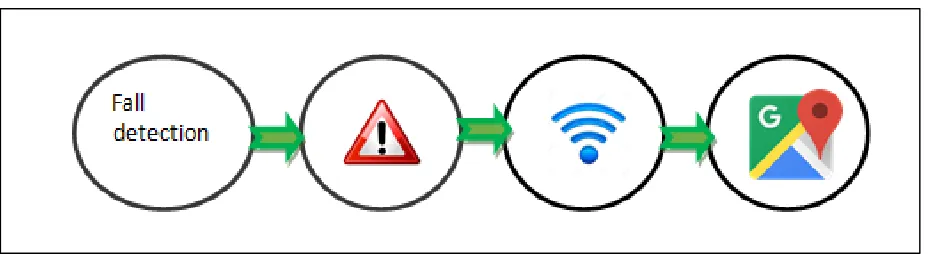
Figure 2. System Functioning
V. ALGORITHMIC FUNCTION
For any two points on a sphere, the haversine of the central angle between them is given by:-
Where,
hav is the haversine function:
d is the distance between the two points (along a great circle of the sphere; see spherical distance), r is the radius of the sphere,
φ1, φ2: latitude of point 1 and latitude of point 2, in radians λ1, λ2: longitude of point 1 and longitude of point 2, in radians
On the left side of the equals sign d/r is the central angle, assuming angles are measured in radians (note that φ and λ; can be converted from radians to degrees by multiplying by 180/π as usual).
Solve for d by applying the inverse haversine (if available) or by using the arcsine (inverse sine) function:
Volume 4, Issue 4, 2017
37
Volume 4, Issue 4, 2017
38
VII. SUMMARY
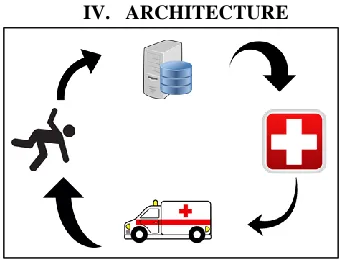
The architecture of the proposed fall accident detection and rescue system is shown in figure. As can be seen in figure, the proposed system is mainly composed of three blocks: the smart phone-based pocket fall accident detector, the coordination center, and the rescue center which is composed of the hospitals nearby or the first-aid stations.
As can be seen in the part of smart phonbased pocket fall accident detector, the triaxial accelerometer and the e-compass will be used to acquire the posture of motion activities for the elderly. In the proposed system, the inclusion of the e-compass is to acquire the tilt angle, i.e., pitch, of the smart phone. This is because when the elderly is suffering a fall accident event, the smart phone in the user’s pocket also tends to lie down, and the pitch angle is usually small. Actually, the work of acquiring the pitch angle of the smart phone can also be accomplished by using a gyroscope that provides the angular acceleration information of the smart phone.
However, the gyroscope is only available in higher grade smart phones. On the contrary, the e-compass is available in most of the smart phones. Furthermore, the tilt angle (pitch angle) of the smart phone can be estimated by using the e-compass in conjunction with the triaxial accelerometer. We, therefore, decide to use the e-e-compass for the estimation of pitch angle so that the proposed algorithm can be applied for most of the smart phone systems.
VIII. CONCLUSION
Hence, we have discussed the papers that have been presented in the literature survey. We have discussed the ideas, methodologies and the technologies used that have been implemented in the papers specified in the literature survey. All of these technologies have been used only for the purpose of minimizing the time used to accompany and heal the victim of a particular accident. Such technologies are time-reducing, saving precious lives in the process.
REFERENCES
[1] Lih-Jen Kau, Chih-Sheng Chen, “A Smart Phone-Based Pocket Fall Accident Detection, Positioning, and Rescue System”, IEEE Journal of Biomedical and Health Informatics, Vol. 19, No. 1, January 2015.
[2] Bruno Fernandes, Vitor Gomes, Joaquim Ferreira and Arnaldo Oliveira, “Mobile Application for Automatic Accident Detection and Multimodal Alert”, 2015 IEEE.
[3] Xiuquan Qiao, Wei Yu, Jinsong Zhang, Wei Tan, Jianchong Su, Wangli Xu, and Junliang Chen, “Recommending Nearby Strangers Instantly Based on Similar Check-In Behaviors”,IEEE Transactions on Automation Science and Engineering, Vol. 12, No. 3, July 2015.
[4] Yunwoo Lee, Joonhwan Lee, Dongsoo S. Kim, Hyunseung Choo, "Energy-Efficient Adaptive Localization Middleware Based on GPS Embedded Sensors for Smart Mobiles“
[5] Juan Cheng, Xiang Chen, Minfen Shen, "A Framework for Daily Activity Monitoring and Fall Detection Based on Surface Electromyography and Accelerometer Signals", IEEE Journal of Biomedical and Health Informatics, Vol. 17, No. 1, January 2013
[6] Adel Rhuma, Miao Yu, and Jonathon Chambers, "Posture Recognition Based Fall Detection System", November 2013
[7] Lina Tong, Quanjun Song, Yunjian Ge, Ming Liu, "HMM-Based Human Fall Detection and Prediction Method Using Tri-Axial Accelerometer", IEEE Sensors Journal, Vol. 13, No. 5, May 2013
[8] Tal Shany, Stephen J. Redmond, Michael R. Narayanan, Nigel H. Lovell, "Sensors-Based Wearable Systems for Monitoring of Human Movement and Falls", IEEE Sensors Journal Vol. 12, No. 3, March 2012
[9] Jorge Zaldivar, Carlos T. Calafate, Juan Carlos Cano, Pietro Manzoni, "Providing Accident Detection in Vehicular Networks Through OBD-II Devices and Android-based Smartphone’s", 2011 IEEE