169
Available online at www.ijiere.com
International Journal of Innovative and Emerging
Research in Engineering
e-ISSN: 2394 - 3343 p-ISSN: 2394 - 5494
POST OCCUPANCY EVALUTION OF GREEN BUILDING
FOR LIGHTING AND ACOUSTIC QUALITY
E. Yazhini1
aand DR. K. Yogeswari2
baM.Tech (CEPM) B.S.Abdur Rahman University, Chennai, Tamilnadu, India
ABSTRACT:
Post Occupancy Evaluation is a structured review of the functional, operational and strategic performance of the building during occupation. The role of the building is that it should support the health and comfort of the occupants using it. In order to find out how well the building meeting the user needs and requirements, it is appropriate to evaluate the building performance of the existing occupied building. This paper focus on the evaluation of lighting quality and acoustic quality in B.S. Abdur Rahman University. The parameters were measured in a quantitative method. The result shows that the lux level is not achieved as per the standard in most of the areas and the sound level is totally outside the limit of standards.
Keywords: Post-occupancy evaluation, building performance, lighting quality, acoustic quality.
I. INTRODUCTION
The building performance concept has been identified as a suitable approach for the development of the assessment framework as it addresses a set of coordinated strategies aimed at bringing about a performance and quality driven construction industry. It also examines and develops processes contributing to the delivery of integrated and high performance buildings with respect to needs and resource availability. The performance assessment system would create a yardstick by which building performance can be benchmarked. The benchmarking would allow for comparisons between the different existing buildings and identify buildings that are not performing as expected.
The aim of green building is to create buildings that preserve the environment and conserve natural resources, as well as to provide a ‘healthy’ environment for its occupants. A healthy environment is one that does not cause disease, promotes well-being and, in the case of places for work and learning (i.e. schools), promotes productivity. An important aspect of the built environment often overlooked or undervalued in design is the lighting and acoustical environment.
The study aims to formulate a holistic objective measure that amalgamates the building performance indicators. The Performance concept is adopted as the basic framework to develop an integrated index for assessment of the performance of buildings. The assessment framework is underpinned by two performance mandates namely: lighting Performance and Acoustic Performance. Within each of these mandates, basic attributes and features are identified as key performance indicators for assessment of the mandates. In order to determine the weights of the performance mandates and the corresponding performance indicators, an expert survey was carried out to establish the ratings and priorities to be placed on the performance parameters.
In view of this, a systematic and objective way of evaluating building performance is essential in the local context. Through the evaluation of occupied facilities, their performance can be reviewed to assure user satisfaction. The building Performance approach is suitably adequate to be adopted in the development of a performance based assessment system because it is holistic and facilitates integration of all the different systems within the building.
II. POST OCCUPANCY EVALUATION
170 To date, there are no in-depth studies on building assessment system carried out in the tropics which might be applicable to buildings in our country. Therefore, the development of such a system would greatly benefit countries in the tropics. Hence there exists a need to create a comprehensive building performance assessment framework and thereby to identify performance attributes relevant to the country. The POE concept has been identified as a suitable approach for the development of the assessment framework as it addresses a set of coordinated strategies aimed at bringing about a performance and quality driven construction industry.
The performance assessment system would create a yardstick by which building performance can be benchmarked. The benchmarking would allow for comparisons between the different existing buildings and identify buildings that are not performing as expected. Hence, this study aims to develop a method for the holistic assessment of building performance with respect to users’ satisfaction in a physically safe and sound environment. In view of this, a systematic and objective way of evaluating building performance is essential in the local context. Through the evaluation of occupied facilities, their performance can be reviewed to assure user satisfaction. The Post Occupancy Evaluation (POE) approach is suitably adequate to be adopted in the development of a performance based assessment system because it is holistic and facilitates integration of all the different systems within the building.
III. LIGHTING QUALITY AND ACOUSTIC QUALITY
A. LIGHTING QUALITY
Research undertaken by Bülow-Hübe (2008) [15], recognizes that lighting quality is influenced by factors such as the window area. The author states that bigger window area will result in higher occasion that a window might generate glare. Installation of blinds or curtains in interior of building can then help in achieving a glare free environment.
According to Altan et al (2008) [13], the tendency of Architect to design buildings enclosed with glazing is anticipated to lower the IEQ of the building due to excessive glare caused by the too much radiation of natural light which hereafter causes visual discomfort to the occupants.
Bülow-Hübe (2008) [15], agreed that when the building environment is free from glare issues and achieved visual comfort among the building users, the building is held to have good IEQ.
According to De Carli & De Giuli (2009) [16], most design professionals fail to include lighting requirements at the initial stage, forgetting the fact that this oversight will affect productivity in the workplace if lighting requirements are not met.
According to AL-Anzi (2009) [17], the recent technological development of lighting has forced designers to include lighting as a necessity in the building. The light is supposed to support both paper-based and computer-based work, which makes it difficult for the occupants to adjust the lights to meet both requirements. Light emitted by the computer also contributes some setbacks to the occupants’ health if the screen light is not set correctly.
Samani (2011) [18], suggests that poor quality of lighting in the workplace will cause eyestrain, which leads to dizziness and stress. Occupants will become disgruntled because of their dissatisfaction with the lights in the building, which will result in reduced productivity. Occupants will start spending long periods away from work to consult a medical expert for treatment of their eyes and/or vision problems.
Samani (2011) [18], shown that light sends visual messages to the occupants of the building, which could decrease or increase the good mood and motivation levels of the individuals in the building. Quality of lighting in the office building is linked to productivity, because without high-quality lights in the building, the productivity drops.
A study by Codreanu (2013) [14], shown that visual comfort is one of the physical criterias for the building occupants to identify their comfort level in indoor environment thus achieve good IEQ.
Accordng to Codreanu (2013) [14], visual comfort is achieved when the illuminance and luminance levels (lux) are maintained in good conditions.
B. ACOUSTIC QUALITY
171 According to Genuit (1996) [12], acoustic quality is undesirable when the sound created has been observed as obnoxious, frustrating or distressing, vice versa.
Vischer (2008) [19], shown that a proper set-up stimulates interaction between the occupants, which will increase productivity in the workplace. Adequate workspace layout will increase the occupants’ concentration and interaction with one another when carrying out work tasks. There is a correlation between the design of workspace and occupant performance. A well-designed workspace stimulates the occupants’ performance, because occupants will always feel motivated to report to work regularly, unlike having to work in an unplanned workspace.
According to Hongisto (2008) [20], strategic thinking is required if the person wants to reduce the noise level, by increasing the room’s capacity for absorption, increasing screen height, and increasing the masking of the sound level.
According to AL-Anzi (2009) [17], college noise, as an indoor environmental factor, disturbs all occupants and can be extremely irritating. Noise can deter occupants from concentrating on their work. Many researchers have acknowledged this, and have produced findings that noise may lead to stress, headaches and other disorders.
According to Kim and Haberl (2012) [10], acoustic quality is studied to pinpoint the sound or vibration isolation and the level of noise from background.
IV. MATERIALS AND METHOD
C. SITE DESCRIPTION
One of the ‘Green building’; selected in this study is an Educational building in Chennai i.e., B.S.Abdur Rahman University which is located in Vandalur, Chennai. It is a multi-storey building which is consist of G + 5 floors. The facility has a total Gross square footage of 121,881 sqft.
Figure 1. Front elevation of building (source: BSAU)
172
D. METHODOLOGY
The research adopted a design strategy that involves an approach of quantitative method. This research was carried out in three phases; the first phase involves preliminary study, literature review, and mapping of previous studies. After the completion of the first phase, the second phase of the research began with preliminary study, framework testing, and data collection. The third phase or the final phase involved, data analysis, comparing to the codes and norms and finally conclusion.
The field measurement focuses on measuring the lighting quality and acoustic quality in the educational building. Lighting was measured using the digital lux meter and the acoustic was measured using the digital sound meter. All the readings were taken at a centre height of 1.3 m above floor level, which represents the approximate height of seated level of students. The readings were taken in all five floors and in each floor one room is selected in each direction to take readings. The readings were taken at the time interval of 9am and 4pm for every three weeks in a month and the process was repeated for a total period of three months.
Figure 3. Digital lux meter Figure 4. Digital sound meter
All collected data of the indicators is analyzed and compared to the codes and the standards to achieve the research objective. The parameters are verified whether it is within the Green Building Standards. Then the parameter is monitored and verified by analyzing the data based on the codal performance of the indicators. After analysis being reviewed, the author suggests and recommends ways to improve the indoor building environment and also concludes all findings and provides future study recommendation.
V. RESULTS AND DISCUSSION
E. LIGHTING QUALITY
The lighting quality parameter was measured using digital lux meter in the months of October, November and December of the year 2016. The readings were taken at the time interval of 9am and 4pm for every three weeks in a month and the process was repeated for a total period of three months. The average maximum and minimum value is calculated from the three months reading. Using statistical tool (Microsoft excel) the data was presented below.
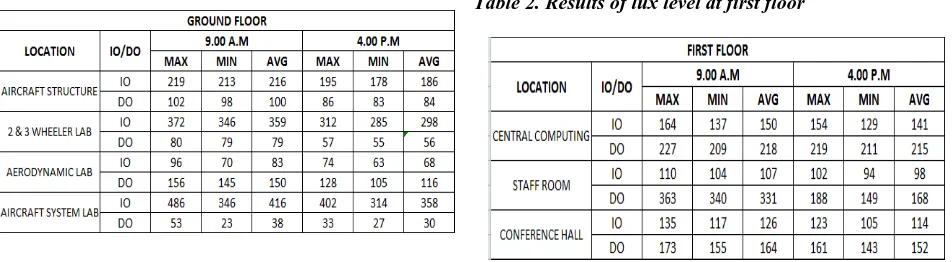
Table 1. Results of lux level at ground floor Table 2. Results of lux level at first floor
173 laboratory the lux level should be between 500- 750 lux. Based on table 1 and table 2, it shows that ground floor and first floor has lowest lighting lux in all four rooms in both the time intervals.
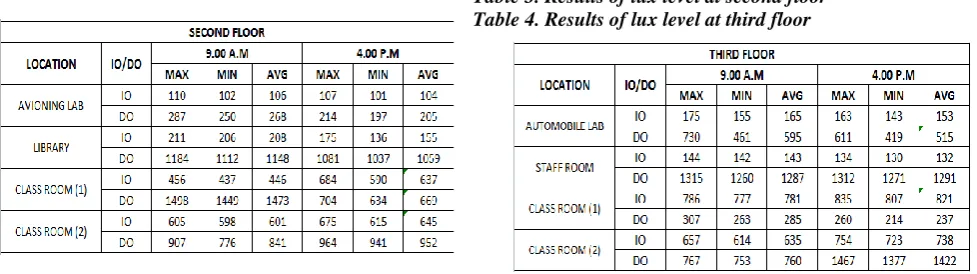
Table 3. Results of lux level at second floor Table 4. Results of lux level at third floor
Based on table 3, it shows that during morning time the avioning lab and library have lowest lighting lux. However, the class room (1) lux value is as per the standard and the class room (2) has highest lux value. During evening time all the four rooms lux level are not as per the standard. The table 4 shows that both morning and evening time the automobile lab and staff room have lowest lux level and the class room (1) and class room (2) have highest lux level.
Table 5. Results of lux level at fourth floor Table 6. Results of lux level at fifth floor
Based on table 5, it shows that only class (1) lux level is as per the standard in both the time intervals. The staff room have relatively poor lighting; the artificial lighting is installed onto the suspended ceiling. However, the class room (1) and class room (2) having stronger lighting. The table 6 shows that only class (1) lux level is as per the standard in both the time intervals. The empty room have relatively poor lighting; the artificial lighting is installed onto the suspended ceiling. However, the class room (1) and class room (2) having stronger lighting.
F. ACOUSTIC QUALITY
The acoustic quality parameter was measured using digital sound meter in the months of October, November and December of the year 2016. The readings were taken at the time interval of 9am and 4pm for every three weeks in a month and the process was repeated for a total period of three months. The average maximum and minimum value is calculated from the three months reading. Using statistical tool (Microsoft excel) the data was presented below.
Table 7. Results of sound level at ground floor Table 8. Results of sound level at first floor
174 As per the code ISO 16032; 2004, the acoustic comfort for educational building should be less than the limit of 50 dB. The table 7 and table 8 reveal that the measured sound level is above the recommended limit.
Table 9. Results of sound level at second floor Table 10. Results of sound level at third floor
Based on the table 9 and table 10, it shows that the acoustic level measured in the second and third floors is greater than the recommended limit of ISO standard.
Table 11. Results of sound level at fourth floor Table 12. Results of sound level at fifth floor
Based on the table 11 and table 12, it shows that the acoustic level measured in the second and third floors is greater than the recommended limit of ISO standard. Failure to resolve the problems and create satisfactory acoustical environments may limit the evolution of building and compromise sustainable development. The results of this study confirm that improving acoustical environments in buildings fundamentally requires good acoustical design with input from an acoustical specialist integrated into the design team from the beginning of the design process.
The results indicate that there exist a significant difference between the standard building performance and actual building performance. The measured values of lighting and acoustic gave consistently higher value when compared to the codes. Based on the analysis it indicates that the comfort zone of the occupant is relatively outside the standard.
VI. CONCLUSION The results obtain can be summarize in the following paragraphs:
1. Both the indoor and outdoor lux level value raises from 500- 1000 lux and lowers to 100- 300 lux in most of the area and from out of 24 rooms only 5 rooms in the morning and 2 rooms in the evening are as per limit ASHRAE standard. Most of the range of lux level is outside the limit of ASHRAE standard.
2. Considering the statistical analysis of the data, the lux level specified by the standard should be below 500 lux. But the statistical analysis reveals that, the values are much higher and lower than the standard in most of the area.
3. The acoustic quality results indicate negative results in all areas. The sound level specified by the standard should be less than or equal to 50 dB, but all the areas are outside the limit of ISO standards.
175 REFERENCE
[1] Ishan G.Kevadiya, Ankush A.Patil and Shruti-Mrudula N.Waghmode, “Sustainable Construction: Green Building Concept – A Case Study”, International Journal of Innovative and Emerging Research in Engineering, vol. 2 (2), pp. 59-65, February 2014.
[2] B.Pritam, B.Mukta, “A Post-occupancy Evaluation of Patient’s Perception of Visual Comfort in Hospital Wards” International Journal of Environmental Sciences, Volume 3, No 3, 2012.
[3] Tiow Chai Yee, “Indoor Environmental Quality (IEQ): A Case Study in Taylor’s University, Malaysia” International Journal of Engineering and Applied Sciences, Vol.5. No. 07, Dec. 2014.
[4] Lukumon O. Oyedele, Kwok Wai Tham, Moshood O. Fadeyi, and Babatunde E. Jaiyeoba, “Total Building Performance Approach in Building Evaluation: Case Study of an Office Building in Singapore” J. Energy Eng., 138(1), p. 25-30, 2012
[5] Ban-Huat Ng and Zainal Abidin Akasah, “Post Occupancy Evaluation of Energy-Efficient Buildings in Tropical Climates – Malaysia” Archnet-IJAR, Volume 7, Issue 2, July 2013.
[6] Natasha Khalil, “Performance Analysis of Government and Public Buildings via Post Occupancy Evaluation” Asian Social Science, Vol. 4, No. 9, 2008.
[7] Mohmed Solla, Lokman Hakim Ismail, and Riduan Yunus, “Evaluation of Non-Residential Green Building in Malaysia” International Conference Data Mining, Civil and Mechanical Engineering (ICDMCME) Feb. 1-2, 2015.
[8] Md Azree Othuman Mydin, Norazmawati Md Sani, Mazran Ismail, “Evaluation of Indoor Environment Quality (IEQ) of Educational Buildings” Journal of Environment and Earth Science, Vol 2, No.8, 2012. [9] S. Abbaszadeh1, L. Zagreus1, D. Lehrer1 and C. Huizenga1, “Occupant Satisfaction with Indoor Environmental
Quality in Green Buildings” Proceedings of Healthy Buildings, Vol. III, p. 365-370, 2008.
[10] Kim, H. & Haberl, J. S. “Field-Test of the New ASHRAE/CIBSE/USGBC Performance Measurement Protocols: Intermediate and Advanced Level Indoor Environmental Quality Protocols” ASHRAE Transactions, pp. 58-65, 2012.
[11] Watson, C. “Review of building quality using post occupancy evaluation.” Journal of Programme Education Building, vol. 35, p. 1-5, 2003.
[12] Genuit K. “Objective Evaluation of Acoustic Quality Based on a Relative Approach.” Proceedings-Institute of Acoustic, vol. 18, p. 3233-3238, 1996.
[13] Altan, H., Ward, I., Mohelníková, J. & Vajkay, F. “Daylight, Solar Gains and Overheating Studies in a Glazed Office Building.” International Journal of Energy and Environment, 2(2), 129-138, 2008.
[14] Codreanu, M. “Indoor Environmental Quality. Risk Assessment Concerning Occupants Comfort and Health’, Bulletin of The Polytechnic Institute Of Iasi.” Construction & Architecture Section, 63(1), 191-201, 2013. [15] Bülow-Hübe, H. “Daylight in Glazed Office Buildings. A Comparative Study of Daylight Availability,
Luminance and Illumince Distribution for an Office Room with Three Different Glass Areas” Division of Energy and Building Design Department of Architecture and Built Environment. Lund University. Faculty of Engineering, 2008.
[16] Michele De Carli and Valeria De Giuli “Optimization of Daylight in Buildings to Save Energy and to Improve Visual Comfort: Analysis in Different Latitudes” Eleventh International IBPSA Conference Glasgow, Scotland, July 27-30, 2009.
[17] Al-Anzi, N. M. “Workplace environment and its impacts on employee’s performance: A study submitted to Project Management Department in Saudi Aramco”, Open University of Malaysia, 2009.
[18] Samani, S.A. “The influence of light on student’s learning performance in learning environments: A knowledge internalized perspective” World Academy of Science, Engineering and Technology, pp. 540-547, 2011.
[19] Vischer, J.C. “Towards an environmental psychology of workspace: How people are affected by environments for work” Architectural Science Review, pp. 97-108, 2008.