University of Mazandaran, Iran
http://cjms.journals.umz.ac.ir
ISSN: 2676-7260 CJMS.9(1)(2020), 68-89
Mathematical modeling of dynamics behavior of terrorism and control
Adamu Gambo1; Ibrahim Mohammed Olarewaju2
12 Department of Mathematics, University of Ilorin, Nigeria
Abstract. Terrorism is generally understood to be the use of threat or extra-normal violence to gain ideological reasons and per-sonal benefit. In this paper, a mathematical modelling of terrorism with military strategies and rehabilitation of terrorists was con-structed. The model is developed to control the spread of terrorist ideologies in society and suitable to describe a terrorist group. The population is divided into six compartments:S(t),I(t),T(t),TL(t),
TS(t) andQT(t). Furthermore, the basic reproduction number,R0
is also calculated ifR0<1 means the terror-organization is nearly eradicated and if R0 > 1 means the number of terrorists is high where the terrorist are endemic to the population. The result of the sensitivity analysis shows that the most sensitive parameters are the recruitment pool of the terrorist from susceptible to mod-erate (β1) and terrorist move to detention facilities due to counter-terrorist activities (b). The least parameter is the probability at which terrorist become militancy leaders (kα). (β1) and (b) are parameters counter-terrorist need to be target. The finding shows that the military/dialogue strategies are to be used while military strategies alone should not be used if the number of terrorists is below a certain basic reproduction number.
Keywords: Counter-Terrorist, Modelling,Terrorism, Dynamic and Sensitivity Analysis.
2010 Mathematics subject classification: 93A30; Secondary 97M10.
1ahlul [email protected]
Received: 11 October 2019 Revised: 7 November 2019 Accepted: 10 December 2019
1. Introduction
The September 11 2001 attack, known as (9/11) in Washington, D.C., New York and Pennsylvania were acts of war against the entire world. This marked the global counterterrorism operation. According to [21,24,
25] terrorism can be defined as an unlawful organization, attempting or threatening to cause death or serious bodily injury to any person, caus-ing damage to private property includcaus-ing public places or government facilities. Although, the [27] adopted at its 814th and 8496th meetings, stressing the primary responsibility of member states in countering ter-rorist acts and reiterating their obligation to prevent and suppress the financing of terrorist acts as well as the call upon all states to become party to the international counter-terrorism conventions and protocols as soon as possible. Similarly, [13] stated that there is no single in-ternationally accepted definition of what constitutes terrorism and the terrorism literature abounds with competing definitions. [22] defined terrorism as an extra normal violent or threat to gain a political ob-jective and intimidating innocent people to adopt their ideology by all means. Also,the level of violence and terrorist activities in Iraq and Syria have fallen considerably in the last two years. Iraq recorded the biggest fall in 2017, a trend which seems to have continued in 2018. The Islamic State of Iraq and the Levant (ISIL) known as Islamic states of Iraq and Syria (ISIS) has lost most of its territory and sources of revenue in Syria and Iraq. However, affiliate groups in other regions are becoming more active. In the Maghreb and Sahel regions of Northern Africa, there has been a resurgence of terrorist activity in the past two years, most notably of Al-Qaida. As at March 2018, there were more than 9,000 members of terrorist groups active in the region, mostly concentrated in Libya and Algeria [13]. Al-Shabaab, a Salafist militant group is active in East Africa. It emerged first in a battle over Somalias capital in the summer of 2006. As an Al-Qaida affiliated terrorist group based in Somalia and Kenya, Al-Shabaab pursues Islamist statehood aspirations in Somalia [13].
third by number of deaths. Terrorist activity in Nigeria is dominated by two groups which are Boko-Haram and Fulani extremists. In 2017, Boko Haram was the deadliest group in Nigeria with both terrorism deaths and attacks increasing over the prior year. Deaths increased from 34 per cent to 1,022 while attacks increased from 62 per cent to 222. The Fulani extremists were less active in 2017 than the prior year with terrorism deaths dropping from 60 per cent to 321, and attacks dropping from 51 per cent to 72. However, preliminary data for 2018 suggests that there has been a significant increase in violence committed by Fulani extrem-ists. Together, Boko Haram and the Fulani extremists are responsible for 63 per cent of terror attacks and 88 per cent of terror-related deaths in Nigeria. The Borno state is home to Boko Haram. It has experienced the highest level of terrorist activity in Nigeria with all deaths caused by Boko Haram. In 2017, 62 per cent of deaths in Nigeria occurred in Borno state. The group is also active in Chad, Cameroon and Niger and has disrupted Foreign Direct investment and humanitarian efforts in Nigeria and its neighbouring countries. In 2016, Boko Haram splintered into two groups. The newer Islamic State West African Province (ISWAP) de-clared allegiance to ISIL in 2015. Both groups see themselves as affiliates of ISIL [13].
The transmission dynamics and spread of terrorism like a disease in-fections was that of [4,5,8,14,19,21,22]. [4] formulated a mathematical model of terrorist and fanatic groups with two models in which the pop-ulation is divided into non-core and core-groups. The first model consid-ered the case of two core populations with no cross interaction between the sub-populations and both core-groups drawn from the same general population. The more efforts the organization implements to recruit and retain its members the more effective it will be in transmitting the ideol-ogy to other vulnerable individuals. The model ignored military/police intervention to combat terrorist risk posed to the society.
[23] developed a deterministic Model of optimal human resources alloca-tion in counter-terrorism operaalloca-tion to study the possible strategies for allocating counter-terrorism resource towards a long-term solution of a given terrorist group. They constructed a simple set of coupled differ-ential equations whose variables are internal and external dynamics of the organization.In their model, detention/rehabilitation facility was ig-nored.
was not specified. Also, [20] developed a deterministic model for rad-icalization process in Kenya and used the model to assess the impact of rehabilitation centers to radicalization burden but ignored detention facility in the model.
Similarly, [21] built a simple compartmental model suitable to describe de-radicalization programs. The population is divided into four com-partments susceptible (S), extremists (E), recruiters (R), and treatment (T) to combat the extremist.Their model failed to incorporate force re-cruitment after treatment from susceptible to extremists or recruiters. Also, [8] developed a mathematical models of radicalization and terror-ism with two cross section to describe a dynamics transition between the various sub-populations. The first model is and individual who pro-gresses from non-radical towards a hierarchy of susceptible and moved to moderate group before becoming fanatics. The second model is two radical group, which originates from the susceptible before becoming fully fanatic without control strategies.
On the other hand, [3] built a model by incorporating optimal con-trol of counter-terrorism tactics which classified counter terrorism into two categories fire and water control respectively. The model failed to incorporate some parameters like surveillance, detention/rehabilitation facilities, force recruitment etc. Also,[1] developed a model of terror-ist that incorporated optimal control using Differential Transformation Method (DTM) and the result show that knowing the best strategy does not imply optimality but accuracy in result compared to other methods. Similarly, [24] built a dynamical model of terrorism by incorporating the effects of direct military/police intervention to reduce the terrorist population. They affirmed that using military/police intervention may reduce the threat of terrorism. Further, [12] built a dynamic model of suicide terrorism and political mobilization which enables predictions to emphasized or de-emphasized by the forces in protecting society. [6] compared what they call fire and water strategies. Further studies on the eradication of terrorism have been given by [18]. The following exist-ing models are that of [7,8,22]. The objective of this paper is to modify the existing models including force recruitment rates, which are from susceptible to terrorist and detention facility/rehabilitation centres such that the model will be in the form of (SITQ).
2. Model Formulation
2.1. Model Description. In this paper, the populations of interest are SusceptibleS(t), Moderate I(t) , TerroristT(t) Terrorist soldiersTS(t),
Terrorist leadersTL(t) and Detention facilityQT(t). Susceptible
individuals have contact(s) with some terrorists, the probability of em-bracing the ideologyβ1 but embracing the ideology did not make them
extremist except with a proportion ofβ2chance for which the individual
move to terrorist group. The terrorist group is further split into foot-soldiers TS(t) and leaders TL(t), alternatively to become extremist in
terrorism this depends on the moderate individual increase in relation with either terrorist leader or foot soldiers. Due to counter-terrorist op-erationsπ terrorism some individuals enter detention facilities and later fall back for some reasons from quarantine to terrorist at rateδ. Some time, foot soldiers move to detention facilities if surrender or capture by military counterterrorism activities with rate atcand later fall back to susceptible group after certified repentance/rehabilitation or end jail term at ratea, but some time terrorist can move to detention facilities if same operation applied on them. The parameterdis considered to be induced death rate of terror either by suicide attack or counter-terrorist activities, whileη is individual death due to torture or life jail in deten-tion facility andµ represents natural death in each compartment.
The model for terrorism network is given by the subsequent deter-ministic system of non-linear differential equations.
dS
dt = Λ +aQT −eS−µS−β1 T NS dI
dt =β1 T
NS−µI−β2 T NI dT
dt = β2T I
N +δQT +eS−bT −παT −(µ+d)T −(1−k)αT dTS
dt =παT−cTS−(µ+d)TS dTL
dt = (1−k)αT −(µ+d)TL dQT
dt =bT+cTS−(a+δ+µ+η)QT
N =S+I+T +TS+TL+QT
(2.1)
Assumption of the Model: From the model above, there is a sub-population potentially at risk of adopting the ideology from the general population. The sub-population is divided into six compartments Susceptible S(t), Moderate I(t),Terrorist T(t), Leader TL(t) and Foot-soldiers TS(t) and
Detention facilities QT(t). The contact rate at which susceptible are
recruited to adopt the extremist ideology is β1T S, while β2T I is the
conversion rate from moderate to terrorist. The rate at which individu-als leave the terrorist compartment to enter foot soldiers isα, where k is the fraction at which terrorist successfully become leaders. It is as-sumed that the average time individuals spent at the transition rate of militancy is α1. Moderates and terrorists are assumed to have frequent contacts with susceptible individuals. 1−kis the probability of some in-dividual terrorists becoming leaders after being fully indoctrinated into the ideology and k ∈ [0,1] of terrorist. Since terrorism is not perma-nently recovered, some individuals may fall back to T(t) from QT(t)
with the rates δ, while some leave QT(t) to S(t) after being certified
by counter-terrorist in detention facilities. The rate c enters detention due to counter-terrorist activities. These rates account for individuals that are imprisoned for life. Certified repentance rates from detention facilities to susceptible isaand the individual death rate due to torture isη and not all individuals in the compartmentalQT(t) are terrorist. It
assumed that the populations are susceptible, moderate, terrorist and detention facilities while terrorist group is further sub-divided into foot soldiers and leaders. Finally, it is assumed that everybody in the popu-lation has same average natural death rateµ.
The description of variables and Parameters of model formulated are
S(t) Susceptible (self identification),I(t) Semi-terrorist (moderate),T(t) Terrorist,TL(t) Leaders,TS(t) Foot-soldiers, QT(t) Detention facilities,
death due to torture and life jail in detention,β1 rate at which terrorist
recruit their members, β2 Per capital recruitment rate into, µ natural
death rates,α rate at which terrorist become foot soldiers or leaders, k
is fraction at which terrorist successfully become leaders,kαis the prob-ability at which terrorist become militancy leaders. (1−k) is probability that not all individuals terrorist become leaders,δ rate at which individ-ual fall back to T(t) from QT(t),c rate at which terrorist soldiers enter
detention due to counterterrorist activities, a certified repentance/end jail term rates from detention facilities to susceptible,bterrorist made to enter the detention facilities due to counter-terrorist operations,eis per capital recruitment from susceptible to terrorist and πα is the rate at which military control strategies/dialogue applied to terrorist that be-come foot soldiers, whileαis the rate at which terrorist move to become foot soldiers.
3. Basic Properties of the Terrorism Model
3.1. Invariant Region. The population size N can be determined by
N =S+I+T+TS+TL+QT or from the non-linear differential equation
of the model formulated
dN
dt =
dS
dt +
dI
dt +
dT
dt +
dTS
dt +
dTL
dt +
dQT
dt
(3.1)
This can be reduced to;
dN
dt = Λ−µ(S+T +TS+TL+QT),which implies that
dN
dt = Λ−µN (3.2)
SinceN =S+I+T+TS+TL+QT, and equation (3.2) resolved to
linear differential equation of the form
dN
dt +µN = Λ (3.3)
Lemma 3.1. The model system of equation (2.1) has solution which is contained in the feasible domain Ω, by following the idea in [9].
Theorem 3.2. The solution of the system of equation (2.1) is feasible for t <0 if they enter the invariant region Ω.
Proof: Let (S, I, T, TS, TL, QT)∈R6 be any solution of the system
by using integrating factor (IF), exp(R pdx) = exp(R µdt) = exp(µt). Multiplying both sides of equation (3.2) by IF gives;
exp(µtdN
dt ) = Λ exp( Z
µt) (3.4)
Integrate equation (3.4) above, which gives:
N(t) exp(µt) = Λ
µexp(µt) +K, where K is constant and divide both
sides by exp(µ) then applying initial condition att= 0
N(t) = Λ
µ +Kexp(−µt) (3.5)
N(0) = Λ
µ +K, this implies that K =N(0)−
Λ
µ
Therefore, substitute the value ofK in equation (3.5) gives;
N(t) =N(0) exp(−µt) +Λ
µ(1−exp(−µt)) (3.6)
N(0)≤ Λ
µ (3.7)
Therefore, as t→ ∞ in equation (3.6) the human populationN ap-proaches K = Λµ i.e. N →K = Λµ The parameter K = Λµ is called the caring capacity.
Hence, all feasible solution set of the human population of the model system (2.1) enter the region
Ω =
(S, I, T, TS, TL, QT)∈R+6 :S, T, TS, TL, QT ≥0;N ≤
Λ
µ
(3.8)
which is a positively invariant set under the flow induced by the model (2.1). Therefore the model equation (2.1) is mathematical well posed in the domain. Thus, in this domain, it is sufficient to consider the dynamics of the flow generated by the model (2.1). In addition, the usual existence, uniqueness and continuation of results hold for the system in [11].
4. Existence and Positivity of Solutions
Here, the following results guarantee by the terrorist model governed in equation (2.1) is well-posed in a feasible region Ω.
Lemma 4.1. Let the initial conditions be{S(0)>0,(I(0), T(0), TS(0), TL(0)>0, QT >0)} ∈Ω,
then the solution set {S, I, T, TS, TL, QT}(t) of the model system (2.1)
Proof: The first equation of the model (2.1) gives;
dS
dt = Λ +a Qt−
e+µ+β1T
N
S ≥ −
e S+µ S+β1T
N S
(4.1)
Thus,
dS
dt ≥ −
e+µ+β1T
N
S
By using the separation of variable
dS
S ≥ −
e+µ+β1T
N
dt
Integrating both sides of the inequality yields:
Z dS
S ≥ −
Z
e+µ+ β1T
N
dt
lnS(t)≥ −
e+µ+β1T
N
t+K
S(t)≥Kexp
−e+µ+β1T
N t (4.2)
Then at t= 0
Applying the initial condition which gives; ‘S(0)≥0 therefore;
Similarly, it can shown thatI(t), T(t), TS(t), TL(t) andQL(t)>0 for all
t≥0.
5. Existence of Terrorist-Free Equilibrium and Basic Reproduction Number
Terrorism-free equilibrium points are steady-state solutions where there is no terrorist. Thus, the terrorism-free equilibrium points E0,
for the terrorist model give I∗ = 0, T∗ = 0, TS∗ = 0, TL∗ = 0 and by solving the model equations using the idea in [29, 30] yields
E0= (
Λ
µ,0,0,0,0) (5.1)
fi(x) is the rate of appearance of new infections in compartmenti, and
vi(x) is the net decreasing rate of infections in compartment i due to
infective flow inside system of infected compartments.
If F = (f1, ...f2n) and V = (v1, ...v2n), let partition the derivative
DF(E0) and DV(E0) as
DF(E0) =
F 0
0 0
, DV(E0) =
V 0
J3 J4
where F = ∂F1 ∂I ∂F1 ∂T ∂F1 ∂TS ∂F1 ∂TL ∂F2 ∂I ∂F2 ∂T ∂F2 ∂TS ∂F2 ∂TL ∂F3 ∂I ∂F3 ∂T ∂F3 ∂TS ∂F3 ∂TL ∂F4 ∂I ∂F4 ∂T ∂F4 ∂TS ∂F4 ∂TL
(x0), V =
∂V1 ∂I ∂V1 ∂T ∂V1 ∂TS ∂V1 ∂TL ∂V2 ∂I ∂V2 ∂T ∂V2 ∂TS ∂V2 ∂TL ∂V3 ∂I ∂V3 ∂T ∂V3 ∂TS ∂V3 ∂TL ∂V4 ∂I ∂V4 ∂T ∂V4 ∂TS ∂V4 ∂TL
(x0)
The next generation matrix: Is the method used to drive R0, for a
compartmental model of the spread of terrorism. This method is given by [10, 30] used to discuss basic reproduction number of the system (2.1). It is clear to see that the system (2.1) has terrorism-free equilibrium.
E0 = (
Λ
µ,0,0,0,0).
LetX = (S, I, T, TS, TL, QT)T, then system (2.1) can be written as
X0 =F(X)−V(X), where F = β1Λ
N µ 0 0 0
0 0 0 0
0 0 0 0
0 0 0 0
and V =
µ 0 0 0
0 A1 0 0
0 −πα A2 0
0 −A4 0 A3
V−1=
1
µ 0 0 0
0 A1
1 0 0
0 Aπα
1A2 1 A2 0
0 −A4α A1A2 0
1 A3
The basic reproduction number, denotes byR0 = Γ(F V−1), where Γ
denotes as spectral radius, and gives;
R0 = Γ(F V−1) =
β1Λ
N µ 0 0 0
0 0 0 0
0 0 0 0
0 0 0 0
1
µ 0 0 0
0 A1
1 0 0
0 Aπα
1A2 1 A2 0
0 −A4α A1A2 0
1 A3
F V−1=
β1
A1 0 0 0
0 0 0 0
0 0 0 0
0 0 0 0
R0 =
β1
A1
(5.2)
where;
A1 = (b+απ+µ+d+α−αk)
A2 = (c+µ+d)
A3 = (µ+d)
A4 =−(1−k)α
The terrorist-free equilibrium,E0
Λ
µ,0,0,0,0
of the system (2.1) is locally asymptotically stable if R0 < 1, that is, terrorism dies out and
unstable iffR0 >1 meaning the terrorist activities will persist.
The threshold quantityR0 is the basic reproduction number of the
ter-rorism. It is the transmission of a new terrorist produced by potential terrorism.
6. Existence of Local stability of Terrorist-Free Equilibrium Point
The Routh-Hurwitz criteria are use to establish asymptotic stabil-ity of equilibrium for non-linear system of differential equation. The Routh-Hurwitz criteria provide the necessary and sufficient condition for all roots of the characteristic polynomial to contain negative parts, therefore entails asymptotic stability [17]. The local stability of the equi-librium may be determined from the jacobian matrix gives
J(E0) =
e+µ 0 β1 0 0 0
0 µ 0 0 0 0
e 0 A1 0 0 0
0 0 πα −A2 0 0
0 0 −A4 0 −A3 0
0 0 b −c 0 −A5
(6.1)
J(E0−λI) =
e+µ−λ 0 β1 0 0 0
0 µ−λ 0 0 0 0
e 0 A1−λ 0 0 0
0 0 πα −A2−λ 0 0
0 0 −A4 0 −A3−λ 0
0 0 b −c 0 −A5−λ
According to [17], the Terrorist-free equilibriumE0 is locally
asymptot-ically stable when there is no terrorist. It follows that the characteristic equation of J(E0) computed from equation(6.2) is given by solving the
determinant with Maple 17 software which gives.
−eλ+eA1−β1e+λ2−λ µ−λ A1+µ A1
(µ−λ) (−A2−λ) (−A3−λ) (−A5−λ)
(6.3)
simplify the equation (6.3) gives
λ6+ (−e−2µ−A1+A2+A3+A5)λ5+ (eA1−β1e+µ A1−
(−e−µ−A1)µ−(e+ 2µ+A1)A2+ (−e−2µ−A1+A2)A3−
(e+ 2µ+A1−A2−A3)A5)λ4+ (−(eA1−β1e+µ A1)µ−
(−eA1+β1e−µ A1+ (−e−µ−A1)µ)A2+ (eA1−β1e+µ A1−
(−e−µ−A1)µ−(e+ 2µ+A1)A2)A3−(−eA1+β1e−µ A1+
(−e−µ−A1)µ+ (e+ 2µ+A1)A2−(−e−2µ−A1+A2)A3)A5)λ3+
(−(eA1−β1e+µ A1)µ A2+ (−(eA1−β1e+µ A1)µ−(−eA1+β1e−
µ A1+ (−e−µ−A1)µ)A2)A3−((eA1−β1e+µ A1)µ+ (−eA1+β1e−
µ A1+ (−e−µ−A1)µ)A2−(eA1−β1e+µ A1−(−e−µ−A1)µ−
(e+ 2µ+A1)A2)A3)A5)λ2+ (−(eA1−β1e+µ A1)µ A2A3−
((eA1−β1e+µ A1)µ A2−(−(eA1−β1e+µ A1)µ−(−eA1+β1e−
µ A1+ (−e−µ−A1)µ)A2)A3)A5)λ−(eA1−β1e+µ A1)µ A2A3A5
Collect the coefficient of the eigenvaluesλand characteristic gives
where
a= 1
a5 = (−e−2µ−A1+A2+A3+A5)
a4 = (eA1−β1e+µ A1−(−e−µ−A1)µ−(e+ 2µ+A1)A2+ (−e−2µ−
A1+A2)A3−(e+ 2µ+A1−A2−A3)A5)
a3 = (−(eA1−β1e+µ A1)µ−(−eA1+β1e−µ A1+ (−e−µ−A1)µ)A2+
(eA1−β1e+µ A1−(−e−µ−A1)µ−(e+ 2µ+A1)A2)A3−(−eA1+
β1e−µ A1+ (−e−µ−A1)µ+ (e+ 2µ+A1)A2−(−e−2µ−A1+A2)A3)A5)
a2 = (−(eA1−β1e+µ A1)µ A2+ (−(eA1−β1e+µ A1)µ−(−eA1+β1e−
µ A1+ (−e−µ−A1)µ)A2)A3−((eA1−β1e+µ A1)µ+ (−eA1+β1e−
µ A1+ (−e−µ−A1)µ)A2−(eA1−β1e+µ A1−(−e−µ−A1)µ−
(e+ 2µ+A1)A2)A3)A5)
a1 = (−(eA1−β1e+µ A1)µ A2A3−((eA1−β1e+µ A1)µ A2−(−(eA1−β1e+
µ A1
µ−(−eA1+β1e−µ A1+ (−e−µ−A1)µ)A2
A3
A5
a0 = (eA1−β1e+µ A1)µ A2A3A5
Using the Routh-Hurwitz criterion by [17], it can be seen that all the eigenvalues have negative real part and therefore the terrorist-free equi-librium is locally asymptotically stable since there is no terrorist and iff it satisfy equation (6.5)
a1 >0, a2 >0, a3 >0, a4>0, a5>0, a6>0, a1a2a3 > a0a23−a21a4 >0,
(a1a5−a0a6)(a1a2a3−a24−a0a21a5)>0, a5(a1a2−a3)2+a0a1a25>0
a6(a2a3a4−a5)3+a0a1a2a36 >0
(6.5)
6.1. Existence of Endemic Equilibrium. The endemic equilibrium point is a positive steady state solution where the terrorist persists in the population. Therefore, the model equation (2.1) has an endemic equilibrium point Ee. The endemic equilibrium of equation (2.1) is
lo-cally asymptotilo-cally stable since terrorist exist. However, whenR0 >1,
the terrorist recruitment will remain at high [19]
7. Sensitivity Analysis
Table 3. Signs of sensitivity index ofR0
Parameter Parameter value Sensitivity value Sensitivity index
β1 0.00000000056 (Assumed) 1.000000 Positive
b 0.20635 [19] 0.4914449672 Positive
kα 0.0792 [19,] -0.1886234136 Negative
µ 0.000034247 (Assumed) -0.000081562955 Negative
α 0.12 [20] -0.2857930510 Negative
d 0.0083 [19] -0.01976735269 Negative
πα 0.66 (Assumed) -0.01428965255 Negative
intervention control strategies that target such parameter should be em-ployed in the control of terrorism. In this way, parameters that are more sensitive to the terrorist are identified and, by reducing the parameters it will also reduce the transmission of the terrorist.
Definition: The normalized forward sensitivity index of a variableεthat depends differentiable on a parameterx is defined as:
Xxε = ∂ε
∂x×
x
ε (7.1)
8. Numerical Simulations
The simulations were carried out using the following variables and parameters for initial conditions. The final time wast= 6 years. Com-putations were run in maple17 software for the analysis.
The rates are e= 0.035 assumed,( β1= 0.00000000056, c= 0.0008, δ=
0.0016, k= 0.66, a= 0.86, Λ= 600, µ= 0.000034247, d= 0.00083 [20]). b= 0.20635 assumed, β2= 0.00076 assumed, η= 0.0025 assumed, α=
0.12 [21], π= 0.9 assumed, S(t)= 1000 assumed, I(t)= 300 assumed, T(t)= 700 assumed,TS(t)= 120, TL(t)= 5 [20], QT(t)= 100 assumed
Figure 2. Graph of Susceptible against time with
re-cruitment rate (e) from terrorist group
.
Figure 3. Graph of Moderate group of terrorist against
time with different rate of contactβ2
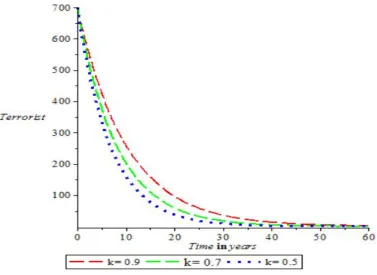
Figure 4. Graph of terrorist group against time with
different rate (k)
.
Figure 5. Graph of terrorist group against time with
different rates
Figure 6. Graph of Foot soldiers of terrorist against
time with rate of military strategiesπ
.
Figure 7. Graph of terrorist leaders against time with
different rate of contact
Figure 8. Graph of Detention facility against time with
different rates
.
9. Results and Discussion
The counter-terrorist measures have focused primarily on reducing foot soldiers of terrorist, if possible leaders, but not necessary leaders. Because of decentralized nature of some terrorist organization, these measures have proven unsuccessful. Therefore, this research focuses on military/dialogue strategies on moderates group, terrorist group, terror-ist foot-soldiers and terrorterror-ist leaders to reduce the way they recruit their new members. But surveillance should also be put in place by counter terrorist operation on susceptible individuals.
The graph in Fig. 2 for a period of six years shows the recruitment pool of terrorists from the susceptible population with contact rate β1
The plots show the impact of counter-terrorist identification rate and self-identification of control mechanism on the removed terrorists. The probability that the interaction leads to militancy is α and proportion rate at which terrorist become leader isk. To combat the insurgency in this model, parameters α and k appear to be dynamics which counter terrorist operation need to check and force them to appoint weak lead-ers. However, Fig. 4 and 5 shows the effectiveness of counter-terrorism, where large number of terrorist are identified and removed. While Fig. 6 and 7 shows the difficulties in countering the leaders of terrorist or-ganizations such as Al-Qaeda, Boko-Haram, ISIS and other terrorist organisations under counter-terrorist programme. Lastly, Fig. 8 shows a period of six years, detention facilities will be close due to effective intervention/rehabilitation programmed being designed.
Finally, from the simulations above, it can be deduced that The terror-ists removed effectively with at least 70%. Therefore, the effectiveness of counter-terrorist measures is shown in figures 2-4 for a period of six years.
10. Conclusion
This paper focused on controlling terrorism using military approach /dialogue to target and strike the terrorist group. However, Boko Haram has suffered significant defeats as a result of efforts by the Multinational Joint Task Force, which includes forces from Benin, Cameroon, Chad, Niger and Nigeria. The task force also receives support from the United States. For instance, Nigeria recorded its second consecutive year of reductions with a 63 per cent drop to 1,832 deaths in 2016.The result of this research can further be extended to other fields of knowledge to study the pattern of terrorism in many parts of the world which pose a significant threat to the public. Therefore, plans are made to address other issues in future studies.
11. Recommendations
1 It is impossible to defeat terrorist organizations without reducing the strength of the organization by using military approach on their footsoldiers. Therefore, security agents should check the parameter kin this study.
3 Government should Propose a practical tool for practitioners dealing with terrorism, counter-terrorism measures and human rights.
4 Military control strategy should not only depends on removing leaders but also concentrate on recruitment poll and terrorism footsoldiers.
5 Military strategies cannot reduce the risk of extremists, rad-icals, headmen/bandits/cattle-rustlers alone, but law enforce-ment agencies should also apply dialogue strategy at the same time.
References
[1] K.B. Akande and M.O. Ibrahim, Application of Differential Transformation Method in solving Optimal Control of Terrorism Model:Journal of the Math-ematical Association of Nigeria.44(1), (2017), 127-133.
[2] J.O. Akanni and A.D. Adediipo, Sensitivity Analysis of the Dynamical Trans-mission and Control of Lassa Fever Virus.Asian Research Journal Mathematics.
9(3), (2018), 1-11.
[3] L. Bayon, P.A. Fortuny, P.J. Garcia-Nieto, J.M. Grau and M.M. Ruiz, Opti-mal Control of Counter-Terrorism Tactics,Journal of Applied Mathematics and Computation.347,(2019), 477-491,(accessed 06 April 2019).
[4] E.T. Camacho(2013), The Development and Interaction of Terrorist and Fa-natic Groups: Communications in Nonlinear Science and Numerical Simulation,
18(11), (2013), 3086-3097.
[5] C. Castillo-Chavez and B. Song, Models for the Transmission Dynamics of Fanatic Behaviours. In Bioterrorism: Mathematical Modelling Applications in Homeland Security, SIAM, (2003), 155-172.
[6] J.P. Caulkins, D. Grass, G. Feichtinger and G. Tragler, Optimizing Counter-terror Operations: Should one fight fire with fire or water.Computers and Oper-ations Research,35(6), (2008), 1874-1885.
[7] A. Cherif, H. Yoshioka, W. Ni and P. Bose, Terrorism Mechanism of Radical-ization Process, Control of Contagion and Counter-Terrorist Measures: arXiv preprint arXiv, 0910.5272, (2010), 1-14.
[8] Y. Chuang and M.R. D’Orsogna, Mathematical Model of Radicalization and Terrorism: arXiv, Physics and Society, 1903.0848, (2019), 1-56.
[9] K.L. Cooke and P. Van Den Driessche, Analysis of an SEIRS epidemic model with two delays.Journal of Mathematical Biology,35 (2), (1996), 240-260.
[10] O. Diekmann, J.A.P Heesterbeek and J.A. Metz, On the definition and the computation of the basic reproduction Number in models for infectious diseases in heterogeneous populations. Journal of mathematical biology,28 (4), (1990), 365-382.
[11] L. Gao and H. Hethcote,(2006). Simulations of rubella vaccination strategies in China.Mathematical Biosciences,202(2), (2006), 371-385.
[12] D.S. Geller and A.M. Saperstein, A dynamic model of suicide terrorism and political mobilization: International Political Science Review, 36(5), (2015), 562-577.
[13] Global Terrorism Index, Measuring and understanding the impact of terrorism:
Institute for Economics and Peace,(2019), 1-90.
[14] S. Hussain, Dynamical Behavior of Mathematical Model on the Network of Mil-itants.Punjab Uiversity Journal of mathematics,51 (1), (2019), 51-60.
[15] I A. syaku, (2013). Terrorism: A New Challenge to Nigerias Stability in the 21 Century.International Affairs and Global Strategy,12,(2013), 16-24.
[16] E.H. Kaplan, M. Kress and R. Szechtman, (2010). Confronting entrenched in-surgents.Operations Research,58(2), (2010), 329-341.
[17] D.R. Merkin, Introduction to the theory of Stability.Springer-Verley, New York, Inc.1(24), (1997), 1-320.
[18] C.G. Ngari, Modell ing Kenya Domestic Radicalization like A Disease Incorporat-ing Rehabilitation Centers.Academic Journal of Applied Mathematical Sciences.
[19] K.N Prasant, S.R. Yerra and C.P. Tarini, Calculation of Basic Reproduc-tion Number by Graph-ReducReproduc-tion Method and Stability Analysis in SEIRQ e-Epidemic Model in Computer Network. Journal of Engineering and Applied Sciences,12(23), (2017), 7332-7338.
[20] O.S Samuel, S. Daouda, A.I. Abdullahi and A.P. Isaac, On the Existence, Uniqueness, Stability of Solution and Numerical Simulations of a Mathematical Model for Measles Disease.International Journal of Advances in Mathematics,
(4), (2019), 84-111.
[21] T. Sandler, (2014). The analytical study of terrorism: Taking stock.Journal of Peace Research, 51(2), (2014), 257-271.
[22] M. Santoprete and F. Xu, Global stability in a mathematical model of de-radicalization.Physica A: Statistical Mechanics and its Applications,509,(2018), 151-161.
[23] I.J. Udoh and M.O. Oladejo, Optimal Human Resources Allocation in Counter-Terrorism Operation: A Mathematical Deterministic Model.International Jour-nal of Advances in Scientific Research and Engineering, 5(1), (2019), 96-115.
[24] F. Udwadia, G. Leitmann L. Lambertini, (2006). A Dynamical Model of Terror-ism.Discrete Dynamics in Nature and Society, Hindawi,(2006), 1-32.
[25] United Nations Office of the High Commissioner for Human Rights, Fact Sheet, Human Rights, Terrorism and Counter-terrorism: Retrieved from http://www.refworld.org/docid/48733ebc2.html, 32(2008), 1-63 (accessed 16 April 2018).
[26] United Nations Security Council, Resolution 2462: Adopted by the Security Council at its 8496th meeting,(2019), 1-8.
[27] United Nations General Assembly, The United Nations Global Counter-Terrorism Strategy.72(840), (2018), 1-87.
[28] United Nations Security Council, Resolution 2395: Adopted by the Security Council at its 814 meeting,(2017), 1-10.
[29] P. Van den Driessche, Reproduction numbers of infectious disease models. Infec-tious Disease Modelling,2(3), (2017), 288-303.
[30] P. Van den Driessche and J. Watmough, Reproduction numbers and sub-threshold endemic equilibria for compartmental models of disease transmission.