AbstrAct
Ischaemic stroke remains a leading cause of death and disability. Current stroke treatment options aim to minimise the damage from a pending stroke during the acute stroke period using intravenous thrombolytics and endovascular thrombectomy; however, there are no currently approved treatment options for reversing neurological damage once a stroke is completed. Preclinical studies suggest that cell therapy may be safe and effective in improving functional outcomes. Several recent clinical trials have reported safety and some improvement in outcomes following cell therapy administration in ischaemic stroke, which are reviewed. Cell therapy may provide a promising new treatment for stroke reducing stroke-related disability. Further investigation is needed to determine specific effects of cell therapy and to optimise cell delivery methods, cell dosing, type of cells used, timing of delivery, infarct size and location of infarct that are likely to benefit from cell therapy.
IntroductIon
Until recently, intravenous recombinant tissue plasminogen activator was the only proven effective treatment for acute stroke. Endo-vascular thrombectomy has now been added to our arsenal for acute stroke treatment following the publication of five randomised trials demonstrating highly significant treat-ment effects favouring endovascular therapy.1–6
Outcome data support advancements in acute stroke care and neurorehabilitation with a significant increase in stroke survivors over time.7 However, despite these advancements,
stroke remains a leading cause of long-term disability.8 For patients with residual deficits
after stroke, we have no currently approved therapy for restoring function.
Cell therapy is one approach to enhancing recovery after stroke. In animal models, delivery of several different types of stem cells reduce infarct size and improve functional outcomes.9 Clinical trials of cell therapy
completed in the 2000s mostly treating small cohorts of patients with chronic stroke demonstrated adequate safety and a sugges-tion of efficacy with the use of cell therapy. Kondziolka and colleagues used N-Tera 2 cells derived from a lung metastasis of a human testicular germ cell tumour that when treated with retinoic acid generate postmitotic neurons that maintain a fetal
neuronal phenotype indefinitely in vitro (LBS neurons). LBS neurons were stereo-tactically implanted around the stroke bed of chronic subcortical ischaemic stroke. This study demonstrated safety and feasibility of stereotactic cell implantation, although there was no significant improvement in functional outcomes.10 11 Using a similar stereotactic approach implanting cells into the basal ganglia, Savitz and colleagues transplanted LGE cells (fetal porcine striatum-derived cells, Genvec) in five patients. Two patients showed improvements, but two patients experienced adverse effects including delayed wors-ening of neurological symptoms and seizure resulting in early termination of the study.12 Bang and colleagues reported the safety and feasibility of intravenous infusion of autolo-gous mesenchymal stem cells (MSCs) with no reported adverse effects in five patients treated with intravenous MSCs. Although they reported some initial motor improvements, at 12 months, there was no significant difference in motor scores.13 These early clinical trials mostly focused on chronic subcortical strokes, but more recent trials are now investigating cell therapy for treatment of both cortical and subcortical infarcts. This review discusses the considerations for design of cell therapy trials and summarises the results of more recent studies.
cell types
Several cell sources have been used for cell therapy. Each cell type requires individual testing for safety and efficacy. The optimal timing and route of administration may differ depending on the characteristics of the cell and the presumed mechanism of action. Neural progenitor cells (NPCs) have been identified in the adult human brain, can migrate towards damaged tissue and may play a role in endogenous repair after isch-aemic injury. NPCs can be harvested from embryonic, fetal or adult tissue, are easily expandable and are capable of differentiating into multiple cell types. Disadvantages of NPCs include ethical concerns involving the use of embryonic and fetal cells as well as their propensity to form tumours. Immortalised
Update on cell therapy for stroke
Cynthia L Kenmuir, Lawrence R Wechsler
Department of Neurology, University of Pittsburgh Medical Center, Pittsburgh, Pennsylvania, USA
Correspondence to Dr Cynthia L Kenmuir; kenmuircl@ upmc. edu
To cite: Kenmuir CL, Wechsler LR. Update on cell therapy for stroke. Stroke and Vascular Neurology 2017;2:e000070. doi:10.1136/ svn-2017-000070
Received 19 January 2017 Accepted 23 January 2017 Published Online First 20 May 2017
on September 18, 2020 by guest. Protected by copyright.
that have been subsequently maintained in cell culture and can be cryopreserved. These cell lines must undergo some differentiation prior to transplantation to reduce the chance of malignant transformation at the expense of limiting potential cell types subsequently produced. Induced pluripotent stem cells (iPSCs) are somatic cells reprogrammed into an embryonic state. Although iPSCs offer the potential for autologous cell transplant, generating adequate cell numbers for transplantation is challenging and there are concerns for oncogenic trans-formation. MSCs have become an increasingly popular choice for stroke cell therapy. MSCs can be derived from bone marrow, adipose tissue, umbilical cord and dental pulp from the patient (autologous) or from one of many existing allogeneic sources. In preclinical studies, MSCs have not been shown to differentiate into unwanted cell types or form tumours and do not seem to promote an inflammatory reaction even when allogeneic cells are used. MSCs are transiently engrafted into the brain and have been shown to deliver multiple trophic factors inducing neurogenesis, synaptogenesis and angiogenesis.
route of administration
More recently trials of cell therapy for stroke extended the results of the early intraparenchymal studies to additional routes of administration. Intravenous, intra-ar-terial, intraparenchymal and intrathecal routes have been used—each with their own pitfalls. While intrave-nous administration of cells is the quickest and least invasive, they are filtered through the lungs, carry the risk of multiorgan exposure and require infusion of higher cell volumes. Intra-arterial therapy is more invasive and can result in cell clumping within the smaller intracranial vessels but affords the use of lower cell volumes and more direct exposure to the tissue of interest. Similarly, intra-thecal injections allow for intracranial cell delivery that could potentially migrate to damaged areas although it requires an invasive procedure for delivery and there is a potential risk of cell adherence to the ventricular wall resulting in obstructive hydrocephalus. Stereotaxic infu-sion, or direct intracerebral injection, is the most invasive and carries the associated surgical risks but allows for the most direct infusion into the tissue of interest while using the smallest volume of cells.
timing of administration
The timing of cell therapy administration should depend on the expected mechanism of action of the transplanted cells. For instance, iPSCs and NSCs have been shown to induce neurogenesis, although their main effect may be via trophic support, whereas most transplanted MSCs are no longer present in the brain within a few weeks and their major effect may be achieved by reducing inflam-mation and later scar forinflam-mation.14 Cell therapy trials in
the acute and subacute stroke setting might focus on cell therapies aimed at cell preservation while trials in the
severe strokes may have more early complications making it difficult to separate cell therapy adverse effects from the natural history of the stroke. Mild strokes may also be difficult to investigate given the goal of early discharge for rehabilitation and thus cell therapy may increase length of stay and cost for these patients.
Mechanism of action
Ischaemic strokes simultaneously damage various neuronal subtypes, glial populations and endothelial cells. The proposed mechanism of action should be considered in choosing the cell type, method of delivery and timing of administration for cell therapy. Some cell types exert their clinical benefits through release of trophic factors while others may directly replace cells. For instance, more differentiated cell types have limited fates and may not be as useful for infarctions involving multiple neuronal cell types or white matter tracks. Recent evidence suggests that one of the mechanisms of intravenous MSCs is suppres-sion of the immune response after stroke, preventing release of inflammatory cells from the spleen and limiting infarct size.15 16 Both MSCs and neural stem cells that
reach the infarct either by direct intracerebral placement or through the blood brain barrier release a variety of trophic factors, growth factors and cytokines that may enhance the local recovery process. Direct replacement of cells with functional connections is less likely given the complexity of neural networks and the short time frame in which improvement is seen. Multiple mechanisms may be operative in some cases contributing to overall functional improvement. In the acute to subacute phase after stroke, the intravenous route might be best as a neuroprotec-tive or anti-inflammatory strategy. At later time intervals, intra-arterial or intrathecal routes might be preferable to better reach ischaemic areas and deliver trophic factors. In chronic stroke, direct intracerebral injection is likely necessary to delivery cells to brain areas surrounding infarction that might be capable of enhancing recovery. Additional information regarding mechanism for each cell type will be helpful in finding the optimal route of administration and timing.
recent cell therApy trIAls
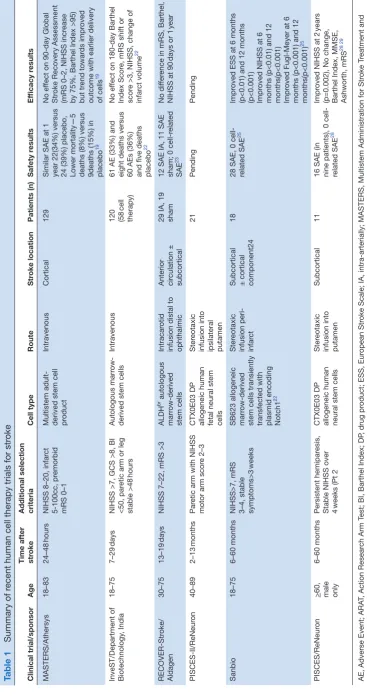
Stem cell studies previously included cells obtained from embryonic and fetal tissues or immortalised tumour cells, but continuation of these studies was limited due to ethical concerns and oncogenic potential. Human stem cells may also be obtained from a number of sources including adult neural tissue, peripheral blood, adipose tissue and bone marrow. Notably, many of these cell lines are composed of heterogenous cell populations including stem cells and have a variety of proposed functions once within the nervous system.9 Several of the most recent cell
therapy trials (table 1) used bone marrow-derived MSCs due to the ready availability, polymorphic effects and
on September 18, 2020 by guest. Protected by copyright.
Table 1
Summary of r
ecent human cell therapy trials for str
oke
Clinical trial/sponsor
Age
Time after str
oke
Additional selection criteria
Cell type
Route
Str
oke location
Patients (n)
Safety r
esults
Ef
ficacy r
esults
MASTERS/Athersys
18–83
24–48
hours
NIHSS 8–20, infar
ct
5-100cc, pr
emorbid
mRS 0–1
Multistem adult- derived stem cell product
Intravenous
Cortical
129
Similar SAE at 1 year 22(34%) versus 24 (39%) placebo, Lower mortality—5 deaths (8%) versus 9deaths (15%) in placebo
19
No ef
fect on 90-day Global
Str
oke Recovery Assessment
(mRS 0–2, NIHSS incr
ease
by 75%, Barthel Index >95) but tr
end towar
ds impr
oved
outcome with earlier delivery of cells
19
InveST/Department of Biotechnology
, India
18–75
7–29
days
NIHSS >7, GCS >8, BI <50, par
etic arm or leg
stable
>48
hours
Autologous marr
ow-derived stem cells
Intravenous
120 (58
cell
therapy)
61 AE (33%) and eight deaths versus 60 AEs (36%) and five deaths placebo
22
No ef
fect on 180-day Barthel
Index Scor
e, mRS shift or
scor
e >3, NIHSS, change of
infar
ct volume
22
RECOVER-Str
oke/
Aldagen
30–75
13–19
days
NIHSS 7–22, mRS >3
ALDH
br autologous
marr
ow-derived
stem cells
Intracar
otid
infusion distal to ophthalmic Anterior circulation ± subcortical 29 IA, 19 sham 12 SAE IA, 11 SAE sham; 0 cell-r
elated
SAE
23
No dif
fer
ence in mRS, Barthel,
NIHSS at 90
days or 1
year
PISCES-II/ReNeur
on
40–89
2–13
months
Par
etic arm with NIHSS
motor arm scor
e 2–3
CTX0E03 DP allogeneic human fetal neural stem cells
Ster
eotaxic
infusion into ipsilateral putamen
21
Pending
Pending
Sanbio
18–75
6–60 months
NIHSS>7, mRS 3–4, stable symptoms>3
weeks
SB623 allogeneic marr
ow-derived
stem cells transiently transfected with plasmid encoding Notch1
22
Ster
eotaxic
infusion peri- infar
ct
Subcortical ± cortical component24
18
28 SAE, 0 cell- related SAE
25
Impr
oved ESS at 6 months
(p<0.01) and 12 months (p<0.001) Impr
oved NIHSS at 6
months (p<0.01) and 12 months(p<0.001) Impr
oved Fugl-Meyer at 6
months (p<0.001) and 12 months(p<0.001)
25
PISCES/ReNeur
on
>60, male only
6–60 months
Persistent hemipar
esis,
Stable NIHSS over 4 weeks (Pt 2 CTX0E03 DP allogeneic human neural stem cells
Ster
eotaxic
infusion into putamen
Subcortical
11
16 SAE (in nine patients), 0 cell- related SAE
28
Impr
oved NIHSS at 2
years
(p=0.002), No change, Barthel Index, MMSE, Ashworth, mRS
28 29
AE, Adverse Event; ARA
T, Action Resear
ch Arm T
est; BI, Barthel Index; DP
, drug pr
oduct; ESS, Eur
opean Str
oke Scale; IA, intra-arterially; MASTERS, Multistem Administration for Str
oke T
reatment and
Enhanced Recovery Study; MMSE, Mini-Mental Status Examination; mRS, modified Rankin Scor
e; NIHSS, National Institutes of Health Str
oke Scale; PISCES, Pilot Investigation of Stem Cells in Str
oke;
SAE, Serious aA
verse Events.
on September 18, 2020 by guest. Protected by copyright.
cells, an autologous subpopulation of MSCs (ALD401, ALDHbr), an adult-derived multipotent adult progenitor cell population (Multistem) or allogeneic neural stem cells (CTX0E03 DP). Allogeneic cell preparations allow for more homogenous cell populations that can be highly expanded for a consistent product. Some of these can be stored for years affording an always available ‘off-the-shelf’ product, although they must be thawed and resuspended prior to administration. Although the most recent clinical trials using allogeneic cells (SB623, Multistem, CTX0E03 DP) did not require immunosuppression, the potential for allergic reaction remains. Autologous cells require bone marrow harvest, resulting in variable stem cell yield and require time for expansion prior to administration, but carry less concern for allergic reaction or rejection.
cell therapy targeting subacute strokes
In the first few days after stroke, the target of cell therapy is most likely an inflammatory process that enhances the extent of brain injury and impedes the recovery process.17 Localisation of cells to the site of injury may not
be as important as immune modulation and intravenous delivery may be as effective as direct intracerebral injec-tion. Clinical trials of cell therapy for early or subacute stroke used intravenous or intra-arterial administration of allogeneic or autologous cells.
MAsters trIAl
The MASTERS trial was a randomised double blind dose escalation trial evaluating allogeneic, adult-de-rived stem cells (Multistem, Athersys) in the treatment of early cortical strokes. Multistem cells are a distinct subpopulation of adherent bone marrow cells that are easily expandable to generate sufficient quantities for intravenous delivery and have shown efficacy in animal models of ischaemic stroke. When administered intrave-nously, Multistem downregulates immune activation and inflammatory responses while upregulating neurogenesis and differentiation. Reduction in spleen size that occurs following stroke is prevented by Multistem administra-tion consistent with immune suppression as an important mechanism of action of these cells.18 The MASTERS
trial enrolled patients aged 18–83 with a cortical stroke measuring 5cc–100cc, an NIH Stroke Scale (NIHSS) of 8–20 and a baseline modified Rankin score (mRS) of 0–1. Multistem cells were given intravenously 24–48 hours after symptom onset19 increased from an initial window
of 24–36 hours due to slow enrolment.20 21 Of 129 patients
randomised, there was no difference between the groups in treatment emergent adverse events but fewer life-threatening adverse events or death (12% multistem vs 25% placebo (Pl), p=0.08) and reduced infections (39% multistem vs 48% Pl, p=0.30) in the treated group. No significant difference was observed in the primary effi-cacy outcome of global recovery (mRS <2, Barthel Index
mRS, BI, NIHSS or excellent outcome (mRS <1, NIHSS <1, BI >95). However, in post hoc analysis of earlier treat-ment in the 24–36 hour window and excluding patients with combined intravenous tissue plasminogen activator (tPA) and endovascular therapy according to the orig-inal protocol, there were greater differences between the groups favouring patients receiving Multistem although only the Rankin distribution and excellent outcomes reached statistical significance.19 At 1 year follow-up,
differences between the groups continued to increase and some additional secondary endpoints reached statistical significance.19 Following Multistem administration, there
was a significant reduction in circulation CD3+ T cells at 48 hours as well as significant reductions in interleukin (IL) 1β, tumor necrosis factor (TNF) α, IL-6 and inter-feron (INF) λ at 7 days that were normalised at 30 days.19
These findings are consistent with the presumed immune modulatory mechanism by which Multistem may improve functional outcomes. Patients treated with Multistem also had substantial cost savings at least in part related to 30% less secondary infections and shorter average hospital stays (3 days less than placebo, 30% reduction) and intensive care unit stays (1.2 days less than placebo, 10% reduction). Based on these promising results, a phase III trial is planned.
Invest
A phase II clinical trial in India evaluated autologous, bone marrow mononuclear stem cells (BMSC) in the treatment of late subacute strokes. Patients were enrolled aged 18–75 who had subacute stroke within the past 7–29 days (median 18.5 days), NIHSS >7, GCS> 8, BI <50 and a paretic arm or leg that was stable >48 hours. Of 120 patients enrolled, 58 received intravenous infusion of mean 280.75 million (SD 162.9) autologous cells. No significant difference was reported in adverse events or deaths. No difference was reported in the coprimary endpoints of BI (63.1 BMSC vs 63.6 Pl, p=0.92), Rankin shift (p=0.53) or mRS score >3 (47.5 BMSC vs 49.2 Pl, p=0.85) at 6 months, or in secondary outcomes of NIHSS or change of infarct volume at 90 or 180 days after cell infusion.22 There were no new areas of
18-flourodeoxy-glucose uptake on positron emission tomography (PET) scanning in the treatment group following treatment. Although treatment was safe, there was no signal of effi-cacy using this type of autologous bone marrow-derived cell therapy at a late subacute time interval after stroke onset.
recover
In this clinical trial autologous, bone marrow-derived stem cells were infused intra-arterially (IA) for treat-ment of late subacute strokes. This phase IIa safety study of locally infused intra-arterial ALDHbr (ALD401) cells enrolled patients with predominantly cortical stroke,
on September 18, 2020 by guest. Protected by copyright.
30–75 years old who had persistent symptoms with NIHSS 7–22 and mRS of 3 or greater. Within 13–19 days after onset of stroke symptoms, cells were delivered IA in the carotid artery just distal to the ophthalmic artery of the affected hemisphere. Results from 48 randomised patients presented at the 2015 European Stroke Organisation Conference reported 12 serious adverse events (SAEs) from 29 IA treated patients and 11 SAEs from 19 sham control patients. There were no significant differences in mRS, BI or NIHSS at 90 days or at 12 months after cell infusion.23
cell therapy targeting chronic strokes
In patients with residual deficits months or years after stroke, there is typically minimal if any further recovery and no effective therapies. In this late time frame, inflam-mation is likely less important and the major targets of cell therapy are neurogenesis, angiogenesis, synapto-genesis and enhanced plasticity in cells bordering an area of infarction. Trials in this time frame target direct injection using stereotactic techniques delivering cells to the surround of the infarcted region to enhance repair and recovery most likely through secretion of growth factors or small molecules that may stimulate the local environment.
sanbio sb623
SB623 cells are MSCs transiently transfected with a plasmid that codes for the Notch I intracellular domain. In rodent stroke models, SB623 cells were superior to traditional bone marrow-derived stem cells in tests of motor and cognitive performance.24 A phase I/II
clin-ical trial of 18 patients evaluated SB623 cells delivered under stereotaxic guidance to the area surrounding the site of infarction in a standard, dose escalation para-digm using 2.5, 5 or 10 million cells. Only patients with subcortical strokes with or without a cortical component occurring within the past 6–60 months were included. Notably, stability of symptoms for at least 3 weeks with an NIHSS >7 and mRS 3–4 was required. There were no serious cell-related complications in the 18 patients enrolled. European Stroke Scale, NIHSS and Fugl-Meyer Score were all improved compared with baseline at 6 and 12 months after cell infusion.25 Cognitive testing, MRI
and PET studies were performed before and after trans-plant. On MRI, increased T2 FLAIR signal was observed along the cannula track at 7 days but not at 1 day, 30 days or 60 days following cell transplantation in 15/18 patients with a mean area of 2.16 cm2. The presence and size of FLAIR abnormality correlated with clinical improvement. Preliminary analysis of PET imaging revealed increased fluorodeoxyglucose (FDG) uptake in 3/5 patients predominantly in cortical areas contralateral to stem cell injection.26 Cognitive testing at 6 months and 12 months
versus baseline revealed significant improvement in verbal learning recall at 12 months independent of stroke loca-tion.27 A blinded randomised controlled trial of SB623
cells is currently underway comparing intracerebral
implantation of SB623 cells to sham controls in patients with chronic stroke.
pIlot InvestIgAtIon of steM cells In stroke trIAl The Pilot Investigation of Stem Cells in Stroke (PISCES) trial also evaluated intraparenchymal cell therapy for chronic stroke, using cells derived from human fetal cortical neuroepithelial cells genetically modified by retro-viral insertion of c-mycER TAM (CTX0E03 DP) similar to the PISCES II trial. PISCES was a phase I/II dose escala-tion trial evaluating four doses of CTX0E03 cells delivered into the ipsilateral putamen using stereotaxic guidance. Men greater than 60 years old with persistent hemiparesis and stable NIHSS over 4 weeks from a subcortical stroke occurring 6–60 months (mean 29 months, SD 14) prior were included. In a median of 44 months of follow-up, there were no serious cell-related complications reported from the 11 patients treated with cell implantation. All SAEs were considered related to the stereotactic proce-dure or other medical conditions but were related to the cells. One patient with chronic sun exposure developed superficial malignant melanoma. Efficacy evaluation was limited but demonstrated improvement in several scores including NIHSS, Ashworth score and BI. Disability as measured by mRS improved in four patients at 12 months and three patients at 24 months.28 Preliminary report of
functional MRI change at 1 month versus baseline revealed increased contralateral putaminal activity that correlated with reduced spasticity, whereas increased contralateral prefrontal cortical activity correlated with increased spas-ticity.29 FLAIR hyperintensity was seen on MRI along the
needle track in five patients but were not found to be associated with clinical change.28 The PISCES II trial
eval-uated the safety and efficacy of the same CTX0E03 cells in 21 patients with subacute stroke 2–13 months following onset. The trial has been completed and detailed efficacy and safety results are currently pending.
conclusIon
Recent clinical trials of cell therapy have demonstrated cell safety and some efficacy in reducing poststroke disability. Cell therapy during the subacute stroke period was asso-ciated with stable clinical and imaging outcomes in the InveST and RECOVER trials, while the MASTERS trial demonstrated promising clinical efficacy trends similar to that observed in rodent models.30 Cell therapy during
the chronic stroke period was associated with improved clinical outcomes in both the Sanbio and PISCES trials. The clinical trials reviewed here used a variety of different cell types, delivery methods and delivery locations each delivered with a variable delay from the time of initial infarction. Despite these differences in trial design, there were no reported cell-related SAEs.
There are many proposed mechanisms by which cell therapy may help improve recovery, which include immune modulation, enhancement of angiogenesis and neurogenesis and secretion of growth factors and
on September 18, 2020 by guest. Protected by copyright.
to develop the best combination of cell delivery method, cell dosing, type of cells used, timing of delivery, infarct size and location of infarct that may benefit from further cell therapy for ischaemic stroke.
Funding This research received no specific grant from any funding agency in the
public, commercial or not-for-profit sectors.
Provenance and peer review Commissioned; internally peer reviewed.
Open Access This is an Open Access article distributed in accordance with the
Creative Commons Attribution Non Commercial (CC BY-NC 4.0) license, which permits others to distribute, remix, adapt, build upon this work non-commercially, and license their derivative works on different terms, provided the original work is properly cited and the use is non-commercial. See: http:// creativecommons. org/ licenses/ by- nc/ 4.0/
© Article author(s) (or their employer(s) unless otherwise stated in the text of the article) 2017. All rights reserved. No commercial use is permitted unless otherwise expressly granted.
RefeRences
1. Berkhemer OA, Fransen PS, Beumer D, et al. A randomized trial of intraarterial treatment for acute ischemic stroke. N Engl J Med
2015;372:11–20.
2. Campbell BC, Mitchell PJ, Kleinig TJ, et al. Endovascular therapy for ischemic stroke with perfusion-imaging selection. N Engl J Med
2015;372:1009–18.
3. Goyal M, Demchuk AM, Menon BK, et al. Randomized assessment of rapid endovascular treatment of ischemic stroke. N Engl J Med
2015;372:1019–30.
4. Jovin TG, Chamorro A, Cobo E, et al. Thrombectomy within 8 hours after symptom onset in ischemic stroke. N Engl J Med
2015;372:2296–306.
5. Saver JL, Goyal M, Bonafe A, et al. Stent-retriever thrombectomy after intravenous t-PA vs. t-PA alone in stroke. N Engl J Med
2015;372:2285–95.
6. Saver JL, Goyal M, Bonafe A, et al. Solitaire™ with the intention for thrombectomy as primary endovascular treatment for acute ischemic stroke (SWIFT PRIME) trial: protocol for a randomized, controlled, multicenter study comparing the Solitaire revascularization device with IV tPA with IV tPA alone in acute ischemic stroke. Int J Stroke
2015;10:439–48.
7. Bushnell C, McCullough LD, Awad IA, et al. Guidelines for the prevention of stroke in women: a statement for healthcare
professionals from the American Heart Association/American Stroke Association. Stroke 2014;45:1545–88.
8. Mozaffarian D, Benjamin EJ, Go AS, et al. Heart disease and stroke statistics--2015 update: a report from the American Heart Association. Circulation 2015;131:e29–322.
9. Savitz SI, Dinsmore JH, Wechsler LR, et al. Cell therapy for stroke.
NeuroRx 2004;1:406–14.
10. Kondziolka D, Wechsler L, Goldstein S, et al. Transplantation of cultured human neuronal cells for patients with stroke. Neurology
2000;55:565–9.
trial. J Neurosurg 2005;103:38–45.
12. Savitz SI, Dinsmore J, Wu J, et al. Neurotransplantation of fetal porcine cells in patients with basal ganglia infarcts: a preliminary safety and feasibility study. Cerebrovasc Dis 2005;20:101–7. 13. Bang OY, Lee JS, Lee PH, et al. Autologous mesenchymal stem cell
transplantation in stroke patients. Ann Neurol 2005;57:874–82. 14. Bang OY. Clinical trials of adult stem cell therapy in patients with
ischemic stroke. J Clin Neurol 2016;12:14–20.
15. Seifert HA, Hall AA, Chapman CB, et al. A transient decrease in spleen size following stroke corresponds to splenocyte release into systemic circulation. J Neuroimmune Pharmacol 2012;7:1017–24. 16. Sahota P, Vahidy F, Nguyen C, et al. Changes in spleen size in
patients with acute ischemic stroke: a pilot observational study. Int J
Stroke 2013;8:60–7.
17. Savitz SI. Developing cellular therapies for Stroke. Stroke
2015;46:2026–31.
18. Yang B, Hamilton JA, Valenzuela KS, et al. Multipotent Adult Progenitor Cells Enhance Recovery After Stroke by Modulating the Immune Response from the Spleen. Stem Cells 2017;35:1290–302. 19. Hess D, Wechsler LR, Clark W, et al. MultiStem in acute stroke
treatment to enhance recovery study (MASTERS): A multicenter, randomize, double-blind, placebo-controlled trial of MultiStem in acute ischemic stroke. Lancet Neurology (Epub ahead of print: 2017).
20. Hess DC, Sila CA, Furlan AJ, et al. A double-blind placebo-controlled clinical evaluation of MultiStem for the treatment of ischemic stroke.
Int J Stroke 2014;9:381–6.
21. Mays R, Deans R. Adult adherent cell therapy for ischemic stroke: clinical results and development experience using MultiStem.
Transfusion 2016;56:6S–8.
22. Prasad K, Sharma A, Garg A, et al. Intravenous autologous bone marrow mononuclear stem cell therapy for ischemic stroke: a multicentric, randomized trial. Stroke 2014;45:3618–24.
23. Yavagal DR, Huang DY, Graffagnino C, et al. Intra-arterial delivery of autologous ALDBHR cells in ischemic stroke: final 1-year results of the RECOVER-Stroke trial. Int J Stroke 2015;10(Suppl 2):13. 24. Mimura T, Dezawa M, Kanno H, et al. Behavioral and histological
evaluation of a focal cerebral infarction rat model transplanted with neurons induced from bone marrow stromal cells. J Neuropathol Exp
Neurol 2005;64:1108–17.
25. Steinberg GK, Kondziolka D, Wechsler LR, et al. Clinical outcomes of transplanted modified bone Marrow-derived mesenchymal stem cells in stroke: a phase 1/2a study. Stroke 2016;47:1817–24.
26. Kenmuir CL, Reddy VK, Mountz J, et al. Changes in FDG-PET activity following intracranial injection of SB623 cells in patients with stable ischemic strokes. Stroke 2015;46(Suppl):AWMP93.
27. Kenmuir CL, Reddy VK, Stilley C, et al. Cognitive outcomes following intracranial injection of SB623 cells in patients with stable ischemic strokes. Stroke 2015;24(Suppl):A34.
28. Kalladka D, Sinden J, Pollock K, et al. Human neural stem cells in patients with chronic ischaemic stroke (PISCES): a phase 1, first-in-man study. Lancet 2016;388:787–96.
29. Kalladka D, Sinden J, Pollock K, et al. PISCES – A phase I trial of CTX0E03 human neural stem cells in ischemic stroke: final results.
Int J Stroke 2015;10(Suppl 2):10.
30. Vu Q, Xie K, Eckert M, et al. Meta-analysis of preclinical studies of mesenchymal stromal cells for ischemic stroke. Neurology
2014;82:1277–86.
on September 18, 2020 by guest. Protected by copyright.