Estimation of Trafficable Grades
from Traction Performance of a Forwarder
Jörg Hittenbeck
Abstract – Nacrtak
Wood as a renewable resource is getting more and more popular for material use as well as for energy usage. In order to meet the demands, it is important to make previously unused wood potentials accessible to the timber market. One area of interest is the incompletely utilized resources in inclined regions. Problems arise in these areas by the topographic limitations of highly mechanized timber harvesting. These limitations occur from the stability of the ma-chines as well as from the damages done to the soils.
Considerations about the downhill slope forces acting on the machines show a direct relation between the inclination of a grade and the traction coefficient. In theory, it seems possible to calculate a trafficable grade for an accepted level of wheel slip. On the basis of a 25% slip limita -tion, a model for trafficable grades was developed and tested for typical hillside conditions. Measurements of traction force vs. slip identified the soil water content and the skeletal rate as the main soil parameters that affect the climbing ability of machines. Test drives in inclined terrain indicated that the approach of calculating limitations (for trafficable grades) from trac -tion tests under level condi-tions lead to a fairly good predic-tion.
Keywords: full mechanized harvesting, slope, loess, slip resistance, model
Trafficability of soils is endangered by the driving activities with forest machinery. Damages to soil result from soil compaction and erosion processes. Compac -tion is especially well investigated for agricultural soils (Blackwell et al. 1986; Bailey et al. 1996; Trautner and Arvidsson 2003, Arvidsson and Keller 2007; Ansorge and Godwin 2007, 2008; Horn and Fleige 2009) as well as for forest soils (Wästerlund 1983; Moffat 1991;Hutch -ings et al. 2002; Horn et al. 2004; Jun et al. 2004; von Wilpert and Schäfer 2006; Horn et al. 2007). Erosion on the other hand is often seen in conjunction with tillage operations and the opportunities through changing to conservation tillage or to a total abandonment of till -age (Tebrugge and During 1999). Besides till-age, traffic on soils leads to increased risk of erosion (Raper 2005). Podsiadlowski (1988) and Mosimann et al. (2008) fo -cused on the tracks of machines and detected that ero -sion increased. Bazoffi et al. (1998) showed that re -duced tire inflation pressure and therefore better traction of the machines leads to reduced erosion on slopes. In low mountain ranges the problem of soil erosion is enforced by higher rain falls and needs for
1. Introduction –
Uvod
traction to assure mobility of forest machines. There -fore, soil erosion caused by slip of the wheels is the main risk to a permanent trafficability in inclined ter -rain.
Results from Söhne (1952) indicate that the risk of serious harm done to the soil increases with increasing slip. High wheel spin leads to a complete shearing-off of the topmost soil structures. Loose soil material gets washed away with the next intense rain. Even for countries with lower requirements to soil protection the long term conservation of technical trafficability as well as the weight of soil as a fundamental factor of production are important. Objective limits for harvest -ing operations with land-based machinery are impor -tant for reducing the additional strain by higher wheel slip. Söhne (1952) found that especially slip levels up to 25% assure a minimum of continuity of the soil pores whereas higher slip leads to a shearing-off of the topmost soil. Particularly, grades are endangered by erosion because of these lost connections between the soil layers. Therefore, slip has to be limited when driv -ing in grades in order to assure long term trafficability (ecological and technical).
The aim of this paper is to present a method to calculate maximum inclination angles for an accepted wheel slip level of 25% as this assures a minimum of continuity of the soil pores (Söhne 1952). Consider -ations about the downhill slope forces acting on the machines show a direct correlation between the incli -nation of a grade and the traction coefficient. The latter describes the relation between traction force and ma -chine weight. Measurements of traction force in de -pendency of slip were taken for a forwarder under different soil conditions in order to oppose them to the downhill slope force at different inclination angles. In theory, it seems possible to calculate a trafficable grade for an accepted level of wheel slip. On the basis of a 25% slip limitation, a model for trafficable grades was developed and tested for typical low mountain range conditions in Germany. In addition, estimation for maximum inclinations with the meaning of safety against sliding down was calculated.
2. Theoretical Approach –
Teorijski pristup
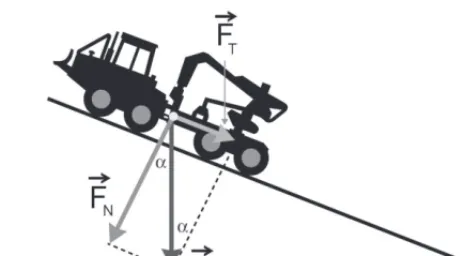
Every self propelled machine has to produce a trac -tion force (or »thrust«) which overpowers the mo-tion resistance forces. The latter result from aerodynamic resistance (Ra), resistances due to the internal running gear (Rin) and resistance due to the interaction between drive line and terrain (Rt), commonly known as rolling resistance (Wong 2010). When driving on slopes, there is an additional grade resistance (Rg), which resultsfrom the downhill slope force (FT (N) in Fig. 1) acting
on the machines.
Fig. 1 illustrates the forces appearing when driving on grades. The downhill slope force (FT) is derived
from the product of weight of the loaded vehicle (G – gravity force (N)) and the sine of the inclination angle following the equation:
FT = G × sina (1)
In order to assure the mobility of a machine, a force at least equal to the downhill slope force has to act in the opposite direction. The force left when the motion resistances (at low speeds this is just the rolling resis -tance) are overpowered is the traction force (or net traction in Zoz and Grisso 2003). It can be calculated from the traction coefficient (μtr also called »net trac -tion ratio«) multiplied with the normal force (FN (N)) acting between the vehicle and terrain.
Fd = FN × mtr (2)
Under flat conditions, the normal force (FN) is equal to the weight (gravity force) of the machine. However, with increasing inclination angle of the slope, the forc -es differ substantially. The traction coefficient vari-es with soil properties, drive line of the vehicle and wheel slip. When soil and drive lines are defined, the traction coefficient changes depending on the slip. Typical pro -gressions of the coefficient over slip were studied by numerous authors (Söhne 1952; Wanjii et al. 1997; Yo -shida and Hamano 2002; Zoz and Grisso 2003; Hit -tenbeck 2009; Wong 2010).
G × sina = FN × mtr (3) The comparison between downhill slope force and drawbar pull in equation 3 reveals that the forces for the calculation differ. In order to solve the equation, the
Fig. 1 Forces acting on machines while driving on slopes (Source: Jacke and Drewes 2004)
normal force of the machine (FN) has to be expressed as a function of weight (G) and the inclination angle.
FN = G × cosa (4)
Inserted into equation (3) this leads to:
G × sina = G × (cosa) × mtr (5) Equation 5 simplifies to:
mtr = tana (6)
From this point, the traction coefficient (μtr) leads to the slope which is barely accessible. The tangent value of the inclination can easily be transformed to slope inclination given in percent by multiplying with 100. As the traction coefficient is closely related to the wheel slip, it is possible to predict the occurring slip values. The general relation between the traction coef -ficient and the inclination trafficable is not new and it has already been shown by several authors (Pampel 1982; Schulz 1988; Kunze et al. 2002; Hoepke and Ap -pel 2002).
3. Methods and Results –
Metode
i rezultati
3.1 Traction Measurements – Mjerenje vučnih značajki
The determination of coefficients of traction was done by traction force vs. slip measurements carried out with a forwarder (Ponsse, model S10) under level conditions. This was done for different variants, which result from different setups of the final drive (worn tires, new tires, reduced tire pressure, combination of tracks and chains) as well as different soil types and varying soil moisture content. In addition to measure -ments with an empty forwarder, a few variants were tested for a loaded machine as well.
A special winch was constructed to apply different loads to the forwarder for the traction tests. The winch is linked to a breaking system from a heavy truck. Both were mounted to a platform in order to be able to in -stall the winch on skidding lanes. Fig. 2 shows the winch fastened with ground anchors and tied to a tree.
The deceleration of the forwarder is controlled by a feed forward control. The forces acting on the brake disc are increased until the forwarder is not able to pull out the rope any more. Afterwards the pressure on the brake is reduced until the machine is able to drive without interference. Both for the pressure increase as for the decrease, a rate of 0.15 bar/s was chosen. This slew rate was the result of several pretests to get the
optimum between a smooth increase of the required traction force and the distance travelled with different rates. 200 m rope and a pulley mounted to the load cell allow between three to seven traction measurements on a single pullout.
During the measurements, the traction force of the forwarder as well as the speed of wheels and above ground were measured on the forwarder. Forces result from a load cell (Hottinger Baldwin Measurements (HBM), model U2B). The speed of the wheels and the effective velocity were determined using incremental rotary encoders (Kübler, model 5800). A modularly equipped measurement system MGCsplit by HBM served as data collector for all applied transducers.
The tests were driven on skidding lanes under dif -ferent site conditions, which are characterized by high percentage of loess. Apart from soil moisture, the main difference between the site types is the stone admix -ture. The tests were carried out on bare soil because of the ambiguous effect of a brushwood layer on vehicle traction (Hittenbeck 2004; Jacke et al. 2004). Before the test drives started, all soil parameters like soil type, soil moisture, humus layer and inclination of the stand were determined. In total 57 different test series were taken with 22 different possible factors (Table 1) influ -encing the traction behavior of the forwarder. Every test run is characterized by the machine configuration (e.g. tracks and chains, unloaded) and stable soil and site conditions. For each of these series, the 22 factors concerning soil and machine parameters were deter -mined and coded into numbers.
Fig. 2 Winch to apply the loads for traction measurements installed on a skidding lane
Slika 2. Vitlo pomoću kojega se opterećuje stroj prilikom mjerenja
3.2 Traction – Trakcija
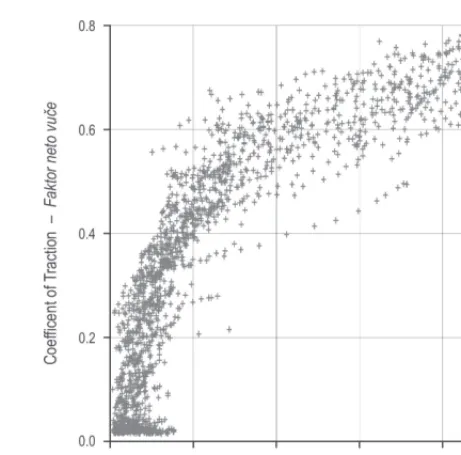
The scatter plot in Fig. 3 is an example of the result -ing coefficients of traction dependent on wheel slip. It displays the results of traction measurements with tracks and chains (chains were mounted on the front axle and tracks on the rear axle) on loess soil at a soil moisture content of 32.1%. The illustrated data are al -ready revised by artifacts which for example result when the brake of the winch is released and the ma -chine starts driving. In this situation higher slip values can occur although the force to pull the rope is rather low. More detailed information about the data pro
-cessing can be found in Hittenbeck (2009). With in -creasing wheel slip, the values of the traction coeffi -cient rise immediately up to a level of about 30% slip. Above that, the increase of the traction coefficients is still clear but less rapid. No maximum value has been specified for the coefficients, although it is often as -sumed for off road conditions (Moore 1975).
The scatter plot in Fig. 3 is typical for measure -ments at good traction conditions. The latter are char -acterized by dry soil conditions or tests with traction aids (tracks and/or chains). Beside this typical (for the conducted tests) shape of the scatter plot, there are other two different types. At higher soil moisture con -tents and without traction aids, the traction coeffi -cients often culminated between 50% and 80% slip, whereas for poor traction conditions (wet soil, no trac -tion aids, low soil strength) the scatter plots show a smooth increase of traction coefficients over slip which result in comparatively low maximum values.
3.3 Prognosis of Grade Ability – Procjena razreda kretnosti po nagibu
For a given slip level (for example the 25% from Söhne /1952/), a wide range of coefficients of traction were measured (Fig. 3). Therefore, it is not plausible to identify an explicit limit resulting from the measure
-Table 1 22 factors considered before the test that can have an impact on traction performance
Tablica 1. 22 čimbenika koji su promatrani prije mjerenja, a za koje se smatra da imaju utjecaja na vučne značajke
Machine parameters
Značajke vozila
Site conditions
Uvjeti radilišta
Soil parameters
Značajke tla
Tires
Gume
Site
Radilište
Water content
Vlažnost tla
Inflation pressure
Tlak u gumama
Slope
Nagib
Soil type
Tip tla
Wheel chains
Lanci
Cross slope
Poprečni nagib
Skeletal admixture
Udio skeleta
Bogie tracks
Polugusjenice
Tree species
Vrsta drva
Humus occurrence
Pojavnost humusa
Load
Teret
Skid trail
Vlaka
Humus type
Vrsta humusa
Shear strength
Posmična čvrstoća
Sand content
Udio pijeska
Silt content
Udio praha
Clay content
Udio gline
Bulk density (skid trail)
Gustoća tla (u kolotrazima)
Bulk density (between trails)
Gustoća tla (između kolotraga)
Bulk density (stand, untouched)
Gustoća tla (negaženo tlo sastojine)
Fig. 3 Traction coefficients over slip measured for the forwarder equipped with tracks and chains at 32.1% soil moisture content on loess soil
Slika 3. Odnos faktora neto i klizanja forvardera opremljenoga po
ments. This can be resolved by adjusting a suitable regression model for the progression of the coefficients of traction above wheel slip. As there were different outlines of the scatter plots due to different traction conditions, which sometimes showed a maximum but most often missed one, a cubic regression model was applied. For the resulting 57 models, the traction coef -ficient (and therefore the resulting inclination through multiplication with 100) at 25% slip was calculated. These values served as command variable for a step -wise linear regression with the possible influence fac -tors on traction behavior. The test conditions are
coded by 22 different variables that describe the char -acteristics of the test stand, machine parameters and soil conditions. Table 1 gives a list of the variables re -lated to the three main categories. From these factors (22 in total), soil water content and skeletal admixtures (grouped into 3 subclasses) as well as the application of traction aids (tracks and/ or chains) were identified by a stepwise linear regression as main parameters to traction behavior. The subclasses to skeletal admix -tures in the topmost 20 cm were: free of skeleton (group 1), up to 7% skeletal admixture (group 2) and admixtures above 7% (group 3).
Table 2 Regression coefficients for determination of soil ecological inclination limits
Tablica 2. Regresijski koeficijenti za određivanje ekološke granice nagib
Variable Varijable
Regression coefficient
Regresijski koeficijent
Standard Error
Standardna pogreška
p-value p-vrijednost
Constant – Konstanta 29.753 1.416 0.000
Soil water content (–30%)
Vlažnost tla (–30 %) –0.831 0.123 0.000
Skeletal rate (0; 1; 2)
Kamenitost (0; 1; 2) 6.185 1.115 0.000
Tracks (Dummy variable)
Polugusjenice (dummy varijabla) 7.579 2.663 0.007
Chains (Dummy variable)
Lanci (dummy varijabla) 6.035 3.283 0.072
Dummy variable: 1 – mounted; 0 – dismounted Dummy varijable: 1 – postavljene; 0 – nepostavljene
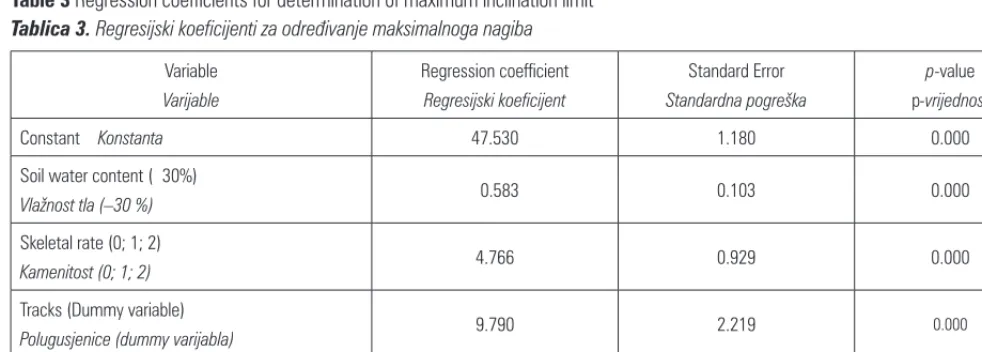
Table 3 Regression coefficients for determination of maximum inclination limit
Tablica 3. Regresijski koeficijenti za određivanje maksimalnoga nagiba
Variable
Varijable
Regression coefficient
Regresijski koeficijent
Standard Error
Standardna pogreška
p-value p-vrijednost
Constant – Konstanta 47.530 1.180 0.000
Soil water content (–30%)
Vlažnost tla (–30 %) –0.583 0.103 0.000
Skeletal rate (0; 1; 2)
Kamenitost (0; 1; 2) 4.766 0.929 0.000
Tracks (Dummy variable)
Polugusjenice (dummy varijabla) 9.790 2.219 0.000
Chains (Dummy variable)
Lanci (dummy varijabla) 9.438 2.735 0.001
The resulting regression model is presented in Table 2. The constant describes the theoretically acces -sible grade (limit) with 25% wheel slip at a soil water content of 30% for the forwarder without tracks and chains. The expected negative influence of soil mois -ture on traction behavior and therefore the ability to climb slopes is indicated by the regression coefficient for the soil water content. An increase of soil water content of 1 Vol-% reduces the prognosis of trafficable grade by 0.83 grade percent. All the other factors en -hance the prognosis of grade ability for the forwarder. Changing the skeletal content of the top soil layers to one of the two superior subclasses (free of skeleton; up to 7%; over 7%) resulted, based on the measured data and the conducted linear regression, in an increase of the prediction (from the regression model, all other conditions remaining equal) of 6.2 grade percent. The skeletal content is divided into subclasses for practical
application of the whole model. The regression coef -ficients for the traction aids sum to 13.614 and point at the positive impact on traction ability.
Besides the grades accessible with an accepted level of wheel slip, the maximum inclinations that as -sure stability against sliding downhill are a question of practical relevance, and especially in cases where the mobility of machines in grades is assisted by a trac -tion support winch (Forbrig et al. 2004; Nick 2005; Stuhlmann and Findeisen 2009). These techniques serve to extend the highly mechanized harvesting into slopes that cannot be traveled on according to the own drive line abilities or just with serious damages to the soil. In the light of safety for the machine operator and machine, it has to be assured that in case of a rope crack or technical problems the machine is able to stand without gliding. Limits depending on soil prop -erties could be calculated similar to the already pre
-Table 4 Inclination limits resulting from regression models for loess soils
Tablica 4. Granični nagib regresijskoga modela za praporna tla
Soil-Water-Content (skeletal rate)
Vlažnost tla
(kamenitost)
Wheels – Kotači Tracks and Chains – Polugusjenice i lanci
Inclination limit (ecological)
Granični nagib (ekološki)
Inclination limit (max.)
Granični nagib (maksimalni)
Inclination limit (ecological)
Granični nagib (ekološki)
Inclination limit (max.)
Granični nagib (maksimalni)
%
25 (0) 34 50 48 70
30 (0) 30 48 43 67
35 (0) 26 45 39 64
40 (0) 21 42 35 61
45 (0) 17 39 31 58
%
25 (<7) 40 55 54 74
30 (<7) 36 52 50 72
35 (<7) 32 49 45 69
40 (<7) 28 46 41 66
45 (<7) 23 44 37 63
%
25 (>7) 46 60 60 79
30 (>7) 42 57 56 76
35 (>7) 38 54 52 73
40 (>7) 34 51 47 71
sented limits from the maximum values of the regres -sion models. Since these models often lack a maximum or the values are not covered by measured data, an -other possibility was used. The measured data were assigned to one of ten groups of wheel slip, which are distributed evenly over the slip range from 0% to 100%. Data with < 10% slip were related to the first group, 10% < 20% to the second and so on. The average values of the traction coefficient were calculated for all of the 57 test series in every group. The maximum (av -erage value) in each case (test series) served again as dependent variable of a linear regression. The result -ing regression model is presented in Table 3.
On the basis of the presented regression models, trafficable grades can be estimated depending on soil properties and machine facilities. Table 4 presents the resulting ecological (max. 25% slip) and maximum (safety against sliding) inclination limits for a forward -er on loess soil for a wide range of soil wat-er contents. At the same time, distinction is made between the ap -plication of traction aids (tracks and chains) and the use of the forwarder just on wheels. For good weather conditions with low soil water contents even grades up to 34% seem trafficable uphill with a maximum of 25% wheel slip (ecological limit). Under the same con -ditions the model assumes stability against sliding up to longitudinal inclinations of 50%. When soil mois -ture increases, the trafficable grades are reduced for example to 21% inclination at 40% soil water content. Notably higher slope angles can be climbed with the machine when tracks and chains are mounted as well as when the top soil layer offers an increased skeletal rate.
3.4 Validation – Provjera modela
Table 4 presents inclination limits for loess soils calculated on the theoretical assumption of confronta -tion of trac-tion force and downhill slope force. Al -though it works in theory, there is no proof that »off road« reality sticks to the theory. In order to answer that question, validation measurements in inclined ter -rain were taken parallel to the traction tests. The aim of these measurements was to verify the ecological inclination limits due to a maximum of 25% wheel slip. Tests persist of trial drives up hill on steady slopes between 11% and 40%. The aim of the test was not to investigate the maximum limits assuming stability against gliding, as such investigation would be too dangerous.
During the tests, slip was measured and reduced to average and maximum values for further consider -ations. The aim was not to verify a precise prognosis of the wheel slip level but to make comparison with
the limits calculated from the model presented in Ta -ble 4. For every trial drive in inclined terrain, it was checked if mobility of the machine was possible with less than 25% slip from the model as well as from the observed average values. For 19 out of 31 validation tests, the inclinations seemed trafficable with no more than 25% wheel slip. Only one of these tests led to an average slip just above that limit. Driving at inclina -tions above the limit calculated from the model re -sulted in seven cases clearly exceeding the slip limit. One test series led to an average slip level of well be -low 25%, whereas the maximum slip clearly exceeded that level. Four test series showed unexpected good traction for the forwarder so that driving uphill was possible without exceeding the slip limit of 25%.
4. Discussion –
Rasprava
The validation tests for the ecological limits showed that the prognosis (trafficable with ≤ 25% slip) matched the reality for over 80% of these tests. The maximum inclinations of the model were not tested. However, the validation test stated that the maximum inclina -tions from the model are not trafficable by driving uphill, which was expected. Anyhow the resulting maximum inclination values might be used for the question of limitations for machinery working down -hill and for machines with traction support winches. Both should only be done or used in areas where the stability of the machines against gliding is assured.
In the light of various factors that influence traction abilities and mobility in grades, the present approach of calculating limits for inclinations indicates a fairly good agreement between the model and validation tests. When evaluating the model, it has to be kept in mind that it was developed especially for loess soil. These are for example widespread in the temperate zone in Europe (and here typical for the middle moun -tain ranges in Germany, where the tests were conduct -ed) or the Midwestern United States (Haase et al. 2007). The focus on loess soils limits the scope of valid -ity of the present models.
the cohesion of the terrain (Wong 2010). It is then in -dependent of the normal force (under flat conditions the weight (in N)). This however conflicts with equa -tion 2, where it is assumed that trac-tion force is the result of normal force and coefficient of friction. For a wide range of trafficable soil, it can be expected that the frictional properties of the soil dominate and there -fore equation 2 can be seen as a justifiable simplifica -tion. In addition, the traction force was measured at varying soil water contents in order to calculate the traction coefficient by division with weight of the ma -chine. For solving the question of calculating the incli -nation limits, it could be assumed that the measure -ments compensate the main errors made by the theoretical traction equation (2) used.
Even though the present model gives appropriate inclination limits, it has to be kept in mind that work -ing at the limits of machine trafficability is not just a matter of soil conservation and timber mobilization but also stress for the operator. Most of the machines used in steeper terrain are not equipped with tilt fa -cilities, which allow a relaxed positioning of the op -erator. Harvesters are often provided with tiltable cabins but there are very few forwarders equipped with tiltable driver seats. This results in ergonomic stress (Lambert and Howard 1990; Heinimann 1999) for the operator. Apart from the physical strain, there are psychic stresses related to increased risks and higher requests for the operation because of the re -duced handling opportunities. In order to ease the harvesting and forwarding operations in steep terrain, the machines that are regularly used for inclined areas should be equipped with tiltable cabins or driver seats and cranes. This would reduce the physical strain for the operator and in case of a tiltable boom the dam -ages to the residual trees would be reduced.
5. Conclusion –
Zaključak
Even with the mentioned inaccuracy, the approach of calculating trafficable inclinations from measure -ments of traction force and slip leads to a good prog -nosis. The resulting model for grade ability on loess soils indicates that a soil conserving highly mecha -nized harvesting is possible in a wide range of inclina -tion angles. However, it should be taken into consid -eration that the resulting limits from the model are based on the soil properties. Therefore, highly mecha -nized harvesting in inclined terrain should be linked to dry weather conditions or to the application of trac -tion aids to allow the requested mobility on grades. For rather unfavorable soil conditions (skeletal free, 40% soil water content) the present inclination model
results in an ecologically trafficable inclination of at least 20%. Under the same conditions, a machine equipped with tracks and chains is able to climb incli -nations up to 35%. For both examples, however, it has to be noticed that the bearing capacity of the soil is already reduced. Considerable soil compaction effects could be expected. It should be emphasized that ma -chine traffic has to be reduced to dry and favorable weather conditions, especially in inclined terrain, in order to reduce the damage to the soil and hence to ensure the long-term trafficability.
Harvesting operations in a terrain with more than 20% inclination should therefore be supported early enough by traction aids (tracks and/or chains). This improvement of soil protection (Kremer et al. 2007) and safety for the operator is the result of damages done to the root system of the trees at the skidding lane edge (Schardt et al. 2007) and of increased machine weight (Jacke 2007). In addition, there are different types of tracks that are optimized for special operation conditions and therefore differ in their ground pres -sure and traction abilities.
Acknowledgements –
Zahvala
The above project was financed by the German Ministry of Food, Agriculture and Consumer Protec -tion (BMELV) under grant number 22027605.
6. References –
Literatura
Ansorge, D., Godwin, R. J., 2007: The effect of tyres and a rubber track at high axle loads on soil compaction. Part 1: Single axle-studies. Biosyst Engineering 98: 115–126. Ansorge, D., Godwin, R. J., 2008: The effect of tyres and a rubber track at high axle loads on soil compaction. Part 2: Multi-axle machine studies. Biosyst. Engineering 99(3): 338– 347.
Arvidsson, J., Keller, T., 2007: Soil stress as affected by wheel load and tyre inflation pressure. Soil and Tillage Research 96(1–2): 284–291.
Forbrig, A., Lelek, S., Nick, L., 2004: Holzernte am Hang mit Seiltragschlepper – verfahrenstechnische Nische oder zu -kunftsweisender Quantensprung. (Timber Harvesting in Inclined Terrain with a Rope Forwarder – Process Niche or Trend Setting Quantum Leap). Forsttechnische Informa -tionen 11–12: 153–155.
Haase, D., Fink, J., Haase, G., Ruske, R., Pécsi, M., Richter, H., 2007: Loess in Europe–its spatial distribution based on a European Loess Map, scale 1:2,500,000. Quaternary Science Reviews 26(9–10): 1301–1312.
Heinimann, H., 1999: Ground-based Harvesting Technolo -gies for Steep Slopes. Proceedings of the International Moun -tain Logging and 10th Pacific Northwest Skyline Symposium.
Hittenbeck, J., 2004: Zugkraft- und Schlupfmessung an ei -nem Forwarder unter besonderer Berücksichtigung von Aspekten der Bodenverträglichkeit in Fichtendurchforstun -gen, (Traction Force and Slip Measurements with a Forward -er with Special Regard to Aspects of Soil Tol-erance in Thin -nings of Spruce). Masterthesis Georg-August Universität. Hittenbeck, J., 2009: Entwicklung eines Grenzneigungsmo -dells für selbstfahrende Arbeitsmaschinen in der Forstwirt -schaft. (Development of a Model for Trafficable Inclinations for Self Propelled Working Machines in Forestry). Disserta -tion Georg-August-Universität Göttingen, Cuvillier-Verlag. Hoepke, E., Appel, W., 2002: Nutzfahrzeugtechnik. Grund -lagen, Systeme, Komponenten. (Commercial vehicles tech -nique. Background, systems, components). 2., überarb. Aufl. Braunschweig: Vieweg (ATZ/MTZ-Fachbuch).
Horn, R., Fleige, H., 2009: Risk assessment of subsoil com -paction for arable soils in Northwest Germany at farm scale, Soil Management for Sustainability. Soil and Tillage Re -search 102(2): 201–208.
Horn, R., Vossbrink, J., Becker, S., 2004: Modern forestry ve -hicles and their impacts on soil physical properties. Soil Physical Quality. Soil and Tillage Research 79(2): 207–219. Horn, R., Vossbrink, J., Peth, S., Becker, S., 2007: Impact of modern forest vehicles on soil physical properties. Meeting the challenges of process-oriented management. Outcomes of the e-Conference »ForwardFORESTs«. Forest Ecology and Management 248(1–2): 56–63.
Hutchings, T. R., Moffat, A. J., French, C. J., 2002: Soil Com -paction under timber harvesting machinery: a prelimary report on the role of brash mats in its prevention. Soil Use and Management 18(1): 34–38.
Jacke, H., 2007: Halbherzige »Bändermänner«. (Half-Heart -ed Tracks Men). Forst und Technik 8: 22–23.
Jacke, H., Drewes, D., 2004: Kräfte, Schlupf und Neigungen. Ein Beitrag zur Terramechanik forstlicher Arbeitsmaschinen. (Forces, Slip and Grades. A Contribution to Terramechanics in Forestry). Forst und Holz 59(6): 259–262.
Jacke, H., Drewes, D., Hittenbeck, J., 2004: Ökologische und ökonomische Optimierungsansätze des Tragschlepperein -satzes in Fichtenbeständen. Zugkraftentwicklung auf reisig
-bewehrten Rückegassen und gewachsenem Boden bei vari -ierenden Reifeninnendrucken. (Ecological and Economical Optimization Approaches in Forwarding from Spruce Stands. Traction Performance on Slash Armored Skid Trails and Bare Soil at Varying Tyre Inflation Pressures). IFA-Mit -teilungen.
Jun, H., Way, T. R., Lofgren, B., Landstrom, M., Bailey, A. C., Burt, E. C., McDonald, T. P., 2004: Dynamic load and infla -tion pressure effects on contact pressures of a forestry for -warder tire. Journal of Terramechanics 41(4): 209–222. Kremer, J., Schardt, M., Borchert, H., Matthies, D., Ganter, C., 2007: Bogiebänder im Direktvergleich mit Reifen. (Tracks in Comparison with Tyres). Forst und Technik 1: 6–11. Kunze, G., Göhring, H., Jacob, K., Scheffler, M., 2002: Bau -maschinen. Erdbau und Tagebaumaschinen (Construction machines. Earthmoving and pit mining); mit 664 Abbildun -gen und 147 Tabellen. 1. Aufl. Braunschweig: Vieweg (Fördertechnik und Baumaschinen).
Lambert, M. B., Howard, J. O., 1990: Cost and productivity of new technology for harvesting and in-woods processing small-diameter trees. Pacific Nortwest Research Station, Re -search Paper PNW-RP-430.
Moffat, A. J., 1991: Forestry and soil protection in the UK. Soil Use and Management 7(3): 145–150.
Moore, D. F., 1975: The friction of pneumatic tyres. Elsevier, Amsterdam.
Mosimann, T., Sanders, S., Brunotte, J., 2008: Erosionsschutz in Fahrgassen. (Protection against Erosion in Machine Tracks). Landtechnik 63(1): 20–21.
Nick, L., 2005: Erster KWF-geprüfter Hangforwarder Forcar FC 200. (First KWF Tested Forwarder for Grades). Forsttech -nische Informationen 8–9: 99–100.
Pampel, W., 1982: Holztransport. (Timber transport). Unter Mitarbeit von P. Hascke und Gaumitz. B. 1. Aufl. Berlin: VEB Deutscher Landwirtschaftsverlag.
Podsiadlowski, S. T., 1988: Wind erosion of light soil in the wheel tracks of a farm tractor. Journal of Agricultural Engi -neering Research 39(4): 231–243.
Raper, R. L., 2005: Agricultural traffic impacts on soil. As -sessing the Impacts of Military Vehicular Traffic on Natural Areas. Journal of Terramechanics 42(3–4): 259–280.
Schardt, M., Kremer, J., Borchert, H., Matthies, D., 2007: Wur -zelschutz beim Einsatz von Forwardern. (Protection of Roots at Forwarding Operations). Forst und Technik 2: 6–11. Schulze, A., 1988: Theorie des Militärkraftfahrzeugs. (Theo -ry of milita-ry vehicles). 1. Aufl. Berlin: Militärverl. d. Dt. Demokrat. Republik.
Stuhlmann, C., Findeisen, E., 2009: Flexible und pflegliche Ernte im Hangübergangsgelände mittelsteiler Lagen. (Flex -ible and Protective Harvesting in the Change Over between Trafficable Slopes and Non-Trafficable Grades). Forst und Holz 64(3): 40–51.
Tebrugge, F., During, R.-A., 1999: Reducing tillage intensity – a review of results from a long-term study in Germany. Soil and Tillage Research 53(1): 15–28.
Trautner, A., Arvidsson, J., 2003: Subsoil compaction caused by machinery traffic on a Swedish Eutric Cambisol at differ -ent soil water cont-ents. Experiences with the Impact and Prevention of Subsoil Compaction in the European Union. Soil and Tillage Research 73(1–2): 107–118.
Von Wilpert, K., Schäfer, J., 2006. Ecological effects of soil compaction and initial recovery dynamics. A preliminary study. European Journal of Forest Research 125: 129–138.
Wanjii, S., Hiroma, T., Ota, Y., Kataoka, T., 1997: Prediction of wheel performance by analysis of normal and tengential stress distributions under the wheel-soil interface. Journal of Terramechanics 34(3): 165–186.
Wästerlund, I., 1983: Growth reduction of trees near strip roads resulting from soil compaction and damaged roots. A literature survey. Sveriges Skogsvaardsfoerbunds Tidskrift 81(2): 97–112.
Wong, J. Y., 2010: Terramechanics and off-road vehicle engi -neering. Terrain behaviour, off-road vehicle performance and design. 2nd ed., Elsevier, Amsterdam, pp. 206–351. Yoshida, K., Hamano, H., 2002: Motion Dynamics and Con -trol of a Planetary Rover With Slip-Based Traction Model. Tohoku University, Sendai, Japan.
Zoz, F. M., Grisso, R. D., 2003: Traction and Tractor Perfor -mance. ASAE. St Joseph, ASAE Distinguished Lecture Se -ries, pp. 1–48.
Sažetak
Procjena razreda kretnosti na nagibu na temelju
vučne značajke forvardera
Drvo kao obnovljivi resurs postaje sve zanimljiviji kao materijal, ali i kao izvor energije. Kako bi se udovoljilo potrebama za drvom, potrebno je da se dosad neiskorištene količine drva učine dostupne tržištu. Zbog toga je sve više zanimanja za nedovoljno iskorišteno drvo na nagnutim terenima. Nagnutost terena vrlo je važan ograničavajući čimbenik koji sprječava upotrebu potpuno visoko mehaniziranih sustava pridobivanja drva i koji smanjuje stabilnost vozila pa vozila čine štetu na tlu.
Utjecaj horizontalne sastavnice težine forvardera (FT na slici 1) upućuje na izravnu povezanost stupnja nagiba i faktora neto vuče. U teoriji se čini mogućim izračunavanje razreda kretnosti na nagibu za prihvatljivo proklizavanje kotača ili izračunavanje graničnoga nagiba pomoću najveće trakcije. Na osnovi odabrane granične vrijednosti kliza -nja od 25 % razvijen je i testiran model određiva-nja razreda kretnosti na nagibu.
Mjerenja faktora neto vuče obavljena su na prapornom tlu, na forvarderu Ponsse S 10. Za potrebe istraživanja konstruirano je dinamometarsko vitlo koje je služilo za mjerenje vučne sile pri kretanju neopterećenoga forvardera, pa sve do sila koje su prelazile mogućnosti istraživanoga vozila. Nadalje, kako bi se ispitala pouzdanost razvijenoga modela, provedena su istraživanja, bez upotrebe vitla, na nagnutom terenu uz ograničavanje klizanja na 25 %. Za poboljšanje kretnosti vozila na nagibu često se upotrebljavaju polugusjenice i lanci pa su zbog toga provedena istra -živanja uz dva različita tlaka punjenja u gumama, pri različitim vrstama tovara te usporedbom novih i istrošenih guma. Tijekom istraživanja prikupljeni su podaci o samom mjestu istraživanja, kao što su vlažnost tla, kamenitost terena, gustoća tla, debljina humusnoga sloja i vrsta drveća (zbog različitih korijenskih sustava).
Mjerenja vučne sile nasuprot klizanju istaknula su vlažnost tla i kamenitost terena kao glavne značajke tla koje utječu na mogućnost kretanja strojeva uz nagib. Što se tiče značajki samoga stroja, razlika između guma i tlaka pu -njenja u gumama ima mali utjecaj, ali upotreba polugusjenica i lanaca značajno povećava trakciju te samim time i mogućnost kretanja forvardera uz nagib. Stoga je procjena razreda kretnosti obavljena na osnovi značajki tla (vlaž -nosti tla, kamenitosti) i upotrebe polugusjenica i lanaca.
No, kako je i očekivano, prekid je kretnosti dosegnut puno prije nego što predviđa model na osnovi maksimalnih faktora neto vuče.
Čak i uz neke netočnosti, pristup računanju razreda kretnosti na nagibu preko mjerenja vučne sile i klizanja daje dobre rezultate. Razvijeni model pokazuje da je upotreba okolišno pogodnih mehaniziranih sustava pridobivanja drva moguća na različitim nagibima. Bitno je naglasiti da je osobito na nagnutim terenima kretanje šumskih strojeva dopušteno samo pri suhom i lijepom vremenu kako bi se smanjili negativni utjecaji strojeva na šumsko tlo te tako osigurala dugoročna prohodnost. Faze mehaniziranoga pridobivanja drva na nagibima većim od 20 % trebale bi se izvoditi uz upotrebu polugusjenica i lanaca.
Ključne riječi: mehanizirano pridobivanje drva, nagib, prapor, klizanje kotača, model
Received (Primljeno): January 31, 2012 Accepted (Prihvaćeno): September 5, 2012
Author’s address – Autorova adresa: Jörg Hittenbeck, PhD.
e-mail: [email protected]
Department of Forest Work Science and Engineering Faculty of Forest Science and Forest Ecology
Georg-August-University Göttingen Büsgenweg 4