Vol. 1, No. 2, pp. 115-120, September (2018)
Maximum Wind Energy Extraction by Using Neural Network Estimation and
Predictive Control of Boost Converter
Mahdi Heidaria)
The power generation from wind turbine are variable because of dependence on environmental conditions and it is important to extract maximum energy from wind. This paper proposes a new method to extract maximum energy from wind turbine systems. The artificial neural network (ANN) is used to estimate the wind speed based on the rotor speed and the output power. In addition to ANN, a predictive controller is used to maximize the efficiency of the boost converter. In predictive controller, duty cycle of boost converter is controlled to obtain the maximum power point based on the slope method. One of the most interesting advantages of this controller is simplicity of control and implementation that is leads to fast response and exact tracking. The method has been developed and analyzed by utilizing a turbine directly driven permanent-magnet synchronous generator (PMSG). The simulation results verify the performance of the proposed method. Results show that this method maximizes wind energy extraction with more accuracy and fastness.
A B S T R A C T
ARTICLE INFO
Keywords:
Boost converter Neural network PMSG
Predictive controller Wind turbine
Article history:
Received February. 16, 2018 Accepted May. 21, 2018
I. INTRODUCTION
Nowadays developed countries place great importance on using renewable energy sources due to their many advantages. As a renewable and non-polluting energy source, wind power has an important role in reducing harmful emissions and the impact of climate change. Since, fossil fuels like coal and oil are subjected to terri-ble price volatility, greater use of wind energy makes us less dependent on traditional fuels1.
During last decay, wind turbine systems have been improved with variable speed turbines and directly con-nected generators. Variable speed wind turbines not only reduce power oscillations and mechanical stresses, but also increase output power and efficiency of the system.
Because of significant progress in the semiconductor devices and power electronics techniques, wind power be-comes much more attractive in electrical power systems2. By using the methods of maximum power point tracking
a)[email protected], Tel: 2020, Fax: +98-54-3123-2020, Department of Electrical Engineering, University of Zabol, Zabol, Iran
http://dx.doi.org/10.22111/ieco.2018.23973.1008
for conversion systems of wind-turbine energy, efficiency of wind-turbine generators is increased3,4. In order to track maximum power point in wind turbines for different wind speeds, turbine speed must be changeable through a broad range5. In this case, we need to separate gen-eration side from the demand side. So the three phase output voltage of generator should be rectified and the voltage of dc bus should be adjusted. In the power-speed characteristic curve of the turbine there is only a certain load that corresponds to the maximum power of turbine. So in order to obtain maximum power, load should be changed, but this is impossible. In order to overcome this problem, an interface part is considered to utilize the maximum turbine capacity for a constant power and different environmental condition. This interface part is a maximum power point tracker which includes a DC/DC converter and a controller6.
Developed algorithms for controllers can be clustered into three control methods, which are named tip speed ratio (TSR) control7–9, power signal feedback (PSF) control10–12and hill-climb search (HCS) control13. How-ever, there are a lot of proposed methods in the litera-ture. In14 artificial neural network (ANN) is combined with particle swarm optimization (PSO) to use the max-imum power point tracking (MPPT) by controlling the rotor speed of the wind generator. In15a variable-speed wind-generator maximum power point tracking (MPPT) based on adaptive neuro-fuzzy inference system (ANFIS) is presented. The optimal speed rotation is predicted by using the variation of the wind speed as the input and implementation of ANFIS model.
system are estimated by neural-network and the duty cy-cle of dc/dc converter is determined by a predictive con-troller. The paper is organized as follows: in SectionII, the wind turbine and its characteristics are described. In Section III the proposed method is illustrated. Finally, Simulation and results are done in SectionIV.
II. DESCRIPTION OF WIND TURBINE
The main parts of the wind conversion systems are: wind turbine, generator, rectifier, dc/dc converter, and control unit. For a wind turbine, the wind power can be expressed as bellow:
Pwind=
1 2ρAV
3
w (1)
Whereρis the air density, Ais the turbine blade sweep area and Vw is the wind speed. If the friction be
ne-glected, mechanical characteristics of a turbine can be obtained as Eq. (2):
Tm−TLoad=J dω
dt (2)
Pm−PLoad=J ω dω
dt (3)
Pm= 0.5×Cp(λ, β)×ρ×A×V3 (4)
WhereTm is the mechanical torque of the turbine,Tload
is the load torque,J is the inertia of the total system,ω
is the angular speed of the rotor, Pm is the mechanical
power of turbine,V is the wind speed,Cpis the turbine
power coefficient,λis the blade tip speed ratio andβ is the blade pitch angle. In Eq. (4),λis defined as bellow:
λ= rω
Vw
(5)
Where r is the wind-turbine blade length and ω is the wind turbine rotation speed. Cpis the function of the tip
speed ratio λand the blade pitch angle β. The typical function is16:
Cp(λ, β) =0.5176× 116
λi
−0.4β−5
×−21
λi
(6)
+0.0068λ
where 1
λi
= 1
λ+ 0.08β −
0.0035 1 +β3.
FIG. 1. Wind turbine power coefficient of a wind turbine17.
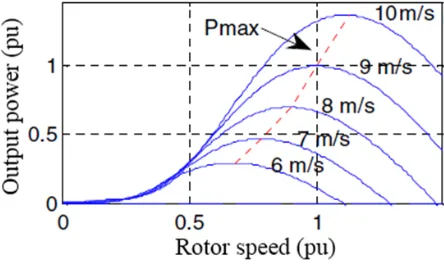
FIG. 2. Power characteristic of a wind turbine17.
Figure1shows that at different blade angles, the power coefficient vary with tip speed ratio17.
If β is at a given value, Cp has a maximum value of Cpmax andλopt is corresponding to the tip speed ratio.
In order to obtain the best power coefficient, we could obtain an optimal line by connectingλoptpoints as shown
in Fig. 2. If CP is maximal, the wind turbine output
power will be maximized.
III. PROPOSED WIND GENERATION SYSTEM AND CONTROL
In wind generation systems, the output power varies by the wind velocity. In order to obtain the maximum power, wind generation system should operate in vari-able speed state. To operate in this case, it is necessary to separate the generation part of the system from the consumption part. So, three phase voltage of PMSG gen-erator is rectified by the AC/DC rectifier. From the Eqs. (4) and (5), it can be seen that the maximum turbine power and the corresponding turbine rotor speed are pro-portional to wind velocity. Hence the wind turbine gen-eration system could be controlled by changing the rotor speed proportional to wind speed to obtain maximum power. Therefore, the wind velocity has an important role in the MPPT algorithm.
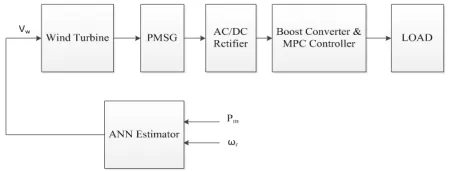
FIG. 3. The proposed wind generation system and its con-troller.
described as Eq. (7):
dPe dωr
= dPm
dωr
−Jdωr dt −J ωr
d2ω
r dt2
dωr dt
(7)
WhereJ is the system inertia andPeis generator power.
Figure 3 presents the proposed wind turbine driven PMSG and its controller. This system includes a PMSG driven by a wind turbine, a three phase full wave diode bridge rectifier, an artificial neural network estimator, boost converter and its predictive controller. Firstly, the ANN estimator predicts the wind speed. Then, based on the obtained wind speed, the wind turbine drives the PMSG. Finally, the predictive controller controls the duty cycle boost converter to obtain the maximum effi-ciency.
A. Wind Velocity Estimation by ANN
The proposed neural network is used to estimate the fast and accurate velocity of wind to avoid using the me-chanical sensor (anemometer). In this method, Pm and ωr are inputs of the neural network which is obtained
from mechanical characteristic of turbine according to Eq. (4) and neural network is configured with 2 linear neurons as input layer, 5 sigmoid neurons in hidden layer and 1 neuron in output layer.
In order to train the neural network, the method of back propagation with Levenberg-Marquardt back prop-agation training function and mean square error (MSE) with 1000 samples of rotor speed and output power are used. Also, wind velocity samples are used as target of the ANN training as shown in Fig. 4.
B. Predictive Controller Design for Boost Converter
The predictive model of controller is implemented to estimate the future behavior of the controlled variables so that proper control actions could be determined18,19. A DC/DC boost converter is used to control theVdc in
order to extract the maximum power from the system. In predictive controller, output voltage of converter is compared with reference value and is used to obtain the maximum power point based on the slope method. Then,
FIG. 4. The proposed artificial neural network21.
FIG. 5. Boost converter20.
PWM control method is used for controlling of duty cycle of DC/DC boost converter. One of the most interesting advantages of this controller is simplicity of control and implementation that is leads to fast response and exact tracking. As it can be seen from the Fig. 5, the operation of the converter can be described as follows when the switch is closed (S= 1).
diL dt =
vdc L
dvdc
dt =−
iL C1
+idc
C1
dvo dt =−
vo RC2
(8)
When the switch is opened (S= 0), we have:
diL dt =
vdc
L −
vo L
dvdc
dt =−
iL C1
+idc
C1
dvo dt =
iL C2
− vo
RC2
FIG. 6. Performance of the ANN.
Discrete form of the system can be written as follows:
iL(k+ 1) =iL(k) + TS
Lvdc(k)− TS
Lvo
vdc(k+ 1) =− TS C1
iL(k) +vdc(k) + TS C1
idc(k)
vo(k+ 1) =− TS C2
iL(k) + (1− TS RC2
)vo(k)
iL(k+ 1) =iL(k) + TS
Lvdc(k)
vdc(k+ 1) =− TS C1
iL(k) +vdc(k) + TS C1
idc(k)
vo(k+ 1) = (1− TS RC2
)vo(k)
(10)
The cost function for states of open and close switch is defined in Eq. (11)21:
JS1=0,1=wA.|vo(k+ 1)Sv∗|2 (11)
+wB.|iL(k+ 1)S−i∗|2
WherewA andwB are penalty coefficient of voltage and
current with dimensions of 1/V and 1/A which are se-lected 4 and 27 respectively. The efficiency of the system is defined as bellow:
η= PM P P T
Pac
(12)
WherePM P P T is the output of controller andPac is the
output power.
IV. SIMULATION RESULTS
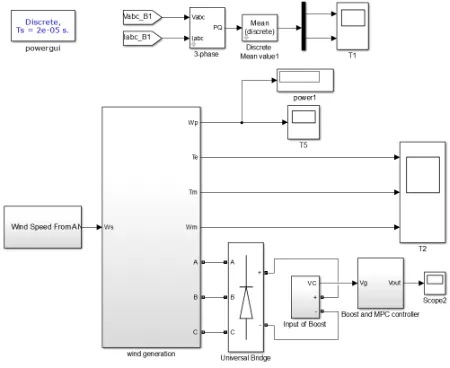
The proposed wind generation system is simulated by using MATLAB/SIMULINK. The parameters of wind
FIG. 7. View of implemented system in MATLAB/Simulink.
FIG. 8. Output of the wind generation system,(a)Te: elec-trical Torque,(b)Tm: Mechanical Torque,(c)rotor speed.
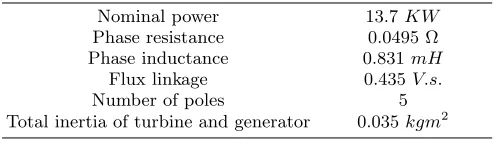
turbine and generator are in TableIand Table IIin the appendix.
FIG. 9.(a)Wind speed (rad/s),(b)Rotor speed (rad/s),(c)
Pitch angle (deg), (d) Electrical torque Te, (e)Mechanical TorqueTm.
FIG. 10. Output of the generator,(a)Output voltage (rms),
(b) Line current (rms), (c) output power of PMSG (Pac),
(d)rotor speed.
by analyzing these figures, it can be observed that the turbine operates with a Cp close to the optimal value
and that means that electrical power is equal to mechan-ical power. Figure 11shows the efficiency of the system and the duty cycle of boost converter. As can be seen from figure, the duty cycle of the boost converter is opti-mized and the proposed system can track the maximum power point exactly.
V. CONCLUSIONS
In this paper, the ANN estimator and the predictive controller of the boost converter is presented together. A neural network is used to estimation of wind velocity. The neural networks inputs are rotor speed and the output power. The estimated wind speed is the output of the ANN that is used in the wind generation system. Moreover, predictive controller is used to maximize the efficiency of the boost converter. The simulation results proved the performance of the proposed method. Compared to the traditional control strategies, the
pro-FIG. 11. (a)Efficiency of the system,(b)Duty cycle of the boost converter.
TABLE I. Parameters of wind turbine
Nominal power 12KW
Nominal wind velocity 12m/s
Turbine radius 3m
Cpmax 0.665
λopt 10.97
Pitch angle 0deg
posed method has a higher performance for extraction of mechanical power and is comparatively easy and high practical value with easy hardware implementation.
APPENDIX
The parameters of wind turbine and generator are expressed in TableIand Table II.
REFERENCES
1L. H. Hansen, L. Helle, F. Blaabjerg, E. Ritchie, S. M. Nielsen, H.
Bindner, P. Sørensen, and B. B. Jensen, “Conceptual survey of generators and power electronics for wind turbines,”RisøNational Laboratory, Roskilde, Denmark, 1205, pp.71-73, 2001.
2S. A. Gawish, S. M. Sharaf, and M. S. El-Harony, “Voltage
Sta-bilization of a Wind Turbine with STATCOM Using Intelligent Control Techniques,”Indonesian Journal of Electrical Engineer-ing and Informatics (IJEEI), Vol. 4, No. 1, pp. 24-34, 2016.
3M. F. Tsai, C. S. Tseng, and Y. H. Hung, “A novel MPPT control
design for wind-turbine generation systems using neural network compensator,”In IECON 2012-38th Annual Conference on IEEE Industrial Electronics Society, pp. 3521-3526, 2012.
4A. Zare, and A. Forouzantabar, “Adaptive Robust Control of
Variable Speed Wind Turbine Generator,”Bulletin of Electrical Engineering and Informatics, Vol. 4, No. 3, pp. 196-203, 2016.
5D. V. N. Ananth, and V. N. Kumar, “Flux Based
Sensor-less Speed Sensing and Real and Reactive Power Flow
Con-TABLE II. Parameters of generator
Nominal power 13.7KW
Phase resistance 0.0495 Ω Phase inductance 0.831mH
Flux linkage 0.435V.s.
Number of poles 5
ics and Control)Vol. 13, No. 3, pp. 745-751, 2015.
7S. Bhowmik, R. Spee, and J. H. R. Enslin, “Performance
opti-mization for doubly-fed wind power generation systems,”In In-dustry Applications Conference, 1998. Thirty-Third IAS Annual Meeting. The 1998 IEEE, Vol. 3, pp. 2387-2394, 1998.
8M. Chinchilla, S. Arnaltes, and J. C. Burgos, “Control of
permanent-magnet generators applied to variable-speed wind-energy systems connected to the grid,”IEEE Transactions on Energy Conversion, Vol. 21, No. 1, pp. 130-135, 2006.
9H. Li, K. L. Shi, and P. G. McLaren, “Neural-network-based
sen-sorless maximum wind energy capture with compensated power coefficient,”IEEE Transactions on Industry Applications, Vol. 41, No. 6, pp. 1548-1556, 2005.
10R. Chedid, F. Mrad, and M. Basma, “Intelligent control of a
class of wind energy conversion systems,”IEEE Transactions on Energy Conversion, Vol. 14, No. 4, pp. 1597-1604, 1999.
11R. M. Hilloowala, and A. M. Sharaf, “A rule-based fuzzy logic
controller for a PWM inverter in a stand alone wind energy con-version scheme,”IEEE Transactions on Industry Applications, Vol. 32, No. 1, pp. 57-65, 1996.
12K. Tan, and S. Islam, “Optimum control strategies in energy
conversion of PMSG wind turbine system without mechanical sensors,”IEEE Transactions on Energy Conversion, Vol. 19, No. 2, pp. 392-399, 2004.
13M. G. Simoes, B. K. Bose, and R. J. Spiegel, “Fuzzy logic based
intelligent control of a variable speed cage machine wind genera-tion system,”IEEE Transactions on Power Electronics, Vol. 12, No. 1, pp. 87-95, 1997.
14C. Y .Lee, Y. X. Shen, J. C. Cheng, Y. Y. Li, and C. W. Chang,
“Neural networks and particle swarm optimization based MPPT for small wind power generator,”World Academy of Science, En-gineering and TechnologyVol. 60, pp. 17-23, 2009.
15A. Meharrar, M. Tioursi, M. Hatti, and A. B. Stambouli, “A
variable speed wind generator maximum power tracking based
egy for off-grid wind power system,”In Power Electronics for Distributed Generation Systems (PEDG), 2010 2nd IEEE In-ternational Symposium on, pp. 759-764, 2010.
18S. Kouro, P. Cortes, R. Vargas, U. Ammann, and J. Rodriguez,
“Model predictive control-A simple and powerful method to con-trol power converters,”IEEE Transactions on Industrial Elec-tronics, Vol. 56, No. 6, pp. 1826-1838, 2009.
19J. Rodriguez, J. Pontt, C. A. Silva, P. Correa, P. Lezana, P.
Cortes, and U. Ammann, “Predictive current control of a volt-age source inverter,”IEEE Transactions on Industrial Electron-ics, Vol. 54, No. 1, pp. 495-503, 2007.
20M. H. Rashid, “Power electronics: circuits, devices, and
applica-tions,”India: Pearson Education, 2009.
21M. Heidari, “Improving efficiency of photovoltaic system by
using neural network MPPT and predictive control of con-verter,”International Journal of Renewable Energy Research (IJRER), Vol. 6, No. 4, pp. 1524-1529, 2016.