Comparison of Two Felling & Processing
Methods in Beech Forests
Dane Marčeta, Boštjan Košir
Abstract
In this research, two motor-manual felling & processing methods were compared, assortment and half-tree length, in beech stands. Investigation was done in two compartments in the north-ern part of Bosnia and Herzegovina (B&H), where four sample plots were chosen that differed by felled tree diameter and harvesting method. On the sample plots A1 and B1 assortment har-vesting method was performed and on the sample plots A2 and B2 half-tree length method. In the study, 318 trees were felled in total, of which 163 by the assortment method and 155 by the half-tree length method. With the increase of DBH, productivity was constantly increasing and it was higher when the half-tree length method was applied than the assortment method. The main reason why half-tree length was more productive was the fact that some working operations, like production and stacking of fuel wood, were avoided or minimized.
Keywords: motor-manual, assortment, half-tree length, productivity
pared the production rate and costs, as well as damage to the residual stand when using the cut-to-length and tree length method. The productivity of the tree length method was higher than that of the cut-to-length method. Damage to the residual stand in the cut-to-length method was higher than in the tree cut-to-length method. Adebayo et al. (2007) studied productivity and cost of the whole tree method and cut-to-length method. Their results proved that the whole tree od was more productive than the cut-to-length meth-od, and consequently the production cost was lower. Spinelli et al. (2014) compared motor-manual cut-to-length (CTL) harvesting, motor-manual whole-tree (WT) harvesting, mechanized CTL harvesting and mechanized WT harvesting as applied to the produc-tion of energy chips from the second thinning of Med-iterranean pine plantations in flat terrain, and con-cluded that mechanization increased productivity, reduced costs and damages. In Greece, the use of tree length system is introduced mainly in stands with ter-rain with low inclination, and cutting of stacked wood into length by chainsaw is a typical technical and tech-nological wood harvesting solution (Galis and Spyro-glou 2012). In central Sweden, studies of conventional Scandinavian short wood processing vs. a differenti-ated processing method were performed. The latter
1. Introduction
A harvesting system refers to tools, equipment and machines used to harvest an area, while harvesting method refers to the form in which wood is delivered to the logging access road, and depends on the amount of processing (Pulkki 1997). According to Rebula (1988), working method determines the form and size of assortments transported from the forest. According to him, there are different methods: assortment, half-tree length, half-tree length, full-half-tree method, part-half-tree method and chipping method. Pulkki (1997) empha-sizes five harvesting methods in use throughout the world: cut-to-length, tree length, full tree, whole tree and complete tree.
com-164 Croat. j. for. eng. 37(2016)1 signifies processing only sawlogs at the logging site.
Pulpwood and fuelwood are transported off the site as undelimbed tree sections. Each operation of collecting, processing and transportation of biomass requires some energy consumption at related costs (Vasković et al., 2015). Differentiated processing was found to be recom-mendable for ergonomic, economical, and efficiency reasons (Bjöerheden 1998). Although, safety hazards increase in motor-manual felling, there are certain ad-vantages because chainsaw felling is not as limited by the ground slope or tree size as mechanized felling. Motor-manual felling is also used to meet management objectives such as pre-commercial thinning, salvage operations and selective harvesting (Behjou et al. 2009).
Bojanin et al. (1989) compared harvesting in oak and alder stands. They applied assortment felling & processing method, where technical roundwood and long pulpwood in transport lengths were produced, and emphasized the advantages of producing wood in transport lengths. Application of motor-manual assort-ment, tree length and half-tree length methods in dif-ferent working conditions were also investigated by Bojanin and Krpan (1994). They established that in-stead of classical 1-m length fuelwood, 4-m transport length fuelwood was made. Krpan and Zečić (1996) investigated effective work time in harvesting of poplar by using of group work, where harvesting was done with modified tree length method, after which skid-ding to forest lanskid-ding was done, where processing continued. Zečić and Marenče (2005) examined the characteristics of work and efficiency of a work team. Zečić and Krpan (2004) examined group work for fell-ing, processfell-ing, skidding and classification in moun-tainous broadleaf thinning stands. Empirical perfor-mance models are generally developed by collecting field data and testing the statistical significance of any relationship with regression analysis (Samset 1990). This technique is used to calculate an equation that can represent the relationship between a dependent vari-able (typically time consumption or productivity) and one or more independent variables (Costa et al. 2012).
Many studies have reported that tree diameter (DBH), ground slope and species of tree influence the felling time in motor-manual felling (Kluender and Stokes 1996, Hartsough et al. 2001, Wang et al. 2004, Ghaffariyan and Sobhany 2007, Ghaffariyan et al. 2013). Notably, the back cut has the highest share of the felling time, and delay times account for about one-fifth of the total working time. Tree diameter (DBH) was found to be the most important factor of time consumption and productivity. In addition to the DBH, distance between trees was also found to influ-ence productivity of felling operation (Behjou et al. 2009). Behjou (2012) established that felling time per
tree was mostly affected by DBH, the distance among harvested trees in single-tree selection method and DBH in group selection method.
A time study is usually done either as a comparative study, a correlation study or a combination of the two (Acuna et al. 2012). The objective of comparative stud-ies is to compare two or several machines, work meth-ods, etc., while the objective of the correlation or rela-tionship study is to describe the relarela-tionship between performance and the factors influencing the work (Nur-minen et al. 2006). Time studies can be carried out using continuous time study methods, such as continuous or repetitive timing or indirect work sampling (Samset 1990, Harstela 1991, Spinelli et al. 2013). Wang et al. (2004) developed a productivity model for motor-man-ual felling, which included variables such as DBH and the distance among harvested trees. Jovanović (1980) conducted time study for two technologies, assortment and tree length method. He used work sampling meth-od for data collection. Poje and Potočnik (2007) studied group work in forestry and concluded that group work demands a highly skilled worker, who is able to per-form any work in the group and this requires constant education and employment stability.
Technical and economic harvesting of forest bio-mass depends on various factors related to terrain con-ditions, transportation networks and harvesting tech-nologies, as well as systems, silviculture and forest operations management (Picchio et al. 2011). Time studies are usually used for the analysis of productiv-ity of various forest biomass harvesting systems (Mag-agnotti et al. 2012, Picchio et al. 2009, Savelli et al. 2010). Although comparison of cut-to-length method and tree length method provides important information about the effect of log length on the productivity and cost and also damage to the residual stand, it is not sufficiently detailed, because performing cut-to-length method involves large variations in log length that re-quire more detailed studies. Therefore, further com-parative studies on the short-log and long-log method are needed to determine various positive and negative aspects of both methods applied under similar condi-tions (Adebayo et al. 2007).
forest, as well as increased stacked wood transport costs (Halilović 2012). A part of woody biomass with low value or minimal value is often called fuel wood (fire wood or wood fuel) and used as a traditional or classic source of energy (Eker 2014). Wood stacked in the for-est applying the assortment method has to be carried out by animal, and due to the lack of animal labour force on the labour market, stacked wood in practice often remains unused in the forest. The problem of stacked fuel wood produced by applying the assort-ment method can be solved if long fuel wood is pro-duced instead of classical stacked fuel wood. Producing of long wood is a rational solution because productiv-ity increases and human labour decreases (Bajić et al. 2007). The problem of practice is that, in applying the assortment method, cutters often crosscut the stem at the stump and produce definite shape of logs without the supervision of specialists for classification.
The aim of this study was to compare two motor-manual felling & processing methods, assortment and half-tree length, in beech stands in order to determine the difference in produced wood assortments, produc-tivity and cost competitiveness.
2. Material and Methods
Investigation was conducted in the northern part of the B&H in the area of municipality of Ribnik. The
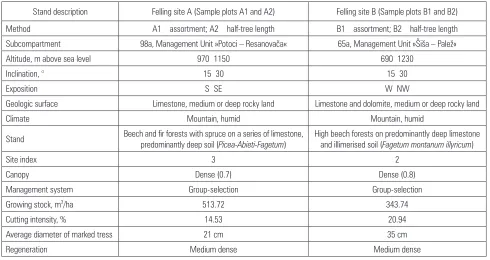
terrain was mountainous, in winter period without or with minor amount of snow. Temperature varied from 0 to 7 °C. Sample plots were placed in two subcom-partments (Table 1): subcompartment 98a MU »Potoci – Resanovača« (Felling site A) and subcompartment 65a MU »Šiša – Palež« (Felling site B).
When choosing the felling sites, stand conditions and characteristics of forest infrastructure had to be average for beech forests in B&H. In each compart-ment, two sample plots i.e. work fields were selected, (A1, A2, B1 and B2). Sample plots were selected accord-ing to the similarity of their stand and habitat condi-tions. In this way, as many factors as possible were isolated in order to compare technologies with more reliability. Felling & processing with chainsaw was per-formed on each sample plot. The width of the work fields was 100 m. The length of each work field was 500 m. So the surface of each sample plot was 5 ha.
Assortment motor-manual felling & processing method was performed on the sample plots A1 and B1, where cutters cut the trees with chainsaw and tree pro-cessing was done at the felling site. Technical assort-ments were made and stacked wood (traditional 1-m length fuelwood) was produced and piled. Fuel wood was made from the thinner part of the stem and branches. Half-tree length felling & processing method was performed on the sample plots A2 and B2, where cutting of trees, delimbing and, if necessary, crosscut-Table 1 Research site description
Stand description Felling site A (Sample plots A1 and A2) Felling site B (Sample plots B1 and B2) Method A1 – assortment; A2 – half-tree length B1 – assortment; B2 – half-tree length Subcompartment 98a, Management Unit »Potoci – Resanovača« 65a, Management Unit »Šiša – Palež«
Altitude, m above sea level 970–1150 690–1230
Inclination, ° 15–30 15–30
Exposition S–SE W–NW
Geologic surface Limestone, medium or deep rocky land Limestone and dolomite, medium or deep rocky land
Climate Mountain, humid Mountain, humid
Stand Beech and fir forests with spruce on a series of limestone, predominantly deep soil (Picea-Abieti-Fagetum) High beech forests on predominantly deep limestone and illimerised soil (Fagetum montanum illyricum)
Site index 3 2
Canopy Dense (0.7) Dense (0.8)
Management system Group-selection Group-selection
Growing stock, m3/ha 513.72 343.74
Cutting intensity, % 14.53 20.94
Average diameter of marked tress 21 cm 35 cm
166 Croat. j. for. eng. 37(2016)1 ting of the stem was done at the site. The stem remained
whole or was cut into the transport lengths to allow easier skidding. Stacked wood was made only from branches. Processing continued at the landing site.
Workers were in group of two. Both workers were cutters but while one of them worked with chainsaw, the other was an assistant. After half of the working day, they changed roles. During the time when the cutter worked with the chainsaw, the assistant was engaged in several jobs like work place cleaning, ac-cessories carrying, moving the branches away after delimbing, producing and stacking of fuel wood, etc. Productivity was calculated for the working crew. All work was performed by the same working crew so as to avoid the influence of skill and devotion of workers. Working crew was selected on the basis of last tree month productivity sheets. The crew with average productivity was selected. They worked with profes-sional chainsaw Husqvarna 372XP.
Productivity was investigated by time and work study method (Björheden et al. 1995, Acuna et al. 2012). Time was divided into time elements, each correspond-ing to one specific task. Time consumptions for work elements were measured by continuous chronometry method and recorded. The distance between marked trees was measured by measuring tape, slope gradient was measured by clinometers and the produced wood data were collected by measuring the diameter and length of each piece of roundwood and by measuring of pile dimension of 1-m length stacked wood. For version of staked volume into solid wood volume, con-version coefficient 0.65 was used. Workers, who worked on processing at the landing site during the research, were paid per shift, not per productivity, because pro-cessing at the landing site was part of the study and it is not common for local forestry organizations. Their productivity was roughly determined on the basis of work time and produced wood volume.
When data were collected, the influence of differ-ent variables on all phases of technological process
was examined on the tree level. Several statistical methods were used (Descriptive statistics, Regression and Multiple regressions with dummy variables, etc.) with the help of software Statistica10. Standard times for both methods were calculated. Cost calculation was done according to official methodology, which is in use in the Public Company »Šume Republike Srp-ske«, based on Myiata (1980).
3. Results
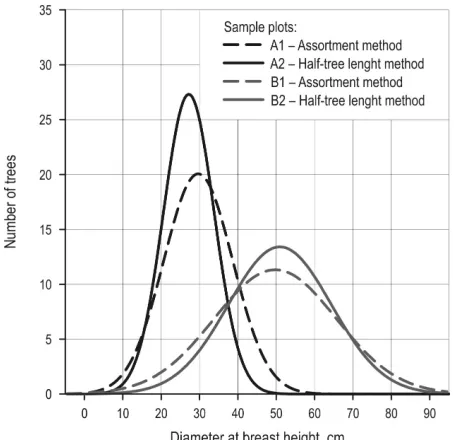
3.1 Description of sampleIn the study, 318 trees were felled in total, of which 163 applying the assortment method (sample plots A1 and B1) and 155 applying the half-tree length method (A2 and B2). The average diameter of felled trees on sample plot A1 was 30 cm and varied from 9 to 54 cm, Fig. 1 DBH distribution of felled trees
Table 2 Sample description
Sample
plot Method N
DBH, cm Vfuelwood, m3 Vroundwood, m3 Vtotal, m3
Mean Min. Max. Std.Dev. Mean Sum % Mean Sum % Mean Sum %
A1
Assortment 113 30 9 54 8.39 0.124 14.001 15.53 0.705 76.172 84.47 0.798 90.173 100
B1 50 49 23 78 15.78 0.643 32.149 17.13 3.173 155.500 82.87 3.762 187.649 100
A2 Half-tree
length
110 27 10 49 7.47 0.072 1.362 1.95 0.629 68.593 98.05 0.636 69.955 100
B2 45 50 18 69 13.39 0.288 12.942 8.12 3.256 146.530 91.88 3.544 159.472 100
on sample plot B1 it was 49 cm and varied from 23 to 78 cm (Fig. 1). On sample plots A2 and B2, the average tree diameter was 27 cm and 50 cm, respectively, and varied from 10 to 49 cm on A2 and 18 to 69 cm on B2 (Table 2).
Total volume of produced wood was 507.25 m3, of which 277.82 m3 in assortments and 229.43 m3 in half-tree length. From the total amount, 231.67 m3 of round-wood was in assortments and 215.12 m3 in half-tree length (Table 2). TTK 50S
The share of stacked wood on sample plots in as-sortments (A1 and B1) was 15.53% and 17.13%,
respec-tively. On sample plots where half-tree length method was performed (A2 and B2), the share of stacked wood was 1.95% and 8.12%. The number of roundwood as-sortments per tree and dimension of asas-sortments are presented in Table 3.
3.2 Comparison of samples
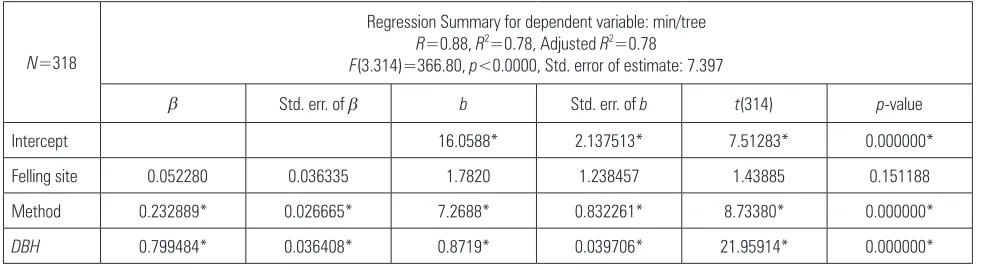
Multiple regression with dummy variables was performed in order to determine which factors influ-ence effective work time per tree. Results showed that felling & processing method and DBH have significant influence on the level p≤0.05 (Table 4). These results Table 3 Characteristics of produced roundwood
Sample plot Mean Min. Max. Std. dev.
Number of assortments per tree
A1
Assortment 2.30 1.0 6.0 1.52
B1 1.81 1.0 7.0 0.92
A2
Half-tree length 6.23 1.0 12.0 3.03
B2 4.77 1.0 12.0 2.57
Average diameter of assortments, cm A1
Assortment 25.73 13.0 51.0 7.22
B1 20.01 8.0 46.0 6.89
A2
Half-tree length 34.83 12.0 79.0 16.23
B2 26.90 10.0 61.0 13.81
Average length of assortments, m
A1
Assortment 5.16 1.0 9.0 1.72
B1 8.83 3.8 14.5 2.09
A2
Half-tree length 4.95 1.0 9.0 1.68
B2 8.66 1.6 18.0 3.23
Average volume of assortments, m3
A1
Assortment 0.262 0.032 1.079 0.13
B1 0.319 0.035 1.594 0.26
A2
Half-tree length 0.501 0.054 2.694 0.45
B2 0.691 0.028 3.505 0.80
Table 4 Regression summary for effective time per tree
N=318
Regression Summary for dependent variable: min/tree
R=0.88, R2=0.78, Adjusted R2=0.78
F(3.314)=366.80, p<0.0000, Std. error of estimate: 7.397
b Std. err. of b b Std. err. of b t(314) p-value
Intercept – – –16.0588* 2.137513* –7.51283* 0.000000* Felling site –0.052280 0.036335 –1.7820 1.238457 –1.43885 0.151188
Method 0.232889* 0.026665* 7.2688* 0.832261* 8.73380* 0.000000*
DBH 0.799484* 0.036408* 0.8719* 0.039706* 21.95914* 0.000000*
168 Croat. j. for. eng. 37(2016)1 indicated that further analysis should be done
sepa-rately for both examined work methods. Felling site did not show significant influence on the effective time per tree and this result indicated that felling sites with similar work conditions were chosen in accordance with the purpose.
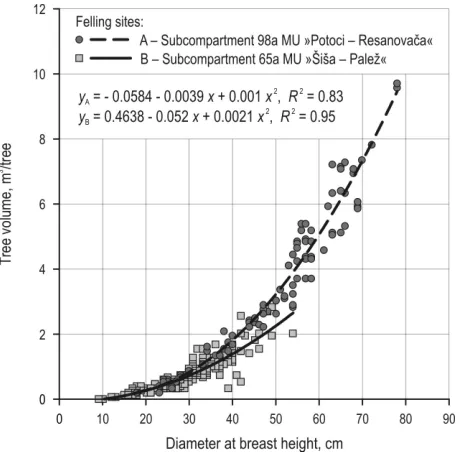
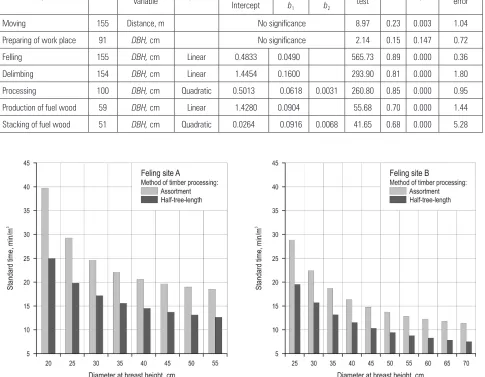
Comparison of net volume per tree on each feeling site showed that work method had no significant in-fluence on the net volume per tree but DBH and felling site did show significant influence (Table 5). Trees on the felling site B had larger net volume per tree for the same DBH (Fig. 2). The difference in the net wood vol-ume, as a result of different site index of felling site and different working method, indicated that produc-tivity should be calculated separately for both work method and felling site.
3.3 Analysis of work operations
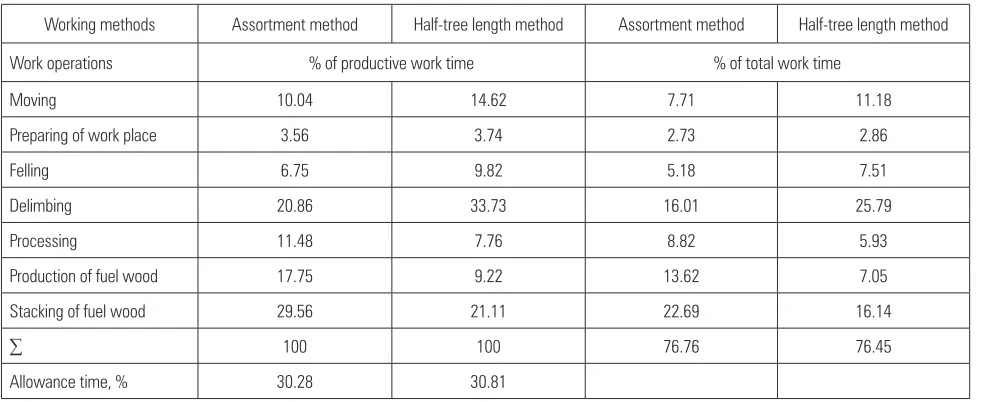
Total studied work time was 4519.44 min on the sample plots where the assortment method was ap-plied and 2502.72 min on the sample plots where half-tree length method was applied. From total time, pro-ductive work time was 3469.12 min (assortment) and 1913.29 min (half-tree length) with relative share of delays 30.28% and 30.81%, respectively (Table 6).
Productive work time was divided into work op-erations. Most time consuming work operation in ap-plying the assortment method was stacking of fuel wood with 6.29 min/tree, then follows delimbing with 4.44 min/tree and production of fuel wood with 3.78 min/tree. In applying the half-tree length method, most time consuming work operations were delimb-ing with 4.16 min/tree, stackdelimb-ing of fuel wood with 2.61 min/tree and moving with 1.81 min/tree. The shortest time operation in both methods was prepar-ing of work place.
In both methods, most of the allowance work time is related to personal delay, 43% in applying the assort-ment method and 51% in applying the half-tree length method. Then follow technical delays with the share of 26% and 30%, preparatory-final time with 19% and 11% and organizational delay with the share of 12% and 8%, respectively.
3.4 Analysis of influencing factors on time consumption of work operations
Research of different factors influencing the time of work operations was done with the regression and cor-relation analysis. The influence strength was presented with correlation coefficient (R), with the level of sig-nificance, p≤0.05. The mathematical models that best show the dependence between variables were present-ed with regression equations. In work operations, where no significant dependences were evidenced, mean values were used for productivity calculations. Table 5 Regression summary for net volume per tree
N=318
Regression Summary for dependent variable: m3/tree
R=0.94, R2=0.88, Adjusted R2=0.88
F(3.314)=785.87, p<0.0000, Std. error of estimate: 0.649
b Std. err. of b b Std. err. of b t(314) p-value
Intercept – – –1.78630* 0.187694* –9.51709* 0.000000*
Method 0.004242 0.019402 0.01598 0.073080 0.21865 0.827061
DBH 0.828727* 0.026491* 0.10907* 0.003487* 31.28351* 0.000000* Felling site –0.152354* 0.026438* –0.62669* 0.108748* –5.76275* 0.000000*
* Significant at p<0.05
Assortment method
Work operations Moving and Preparing of work place did not show significant difference of any examined variable. Their mean value was used for productivity calculation. All other work operations showed depen-dence on DBH (Table 8).
Half-tree length method
In half-tree length method it was similar. Moving and Preparing of work place did not show significant
difference from any examined variables and all other work operations depended from DBH (Table 9).
3.5 Productivity and costs
Productivity was calculated according to the time for each work operation calculated by the regression equation in cases where significant dependence on influencing factors was established or the mean values were used if there was no dependence. The sum of work operations was multiplied by the coefficient of Table 6 Descriptive analysis of work time
Working methods Assortment method Half-tree length method
Work operations Sum Mean Minimum Maximum Sum Mean Minimum Maximum
Min. min/tree Min. min/tree
Moving 348.26 2.14±1.53 0.13 8.23 279.72 1.81±1.07 0.35 5.23 Preparing of work place 123.33 0.76±1.04 0.03 7.38 71.59 0.46±0.73 0.08 4.80 Felling 234.23 1.44±1.18 0.12 6.98 187.87 1.21±0.78 0.10 3.37 Delimbing 723.69 4.44±3.37 0.30 18.63 645.38 4.16±3.07 0.67 21.08 Processing 398.42 2.44±4.19 0.12 35.35 148.44 0.96±1.81 0.12 8.85 Production of fuel wood 615.66 3.78±3.45 0.17 19.27 176.47 1.14±2.01 0.20 10.35 Stacking of fuel wood 1025.53 6.29±7.17 0.42 35.00 403.82 2.61±7.11 0.33 40.00 Productive work time, min 3469.12 1913.29
Allowance time, min 1050.32 589.43
Allowance time, % 30.28 30.81
∑ Total, min 4519.44 2502.72
Table 7 Relative share of work operations in total and productive work time
Working methods Assortment method Half-tree length method Assortment method Half-tree length method
Work operations % of productive work time % of total work time
Moving 10.04 14.62 7.71 11.18
Preparing of work place 3.56 3.74 2.73 2.86
Felling 6.75 9.82 5.18 7.51
Delimbing 20.86 33.73 16.01 25.79
Processing 11.48 7.76 8.82 5.93
Production of fuel wood 17.75 9.22 13.62 7.05
Stacking of fuel wood 29.56 21.11 22.69 16.14
∑ 100 100 76.76 76.45
170 Croat. j. for. eng. 37(2016)1 Table 8 Time dependence analysis – Assortment method
Work operation N Independent variable Equation Parameters F
test R p
Standard error Intercept b1 b2
Moving 158 Distance, m – No significance 0.04 0.02 0.849 1.54
Preparing of work place 130 DBH, cm – No significance 3.93 0.17 0.049 1.03 Felling 161 DBH, cm Quadratic 0.3810 –0.0075 0.0009 315.30 0.82 0.000 0.69
Delimbing 162 DBH, cm Linear –2.1889 0.1794 – 384.04 0.84 0.000 1.83 Processing 127 DBH, cm Quadratic 0.2109 –0.0699 0.0031 234.61 0.81 0.000 2.48 Production of fuel wood 161 DBH, cm Quadratic 1.2539 –0.0215 0.0021 203.89 0.75 0.000 2.29
Stacking of fuel wood 156 DBH, cm Quadratic 1.8507 –0.1583 0.0068 430.71 0.86 0.000 3.69
Table 9 Time dependence analysis – Half-tree length method
Work operation N Independent variable Equation Parameters testF R p Standard error
Intercept b1 b2
Moving 155 Distance, m – No significance 8.97 0.23 0.003 1.04 Preparing of work place 91 DBH, cm – No significance 2.14 0.15 0.147 0.72 Felling 155 DBH, cm Linear –0.4833 0.0490 – 565.73 0.89 0.000 0.36 Delimbing 154 DBH, cm Linear –1.4454 0.1600 – 293.90 0.81 0.000 1.80 Processing 100 DBH, cm Quadratic 0.5013 –0.0618 0.0031 260.80 0.85 0.000 0.95 Production of fuel wood 59 DBH, cm Linear –1.4280 0.0904 – 55.68 0.70 0.000 1.44 Stacking of fuel wood 51 DBH, cm Quadratic 0.0264 –0.0916 0.0068 41.65 0.68 0.000 5.28
allowance time and divided by the volume of wood (Fig. 3).
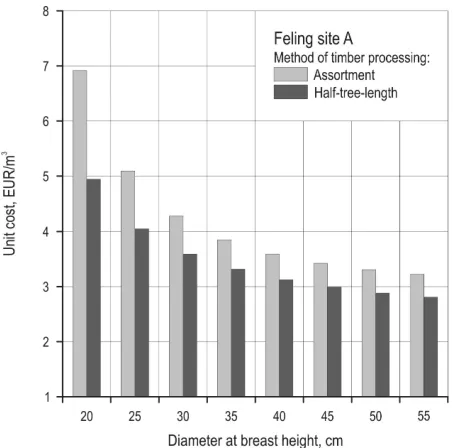
The cost of the working day of chainsaw was cal-culated on the basis of official methodology used by the Public Company »Šume Republike Srpske«. Prices of material and labour, which were valid at the mo-ment of research, were taken as inputs. The cost of one 8-hour-working day was EUR 78.4 (9.80 EUR/hour). In half-tree length method, workers who performed processing at the roadside landing were paid per shift and costs of processing at the landing site were 0.6 EUR/m3 for felling site A and 0.5 EUR/m3 for felling site B (Fig. 4) on the basis of daily productivity of 130.7 m3 for felling site A and 156.8 m3 for felling site B and daily costs of EUR 78.4.
4. Discussion
The share of stacked wood was significantly lower in applying the half-tree length method than assort-ment method, 1.95% (A2 – half-tree length method) vs 15.53% (A1 – assortment method) and 8.12% (B2 – half-tree length method) vs 17.13% (B1 – assortment method). These results were expected in accordance with the working methods. In applying the assortment method, stacked wood was made from branches and from thinner parts of the stem, while in the half-tree length method, it was only made from branches. The decision on the place where producing of roundwood stops and producing of stacked wood starts on the stem was based on recommendations of operation
plans for the specific compartment. The difference in the amount of stacked wood within the same harvest-ing method was higher on the sample plots with smaller average tree diameter. The reason for that could be that thicker trees have a relatively higher amount of branches above 7 cm diameter from which stacked wood is produced. The average number of as-sortments per tree was smaller in half-tree length method, 1.81 pieces per tree (A2 – half-tree length method) vs 2.23 pieces per tree (A1 – assortment meth-od) and 4.77 (B2 – half-tree length methmeth-od) vs 6.23 (B1 – assortment method). The difference was slightly big-ger on sample plots with larbig-ger DBH, 19% (A2 vs A1) and 23% (B2 vs B1). The diameter of assortments was lower in applying the half-tree length method than the assortment method. The difference was the conse-quence of the fact that in using the half-tree length method logs were relatively longer and stretched to the thinner parts of the stem, while in using the assort-ment method these parts were bucked into the stacked wood. The emphasis is on the fact that technical and firewood logs are the same in half-tree length method, which makes skidding of lower value wood cost com-petitive (Košir 2009, Bajić et al. 2007).
172 Croat. j. for. eng. 37(2016)1 most cases. As a consequence of length and diameter,
the average volume of assortments was larger in ap-plying the half-tree length method 19% (A2 vs A1) on sample plots with lower DBH and 27% (B2 vs B1) on plots with larger DBH.
Relative structure of productive work time showed that work operations Production of fuelwood and Stack-ing of fuelwood consumed relatively less time in apply-ing the half-tree length method than the assortment method, 9.22% and 21.11% in applying the half-tree length method and 17.75% and 29.56% in applying the assortment method, respectively. Time Delimbing takes relative larger share in half-tree length method, 33.73% vs 20.86% in assortment method. The explanation for that could be the fact that in upper parts of stem in applying the assortment method Delimbing can over-lap with the Production of fuelwood and it is hard to define the border between those two operations dur-ing time study. Structure of additional times was sim-ilar in both methods, coefficient of allowance times are 1.30 for assortment and 1.31 for half-tree length meth-od. Ghaffariyan et al. (2013) determined next-time distribution in chainsaw motor-manual felling: mov-ing to tree 12%, reconnaissance 11%, under cut 27%, backcut 31% and delay 19%. In uneven-aged beech forests, Behjou et al. (2009) established mean delay times of 0.81 min per tree, based on 0.22, 0.44 and 0.15 min per tree for operational, mechanical and per-sonal delays.
Regression and correlation analysis showed that in both methods, the operation Moving did not show de-pendence on distance. The reason could lie in the fact that trees marked for felling were equally distributed in the stand. The reason could also be the discipline of workers. Preparing of work place did not show signifi-cant dependence on any examined factor. Other work operations showed more or less strong significant de-pendence on DBH. Productivity was constantly in-creasing with the increase of DBH and it was higher in applying the half-tree length method than the assort-ment method. The reason for higher productivity of the half-tree length method was the fact that some working operations were avoided or minimized in ap-plying the half-tree length method, like production and stacking of fuel wood. Also, bucking was mostly transferred to the landing site, where it could be done in a more productive way.
5. Conclusion
Investigation showed that performing of the half-tree length harvesting method was more productive and cost competitive than the assortment method.
Unit costs were significantly lower. Large amount of stacked wood remaining after the assortment method is a transport problem for forest managers because it is more and more difficult to find animals on the la-bour market. Working with animals is very expensive. In some surrounding countries, forest managers sell wood felled by the stump to the local population that produces fuelwood for personal consumption (Vusić 2013), but in B&H local people are, in general, still not interested in it. In applying the half-tree length meth-od, stacked wood also occurred, but in significantly less amount than in applying the assortment method. It only came from the branches, while the other fuel wood remained as roundwood and was skidded to-gether with the other more valuable parts of the stem. This resulted in increased felling & processing produc-tivity and allowed transport of lower value wood.
6. References
Adebayo, A.B., Han, H-S., Johnson, L., 2007: Productivity and cost of cut-to-length and whole-tree harvesting in a mixed-conifer stand. Forest Product Journal 57(5): 59–69. Acuna, M., Bigot, M., Guerra, S., Hartsough, B., Kanzian, C., Kärhä, K., Lindroos, O., Magagnotti, N., Roux, S., Spinelli, R., Talbot B., Tolosana, E., Zormaier F., 2012: Good practice guidelines for biomass production studies. COST Action FP-0902, WG 2 Operations research and measurement method-ologies, CNR Ivalsa – Italy, 1–50.
Bajić, V., Danilović, M., Gačić, D., Stefanović, D., Krajnc, N., Dolenšek, M., 2007: Korišćenje nekih resursa u šumama hrasta kitnjaka. Monografija Hrast kitnjak u Srbiji, Šumarski fakultet Univerziteta u Beogradu, 1–498.
Behjou, F.K., Majnounian, B., Dvorak, J., Namiranian, M., Saeed, A., Feghhi, J., 2009: Productivity and cost of manual felling with a Chainsaw in Caspian forests. Journal of Forest Science 55(2): 96–100.
Behjou, F.K., 2012: Effect of selective cutting type on the chainsaw productivity in Caspian Forests. Journal of For-estry Research 23(4): 699–702.
Björheden, R., Apel, K., Shiba, M., Thompson, M.A., 1995: IUFRO Forest work study nomenclature. Swedish Univer-sity of Agricultural Science, Dept. of Operational Efficiency, Garpenberg, 16 p.
Bjöerheden, R., 1998: Differentiated processing in motor manual and mechanized logging. International Journal of Forest Engineering 9(2): 49–59.
Costa, C., Menesatti, P., Spinelli, R., 2012: Performance mod-elling in forest operations through partial least square re-gression. Silva Fennica 46(2): 241–252.
Doležal, B., 1984: Štete u šumi izazvane primjenom meha-nizacije. Dokumentacija za tehniku i tehnologiju u šumarstvu 81: 1–47.
Eker, M., 2014: Trends in Woody Biomass Utilization in Turkish Forestry. Croatian Journal of Forest Engineering 35(2): 255–270.
Gallis, C., Spyroglou, G., 2012: Productivity Linear Regres-sion Models of Tree-Length Harvesting System in Natural Coastal Aleppo Pine (Pinus halepensis L.) Forests in the Chalkidiki Area of Greece. Croat. j. for. eng. 33(1): 115–123. Ghaffariyan, M.R., Sobhany, H., 2007: Cost production study of motor-manually felling and processing of logs. Forest Sci-ence 3: 69–76.
Ghaffariyan, M.R., Naghdi, R., Ghajar, I., Nikooy, M., 2013: Time Prediction Models and Cost Evaluation of Cut-To-Length (CTL) Harvesting Method in a Mountainous Forest. Small-Scale Forestry 12(2): 181–192.
Halilović, V., 2012: Komparacija metoda dobivanja šumske biomase kao obnovljivog izvora energije iz hrastovih sasto-jina. Disertacija, Šumarski fakultet Univerziteta u Sarajevu, 1–154.
Harstela, P., 1991: Work studies in forestry. Silva Carelica 18: 41 p.
Hartsough, B.R., Zhang, X., Fight, R.D., 2001: Harvesting cost model for small trees in natural stands in the Interior Northwest. Forest Products Journal 51(4): 54–61.
Jovanović, B., 1980: Istraživanje utroška vremena za dvije tehnologije rade kod eksploatacije bukovih šuma u SR BiH. Magistarski rad, Šumarski fakultet Sveučilišta u Zagrebu, 1–248.
Kluender, R.A., Stokes, B.J., 1996: Felling and skidding pro-ductivity and harvesting cost in southern pine forests. In: Proceedings: Certification-Environmental implications for forestry operations, September 9–11, 1996, Quebec City, Quebec, Joint conference Canadian Woodlands Forum, Ca-nadian Pulp and Paper Association, and International Union of Forest Research Organizations, 35–39.
Košir, B, Krajnc, N., Piškur, M., 2009: Uvajanje tehnologije strojne sečnje in izkoriščanja sečnih ostatkov. Konačno poročilo projekta, Biotehniška fakulteta Univerze u Lju-bljani, 177p.
Krpan, A., Zečić Ž., 1996: Efektivno vrijeme pri sječi i izradi topole primjenom skupnog rada. Savjetovanje »Skrb za hrvatske šume od 1846. do 1996.«, Knjiga 2, 217–226. Kulušić, B., Miodragović, D., 1979: Prilog istraživanja tehnološkog procesa sječe, izrade i privlačenja drveta pri iskorišćavanju borovih i hrastovih šuma u BiH, Radovi Šumarskog fakulteta u Sarajevu 22(5–6): 3–66.
Kulušić, B., 1981: Tehnološka tipizacija bukovih šuma i mješovitih šuma bukve, jele i smrče u SR BiH. Prilog
pozna-vanju tehnologije iskorišćavanja bukovih šuma u SR BiH, Naučnoistraživački projekat, Šumarski fakultet Sarajevo, 1–83.
Kulušić, B., Jovanović, B., Miodragović, D., Ljubojević, S., Davidović, V., 1980: Prilog poznavanju tehnologije iskorišćavanja bukovih šuma u SR BiH. Šumarski fakultet Sarajevo, 1–82.
Ljubojević, S., 1990: Uticaj nekih faktora na učinke privlačenja bukove i jelove deblovine zglobnim traktorom Timberjack 350A na teškim terenima. Mehanizacija šumarstva 15(5–6): 101–106.
Magagnotti, N., Pari, L., Spinelli, R., 2012: Re-engineering firewood extraction in traditional Mediterranean coppice stands. Ecological Engineering 38(1): 45–50.
Meyer, G., Ohman, J.H., Oettel, R., 1966: Skidding hard-woods, Articulated rubber-tyred skidders vs. crawler trac-tors. Journal of Forestry 64(3): 191–196.
Miyata, E.S., 1980: Determining fixed and operating costs of logging equipment. General Technical Report NC-55, US Department of Agriculture, Forest Service, St. Paul, 16 p. Naghdi, R, Rafatnia, N., Jalali, G.H., Hosseini, S.M., 2005: A survey of the efficiency of Timberjack 450C wheeled skidder in Shafaroud forests in Guilan province. Iranian Journal of Natural Resources 57(4): 675–687.
Nurminen, T., Korpunen, H., Uusitalo, J., 2006: Time con-sumption analyses of the mechanized cut-to-length harvest-ing system. Silva Fennica 40(2): 335–363.
Rebula, E., 1988: Tehnologija u šumarstvu na početku idućeg tisućuljeća. Mehanizacija šumarstva 13(3–4): 31–40.
Picchio, R., Maesano, M., Savelli, S., Marchi, E., 2009: Pro-ductivity and Energy Balance in Conversion of a Quercus Cerris L. Coppice Stand into High Forest in Central Italy. Croat. j. for. eng. 30(1): 15–26.
Picchio, R., Spina, R., Maesano, M., Carbone, F., Monaco, A.L., Marchi, E., 2011: Stumpage value in the short wood system for the conversion into high forest of a oak coppice. Forestry Studies in China 13(4): 252–262.
Poje, A., Potočnik, I., 2007: Influence of working conditions on overlapping of cutting and ground skidding in group work. Croat. j. for. eng. 28(2): 157–167.
Pulkki, R., 1997: Cut-to-length, tree-length or full tree har-vesting? Central Woodlands 1(3): 22–27.
Samset, I., 1990: Some observations on time and performance studies in forestry. Meddelelser fra Norskinstitutt for skog-forskning 43(5): 80 p.
Savelli, S., Cavalli, R., Baldini, S., Picchio, R., 2010: Small scale mechanization of thinning in artificial coniferous plan-tation. Croat. j. for. eng. 31(1): 11–21.
174 Croat. j. for. eng. 37(2016)1 Spinelli, R., Laina-Relano, R., Magagnotti, N., Tolosana, E.,
2013: Determining Observer and Method Effects on the Ac-curacy of Elemental Time Studies in Forest Operations. Bal-tic Forestry 19(2): 301–306.
Vasković, S., Halilović, V., Gvero, P., Medaković, V., Musić, J., 2015: Multi-Criteria Optimization Concept for the Selec-tion of Optimal Solid Fuels Supply Chain from Wooden Bio-mass. Croatian Journal of Forest Engineering 36(1): 109–123. Vusić, D., 2013: Pogodnost sustava pridobivanja drvne bio-mase u smrekovoj šumskoj kulturi. Disertacija, Šumarski faklultet Sveučilišta u Zagrebu, 1–174.
Wang, J., Long, C., McNeel, J., Baumgras, J., 2004: Productiv-ity and cost of manual felling and cable skidding in central Appalachian hardwood forests. Forest Product Journal 54(12): 45–51.
Zečić, Ž., Marenče, J., 2005: Mathematical models for opti-mization of group work in harvesting operations, Croat. j. for. eng. 26(1): 29–37.
Zečić, Ž., Krpan, A., 2004: Efficiency of group work in har-vesting mountainous broadleaf thinning stands. Zbornik gozdarstva in lesarstva 74: 41–57.
Received: August 6, 2014 Accepted: November 18, 2014
Authors’ addresses:
Assist. Prof. Dane Marceta, PhD.* e-mail: [email protected]
University of Banja Luka, Faculty of Forestry Bulevar Vojvode Stepe Stepanovića 75 78000 Banja Luka
BOSNIA AND HERZEGOVINA Prof. Boštjan Košir, PhD.
e-mail: [email protected]
University of Ljubljana, Biotechnical Faculty Jamnikarjeva 101
1000 Ljubljana SLOVENIA