Influence of Base Additive on Nanoporous Carbon
Materials via HTC for Catalyst Support
Tripob Longprang
1, Dolrudee Jaruwat
2, Parncheewa Udomsap
1,3, Nuwong Chollacoop
3, Apiluck
Eiad-ua
1*1 College of Nanotechnology, King Mongkut's Institute of Technology Ladkrabang, Thailand.
2 Department of Chemical Engineering, Faculty of Engineering, Chulalongkorn University, Phayathai Rd., Phathumwan, Bangkok, 10330, Thailand.
3 National Metal and Materials Technology Center, National Science and Technology Development Agency, Pathumthani 12120, Thailand.
* Corresponding author. Tel.: +66-89-781-5665; email: [email protected] Manuscript submitted September 10, 2018; accepted March 8, 2019.
doi: 10.17706/ijmse.2019.7.2.34-39.
Abstract: Nanoporous support materials were successfully synthesized from biomass via hydrothermal carbonization with base additives. This research study the effect of hydrothermal temperature (160-200 °C), hydrothermal time (4-24 h) and influence of base additive (NaOH, KOH, Na2CO3 and K2CO3) have been chosen in order to improve the surface structure. The samples have been characterized by scanning electron microscopy, nitrogen sorption, Fourier transform infrared spectroscopy and X-ray diffraction. The experimental results revealed that hydrothermal carbonization process and acid addition have effect on the properties of catalyst support. The results indicated that hydrothermal process at 200°C for 12 h and activation with KOH at 900°C for 2 h, exhibited the highest surface area, porosity and pore volume leading to increased distribution of metal on the carbon support.
Keywords: Biomass, Nanoporous carbon, Catalyst support, Hydrothermal carbonization.
1.
Introduction
Sustainable and renewable materials are required in all aspect of energy and environment because of decreasing of the resource.Most researchfocuses on synthesis or production of biofuel,solar energy, use of biomass for energy and resources such as activated carbon [1]. Activated carbons applications in water treatment in most industry such as food [2, 3], pharmaceutical, petroleum [4], automobile [5], nuclear [6], [7], and biofuel. Furthermore, activated carbon with high porosity are used extensively for adsorption of small sized molecule. Treatment system is necessary for increasing of pore size to containing large molecules requires adsorbents with mesoporous content [8].
Carbon with high mesoporous surface areas have utility in many applications, for example in chromatography, dye removal from water, electronic capacitor, lithium batteries, bio-catalyst, electro-catalyst, support materials, etc. [9] Synthesis of activated carbons from biomass has been carried out using physical (CO2, stream, etc.) and chemical (typically, ZnCl2, acid and base) activation [10]-[16].
In this research, there is interesting to investigate the influence of base additive to activated the high porosity of the activated carbon by using cattail leave as raw material. Cattail leave is one of the most common weeds in Thailand. Cattail grow rapidly and can be breed in large numbers in water source. It has an impact on the environment and waste water. Cattail leave is a biomass composed of 38.5% cellulose, 37.6% hemicellulose, 12.8% lignin and 11.1% ash [19]. Objective of this research, to synthesis and investigate the morphology, functional group and porosity of the activated carbon in different kind of base (NaOH, KOH, Na2CO3 and K2CO3) activation.
2.
Materials and Methods
Material Preparation
Activated carbons prepared by used Cattail leaves (Typha angustifolia) as carbon source from nature. Cattail leaves was washed by water to remove the impurities and cut in to 2.5 cm then dried at 90°C for 24 h, mesh and sieved for separated powder and fiber. Cattail leave powder was used to synthesis the activated carbon in this research.
Hydrothermal Treatment
Teflon autoclave was filled with 30 g cattail leaves powder and 60 mL deionized water. The hydrothermal held in range of temperature at 160, 180 and 200 °C for 4, 8, 12 and 24 h. The hydrothermal treated product (hydrochar) was cool in room temperature and were dried at 90 °C for 24 h.
Chemical Activation
The activated carbons were prepared by used base (NaOH, KOH, Na2CO3 and K2CO3) activation. Precursor were mixed with 4 M base solution and stirred for 3 h. The mixture was loaded in to quartz boat and positioned inside aluminum tube that was place in horizontal tube furnace for carbonization process. Carbonization temperature was used at 900 °C for 2 h and 10 °C/min heating rate under nitrogen atmosphere at a flow rate of 100 cc/min. The products were rinsed by used hydrochloric acid (0.1 mol/L) and washed with deionized water until a pH of 7 was obtained. Finally, the activated carbons were dried at 105 °C for 12 h.
Characterization
The surface morphology of the activated carbons prepared at the optimum conditions was identified by scanning electron microscopy (SEM) (Zeiss EVO MA10) operated at 10 kV. Fourier Transform Infrared spectroscopy (FT-IR) (Perkin Elmer Spectrum Two) was used to determine the function group on surface of sample. The porosity and surface area were calculated by applying the Brunauer-Emmett-Teller (BET) model.
3.
Results and Discussions
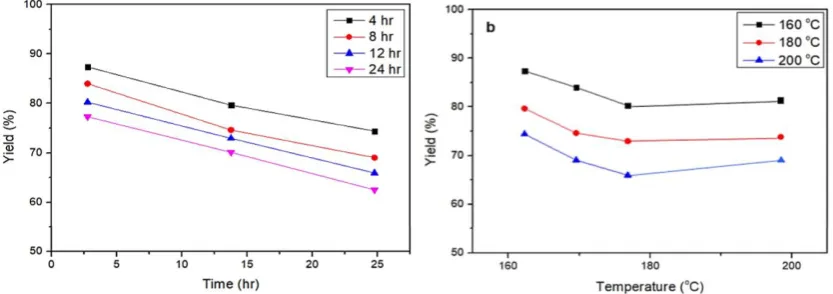
than temperature.
Fig. 1. Yield of hydrochar through hydrothermal process at different (a) times and (b) temperatures.
Fig. 2. FTIR spectra of carbon activated by (a) Non-activated, (b) NaOH, (c) KOH, (d) Na2CO3 and (e) K2CO3.
Fig. 3. SEM image (500x) of activated carbon through hydrothermal carbonization process and activated by base (a) NaOH, (b) KOH, (C) Na2CO3 and (d) K2CO3.
and dehydration from base additive generated porosity inside the activated carbon. Hemicellulose, cellulose and lignin have degradation and generated the -OH group form -OK group on the surface. After rinse by water after activated by base cause an ion exchange, K+ is disappear and left -OH at the surface of activated carbon. Morphology of prepared activated carbon shown as scanning electron micrograph in Fig. 3 (a-d). After activated the hydrochar by chemical activation with base significant change on the surface morphology can be found in different kind of base. Base activation can be increase pore size and porosity depend on the dissociation of base.Comparation of hydroxy and carbonate group, carbonate base have too influence to the pores becauseamount of base dissociation cause the pore fracture. In the other way, hydroxy basehave an appropriate influence to size increasing of pores and KOH activated exhibits a great porosity and distribution.
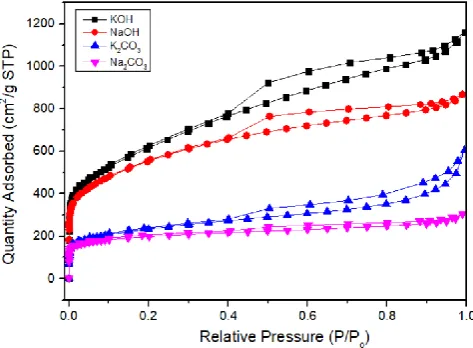
Fig. 4. Nitrogen sorption isotherm of activated carbon.
Nitrogen sorption isotherms of activated carbon shown in Fig. 4. Base activated carbon present typical (I+IV) isotherms according to the IUPAC classification. The major nitrogen adsorption occurs at relative pressures in range of 10-6-0.999. A horizontal adsorption at 0.3 P/P0 ratios, suggesting that the mesopores dominant in all activated carbon there exist some micropores because of large hysteresis loop and high deviation from the plateau region in isotherm plot. Activated carbon used hydroxy base (NaOH and KOH) have higher deviation and laugher hysteresis loop than activated carbon used carbonate base (Na2CO3 and K2CO3). Activated carbon by used KOH additive exhibited highest surface areas at 2162 m2g-1.
4.
Conclusions
The hydrothermal temperature and base activation are mainly affected on the morphology and porosity of synthesized activated carbon. Hydrothermal carbonization at 200 °C for 12 h was the best condition in this work. The temperature is the mainly effect to the solid yield and structural properties of activated carbon. Increasing of the temperature cause decreasing of hydrochar yield above 30% from decomposed of hemicellulose and cellulose. The base activation has an effect to the porosity of activated carbon. Tar and gas compositions from degradation of hemicellulose and cellulose was expose and increase the pore size of activated carbon. Carbon activated by KOH could be generate the highest pore volume in this research.
Acknowledgment
References
[1] Su, D. S. (2009). The use of natural materials in nanocarbon synthesis. ChemSusChem, 2, 1009–1020.
[2] Ahmedna, M., Marshall, W., & Rao, R. (2000). Surface properties of granular activated carbons from agricultural by-products and their effects on raw sugar decolorization. Bioresour. Technol., 71, 103–112.
[3] Legrouri, K., Khouya, E., Ezzine, M., Hannache, H., Denoyel, R., Pallier, R., & Naslain, R. (2005). Production of activated carbon from a new precursor molasses by activation with sulphuric acid. J. Hazard. Mater., 118, 259–263.
[4] Parshetti, G. K., Liu, Z., Jain, A., Srinivasan, M., & Balasubramanian, R. (2013). Hydrothermal carbonization of sewage sludge for energy production with coal. Fuel, 111, 201–210.
[5] Falco, C., Sevilla, M., White, R. J., Rothe, R., & Titirici, M. M. (2012). Renewable nitrogen-doped hydrothermal carbons derived from microalgae. ChemSusChem, 5, 1834–1840.
[6] Kubo, S., Demir-Cakan, R., Zhao, L., White, R. J., & Titirici, M. M. (2010). Porous carbohydrate-based materials via hard templating. ChemSusChem, 3, 188–194.
[7] Baccile, N., Antonietti, M., & Titirici, M. M. (2010). One-step hydrothermal synthesis of nitrogen‐doped nanocarbons: Albumine directing the carbonization of glucose. ChemSusChem, 3, 246–253.
[8] Jain, A., Balasubramanian, R., & Srinivasan, M. P. (2015). Tuning hydrochar properties for enhanced mesopore development in activated carbon by hydrothermal carbonization. Microporous and Mesoporous Mater., 203, 178–185.
[9] Ryoo, R., Joo, S. H., Kruk, M., & Jaroniec, M. (2001). Ordered Mesoporous Carbons, Adv. Mater., 13, 677–681.
[10] Aygu n, A., Yenisoy-Karakas, S., Duman, I. (2003). Production of granular activated carbon from fruit stones and nutshells and evaluation of their physical, chemical and adsorption properties. Microporous Mesoporous Mater., 66, 189–195.
[11] Guo, J., & Lua, A. C. (1999). Textural and chemical characterizations of activated carbon prepared from
oil-palm stone with H2SO4 and KOH impregnation. Microporous Mesoporous Mater., 32, 111–117.
[12] Ania, C., Parra, J., Menendez, J., & Pis, J. (2005). Effect of microwave and conventional regeneration on the microporous and mesoporous network and on the adsorptive capacity of activated carbons. Microporous Mesoporous Mater., 85, 7–15.
[13] Stavropoulos, G., & Zabaniotou, A. (2005). Production and characterization of activated carbons from
olive-seed waste residue. Microporous Mesoporous Mater., 82, 79–85.
[14] Yang, J., & Qiu, K. (2011). Experimental design to optimize the preparation of activated carbons from
herb residues by Vacuum and traditional ZnCl2 chemical activation. Ind. Eng. Chem. Res., 50, 4057–4064.
[15] Hao, W., Bjo rkman, E., Lilliestra le, M., & Hedin, N. (2014). Activated carbons for water treatment prepared by phosphoric acid activation of hydrothermally treated beer waste. Ind. Eng. Chem. Res., 53, 15389– 15397.
[16] Mohanty, K., Jha, M., Meikap, B. C., & Biswas, M. N. (2005). Preparation and characterization of activated
carbons from terminalia arjuna nut with zinc chloride activation for the removal of phenol from wastewater. Ind. Eng. Chem. Res., 44, 4128–4138.
[17] Romero-Anaya, A. J., Ouzzine, M., Lillo-Ro denas, M. A., & Linares-Solano, A. (2014). Spherical carbons:
Synthesis, characterization and activation processes. Carbon, 68, 296-307.
[18] Kang, S., Li, X., Fan, J., & Chang, J. (2012). Characterization of hydrochars produced by hydrothermal carbonization of lignin, cellulose, d-xylose, and wood meal. Ind. Eng. Chem. Res., 51, 9023–9031.
[19] Ruangmee, A., & Sangwichien, C. (2013). Statistical optimization for alkali pretreatment conditions of
Tripob Longprang is a bachelor degree student. He is with the College of Nanotechnology, King Mongkut’s Institute of Technology Ladkrabang (KMITL) in Young Scientist and Technologist Program (YSTP) of National Science and Technology Development Agency (NSTDA). He joined in Nonoporous Material Laboratory since 2017. His present research interest is on application of nanoporous carbon for renewable energy.
Dolrudee Jaruwat is a master degree student. She is with the Department of Chemical Engineering, Faculty of Engineering, Chulalongkorn University. She graduated with a bachelor of nanomaterial engineering from College of Nanotechnology, King Mongkut’s Institute of Technology Ladkrabang (KMITL) in 2018. She was a student of Young Scientist and Technologist Program (YSTP) and become to student in Thailand Graduate Institute of Science and Technology (TGIST) of National Science and Technology Development Agency (NSTDA) since 2018.
Parncheewa Udomsap is Ph.D student. She is with the College of Nanotechnology, King Mongkut’s Institute of Technology Ladkrabang (KMITL). She graduated with a bachelor of industrial chemistry at KMITL and master degree of science in chemical chemistry from Chulalongkorn University in 2005. She had work in Renewable Laboratory at National Metal and Materials Technology Center (MTEC) since 2006. She studied doctural degree since 2016 and research in theme of application of porous materials in form of catalyst.
Nuwong Chollacoop is thehead of Renewable Energy Laboratory, National Metal and Materials Technology Center (MTEC).He received a bachelor degree in engineering with economics minor from Brown University in 1999, and doctor degree in material engineering with bio-engieering minor from Massachusetts Institute of Technology (MIT) in 2004. He had experience to invited researcher of Asia Biomass Energy Reseaechers Invitation Program in National Institute of Advanced Industrial Science and Technology (AIST), Japan in 2009 and country expert in field of biodiesel fuel and sustainable automobile of economic research institute for ASEAN and East Asia (ERIA) from 2008 to present. He joined MTEC with present research interest on synthesis and application of renewable energy and electrical automobile since 2004.