1. Introduction
Distribution systems act as mediums providing final links between the electric utility and customers. Perhaps the oc-currence of failures in power system components is one the most main reasons of unavailability in supplying elec-tric energy to users. Most of failures occur in the distri-bution voltage level. There are some accessible strategies to enhance reliability in distribution system; some of which are[1], [2]: utilizing highly reliable equipment for protection; reclosing and switching; automation; acceler-ation of restore processes by employing faster crew; faster fault prophecy techniques; and fewer equipment failures to avoid contingencies. Distribution feeder
reconfigura-tion is also one of the most important strategies among reliability improvement schemes. Two types of switches are usually installed in distribution systems along the main feeders and laterals: normally closed switches (sec-tionalizing switches) and normally open switches (tie switches). A sectionalizing switch isolates a faulted sec-tion of the system so that the healthy part can still be elec-trically supplied, while a tie switch recovers loads that have been disconnected by transferring some of loads to other supporting distribution feeders without violating op-eration and engineering constraints. The reconfiguration task of a distribution system, which is to change the open/close status of sectionalizing and tie switches, is done in order to achieve a radial operating structure that optimizes certain objectives while satisfying operational constraints without islanding any load [1]. Since the status of these switches has a vital effect on branch power flows as well as on interruption durations in the event of a sys-tem failure, power losses and reliability of a distribution system can be effectively improved by reconfiguration [1].
A great deal of work has been done in literature on net-work reconfiguration (also known as feeder reconfigura-tion) in distribution systems mainly with the objective
Reconfiguration of Distribution Systems to Improve
Re-liability and Reduce Power Losses using Imperialist
Com-petitive Algorithm
M. Sedighizadeh*(C.A.), M. Esmaili**and M. M. Mahmoodi***
Abstract:Distribution systems can be operated in multiple configurations since they arepossible
combina-tions of radial and loop feeders. Each configuration leads to its own power losses and reliability level of supplying electric energy to customers. In order to obtain the optimal configuration of power networks, their reconfiguration is formulated as a complex optimization problem with different objective functions and net-work operating constraints. In this paper, a multi-objective framenet-work is proposed for optimal netnet-work re-configuration with objective functions of minimization of power losses, System Average Interruption Frequency Index(SAIFI), System Average Interruption Duration Index (SAIDI), Average Energy Not Sup-plied (AENS), and Average Service Unavailability Index (ASUI). The optimization problem is solved by the Imperialist Competitive Algorithm (ICA) as one of the most modern heuristic tools. Since objective functions have different scales, a fuzzy membership is utilized here to transform objective functions into a same scale and then to determine the satisfaction level of the afforded solution using the fuzzy fitness. The efficiency of the proposed method is confirmed by testing it on 32-bus and 69-bus distribution test systems. Simulation results demonstrate that the proposed method not only presents intensified exploration ability but also has a better converge rate compared with previous methods.
Keywords: Distribution System Reconfiguration, Distributed Generation, ICA, Multi-Objective
Optimiza-tion, Reliability Indices.
Iranian Journal of Electrical & Electronic Engineering, 2017. Paper received 7November 2016 and accepted 7 August 2017. *The Author is with the Faculty of Electrical Engineering, Shahid Be-heshti University, Evin, Tehran, Iran.
E-mail: [email protected]
**The Author is with the Department of Electrical Engineering, West Tehran Branch, Azad University, Tehran, Iran.
E-mail: [email protected]
***The Author is with the Department of Electrical Engineering, college of Engineering, Saveh Branch, Islamic Azad University, Saveh, Iran. E-mail: [email protected]
Corresponding Author: M. Sedighizadeh
function of active power loss reduction due to the fact that the cost of active power losses occupies considerable amount of operation cost and therefore, even a small re-duction in power losses is still attractive for electric power utilities. Abdelaziz et al. in [2] utilized the Improved Tabu Search (ITS) algorithm for network reconfiguration with the objective function of minimizing active power losses. Constraints consist of preserving the network radial struc-ture and limits for bus voltages and line flows. Gupta et al. in [3] proposed a multi-objective network reconfigu-ration problem based on Adaptive Genetic Algorithm (AGA). Suggested objective functions include minimiz-ing power losses, voltage violations, branch current vio-lations, and number of switching. Objective functions are converted into fuzzy memberships with the same range of [0, 1] using truncated sinusoidal and trapezoidal fuzzy membership functions. The degree of overall satisfaction of the multi-objective solution is specified by the 'max-geometric mean' operator. The output of this operator is employed as the fitness function of the AGA method. To minimize power losses, Srinivasa Rao et al. in [4] pro-posed the Harmony Search Algorithm (HSA) for recon-figuration of distribution systems with constraints including voltage profile, feeder capacities, and radial structure of the network. Niknam et al. in [5] suggested a multi-objective optimization for reconfiguration of distri-bution networks equipped by fuel cells using probabilistic load flow. Shuaib et al. in [6] applied the Gravitational Search Algorithm (GSA) for distribution system recon-figuration problem with the objective functions of mini-mizing power losses and balancing loads in feeders subject to voltage profile and network radiality.
In literature, little attention has been paid to reliability en-hancement in feeder reconfiguration. Duan et al. in [7] performed network reconfiguration for power loss reduc-tion and reliability enhancement with constraints of volt-age profile and network radiality. The algorithm used to solve the optimization problem is an enhanced Genetic Algorithm (GA). The basis for this work is the informa-tion of a single loop caused by closing a normally open switch and to develop the algorithm on crossover and mu-tation operations of the original GA. Shareef et al.in [8]ap-plied the Quantum-Inspired Binary Firefly Algorithm (QBFA) to network reconfiguration to minimize the num-ber of propagated voltage stages and other reliability in-dices such as System Average Interruption Frequency Index (SAIFI) and Momentary Average Interruption Fre-quency Index (MAIFI). The problem constraints are volt-age profile and network radiality. Kavousi-Fard et al. in [9] utilized the self-adaptive modified optimization algo-rithm based on the Bat Algoalgo-rithm (BA) for distribution network reconfiguration with considering several objec-tives of SAIFI, Average Energy Not Supplied (AENS), total active power losses, and total network cost. In order to observe the effect of distributed generation on the
reli-ability of the power system, wind power source is also considered in the method. This optimization is solved sub-ject to constraints of voltage profile, feeder ratings, and radial structure of the network. Gupta et al. in [10] used an efficient GA to perform optimal distribution system re-configuration. The objectives of optimization are feeder power losses and system’s node voltage deviation reduc-tion, and improvement of reliability indices such as SAIFI, system’s average interruption unavailability index and energy not supplied. Zhang et al. in [11] presents a new reliability-oriented algorithm to distribution system reconfiguration. This method uses the interval analysis techniques to include data uncertainties and to maximize the possibility of reliability enhancement and/or loss re-duction.
The problem of reconfiguring the network is formulated as a Nonlinear Programming (NLP) optimization problem that can be solved by a variety of solution methods. From viewpoints of optimality and accuracy, intelligent or evo-lutionary tools such as GA, Particle Swarm Optimization (PSO), Ant Colony Optimization (ACO), and Imperialist Competitive Algorithm (ICA) may give better solutions compared with classical methods such as Lagrangian. In literature, some evolutionary algorithms are used to solve reconfiguration in distribution systems; for instance, we can refer to modified Tabu Search in [2], HSA in [4], AGA in[3], GSA in [6], QBFA in [8], Shuffled Frog Leaping Algorithm (SFLA) in [12]. Furthermore, ICA as one of new evolutionary methods has recently got more attention in power system applications [13-16] due to its special ca-pabilities. The efficiency of ICA to solve optimization problems in other fields has confirmedits better perform-ance compared with other evolutionary algorithms [14, 15].
According the features reviewed above, the contribution of this paper is to perform the optimal reconfiguration of distribution networks using a fuzzy-based multi-objective ICA algorithm to enhance reliability indices and reduce power losses[17]. The objective functions include mini-mization of power losses, SAIFI, System Average Inter-ruption Duration Index (SAIDI), AENS, and Average Service Unavailability Index (ASUI). The optimal con-figuration of the distribution system is so obtained that power losses are minimized and reliability is enhanced at the same time. A fuzzy-based decision maker [18, 19] is used to transform objective functions into fuzzy member-ships and then finally to combine them into a single ob-jective function, which is optimized subject to a variety of power system operational constraints.
The paper is organized as follows. In Section 2, the multi-objective reconfiguration problem is formulated as an op-timization problem with is objective functions and constraints. In section 3, the ICA algorithms are intro-duced to solve the problem. Section 4 explains how to apply the ICA algorithm to the reconfiguration problem.
Simulation results obtained from two test distribution sys-tems are presented in Section 5. The results are compared with those of other approaches and they demonstrate the efficiency of the proposed algorithm. Finally, Section 6concludes the paper.
2. Proposed Multi-Objective Problem for Network Re-configuration
The primary or main feeders and lateral distributors are two important parts of a distribution network. A primary feeder starts from a substation and ends to major load cen-ters. Individual load points are connected to the main feeder through the lateral distributors with distribution transformers at their end point. A radial distribution net-work has a main feeder with components such as lines, cables, and transformers to supply load points. Review of failure statistics clarifies that overhead and underground cable failures contribute to a large part of customer inter-ruptions. Indeed, underground cables have a high operat-ing temperature and when the temperature of a cable exceeds its threshold, it can motivate insulation break-down and thus exacerbate the component failure rates. Furthermore, with increasing operating temperature, the life expectation of dielectric materials reduce exponen-tially. There are the same issues for overhead lines. High levels of currents cause to increase the sag of overhead lines and to reduce the ground clearance and this results in raising the risk of happening an electric outage. So, any planning strategy that intends to enhance reliability of the system should reduce the branch currents. In addition, total power losses are also reduced by reducing branch currents since losses are proportional with the square of currents. The branch currents can be reduced by altering the topology of the distribution network via distribution feeder reconfiguration. Consequently, the reliability in-dices and power losses are effectively managed by reduc-ing the harmful impacts of the temperature. Regardreduc-ing the above explanations, the distribution feeder reconfigura-tion can be a suitable strategy to reduce failure rates through reducing the temperature in overhead lines and underground cables by controlling the current magnitude. Then, after reconfiguration and current reduction, the fail-ure rate of branches are improved. The new failfail-ure rate as a function of current magnitude can be expressed as [20]:
(1)
where and represent branch i current mag-nitude before and after reconfiguration, respectively; and are the failure rate of branch i (failure /year) before and after reconfiguration, respectively; is the best failure rate which can be attained for
branch i by current reduction (this failure rate corresponds to the zero branch current =0).
As seen in (1), the failure rate of a branch is linearly re-lated to the ratio of the feeder current after and before per-forming distribution feeder reconfiguration; this can be used as the failure rate reduction coefficient. By this strat-egy, branch currents are reduced by changing direction of power flow and as a result,the failure rate of whole net-work would be decreased.
2. 1. Reliability Indices
Reliability indices in a distribution system can be studied from two viewpoints: load point reliability indices and system reliability indices. For a load point P, basic relia-bility indices that can be defined include the average fail-ure rate λp, average outage durationrP, and annual outage time UP. These reliability indices can be calculated as-suming a series system as follows:
(2)
(3)
(4)
where nis number of outage events for load point P; ri is repair time of component i (in hours).
Using the three basic load point indices in (2)-(4), cus-tomer-oriented reliability indices can be introduced as SAIFI, SAIDI, Average Service Availability Index (ASAI), ASUI, Energy Not Supplied (ENS), and AENS. In the next subsection, enhancement of these customer-oriented reliability indices and minimization of power losses are considered as objective functions of the pro-posed reconfiguration problem.
2. 2. Objective Functions
2. 2. 1. Minimization of Reliability Indices A few reliability indices are optimized in the proposed method to ensure power quality in the network. The av-erage number of interruptions that a customer experiences is measured by SAIFI. This index is the first objective function and expressed as:
(5) ߣ௪ൌ
ܫோǡ௪
ܫோǡ௧
൫ߣ௧െ ߣ௦௧൯ ߣ௦௧
ܫோǡ௧ ܫோǡ௪
ߣ௧
ߣ௦௧
ܫோǡ௪
ߣ௪
ߣൌ ߣ
ୀଵ
ܷൌ ߣ
ୀଵ
ݎ
ݎൌ
ܷ
ߣ
ൌσ ߣ
ୀଵ ݎ
σୀଵߣ
݂ଵሺݔሻ ൌ ܵܣܫܨܫ ൌ
σୀଵߣܰ σୀଵܰ
ሺȀ ሻ
where Nj is the number of customers supplied at load point j; λjis failure rate for load point j(failure/year); nl is number of load points.
The SAIDI is the reliability index utilized by electric power utilities; it gives the average outage duration time that a customer experiences and is defined as:
(6)
where Ujis unavailability of load j (failure/year). The ASAI is the ratio of the total number of customer hours that service was accessible during a given time pe-riod to total customer hours; this is also referred as the service reliability index. The ASAI is usually computed on either a monthly basis (730 hours) or a yearly basis (8760 hours) and expressed as:
(7)
The third objective function of ASUI, which is the con-trary of ASAI, is defined as:
(8)
Another reliability index is ENS, which is the energy not supplied to customers as a result of outages. It is defined for each load bus as:
(9)
where La(j)is the average connected load to the load point j(kW).The Average Energy Not Supplied (AENS), as the last reliability objective function, is defined:
(10)
2. 2. 2. Minimization of Power Losses
Minimizing active power losses has been one of vital is-sues in distribution systems. It is computed as sum of power loss of branches as:
(11)
where Rkand Ikrepresent the resistance and current of branch krespectively; SBR is the set of branches. The proposed multi-objective optimization problem has four reliability objective functions of f1(x), f2(x), f3(x), and f4(x)as formulated in (5), (6), (8), (10), respectively, and the power loss objective function as formulated by (11). By minimizing these objective functions simultane-ously, it is ensured that the network after reconfiguration have a higher reliability in supplying energy with a re-duced power losses.
2. 3. Decision Variables
The decision variables of the proposed method for recon-figuration include the status of normally open switches (tie switches) and normally closed switches (sectionaliz-ing switches).The correspond(sectionaliz-ing binary vector is defined as:
(12)
where ntieand nsware number of tie and sectionalizing switches, respectively.
2. 4. Fuzzy-Based Combination of Objective Func-tions
Using the proposed multi-objective programming method, all objective functions are optimized to find an optimal solution. In view of the fact that the five introduced ob-jective functions have different scales, if they are simply combined into one objective function, It leads to the ing problem. The fuzzi fication method can prevent scal-ing problems by convertscal-ing objective functions into the same range. In this technique, all objective functions are fuzzi fied and transformed into the same range of [0, 1]. The membership function for minimizing objective func-tion iis presented as:
(13)
where and represent the ideal and nadir values from the payoff table for objective function i, respec-tively; giis objective function value; βiis its fuzzy mem-bership value. A smaller value of the objective function causes a larger membership function; this is more favor-able when the goal is minimization.
Ideal and nadir values characterize the best and worst ݂ଶሺݔሻ ൌ ܵܣܫܦܫ ൌ
σୀଵܷܰ σୀଵܰ
ሺȀ ሻ
ܺ ൌ ሾܶ݅݁ǡ ܹܵሿ
ܶ݅݁ ൌ ሾܶ݅݁ଵǡ ܶ݅݁ଶǡ ǥ ǡ ܶ݅݁௧ሿ
ܹܵ ൌ ሾܹܵଵǡ ܹܵଶǡ ǥ ǡ ܹܵ௦௪ሿ ܣܵܣܫ ൌσ ܰൈ ͺͲ
ୀଵ െ σୀଵܷܰ
σୀଵܰൈ ͺͲ
݂ଷሺݔሻ ൌ ܣܷܵܫ ൌ ͳ െ ܣܵܣܫ
ܧܰܵ ൌ ܮሺሻܷሺ݆ሻ
ୀଵ
݂ସሺݔሻ ൌ ܣܧܰܵ ൌ ܧܰܵ σୀଵܰ
ሺȀ ሻ
݂ହሺݔሻ ൌ ܲ௦௦ൌ ܴȁܫȁଶ אௌோ
ߚൌ
ە ۖ ۖ ۔ ۖ ۖ
ۓ 1݃ ݃
݃௫െ ݃ ݃௫െ ݃
݃ ݃ ݃௫
0݃ ݃௫
݃ ݃௫
available value of each objective function, respectively, in the solution space of the problem. To obtain ideal and nadir values of an individual objective function, the best and the worst system configuration is obtained by indi-vidually optimizing each objective function regardless of other objective functions. Among the obtained values from single objective optimizations, the worst and best values of each objective function gives its nadir and ideal values.
In this paper, five memberships of βSAIFI, βSAIDI, βASUI, βAENSand βLossare computed for objectives functions of SAIFI, SAIDI, ASUI and AENS, and power losses, re-spectively. There are several operators to determine an overall fuzzy satisfaction function, but some of them have disadvantages. For instance, when the “max-weighted ad-dition” operator is used, the overall fitness function will not equal zero when one of membership functions is equal to zero. Another operator is “max-product” that cannot determine the distance of solutions from the ideal one. Soin this paper, to combine objective functions and pro-vide the degree of overall fuzzy satisfaction, an operator named “max-geometric mean,” [3, 21], is considered. This combining technique offers a better performance than other techniques. Its overall fuzzy satisfaction is de-fined as follows:
(14)
where μf represents the overall fitness function of the so-lution. For our multi-objective problem, the overall fitness function is the objective function that should be maxi-mized.
2. 5. Constraints of the optimization problem The proposed multi-objective programming problem is optimized subject to different constraints as described in the following subsections.
2. 5. 1. Load flow equations
The following equations represent power balance at each node of the distribution system as equality constraints.
(15)
(16)
where PIiand QIiare active and reactive net injections at bus i; |Ei| and δirepresent the magnitude and angle of voltage phasor at bus i; Nbis number of buses; |Yij| and
φijare the magnitude and angle of entry ijfrom the ad-mittance matrix.
2. 5. 2. Network Radiality and Connectivity The conservation of network radiality is one of the most vital constraints in system reconfiguration. To keep sim-plicity in protection of distribution systems and other as-pects, networks are designed as radial. Thus, this property should be retained during reconfiguration process. In ra-dial networks, the number of fundamental loops is deter-mined by closing all tie switches. It is calculated as [5]:
(17)
where Nbis the total number of buses of the network; NLoopis the number of tie switches of the system; Nbris the total number of network branches.
In the proposed algorithm, the number of switches to be opened to maintain feasible radial configurations is con-sidered as a control variable as an integer number. In this paper, the radiality in the reconfiguration process is guar-anteed by graph rules [13], where the distribution network is radial if there is neither any loop nor any isolated load point in the network. Mathematically, the topology of a graph with n nodes is radial if:
(18)
where xkis the status of branch k (equals to 1 if branch k is closed, otherwise 0); n is the number of nodes of the graph; SBR is the set of branches of the graph.
2. 5. 3. Branch capacity limits
For protection of cables and feeders against extreme cur-rents, feeder currents should be limited to their permissi-ble rating:
(19)
where Iijrepresents the current of branch ij; is the permissible rating of branch ij.
2. 5. 4. Bus voltage permissible range
In order to keep voltage of buses in their allowed range specified by the system operator after reconfiguration, the following limitation is considered:
(20) ݔ
אௌோ
ൌ ݊ െ ͳ ߤൌ ඥߚఱ ௌூிூൈ ߚௌூூൈ ߚௌூൈ ߚாேௌൈ ߚ௦௦
ܲܫൌ ȁܧȁȁܧȁȁܻȁ ൫ߜെ ߜെ ߮൯ ே್
ୀଵ
݅ ൌ ͳǡ ǥ ǡ ܰ
ܳܫൌ ȁܧȁȁܧȁȁܻȁ ൫ߜെ ߜെ ߮൯ ே್
ୀଵ
݅ ൌ ͳǡ ǥ ǡ ܰ
ܰൌ ܰെ ܰ ͳ
หܫห ܫ௫݅ǡ ݆ ൌ1ǡ ǥ ǡ ܰ
ܫ௫
ܸ ܸ ܸ௫݆ ൌ1ǡ ǥ ǡ ܰ
3. Imperialist Competitive Algorithm (ICA)
The policy of extending the power of an imperial beyond its own boundaries is named imperialism. An imperialist uses different policy for dominating other countries in-clude direct rule or by less clear tools such as control of the market for goods or raw materials. Atashpaz-Gargari and Lucas [22] proposed the ICA in 2007. This algorithm as a socio-politically motivated global search strategy has recently been used for optimizing different optimization tasks [23, 24].
3. 1. Initialization Phase
This algorithm similar to other evolutionary algorithms is initialized by the population of Pcountries which are gen-erated randomly within the search space. Each country is defined by contryi=[p1, p2, …, pnvar] which never is num-ber of decision variables. The best countries with the best fitness function in the initial population are chosen as the imperialists and other countries are as the colonies of these imperialists. The initial empires are built by dividing colonies among imperialists based on imperialist’s power. To divide the colonies among imperialists proportionally, the following normalized cost of an imperialist is defined [23]:
(21)
where cnand Cnare the cost of nthimperialist and its nor-malized cost, respectively. The nornor-malized power of each imperialist can be calculated by the normalized cost of all imperialists according to the following equation [23]:
(22)
The empires should be divided into the initial colonies based on their powers; consequently, the initial number of colonies belonging to the nthempires is as follows[23]:
(23) where N.C.n is the initial number of colonies belonging to the nthempires; Ncol is the total number of initial colonies. The initial number of colonies are randomly allocated to the nth
im-perialist. In this algorithm, the bigger empires have more number of colonies, while the weaker ones have less [23].
3. 2. Assimilation Phase
After clustering colonies among the imperialists, the as-similation phase is started. In this phase, the colonies start moving toward their empire. A vector x from the colony to the imperialist is determined for direction of the
move-ment. The vector xis a random variable with having uni-form distribution.
(24)
where dis the distance between the colony and the impe-rialist state; βis a number greater than one. The reason behind using β> 1 is that the colonies to get closerto the imperialist state from both sides. For realization this phase, it is not necessary that the colonies movement to-ward imperialists be done in straight line due to limita-tions of the searching capability [23]. For movement toward imperialists, the colonies can be diverted from straight line equal to θdegree. This fact increases the abil-ity of searching more area around the imperialist. θis a random angle with uniform distribution:
(25)
where γis parameter for regulating the deviation from the original direction. The amounts of βand γare arbitrary. However, for good convergence of countries to the global minimum, a value of about two for βand about π/4 (rad) for γare used in most of implementations [23].
3. 3. Exchanging Phase
When the colonies move toward imperialist, it is possible that a colony get a position with lower cost than the im-perialist. In this situation, the colony and the imperialist exchange their positions. After that, the algorithm will progress by the imperialist in the new position and the im-perialist will assimilate the colonies in its new position.
3. 4. Calculation of total power of an empire Total power of an empire is summation of the power of imperialist country and a percentage of the power of the colonies of an empire as follows:
(26)
where T.C. is the total cost of the nthempire; δis
partici-pation factor of colonies in the total power of empire and it is a positive small number; δrepresents good results with a value 0.1 in most of the implementations[23].
3. 5. Imperialistic competition
This phase is started by selecting a colony of the weakest empire and then finding the possession probability of each empire. The possession probability PPand the total power of the empire have a proportional relation. The normalized ܥൌ ܿെ ݉ܽݔሼܿሽ
ݔ̱ܷሺͲǡ ߚ ൈ ݀ሻ
ܲൌ อ
ܥ
σ ܥ
ே ୀଵ
อ
ܰǤ ܥǤൌ ݎݑ݊݀ሼܲൈ ܰሽ
ߠ̱ܷሺെߛǡ ߛሻ
ܶǤ ܥǤ ൌ ܥݏݐሺ݅݉ݎ݈݅ܽ݅ݏݐሻ
ߜ݉݁ܽ݊ሼሺ݈ܿ݊݅݁ݏ݂ ݁݉݅ݎ݁ሻሽ
total cost of an empire is obtained as follows:
(27)
where N.T.C.nand T.C.nare the normalized total cost and the total cost of nthempire, respectively. The possession
probability of each empire is determined by having the normalized total cost as follows:
(28)
The vector Pis generated to clusterthe mentioned colonies among empires, this vector is as follows:
(29)
After that, the vector Ris generated in the same size with P. The elements of this vector are uniformly distributed random numbers.
(30)
Finally, the vector Dis created by subtracting R from P. The mentioned colony (colonies) belonging to an empire which relevant index in D has maximum value. The process of selecting an empire is similar to the roulette wheel process in Genetic Algorithm (GA) [23].
4. Application of the Proposed Algorithm to Distribu-tion System ReconfiguraDistribu-tion
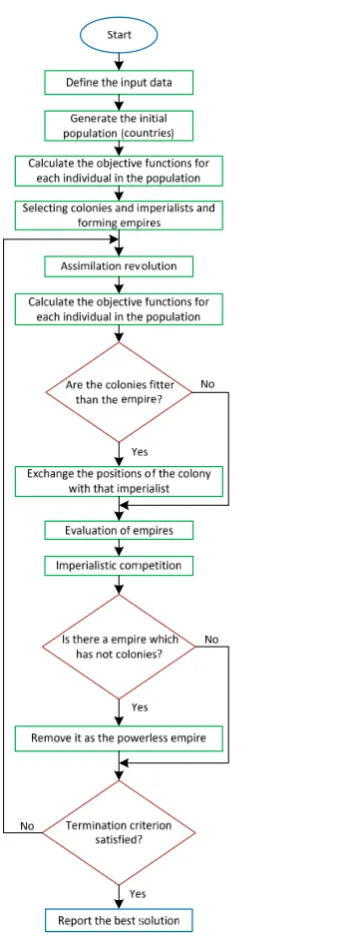
The ICA algorithm is applied here to the problem of the multi-objective network reconfiguration as depicted in the flowchart of Fig. 1. In the first step, input data are given; they include network data and parameters of the ICA al-gorithm. Then, the initial countries is generated. In each candidate, one switch from each fundamental loop to be opened is randomly chosen. Afterwards, the radiality and bus islanding are checked for candidates. To check whether radiality is maintained as well as to make sure that all loads are in service to prevent load islanding, the graph theory is employed. If the network graph is not a tree, it means that either the network is not radial or at least one load has been isolated. In this state, the value of the fitness function is considered to be zero for the corre-sponding candidate. In the next stage, a distribution load flow is run in order to calculate the fitness function (μf) using (14) for each country.
To applying the proposed ICA to this problem, the follow-ing steps have been considered:
1. Define the input data. The input data which
should be provided includes system base configu-ration, line impedances, the number of countries, the number of empires, number of decision vari-ables in the country, the maximum number of iter-ations, and the internal parameters of the algorithm (assimilation coefficient and assimilation angle). 2. Generate the initial population (countries). The initial individuals of the population must be gener-ated randomly in this step.
3. Calculate the objective functions. For each indi-vidual in the countries, the overall fitness function ܰǤ ܶǤ ܥǤൌ ܶǤ ܥǤെ ݉ܽݔሼܶǤ ܥǤሽ
ܲ ൌ อ
ܰǤ ܶǤ ܥǤ
σ ܰǤ ܶǤ ܥǤ ே
ୀଵ
อ
ܲ ൌ ቂܲଵǡ ܲଶǡ ܲଷǡ ǥ ǡ ܲேቃ
ܴ ൌ ቂݎଵǡ ݎଶǡ ݎଷǡ ǥ ǡ ݎேቃ ݎ א ܷሺܱǡ ͳሻ
Fig. 1.Flowchart of the proposed ICA for distribution system
reconfiguration
is calculated using (14). The violation of the con-straints is also investigated in this step. For solu-tions that constraints are violated, fitness values are considered zero.
4. Selecting the colonies and imperialists and form-ing empires.
5. Moving the colonies toward their relevant impe-rialist (assimilation).
6. Exchanging the position of the colonywith its imperialist if the cost of the mentioned colony is lower than that imperialist.
7. Computing the total cost of all empires, regard-ing the power of the imperialist and its colonies. 8. Selecting the weakest colony (colonies) from the weakest empires and give it (them) to the empire that has the most likelihood to possess it (imperial-istic competition).
9. Removing the powerless empires.
10. Check the termination criterion. The termina-tion criterion is the maximum number of iteratermina-tions. If the number of iterations is equal to the predefined number, go to the step 11; otherwise, go to the step 5.
11. Determine the best solution. After meeting the termination criterion, the process is finished.
5. Simulation Results
To demonstrate the performance of the proposed algo-rithm, it is tested on two case studies including 33-bus and 69-bus test systems and their numerical results are inves-tigated and compared with other algorithms. The pro-posed method is implemented using the MATLAB software package. Parameters that are assumed for the ICA algorithms are listed in Table 1for the two case stud-ies. These parameters are previously defined in section 3. Results are presented in two subsections for the two case studies in the following.
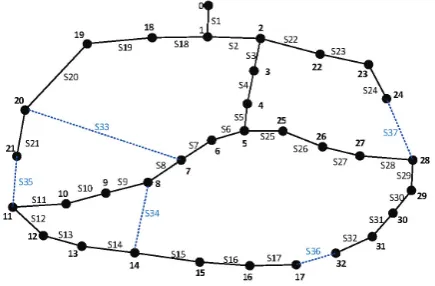
5. 1. Case Study 1 (33-bus test system) The Baran and Wu [13] distribution network, whose one line diagram is shown in Fig. 2, is used as the first test system. The system consists 32 sectionalizing (normally closed) switches numbered S1-S32 and 5 tie switches (normally open) numbered S33-S37. The total real and re-active power loads of the system are 3715 kW and 2300 k VAR, respectively. In the base case (initial) load flow,
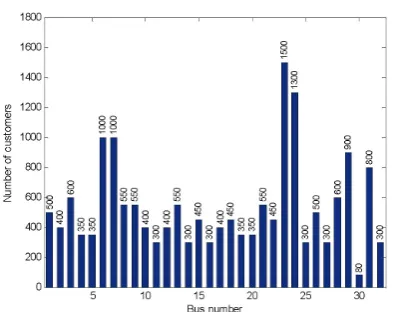
the network has power losses of 202.677 kW and the mimum bus voltage of 0.913 p.u. Regarding reliability in-dices, it is assumed here that the failure rate of the line with the greatest and the smallest length is 0.4 and 0.1 failure/year, respectively. Consequently, the failure rate of other lines is calculated proportional to their lengths between these two boundary failure rates [25].The time that is required for switching is supposed to be 0.5 h and the required time for repairing is assumed to be 6 h. In ad-dition, it is assumed that components like transformers, breakers, and bus bars are entirely reliable because distri-bution system reconfiguration would just deal with the re-liability of feeder sections. Another assumption is that the least failure rate, which can be acquired for a line by de-creasing current, equals to 0.85 of its non-reduced failure rate. Moreover, the number of customers supplied in each load point, which is presented by Njin (5)-(10), is shown in Fig. 3.
As mentioned before, the proposed method is a multi-ob-jective programming with obmulti-ob-jective functions of minimiz-ing power losses and reliability indices of SAIFI, SAIDI, AENS and ASUI. However, in order to compare the per-formance of the ICA with other methods in reconfigura-tion, the objective functions are optimized individually at first to get their single objective results and compare them with other methods. The results of single objective opti-mizations can be used for calculation of ideal and nadir
Test system Number of countries
Number of
empires ࢼ ࢽ
Max.
iterations ࢀ࢘ࢇࡹࢇ࢞
IEEE 33-bus test system 50 6 2 0.5 60 30
IEEE 69-bus test system 50 6 2 0.5 100 30
Table 1.Parameters of the proposed algorithm for the examined test systems
Fig. 2.One line diagram of the 33-bus Baran and Wu
distribu-tion test system
values in (13). Results of the five single objective opti-mizations are shown in Table 2 and Table 3.
In Table 2, results of the optimizing four objective func-tions off1=SAIFI,f2=SAIDI, f3=ASUI, and f4=AENS as single objective optimizations are presented. In the last column, open switches after optimal reconfiguration are also given. It is worthwhile to note that results of three objective functions (SAIFI, SAIDI and AENS) in this table are reported from [25] using different methods of GA, PSO, SFLA and Improved SFLA (ISFLA) to be com-pared with the proposed method. However, since there is
no other work to address the ASUI objective function, two well-known algorithms of GA and PSO are implemented in this paper and their results are reported also in Table 2. For optimization through GA, the algorithm needs the crossover and mutation probability, the initial population, and number of iterations; they have been chosen as 0.8, 0.08, 600, and 200, respectively [26]. Parameters used for the PSO algorithm include the initial number of particles, maximum number of iterations, the maximum velocity, and the inertia weight factor; they are considered as 40, 1000, 2, and 0.8, respectively, in simulations. As seen in Table 2, each method leads to an optimal value of the ob-jective function with its status of open switches. Methods that result in the same status of open switches have the same optimal value of the objective function. As seen in this table, the proposed ICA offers the best value of relia-bility indices when it is optimized in its single objective mode.
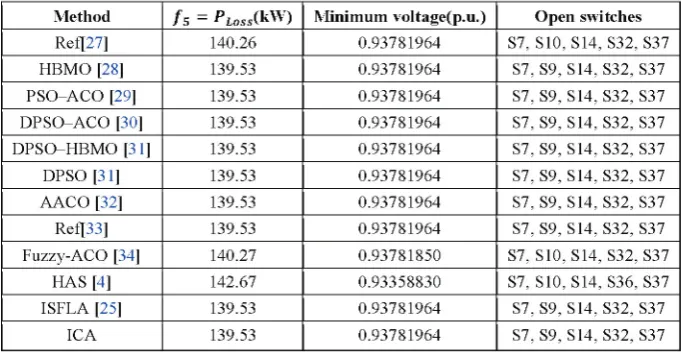
The results of minimization of total active power losses orf5(x)as a single objective optimization are also shown in Table 3, where columns 2-4 represents results of opti-mization methods. Results from different methods are re-ported in this table including Honey-Bees Mating Optimization (HBMO), Discrete Particle Swarm Opti-mization (DPSO), and Adapted Ant Colony OptiOpti-mization (AACO). As seen in this table, the least possible power losses that is obtained by some methods equals to 139.35kW and the proposed ICA method can optimally find the most optimal solution with the best switching
op-Fig. 3.Number of customers at each bus of the 33-bus test
system
Table 2.Results of single objective optimization to minimize reliability indices by different methods in the 33-bus test system
Iranian Journal of Electrical & Electronic Engineering, Vol. 13, No. 3, September 2017 296
eration. As a result, Table 3 and Table 2 show that the pro-posed ICA method leads to the best performance in com-parison with other methods.
After validating the efficiency of the proposed ICA method in its single objective cases in Table 2 and Table 3, it is time to run the proposed method in its multi-ob-jective form. In order to fuzzify obmulti-ob-jective functions, their ideal and nadir values are needed. These values are ob-tained as reported in Table 4.
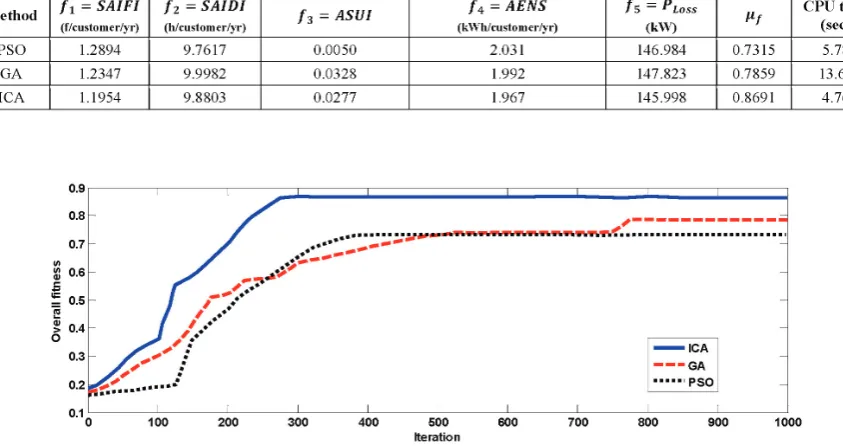
Results of the ICA method in the multi-objective mode are shown in Table 5. Since the proposed method has five objective functions and there is no other work in literature with the same objective functions to compare results, we here have implemented two well-known algorithms of PSO and GA with the same conditions and have solved the same multi-objective problem with these two methods to evaluate the proposed method in its multi-objective case.Parameters of the PSO algorithm including the initial number of particles, number of maximum iterations, the maximum velocity, and the inertia weight factor are as-sumed as 45, 1000, 2, and 0.8, respectively. For the GA algorithm, the crossover probability, mutation probability, the initial population, and number of iterations are
con-sidered as 0.8, 0.08, 600, and 1000, respectively. Inas-much as these methods have stochastic nature and they are based on generation of random numbers, these meth-ods are run multiple times and the results presentedin Table 5 are the best solutions after 50 times running of simulations.
In Table 5, the optimal value of five objective functions are reported in columns 2-6 as obtained by the three ex-amined methods. As seen in the table, the three methods lead to different optimal sets of objective functions. It is noted that a less value for objective functions is more pre-ferred since they are for minimization. In column 7 of the table, the overall fuzzy fitness of optimal solutions is pre-sented. A higher value of the overall fitness implies a more optimal solution. As seen, the proposed ICAmethod offers a better fitness than PSO and GA algorithms (0.8691 against 0.7315 and 0.7859). Although the ICA algorithm offers a bit higher value for some objective functions, it can manage to make a better tradeoff considering all ob-jective functions leading to a better overall fitness. In the last column of the table, CPU running times are given for examined methods. The PC used in simulations had a dual 2 GHz CPU with 1 GB RAM. As seen, the ICA algorithm
Table 3.Comparison of single objective optimization of active power losses by ICA and other methods in the 33-bus test system
Objective function Ideal value Nadir value
݂ଵൌ ܵܣܫܨܫ(f/customer/yr) 1.1782 1.3530 ݂ଶൌ ܵܣܫܦܫ(h/customer/yr) 9.6423 11.7221
݂ଷൌ ܣܷܵܫ 0.00005 0.1477
݂ସൌ ܣܧܰܵ(kWh/customer/yr) 1.9052 2.3150 ݂ହൌ ܲ௦௦(kW) 139.5300 204.0504
Table 4.Ranges of objective functions
is the fastest of the three ones.
The convergence behavior of the three algorithms is de-picted in Fig. 4. According to this figure,the ICA algo-rithem converges to the fitness value of 0.8642 after 274 iterations (in the knee point), whilethe GA algorithm reaches to the fitness value of 0.7859 after 775 iterationsat its knee point and the PSO reaches to the fitness of 0.7291 at iteration 382 at its knee point. According to this figure, the proposed ICAalgorithmhas better a performance in comparison with GA and PSO algorithms from both com-putional burden and solution optimality.
5. 2. Case Study 2 (69-bus test system) This case study is the practical distribution network of Taiwan Power Company [35] with the voltage level of
12.66 kV. Theone line diagram of this distribution system including 11 feeders, 69 buses, and 69 switchesis shown in Fig. 5. This system has 5tie switches, numbered S69 to S73 and shown by dotted lines, as well as 68 sectionaliz-ing switches, numbered S1 to S63 and illustrated by solid lines. Power losses and minimum bus voltage in the initial configuration are 224.952 kW and 0.909 p.u, respectively. To calculate reliability indices, it is assumed that there is a breaker at the beginning of each feeder and a sectional-izer at the beginning of each section. The failure rate of the branch with the largest impedance and the branch with the smallest impedance are considered as 0.4 and 0.1, re-spectively. The failure rate of other branches is considered in the range between these two values. Switching time and repairing time are considered as 0.5 and 6 hours,
respec-Table 5.Comparison of results from the proposed method with PSO and GA algorithms in the 33-bus test system
Fig. 4.The convergence behavior of the proposed method along with PSO and GA algorithms in the 33-bus test system
Fig. 5.The one line diagram of 69-bus distribution system
tively.
Similar to the previous case study, at first, objective func-tions are individually optimized so that we can compare the ability of different methods in optimizing individual objective functions. Results of optimizing the active pow-erloss objective function isshown in Table 6.From this table, it can be understood that the proposed method offers the most optimal power losses of 99.62 kW. In this table, the optimal open switches resulted by different methods are also shown in the last column.
Results of single objective optimization of SAIFI, SAIDI, AENS, and ASUI by a few methods are shown in Table 7. The values of SAIFI, SAIDI, and AENS before
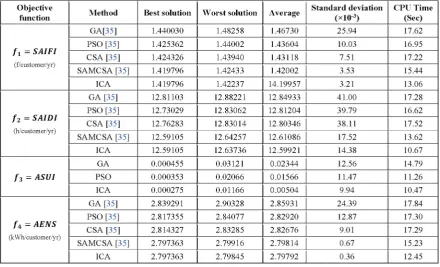
recon-figuration were 1.7193689 (fr/customer/yr), 14.27470 (h/customer/yr), and 3.168866 (kWh/customer/yr), re-spectively. After reconfiguration, all methods enhances reliability indices as seen in the table. Since the methods in Table 7 uses random number generations in their algo-rithm, they can result in a different solution in runs. Then, in this table, the problem is solved for 25 trials by each method and the values of the best solution, the worst so-lution, the average of the optimal solutions, the standard deviation of the optimal solutions, and the CPU time ob-tained are shown. Since there is no work addressing the ASUI objective function, two algorithms of GA and PSO are implemented here and their results are compared with
Table 6.Comparison of single objective optimization of minimizing active power losses yielded by different methods
Table 7.Comparison of single objective optimization ofreliability indices by ICA and other methods in the 69-bus test system
ICA in Table 7 for the ASUI objective function.
Considering Table 7, the proposed method offers its opti-mal solution and configuration like the SAMCSA method on objective functions of f1, f2,and f4. However, the pro-posed method needs less CPU time for catching the opti-mal solution and also it has better results for the worst solution, average, and standard deviation. The simulation results reveal that the proposed method has more satisfy-ing results in comparison to GA, PSO, and CSA methods in terms of robustness and CPU time.
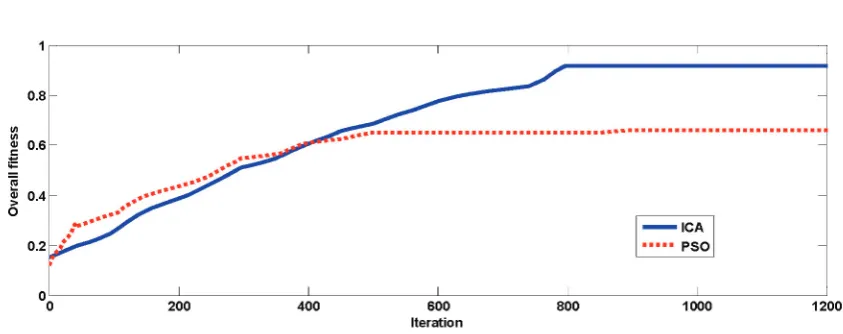
Results of multi-objective optimization by the proposed method are shown in Table 8, where results from the multi-objective PSO algorithm are also reported. The re-sults are reported in this table are the best solutions ob-tained after 50 times running of simulation. Objective functions obtained by the ICA in this table lead to the overall fitness of 0.9203, which is close to its ideal value of unity. However, the PSO algorithm results in a multi-objective solution with the overall fitness of 0.6585. This means that the proposed ICA can manage to find a more optimal solution than the PSO. This is due to the mutation operator used in the ICA that makes the method searches for a more optimal solution.
In Fig. 6, the convergence rates of the proposed ICA and the PSO algorithms are depicted. As seen from this figure, the ICA method reaches to its ultimate overall fitness of 0.9176 (almost optimal) at iteration 797, whereas the PSO reaches to its final overall fitness of 0.6585 at iteration
892. This implies that the ICA offers a more optimal so-lution than the PSO with a faster execution time.
6. Conclusions
In this paper, a multi-objective method for the network reconfiguration problem in distribution systems is pre-sented. The objective functions include minimization of power losses and reliability indices of SAIFI,SAIDI, ASUI, and AENS. The proposed problem is solved using the efficient ICA in a fuzzy framework. Results obtained from testing the proposed reconfiguration problem on the 33-bus and 69-bus test systems are discussed and com-pared with other previous works. The performance of the ICA algorithm is evaluated under different single objec-tive and multi-objecobjec-tive scenarios. According to obtained results, the proposed ICA algorithm can manage to get more optimal solutions than previous works with a less execution time. In fact, the modified ICA is able to ex-plore its optimal solution in early iterations. As a result, the ICA offers an optimal solution with overall fuzzy fit-ness, which is better than other methods.
References
[1] I. Ziari, G. Ledwich, A. Ghosh, and G. Platt, "Inte-grated Distribution Systems Planning to Improve Reliability Under Load Growth," IEEE Transac-tions on Power Delivery, vol. 27, pp. 757-765,
Table 8.Multi-objective optimization results obtained by different methods in the 69-bus test system
Fig. 6.The convergence of multi-objective ICA and PSO algorithms in the 69-bus test system
2012.
[2] A. Y. Abdelaziz, F. M. Mohamed, S. F. Mekhamer, and M. A. L. Badr, "Distribution system reconfigu-ration using a modified Tabu Search algorithm," Electric Power Systems Research, vol. 80, pp. 943-953, 8// 2010.
[3] N. Gupta, A. Swarnkar, K. R. Niazi, and R. C. Bansal, "Multi-objective reconfiguration of distri-bution systems using adaptive genetic algorithm in fuzzy framework," IET Generation, Transmission & Distribution, vol. 4, p. 1288, 2010.
[4] R. Srinivasa Rao, S. V. L. Narasimham, M. Rama-linga Raju, and A. Srinivasa Rao, "Optimal Net-work Reconfiguration of Large-Scale Distribution System Using Harmony Search Algorithm," IEEE Transactions on Power Systems, vol. 26, pp. 1080-1088, 2011.
[5] T. Niknam, A. Kavousi Fard, and A. Baziar, "Multi-objective stochastic distribution feeder reconfigu-ration problem considering hydrogen and thermal energy production by fuel cell power plants," En-ergy, vol. 42, pp. 563-573, 6/ 2012.
[6] Y. M. Shuaib, M. S. Kalavathi, and C. C. Asir Rajan, "Optimal Reconfiguration in Radial Distri-bution System Using Gravitational Search Algo-rithm," Electric Power Components and Systems, vol. 42, pp. 703-715, 2014/05/19 2014.
[7] D. L. Duan, X. D. Ling, X. Y. Wu, and B. Zhong, "Reconfiguration of distribution network for loss reduction and reliability improvement based on an enhanced genetic algorithm," International Journal of Electrical Power & Energy Systems, vol. 64, pp. 88-95, 1// 2015.
[8] H. Shareef, A. A. Ibrahim, N. Salman, A. Mo-hamed, and W. Ling Ai, "Power quality and relia-bility enhancement in distribution systems via optimum network reconfiguration by using quan-tum firefly algorithm," International Journal of Electrical Power & Energy Systems, vol. 58, pp. 160-169, 6// 2014.
[9] A. Kavousi-Fard and T. Niknam, "Multi-objective stochastic Distribution Feeder Reconfiguration from the reliability point of view," Energy, vol. 64, pp. 342-354, 1/1/ 2014.
[10] N. Gupta, A. Swarnkar, and K. R. Niazi, "Distrib-ution network reconfiguration for power quality and reliability improvement using Genetic Algo-rithms," International Journal of Electrical Power & Energy Systems, vol. 54, pp. 664-671, 1// 2014. [11] P. Zhang, W. Li, and S. Wang, "Reliability-oriented distribution network reconfiguration considering uncertainties of data by interval analysis," Interna-tional Journal of Electrical Power & Energy Sys-tems, vol. 34, pp. 138-144, 1// 2012.
[12] B. Arandian, R. A. Hooshmand, and E. Gholipour,
"Decreasing activity cost of a distribution system company by reconfiguration and power generation control of DGs based on shuffled frog leaping al-gorithm," International Journal of Electrical Power & Energy Systems, vol. 61, pp. 48-55, 10// 2014. [13] M. Sedighizadeh, S. Ahmadi, and M. Sarvi, "An
Ef-ficient Hybrid Big Bang–Big Crunch Algorithm for Multi-objective Reconfiguration of Balanced and Unbalanced Distribution Systems in Fuzzy Frame-work," Electric Power Components and Systems, vol. 41, pp. 75-99, 2013/01/01 2013.
[14] A. Deihimi and A. Solat, "Optimized echo state net-works using a big bang–big crunch algorithm for distance protection of series-compensated trans-mission lines," International Journal of Electrical Power & Energy Systems, vol. 54, pp. 408-424, 2014.
[15] E. Yesil, "Interval type-2 fuzzy PID load frequency controller using Big Bang–Big Crunch optimiza-tion," Applied Soft Computing, vol. 15, pp. 100-112, 2014.
[16] A. Ameli, A. Ahmadifar, M. H. Shariatkhah, M. Vakilian, and M.-R. Haghifam, "A dynamic method for feeder reconfiguration and capacitor switching in smart distribution systems," International Journal of Electrical Power & Energy Systems, vol. 85, pp. 200-211, 2017.
[17] N. G. Paterakis, A. Mazza, S. F. Santos, O. Erdinç, G. Chicco, A. G. Bakirtzis, et al., "Multi-objective reconfiguration of radial distribution systems using reliability indices," IEEE Transactions on Power Systems, vol. 31, pp. 1048-1062, 2016.
[18] B. Majhi and C. M. Anish, "Multiobjective opti-mization based adaptive models with fuzzy decision making for stock market forecasting," Neurocom-puting, vol. 167, pp. 502-511, 11/1/ 2015.
[19] B. Sultana, M. Mustafa, U. Sultana, and A. R. Bhatti, "Review on reliability improvement and power loss reduction in distribution system via net-work reconfiguration," Renewable and Sustainable Energy Reviews, vol. 66, pp. 297-310, 2016. [20] A. Kavousi-Fard, T. Niknam, M. R. Akbari-Zadeh,
and B. Dehghan, "Stochastic framework for relia-bility enhancement using optimal feeder reconfig-uration," Journal of Systems Engineering and Electronics, vol. 25, pp. 901-910, 2014.
[21] O. Badran, S. Mekhilef, H. Mokhlis, and W. Daha-lan, "Optimal reconfiguration of distribution system connected with distributed generations: A review of different methodologies," Renewable and Sus-tainable Energy Reviews, vol. 73, pp. 854-867, 2017.
[22] E. Atashpaz-Gargari and C. Lucas, "Imperialist competitive algorithm: An algorithm for optimiza-tion inspired by imperialistic competioptimiza-tion," in 2007
IEEE Congress on Evolutionary Computation, 2007, pp. 4661-4667.
[23] A. Khabbazi, E. Atashpaz-Gargari, and C. Lucas, "Imperialist competitive algorithm for minimum bit error rate beamforming," International Journal of Bio-Inspired Computation, vol. 1, pp. 125-133, 2009.
[24] E. S. Ali, "Speed control of induction motor sup-plied by wind turbine via Imperialist Competitive Algorithm," Energy, vol. 89, pp. 593-600, 9// 2015. [25] A. Kavousi-Fard and M.-R. Akbari-Zadeh, "Relia-bility enhancement using optimal distribution feeder reconfiguration," Neurocomputing, vol. 106, pp. 1-11, 4/15/2013.
[26] T. Niknam, A. K. Fard, and A. Seifi, "Distribution feeder reconfiguration considering fuel cell/ wind/ photovoltaic power plants," Renewable Energy, vol. 37, pp. 213-225, 1// 2012.
[27] D. Shirmohammadi and H. W. Hong, "Reconfigu-ration of electric distribution networks for resistive line losses reduction," IEEE Transactions on Power Delivery, vol. 4, pp. 1492-1498, 1989.
[28] T. Niknam, "Application of honey-bee mating op-timization on state estimation of a power distribu-tion system including distributed generators," Journal of Zhejiang University SCIENCE A, vol. 9, pp. 1753-1764, 2008/12/01 2008.
[29] T. Niknam, "An efficient hybrid evolutionary algo-rithm based on PSO and ACO for distribution feeder reconfiguration," European Transactions on Electrical Power, vol. 20, pp. 575-590, 2010. [30] T. Niknam, "A New Hybrid Algorithm for
Multi-Objective Distribution Feeder Reconfiguration," Cybernetics and Systems, vol. 40, pp. 508-527, 2009/07/30 2009.
[31] T. Niknam, "An efficient hybrid evolutionary algo-rithm based on PSO and HBMO algoalgo-rithms for multi-objective Distribution Feeder Reconfigura-tion," Energy Conversion and Management, vol. 50, pp. 2074-2082, 8// 2009.
[32] A. Swarnkar, N. Gupta, and K. R. Niazi, "Adapted ant colony optimization for efficient reconfigura-tion of balanced and unbalanced distribureconfigura-tion sys-tems for loss minimization," Swarm and Evolutionary Computation, vol. 1, pp. 129-137, 9// 2011.
[33] F. V. Gomes, S. Carneiro, J. L. R. Pereira, M. P. Vinagre, P. A. N. Garcia, and L. R. Araujo, "A New Heuristic Reconfiguration Algorithm for Large Dis-tribution Systems," IEEE Transactions on Power Systems, vol. 20, pp. 1373-1378, 2005.
[34] A. Saffar, R. Hooshmand, and A. Khodabakhshian, "A new fuzzy optimal reconfiguration of distribu-tion systems for loss reducdistribu-tion and load balancing using ant colony search-based algorithm," Applied
Soft Computing, vol. 11, pp. 4021-4028, 7// 2011. [35] A. Kavousi-Fard and T. Niknam, "Optimal Distri-bution Feeder Reconfiguration for Reliability Im-provement Considering Uncertainty," IEEE Transactions on Power Delivery, vol. 29, pp. 1344-1353, 2014.
[36] L. Liu and X. Y. Cheng, "Reconfiguration of Dis-tribution networks based on fuzzy Genetic algo-rithms," in Proceedings of the CSEE, 2000, pp. 66-69.
[37] P. X. Bi, J. Liu, C. X. Liu, and W. Y. Zhang, "A re-fined genetic algorithm for power distribution net-work reconfiguration," Automation of Electric Power Systems, vol. 26, pp. 57-61, 2002.
[38] L. Zhenkun, C. Xingying, Y. Kun, S. Yi, and L. Haoming, "A hybrid particle swarm optimization approach for distribution network reconfiguration problem," in Power and Energy Society General Meeting - Conversion and Delivery of Electrical Energy in the 21st Century, 2008 IEEE, pp. 1-7, 2008.
[39] Y. Jianming, Z. Fan, N. Feng, and M. Yuanshe, "Im-proved Genetic Algorithm with Infeasible Solution Disposing of Distribution Network Reconfigura-tion," in Intelligent Systems, 2009. GCIS '09. WRI Global Congress on, pp. 48-52, 2009.
M. Sedighizadeh received the B.S. degree in Electrical Engi-neering from the Shahid Cham-ran University of Ahvaz, ICham-ran and M.S. and Ph.D. degrees in Electrical Engineering from the Iran University of Science and Technology, Tehran, Iran, in 1996, 1998 and 2004, respectively. From 2000 to 2007 he was with power system studies group of Moshanir Company, Tehran, Iran. Currently, he is an Assistant Professor in Faculty of Electrical En-gineering, Shahid Beheshti University, Tehran, Iran. His research interests are Power system con-trol and modeling, FACTS devices, Artificial Intel-ligence, application of optimization in power systems and Distributed Generation.
M. Esmaili (IEEE SM'16) re-ceived his PhD degree in Electri-cal Power Engineering from Iran University of Science and Tech-nology in 2010. Currently, he is with West Tehran Branch, Islamic Azad University, Tehran, Iran. His research interest includes power
system related topics especially smart grids, power system observability, power system stability, dis-tributed generations, and electricity markets. He has published more than 26 papers in international journals and 27 papers in conferences.
M. M. Mahmoodi received the B.S. degree in Electrical Engi-neering from the Shahid Be-heshti University Tehran, Iran and M.S. degree in Electrical En-gineering from Islamic Azad University،Science and Research Branch, Tehran, Iran, in 2004 and 2007, respectively. Currently, he is with Saveh Branch, Islamic Azad University, Saveh, Iran. His research interest includes power system stability, Modeling and optimization in power systems.