Journal of Theoretical and Applied Vibration and Acoustics
* Corresponding Author: Abdolreza Ohadi I S A V
Effect of non-acoustic properties on the sound a
polyurethane foams
Mostafa Asadi
a, Abdolreza Ohadi
a
M.Sc. Student, Acoustics Research Technology, Hafez Ave. 15875-4413
b
Associate Professor, Mechanical Engineering Department, Amirk Ave. 15875-4413, Tehran, Iran
c
Ph.D. Student, Acoustics Research Technology, Hafez Ave. 15875-4413
K E Y W O R D S A B S Porous media
Polyurethane Non-acoustic properties
Absorption coefficient
In this paper the influence of non
absorption coefficient of polyurethane foams as a porous medium is investigated. Biot’s equations with transfer matrix m
approach
selected polyurethane foams. The major issue is the dependency of non acoustic properties on each other which makes difficulties to examine the effect of parameters individually. Some facts from the results of previous works are us
show that
absorption coefficient and only for highly porous foams, raising porosity decreases the sound absorption performance.
resistivity
Furthermore, for partially reticulated (partially open cell) foams, the increase of tortuosity improves the sound absorption efficiency at lower frequenc
1. Introduction
Porous materials are a combination of two distinct phases, fluid phase (usually air) and solid phase (frame). These kinds of new interesting materials have a great application
science, especially for sound absorbing goals. Interacti
further attenuation of wave’s energy in comparison to a mere solid or fluid medium.
Porous media whose solid phase is For the first time, Biot [1-3
poroelastic medium. The equations are written with the help of non Journal of Theoretical and Applied Vibration and Acoustics 1(2) 122-132
Abdolreza Ohadi, Email: [email protected]
Journal of Theoretical and Applied
Vibration and Acoustics
journal homepage: http://tava.isav.ir
acoustic properties on the sound absorption
Abdolreza Ohadi
b*, Reza Keshavarz
cesearch Lab., Mechanical Engineering Department, Amirkabir Univ 4413, Tehran, Iran
Professor, Mechanical Engineering Department, Amirkabir University of Technology,
esearch Lab., Mechanical Engineering Department, Amirkabir Uni 4413, Tehran, Iran
T R A C T
In this paper the influence of non-acoustic properties on the sound absorption coefficient of polyurethane foams as a porous medium is investigated. Biot’s equations with transfer matrix m
approach are employed to evaluate the sound absorption coefficient of selected polyurethane foams. The major issue is the dependency of non acoustic properties on each other which makes difficulties to examine the effect of parameters individually. Some facts from the results of previous works are used in order to overcome this prominent
show that increasing the porosity doesn’t have a great influence on the sound absorption coefficient and only for highly porous foams, raising porosity decreases the sound absorption performance. The i
resistivity up to an optimized value, intensifies the
Furthermore, for partially reticulated (partially open cell) foams, the increase of tortuosity improves the sound absorption efficiency at lower frequenc
©2015 Iranian Society of Acoustics and Vibration, All rights reserved
Porous materials are a combination of two distinct phases, fluid phase (usually air) and solid phase (frame). These kinds of new interesting materials have a great application
science, especially for sound absorbing goals. Interaction of the fluid and solid phase further attenuation of wave’s energy in comparison to a mere solid or fluid medium.
Porous media whose solid phase is elastic and the fluid phase is viscous
] introduced the governing equations of sound propagation in a poroelastic medium. The equations are written with the help of non-acoustic properties
132 (2015)
bsorption of
ab., Mechanical Engineering Department, Amirkabir University of
abir University of Technology, Hafez
ab., Mechanical Engineering Department, Amirkabir University of
acoustic properties on the sound absorption coefficient of polyurethane foams as a porous medium is investigated. Biot’s equations with transfer matrix method, as the solution bsorption coefficient of selected polyurethane foams. The major issue is the dependency of non-acoustic properties on each other which makes difficulties to examine the effect of parameters individually. Some facts from the results of previous ed in order to overcome this prominent obstacle. The results increasing the porosity doesn’t have a great influence on the sound absorption coefficient and only for highly porous foams, raising porosity The increase of air flow intensifies the absorption capability. Furthermore, for partially reticulated (partially open cell) foams, the increase of tortuosity improves the sound absorption efficiency at lower frequencies.
ty of Acoustics and Vibration, All rights reserved
Porous materials are a combination of two distinct phases, fluid phase (usually air) and solid phase (frame). These kinds of new interesting materials have a great application in acoustic uid and solid phases leads to further attenuation of wave’s energy in comparison to a mere solid or fluid medium.
M. Asadi et al. / Journal of Theoretical and Applied Vibration and Acoustics 1(2) 122-132(2015)
123 One solution method of Biot’s equations, which is called transfer matrix method, has wide applications in the optimisation of absorbent layers [6, 7]. Among several kinds of porous materials including rocks, soils and man-made materials such as foams and ceramics, polyurethane foam is very common in sound absorbing applications. Researchers have done several works on polyurethane foams and other porous materials to improve their sound absorption efficiency. To this end, having a whole understanding of the effect of non-acoustic parameters on the sound absorption is the integral part of any research.
Doutres et al. [8] established some semi-empirical relations between microstructure and non-acoustic properties of polyurethane foam. In two recent articles, they worked on the accuracy and simplicity of the relations [9, 10]. Bies and Hansen [11] discussed the role of flow resistance for fibrous and foamed products in three acoustical applications including attenuation of sound propagating in ducts. In a more recent work, Cuiyun et al. [12] studied acoustical properties of a ceramic porous material and explained the effect of thickness and porosity on the sound absorption performance. However, to our knowledge, the direct effect of non-acoustic parameters on the sound absorption coefficient of polyurethane foams has not been discussed yet.
In this work, after a brief presentation of non-acoustic parameters, governing equations and solution methods (Sections 2-4), the direct influence of those parameters on the sound absorption coefficient of polyurethane foam samples is investigated (Section 5). It is the complement key to the optimization of the foaming process.
2. Non-acoustic properties of porous media
Firstly it is important to review non-acoustic properties of a porous medium which are governing parameters for the propagation and absorption of sound within porous materials. They are prerequisite for modelling of sound propagation in porous material.
Porosity: It is the volume fraction of a porous material occupied by the fluid phase. If is the total volume of the porous material and volumes of the solid and fluid phases are indicated by and respectively, then it concludes . The porosity ( ) of the material is defined
as [4]. For highly porous material, porosity can be stated as [8],
1 (1)
where is the solid phase or frame density and is the solid phase material density.
Air flow resistivity: It is the resistance of a porous material to an air flow. If a steady air stream of mean flow rate per unit area is passed through a porous layer of thickness and causes a pressure gradient between the surfaces of the layer, then the air flow resistivity is [4].
M. Asadi et al. / Journal of Theoretical and Applied Vibration and Acoustics 1(2) 122-132(2015)
124 measured resistances of the saturated material and the fluid respectively. The tortuosity is then
given by [4].
Viscous characteristic length: Johnson et al. [5] have defined a characteristic dimension which is called viscous characteristic length , and includes the effect of viscosity at high frequencies. It has been noted by Johnson et al. that the viscous characteristic length is related to other properties by,
1 8! "#/%
(2) where ! is the air viscosity and is a constant.
Thermal characteristic length: There is another parameter that introduces the heat transfer which occurs between two phases at high-frequency range called thermal characteristic length & and is given by [4],
& 2 (
( )* 2
) (3)
The integral in the numerator is performed over the pore surfaces ) in the elementary representative volume and the integral in the denominator is performed over the volume of the pore. A similar relation can relate ′ to other parameters [4];
& 1
& 8! " #/%
(4) where & is also a constant. Two characteristic lengths and & only depend on the geometry of the frame, therefore, constants and & are such as well and have a value in the range [0.3 , 3], for all types of foam with the consideration that & , [4].
3. Governing equations of sound propagation in porous media
(Biot equations)
Propagation of waves in porous media is expressed via dynamic equations known as Biot equations. In a series of papers [1-3], Biot developed the theory of dynamic poroelasticity (presently known as the Biot theory) which gives a comprehensive description of the mechanical behavior of a poroelastic medium. Biot equations of poroelasticity are derived through a Lagrangian approach. One of the key findings of this theory is that in poroelastic media, there exist three types of waves: a shear or transverse wave and two types of longitudinal or compressional waves. In the present work, Biot equations are used as reference [7] for calculation of sound absorption coefficient. For detail information, readers are referred to [7]. As a summary, equations of propagation of sound in elastic porous media are as follows.
-. / 0 1##234 0 1#%234
M. Asadi et al. / Journal of Theoretical and Applied Vibration and Acoustics 1(2) 122-132(2015)
125 where / displays the stress tensor and 3 is the displacement tensor. Signs 5 and 6 show the fluid and solid phases respectively. 7 189: ;<, > 1,2? are tensors of second order which are called Biot densities. These quantities are evaluated based on properties as,
0 1#%2 ;0@2 0 12?
0 1%%2 ;0@2 0 1#%2?
0 1##2 ;1 ? 0@2 0 1#%2
(6)
where is porosity and 0 12 reperesents dynamic tortuosity [7] which is defined based on non-acoustic properties. and are the densities of the fluid and solid phases respectively.
4. Solution method
For solving the Biot's equations and calculating the acoustical properties, different methods can be implemented. Not only numerical methods such as finite element can be used, but also analytical methods like the transfer matrix method can be applied. In this work, the transfer matrix method (TMM) is employed to compute the absorption coefficient of a porous layer as has been applied in [7]. Although in the TMM method the lateral dimensions of the porous layer are assumed to be infinite, for comparison purposes it is the best method which can be chosen on account of its simplicity.
Solving the Biot’s equations using the transfer matrix method for a porous layer gives the acoustical parameters like incident and reflected pressure amplitudes. Then reflection coefficient (A) is defined as A B&/B where B& and B are the amplitudes of reflected and radiated waves respectively. Ultimately, the absorption coefficient is evaluated based on the reflection coefficient.
1 |A|% (7)
Absorption coefficient determines the amount of the absorbed energy of radiated wave by the porous media. It is the main acoustic property to examine the efficiency of absorbent materials.
5. Influence of non-acoustic properties of porous media on the sound
absorption coefficient
The aim of this section is to investigate the effect of each non-acoustic property of a porous medium on its sound absorption coefficient. To this end, Biot’s equations have been solved for one layer of polyurethane foam sample using the transfer matrix method as elaborated in Section 4. A MATLAB code is written to calculate the sound absorption coefficient in the frequency range of 1 Hz to 6300 Hz.
In order to apply governing equations, eleven samples of polyurethane foam from reference [6] are considered in Table 1 where the Young’s modulus and Poisson’s ratio of all samples are
E=144000 Pa and D= 0.3 respectively.
The eleven samples are divided into three groups with constant solid phase densities. The first group is with = 856 EF/GH, the second with = 1285 EF/GH and the third with = 2570
M. Asadi et al. / Journal of Theoretical and Applied Vibration and Acoustics 1(2) 122-132(2015)
126 Polyurethane foam has a cellular structure. Some of these cells are connected to each other within which air can flow freely. On the other hand, there are some membranes that can close the cells or prevent them to be directly connected, accordingly, obstruct the sound waves to propagate straightly. The former is called open pore content and the latter, closed pore content. Reticulation rate (AI) determines the open pore content of a polyurethane foam. A foam with AI=100% is known as fully reticulated and one with AI<100% is called partially reticulated.
These two terms will be used in the following.
Table 1. Non-acoustical properties of eleven samples of polyurethane (PU) foam [6].
Foam
Number ;N. s/mM? ;μm?
&
;μm? ;kg/mH? number Group
1 0.97 600 1.06 420 600 856
I
2 0.97 900 1.07 400 520 856
3 0.97 1300 1.07 300 490 856
4 0.97 3800 1.07 200 220 856
5 0.98 2600 1.07 210 380 1285
II
6 0.98 10000 2.3 60 310 1285
7 0.98 19000 1.7 20 270 1285
8 0.99 1000 1.07 350 600 2570
III
9 0.99 1400 1.05 290 500 2570
10 0.99 1700 1.04 290 490 2570
11 0.99 1900 1.04 260 420 2570
5.1. Basic facts
In the following, non-acoustic properties of a sample foam are changed and their effect on the sound absorption coefficient will be shown. Since there is a correlation between the properties of a porous medium, changing one of them results in variation of others. Therefore, some outcomes of previous works have been considered here as basic facts that make it possible to investigate the effect of so-called parameters on the sound absorption. These facts have been adopted from reference [8] as follows:
(a) The porosity of both fully reticulated and partially reticulated foams is independent of the cell size. It is only a function of solid material and frame densities (Eq. 1) as it is evident from the values of porosity in Table 1.
(b) For fully reticulated foams, tortuosity is independent of cell size. As shown in Table 1, the tortuosity of groups I and III is roughly unchanged while the airflow resistivity and characteristic lengths are changing (because of different cell size for each sample). So these two groups are fully reticulated and the cell sizes vary from one sample to another. It should be noted that higher flow resistivity and lower characteristic lengths show smaller cell size.
M. Asadi et al. / Journal of Theoretical and Applied Vibration and Acoustics
5.2. Effect of porosity on the sound absorption coefficient
Based on point (a) of Section
and solid material densities. For each group of Table been calculated from Eq. (1)
varies in a narrow reasonable rang
density is calculated using a revised form of Eq
point of view, it is possible to change solid phase density and porosity while other parameters are constant. Three samples of Table
group II and sample 10 of group III
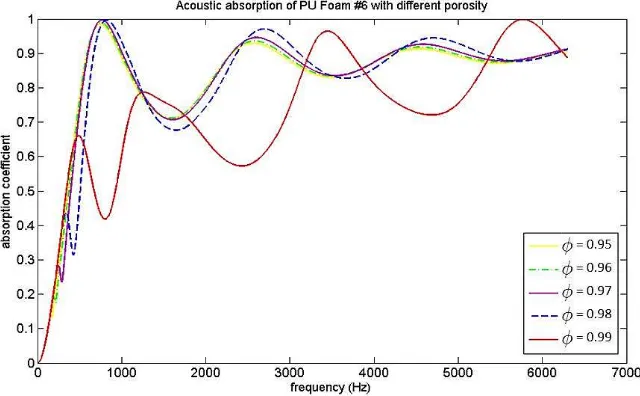
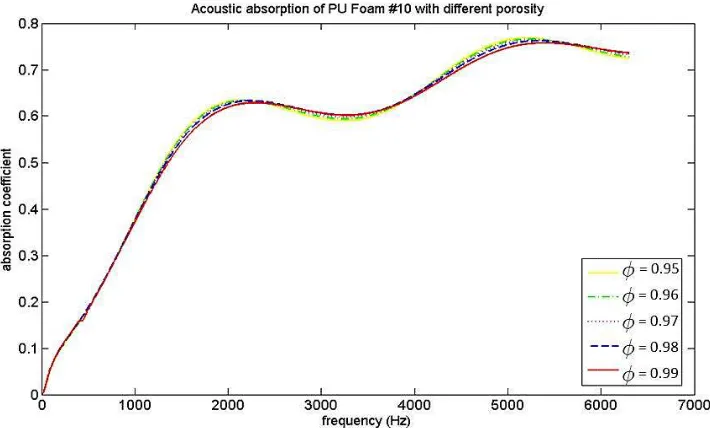
Q0.99. Figures 1-3 display the absorption coefficient of three selected porosities. Thickness of all samples is supposed to be
Fig. 1. Sound absorption coefficient of PU Foam
Fig. 2. Sound absorption coefficient of PU Foam
Journal of Theoretical and Applied Vibration and Acoustics 1(2) 122
Effect of porosity on the sound absorption coefficient
of Section 5.1 and values of Table 1, porosity depends on
For each group of Table 1, the value of solid material density
based on the values of and . Then it is assumed that porosity varies in a narrow reasonable range and for each value of porosity, corresponding solid phase density is calculated using a revised form of Eq. (1) as ;1 ? . From a foaming process point of view, it is possible to change solid phase density and porosity while other parameters are
Three samples of Table 1 from different groups (sample 4 of group I
of group III) are picked here. The porosity changes in the range display the absorption coefficient of three selected
Thickness of all samples is supposed to be 5 cm.
Sound absorption coefficient of PU Foam #4 for different values of porosity
Sound absorption coefficient of PU Foam #6 for different values of porosity
122-132(2015)
127 porosity depends only on the solid phase the value of solid material density has . Then it is assumed that porosity e and for each value of porosity, corresponding solid phase . From a foaming process point of view, it is possible to change solid phase density and porosity while other parameters are of group I, sample 6 of The porosity changes in the range 0.95Q display the absorption coefficient of three selected samples for assumed
or different values of porosity
M. Asadi et al. / Journal of Theoretical and Applied Vibration and Acoustics
According to Fig. 1-3, in the case does not have any considerable effect on
after a special value of porosity, an irregular decrease partially reticulated foam (Fig
frequency at which sound absorption reaches its maximum is observed graph especially for frequencies
these observations are more considerable; also the first maximum of sound absorption is significantly decreased.
Fig. 3. Sound absorption coefficient of PU Foam
5.3. Effect of air flow resistivity and characteristic lengths on the coefficient
According to Table 1 and points
lengths are completely dependent. To change these of Section 2 are used. As stated before
microstructure and vary in the range acceptable range related to each sample
sample, values of and & are calculated based on real values of parameters using equations. Since the calculated
other, it is reasonable to use an average value of average values are used in Eqs
value of flow resistivity. Finally the sound absorption coefficient is computed in terms of new set of parameters. For group I, the average values of constants are
4 shows the result with air flow resistivity in
Journal of Theoretical and Applied Vibration and Acoustics 1(2) 122
in the case of fully reticulated foams (Fig. 1, 3), the increase of porosity does not have any considerable effect on the absorption coefficient. Only for some kinds
after a special value of porosity, an irregular decrease of sound absorption is observed. For Fig. 2) the effect of porosity is different.
frequency at which sound absorption reaches its maximum is observed with more fluctuation of especially for frequencies greater than 1000 Hz. After some specific values of porosity these observations are more considerable; also the first maximum of sound absorption is
Sound absorption coefficient of PU Foam #10 for different values of po
Effect of air flow resistivity and characteristic lengths on the sound absorption
and points (b) and (c) of Section 5.1, air flow resistivity and characteristic lengths are completely dependent. To change these three properties coherently
As stated before, constants and & only depend on the foam microstructure and vary in the range [0.3, 3]. Air flow resistivity is assumed to change in an
each sample compatible with the values of Table are calculated based on real values of parameters using
calculated and & for different samples of similar groups are close to each other, it is reasonable to use an average value of and &for each group of Table
age values are used in Eqs. (2) and (4) to evaluate the characteristic lengths based on the value of flow resistivity. Finally the sound absorption coefficient is computed in terms of new set of parameters. For group I, the average values of constants are RST=1.066
ith air flow resistivity in the range of 500Q Q4500.
122-132(2015)
128 the increase of porosity Only for some kinds (Fig. 1), of sound absorption is observed. For . A slight increase of with more fluctuation of After some specific values of porosity, these observations are more considerable; also the first maximum of sound absorption is
for different values of porosity
sound absorption
M. Asadi et al. / Journal of Theoretical and Applied Vibration and Acoustics
Fig. 4. Sound absorption coefficient of PU foam group I for different values of
For group II, the average values are in the range 2000Q Q10000 values are RST=1.131, RST& =0.672
Fig. 5. Sound absorption coefficient of PU foam group II for different values of
As it is clear from Figs. 4-6, an increase in of and & (Eqs. (2) and (4
frequency range. In the case of partially reticulated
improvement of sound absorption efficiency at lower frequencies is another result. As a Journal of Theoretical and Applied Vibration and Acoustics 1(2) 122
Sound absorption coefficient of PU foam group I for different values of
For group II, the average values are RST=2.144 and RST& =0.628. Air flow resistivity is changing 10000 and the results are illustrated in Fig. 5. Also for group III
0.672 and 1000Q Q1800 , then Fig. 6 shows the result
Sound absorption coefficient of PU foam group II for different values of
an increase in the air flow resistivity with corresponding reduction 4)) leads to an enhancement of absorption coefficient in the whole frequency range. In the case of partially reticulated foam, Fig. 5, beside the
improvement of sound absorption efficiency at lower frequencies is another result. As a 122-132(2015)
129 Sound absorption coefficient of PU foam group I for different values of /, U and U&
Air flow resistivity is changing Also for group III, the shows the result.
Sound absorption coefficient of PU foam group II for different values of /, U and U&
M. Asadi et al. / Journal of Theoretical and Applied Vibration and Acoustics
microstructural point of view, based on some experimental researches in this field reduce cell sizes of foams, it
characteristic lengths and consequently improvement in sound absorption coefficient. How an optimum value will exist for air flow resistivity because further increase of this parameter prevents acoustic wave to penetrate into the foam.
Fig. 6. Sound absorption coefficient of PU foam group III for
5.4. Effect of tortuosity on the sound absorption coefficient
A point was stated in Section cell size (groups I and III of Table
tortuosity changes with air flow resistivity and character
approximate effect of tortuosity, in the lack of any proper mathematical relation, Table 1 is selected and two values
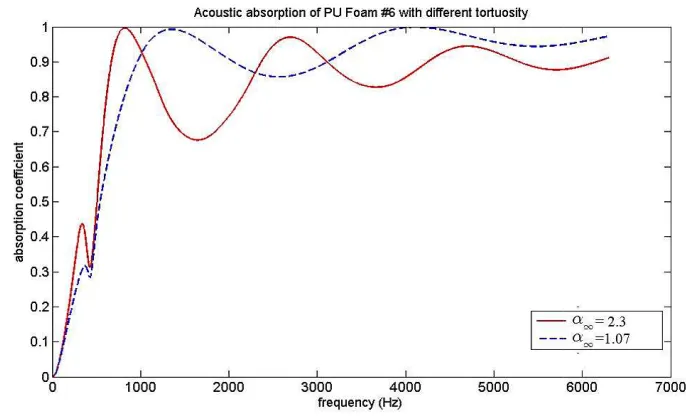
coefficient. The obtained result is illustrated in Fig
According to Fig. 7, with the increase of tortuosity frequencies is improved and its fluctuations
Moreover, reduction of sound absorpt
factor which governs the value of tortuosity is the reticulation rate
related to each other inversely. In fact, by the increase of closed cells in the structure, i.e. reduction of reticulation rate, foam sample would be more tortuous and vice versa. Accordingly, to improve sound absorption performance at lower frequencies, increasing the content of closed pore cells is advisable.
Journal of Theoretical and Applied Vibration and Acoustics 1(2) 122
microstructural point of view, based on some experimental researches in this field
e cell sizes of foams, it results into the increase of airflow resistivity, decrease of characteristic lengths and consequently improvement in sound absorption coefficient. How
exist for air flow resistivity because further increase of this parameter c wave to penetrate into the foam.
Sound absorption coefficient of PU foam group III for different values of
Effect of tortuosity on the sound absorption coefficient
A point was stated in Section 5.1 that the tortuosity of fully reticulated foam is independent of groups I and III of Table 1) and is nearly constant. But for partially reticulated foam tortuosity changes with air flow resistivity and characteristic lengths. Now, to understand the approximate effect of tortuosity, in the lack of any proper mathematical relation,
and two values are used for its tortuosity for evaluation of sound absorption result is illustrated in Fig. 7.
with the increase of tortuosity, sound absorption performance at lower frequencies is improved and its fluctuations are increased for frequencies more than
Moreover, reduction of sound absorption is observed at high frequencies. The main structural factor which governs the value of tortuosity is the reticulation rate [8]. These two parameters are related to each other inversely. In fact, by the increase of closed cells in the structure, i.e. reduction of reticulation rate, foam sample would be more tortuous and vice versa. Accordingly, sound absorption performance at lower frequencies, increasing the content of closed
122-132(2015)
130 microstructural point of view, based on some experimental researches in this field [8, 13], if we the increase of airflow resistivity, decrease of characteristic lengths and consequently improvement in sound absorption coefficient. However, exist for air flow resistivity because further increase of this parameter
different values of /, U and U&
that the tortuosity of fully reticulated foam is independent of But for partially reticulated foam, istic lengths. Now, to understand the approximate effect of tortuosity, in the lack of any proper mathematical relation, sample 6 of used for its tortuosity for evaluation of sound absorption
M. Asadi et al. / Journal of Theoretical and Applied Vibration and Acoustics
Fig. 7. Sound absorption coefficient of PU Foam
6. Conclusion
In this paper, the issue of non
polyurethane foams has been scrutinized. Inde
change in others, therefore, some basic facts have been stated which make it possible to ex their effects individually. The results show that increasing
on the absorption behaviour of polyurethane foams
irregular decrease of sound absorption is observed. In corresponding reduction of characteristic lengths
Besides, increase of tortuosity coefficient. As non-acoustic properties
this study can be used in order to make a foam with a desirable high sound absorption performance.
References
[1] M.A. Biot, Theory of propagation of elastic waves in a fluid Higher frequency range, The Journal of the Acoustical Society of America [2] M.A. Biot, Theory of propagation of elastic waves in a fluid Low‐frequency range, The Journal of the Acous
[3] M.A. Biot, Generalized theory of acoustic propagation in porous dissipative media Journal of the Acoustical Society of America
[4] J. Allard, N. Atalla, Propagation of sound in por materials 2e, John Wiley & Sons
[5] D.L. Johnson, J. Koplik, R
saturated porous media, Journal of fluid mechanics [6] V. Dabbagh, R. Keshavarz
system using genetic algorithm for application in anechoic chambers, in: ASME Noise Control Journal of Theoretical and Applied Vibration and Acoustics 1(2) 122
Sound absorption coefficient of PU Foam #6 for two different values of tortuosity
non-acoustic parameters’ effect on the sound absorption coefficient of polyurethane foams has been scrutinized. Indeed, each of these parameters is
change in others, therefore, some basic facts have been stated which make it possible to ex their effects individually. The results show that increasing porosity does not
on the absorption behaviour of polyurethane foams. Except after a special value of porosity, an irregular decrease of sound absorption is observed. Increase of air flow resistivity and ction of characteristic lengths enhance the sound absorption to higher values. Besides, increase of tortuosity decreases the frequency of maximum sound absorption acoustic properties are dependent to cellular structure of foams, the results of this study can be used in order to make a foam with a desirable high sound absorption
Theory of propagation of elastic waves in a fluid‐saturated porous solid. II. The Journal of the Acoustical Society of America,
Theory of propagation of elastic waves in a fluid‐saturated porous solid. I. frequency range, The Journal of the Acoustical Society of America, 28
Generalized theory of acoustic propagation in porous dissipative media Journal of the Acoustical Society of America, 34 (1962) 1254-1264.
Propagation of sound in porous media: modelling sound absorbing Sons, 2009.
R. Dashen, Theory of dynamic permeability and tortuosity in fluid Journal of fluid mechanics, 176 (1987) 379-402.
Keshavarz, A. Ohadi, Accurate designing of flat-walled multi
system using genetic algorithm for application in anechoic chambers, in: ASME Noise Control 122-132(2015)
131 erent values of tortuosity
acoustic parameters’ effect on the sound absorption coefficient of ed, each of these parameters is sensitive to any change in others, therefore, some basic facts have been stated which make it possible to examine porosity does not have great influence after a special value of porosity, an crease of air flow resistivity and enhance the sound absorption to higher values. decreases the frequency of maximum sound absorption are dependent to cellular structure of foams, the results of this study can be used in order to make a foam with a desirable high sound absorption
turated porous solid. II. , 28 (1956) 179-191. saturated porous solid. I.
28 (1956) 168-178. Generalized theory of acoustic propagation in porous dissipative media, The
ous media: modelling sound absorbing
Theory of dynamic permeability and tortuosity in
M. Asadi et al. / Journal of Theoretical and Applied Vibration and Acoustics 1(2) 122-132(2015)
132 and Acoustics Division Conference at InterNoise 2012, American Society of Mechanical Engineers, 2012, pp. 227-235.
[7] R. Keshavarz, Optimal layer sequencing of anisotropic porous materials for maximizing noise absorption, in: Department of Mechanical Engineering, Amirkabir University of Technology, 2011.
[8] O. Doutres, N. Atalla, K. Dong, Effect of the microstructure closed pore content on the acoustic behavior of polyurethane foams, Journal of Applied Physics, 110 (2011) 064901.
[9] O. Doutres, N. Atalla, A semi-empirical model to predict the acoustic behaviour of fully and partially reticulated polyurethane foams based on microstructure properties, in: Acoustics 2012, 2012.
[10] O. Doutres, N. Atalla, K. Dong, A semi-phenomenological model to predict the acoustic behavior of fully and partially reticulated polyurethane foams, Journal of Applied Physics, 113 (2013) 054901.
[11] D.A. Bies, C.H. Hansen, Flow resistance information for acoustical design, Applied Acoustics, 13 (1980) 357-391.
[12] D. Cuiyun, C. Guang, X. Xinbang, L. Peisheng, Sound absorption characteristics of a high-temperature sintering porous ceramic material, Applied Acoustics, 73 (2012) 865-871.
![Table 1. Non-acoustical properties of eleven samples of polyurethane (PU) foam [6].](https://thumb-us.123doks.com/thumbv2/123dok_us/25111.2002773/5.595.88.537.226.385/table-non-acoustical-properties-samples-polyurethane-pu-foam.webp)