Please cite this article as: M. Kaviyani-Charati, F. Heidarzadeh Souraki, M. Hajiaghaei-Keshteli, A Robust Optimization Methodology for Multi-objective Location-transportation Problem in Disaster Response Phase under Uncertainty, International Journal of Engineering (IJE), IJE TRANSACTIONS B: Applications Vol. 31, No. 11, (November 2018) 1953-1961
International Journal of Engineering
J o u r n a l H o m e p a g e : w w w . i j e . i rA Robust Optimization Methodology for Multi-objective Location-transportation
Problem in Disaster Response Phase under Uncertainty
M. Kaviyani-Charatia, F. Heidarzadeh Sourakia, M. Hajiaghaei-Keshteli*b
a Department of Industrial Engineering and Management Systems, Amirkabir University of Technology, Tehran, Iran b Department of Industrial Engineering, University of Science and Technology of Mazandaran, Behshahr, Iran
P A P E R I N F O
Paper history:
Received 25 Januray 2018
Received in revised form 31 August 2018 Accepted 26 October 2018
Keywords:
Humanitarian Aid Logistic Location-Transportation Problems Uncertainty
Robust Optimization
A B S T R A C T
This paper presents a multi-objective model for location-transportation problem under uncertainty that has been developed to respond to crisis. In the proposed model, humanitarian aid distribution centers (HADC), the number and location of them, the amount of relief goods stored in distribution centers, the amount of relief goods sent to the disaster zone, the number of injured people transferred to medical centers and the delivery of relief regarding the limits of capacity for transport, distribution centers and also available time and budget limits are all considered. This work aims at minimizing unfulfilled needs; that is meaning the number of people have not been transferred to medical centers. In order to take the inevitable uncertainty in some parameters into account, the primal deterministic model has been reformulated by applying the robust optimization approach. Also the performance of the both deterministic and robust models are investigated by solving a numerical example. The results of the study show that the robust counterpart of deterministic model will remain feasible with a high probability in reality.
doi: 10.5829/ije.2018.31.11b.20
1. INTRODUCTION1
One consequence of population growth in recent years is intensification of life and financial damages due to natural disasters such as earthquake, flood, storm, and terrorism. One of the main concerns about crisis have been the lack of certainty and neglecting that leads to failure to have effective Humanitarian Aid Logistic (HAL) and increase of financial and life damages. To minimize or remove this problem, the robust optimization has been used. Recently, there have been significantly rise in the number of published paper on disaster area. Disaster management is generally discussed by Altay and Green III [1].
Many researchers have focused on the disaster, for example; Abounacer et al. [2] proposed a multi-objective transportation-location problem to minimize the three objectives of transportation time, number of distribution centers, and unmet demands. The problem
*Corresponding Author Email: [email protected] (M.
Hajiaghaei-Keshteli)
was solved in a definite space following accurate solution approach. Begona et al. [3] proposed several measures to solve the problem of distribution. The authors developed a multi-variable optimization model based on the aspects under consideration. The proposed model is a core of a decision-making back up system to help humanitarian aids. Najafi et al. [4] proposed a objective, style, product, and multi-period model for goods logistics and victims management in earthquake. The model was developed as a robust model and to ensure proper implementation of the model; it was used under different earthquake scenarios. Moreno et al. [5] survey two-stochastic mixed-integer programming models to integrate and coordinate facility location, transportation, and fleet sizing decisions in a multi period, multi commodity, and multi modal context under uncertainty.
decision-making, as well as, they had applied the model to the real condition of the flood of Mexico in 2013.
Relief logistic network was designed by Bashiri and hassanzadeh [7], their model includes a covering location problem. In addition, they had employed Lagrangian relaxation method to discover a proper lower limit of the disaster for large cases. Some published articles have concentrated on location-allocation problems Duhamel et al. [8], Ruan et al. [9] Fard and Hajaghaei-Keshteli [10].
Singhtaun [11] proposed a mathematical model and surveying performance of the algorithm for solving transportation-location problem of humanitarian aid reliefs and solved with the help of branch-limit algorithm. Huang et al. [12] developed the principles of humanitarian distribution with three objectives including saving tools, delay costs, and fairness. Wang et al. [13] focused on post-earthquake phase and proposed a non-linear integer model for positioning and routing relief aids distribution problems by taking into account trip time, total cost, and reliability of delivery mission and genetic algorithm have been used.
Ben-Tal et al. [14] introduced a general method for robust supplying programming that can reduce uncertain demand in humanitarian aid supply chain. Mete and Zelda [15] developed an optimization approach to stock and distribute medicines in different crises types. They also introduced a probable programming model to select the best point of distribution and inventory level. Berkoune et al. [16] proposed a model for practical transportation problem, which is very common. They had represented that optimum solution of the model is possible only at small scale and improved its solution by proposing an effective genetic algorithm. Bozorgi et al. [17] introduced a multi-objective model of probable programming to optimize humanitarian operation before and after crisis. Their aim was to minimize total costs and maximum satisfaction of aid takers. The model was implemented for different scenarios.
As well as, the reconfiguring model in disaster preparedness phase is suggested by Khademi Zare et al. [18] in which they have decided on facilities location, distribution of emergency goods, distribution centers, and demand areas. Also, multi-stage stochastic programming has been employed [19, 20].
In this paper, a new multi-objective mathematical model is developed for response phase of disaster management. A multi-objective emergency location-transportation problem was demonstrated by Abounacer et al. [2], proposed model have tried to minimize transportation duration of required goods, the number of distribution centers, and unmet demand. According to the survey, advance notice of wounded people, uncertainty, budget limitation have been vital in disaster management, so, in this paper, we concentrate on transferring injured people, uncertainty, and budget
addition to the cases discussed by Abounacer et al. [2]. As a solution approach, robust optimization has been used. Finally, in order to look into the efficiency of result of robust optimization model is compared with deterministic one, we apply Monte-Carlo simulation. The remainder of the paper is organized as follows. Section 2 describes the multi-objective location-transportation problem and proposes a mathematical model for it. Our proposed solution and the results of the model are defined in section 3 conclusion and future research are provided in section 4.
2. DISASTER TRANSPORTATION LOCATION
MULTI OBJECTIVE PROBLEM
In this section, we provide description of the mathematical model and problem to formulate it. 2. 1. Problem Description The set of demand points and demanded products are illustrated by i and j indices. The request for each demand point for each product is represented by
ij
d . Also, to construct
distribution centers are considered budget constraints. To determine the HADCs location, it is assumed that a set of candidate sites exist in advance. This set is represented by L in continue. Required time to send goods from distribution center l to demand point i by vehicle of type h is represented by where
. .
iI jJ lL. Each possible site has a total and per
product limitation that fixes the maximum quantity that can be stored inside the site. The global capacity of a site l is indicated Sland capacity of product j is showed . Several types of vehicles have been considered in here. The time needed by vehicles of type h to arrive the distribution point i is equal to . Loading and unloading time one unit of product jth into a vehicle hth is described as where the product jth cannot be loaded into a vehicle of type h, loading time will be
jh
. So product jth cannot be assigned to vehicle of types h. Also, there are some limitations on the total volume and weight assigned to vehicles. A type h vehicle must not be loaded more than weight units nor over volume units. In addition, each product j has specific volume and weight that is shown by and respectively. A maximum daily work time, (in time units) for each vehicle type h is considered. A vehicle could only go to a specific number of trips per day (just forward and backward trip). According to available time for each vehicle, the number of trips during a day was considered 2. Also we also divide the
ilh t
l
S
lj
s
lh
jh
h
Q
h V
j v
j
injured into several categories which is shown by r. The number of hospital and the number of injured in point ith is indicated by s and . Collection time for the injured and transport them to the hospital are respectively represented by , r tihs. Other assumptions
of the model are:
The number of injured people distribution centres and hospitals are certain;
capacity of each vehicle, distribution center and hospital is limited;
There are three types of commodities;
There is no flow of goods between distribution centers and also affected area;
Limited budget.
2. 2. Mathematical Model The parameters and decision variables used in the proposed mathematical model are defined as follows:
Sets
set of demand points; set of products; set of injured types;
set of distribution points; k set of vehicle types;
set of vehicles for each type; set of trips;
set of hospitals; Parameters
ij
d demand of point i for product j
the number of injured type r in the disaster ith capacity of site l for all products
capacity of site l for product j
cost of acquisition and maintenance products, j in place of l
needed time to travel from demand point i to site l
by car type hth
fixed cost of distribution center lth
time of traveling vehicle type of h from demand point ith to hospital sth
available budget
docking time for a vehicle of type h at site l
weight capacity of a vehicle of type h
volume capacity of a vehicle of type h
loading and unloading time one unit of product j
into a vehicle of type h
maximum daily work time for a vehicle of type h
weight of one unit of product j
volume of one unit of product j
collection time the injured type of r
the capacity of kth transportation type h vehicle for covering the injured
the capacity of the hospital type s
Decision variables
Equal to 1 If the location l is selected, otherwise 0.
Equal to 1 if demand point i is visited from HADC l with the kth vehicle of type h on its vth trip to i, otherwise 0.
Quantity of product j delivered to point i from HADC l with the kth vehicle of type h on its vth trip to i.
number of injured type r transferred from effected area with the kth vehicle of type h on its vth trip to the hospital s.
Quantity of product j provided at site l.
The mathematical model for location-transportation problem can be formulated as follows:
1
1 1 1 1 1 1
2 . z
.
il lh ilhkv
q g
n m
p
jh ijlhkv i l h k v
j t X Min Q
(1) 21 1 1 1 1 1
( )
p q g
n m
ij ijlhkv
i j l h k v
Min z d Q
(2)3
1 1 1 1 1 1
( )
g
n s m v
ri rihkvs
i r h k v s
Min z d n
(3)S.t:
g
l 1 1 1 1
.
q m
ijlhkv ij h k v
Q d i j
(4)m
1 1 1 1
0 .
g n
ijlhkv jl i h k v
Q p l j
(5)
1 1 1
2 ) .
. . .
ilh lh ilhkv n p hk l p jh ijlhkv i v j t X
D y l h k Q
(6)
1 1 1 1
( ) . .
n v s
ihs r rihkvs hk i s r v
t n D h k
(7)
1
. . . . .
p
j ijlhkv h ilhkv j
w Q Q X i l h k v
(8) 1 . . . . . pj ijlhkv h ilhkv j
v Q V X i l h k v
(9)ri
d
I I
1 ..n
J J
1..p
r
r
1..s
L L
1..q
1. .
k gh h
1..m
v v
1..
s s
1..r
1 1 1 1
0 .
n s v
rihkvs hk i r s v
n ca h k
(10)1 1 1 1
0 .
n s v
rihkvs ri i r s v
n d r i
(11)m
1 1 1 1 1
0
g n s
rihkvs s i r h v k
n ca s
(12)( . . )
q p
l l lj lj
l j
f y c p
(13)
1
.
p
jl l l j
p S y l
(14).
jl lj
p S j l (15)
. 0.1 . . . .
ilhkv l
X y i l h k v (16)
, . 0 . . . . . .
ijlhkv jl rihkvs
Q p n i j l h k v s (17) The three main objectives are illustrated by Equations
(1)-(3). First objective function minimizes
transportation time, the second objective function minimizes unsatisfied demands and the third objective function minimizes the number of unserved injured people. Constraint (4) ensures that quantity of delivered goods sent to demand point ith is not more than the demand. Constraint (5) ensures that quantity of jth goods from distribution point lth is not more than available goods at this point. Constraint (6) shows that maximum daily work time does not exceeds the maximum allowable time for vehicle type h. Constraint (7) represents the maximum time available for collecting and transferring the injured to the hospital by vehicle type h. Constraints (8) and (9) apply the vehicle capacity limits for each trip, as weight ( ) and volume ( ). Constraints (10) and (12) indicate the capacity of vehicles and hospitals for transferring and treatment of the injured. Constraint (11) ensures that the number of the injured people transferring to hospitals are not more than the injured people. Constraint (13) indicates the maximum budget for the construction of distribution centers and the preparation and storage of commodities. Constraints (14) and (15) demonstrate the total capacity of all relief goods for distribution center and the capacity for each product at these points. Constraints (16) and (17) defines the decision variables.
We can say that the model will be efficiency when the input data is deterministic. If the input data is non-deterministic, the model will miss its effectiveness and credibility. According to the importance of disaster
models, incorrect planning will follow irreparable financial damages and loss of human life. We haven’t got exact information about the demand for commodities, road status, and the number of injured during the disaster. Applying stochastic optimization methods, fuzzy and robust optimization under these conditions has become crucial to prevent mathematical model from getting infeasibility in real situation. This article has used the robust optimization approach to handle uncertainty.
Description of the robust optimization based on polyhedral uncertainty set that was extended by Bertsimas and Sim [19] is provided as follows:
2. 3. The Robust Counterpart of Deterministic Model Robust optimization with taking the worst condition is trying to offer the solutions that the probability of constraint violation has been significantly reducing in real world. Moreover, the robust optimization is based on polyhedral uncertainty sets that was presented by Bertsimas and Sim [19] has two major characteristics: The complexity of the solution will not increase and the method makes a robust solution that level of conservatism can be flexibility modified in terms of probabilistic limits for constraint violation. According to Bertsimas and Sim [19], the robust counterpart of the deterministic model is:
1
1 1 1 1 1 1
2 . ) . z
.Γ
t ilh ilhkv ilh
q g
n m
lh ilhkv p i l h k v
jh ijlhkv j
t t o o
t X q X Min Q z
)18(
2
1 1 1 1 1 1
z ( )
.Γ
p q g
n m
d
ij ij ijlhkv
i j l h k v
d d o o
Min d q Q
z
)19(
3
1 1 1 1 1 1
z ( )
.Γ
g
n s m v
dd
ri ri rihkvs
i r h k v s
dd dd
o o
Min d q n
z
)20(
S.t:
. . . . . ˆ
t t
o ilh ilh ilhkv
z q t X i l h k v )21(
ˆ .
dd dd
ri o ri
q z d i r )22(
. ˆ
d d
ij o ij
q z d i j )23(
1 1 1 1
.Γ . ˆ
q m g
d ijlhkv ij ij ij l h k v
Q d d i j
)24(
h
Q
1 1 1 1
ˆ .
g
m v
rihkvs ri ri h k v s
n d d i r
) 25( g m1 1 1 1
0 .
n
ijlhkv jl i h k v
Q p l j
)26(
1 1 1 . ) 2 .Γ . . . t ilh ilhkv ilh
t t ilh ilh n
h l lh ilhkv
i v p
jh ijlhkv j
t X q z
D y l h k X Q
)27(
1 1 1 1
. .Γ
.
ihs rihkvs tt tt s n v
ihs ihs hk tt
r i v s ihs
r rihkvs
t n z
D h k q n
)28(
. . . . . . ˆ
tt tt
ihs ihs ihs rihkvs
z q t n i s r h k v
)29(
1
. . . . .
p
j ijlhkv h ilhkv j
w Q Q X i l h k v
)30(
1
. . . . .
p
j ijlhkv h ilhkv j
v Q V X i l h k v
) 31( . jl ljp S j l )32(
1 1 1 1
0 .
n s v
rihkvs hk i r s v
n ca h k
)33(
1 1 1 1 1
0
g s n m
rihkvs s r i h k v
n ca s l
)34(( . . )
q p
l l lj lj
l j
f y c p
)35(
1
p
jl l l j
p S y l
)36(
, 0.1 . . . .
ilhkv l
X y i l h k v
)37(
, , , , , , , , , , 0 . . . .
t t dd dd d d tt ijlhkv o ilh ri o ij o ihs tt
ihs jl rihkvs
Q z q q z q z z
q p n i j l h k v s )
38)
3. SOLUTION APPROACH
To resolve this model, we used the method that was applied by Najafi et al. [4], so that, the solution method is completely represented in the paper. Then, using
software GAMS tried to evaluate this model in our small community and the results will be presented in the next section. Finally, we use the Monte-Carlo Simulation to analyze and compare the result of deterministic and non-deterministic models.
3. 1. Numerical Example In this numerical example, it is assumed that there are six affected areas which need emergency commodities and are covered by six distribution centers. Also, in each affected area, injured people could be transferred to six hospitals with limited capacity by three kind of vehicles with certain capacity. The capital costs for establishment of each distribution center in the affected area are listed in Table 1.
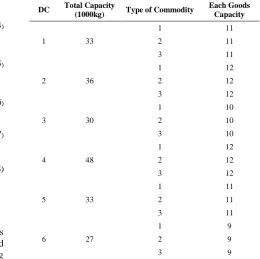
Each distribution center owns a certain capacity for each product. The capacity of each distribution center for the whole medical products as well as the capacity of each product in the accosted distribution center are shown in Table 2.
TABLE 1. Fixed cost for construction of distribution centers
Distribution Center (DC) Fixed Cost ($)
1 60000
2 90000
3 120000
4 70000
5 80000
6 75000
TABLE 2. Total capacity and capacity for each commodity in
distribution center l
DC Total Capacity
(1000kg) Type of Commodity
Each Goods Capacity
1 33
1 11
2 11
3 11
2 36
1 12
2 12
3 12
3 30
1 10
2 10
3 10
4 48
1 12
2 12
3 12
5 33
1 11
2 11
3 11
6 27
1 9
2 9
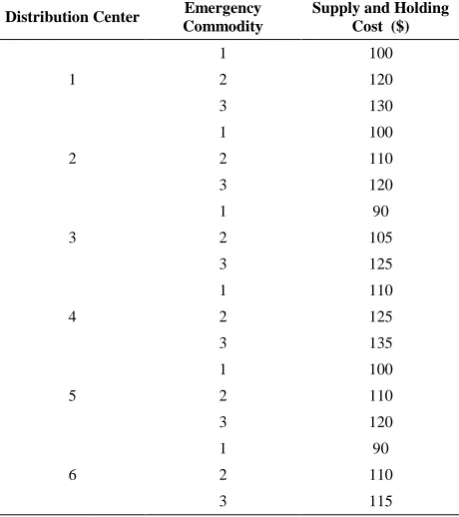
Three types of transports are considered for transferring injured people to the hospital and sending products. The capacity of each transport for relief goods and injured people in Table 3, as well as the volume and weight of each relief cargo are presented in Table 4. In this problem, the costs of supply and holding are also considered and are listed in Table 5. The capacity of each hospital are also demonstrated in Table 6. It is assumed that the random parameters in this problem vary in a certain range, which listed in Table 7. Finally, regarding the discussion above, the output of the model could be reported as follow.
We have taken a decision to give the priority to servicing injured people, minimizing unmet demands, and transportation duration respectively.
TABLE 3. Capacity of transportation
Type of Vehicle
Volume Capacity (m3)
Weight Capacity (1000kg)
Injured Capacity (Person)
1 38 28 70
2 12 18 20
3 6 3.8 10
TABLE 4. Volume and weight of each commodity
Type of Commodity Volume (m3) Weight (1000kg)
1 4.5 5
2 2.5 3
3 6 2
TABLE 5. Cost of supply and holding for every type of
emergency commodity in every distribution center Distribution Center Emergency
Commodity
Supply and Holding Cost ($)
1
1 100
2 120
3 130
2
1 100
2 110
3 120
3
1 90
2 105
3 125
4
1 110
2 125
3 135
5
1 100
2 110
3 120
6
1 90
2 110
3 115
TABLE 6. Hospitals’ capacity
Hospital Capacity (Person)
1 1200
2 615
3 300
4 300
5 156
6 310
TABLE 7. Value of stochastic parameters
Stochastic Parameters Value
ihs
t (min) Uniform(30,50)
ilh
t (min) Uniform(20,40)
ij
d (ton) Uniform(2000,3600)
ri
d (person) Uniform(150,240)
So, the result of the proposed model is shown in Table 8.
Most of the information about injured people, demand, and etc. have been non-specific. So, if we have ignored the importance of uncertainty, the model will miss its efficiency in real world.
We have used the robust approach in order to prevent the model from being infeasible in reality. Then, three different levels of conservatism degree (Γ) in the range of [0, 1] and three levels of a perturbation 5, 10 and 15% to perform sensitivity analysis are considered by authorities. The value of the objective function when the transportation time is non-deterministic indicates in Table 9.
TABLE 8. The value of the objective function of
deterministic model 1
Z (People) Z2 (Tons) Z3 (Time) Z (The unit)
2021.295 11141.715 37130.128 6.928043E+8
TABLE 9. The value of the objective function under
uncertainty of transportation time
Perturbation Conservatism degree (Γ) Objective Function
0.05
0 6.928043E+8
0.4 6.928053E+8
1 6.928067E+8
0.1
0 6.928043E+8
0.4 6.928063E+8
1 6.928092E+8
0.15
0 6.928043E+8
0.4 6.928072E+8
According to the result of the robust counterpart of deterministic, the objective function value has become worse with rising conservatism degree (Γ) and perturbation when time was considered under uncertain data. As a result in Table 9 shows, The value of objective function becomes worse with increasing levels of conservatism degree, real condition with non-deterministic data is applied by the robust model, so the solution robustness have remained feasible for all data with high probability. The results imply that the robust model has had better efficiency on the higher uncertainty levels versus the deterministic one.
The rest of solutions, considering another uncertain parameter, are shown as follow. The three objective functions under uncertainty with the level of conservatism (Γ) 0.2 to 1 and three levels of perturbation 5, 10 and 15% are shown in Figures 1, 2, and 3. As the results in Figures 1, 2, and 3 show, the value of objective function have increased with increasing conservatism degree (Γ) and keeping levels of perturbation, indeed it have become worse than the result of deterministic model, and also it’s the contrary it has established that the levels of perturbation have risen and the conservation degree keeps, the result of robust model have become worse.
Figures 1-3 have shown the effect of uncertainty on first, second, and third objectives. However, if conservatism degree (Γ) or the perturbation values will equal zero, the result of robust model has been as same as the result of deterministic model. The deterministic model has gained the solution better than the uncertain one, because deterministic model has been completely ignoring real situation.
The part of deterministic and non-deterministic variables is reported as follow.
The quantity of commodities carrying and the number of transfer of wounded people in 0.8 of a conservatism degree (Γ) and 0.1 of the perturbation are shown in Table 10. According to the result, the number of wounded people transferring and goods carrying in deterministic model has been more than robust one.
Figure 1. The amount of unmet demand in different levels of
conservatism degree (Γ) in 0.2 to 1 and three levels of a perturbation 5%, 10%, and 15%
Figure 2. The number of remain injured in different levels of
conservatism degree (Γ) in 0.2 to 1and three levels of a perturbation 5%, 10%, and 15%
Figure 3. Transportation duration in different levels of
conservatism (Γ) in 0.2 to 1 and three levels of perturbation 5%, 10%, and 15%
TABLE 10. Variables’ value
Non-deterministic Deterministic Variable
39838.571 40558.286 Qijlhkv
1475.718 1553.705 nrihkvs
The number of injured people and commodities are carried under uncertain condition that have significantly decreased nearly 78 people and 720 tons versus the deterministic one.
Moreover, regarding what we have gained, five distribution centers (1, 2, 4, 5, and 6) have opened and 156 binary variables xilhkv have taken value.
In addition to above, we have sought to provide another solution for our proposed model in different sizes. The result of solutions to the problem with the several dimensions, fixed perturbation (0.1) and specific conservation levels (0, 0.2, 0.5, and 1) are shown in Table 11.
3. 2. Simulation Results The quality of the robust solution is examined by running 7000 simulation of random yields. In robust model, the protection level has determined probability bounds of constraint violation, moreover the probability of constraint violation are analyzed with changes in data in order to assess the robustness of the solutions obtained as follow.
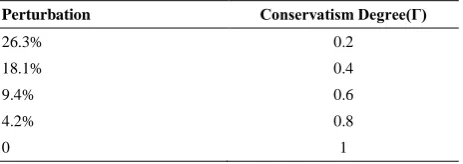
We have used Monte-Carlo Simulation. The simulation output of the deterministic model under uncertain condition has shown that 33.9% of the deterministic model constraints have been violated (Table 12). The simulation output of the robust model is shown in 5 levels of a conservatism degree (Γ) as follow.
As a result in Table 13 shows, the probability of constraint violation has reduced with increasing level of conservatism degree (Γ), therefore, when conservatism degree equals 1, there have not been any constraint violation (Table 13).
TABLE 11. Summary of result in several dimensions under
uncertainty Problem size2
|I|*|L|*|S| CD
1 Objective function
Deterministic Robust
|6|*|6|*|6|
0
6.928043E+8
6.928043E+8
0.2 6.928053E+8
0.5 6.928068E+8
1 6.928092E+8
|10|*|10|*|10| 0
8.239374E+8
8.239374E+8
0.2 8.239396E+8
0.5 8.239436E+8
1 8.239485E+8
|15|*|15|*|15| 0
10.006431E+8
10.006431E+8
0.2 10.006492E+8
0.5 10.006589E+8
1 10.006701E+8
1.Conservation degree
2.Some sets are not included because of fixed size
TABLE 12. The probability of constraint violation
Constraint Violation
Unjustified
Constraints Total number
1 Type of Model
33.9% 2371 7000 deterministic
1. The Total Number of Constraints with Uncertainty Parameters
TABLE 13. The probability of constraint violation (Robust
Model)
Perturbation Conservatism Degree(Γ)
26.3% 0.2
18.1% 0.4
9.4% 0.6
4.2% 0.8
0 1
Indeed, to solve model, we have considered the worst condition. Although, the objective function has become worse, the solution has remained feasible and near optimal when the data alters.
4. CONCLUSION AND FUTURE RESEARCH
The proposed three objective optimizations to make the best decision in order to minimize transportation duration, unsatisfied commodities demand and unserved wounded people has been developed. Regarding the importance of the uncertainty sets in natural disaster, the Robust Optimization approach based on polyhedral uncertainty sets was used to solve that was proposed by Bertsimas and Sim [19].
The results have shown that if we have not paid attention to the importance of data uncertainty, the model will miss its efficiency in real world. According to the results, the robust model has had higher efficiency on data uncertainty against the deterministic one. The deterministic model hasn’t got perfect performances and the result had provided incorrect information to decision makers, but the proposed model has remained feasible in real conditions.
As for future research, the proposed model will be developed by taking elliptical uncertainty sets that was offered by Ben-Tal et al. [14]. Also shelter and carrying the homeless people to shelter has been considered. Moreover, the routing problem can be added to model. Therefore, meta-heuristic solution of the proposed model recommend an interesting alternative approach for handling such cases [19-22]. Furthermore, in this case, when some parameters are considered as uncertain data, solution of the problem will be difficult, so, solving the model in large scale problems can be attractive.
5. REFERENCES
1. Altay, N. and Green III, W.G., "Or/ms research in disaster
operations management", European Journal of Operational
Research, Vol. 175, No. 1, (2006), 475-493.
2. Abounacer, R., Rekik, M. and Renaud, J., "An exact solution approach for multi-objective location–transportation problem for disaster response", Computers & Operations Research, Vol. 41, (2014), 83-93.
3. Vitoriano, B., Ortuño, M.T., Tirado, G. and Montero, J., "A multi-criteria optimization model for humanitarian aid distribution", Journal of Global Optimization, Vol. 51, No. 2, (2011), 189-208.
4. Najafi, M., Eshghi, K. and Dullaert, W., "A multi-objective robust optimization model for logistics planning in the earthquake response phase", Transportation Research Part E: Logistics and Transportation Review, Vol. 49, No. 1, (2013), 217-249.
vehicles in emergency logistics", Computers & Operations Research, Vol. 69, (2016), 79-96.
6. Rodríguez-Espíndola, O., Albores, P. and Brewster, C.,
"Disaster preparedness in humanitarian logistics: A collaborative
approach for resource management in floods", European
Journal of Operational Research, Vol. 264, No. 3, (2018), 978-993.
7. Hasanzadeh, H. and Bashiri, M., "An efficient network for
disaster management: Model and solution", Applied
Mathematical Modelling, Vol. 40, No. 5-6, (2016), 3688-3702.
8. Duhamel, C., Santos, A.C., Brasil, D., Châtelet, E. and Birregah,
B., "Connecting a population dynamic model with a multi-period location-allocation problem for post-disaster relief operations", Annals of Operations Research, Vol. 247, No. 2, (2016), 693-713.
9. Ruan, J., Wang, X., Chan, F. and Shi, Y., "Optimizing the intermodal transportation of emergency medical supplies using
balanced fuzzy clustering", International Journal of
Production Research, Vol. 54, No. 14, (2016), 4368-4386. 10. Fard, A.M.F. and Hajaghaei-Keshteli, M., "A tri-level
location-allocation model for forward/reverse supply chain", Applied Soft Computing, Vol. 62, (2018), 328-346.
11. Singhtaun, C., "An exact algorithm for location–transportation problems in humanitarian relief", World Academy of Science, Engineering and Technology, International Journal of Social, Behavioral, Educational, Economic, Business and Industrial Engineering, Vol. 9, No. 3, (2015), 815-819.
12. Huang, K., Jiang, Y., Yuan, Y. and Zhao, L., "Modeling multiple humanitarian objectives in emergency response to
large-scale disasters", Transportation Research Part E:
Logistics and Transportation Review, Vol. 75, (2015), 1-17. 13. Wang, H., Du, L. and Ma, S., "Multi-objective open
location-routing model with split delivery for optimized relief distribution in post-earthquake", Transportation Research Part E: Logistics and Transportation Review, Vol. 69, (2014), 160-179.
14. Ben-Tal, A., Do Chung, B., Mandala, S.R. and Yao, T., "Robust optimization for emergency logistics planning: Risk mitigation in humanitarian relief supply chains", Transportation Research part B: Methodological, Vol. 45, No. 8, (2011), 1177-1189. 15. Mete, H.O. and Zabinsky, Z.B., "Stochastic optimization of
medical supply location and distribution in disaster
management", International Journal of Production Economics,
Vol. 126, No. 1, (2010), 76-84.
16. Berkoune, D., Renaud, J., Rekik, M. and Ruiz, A., "Transportation in disaster response operations", Socio-Economic Planning Sciences, Vol. 46, No. 1, (2012), 23-32. 17. Bozorgi-Amiri, A., Jabalameli, M. and Al-e-Hashem, S.M., "A
multi-objective robust stochastic programming model for disaster relief logistics under uncertainty", OR Spectrum, Vol. 35, No. 4, (2013), 905-933.
18. Rezaei, H., Zare, H.K., Bashiri, M. and Fakhrzad, M., "Re-configuration of the relief network considering uncertain demand and link failure in an earthquake: A multi-stage
stochastic programming", International Journal of
Engineering-Transactions C: Aspects, Vol. 31, No. 6, (2018), 932-942.
19. Bertsimas, D. and Sim, M., "The price of robustness",
Operations research, Vol. 52, No. 1, (2004), 35-53.
20. Cheraghalipour, A., Paydar, M. and Hajiaghaei-Keshteli, M., "An integrated approach for collection center selection in
reverse logistics", International Journal of
Engineering-Transactions A: Basics, Vol. 30, No. 7, (2017), 1005-1016. 21. Nasiri, E., Afshari, A. and Hajiaghaei-Keshteli, M., "Addressing
the freight consolidation and containerization problem by recent
and hybridized meta-heuristic algorithms", International
Journal of Engineering-Transactions C: Aspects, Vol. 30, No. 3, (2017), 403-410.
22. Rastaghi, M.M., Barzinpour, F. and Pishvaee, M., "A multi-objective hierarchical location-allocation model for the healthcare network design considering a referral system",
International Journal of Engineering-Transactions B: Applications, Vol. 31, No. 2, (2017), 365-373.
A Robust Optimization Methodology for Multi-objective Location-transportation
Problem in Disaster Response Phase under Uncertainty
M. Kaviyani-Charatia, F. Heidarzadeh Sourakia, M. Hajiaghaei-Keshtelib
a Department of Industrial Engineering and Management Systems, Amirkabir University of Technology, Tehran, Iran b Department of Industrial Engineering, University of Science and Technology of Mazandaran, Behshahr, Iran
P A P E R I N F O
Paper history:
Received 25 Januray 2018
Received in revised form 31 August 2018 Accepted 26 October 2018
Keywords:
Humanitarian Aid Logistic Location-Transportation Problems Uncertainty
Robust Optimization
هدیکچ
یبایناکم هلئسم یارب هفده هس لدم کی هلاقم نیا رد
هعسوت نارحب هب خساپ یارب تیعطق مدع طیارش تحت لقن و لمح
رشب عیزوت زکارم ناکم و دادعت هطوبرم لدم رد .تسا هدش هداد
زکرم ره رد هدش هریخذ یدادما یلااک رادقم ،هناتسود
قم ،عیزوت نامز و ینامرد زکارم هب هدش لقتنم هدید هثداح دارفا دادعت ،هدید هثداح طاقن هب هدش لاسرا یدادما یلااک راد
تیدودحم نتفرگ رظنرد اب یدادما لااک لاسرا جدوب تیدودحم نینچمه و عیزوت زکارم ،لمح لیاسو یارب تیفرظ یاه
و ه
،تسا هدش نییعت سرتسد رد نامز رک لقادح نآ فادها هک
لقتنم دارفا دادعت و لااک لاسرا نامز ،هدشن هدروآرب یاضاقت ند
یم ینامرد زکارم هب هدشن .دشاب
مدع نتفرگ رظن رد اب یخرب رد تیعطق
راوتسا یاتمه ،لدم یاهرتماراپ زا هعسوت یعطق لدم
.تسا هدش یسررب یددع لاثم کی رد یعطق لدم هب تبسن یعطق لدم یاتمه راوتسا لدم ییاراک نینچمه .تسا هدش هداد
لدم لح جیاتن یم ناشن هدش هعلاطم یاه
یندش یعقاو طیارش رد ییلااب لامتحا اب یعطق لدم یاتمه راوتسا لدم هک دهد
.دنام دهاوخ یقاب
doi: 10.5829/ije.2018.31.11b.20