Eureka Mokibelo (PhD)
Senior Lecturer, Communication and Study Skills Unit, University of Botswana, Private Bag 0022,
Gaborone, Botswana
Transporting
Learners In Remote
Area Dweller
Settlements Schools:
ABSTRACT
This study examined the transportation of students who attend school at a Remote Area Dweller primary school in the Central District in Botswana from their school to and from cattle-posts where their parents work or to
their final destinations in 2015-17. The parents’ children work in cattle-posts as cattle-herders while their children attend school distances away from them. The children stay in a hostel. A broader study was conducted
in 2005-6 on reading abilities of learners in the school where learners attend. Hence, this theme emerged and a tracer study was conducted due to some disturbing verbatim from the students. The study used the qualitative research to reflect on any improvements and developments made by the school or Ministry of Education and
Skills Development with regard to transporting learners to and from their respective home areas. Transporting learners in the previous research was a thorny issue with unpleasant consequences. The study used the interview
and observation methods to reflect on this issue. The findings indicated that there were some improvements though there were still some flaws. Implications were highlighted about the transportation practice on
educational authorities, learners and parents. The study concluded that more still needed to be done to improve the measures put in place to transport students.
Key words: transportation, care-takers, drivers, learners, trucks, parents
1. INTRODUCTION
It has become a common practice to transport learners who stay in remote areas where there are no resources
such as transport and tarred roads from their homes to school and back in Botswana. This practice affects learners from indigenous groups of Botswana who live below the poverty datum line. The parents of these
learners are usually not educated enough or are completely illiterate; hence they are either not working or work as cattle – herders in remote areas such as cattle-posts. In this regard, the government assists parents by transporting their children to school for learners to be educated as per Botswana’s vision 2016 and 2036. Botswana Vision states that ‘by 2036 Botswana will be a moral, tolerant and inclusive society that provides
opportunities for all. Therefore the transport system should resonate with this goal by trying to retain learners in school instead of “driving” them away. Also, the Universal Declaration of Human Rights of 1948 clearly
articulates that everyone has the right to education and it should be free especially at elementary level. This concept was enshrined in the Education for All goal number two which states that: “All children, particularly
girls, children in difficult circumstances and those belonging to ethnic minorities have access to free, quality and compulsory primary education by 2015.” However, the children’s education comes at a price in some rural
areas due to the transport system used.
transported to where their parents are to the school at the beginning and end of every school term or when there are holidays within the school calendar year. It is this transportation system that this paper interrogates and
reflects on.
Transporting learners to and from their homes who attend schools in Remote Area Dweller settlements in Botswana has for a long time been a controversial issue. Learners have been transported in open trucks when
undertaking school trips and when school terms ended and began. Research indicated that there has been complaints from learners and parents about incidents and accidents that occur when they were transported in
overloaded and open trucks. The children used to tell stories to their parents that needed the attention of the authorities but remained untold and unknown because learners and parents do not report them to school
authorities. In this study many of such untold incidents have harmed learners emotionally and forced them to drop out of school. Therefore, their stories remain their secrets between themselves and their parents. The people
who were supposed to get feedback never knew the learners’ experiences along the way as they were transported to their homes. Therefore, this paper makes noise about such incidents to draw the attention of educational
authorities.
Of late, problems such as accidents have been registered where college students who were in basically the same
situation (staying far away from schools) as that of the learners in this study have lost their lives. The incident is used as an example to indicate the seriousness of the issue of transporting learners from indigenous groups
similar to the ones case studied in this paper. The following extract from the Botswana Daily News of 14th November 2015, by Benjamin Shapi, puts this problem into perspective:
The Minister of Health,… has confirmed that 126 Matsha College students were involved in a road accident near Dutlwe in the
Letlhakeng Sub-district yesterday (November 13). She told a press conference in Gaborone this afternoon (November 14) that seven
students lost their lives, 69 were admitted at Scottish Livingstone Hospital in Molepolole, 28 at Princess Marina Hospital with three in
the intensive care unit while a few others were admitted at both Gaborone Private Hospital and Bokamoso in Mmopane. Eight students
were briefly admitted and discharged at Letlhakeng clinic. The driver and the assistant driver of the truck were admitted at Scottish for
medical attention and counselling. The students, who are Remote Area Dwellers, were being transported to their villages after completing
BGCSE examinations at Matsha College and BOCODOL in Kang. Their ages ranged between 15 and 22 years.
The above quotation indicated that transporting learners to and from their destination could be a painful experience to learners, parents, the community and educational authorities. It could claim the lives of learners. It could drain government resources by paying medical bills, paying funeral parlours and compensating families
for the lost lives. Again, it could be emotionally traumatizing to learners who were in the same classes at school and for those who survived the accident. However, this is not enough, other transporting problems exist in other
regions of the country. From the previous study the following problems were spelt out in the process of transporting learners in open trucks: trucks overloaded, travelling long distances unnecessarily, mechanical
Despite the above, Labriola (2012) argued that there are government policies and guidelines to assist in transportation of learners. Some of the guidelines are training drivers in order to develop and improve their
transportation competencies was an issue that needed serious attention to avoid unnecessary pain. The notion of transporting learners to and from their destinations is central to this paper and is predicated on the observation that nine years after the previous research, there were still semblances of the problem. This issue involved the
indigenous groups of Botswana society. It also involves learners aged between seven to sixteen years who if they can be protected and not killed in road carnages can live to be leaders of tomorrow.
Literature review in transporting learners who attend Remote Area Dweller primary schools is limited because although not a new phenomenon, the area has not been researched in the context of Botswana. Again, the only
evidence provided would be from newspapers when an accident occurs. Hence, this paper problematizes a rather unique theme in the areas of research that affects indigenous groups in Botswana education system. Again, the
documents available from other countries are not related to the type of transportation discussed in this paper. Therefore, the revelations in this study are still unique.
2. RESEARCH METHODOLOGY
This study was conducted in two remote areas in the Central District where the learners were transported in government vehicles from their homes at the beginning and end of school terms. The transportation of RAD
learners was observed from 2015 – 2017 as a tracer study from a primary about 30 - 40 kilometers to the cattle posts where the learners and parents currently reside or are working as cattle herders. The study was based on observations and parents’ grievances and patterns of the practice by drivers especially when learners were
dropped from school.
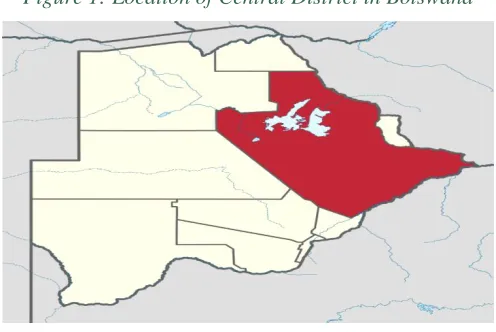
Figure 1: Location of Central District in Botswana
Source: Botswana location map.svg (by NordNordWest).
The Central District (the shaded area) is one of the largest districts in Botswana in terms of population of
- Bangwato. It has two main villages that are regarded as the largest in Africa such as Serowe and Palapye.
The Central District borders
Zimbabwe
's Matabeleland North and Matabeleland South Provinces, and in theSoutheast, it borders
South Africa
'sLimpopo
Province.Participants involved in this tracer study were caretakers and drivers who accompanied learners as they were
going home. The caretakers and drivers studied in 2015 were different from the ones studied in 2016-7. They changed with times and their availability at the time of dropping the learners in their respective destinations.
Therefore, four drivers who delivered learners were interviewed while two caretakers were interviewed. The interviews occurred on different dates when the drivers and caretakers delivered and picked the learners. The
study also involved eight parents whose children were transported and dropped off at their places of work. The students involved were ten and they was a mixed bag of males and females. The ages of the learners ranged
between eight and eleven years.
Caretakers, drivers and parents were interviewed at different times of the year to check the consistency of their responses. This made the data reliable and valid. The ten students were interviewed again at different times,
when they were dropped off and when they were taken back to school at the end of the school or public holidays. The students also were different; the students studied in 2015 were different from those studied in 2016-7. The
researcher made observations when learners were dropped off and when they were picked up and noted visible signs on the students.
Data were categorized according to participants such as the drivers, caretakers and learners and parents. The researcher noted major and minor themes that emerged from the data and a vivid picture was painted from the
answers provided. A comparison was made with the historical data from previous research on a similar study. Although the similarities outweighed the differences, there was an indication of change for improvement in the
data.
The study had a number of limitations. Though a longitudinal study, it involved participants in two remote areas, with a limited number of participants. There could have been more learners in different areas and more
drivers and care takers in different places who had different views. However, the gist of this study was not to generalize information to other areas, but to reflect on previous research from school and now on a different
setting so as to glean improvements in the transport system operations or lack thereof in the same area. Hence, information in this study would be shared with other researchers to further debate issues that indirectly affected
learning and achievement of educational goals that affect ethnic minority groups.
3. THE RESULTS OF THE STUDY
3.1 PREVIOUS RESULTS FROM LEARNERS AT THE HOSTEL 2005 – 2006
Learners were transported after 2-3 days after closure of the school;
Learners were transported by the driver without the company of care takers;
There was no food or provision made for the learners to eat along the way;
Learners who lived nearer (25 kilometres) to the school were not dropped off first but had to travel long distances
and dropped off last;
Intruders such as parents and other people were given a lift and this led to overloading of the trucks;
Open trucks were used to transport learners and snakes and other dangerous animals would drop inside the truck
in small ungazetted roads and learners would jump out to save their lives while the truck was in motion;
Intruders (people who come to ask for lifts) would sit on and crush learners’ bags;
Intruders would shout at learners along the way because there was no supervision in the truck;
Learners would sleep in the truck or bush without blankets on when the truck had mechanical problems until
the truck has been attended to;
Learners were dropped off hungry, dehydrated, with lies and no shoes.
(Mokibelo, 2010)
The results above were obtained from learners at a hostel where they were accommodated during the school
term. The students studied then, had already completed their primary school education. The results were shared with the school administration to put measures in place to address the issue. After the results of this study it was essential to follow learners in remote areas to witness how they were dropped off and the current results are
below.
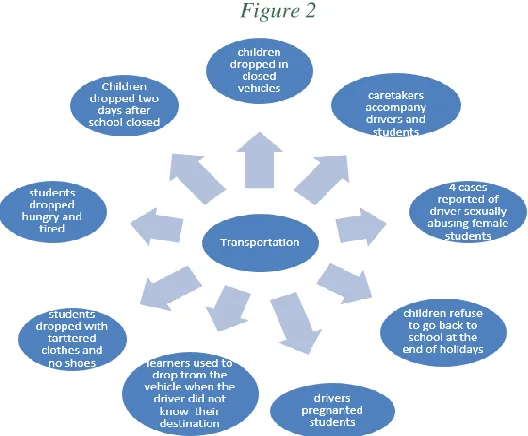
3.2 TANGIBLE EVIDENCE OF THE TRANSPORTATION SYSTEM IN 2015 – 2017
Below are results from caretakers, drivers, parents and students
Figure 2
learners and drive off. They also talk to their parents before they drive off to the next destination. In this regard, students no longer jumped from the vehicle when it was in motion. Despite this improvement, there were still
some dark areas observed by the researcher and articulated by the parents.
Parents reported that there were four cases of females students who were sexually abused by the drivers and two of the girls who were sisters got pregnant. This suggested that it took long for the Ministry of Education
and Skills Development to provide care takers to go along with the students.
Parents reported that their children still refused to go back to school when the schools responded and the reasons
are partly attributed to the transport system used. But with the improvement of travelling short distances some of the children do go back to school. This could suggests that there are still problems along the way or it could
be the conditions of learning at school and at the hostel that keep learners away from school.
The researcher also observed that children were drop off dirty and with tattered clothes that were not even theirs
because they were too big on them. The students reported that some older students take their new clothes and give them the old, tattered ones. The shoes would have been stolen at school by others or along the way when
they forget to pick them up after playing when they walk from school to the hostel.
The students also reported that no one cooks for them as the school closes and therefore they are dropped off
hungry to go and eat at home. Further, they were not given any provision to eat something along the way.
4. DISCUSSION OF FINDINGS
The findings of the study indicated that there were some improvements in the transportation of RADs students.
For example, students were transported in closed vehicles that accommodated a small number, hence problems such as overloading, learners getting scratched by tree branches and snakes getting into the vehicles have been addressed. Again, learners travelled short distances from school to their destinations, different vehicles are
used to drop students who go far and nearer the school – a distance of 25 to 30 kilometres. This was not only inconvenient, but learners were dropped off after two days to a week depending on whether the truck had
mechanical problems or not.
Another positive observation was that learners did not travel only with the driver; there were caretakers who
assisted the driver. The care takers knew where learners were supposed to be dropped off. In the past learners would drop from the vehicle when it was in motion because the driver would not have stopped at their
destination. In some cases the driver would not know exactly where learners were supposed to be dropped off and learners would assume that the driver wanted to harm them along the way. Dropping of when the vehicle
was in motion was a dangerous incident that left the parents worried about the safety of their children. In this regard, parents would not allow their children to return to school. Such cases were not reported to school
The presence of caretakers was a bonus to female students who previously were reported to have been sexually abused by notorious drivers along the way when they were alone with the learners. What was new in this study
was that two pregnancy cases were reported by parents because their children who are sisters were impregnated by a driver and such cases were not reported to school authorities. The cases of the two girls remained hidden in remote areas to haunt the young girls with babies that were ‘fatherless’. Again, parents had to take care of both the young girls and their babies while the father was nowhere to be found. The girls’ silence was a sign of
immaturity and this also affected their judgment, engaged in riskier behaviour that could lead to HIV/AIDS
infection. Hence, the presence of caretakers rescued young female learners from such predators.
While the learners waited for transport for a day or two at school in the past, another positive move observed
was that learners arrived home on the same day of departure from school. In the past, learners used to sleep in the truck with neither blankets nor food to eat. This happened when the truck had mechanical problems along
the way and had to wait for a Good Samaritan to rescue them. It would be the driver with the students and no caretakers. This driver would not know how to handle irritable students because he would have not been trained
on how to handle students. It is hoped that best practices on transportation can be put in place for the safety of children.
Although the issue of selecting drivers to transport learners was not clear in this study, it would be essential to carefully select drivers to transport learners in remote areas. These would not be just drivers, but those who
comply with regulations and are trained to prevent unsafe behaviours. The Ministry of Education and Skills Development should inquire about driver safety records, alcohol and drug testing records, policies on drivers’ hours of service, driver qualification, accident registers and other such information. Individual driver performance should be a part of a carrier’s overall safety records and should be reviewed by trip organizers
prior to taking a road trip with students (Labriola, 2012).
The positive findings could also support the Education for All goal number two because all children, particularly girls, children in difficult circumstances and those belonging to ethnic minorities will have access to education
without being disturbed by the transportation system. The school administration has to take precaution to make sure that learners are comfortable when they are transported and special measures are put in place to strengthen
discipline in all involved in transporting children. The parents involved in this study were not the type who could file lawsuits if anything goes wrong with their children’s education. Therefore, a safe transport system
could promote accessibility and completion of the learners’ primary school education.
Despite the positives noted above, earlier in 2015, parents reported two cases of sisters who were impregnated
by the driver, this was before the caretakers accompanied the children back to their homes. The case was not reported to school authorities because the girls never went back to school. Further, the parents were unable to
with ill motives that this study intends to make noise about because they cut short the studies of these young girls. The driver ruined their future in school and the girls remained traumatized by the rape. They have babies
who they do not know where their father is. They are sisters who bore babies of the same father. The incident shall haunt the girls for the rest of their lives.
On the same breath, the sight of seeing children being dropped hungry and dirty by their parents is another issue
that needs attention. While the expectation is that when the school closes, the school authorities remain in the school until all the learners are all gone, children go back home hungry and dirty. Again they were dropped off
after two days of school closure. Though it could be an issue of logistics within the school system, this issue needs further interrogation. The children may remain vulnerable in a hostel that has been disserted by the school
administrators. Transport should be availed on time especially on the same day of school for children to reach home on the same day of school closure.
All in all, there were positives noted but there were some grey areas that still needed to be addressed. According to caretakers, no provision was made for learners on the day of transportation because they were going home.
In fact, when the school closes, teachers and matron drive to their respective homes leaving learners behind in the hands of care takers. Parents complained about this unpleasant sight and they remained with questions
unanswered. It is vital to move towards a unified approach led by trained personnel and supported by various technical, regulatory, and law enforcement entities with clearly defined responsibilities.
5. IMPLICATIONS OF THE STUDY
The study has implications on the educational goals, learners and parents. After experiencing such traumatizing incidents, learners refused to go back to school, and hence, did not complete their education. This could be the reason why in some cases Remote Area Dweller settlements schools recorded a high rate of school dropouts
especially the same school where the studied children attended. Transportation problems were a contributory factor.
Female learners did not continue with their education because of pregnancy. They went through a traumatizing pregnancy period because they did not plan for it and secondly it is not their choice to have the ‘drivers’ as the
father of their children. The bottom line is that the girls got pregnant at a tender age. They nursed babies whom they did not know where their fathers were. The girls remained silent in the remote areas because the cases go
unreported.
The parents also have problems of releasing their children to go to school after such disturbing instances. They
6. CONCLUSION
It was imperative that all educational authorities and stakeholders played an active role in transporting learners to and from their homes to minimize potential harmful and traumatizing incidents and ensured safety.
Educational authorities and stakeholders should work closely with trip organizers to make safety a priority. It is the duty of the school administrators, matron, boarding master, caretakers and the Ministry of Education and
Skills Development to identify and select the safest modes and measures of transport in remote areas. When engaging drivers, they should first strive to know the background of the driver, his or her qualifications and enquire into safety policies, procedures and records.Sound driver qualifications and continual training, as well
as a regulatory framework are some of the key factors for a safer school transport system. It can be a risky exercise to transport learners with a driver who turns out to be a monster along the way. We should not allow
casualties to occur and then take action when the damage has already been done. Again, all vehicles transporting learners should undergo safety checks before they could be used on the roads.
7. REFERENCES
Patrick Labriola (2012). An Active Approach to Student Transportation Safety: University Business, Feb 2012
Republic of Botswana, (2017). Vision 2036: Prosperity for All. Gaborone. Government Printers