ELECTRONIC PUBLICATIONS : ISSUES AND CONCERNS
A Lakshmana Moorthy & CR Karisiddappa*
Defence Scientific Information & Documentation Centre, Metcalfe House, Delhi-110 054 *Dept of Library & Information Science, Karnatak University, Dharwad-580 003
ABSTRACT
Electronic publishing is one of the important developments of the information technology. The developments in the mass storage, computers and communications fields have made this technology very popular. The impact of electronic publishing on libraries has been widely reported in the literature. The benefits and drawbacks of electronic publications have been felt by the librarians. Electronic and online journals are making a forceful entry into the libraries by painting a rosy picture. Many libraries, especially the affluent, of the academic and R&D institutions are slowly migrating to the electronic publications including CD-ROM databases, and electronic and online journals. Libraries of other institutions are watching the situation and may follow suit in the near future. Electronic publications pose a number of issues and concerns, a few of which have been dealt by some authors. This paper discusses electronic publishing, electronic and online journals, and the various issues and concerns posed by the electronic publications.
1. ELECTRONIC PUBLISHING
Electronic publishing (e-publishing) is one of the widely discussed and published topics of informa-tion technology and, perhaps, second only to Internet in the number of papers published. After the introduc-tion and success of CD-ROM and some of its variants as the medium of e-publishing, the technology as well as the subject became very popular. The number of CD-ROM titles, journal articles, books, monographs, reference sources, reports, and conferences in various subject fields have been growing for quite some time now. Some of the reasons which resulted in the shift of emphasis from conventional publishing to e-publish-ing include (i) the exponential growth in the volume of published information, (ii) the difficulty in retrieve-publish-ing information from libraries due to the literature seepage and scattering, (iii) the need to control and provide access to ever increasing volume of information, (iv) the faster rate of increase in the costs of raw materials used in publishing leading to the escalation of manufacturing costs of books and journals, (v) the need to reduce the time required for conventional publishing, and (vi) the realisation of the potential and unique features of electronic media. Perhaps influenced by the various developments in the field, Robin Peek (1994) has rightly observed that the next chapter in the history of publishing is being written and published electroni-cally.
Since the publication of the first electronic book in 1985 in Germany (Gurnsey, 1992), there has been a steady growth in the number of electronic publications (e-publications). More and more publishers of schol-arly, academic and reference works from almost all fields of human knowledge are entering into the e-publishing field. Though many publications exist in ‘dual’ (both on paper and electronic) versions, some ‘electronic only’ publications have also emerged. The first e-publishing products were mostly reference works, secondary publications, and machine-readable databases of indexing/abstracting services.
Electronic publishing can be defined as the publication process where the manuscripts are submit-ted in electronic format, edisubmit-ted, prinsubmit-ted, and even distribusubmit-ted to subscribers and readers (users) by employ-ing computers and telecommunications. In the most pedestrian interpretation, computers and related de-vices are used for economy and convenience in producing a conventional print-on-paper publication. In the most sophisticated interpretation, the full capabilities of the electronic media—including motion, sound, and interactive features—are exploited in the creation of completely new publication forms (Lancaster, 1989). In general, the fusion of electronic, computer and communication technologies with publishing can be termed as e-publishing, i.e., any information source published in electronic form. This would include sources distrib-uted on magnetic tape and such media as videodiscs as well as sources not really distribdistrib-uted at all but only accessible (like databases) (Lancaster, 1983).
In an e-publication, there is less involvement of paper. All the routines of publishing, from paper submission to publishing and distribution including accessing can be performed using electronic media. The author writes a document using a computer at his end. Alternatively, it can also be authored by more than In Electronic sources of information : Papers presented in the DRTC Annual Seminar held during 1-3 March 2000 at the DRTC,
one author separated by or scattered over a large geographical area but connected through a network using mail, or chat over Internet or through teleconferencing. The completed document is then sent through e-mail to colleagues and peers for comments and suggestions made, if any, are incorporated. Now the docu-ment is ready to be transferred from the authors domain to the publisher’s or editor’s domain by way of e-mail. The document, then will be under editorial processing. Referees upon hearing a message or transfer of paper to their domain, evaluate and transmit back to the editor with comments. These peer-reviewed docu-ments are then processed further based on the final status. Once accepted for publication, the document will be transferred into the users’ domain when it is available online. In case of e-journal, this could be either issue-wise (as is the case of many e-journals) or by sending periodical updates of papers automatically as and when ‘published’ (as in the case of e-journals of American Chemical Society). When a subscriber or user accesses the e-journal, the latest additions after his prior access will be tagged. Others may browse by means of search queries the titles added after their previous access.
Electronic submission of papers to journals and conferences is gaining momentum. E-mail, file transfer, and sending through floppy diskettes are the main types of electronic submission. Studies have been con-ducted (see for example, Wood, 1998) in various subject disciplines. Most of the authors are keen to send articles electronically due to cost savings, speed and reducing proof checking etc. When the paper contains less number of or nil figures, electronic submission increases. Sending graphics/images is the difficult part and lack of standardisation in e-mail software and the availability of the software used for creating graphics at the processing end makes it difficult. Referees are also more willing to accept papers and send comments electronically. For publishers, it is a cost saving mechanism, avoiding keying in, proof reading, revision etc and also cutting the time required for publication. It has been observed that, even in the present conditions prevailing in India, more than 85 per cent of papers are being submitted in electronic form or sent by e-mail. Although maintaining confidentiality of peer review process is the main concern of scholarly publishing, e-journals are encouraging authors to submit papers in HTML format through e-mail (for example, Journal of
Biology), and even post the articles on Internet for comments by open research community (for example, Medical Journal of Australia). Interactive publications where researchers can submit brief reports of new
ideas and findings on which the author wishes to obtain a rapid peer feed back via e-mail (for example,
Psycoloquy) have also became possible. In due course of time, these developments may lead to Webometrics,
informatric analysis of the Web.
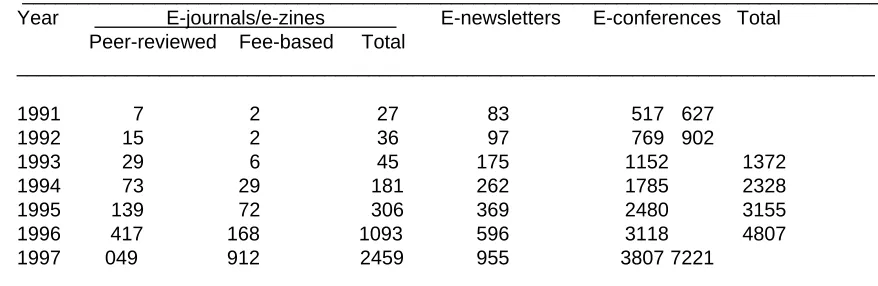
According to the observations of Lancaster (1981), 25 per cent of reference books will be in elec-tronic form by 1990, 50 per cent of the existing abstracting services will be available only in elecelec-tronic form by the year 2000, and 25 per cent of the periodicals in science and technology, social sciences and humani-ties will not reach this conversion level until after the year 2000. It is an established fact that many primary journals and reference books including secondary periodicals are issued in electronic form. This number is steadily growing for the past one decade with more and more publications being issued on CD-ROM and also with ever growing number of electronic journals (e-journals) on Internet (see Table 1). The 1998 edition of
Ulrich’s International Periodicals Directory lists more than 1,56,000 titles of which 2,903 are on CD-ROM and
8762 are online journals. More than 22,000 titles are having Internet Web pages. The eighth edition of
Direc-tory of CD-ROMs and Multimedia of TFPL, London lists over 24,000 titles (Woodward, 1991). This trend
clearly establishes that the observation of Lancaster would become a reality, if not by the year 2000, in a couple years later.
Table 1. Growth of e-publications on Internet*
______________________________________________________________________________ Year E-journals/e-zines E-newsletters E-conferences Total
Peer-reviewed Fee-based Total
______________________________________________________________________________
1991 7 2 27 83 517 627 1992 15 2 36 97 769 902
1993 29 6 45 175 1152 1372 1994 73 29 181 262 1785 2328 1995 139 72 306 369 2480 3155 1996 417 168 1093 596 3118 4807 1997 049 912 2459 955 3807 7221
Discus-sion Lists. Washington, D.C., Association of Research Libraries, 1996 (www.arl.org).
1.1 Optical Discs and Electronic Publishing
Optical discs have become synonymous with e-publishing and CD-ROMs have penetrated all branches of professional and scholarly publishing. This is because of success of the CD-ROM as the optical medium of choice for the publishing industry and also due to its acceptance by major libraries around the world. Durability, capability to hold large volumes of data, and affordability are the important factors for the success of CD-ROMs. Many publishers including McGraw-Hill, Wiley, Elsevier, North-Holland, Meckler, Grolier, Prentice-Hall, Oxford University, etc have all ventured in this area. CD-ROMs are slowly inching towards replacing microform documents primarily due to their versatility, low cost and ease of use. The usability of CD-ROMs in a networking environment made this technology more attractive and acceptable to the library community. CD-ROMs, videodiscs and online bibliographic databases form a major part of the e-publishing field.
Electronic publishing started with reference books and replaced the printed reference sources to a large extent; secondary and some tertiary periodicals followed suit. The primary journals embraced CD-ROM rather slowly and now many publishers (for example, Elsevier, ADONIS, IEEE, Chemical Abstract Service (CAS), Cambridge Science Abstracts, SCI, BIOSIS, UMI, INSPEC, etc) are distributing primary, peer-reviewed periodicals in CD-ROM format; the full-text databases produced on CD-ROM during 1993 accounted for 47 per cent of the total CD-ROM titles. In the next few years, we can expect all the reference, primary and secondary periodicals are brought in electronic form rather than print-on-paper.
1.2 Hybrids
The choice of publication medium changes as per the situational need and depends upon various considerations including cost, availability of equipment, frequency of updation, etc. In situations where text, graphics and video (including animation) are part of publication, CD-ROM emerged as the best medium for electronic publishing. Networks, including intranets and Internet became the publishing medium when the publishing environment warranted continuous updation. In a hybrid environment, the hybrid publications combining CD-ROMs with online networks may be appropriate medium.
Of late, CD-ROM/online hybrids are gaining acceptance. These are an extension of CD-ROMs in that they allow the user using a database or an encyclopedia on CD-ROM to get connected through a network to forums, electronic publications, news services and chat rooms relevant to the subject. Thus
Grolier Electronic Encyclopedia includes more than 12,000 links through CompuServe; and it is one of such
many CD-ROM/online hybrid products. World Book Encyclopedia (1998) of IBM links to a site offering cur-rent news and updates to the CD. Many major encyclopedias of 1998 offer online connections. Database vendors like Knight Ridder OnDisc (Dialog), LEXIS-NEXIS, etc allow users access updated information on their files being searched; these also allow users of the respective CD-ROMs save search strategies and then log on to the online files to search and download results. A number of CD-ROM periodicals (for example,
Medio Magazine) with online links have been introduced. Some have links to Internet. America OnLine also
offers Compton’s Interactive Encyclopedia, and 2Market—a hybrid CD-ROM shopping service; Time
Alma-nac, multimedia games and buyers guides (Pack, 1996). The Multimedia and CD-ROM Directory of TFPL
Multimedia listed 600 hybrid titles by mid-1997, an increase of 160 per cent from January 1997 (de Stricker, 1998). It is likely that the same trend will be observed in future too. Also, many CD-ROM publishers are offering their publications on Internet.
2. ELECTRONIC/ONLINE JOURNALS
example, ADONIS, IEL, ABI Inform, etc). The networked e-journals are based on mailing list software or client/server computing applications including WWW. Both the electronic and online journals (except the ‘online only’ journals) have printed counterparts.
Many factors spurred the interest in the concept of e-journal. These include the delays experienced in communicating the research results; the slowness in the flow of manuscripts; the peer evaluation process; the time required for editing, typesetting, page layout, and page proofs; the ever increasing overhead costs such as printing, binding, packaging and mailing charges; and the decreased buying power of libraries due to the insufficient budgets. E-journals facilitate lesser time lag between paper submission and publication, in some cases as much as 2-3 months, than the print versions. Audio and video effects also can be delivered through Internet, and search engines facilitate keyword/subject searches. They allow printing of required articles at end-user level and result in space and maintenance savings; facilitate retrospective searching with ease, provide hyperlinks to related articles cited in the text.
Many printed journals are available in electronic form over Internet either free of charge or on sub-scription. Periodicals like the Journal of Universal Computer Science, Electronics Letters Online, New York
Journal of Mathematics, Chicago Journal of Theoretical Computer Science, Journal of Universal Computer Science, Electronic Journal of Differential Equations, Electronic Transactions in Numerical Analysis, Elec-tronic Journal of Combinatorics, Online Journal of Knowledge Synthesis in Nursing, and Current Clinical Trials have no print equivalents and are available only on the Net. Electronic Letters Online of the Institution
of Electrical Engineers (UK) and all the eleven titles of IEE Proceedings are available over Internet along with many other scientific electronic journals through OCLC. The Scientist, the bi-weekly newsletter of ISI is also available online. The number of journals available ‘online only’ are on the increase. These are accessed through the graphical interface Guidon of the OCLC and using the NetScape and Mosaic browsers. Starting from 1996, the Institute of Physics Publishing (IOP) of USA started issuing all its 31 journals in both printed and online (electronic) form. Journals from humanities (for example, Postmodern Culture) and social sci-ences (for example, Psycholoquy) are not far behind.
Almost all major databases like INSPEC, MEDLINE, BIOSIS, ERIC, CAB Abstracts, Compendex Plus, Metadex, MathSci, ABI Inform, AIDSLINE, Agricola, Chemical Abstracts, NTIS, ASTI, etc are available on CD-ROM as well as printed formats. On the journals front, many commercial publishers including Elsevier, HW Wilson, Silver Platter, Wiley, McGraw-Hill, Academic, Kluwer, etc and many professional societies in-cluding IEEE, IEE, ACM, ACS, American Institute of Physics, etc are bringing out electronic versions of journals. There are many journals available online only through networks like Internet. In the near future we may expect increased number of electronic publications. Many professional associations like American Physical Society, Institute of Physics, Royal Society of Chemistry, American Astronomical Society, etc also offer free access to the online Internet editions of their journals. Many publishers offer online journals along with the printed version, to the subscribing institutions on WWW at no extra cost. This has speeded up the dissemina-tion/delivery of the primary journals. McGraw-Hill is offering electronic version of its Business Week on America OnLine. Readers are allowed to comment through an interactive message board appearing at the end of the feature. For many publishers these attract new readers and additional revenue over and above the printed circulation, as well as facilitate content revision through feedback analysis. It was reported that the electronic products account for 35 per cent of the McGraw-Hill’s total revenues (The Economic Times, 1995). An electronic-only news paper on the Web, The Nando Times received 5.5 million accesses (clicks) daily in 1995 (Sussman and Pollack, 1995).
While some e-journals are published in parallel with their printed versions 3-5 weeks early, the instantaneous Internet journals are made available about 8-11 weeks in advance to their printed versions. The journals include a number of newspapers, magazines, BBSs, newsgroups, discussion forums and e-conferences. There has been a steady growth of e-journals on the Internet. The first edition of E-conferences
or Academic Discussion Lists, appeared online in January 1991 contained 200 entries which rose to 729 by
March 1992; to 1,152 by February 1993; and to 1,785 by May 1994. According to the Directory of Electronic
Journals, Newsletters and Academic Discussion Lists, published by the Association of Research Libraries
(ARL), there were 110 e-journals in 1991 which increased to 133 in 1992; this rose to there were 220 (29 of them peer-reviewed) in 1993, to 443 titles (73 peer-reviewed) in 1994, to 675 titles (139 peer-reviewed) in 1995 and to 1689 (417 peer-reviewed) in 1996 (Kumbar and Sangam, 1997). The 1998 edition of the Direc-tory contains 7221 distinct electronic periodicals, newsletters, e-zines, BBSs and e-conferences on Internet, out of which 3414 are serial publications and 3807 belong to e-conferences, BBSs, etc. About 31 percent of these (1049) are peer-evaluated journals and 27 per cent (912) are charged for their access while the re-maining are freely available on Internet. Out of electronic journals (excluding magazines, newsletters, etc) science and technology accounts for 58 per cent, arts and humanities 24 per cent, social sciences 13 per cent and recreation and general interest 4 per cent (Parekh, 1999).
Apart from the e-journals, Internet also provides digitised collections. Many libraries (for example, Library of Congress) are involved in digitizing collections. The Internet Library of Early Journals (ILEJ) project of eLib programme in UK envisages to create full text resource of 120,000 digitised pages with indexes three journals each of eighteenth and nineteenth centuries and to make them available for the academic commu-nity. The journals include Notes and Queries, Blackwood’s Edinburgh Magazine, and The Builder (19th century); and The Gentleman’s Magazine, The Annual Register, and Philosophical Transactions of the Royal
Society (18th century). Optical Character Recognition (OCR) and scanning were used to digitise the
publica-tions (Jupp, 1997). Many such projects are underway to preserve and archive documents by digitisation.
3. ISSUES AND CONCERNS
A number of issues and concerns are associated with the usage of e-publications. Many authors addressed various problems faced by the libraries in the electronic/digital/virtual library environment (for example, Chepesiuk, 1997; Crawford, 1998; Jasperse, 1994; Lakshmana Moorthy and Karisiddappa, 1996 1997, 1998a and 1998b; Lynch, 1994; Perryman, 1994; Sasse and Winkler, 1993; von Ungern-Stenberg and Lindquist, 1995; etc). The problems and concerns of publishers, librarians as well as users of e-publications include issue of single articles versus full issues of e-journals, copyright, user-friendliness, pricing, incompatible hardware and software, formatting, graphics, scholarly recognition, and obsolescence. The problems like credibility, accessibility, permanence and issues concerning the dissemination over networks like Internet, scholarship, etc associated with e-journals were dealt by Collins and Berge (1994). Some of the problems concerning libraries, librarians, and users of e-publications are briefly discussed in this section.
3.1 Accessibility
Generally the e-publications will be easier to access only when the necessary communication links and computer systems are available. Incompatible hardware and software, the gap between developed and less developed countries, and geopolitical compulsions are some of the related issues which restrict the accessibility of electronic publications. Further, unless the users/subscribers are trained in the mechanics of search and retrieval techniques is a must without which the e-publications though ‘available’ will be inacces-sible. This calls for establishing training facilities for the subscribers/users to access electronic information through networks. At present accessibility of data over Internet is rather slow. When the retrieved information contains figures, images and graphics, the speed is considerably reduced. And in a developing country like India, the unreliable telecommunication links and low transmission bandwidths make this painfully slow.
OCLC’s FirstSearch.
In an evaluative study of the electronic issue of The New Zealand Journal of Marine and Fresh
Water Research, doubts about universal access to information, preference to hard copy over screen
dis-plays, and disappointment with the quality of graphics were expressed. The respondents described that electronic publication must supplement and not replace the printed journals (Jasperse, 1994).
3.2 Awareness and Coverage in Secondary Periodicals
An important point which influences the accessibility of an electronic journal is the awareness. The reader should know about the existence of the electronic journal, its mode of access, and charges/tariff, if any. This calls for reference tools such as directories of e-journals and also bulletins/newsletters to an-nounce such information on such publications.
Another point which greatly enhances the access of e-publications is their coverage in abstracting and indexing periodicals and databases. As of now, very few are covered by these services. This is mainly because of quality of e-publications, acceptability of e-publications and integrity of Web sites. It is not uncommon now to see citations to electronic documents; these are mainly to their site addresses. It is also a common phenomenon that many sites vanish without a trace after some time. Perhaps this may be one of the reasons which made many publishers to opt for both print and electronic versions. Further, it is difficult to cite material from e-journals due to their non-coverage in secondary publications. The reluctance of authors in submitting their papers stems from the lack of audience and uncitedness due to the non-coverage in secondary services. Recently the Institute for Science Information has started including the references to the electronic publications in their services. Some e-journals are covered by INSPEC and other services. In due course as the electronic journals gain wide accep-tance from researchers and professionals, we may see their increased coverage in the secondary periodicals.
3.3 Access versus Ownership
The use of e-publications has resulted in a paradigm shift from acquiring printed publications which result in ownership of documents to providing access to electronic information. As the back files are maintained on networks, libraries have to pay extra charges for accessing back volumes (subscribed earlier) after the expiry or cancellation of subscription by way of access fee, password fee or renewal fee etc. which is not the case with printed journals. This means that, even after paying subscription charges to electronic (online) journals, the library may not possess (own) them; they merely provide access to information contained in them even during the subscription period.
3.4 Journal Acquisitions
Periodicals are selected based on certain procedure like asking for a sample issue, evaluation, etc before they are actually acquired. In electronic environment, trial usage is the mode before deciding sub-scription to the service/journal. Identification, evaluation, selection and organising are the issues to be ad-dressed before resorting to subscription of e-journals. Another concern is the decision regarding the format and the type of journal to be subscribed, i.e., whether to continue the print version, or subscribe electronic version only or both or provide access on per-use/per-access basis. In case of going for an electronic ver-sion, decision regarding single-user or multi-user access or site license is also to be decided.
3.5 Acceptability
e-publica-tions have not achieved the same level of prestige and acceptability as their counterparts, these will be viewed as no more than self-publications (Aluri, 1996).
3.6 Accountability
The question of cataloguing electronic (online) journal issues, volumes and back volumes needs to be answered. Issues like the agency to over see stability and authenticity of material, maintain the collection including archival, long-term storage and access, and granting equal access to the information are to be addressed in depth (von Ungern-Stenberg and Lindquist, 1995).
3.7 Preservation, Archiving and Accessing Back Files
Selection, acquisition, organisation, provision and preservation of back volumes are the functions of libraries and not of the computer centres or networks which are at present providing access to the electronic publications. When the ‘copy’ is available through networks, who will ensure its archiving and in what form? CD-ROMs, video discs, magnetic tapes, and online databases are some of the forms which can be used for archiving the electronic journals. Agencies like the National Academy of Public Administration of USA are taking steps to develop standards for preservation of e-journals. This may influence their nature of availability and preservation (Sasse and Winkler, 1993). From a purely procedural perspective, preserving and retro-spectively accessing e-publications will be difficult since the hardware and software which created that infor-mation are to be obsolete quite quickly and no one is clearly sure of the longevity of electronic media (Aluri, 1996).
Subscription of print journals entails access to back files (old volumes which were subscribed) even if future subscription is stopped. In the case of e-journals, a user automatically gets access to back volumes upon subscription. But if the subscription is stopped due to any reason, the subscriber is denied archival access of the previous subscription unless the access and password charges are paid. OCLC offers ‘per-petual archiving’ for subscribers of Electronic Collection Online (ECO); but in case a subscriber stops the subscription to the journal for any reason, it would allow access to back files if the subscriber renews the journal within 5 years. OCLC’s ECO will maintain the subscription details of the institutions to online journals by title and duration. As long as the institution subscribes to ECO, the institution will have access to the archived journals for the subscription period, via ECO, even if the subscription is discontinued subsequently.
Further, there are major differences between the archiving programmes of non-profit and for profit vendors of online journals. Non-profit vendors like OCLC and JSTOR have made commitments that they will be there always for accessing their archives, of course under a fair set of assumptions. Blackwell, a for profit vendor, has also indicated similar plans. One doubt which remains answered is that just because of the infrequent access to old files (as compared to current files), the publishers will not discontinue the archival files due to sheer economics. This brings up the thorny issue of responsibility for archiving of back files. The amount of disc space needed for back files, current and future issues of e-journals is anybody’s imagination. Although storage capacities increase and costs are going down, it still may be difficult to cope with as online maintenance of the backfiles costs are considerable. Even in the event of some one takes the responsibility of storage and archiving, retrieval and upgradation of the software as and when available are also to be taken care by them. Caution is to be the watch word as no aggregator has expressly committed for providing long term access, archival storage and long-term protection from publisher interventions on the current and archi-val content.
3.8 Readability
Even computers with the best resolution cannot match the print equivalent for reading. Further con-ventional publications allow continuous, uninterrupted reading. Computers cannot hold a full page at a time and need scrolling of screen every few minutes for browsing which may detract the attention of the readers. The quality of figures in the computer printed output, even using laser printers, cannot match that of print publications because of resolution and many a time grey scales merge and are not clearly discernible. This in addition to the lack of pagination (for example, IPCT), ease of usage, and the transportability of publication for a leisurely reading at a convenient place and time still make the printed journal preferable over the elec-tronic journal.
It is a major issue for publishers as they make substantial investments and so naturally wish to protect their financial interests. All publication aspects like manuscript processing, peer review, editing, lay-out and design are common for both print and electronic versions except printing and distribution. As printing, binding, transporting and mailing the printed copies to the subscribers is labour intensive, and also as the electronic versions are by products in the process, when electronic versions only are subscribed, it should have been cheaper than the printed publications. Further, as Internet is providing a way to cheaply distribute their products, it is expected that the publishers pass the resulting cost savings to subscribers, thereby bringing back some of those who resorted to cancellation due to price escalations and budgetary deficien-cies. But contrary to this expectation, publishers generally charge electronic versions almost equal (around 95 per cent) to the subscription rates of the printed journals. Some publishers offer electronic versions free of charge along with with print subscriptions; some charge 10 to 20 per cent extra for dual subscriptions. Many insist dual subscriptions; only a few publishers offer e-journals alone on subscription. E-journal subscriptions delivered through intermediaries/aggregators (such as ECO service of OCLC, Electronic Journal Navigator service of Blackwell, etc) involve additional access/archival charges, over and above the full subscription prices. Such pricing structures made library consortia (for example, International Coalition of Library Consor-tia) issue press releases on the subject (www.library.yale.edu/ consortia/statement.html). This situation should change for the benefit of both libraries and publishers. It can be observed that some electronic products are cheaper than their printed counterparts, some are the same price and some more expensive. It is difficult to find any rationale behind such pricing structures as many publishers view the digital environment as an opportunity to enhance their revenues.
Determining how to charge a library for the use of online reference works is a challenge for publish-ers. When cooperative acquisition and interlibrary loan are followed by a group of libraries, this issue be-comes even more problematic. However, like the Usage Statistics Collection and Management System developed by ELINOR Electronic Library Project (Zhao, 1995) may solve such problems. The System main-tains and analyses statistics for the publishers concerning the number of pages browsed, time spent and the number of pages viewed and printed by the users to enable the system to calculate charges, if any, towards copying; and statistics related to maintain users’ accounts, including monitoring and finding out the heavily used documents.
3.10 Monopolistic Digitisation Practices
In moving from print to electronic format, publishers follow different routes. Many follow dual publica-tion schedule till such time the electronic version stabilises and the subscribers get accustomed to the new environment. Some publishers resort to partial digitisation (for example, Gale Research which digitised only parts of 4 volumes of their 105-volume Contemporary Literary Criticism, Yale University which offered online access to 60 files of 360 ancient and modern cultures of the Human Relations Area Files) making libraries to subscribe/retain both print and electronic versions. Some publishers (like the GartnerGroup) converted to digital format and completely abandoned print versions forcing libraries either cancel or migrate to other titles. In the digitisation process, publishers sometimes resort to content shuffling and pricing changes which make it difficult to determine whether the new electronic version is comparable with the old print version (Majka, 1999, p. 45).
3.11 Standardisation
At present the e-journals are available in various forms, formats and through different access points. This is a problem for the reader for accessing. Some of the e-journals do not include page numbers as the size of the page in different computers (VDUs) is different. This raises citation problem when the same material to be cited can appear in different pages. The hardware and software are also to be standardised to enable the end-user to retrieve information irrespective of the make of the machine and the retrieval software used. At present a user has to get familiarised with a plethora of retrieval software associated with the various CD-ROM databases. A common command information retrieval language which can work with any computer and retrieval software may be useful in such situations.
3.12 Compatibility of Hardware/Software
The e-publication industry has not stabilised yet. As a result the players on the scene keep changing bringing concerns to the libraries and librarians. For example, recently librarians subscribing IEL full text database witnessed compatibility problems while using them. The University Microfilms International (UMI), the former publishers of IEL, had a simple configuration of 14" monitor with a dual CD drive for index and text CDs and used Proquest software. When a new publisher IHS took over the publication at the end of 1996, a new configuration was suggested having a high resolution 17" monitor with increased hard disc capacity to load the index, and a CD-ROM hexa-drive mini-changer. The Proquest software was changed to an alto-gether new software. Due to this change, the subscribers are forced to buy new computer systems.
Also, due to the breathtaking innovations in computer hardware and software, although backward compatibility is ensured by manufacturing firms, it is to be seen if the computer program which used to create digitised files will still be available a decade from now and still be compatible with the computer configuration at that time. This problem is serious if we consider the closures, sell outs or mergers of many firms dealing in the computer hardware, software and peripherals.
3.13 Bibliographic Control
No suitable bibliographic control mechanisms are available for e-publications, especially, e-journals as of now. The Directory of Electronic Journals, Newsletters and Academic Discussion Lists of the Associa-tion of Research Libraries, and NetFirst of OCLC are two major efforts in this direcAssocia-tion in so far as e-journals are concerned. The reference sources available to know details about the e-publications issued on CD-ROMs include the Directory of CD-CD-ROMs and Online Databases and the CD-ROM Directory, both published by TFPL, London; the CD-ROMs in Print of Meckler, Westport and CD-ROM Finder of Learned Information, Medford. However, each of these has a different focus and so there is no unanimity among these publica-tions in the number of titles published in an year.
3.14 Sociological and Psychological Issues
Traditionally libraries are meeting places of teachers, students and researchers supporting formal, interdependent and collaborative learning and research. However, virtual libraries facilitate individual, inde-pendent and informal learning. Users can access the electronic resources irrespective of their location from any where—from office desk, home or even from the rooms of the researchers.
Libraries are important treasure houses of knowledge for preservation. They act as information resource centres both for the individuals and the community alike. The old statement that ‘libraries are the hearts of educational institutions’ will no longer hold true if nobody have to go to the library and if the libraries are indistinguishable from computing centres. Preserving, organising and providing access to scholarly and cultural record which is the primary and historical role of libraries, is threatened in the face of library without walls. Already there is a shift in the objectives and internal operations of a library such as collection devel-opment, inter library lending, and reference services (Aluri, 1996). The issue of sociological and psychologi-cal impact on the profession and the traditional role of the libraries in the event of the researcher accessing information resources through networks without actually entering into a library is difficult to understand and address at present. When publishers introduce pay-per-use or pay-per-article modes and more and more users get connected to Internet, individual subscribers may increase and may result in the reduced role of libraries (Kumbar and Sangam, 1997)
3.15 Shelf Life
Another concern is the storage life. As against a print-on-paper (acid-free) document or a microfiche/ film which have a much longer shelf life, floppy disks and hard disks lost only a few years. Comparatively computer tapes and the sturdy CD-ROMs survive longer. But whereas tapes necessitate frequent transfering data as and when new technologies come to play, the big question is whether the technologies that createdCD-ROM or DVD will be around a few years from now ? No one is sure.
3.16 Other Issues
OCLC and other agencies have taken steps in this direction. Print publications facilitate user and use studies, including usage, citation, circulation and interlibrary loan studies. The e-publications will change this scenario and may call for entirely new methods for such studies.
Issues like developing electronic catalogues that can retrieve information scattered across digital libraries over a network (say, Internet), finding a cost-effective way to digitise the material without spoiling the original in the process, and making the digital material available while protecting the literary rights of writers and publishers (Chepesiuk, 1997) are also to be addressed. There are enormous economic and ecological disadvantages to the all-digital library as users tend to print any thing that is more than 500 words, and a typical library would spend much more on printing and licenses than its current budget and would use at least 50 times as much paper as at present. A critical yet realistic view of omnipresent electronics, the death of printed text, universal conversion of collections into digitised form, digital communications and computer hardware, copyright vis-a-vis publishers and libraries are to be taken care (Crawford, 1998).
Browsing digital documents is an infringement. It is impossible to browse through a digital document without accessing it. This makes the users to pay some sort of fee, even for ascertaining whether it is useful. If potential users of a digital document are expected to pay a fee, then they must be in a position to determine, in advance, the usefulness of the document and the price tag. This is one of the most important issues which concerns the users and librarians alike. Site licenses at a reasonable cost would allow institutions to do their services as well as research without complexity.
Other concerns of libraries while transforming in to digital libraries include addition of more and more electronic and digitised information, development and maintaining proper infrastructure facilities for access, and re-appropriation of budgets in the changing information technology environment. Further, techniques for using electronic information for training, teaching and learning are to be mastered.
4. ACKNOWLEDGEMENTS
The authors are thankful to Dr Mohinder Singh, Director, DESIDOC for providing facilities and for permission to present this paper in the Convention. Thanks are also due to Smt K Shailaja Reddy for her secretarial assistance.
5. REFERENCES
Aluri, Rao. Electronic publishing: Unfolding of an information revolution. DESIDOC Bulletin of Information Technology, 1996, 16(1), 3-8.
Chepesiuk, Ron. The future is here: America’s libraries go digital. American Libraries, January 1997, 28(1), 47-49.
Collins, Mauri P. & Berge, Zane L. IPCT Journal: A case study of an electronic journal on the Internet. Journal
of the American Society for Information Science, 1994, 45(10), 771-776.
Crawford, Walt. Paper persists: Why physical library collections still matter. Online, January-February 1998, 22(1), 42-48.
The Economic Times, 29 November 1995, 37; and 24 July 1998, 11.
Gurnsey, John. Electronic publishing: A state-of-the-art review. Infromation Media & Technology, 1992, 18(3), 101-104.
Jasperse, Jaap A. Primary science on CD-ROM: The New Zealand experiment. Journal of the American
Society for Information Science, 1994, 45(10), 777-784.
Jupp, Bill. The Internet library of early journals. Aslib Proceedings, June 1997, 49(6), 153-158.
Kumbar, T.S. and Sangam, S.L. Emergence of electronic Journals. In Access to electronic information: Papers presented at Sixteenth Annual Convention and Conference, 25-29 January 1997, Bhubaneswar. M. Mahaptra, et al (Eds). New Delhi, SIS, 1997. pp. 25-39.
Infor-mation, 25-29 January 1997, Bhubaneswar. M. Mahaptra, et al. (Eds). New Delhi, SIS, 1997. pp. 403-416.
Lakshmana Moorthy, A. and Karisiddappa, C.R. Electronic publishing: Impact and implications on library and information centres. In Digital libraries: Dynamic store house of digitized information. Papers presented at the SIS 96: Fifteenth Annual Convention and Conference, 18-20 January 1996, Bangalore. N.M. Malwad,et al. (Eds). New Delhi, New Age International Publishers, 1996. pp. 15-35.
Lakshmana Moorthy, A. and Karisiddappa, C.R. Intellectual property rights and virtual libraries. In Towards the new information society of tomorrow : Innovations, challenges and impact. Papers presented at the 49th FID Conference and Congress, New Delhi, 11-17 October 1998. N.M. Malwad, et al (Eds). New Delhi, INSDOC, 1998a. pp. IV.51—IV.61. FID Publication No. 719.
Lakshmana Moorthy, A. and Karisiddappa, C.R. Transformation to virtual libraries: Real or virtual? Paper pre-sented at the SIS 98: Seventeenth Annual Convention and Conference on Virtual Libraries: Internet-based Library and Information Services, 12-14 March 1996, University of Hyderabad. New Delhi, SIS, 1998b. pp. 109-122.
Lancaster, F.W. Electronic publishing. Library Trends, 1989, 37(3), 316-25.
Lancaster, F.W. Electronic publishing and their implications for libraries: In Beyond 1984: The future of library technical services.Peter Gellatly (Ed). Haworth Press, New York, 1983. 245 p.
Lancaster, F.W. The future of the library in the age of telecommunications. In Telecommunications and libraries:a primary for librarians and information managers. D.W. King, et al (Eds). Knowledge Industry, White Plains, 1981.
Lynch, Clifford A. The integrity of digital information, mechanics and definitional issues. Journal of the
Ameri-can Society of Information Science, 1994, 45(10), 737-744.
Majka, David R. Seven deadly sins of digitisation. Online, March/April 1999, 23(2), 43-48.
McMillan, G. Embracing the electronic journal: One library’s plan. The Serials Librarian, 1991, 21(1), 97-108.
Pack, Thomas. Greater than the sum of their parts: CD-ROM/Online hybrids. Online, March/April 1996, 20(2), 70-74.
Parekh, Harsha. Information resources on the Internet for higher education and research. In CALIBER-99 : Academic libraries in Internet era. Papers presented in the Sixth National Convention for the Automation of Libraries in Education and Research, 18-20 February 1999, Nagpur. Ahmedabad, INFLIBNET Centre, 1999. 9 p. (memeo).
Peek, Robin P. Introduction and overview. Journal of the American Society for Information Science, 1994, 45(10), 727-729.
Perryman, W.R. The changing landscape of information access: The impact of technological advances upon the acquisition, ownership, and dissemination of information resources within the research library commu-nity. Journal of Library Administration, 1991, 15(1/2), 73-93.
Sasse, Margo Q. Winkler, B. Jean. Electronic journals: A formidable challenge to libraries. In Advances in librarianship, Vol.17. Irene P. Godden (Ed). Academic Publishers, New York, 1993. pp. 149-173.
de Stricker, Ulla. New information technologies : Possible implications for libraries. Computers in Libraries, February 1998, 61-65.
Sussman, V and Pollack, K. Goldrush in cyberspace. US News & World Report, 1995, 113(19), 72-80.
von Ungern-Sternberg, Sara & Lindquist, Mats G. The impact of electronic journals on library functions.
Journal of Information Science, 1995, 21(5), 396-401.
refrees and learned society publishers. Journal of Documentation, March 1998, 54 (2), 173-197.
Woodward, Hazel. The impact of electronic information on serials collection management. IFLA Journal, 1991, 20(1), 35-45.
Zhao, Dian G. Usage statistics collection and management in the ELINOR electronic library. Journal of