University of New Orleans University of New Orleans
ScholarWorks@UNO
ScholarWorks@UNO
University of New Orleans Theses and
Dissertations Dissertations and Theses
Spring 5-17-2013
The Brutal Reality of Bringing Kids up to Level: Are Critical
The Brutal Reality of Bringing Kids up to Level: Are Critical
Thinking and Creativity Lost in the World of Standardized Testing?
Thinking and Creativity Lost in the World of Standardized Testing?
Jamie M. Carroll
University of New Orleans, [email protected]
Follow this and additional works at: https://scholarworks.uno.edu/td
Part of the Educational Sociology Commons, Social Psychology and Interaction Commons, and the
Work, Economy and Organizations Commons
Recommended Citation Recommended Citation
Carroll, Jamie M., "The Brutal Reality of Bringing Kids up to Level: Are Critical Thinking and Creativity Lost in the World of Standardized Testing?" (2013). University of New Orleans Theses and Dissertations. 1616.
https://scholarworks.uno.edu/td/1616
This Thesis is protected by copyright and/or related rights. It has been brought to you by ScholarWorks@UNO with permission from the rights-holder(s). You are free to use this Thesis in any way that is permitted by the copyright and related rights legislation that applies to your use. For other uses you need to obtain permission from the rights-holder(s) directly, unless additional rights are indicated by a Creative Commons license in the record and/or on the work itself.
“The Brutal Reality of Bringing Kids Up to Level”: Are Critical Thinking and Creativity Lost in the World of Standardized Testing?
A Thesis
Submitted to the Graduate Faculty of the University of New Orleans in partial fulfillment of the requirements for the degree of
Master of Arts in Sociology
by
Jamie M. Carroll
B.A. New York University, 2008
Table of Contents
List of Tables ... iii
Abstract ... iv
Introduction ...1
Literature Review...5
Research Design...28
Analytic Strategy ...34
Results ...39
Discussion ...65
References ...70
Appendices ...75
List of Tables
Table 1 ...31
Table 2 ...32
Table 3 ...34
Abstract
Since the passage of No Child Left Behind, the output of education has been measured through student achievement on standardized tests. School ratings, student graduation, teacher jobs and school charters are all tied to these tests. This study analyzes the extent to which math and science public high school teachers in New Orleans focus on critical thinking and creativity, skills needed to be successful in the future. Through a framework of Richard Paul’s model of critical thinking and Theresa Amabile’s social psychology of creativity, this study evaluates support for critical thinking and creativity through classroom observations, analysis of
instructional materials and teacher interviews. Findings indicate that teachers at academically selective schools are more likely to support critical thinking and creativity in their classrooms than teachers at open enrollment schools. Classroom tests of participating teachers mainly focus on assessing basic knowledge and skills, not critical thinking and creativity.
Introduction
Mr. Hedberg1 puts a list of problems on the board. They start out easy, but end with three
“Challenge” questions. He says nothing as the Algebra II students work in groups of four to
solve these problems. A steady level of chatter fills the classroom. “How did you get that?” one
student asks his teammate. “Why is that the answer?” another student argues with her teammate.
Mr. Hedberg, from the side of the classroom where he has been perched, observing group
interactions, announces, “After problem 8, write your rule, your problem and your title.”
“Coach, check our rule,” a student asks, referring to the teacher’s afterschool coaching position,
but more accurately describing his teaching role in this classroom. “Check your rule with the
challenge problem,” Mr. Hedberg responds. “There are multiple ways to do this,” he continues,
helping students design strong rules through leading questions. “Work hard for three minutes,
then we will take a break.” During the “break,” students stand in a circle around the room and
throw a plush baseball while announcing perfect squares in order. “Be careful, you might get
hit,” a student warns me as I slink in the corner, hoping I’m not going to have to remember my
times tables.
Mr. Blout greets students at the door as they walk silently into the room and work on the “Do
Now” on the board. A timer reminds students to work quickly while the teacher softly whispers
help to students who raise their hands. “You should be done in 30 seconds,” Mr. Blout
announces. When the countdown ends he says, “Pencils in the air!” and all students hold their
pencils up, slam them on the desk and clap their hands above their heads making a shape of a
triangle. The teacher calls students out to answer the problems on the board, having one student
answer, and then another explain. Students snap when they agree with an answer. The students
explain to Mr. Blout each step of writing an equation while he writes the answer on the board.
“It’s been a week and a half since we’ve done this material,” Mr. Blout says. “If you remember
this, you will remember it on the EOC [End of Course Exam].” He swiftly moves through the
problems, having students snap to show they got the right answer. When doing an inequality
problem he asks, “Do we have to do the big flip?” after students snap in response he asks them to
turn and talk to their neighbor to explain why. The silent classroom becomes a muddled rumble
for 30 seconds. For the next problem, he asks, “Show me on your arms, is it going to be a union
or intersection? Ready and show.” All of the students put their arms in the air to show the
inequality will be a union. “On your paper, write down union. I want us to write these all over
again because we are forgetful, but because we are nerdy in our mastery, we just do stuff over
and over and practice to get it right. You have 30 seconds to get that all done.” The students
silently copy down the rules to solving and graphing inequalities.
Education reform since passage of No Child Left Behind in 2001 has focused on the
output of learning measured through standardized test scores. School ratings, school funding,
student graduation, school charters and, through the addition of Race to the Top, teacher jobs and
salary are all linked to these tests. The state written, federally mandated tests focus on testing
student knowledge and application of concepts, not on the process of learning. The above
examples show just how different classroom environments, instructional strategies and student
and teacher interactions can be. While Mr. Hedberg stresses student centered learning and play
in his classroom, Mr. Blout emphasizes memorizing concepts and learning steps. The process of
learning varies greatly depending on the focus of education. The process of instilling in students
a love of learning and the thinking strategies needed to be successful in the future is minimized
Standardized tests reduce student achievement to an output of test scores, belittling the
process of learning. The emphasis on standardized tests creates students who are skilled test
takers, not productive citizens ready to advance our culture and society (Alcazar 2006). Our
society today demands high levels of literacy and critical thinking to be successful (Dorman et al.
2006). Along with being able to read and write, students have to think critically, participate in a
global economy, use technology and apply skills to the real world (Adam et al. 2009). These are
the skills needed to be innovative problem solvers in college and beyond, and are the skills
employers emphasize, but not the skills standardized tests are best suited to evaluate.
Teachers are thrust into the middle of this debate. Their job evaluations, their students’
graduation, their school ratings, their school charters and their school funding are tied to
standardized test scores. The tests may offer concrete evidence of learning through a number of
questions that students answer correctly, but learning is a process only inferred through
assessment (Ambrose et al. 2010). Teachers decide the process of learning in their classrooms,
but work within the constraints of assessments. According to the MetLife Survey of the
American Teacher, teachers, parents and executives surveyed believe that higher order thinking
skills (such as critical thinking and problem solving), cross-disciplinary learning, self-motivation
and team skills are essential for college and career readiness (Markow & Pieters 2011). The role
of a teacher in supporting critical thinking and creativity is more subtle and much more difficult
to measure than basic knowledge and skills measured in standardized tests. Despite the
difficulty to measure these goals, they are the heart of education: creating productive citizens
The purpose of this study is to evaluate the extent to which New Orleans high school
math and science teachers focus on critical thinking and creativity in the classroom in an
environment saturated with standardized testing. Using social psychology, business management
and education strategies, I plan to measure the techniques teachers use that align with increasing
critical thinking and creativity. Emphasizing student achievement on tests is not entirely
compatible with increasing critical thinking and creativity skills. Through the literature, a
framework emerges that details the intervening factors of standardized testing, basic knowledge
and skills and control mechanisms that negatively affect critical thinking strategies and an
environment that supports creativity. Through understanding what critical thinking entails and
the environmental factors that influence creativity, we can analyze and evaluate classrooms
through how well teachers prepare students for the future, not how well students perform on
Literature Review
Schools are organizations, systems of complex elements that intersect in a patterned set
of activities to produce a common output (Johnson 1970). Schools as organizations are
evaluated through how well they achieve their intended output (Johnson 1970). In 1971, the
American Council of Education released a collection of research on educational measurement
that defines the general process of education: “providing a series of environments that permit the
student to learn new behaviors or modify or eliminate existing behaviors to the point that he
displays them at some reasonably satisfactory level of competence and regularity under
appropriate circumstances”(Krathwohl & Payne 1971, pg. 17).
The teacher’s role in such a definition is to create and sustain the environment that brings
about the desired changes. High quality teachers can offset other negative impacts on education,
including socioeconomic status, large class size and limited school resources (Rivkin et al.
2005). Teachers matter most when predicting student learning. Of all the educational
interventions to serve poor and minority children the one with the strongest evidence behind it is
effective teaching (College Ready 2009). According to the Academic Impact Model, supported
by Teach for America, teachers’ mindsets determine teacher actions, which directly influence
student actions and student achievement. A teacher’s mindset thus impacts student achievement.
The desired behaviors teachers foster are divided between immediate objectives – ones
incorporated in a school program, such as subjects, classes and lessons – and ultimate objectives
–the development of an educated person through those objectives. Immediate objectives are
content-driven goals of basic knowledge and skills. Ultimate objectives are cross-disciplinary
skills that help students be successful citizens in the future. E.L. Lindquist outlined in 1951 how
objectives: “many detailed elements which have no relationship whatever to the ultimate
objectives have entered the curriculum simply because they ‘belonged’ in the same broad
category of knowledge”(Lindquist 1951, pg. 121). The objectives in curricula should be
designed to prepare students to be successful in the future, not just ensure that they understand
certain basic ideas, according to Lindquist. For example, the immediate objective of knowing a
cell’s organelles is loosely tied to an ultimate objective of critically thinking about how parts of a
system relate to the whole. The basic knowledge and skills included in curriculum materials are
content-focused, immediate objectives, but in some circumstances are barely related to
cross-disciplinary, ultimate objectives of education.
If the output of schools is to create productive citizens, what does that mean in the 21st
century? What skills are going to make students successful in the future? Changes in education
policy need to evolve with changes in the economy (Fatt 2000). The skills students need today
include high levels of literacy, critical thinking, use of technology and media, applying skills to
the real world, creative problem solving and coming up with alternative processes (Fatt 2000,
Adam et al. 2009, Dorman et al. 2006). A productive citizen has the critical thinking and
creativity skills needed to be innovative and successful in the idea economy. Bill Gates
challenged American high schools as obsolete in a speech in 2005:
“By obsolete, I mean that our high schools – even when they’re working exactly as designed – cannot teach our kids what they need to know today. Training the workforce of tomorrow with the schools of today is like trying to teach kids about today’s
computers on a 50-year-old mainframe. It’s the wrong tool for the times” (College Ready 2009).
According to Grading Education, there should be eight different goals of education: basic
academic knowledge and skills, critical thinking and problem solving, appreciation of the arts
community responsibility, and physical and emotional health (Rothstein 2008). Along with these
goals, research sponsored by the Bill & Melinda Gates foundation found that the following
habits of mind contribute to academic success and college readiness: willingness to put effort and
discipline into work now to achieve long-term success, and the ability to study independently,
sustain concentration on a task, use evidence to defend a point of view, and self-correct in
response to feedback (College Ready 2009).
The educational goals that are the focus of this research are basic knowledge and skills,
critical thinking and creativity. These goals encompass preparation for skilled employment,
social skills, work ethic and habits of mind, including independence, using evidence to defend a
point of view and self-reflection. Evaluation of school output is measured through standardized
testing, which focuses on basic skills and knowledge. The process of learning critical thinking
and creativity, a critical long-term goal of education, is evaluated through teacher observations.
But standardized tests determine teacher evaluations, student graduation, school ratings, school
funding and school charters. In high school classrooms, ultimate, cross-disciplinary goals are
pushed aside to focus on immediate, content-specific goals, measured through standardized tests.
Basic Knowledge and Skills and No Child Left Behind
The immediate objectives of basic knowledge and skills include recall of basic facts, such
as terms, processes and ideas, and application of basic skills, such as steps of math problems and
science processes measured through standardized testing in schools. No Child Left Behind
(NCLB) is the federal program that requires all public schools to administer standardized tests to
grade levels (Ravitch 2010). These tests measure basic levels of proficiency (Rury 2012) and
determine what it means to be successful in the classroom (Ravitch 2010). In Louisiana, the
LEAP tests measure proficiency in English, Math, Science and Social Studies, but only require
students to pass English and Math to graduate to the next grade level. End of Course Exams are
computerized standardized tests with multiple choice and constructed response questions given
in May during the school year a student takes Algebra 1, Geometry, English 2, English 3,
Biology and American History. To graduate from high school in Louisiana a student needs to
score fair or above on one math test, one English test and either history or science. The
Louisiana Department of Education determines a numerical and letter grade for each school
based on attendance, dropout rates, graduation rates and these assessments. The majority of the
score (90% for schools K-8 and 70% for schools 9-12) is based on how well students perform on
the state’s standardized tests. The scores range from 0 to 200 and schools below 65 are
considered failing (Louisiana Department of Education 2012). Each school is also required to
meet its Adequate Yearly Progress (AYP), an increase in score set by NCLB. If schools are
labeled as “failing” or Academically Unacceptable and do not meet their AYP, they are in
jeopardy of losing funding, being taken over by the state and losing their charter. Funding
through Title 1, given by the federal government to urban, minority and lower income schools, is
connected to SPS and AYP values (Ravitch 2010). If a charter school receives a D or F SPS
score grade after three years of operation, its charter will be transferred to another organization
and the school will be closed (BESE 2013).
Standardized tests are limited in what they can measure. The bulk of standardized tests –
50 out of 53 questions in Louisiana – are multiple choice because of the simple method of
grading and reporting results (Koretz 2008). Thomas Haladyna outlines the difficulty in writing
multiple choice questions that measure higher order thinking skills, such as critical thinking,
wrong answer, not the thought process the students use to answer it. Thus, if students are
coached on how to answer multiple choice questions, or are presented the questions in a similar
fashion before the actual test day, they will use memory, not critical thinking, to approach the
problem (Haladyna 1999). To understand this disconnect, one study asked students who passed
their state standardized test to take a comprehensive exam with the same questions presented as
essay questions. The students had to explain why they chose the multiple choice answers in the
comprehensive exam. Seventy-one percent of the students who passed the standardized test
failed the comprehensive exam, indicating that students are trained to answer multiple choice
questions, but cannot explain their choices (Berube 2004).
Tests that do claim to measure critical thinking ask students to explain their thought
processes while answering questions. Students read and evaluate arguments through written
essays (Yeh 2001). These tests may be effective tools to measure critical thinking, but they are
not practical for widespread use because of the cost of grading such tests (Yeh 2001, Koretz
2008). Designing standardized tests that measure critical thinking through multiple choice
questions is possible, according to Yeh. “The goal of a test of critical thinking is to determine if
children can use facts, rather than recall them,” writes Yeh (2001, pg. 14). He simplifies critical
thinking to a “workplace” definition through evaluation of arguments. Through this
conceptualization, he writes multiple choice questions that provide students with two different
opinions about content and asks them to determine which argument is more valid. These
questions do not require content knowledge as much as thinking skills to evaluate arguments.
Yeh acknowledges that more than one option may appear valid, but that one will always be the
strongest. Yet if students are shown very similar problems during class, they will use memory
This example of multiple choice questions that attempt to measure critical thinking
simplifies what critical thinking requires and is not widely used. First, the definition for critical
thinking, as outlined in this literature review, is more complex than argument. Also, out of the
80 released test items from the Louisiana End of Course Exam from 2009 to 2012 in Algebra and
Geometry (students must pass one of these required exams to graduate), only two followed
Yeh’s suggestion of test questions. Also, only half of the constructed response questions, the
only non-multiple choice questions on the exams, asked students to provide explanations for
their answers. These explanations were also for lower-level questions, simply asking students to
describe a process that was most likely explicitly taught. The Biology End of Course Exam (the
only standardized test in high school science) has only three constructed response and 50
multiple choice questions. Science as Inquiry, a section of all high school science curricula that
focuses on the scientific method and problem solving skills, is not a part of the constructed
response questions. Further, none of the 20 released multiple choice test items (this is only the
third year the Biology tests have been given) ask for critical thinking skills. The two constructed
response questions released do ask students to provide evidence for a conclusion, but the
conclusion is drawn from a low-level question. Thus, the End of Course Exams in Louisiana do
not adequately assess student’ critical thinking skills.
To measure the lower-level basic skills, NCLB asks teachers to align instruction with
standards and assessment (Polikoff 2012). State standards and curriculum materials have existed
for decades, but enforcing it started with NCLB. The assessments provide extrinsic motivation
for teachers to reinforce the messages of the content (Polikoff 2012). NCLB limited teacher
agency to choose the material covered in the classroom. With standardized testing teachers
teachers from 2003 to 2009 found increased alignment of state curriculum and classroom
instruction in math and English, but decreased alignment in science courses (Polikoff 2012).
Since standardized testing does not require students to pass the science section, science
classroom content is less strictly monitored, thus less aligned to state standards.
Henry Dyer, VP of the Educational Testing Service and creators of the SAT, warns that
accountability systems must define goals for schools and should not only concentrate on one
goal. By focusing on basic knowledge and skills, schools encourage students and teachers to
focus on just that aspect of becoming successful, ignoring the social development involved in
education and the interdisciplinary nature of learning (Rothstein et al. 2008). E. L. Lindquist,
who developed the Iowa Test of Basic Skills, the ACT, GRE and original National Merit
Scholarship Qualifying test warned back in 1951 about using tests as a single indicator of student
achievement (Koretz 2008) although that is precisely how tests are being used today.
Gains in scores are typically the result of teaching test skills, not broadening and
deepening of knowledge of the world and truly understanding what students have learned
(Ravitch 2008). Tests are generally very small samples of behavior that we use to make
estimates of mastery of large domains of knowledge and skills (Koretz 2008). Tests can only
assess the ability to recall and apply information learned over a particular period of time
(Burgess 2010). The immediate objectives of education in the curriculum are what tests focus
on.
When designing tests, administrators have to pick a sample of the subject area to include.
For example, when testing a student’s vocabulary, the test administrator picks a few words that
represent different levels of vocabulary. The test cannot assess if the student knows all of the
such tests can come into question when sampling is not done correctly. Reliable tests measure
the same level of proficiency for students on a standard, no matter which test they are taking.
Valid tests make the correct inferences from the question and correctly determine if a student is
proficient or not. Koretz insists that the tendency of teachers to “teach to the test” limits both the
validity and reliability of these tests. If students are taught the specific vocabulary chosen for the
test, for example, then the test administrator cannot infer a highly proficient vocabulary and, if
given a different kind of test, the student would not get the same score (Koretz 2008).
Most studies have found that standardized tests limit instructional practice. In a study of
teachers across grade levels in Kansas, Massachusetts and Michigan, a majority of teachers at
each grade level said that state testing causes them to teach in a manner that goes against their
views of what constitutes good educational practice (Clarke et al. 2003). Some teachers claimed
that standardized tests improved instruction in math and reading by challenging teachers to cover
more material, but they recognized how that shift takes away enrichment activities that improve
students overall development (Clarke et al. 2003). One fifth of the teachers interviewed believed
standardized testing forces them to focus on breadth of topics, not depth. While instruction in
math and English may have improved the amount of content covered, the expanded curriculum
and time constraints of lessons force teachers to focus on test-taking strategies. Teachers in
urban middle and high schools expressed a concern about removing lessons that relate more to
being successful in society than succeeding on the tests, such as performance activities, learning
financial math, and public speaking (Clarke et al. 2003).
In a study of 300 classrooms done by Horizon Research, only 15% of classes provided
opportunities for thinking, reasoning and sense-making during math instruction. High-level
students are uncomfortable with the ambiguity and struggle that are caused by high levels of
thinking, reasoning and problem solving (Weiss & Pasley 2004). Teachers can keep thinking
and reasoning at a high level by questioning, encouraging conceptual connections and holding
students accountable for explanations and meaning. Teacher use of questions that elicit and
support student thinking and allocation of class time to reflect and communicate ideas are
associated with higher student success in terms of motivation to study math and deeper
conceptual understanding of the material (Boston 2012).
A study by the Center on Educational Policy found that shifts in instruction are related to
the proportion of minority students in schools. Out of the 349 school districts sampled during
the 2006-2007 school year, 62% had increased instruction in reading and math, but in urban
school districts, the number was much higher, totaling about 4 hours per week more instruction
in math and English (Rothstein 2008). Standards and strict curriculum guides force teachers to
rush through a number of lessons in order to follow the pace set by the state. This produces rote
mathematical knowledge instead of rich mathematical understanding. Since NCLB,
mathematical instruction has lost sense-making and turned into a jumble of formulas and
equations (Spencer 2012).
There is also no stipulation in NCLB to measure science inquiry, instructing students on
how to use the scientific method to propose, defend, evaluate and solve problems. A study of
third grade classrooms by the National Institute of Child Health and Human Development found
that teachers only spent 6% of class time focused on science, compared to 56% of class time
spent on literacy and 29% spent on math (Marx and Harris 2006). Science inquiry includes
deepening student knowledge, applying new information, and engaging in investigations (Marx
Title 1 Funds (generally non-minority, suburban schools) are more capable of focusing on
science inquiry skills. Researchers fear this difference between urban and suburban, minority
and non-minority schools, will make science inquiry an “upper class” skill (Marx & Harris
2006).
Findings of the Bill and Melinda Gates Foundation study on teacher effectiveness show
that teachers with high student achievement on state tests are more likely to promote deeper
conceptual understanding as well. The study compared student scores on math standardized tests
in elementary and middle schools with tasks completed on the Balanced Assessment in
Mathematics (BAM), a task-based assessment that is considered to have higher cognitive
demands and require higher-order reasoning than most state tests. Teachers with high levels of
achievement on state tests are more likely to also show achievement on the higher-order test
according to the report but with a moderate correlation (.31 in elementary school and .38 in
middle school). According to the report, this indicates that teachers are not simply teaching to
the test, but improving higher levels of thinking (Ensuring Fair and Reliable Measures 2013).
This study is the only example providing positive support for standardized testing.
Changes in instruction have not just led to issues with student achievement, but have also
affected dropout rates. The Silent Epidemic, a 2006 report funded by the Bill & Melinda Gates
Foundation, surveyed 470 dropouts. Over half said they left because their classes were boring,
did not relate to the real world and were not engaging. A majority said they would have worked
harder to graduate if school was more challenging and helped them achieve their goals (College
Ready 2009).
The focus on standardized test scores comes from a scientific management and business
increasing economic productivity in the workplace by quantifying every movement of workers
and analyzing the most efficient way to organize workflow. According to Jim Garrison, business
leaders and politicians are leading the debate about how to fix our country’s schools, constantly
talking about the economy, efficiency, competitiveness, human capital theory and
standardization. Suggestions of incentive-based pay and connecting test scores to teacher
salaries come from the private sector, but private sector incentive systems are not solely based on
quantitative measures (Rothstein 2008). Business leaders stress that using only quantitative
measures, such as test scores, is a limited approach. Management literature also recognizes the
importance of choosing evaluation tools and warns against picking the one that is the most easily
measured: “it is better to imperfectly measure relevant dimensions than to perfectly measure
irrelevant ones”(Bommer et. al. 1995). Evaluating teachers and students through basic skills, the
easiest goal of education to measure, and matching that evaluation to teacher pay misinterprets
private sector principles administrators are trying to mirror (Rothstein 2008). “Schools serve as
a site for the smelting and refining of human resources”(Garrison 2012). Scientific management
approaches to education train efficient and productive students suitable only for low-level jobs.
An emphasis on standardized tests also indicates the social control and normative
pressures of contemporary education. In Discipline Punish, Foucault outlines the power
mechanisms of schools (1975). The standards of education, the tests and the rules of
engagement in schools represent hegemonic education policy that some educators question. In
Foucault and Education, an analysis of Foucault offers teachers an alternative from following
the enforced norms of education (Jardine 2005). The authors question the labeling of students as
“ADHD” just because they do not want to passively accept knowledge and behave the same way
knowledge into enforceable skills that can be monitored and measured, further depicts
mechanisms of power. Teachers do have to constantly monitor students to assess how well they
understand the lesson and are comprehending the knowledge, but this monitoring can lead to
panopticism, partitioned time and space, documentation, prescribed activities and repeated
exercises that create an objectified and trained individual (Jardine 2005). The teacher’s panoptic
gaze constantly watches students from above and forces them to passively accept information as
an object, not an active part of the learning process.
Foucault leads us to question not only the use of testing in No Child Left Behind, but also
the whole idea of grades, points, ranks and documentation. If these standards of education are
the artificial creations of society to discipline, normalize and make economic use of students,
should they be so strictly followed? Should every class, from every region, be expected to
follow the same route to high school graduation? Why do we learn about dinosaurs in 4th grade?
Why do we study the weather in middle school? In subjects like math and English, the
separation is a little more natural, as Foucault indicates, but there is some sorting of subjects that
seems rather arbitrary. Are the “disciplines” in college simply different ways to discipline and
categorize people? Sorting students by their majors is a convenient way to classify individuals
according to a perceived set of their strengths and weaknesses.
We can simply accept the hegemony of education policy and follow the standards, but
Foucault asks us to analyze the institutionalized norms placed upon us and question their
purposes (Jardine 2005). Currently the U.S. Department of Education is questioning the
scientific management of the education system. Teachers, principals, students and administrators
form pockets of resistance within the power discourse in the face of bureaucratic management of
considered as “passing.” Some districts and schools were caught cheating on these tests, either
by feeding the students answers, erasing and correcting answers or using test questions to prep
the students (Becket 2013).
These tests remain the basis of educational discourse because they are a rational,
scientific way to measure school success. But the rational science aspect of these tests is starting
to turn. According to the U.S. Department of Education, the lowering of curriculum standards
and minimizing student achievement to achievement on standardized tests has diminished the
competency level of students that graduate from high school. An increase in college remediation
rates indicates a disconnect between curriculum expectations and college readiness (Howell
2011). Four in ten students starting 4-year colleges and half of all students enrolled in
community college are required to take remedial classes. Enrollment in remedial courses makes
it difficult for students to graduate college on time, or at all. A 2004 U.S. Dept. of Education
study found that only 17% of students enrolled in remedial reading graduate with a bachelor’s
degree, and 27% of those enrolled in remedial math, graduate with a bachelors compared to 58%
of students not enrolled in such classes. Standardized tests are not producing the same level of
knowledge in students. They are producing students that are less politically and economically
useful to society. The discourse of “truth” in education is beginning to question how useful these
examinations are to train students in the correct manner. Strict discipline, standards and
evaluations produce students who cannot be successful in the 21st century economy. Critical
thinking and creativity are skills needed to be productive citizens, but not the objectives
Critical Thinking
Unlike basic levels of knowledge, critical thinking is hard to categorize, evaluate and
teach. The goals of “higher order thinking skills” and “critical thinking for innovation” appear
frequently in educational rhetoric, but the definition of these terms is complex in relation to
classroom learning. Bloom’s taxonomy is a ranking of levels of knowledge, separating lower
level thinking (recall, comprehension and application) and higher order thinking (analysis,
synthesis and evaluation). Although critical thinking is a higher order thinking ability, it entails
deeper reasoning and problem solving skills than the skills Bloom’s outlines as higher order
thinking (Ennis 1987). In “Critical Thinking and Learning,” Mark Mason outlines the biggest
differences between definitions suggested by authorities on critical thinking. One main
distinction is whether critical thinking is domain specific, or can be related across disciplines.
While John McPeak insists that one must learn the basics of a discipline in order to critically
think within it, Robert Ennis and Richard Paul stress the application of reflective thinking and
correctly assessing statements within all disciplines (Mason 2009). Siegel believes that critical
thinking can extend through disciplines, but one must understand the logic and principles of a
discipline to rationally apply critical thinking to it (Mason 2009).
This study will use Paul’s model of critical thinking (Elder 2012) because it applies
across all courses and grade levels. Paul also emphasizes using critical thinking to help the
learning process, and not needing to have basic knowledge of a discipline to effectively use
thinking skills. To Paul, critical thinking is that mode of thinking in which the thinker improves
the quality of his or her thinking by skillfully analyzing, assessing and reconstructing it.
Students are thinking critically when they are consciously and deliberately thinking through
purposes, raises questions, uses information, utilizes concepts, makes inferences, makes
assumptions, generates implications and embodies a point of view (Elder 2010). Critical and
creative thinking is a skill that requires generating and choosing ideas around a core of
knowledge and logic. There is a cyclical relationship between idea generation and reflective
judgment. Through thinking through a topic, one can question, investigate and build knowledge,
reflecting upon ideas and reasoning through problems. Self-regulation is essential to the process,
and understanding one’s own attitudes and dispositions also affect this process (Baum-Combs
2009).
In Learning to Think Things Through, Gerald Nosich presents steps to critical thinking
using Paul’s model of Elements of Reasoning and Standards of Critical Thinking that students
can apply to any subject area. The steps to approach any critical thinking question are to reflect
on the question asked, think through the question using the elements of reasoning – point of
view, purpose, assumptions, concepts, implications, information and consequences – and hold
them to the standards of critical thinking – clear, accurate, important/relevant, sufficient, precise,
deep and broad. According to Nosich, one can apply these steps to any discipline by thinking
through the fundamental and powerful concepts of the discipline. These are concepts that can be
used to explain a huge body of problems or questions. For example, one can answer a question
about what happens when we get a cut through the fundamental and powerful concept of the cell.
By using the same critical thinking strategies, but applying the concepts and vocabulary of a
discipline, one can gain the skills needed in any area (Elder 2010; Nosich 2001).
Paul’s model for critical thinking brings into account many elements of the goals of
education. For example, he stresses exercising fair-mindedness, empathy and intellectual
the Foundation for Critical Thinking believe you can change all aspects of your personal and
professional life (Elder 2010). According to bell hooks, critical thinking builds self-esteem,
teaching people to be self-actualizing and self-determining. “It helped me survive the racist,
sexist, class elitism outside the home of my growing up and the dysfunction which sanctioned
abuse, betrayal, and abandonment within the patriarchal home”(hooks 2010, pg. 183). This
process of critical thinking is essential to develop productive citizens in education. It is
imperative to progress (Burgess 2010). Garrison stresses “true democratic education seeks
educational equality as a way to educate individuals capable of criticizing and recreating society
– not simply recreating the status quo” (Garrison 2012). Criticizing and recreating society
require critical thinking and creativity, while basic knowledge and skills simply recreate the
status quo.
Creativity
According to Paul, one cannot separate the ability to think critically and the ability to
think creatively: “Creativity is essential to all rational dialogical thinking” (Paul 1987, pg. 143).
The application of critical thinking and creativity in the workplace is referred to as innovation
(Badran 2007). Innovation is taking a new creative idea and being able to implement it within an
organization through seizing opportunities, seeking possibilities and creating new ventures
(Badran 2007; Amabile et al. 1996).
Although it is difficult for students to be highly innovative, but giving them the creativity
and critical thinking skills needed to be innovative in the future is possible. Supplementing the
framework of critical thinking outlined above with an environment that supports creativity can
achieve this goal. Creativity is the ability to create something new as applied to any domain. It
interpretation (Badran 2007; Amabile et al. 1996). In math or science, creativity refers to
designing new rules, new solutions, new problems and new questions. Schools and society are
blamed for squashing creativity, but according to Sawyer, they actually make it possible (2006).
It is possible to support creativity in the classroom, but unfortunately more often than not
creativity is pushed aside to focus on short-term goals of normative lessons and standardized
testing.
Research on creativity focuses on the cognitive processes and personality features of
creative people, and environmental and social aspects of the creative process. J.P. Guilford, an
early creative thinking researcher, explained novel idea generation as one aspect of intellect:
divergent thinking. One’s ability to be creative is determined by the four aspects of divergent
thinking: fluency, flexibility, originality and elaboration (Guilford 1988). To fully understand
how and why the cognitive processes of creativity occur, many psychologists look at creative
people and their personality traits. One such study found that creative people are autonomous,
introverted, open, norm-doubting, self-confident, self accepting, driven, ambitious, dominant,
hostile and impulsive (Feist 1998).
The idea of the creative person in such studies makes creativity seem as something that
cannot be taught or supported by an organization. Creative people with specific cognitive
processes and personalities can alone create novel ideas. But creativity is essentially tied to
society and environment. Andrew Hargardon refers to creativity as a “Chimera,” a model of two
genetically different materials tied together (2006). Personal creativity is essentially connected
to the existing social structure through recombining established ideas and gaining acceptance of
The accepted definition of creativity within social psychology and management literature
is “the generation of a novel product that is useful and relevant” (Paulus & Dzindolet 2008;
Amabile et al. 1996; Badran 2007; Sawyer 2006; Agars et al. 2008). Thus, the creative idea is
intertwined with the domain in which it is generated and social acceptance of the idea. Baer and
Kaufman’s 2005 amusement park theory of creativity attempts to explain this complex
relationship. The initial requirements for creativity are intelligence, motivation and a suitable
environment. The level of each of these elements is different for each situation, but not
sufficient enough alone. For example, in mathematics, a certain level of knowledge of math
processes is essential to creatively solve any problem, but simply having this knowledge will not
produce creativity. Motivation and environment are complex, multidimensional elements that
creativity cannot survive without. According to this theory, creativity varies according to the
domain but the specific tasks can require similar skills. Therefore, creativity requires certain
intelligence, motivation and a suitable environment, depending on the domain and the task at
hand, but certain skills can be applicable in any domain.
Motivation is an essential element to creativity that has been studied from many angles.
The amusement park theory stresses that motivation is directed in specific domains of creativity
in empathy and communication, math and science or hands on activities. Regardless of shared
skills, a person may exhibit creativity in only the domain that engages the person (Baer &
Kaufman 2005).
Teresa Amabile’s studies on the social psychology of creativity also pinpoint motivation
as an essential factor in determining a level of creativity. She divides creativity into creative
thinking skills, expertise and motivation. Task motivation is the element Amabile focuses her
Instead of separating motivation by domain, Amabile separates motivation into intrinsic and
extrinsic motivation. According to the Intrinsic Motivation Principle, “Intrinsic motivation is
conducive to creativity; controlling extrinsic motivation is detrimental to creativity” (Amabile
1996). Intrinsic motivation is being internally motivated to complete a task for one’s own
interest or enjoyment. Extrinsic motivation is an outside goal imposed upon an individual, and it
is what many managers and teachers focus on. Giving money or prizes for completing a task, or
stressing the importance of the task for an external goal, such as graduating college, reduces
participant creativity. If students and workers perform a task because their own desire and not
for a desired end product, then they will be more creative, according to Amabile (1987).
Teacher Evaluation Systems
The three goals of education mentioned above: basic knowledge and skills, critical
thinking and creativity are not measured with the same consequences in teacher evaluations.
NCLB measures the effectiveness of teachers through standardized test scores. These test scores
also determine the school ranking, student graduation and school funding. Critical Thinking and
Creativity are measured through classroom observations, which only weigh on the evaluation of
teachers, not the entire school environment.
In “Measuring What Matters,” Aaron Pallas, an educational sociologist at Columbia,
outlines the difficulties with measuring teacher effectiveness. Teacher evaluation systems
identify the kind of learning society values, and NCLB doesn’t measure critical thinking,
problem solving, social skills, work ethic, citizenship, community responsibility and other goals
of public education (Pallas 2012). It also expresses what society values as good teaching which
can only be measured through classroom observations (Pallas 2012). In a study of teachers,
importance of evaluation systems for teachers but suggested portfolios of classroom tools and
classroom visits to exhibit use of effective classroom strategies in the process of learning not test
scores, the output of education (Ballard & Bates 2008).
The Bill and Melinda Gates Foundation is currently running studies to examine current
teacher evaluation systems and design more effective ones. Their preliminary report from a
study of 4th through 8th grade teachers in five representative districts finds that a teacher’s
value-added score, while volatile from year to year and class to class, is one of the strongest predictors
of future student achievement on standardized tests. Value-added scores use students’ previous
achievement on test scores as a predictor to determine how much the students should grow in one
year and evaluate teachers through their students’ growth. The Foundation also found that
student perceptions of teacher effectiveness, a measure used in higher education but rarely
included in primary or secondary education, was consistent for teachers across different classes.
The most important indicators according to the study, were student perception of teacher control
of the classroom and the use of challenging lessons (Learning About Teaching 2010).
The current evaluation model in Louisiana, COMPASS (Clear, overall measure of
performance to analyze and support success) uses both value-added measures from test scores
and classroom observations to evaluate teachers. The 2012-2013 school year is the first time that
this evaluation system will be fully implemented. Each teacher’s annual evaluation will be based
50% on value-added measures of student growth and the other half on classroom observations
and professional practice. In New Orleans, schools in the Recovery School District and Orleans
Parish School Board will be a part of this new evaluation system. Charter schools, which
educated 78% of New Orleans public school students in the 2011-2012 school year create their
administer the same standardized tests they have freedom to evaluate teachers and design courses
on their own.
Value-added measures take into account previous test scores, disability status, free and
reduced meal eligibility, attendance, English language proficiency and discipline history to
determine the expected score for the student on standardized tests. In high school, this system
currently applies only to the End of Course Exams in Algebra 1 and Geometry. Biology and
American History are not all currently used for the value-added measures of student achievement
because this is the first school year and the first graduating class that will be evaluated by these
tests.
The nearly two-thirds of Louisiana teachers whose performance is not measured through
test scores will develop student learning goals at the beginning of the semester based on
district-approved assessments. Teachers in subjects that have EOCs, but do not have data from previous
years to use value-added scores, can determine student goals through their achievement on these
tests. For subjects not tested at all, the state recommends that national assessments be used, or
the district can determine the assessments. At this point in Louisiana, teacher salary is not linked
to performance on these assessments, or the EOCs, as in some states.
The other half of teacher evaluation is constructed from Charlotte Danielson’s
Framework for Teaching. This rubric, which outlines different levels of effective teaching, was
originally developed in 1996, but has been updated many times, including in 2011, as part of the
Measures of Effective Teaching Project sponsored by the Bill & Melinda Gates Foundation
(Danielson 2011). Louisiana adapted the rubric, focusing on a subset of original categories,
including setting instructional outcomes, managing classroom procedures, using questions and
than 15 states have chosen to use the Danielson model in their evaluation tools (Louisiana
Department of Education 2012). Parts of the model are directly related to critical thinking
teaching strategies, such as planning lessons with rigor and high expectations, using questioning
strategies to promote higher order thinking skills, engaging students in problem solving and
task-oriented assignments, and allowing time for student reflection. Other parts are related to
creativity, including putting students in diverse work groups, allowing students to evaluate
themselves, providing sufficient resources to complete tasks and engaging students to be
motivated in learning. The last part of the evaluation focuses on assessment, ensuring that
students understand evaluation criteria and the meaning of high quality work and regularly
diagnosing evidence of learning (COMPASS 2011).
Although approximately half of the evaluation of teachers is linked to goals of education
other than basic skills, this half is unrelated to school ratings, student graduation and school
funding. Students must pass certain parts of the EOCs and finish course work in order to
graduate. Schools are rated and ranked through their graduation rates and student achievement
on standardized tests and the school ranking determines the Title 1 funds a school can receive
and if its charter will be renewed. Teachers must weigh the importance of their classroom
observations with the importance of their school ratings, student graduation, funding and
charters. The school environment is saturated with standardized testing and teacher evaluations
are linked to this environment.
This thesis proposes a study of how teachers navigate the apparent contradictions of their
roles in schools. Teachers are expected to focus on basic skills for students to pass standardized
tests and use techniques of critical thinking and creativity for instruction. The heavy weight that
attention teachers can place on critical thinking and creativity. This study will evaluate the
extent to which teachers in New Orleans high school math and science classrooms focus on
critical thinking and creativity skills. It will explore the goals of education that teachers have
Research Design
This study focuses on the consequences of educational policy actions and real world
applications of learning strategies and the process of learning. Through this pragmatic
worldview, I hope to gain an understanding of the process of learning in classrooms and the
reality of teaching critical thinking and creativity skills. The pragmatist is able to reveal practical
answers to society’s problems (Creswell 2003). Through studying the education system in this
manner I hope to aid in solving the disconnect between the immediate, content-specific goals of
education, basic skills measured through standardized testing, and ultimate, cross-disciplinary
goals of education, critical thinking and creativity. I focus on the effect of standardized testing
on the teaching and the consequences on the learning process throughout my research.
This project is a case study of the teaching process and classroom objectives of New
Orleans math and science high school teachers. A case study approach is most suitable for
pragmatic research because it gives the researcher flexibility to use a variety of data collection
procedures. A case study is an in-depth investigation of a phenomenon bounded by time and
activity (Creswell 2003, Ali 2011). This design is “suitable for dealing with critical problems of
practice and extending the knowledge base of various aspects of education” (Ali 2011). The
problem of teaching critical thinking and creativity skills is important in education and
understanding the classroom learning process will extend the knowledge of how to teach these
skills. Case study is an appropriate tool to understand the dynamics of interactive social,
cultural, personal and academic phenomenon in a classroom (Hitchcock & Hughes 95). While
the findings are based in a specific time and place, New Orleans math and science classrooms
classrooms juggling with standardized tests and attempting to incorporate a focus on critical
thinking and creativity as well.
Data for this research project include classroom observations, teacher interviews and
content analysis of instructional and assessment materials. The classroom observations are
participant observations where my role as a researcher is known to the teacher. Local, state,
district or school administrators and other teachers frequently observe classrooms, thus the
students and teachers are used to having classroom visitors. I asked the teacher to pick the day
and time of the first observation. I observed each teacher for three hours, which meant two 90 to
100-minute periods for seven teachers and three 50 to 60-minute periods for two teachers. Each
observation was accomplished during the same class period and lasted the entire length of the
period. “Classroom observations help in drawing pictures of learning activities, the challenges,
dilemmas and difficulties the teacher faces, and the way the teacher responds to these
challenges”(Hancock 1998, pg. 162). Observations focused on teacher and student interactions,
the classroom environment and the teaching strategies used. The field notes consisted of
narrative accounts of these classroom attributes and any inferences, questions or insights I had
during the class. The teacher is the main focus of the observation, but the students are minimal
actors whose responses to teacher actions are noted.
The teacher interviews are based on the observations and a semi-structured interview
schedule. The interviews cover any questions I had about my observation, classroom goals, the
skills needed to be successful, teaching strategies used, negative factors that affect instruction,
school support, testing, NCLB and goals for the future of education. A draft of sample interview
questions is attached (see Appendix A). Two interviews were completed outside of the school
during planning periods or after school. The interviews range from 45 minutes to 1 hour 20
minutes. I transcribed the interviews and coded them using the analytic strategy outlined below.
The content analysis includes instructional materials and assessments for one unit of
classroom instruction. These materials include handouts, homework, projects, labs, assignments,
tests and quizzes. Teachers either offered electronic versions of materials on my protected
memory drive or hard copy versions copied from a notebook. The amount of materials received
varied by the teacher’s teaching method. For example, teachers that use the textbook do not have
many handouts to give.
Research procedures were approved by the Institutional Review Board (See Appendix B).
To protect the privacy of participants, I assigned each teacher a number and letter to represent
their interview, observations and school documents. Any personal information on the
documents, including teacher and student names and the names of the schools, was blacked out
immediately upon acceptance. Throughout the study, I refer to the school through the SPS score
or type of enrollment (For example, “C-School” for non-academically selective school with a C
SPS score and “academically selective” for the two A schools that require an admissions test). I
received informed consent from each participating teacher which outlined their participation and
rights in the study. The informed consent form is attached (see Appendix C).
Sampling Procedures
To understand the effects of NCLB and the process of teaching critical thinking and
creativity skills, I sampled New Orleans public high school math and science teachers. The
schools chosen offer a diverse representation of the structure of schools in New Orleans,
including network charter schools and non-network charter schools. There are no traditional
the United States enrolled in charter schools at 78%. Of the 26 high schools in New Orleans
during the 2011-2012 school year, only 10 were directly run by the Recovery School District or
the Orleans Parish School Board. Of these, 8 were in transitional years, either just opening or
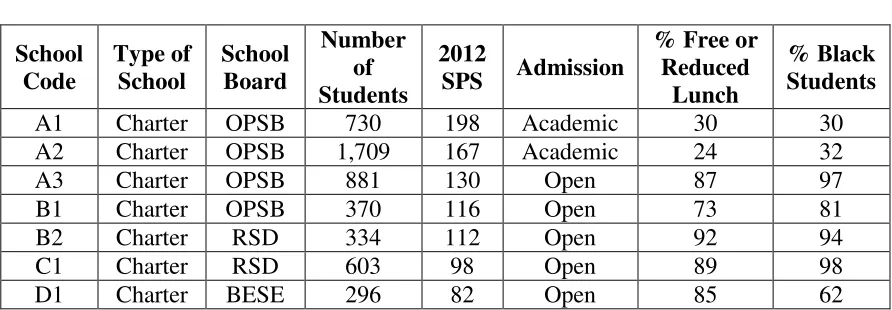
shutting down (Cowen Institute 2012). Table 1 contains information about the seven selected
schools. Table 1 Schools Sampled School Code Type of School School Board Number of Students 2012
SPS Admission
% Free or Reduced
Lunch
% Black Students
A1 Charter OPSB 730 198 Academic 30 30 A2 Charter OPSB 1,709 167 Academic 24 32 A3 Charter OPSB 881 130 Open 87 97 B1 Charter OPSB 370 116 Open 73 81 B2 Charter RSD 334 112 Open 92 94 C1 Charter RSD 603 98 Open 89 98 D1 Charter BESE 296 82 Open 85 62
I recruited participants through purposive sampling, choosing teachers at schools through
subject area, teaching experience and suggestions from professionals in the field. The nine
teachers include four math, four science and one engineering teacher, to represent a merger of
the two subject areas. Four of the teachers have tested subjects (Algebra 1 and Biology) and the
other five have non tested subjects (Physics, Chemistry, Algebra 2, and Engineering). Four of
the teachers are from schools with academic selective enrollment and five teachers are from open
enrollment schools.
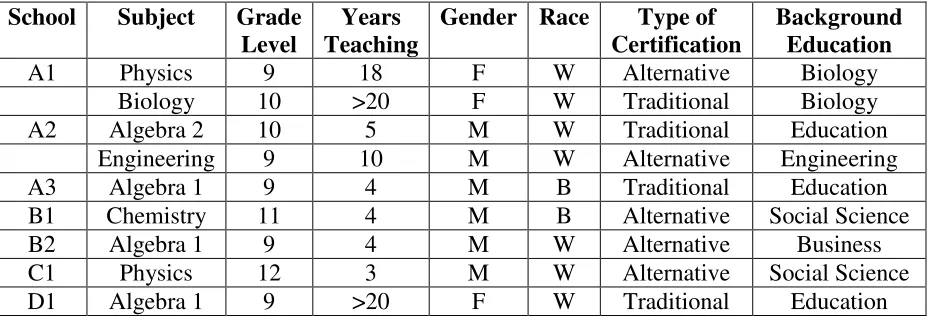
The respondents vary by gender, race, teaching experience, background education and
subject taught (see Table 2). Three respondents are female, six are male. Two are black and the
Participants include four traditional teachers, who received a teaching degree from an education
school, and five non-traditional teachers. Non-traditional teachers received certification through
alternative certification programs. Two of these teachers were trained through Teach for
America, two through University of New Orleans and one through Tulane. According to Teach
for America, 1 in 3 current students in the Greater New Orleans region have been in at least one
classroom led by a Teach for America corps member. Thus, including a few of the over 400
former and 375 current TFA corps members is essential to understanding New Orleans public
school education. Three teachers at academically selective schools did post graduate work
within the sciences and taught at the university level before deciding to teach high school.
Elementary and Secondary teachers must be certified through the state in order to teach in public
schools despite previous teaching experience in private schools or universities.
Table 2
Teacher Demographic Information
School Subject Grade Level
Years Teaching
Gender Race Type of Certification
Background Education
A1 Physics 9 18 F W Alternative Biology Biology 10 >20 F W Traditional Biology A2 Algebra 2 10 5 M W Traditional Education
Engineering 9 10 M W Alternative Engineering A3 Algebra 1 9 4 M B Traditional Education B1 Chemistry 11 4 M B Alternative Social Science B2 Algebra 1 9 4 M W Alternative Business C1 Physics 12 3 M W Alternative Social Science D1 Algebra 1 9 >20 F W Traditional Education
Role of Researcher
The motivation behind this research project stems from my own experience teaching
pounding terms and concepts into the minds of my students. The pressures of standardized
testing (at that point the Graduate Exit Exam – GEE – which tested 10th grade students in math
and 11th grade students in science) redirected the goals of my classroom. My educational
philosophy is built upon the idea that all students have the ability to learn, despite any family,
health, socioeconomic status, race or gender barriers that may stand in their way. Through my
own training in Teach for America, I learned about the power a teacher can have within the
classroom to motivate and educate students to high levels of achievement. My novice status as a
teacher makes me far from an expert but my experience at least provides a glimpse into the lives
of teachers. I am familiar with the state curriculums for high school math and science, especially
Algebra 1, Physical Science, Biology and Chemistry, and with the state required exams. My last
year teaching was the pilot year for the EOC and I am currently teaching EOC prep courses in
Biology at a local high school. Keeping in mind the failures of my classroom, I can appreciate
the successes and failures of other science and math classrooms and understand the difficulties
Analytic Strategy
The coding strategy for the observations, interviews and instructional materials is based
on Dr. Paul’s model for Critical Thinking and Teresa Amabile’s KEYS rubric. Dr. Paul’s model
for critical thinking entails concrete parts of learning for teachers to focus on during instruction.
The process of critical thinking includes addressing a problem by thinking it through using the
elements of reasoning and using standards to evaluate your own thinking. The two parts of this
model, elements of reasoning and standards for critical thinking, depict ways teachers can model,
teach and evaluate critical thinking in their classrooms. The elements of reasoning provide a
way for teachers to ask for elements of thinking within assignments and in the classroom. The
standards of critical thinking are a tool for evaluating student’s critical thinking abilities. An
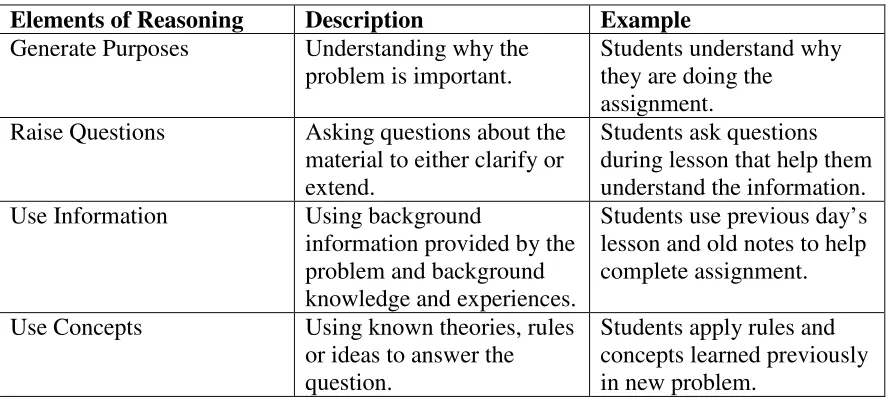
adaptation of the model with classroom examples is outlined below.
Table 3
Assessing Instruction for Critical Thinking
From Elder, Linda. 2010. “Richard W. Paul: A Biographical Sketch.” Foundation for Critical Thinking. Available: http://www.criticalthinking.org/ABOUT/Fellow_Richard_Paul.cfm
Elements of Reasoning Description Example
Generate Purposes Understanding why the problem is important.
Students understand why they are doing the
assignment. Raise Questions Asking questions about the
material to either clarify or extend.
Students ask questions during lesson that help them understand the information. Use Information Using background
information provided by the problem and background knowledge and experiences.
Students use previous day’s lesson and old notes to help complete assignment.
Use Concepts Using known theories, rules or ideas to answer the question.
Students apply rules and concepts learned previously in new problem.
Make Inferences Extending the known information to infer possible conclusions.
Students use observations and knowledge to infer possible answers to the question.
Make Assumptions Using information and inferences to justify assumptions.
Students use prior knowledge to make assumptions about the question.
Generate Implications Extending information and inferences to other areas.
Students predict outcomes using prior knowledge. Embody a Point of View Placing knowledge and
questions within a field of study or point of view.
Students approach problems as “mathematicians” or “scientists” according to their point of view.
Standards of Critical Thinking
Clear Explicitly presenting information, keeping audience and discipline in mind.
Students explain thinking explicitly to audience in clear voices.
Accurate Using information
appropriately and answering questions correctly.
Students present their answers with correct units, numbers and information. Important/Relevant The thinking relates to the
question and extends information.
Students ask questions and imply information relevant to the problem.
Sufficient Thinking process is complete and answers the question.
Students complete entire problem, keeping all parts of the problem in mind. Precise Thinker presents only
relevant material and similar thinking processes draw similar conclusions.
Students stay on task and draw conclusions similar to classmates.
Deep Thinking goes deep into problem at hand.
Students analyze all aspects of small details of the problem.
Broad Relating problem to diverse situations.
Students apply thinking to many situations and come up with solutions that apply broadly.
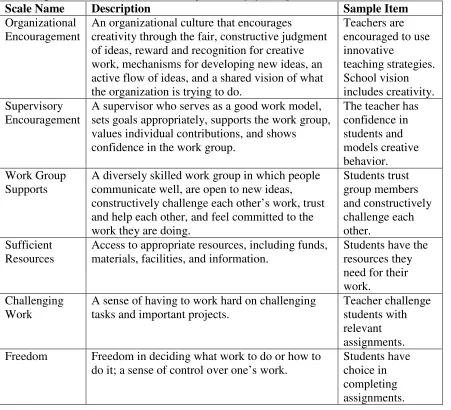
To supplement Paul’s framework for critical thinking, Amabile’s rubric outlines the