R E S E A R C H A R T I C L E
Open Access
Research impact in the community-based
health sciences: an analysis of 162 case
studies from the 2014 UK Research
Excellence Framework
Trisha Greenhalgh
*and Nick Fahy
Abstract
Background:The 2014 UK Research Excellence Framework (REF2014) generated a unique database of impact case studies, each describing a body of research and impact beyond academia. We sought to explore the nature and mechanism of impact in a sample of these.
Methods:The study design was manual content analysis of a large sample of impact case studies (producing mainly quantitative data), plus in-depth interpretive analysis of a smaller sub-sample (for qualitative detail), thereby generating both breadth and depth. For all 162 impact case studies submitted to sub-panel A2 in REF2014, we extracted data on study design(s), stated impacts and audiences, mechanisms of impact, and efforts to achieve impact. We analysed four case studies (selected as exemplars of the range of approaches to impact) in depth, including contacting the authors for their narratives of impact efforts.
Results:Most impact case studies described quantitative research (most commonly, trials) and depicted a direct, linear link between research and impact. Research was said to have influenced a guideline in 122 case studies, changed policy in 88, changed practice in 84, improved morbidity in 44 and reduced mortality in 25. Qualitative and participatory research designs were rare, and only one case study described a co-production model of impact. Eighty-two case studies described strong and ongoing linkages with policymakers, but only 38 described targeted knowledge translation activities. In 40 case studies, no active efforts to achieve impact were described. Models of good implementation practice were characterised by an ethical commitment by researchers, strong institutional support and a proactive, interdisciplinary approach to impact activities.
Conclusion:REF2014 both inspired and documented significant efforts by UK researchers to achieve impact. But in contrast with the published evidence on research impact (which depicts much as occurring indirectly through non-linear mechanisms), this sub-panel seems to have captured mainly direct and relatively short-term impacts one step removed from patient outcomes. Limited impacts on morbidity and mortality, and researchers’relatively low emphasis on the processes and interactions through which indirect impacts may occur, are concerns. These findings have implications for multi-stakeholder research collaborations such as UK National Institute for Health Research Collaborations for Leadership in Applied Health Research and Care, which are built on non-linear models of impact.
Keywords:Primary care, Public health, Research impact, Knowledge translation
* Correspondence:[email protected]
Nuffield Department of Primary Care Health Sciences, University of Oxford, New Radcliffe House, Radcliffe Observatory Quarter, Woodstock Road, Oxford OX2 6GG, UK
Background
The 2014 UK Research Excellence Framework (REF2014) was the first national exercise to measure the impact of research in the higher education sector (Box 1) [1]. It reflected a growing policy interest in demonstrating the benefits of investment in academic research and
reducing the waste that occurs when findings are not implemented [2, 3].
The literature on research impact has been summarised in several recent reviews [4–7]. Researchers often assume a direct and linear link between a study and subsequent impact, achieved through academic publications or corre-sponding lay summaries [8]. Policymakers may assume that they can commission targeted research to solve policy problems. In reality, these ‘knowledge-driven’and ‘ prob-lem-solving’ mechanisms of impact are uncommon [9]. Clinicians rarely read published research or consciously follow guidelines [10]; and policymakers ask different questions and operate to very different logics, timescales and value systems from researchers [11, 12].
That is not to say that a direct and linear link between research and impact never occurs. If a research finding is simple, unambiguous and uncontested; if it aligns with people’s values and predictions (especially those of local opinion leaders) and/or with a policy window; if its im-plementation can be trialled on a small scale before practitioners commit; if mechanisms exist (or can easily be made to exist) to provide timely reminders and feed-back on the change; if implementing the finding saves money or becomes a legal or professional requirement; and if the implementation is generously resourced and incentivised, the research finding may be taken up directly [12–14].
More commonly, impact from research occurs indir-ectly. Among clinicians, this happens via ‘mindlines’ (that is, collectively generated and socially shared tacit knowledge, developed in professional communities of practice) [10]. In the policy setting, it occurs when re-searchers and policymakers, through repeated inter-action over time, come to better understand each other’s worlds and develop goals that are compatible if not fully aligned. This process has been described variously as ‘percolation’ [15], ‘linkage’ [16] and ‘pragmatic mud-dling through’[17]. In the commercial sector, it occurs Box 1: Impact and the 2014 UK Research Excellence
Framework (REF)
In the 2014 REF, 20 % of the score (and hence funding allocation) for each higher education institution was awarded for impact [1]. Impact was defined as occurring when academic research led to
“…benefits to one or more areas of the economy, society, culture, public policy and services, health, production, environment, international development or quality of life, whether locally, regionally, nationally or internationally”(paragraph 62) and as“… manifested in a wide variety of ways including, but not limited to:
the many types of beneficiary (individuals, organisations, communities, regions and other entities); impacts on products, processes, behaviours, policies, practices; and avoidance of harm or
the waste of resources”(paragraph 63) [1].
RAND Europe advised the Higher Education Funding Council when developing the 2014 REF that the case study, written in narrative form and incorporating (where appropriate) both qualitative and quantitative data, was the format most likely to
capture the complex links between research and impact [7]. Accordingly, each submitting unit (e.g. university department) provided animpact templatedescribing infrastructure and activities
oriented to maximizing impact and (depending on size) between two and forty-six 4-pageimpact case studies—examples of research programmes (1993–2013) and their impact beyond the higher education sector (2008–2013). In total, 6,975 impact case studies were submitted.
Panel A (Medicine) oversaw six sub-panels, including sub-panel A2 for community-based disciplines (Public Health, Health Services and Primary Care). Final impact scores across the
Medicine sub-panels were high, with 95 % of 162 case studies in sub-panel A2, for example, scored as 4* (corresponding to‘world leading’) or 3* (corresponding to‘internationally excellent’) [32]. In an early calibration exercise, international assessors had given higher scores than UK assessors and encouraged a recalibration.
As the final report from the Medicine Panel observed, almost every impact case study had drawn a compelling narrative linking research at the submitting institution with changes in
policy, clinical or public health practice, service delivery, morbidity or mortality.
Impact scores from REF2014 were published in December 2014; all non-confidential case studies were placed in the public
domain in January 2015. The final report from Main Panel A commented positively on the new component of impact (“Main Panel A were extremely impressed by the quality and breadth of research impact described. We believe that the collection of
impact case studies from REF2014 provides a unique and powerful illustration of the outstanding contribution that research in the fields covered by this panel is making to health, wellbeing and society within and beyond the UK”) [32]. But the
through two-way secondments and‘value co-creation’ by the entrepreneurial university [18–20]. The principle of co-creation—the collaborative generation of knowledge in its context of application by academics working with other partners, sometimes referred to as ‘Mode 2 knowledge production’[21]—also underpins networked models of re-search such as the UK’s Collaborations for Leadership in Applied Health Research and Care (CLAHRCs), in which universities and local National Health Service organisa-tions collaborate to identify research priorities, undertake applied research and build research capacity in the service sector [22].
Contemporary health research systems are made up of multiple stakeholders with competing interests, and are characterised by (more or less) productive conflicts and bidirectional knowledge exchange. They illustrate why the unenhanced ‘logic model’of impact, comprising in-puts (research funding)→activities (research)→ out-puts (e.g. papers, guidelines)→outcomes (e.g. changed clinician behaviour, new service models)→impacts (e.g. reduced mortality), is increasingly viewed as over simplistic [4, 5, 18]. Some scholars of impact (notably Buxton and Hanney, who developed the widely used payback framework [23]) have proposed making the logic model more‘permeable’, for example by emphasising the inter-actions and feedback loops that link researchers, re-search commissioners, knowledge intermediaries and end-users throughout the research cycle.
Other scholars prefer to depict the research endeav-our and its various stakeholders as a complex (adaptive) system [22, 24, 25]. Especially when research findings are complex and ambiguous (e.g. where they illuminate the complexity of a phenomenon rather than providing a definitive answer to a simple question); where they fit poorly with prevailing policy priorities; or where their potential stakeholders are many but agreement be-tween those stakeholders is low (perhaps because of conflicts of interest), logic models lose their predictive power [8, 12, 16]. In such cases, it is particularly im-portant to study the processes and interactions by which research priorities are set, studies planned and executed, data analysed, findings made public and im-plications debated [12, 26, 27]. If we overlook these in-teractions, there is a risk that any impact assessment exercise will be reductive and naïve.
REF2014 produced a unique and important database of impact case studies, each describing a body of search and impact beyond academia (Box 1). Some re-searchers have begun to use computerised text mining techniques to generate ‘big data’ from all 6,975 impact case studies in this dataset (save for a tiny fraction of commercially or otherwise sensitive case studies that were redacted) [28]. In this study, we sought to comple-ment that work by manually reading and coding a
smaller (though still substantial) sample of case studies submitted to a single sub-panel (A2: Public Health, Health Services Research and Primary Care). Our research questions were (1) What kinds of research designs and impacts were described in these submissions?; (2) What models and mechanisms were invoked to account for the impacts?; and (3) To what extent did the format and scoring system support the assessment of direct, indirect and co-produced impact?
Methods
Our study consisted of two elements: a descriptive sur-vey of all 162 impact case studies submitted to sub-panel A2 in REF2014, and a more in-depth analysis of four of these case studies selected for maximum variety in study design, range of impacts and mechanism of im-pact; all were considered to illustrate some aspect of good practice. Queen Mary University of London Research Ethics Committee approved the study in December 2014 (QMERC1388b). Informed consent was not required be-cause all documents were in the public domain.
TG read and re-read a sub-sample of 30 impact case studies and used these inductively to develop a draft data extraction framework on a Microsoft Excel spreadsheet, informed by a systematic literature review undertaken in parallel [4]. She then went through the full set of 162 cases and extracted data on study design(s), impacts, assumed mechanism of impact (coded as direct, indirect, or co-produced or‘Mode 2’), and active efforts described by the research team to achieve impact. NF independ-ently coded a random 20 % sample of the case studies and checked TG’s interpretations; differences were re-solved by discussion.
Judgement was needed to code and categorise free-text descriptions, especially in the last category. For ex-ample, many case studies mentioned one-off coverage of the research findings by the lay press, but this alone was considered insufficient to count as proactive engagement with the media. Similarly, linkage with policymakers or front-line clinicians was counted as ‘active efforts’ if there was evidence that these links were strong and on-going, preferably pre-dating the research and continuing through the research period and beyond it. If the re-search had been commissioned (e.g. by policymakers, industry or other interest groups), this ‘pull’ was also classified as a form of linkage. The 31 impact templates (which described the infrastructure for achieving im-pact in submitting institutions) were also coded.
also evident across different categories of impact). For each of the four included case studies, we conducted an interpretive analysis considering how the research was linked to the claimed impact, taking account of the dif-ferent framings and mechanisms of impact described in the introduction. In these four case studies, we also read the papers from the underpinning research and con-tacted the authors by email and telephone for their own account of the case. Our initial sample was five such studies but the lead author of one responded (positively) only to our initial email and ignored subsequent contact, so after checking to ensure that no further themes had been identified thus far in the excluded case, we reduced our sample to four.
Results
As predicted by RAND Europe [7], the case study for-mat generally contained rich inforfor-mation, allowing us to make a reasonably confident judgement about the nature and quality of the research, the depth and quality of in-teractions, and the nature and mechanism of claimed impact. All 162 case studies are in the public domain [29]; the detailed dataset extracted from them is avail-able from the authors; our inter-rater reliability in coding was 89 %; most discrepancies were minor and stemmed from ambiguities in the coding framework.
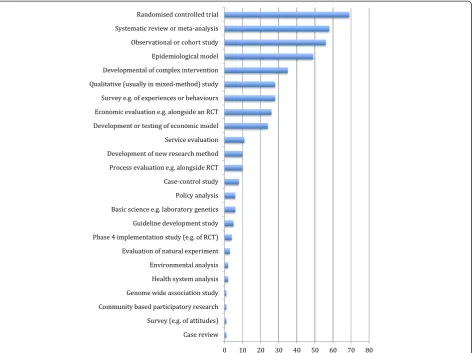
Figure 1 shows the research designs represented. Most case studies included more than one design (mean 2.7). Quantitative methods predominated, especially randomised controlled trials, systematic reviews with statistical meta-analysis, longitudinal cohort studies and modelling studies (epidemiological or economic). Twenty-eight (around one in six) described some qualitative research, but in all but two, the qualitative research was presented as preliminary (hypothesis-generating) or as a minor element of a mixed-methods study (typically, attitudes of participants in a ran-domised trial).
Most case studies identified more than one target au-dience for the research findings: policymakers in 133 (including the National Institute for Health and Clinical Excellence, which leads most national guideline develop-ment in the UK), clinicians in 88 and industry in 15. Few (8 our of 162) explicitly identified patients and/or the lay public as an audience, which was especially surprising given that every submitting institution claimed in its im-pact template that ‘patients and the public’ were a key audience for its work.
In 161 of the 162 case studies, the main mode of im-pact depicted was direct; in nine of these there was also considered to be an element of co-production and in two, the authors proposed an element of indirect (‘enlightenment’) impact. In one case study, impact was depicted as mainly co-produced with a lesser
component of direct impact. Some case studies talked in general (and sometimes unconvincing) terms about promoting public debate.
The main impacts described are shown in Fig. 2. Each case study claimed impact in (on average) three different areas. In more than two-thirds (122/162), re-search had influenced a clinical guideline and in more than half, it had had some influence on an international, national or local policy (88/162) and/or changed clinical or public health practice (84/162). Less commonly, there was evidence of a new service model (57/162), or im-provement in morbidity (e.g. disease progression, symp-tom severity; 44/162), mortality (i.e. clear evidence of improved survival; 25/162) or quality of life (5/162) at-tributable to the research. In 32 case studies, research was linked to cost saving to the health service and in three to documented profits for industry.
Active efforts described by research teams to maximise impact are summarised in Fig. 3. In 40 of the 162 case studies, researchers described no active efforts to achieve impact. This is perhaps not surprising because the offi-cial REF guidance did not specifically advise them to in-clude such descriptions. Encouragingly, in over half the case studies (82/162), and notably in those that de-scribed commissioned research for the Department of Health (England) or Chief Scientist’s Office (Scotland), there was evidence of strong and ongoing links with policymakers. It was also common for submitting re-searchers to be represented on (and perhaps be invited to chair) guideline development groups.
Much less commonly (in only 10/162 case studies) was there evidence of strong linkage with front-line cli-nicians, though again such links may have been assumed and gone undescribed. Surprisingly, only a minority of case studies (38/162) explicitly described efforts to ‘translate’ their research findings into formats access-ible to policymakers, front-line clinicians or the lay public (for example by producing leaflets or online ma-terials designed for the needs and learning styles of designated audiences), and only 22 of 162 described a specific training package developed for, and delivered to, a particular non-academic audience. There also ap-peared to be limited engagement with industry, but this may have been due to the fact that most industry-relevant studies were returned to other sub-panels.
Fig. 1Study designs used in 162 impact case studies submitted to sub-panel A2 of REF2014.RCTrandomised controlled trial
The Bell’s Palsy case study from the University of Dundee (Appendix 1) described a well-conducted clinical trial in a community setting whose findings were important, defini-tive and easy to understand. The study’s impact was direct and readily captured by existing data systems. It was aided by the high quality of the research, the commissioned mode
of research (hence, a ‘policy pull’) and extensive ex ante links with front-line general practitioners and the emerging networks for general practice research in Scotland.
The case study from the University of Bristol on sud-den infant death syndrome (Appendix 2) illustrates the rare but effective approach of developing proactive links
Table 1Four in-depth impact case studies: summary of key features
Short title Study design Main impacts Main mechanisms of impact
BELLS (Dundee) [36] Randomised controlled trial Improved cure rate Commissioned as‘high clinical priority’study by Health Technology Assessment Programme
Reduced referral to hospitals Ex ante and ongoing engagement of clinicians
Widespread involvement of clinical research networks nationally
High-impact publication in international journal
Cot death (Bristol) [37] Case–control Reduced mortality Well-established and mature programme of ‘niche’research
Ex ante and ongoing engagement of third sector charity
Skilled knowledge translation (working with knowledge translation experts) to disseminate key messages for lay audiences
Commitment of researchers to the‘moral work’ of linking the contribution of research participants (bereaved parents) and potential beneficiaries (new and prospective parents)
Social inequality (York) [38] Systematic review of observational studies
Shifting the focus of public debate
Energetic and proactive dissemination campaign run through a newly established charitable trust
Achieving political commitment to addressing the issues
Extensive lobbying of prospective and existing politicians and policymakers
Authors’input to commissions and working parties
Primary focus on outputs for a lay/civic audience with‘academic’outputs as a secondary priority
Production of cultural artefacts Researcher commitment to‘moral work’
Lay people in public health (Leeds Beckett) [39]
Co-production, systematic review, service evaluation
Lay health trainer programmes established locally
Local multi-stakeholder partnerships
Online public information resource
Co-production model
Emphasis on ensuring all voices were heard
Ex ante linkage with (and preferred provider status to) national policymakers
with a‘niche’patient charity and paying careful attention to high-quality knowledge translation for a lay audience. It also shows how researchers’personal, emotionally en-gaged, ethical commitment to reducing harm through research can provide impetus and justification for the time spent on impact activities.
Passionate commitment to ethical implications was also a feature of Wilkinson and Pickett’s study of income inequality from the University of York (Appendix 3). Strikingly—and very unusually in our sample of 162—the societal impact of this research (promoting debate, influ-encing political and policy decisions in the UK and inter-nationally) seemed to have been the authors’ primary objective, while publication in ‘high impact’ journals ap-peared secondary.
Our last case study, Developing the Evidence Base on Lay Health (Appendix 4) was selected because it was the only one in this sample of 162 that was based primarily on co-produced (Mode 2) research. Raw scores for indi-vidual impact case studies were not published, but the overall impact submission (template plus three case studies) from Leeds Beckett did not score well. The pscribed format of the impact case study (describe the re-search and then describe the impact) may have made it difficult for the authors to emphasise the strengths of this work. As the account in Appendix 4 illustrates, the authors did not depict a linear and causal link between ‘upstream’ research and ‘downstream’ impact (this was an impossibility inherent to the Mode 2 design). The au-thors’ emphasis on principles (inclusivity, inter-sectoral partnerships) and activities (relationship-building, on-going dialogue with policymakers) may have been un-favourably compared with ‘hard’ metrics of impact in other case studies that had been narrativised in logic model frameworks.
Discussion
This detailed review of the impact case studies submit-ted to a single sub-panel in REF2014 showed that the underpinning research for cases submitted to this sub-panel was overwhelmingly university-led and consisted mainly of clinical trials, meta-analyses and modelling studies. Impacts were mostly in the form of changes to guidelines and policies, and the main mechanism of im-pact was depicted as direct knowledge-into-practice, often achieved via ex ante linkage with policymakers and representation on guideline development groups. Few case studies described patient-relevant changes in morbid-ity, mortality or quality of life or documented whether the evidence-based guideline was actually being followed. Only a handful placed significant emphasis on indirect im-pact or collaborative knowledge production. There was a striking mismatch between institutions’claims to have en-gaged with‘patients and the public’(universally made in
impact templates) and the limited range and depth of ac-tivities oriented to achieving this described in the individ-ual case studies.
This study illustrates how detailed manual analysis of a small sample of case studies can complement the more automated ongoing analysis of the wider REF dataset. Text mining of the REF dataset has already produced useful quantitative data (such as frequency statistics on different countries to which impact had spread) [28]. There is, however, a trade-off between breadth and depth, given that automated analysis of a massive data-set is unable to tease out meaningful narratives or de-tailed mechanisms. Further research could fruitfully explore where and how in-depth qualitative analysis could inform and complement text mining approaches and vice versa.
The structure of the impact case study in REF2014 (a four-page document divided into ‘summary’,‘ underpin-ning research’ and ‘impact’along with space for refer-ences and corroborating sources) arguably implied a direct and linear link between a programme of re-search and its subsequent impact. Perhaps because of this, and also because of the context of REF2014 (UK higher education’s opportunity to demonstrate that it was internationally competitive and value for money), almost all impact case studies in our sample were pre-sented using a linear,‘logic model’framing.
To some extent, this framing worked in that it allowed research teams to draw out the link between particular research studies and resulting changes in clinical guide-lines, health policies (international, national or local) and, to a lesser extent, health outcomes and/or some form of cost saving. The narrative form also allowed re-search teams to express their passion for the topic, ex-plain why it mattered and convey how their research did ‘moral work’ (reducing harm and/or achieving social justice). But as others have predicted previously (see Background), the implicit logic model framing seemed to both invite and reward‘hard’, quantitative experimen-tal studies and computational models that had clear, measurable and attributable short-term impacts (most commonly, incorporation into guidelines).
sciences (such as qualitative studies, evaluations of nat-ural experiments and policy analyses) in impact sub-missions is consistent with previous claims that such work rarely produces direct and readily measurable im-pacts [8]. The format of the REF impact case study (strong emphasis on measurable impacts that could be tracked back to the study reported in the ‘research’ sec-tion) allowed direct but not indirect flows of influence to be demonstrated. This may have created a bias to-wards biomedical and epidemiological research and away from health services and policy research (in which impact is inherently less linear, more complex and multi-stakeholder, and thus harder to demonstrate).
None of the case studies in this sample framed im-pact in terms of the productive (and organic and recip-rocal) interactions among organisations and sectors described by impact scholars who have taken a ‘ com-plex systems’ perspective [8, 21, 22, 24–27]. Indeed, perhaps our most significant empirical finding is the mismatch between the sophistication of theoretical ap-proaches to assessing impact published in the specialist ‘research on research’literature (see‘Background’) and the direct and linear way in which the research-impact link was actually depicted and scored in REF2014 submissions.
Almost entirely absent from this sample of impact case studies was any acknowledgement of power differentials or conflicts of interest in the research-impact link. Few case studies describing co-produced research were sub-mitted, but as the example in Appendix 4 illustrates, even those that were submitted did not highlight clearly how power was shared during the research or the extent to which power was redistributed as a result of that re-search (so-called emancipatory benefits [30]). Again, this may have been because the REF template did not ask for such information and its linear format implicitly discour-aged discussion of such matters. Yet the emerging evi-dence from CLAHRCs suggests that issues of power and conflict loom large in co-production models of research, and that any impacts are likely to depend heavily on how these issues are handled [22, 31].
Our findings thus suggest that that the high impact scores for Medicine in REF2014, whilst commendable up to a point, are no cause for complacency. The final report from REF Main Panel A strongly upheld the use-fulness of the case study format and cautioned against reducing any future exercises to automated metrics [32]. But that conclusion does not mean that the outline structure used in REF2014 is optimal. In particular, our data suggest (though they fall short of proving) that those whose research had indirect, long-term and (therefore) more contestable impacts and those in-volved in participatory (co-production) models may have been discouraged from submitting impact case
studies in this exercise. We know of no comparable ex-ercises in other countries that could help answer the important question: might a different structure for reporting impact support the submission of a broader range of research?
On the basis of our findings, and with a view to en-suring that future research assessment exercises do not inadvertently create a perverse incentive to focus on ‘safe’impacts at the expense of wider engagement activ-ities, we suggest some changes to the design of the impact case study. First, systematic reporting of the processes and activities oriented to achieving impact should be a requirement. Indeed, in studies such as health policy research where impact is largely indirect, these processes and activities should be allocated a sub-stantial proportion of the overall score. Research teams should not be penalised for impact activities (such as building relationships with policymakers, professional bodies or citizens) that are worthwhile in the long term but unlikely to map to specific, measurable impact met-rics in the timescale of the assessment.
Second, we suggest that impact case studies from Mode 2 research collaborations such as action research partnerships (Appendix 4) or CLAHRCs should be assessed differently from more conventional study de-signs such as randomised trials. In particular, assess-ment should recognise that in such designs,‘research’ and ‘impact’ are not always separate and sequential stages but may be two dimensions of co-produced ac-tivity; and that activities oriented to effective govern-ance may be crucial to the success of this activity.
Third, given the importance shown in this study of individual researcher enthusiasm and commitment in achieving research impact, it may be worth reconsider-ing the current model of assignreconsider-ing the entire impact score to the researcher’s current institution. If re-searchers move institutions, they are likely to continue their efforts to follow through on past research under-taken elsewhere. And such work would be in the pub-lic interest—but it will not bring benefit to the new institution.
Conclusion
Appendix 1: A commissioned randomised controlled trial
‘BELLS’ was a large randomised trial conducted in general practices across Scotland, commissioned by the Department of Health via its Health Technology Assess-ment (HTA) Programme. The target condition, Bell’s Palsy, was sufficiently common that most general practi-tioners (GPs) would see a case every year or two, and there was a high level of clinical uncertainty about the best treatment. The trial was simple and easily imple-mented: each newly presenting patient received an anti-viral, a steroid, both, or neither, with placebo pills in double-blind fashion. After a pilot study in two General Practice [regional] Research Networks to confirm feasi-bility, the trial was rolled out to over half of all general practices in Scotland—immediately achieving high clinician engagement for subsequent dissemination of findings. The primary outcome (full recovery at 3 and 9 months) was meaningful to both doctors and patients.
The findings of the BELLS trial were definitive (ste-roids were better than antivirals), and viewed as very important by clinicians. The principal investigator com-mented: “[BELLS was] the only study [I have done] where I have had clinicians phoning me to ask about the results in the embargo period when they had a pa-tient in the consulting room”(Professor Frank Sullivan, personal communication, February 2015).
The trial was published in a leading US journal and won a major research prize. This paper and the (longer) HTA report were widely disseminated, actively aided by the HTA who had commissioned the study, and were used to inform national and international guidelines and decision support tools. One mechanism for this was ac-tive involvement of the trial’s authors in updating the relevant Cochrane review (the accepted international ‘gold standard’evidence summary).
Another mechanism was Scotland’s strong General Practice Research Networks, which helped raise aware-ness among Scottish GPs who had not been part of the trial. Prescribing practice changed quickly as a result. At the time, Scottish general practice had advanced elec-tronic record systems that allowed prescribing patterns for Bell’s Palsy to be tracked using automated data link-age (between the coded diagnosis ‘Bell’s Palsy’ and the coded treatment ‘prednisolone’), so a substantial fall in antiviral prescribing was readily documented.
Appendix 2: A case–control study of the causes of cot death
The University of Bristol achieved the maximum 4* score for its impact submission in UoA2. One of its case studies, on sudden infant death syndrome (SIDS), de-scribed a case–control study that had demonstrated, se-quentially over several years, the key risk factors for
SIDS—including increased risk from prone and side sleeping positions, sharing, infant covered by bed-ding, and parental smoking; and the protective effect of breastfeeding. Impacts included change in the legal requirements for investigating cot deaths, widespread changes to public health policy and practice, and a steady and significant reduction in the annual rate of SIDS (partly but not wholly attributable to this re-search, given that other research teams were also con-tributing to the evidence base, and social changes such as reduction in smoking prevalence were occurring on the same timescale).
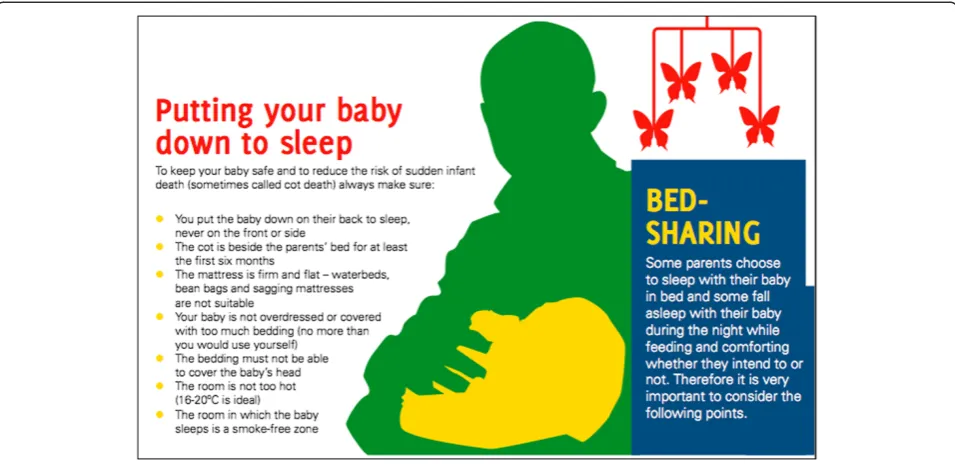
This case study described an unusually high level of activity by the research team to help maximise impact. There was, for example, extensive knowledge translation activity, working closely with UNICEF UK to produce a leaflet ‘Caring for your baby at night’which encourages breastfeeding and outlines the circumstances in which bed-sharing may be unsafe (Fig. 4). The authors also produced an evidence-based guideline for health profes-sionals to accompany the leaflet. There was active out-reach to patient charities (two of the lead investigators were elected, successively, as Vice Chair of the Inter-national Society for the Study and Prevention of Perinatal and Infant Deaths, which delivers risk reduction messages in different formats for different countries).
As in the BELLS example, the principal investigators highlighted the importance of working actively and through personal commitment to communicate (initially) the rationale for the study and (subsequently) its findings through a range of media and professional channels.
“The most important part of the mechanism was con-tinuity –we took our own research and pushed its im-plementation at every stage –we did not leave any part of the implementation to others –having collected and analysed the data, we were in the best position to drive implementation and really understood what could be achieved–probably much more than those who had not been involved in the original studies.” (Professor Peter Fleming, personal communication, February 2015).
Professor Fleming also stressed the ethical duty that he and his team felt to disseminate the findings of the study, which had involved sensitive research on parents who had lost a child to cot death. “Information freely provided by families – many of whom were very de-prived – has been used to help other families and pre-vent babies from dying. I feel that our role was to be a conduit ensuring the information was interpreted and used appropriately”.
Appendix 3: Evidence synthesis on the link between income inequality and ill health
which synthesised evidence from primary studies that the higher the level of income across a wide range of in-dicators (“life expectancy, infant mortality, mental health, levels of violence, teenage birth rates, drug abuse, child wellbeing, obesity rates, levels of trust, the educa-tional performance of school children, imprisonment and social mobility”), the worse the society’s physical, mental and social health.
The research demonstrated that the link between in-equality and poor health and social outcomes was largely psychosocial and attributable mainly to three factors: low social status, weak social support, and poor quality of early childhood experience.
The Spirit Level sold hundreds of thousands of copies worldwide. One of the main impacts (unusually for case studies in our sample) was a significant shift in the focus of public debate. In the light of consistent evidence from multiple studies in numerous contrasting settings, it was much harder to dismiss concerns about the widening gap between rich and poor as‘the politics of envy’. The conclusion (politically sensitive but strongly supported by the data) was that improvements in social environ-ment, social relations and material environment are likely to improve the psychosocial wellbeing and social functioning of whole societies.
Dissemination strategies were bold and proactive. The authors obtained funding from the Joseph Rowntree Charitable Trust to establish an independent charitable trust whose sole remit was to spread key messages and lobby for change. The Equality Trust [33] produces
‘research digests’and social media feeds, and coordinates and supports local pressure groups.
Between 2009 and 2013, the authors gave over 600 lec-tures, workshops and seminars, mostly to lay audiences but also to“government ministries and agencies, the UK Cabinet Office, health authorities, political party confer-ences, universities, trade unions, faith groups, NGOs, think tanks and charities”. They approached parliamen-tary candidates in the 2010 UK general election and asked them to “actively support the case for policies de-signed to narrow the gap between rich and poor”; soon after, 75 signatories (in all main parties) were elected to parliament. The Prime Minister personally endorsed the work and cited the book in speeches. The authors were invited onto working groups that established Fairness Commissions (in various localities) and the national Independent Living Wage Commission.
Dissemination materials for young people were im-aginative and diverse. They included a‘Theatre in Edu-cation’learning module, a novel (Kuan’s Wonderland) and linked study guide, a statistics learning module, a game for learning about economics and inequality, plus collections of videos and other cultural artefacts (see [34]).
One of the authors commented, “I’m … proud of the fact that we managed to create a readable account for people with no expertise or confidence in statistics or reading charts, and that they were empowered to get to grips with important ideas and debates” (Prof Pickett, personal communication, May 2015). Yet the original funding sources were very conventional: an NIHR Career
Scientist award and an ESRC grant to produce educational materials for schools.
Appendix 4: Co-production of research on lay involvement in public health
Researchers from Leeds Beckett University described a co-production (action research) approach to developing lay roles in public health.
The research section of their impact case study lists a number of activities and outputs:
Three local community-based service development
projects (‘health trainers’,‘community apprentices’
and‘social prescribing’)
Three NIHR-funded national‘public hearings’of the
views of lay health workers, in which the research team played a supportive and evaluative role and also produced an academic paper
An NIHR-funded literature review,‘People in
Public Health’, of lay roles in public health
(though surprisingly, the main publication from this was not referenced in the case study)
A series of evidence reviews and thematic evaluations
on a new community health champion model
A study commissioned by the Department of Health
to produce and disseminate“research-based
information to support better engagement with citizens to co-produce better health and well-being
outcomes”.
The impact component of the case study describes the following activities and outputs:
“Extensive public engagement and the production of
outputs for practitioners and policy makers”
An online searchable database about public
involvement in public health with the results of 224 peer-reviewed publications
Various endorsements, lay versions and policy
briefings of the‘People in Public Health’review
Contribution of the research team to various inquiries
and consultations on lay health workers—for
example to national reviews of obesity and exercise strategies and the Department
of Health’s Third Sector Partnership Team.
Implicit in this case study, and more explicitly in a further paper published after it was submitted, is a col-laborative programme of work characterised by the goals and standards of participatory research—such as power sharing, partnership synergy and trust. Also evident from the authors’post-REF publications [35] is a distinct sense of non-linearity, with the different‘academic’and‘ en-gagement’components of the study feeding bi-directionally
into one another (e.g. when‘lay’informants supplied mater-ial that added to a systematic review) and the programme evolving in ways that were not initially anticipated (e.g. fur-ther NIHR funding to undertake a systematic review of peer-based interventions in prison settings).
Competing interests
In REF2014, TG was Deputy Chair of Main Panel A, for which she received an honorarium for days worked (in common with all others on REF panels). She was appointed to this panel in 2012 partly on the strength of her research record in knowledge translation. She worked across all six sub-panels to help ensure consistency of scoring, and participated in several calibration exercises and some of the sub-panel scoring exercises. She contributed to the writing of the final report from REF Main Panel A. TG was also involved in preparing the impact case studies for the Queen Mary University of London submission to REF2014. NF declares that he has no competing interests.
Authors’contributions
TG conceptualised the study, undertook the initial analysis and wrote the first draft of the paper. NF checked the coding of case studies and helped revise the paper. Both authors have seen and approved the final manuscript.
Acknowledgements
We are grateful to the authors of the four impact case studies reviewed in depth for participating in correspondence about them and to Richard Hobbs for helpful feedback on an earlier draft of this paper. The study received no formal financial support but NF’s time was supported by an NIHR Senior Investigator Award to TG.
This study formed a section of a dissertation entitled‘Research Impact in the Community Based Health Sciences: What Would Good Look Like?’for TG’s MBA in Higher Education Management at UCL Institute for Education, supervised by Professor Sir Peter Scott and part-funded by TG’s NIHR Senior Investigator Award.
Data sharing
The impact case studies that form the dataset for this study are already in the public domain.
Transparency declaration
The manuscript is an honest, accurate, and transparent account of the study being reported; no important aspects of the study have been omitted; any discrepancies from the study as planned have been explained.
Received: 6 August 2015 Accepted: 28 August 2015
References
1. Higher Education Funding Council for England. 2014 REF: Assessment framework and guidance on submissions. Panel A criteria. London (REF 01/2012): HEFCE; 2012.
2. Walshe K, Davies HT. Health research, development and innovation in England from 1988 to 2013: from research production to knowledge mobilization. J Health Serv Res Policy. 2013;18:1–12.
3. Glasziou P, Altman DG, Bossuyt P, Boutron I, Clarke M, Julious S, et al. Reducing waste from incomplete or unusable reports of biomedical research. The Lancet. 2014;383:267–76.
4. Raftery J, Hanney S, Greenhalgh T, Glover M, Young A. A systematic review of impact measures in health technology assessment. Under Review for Health Technology Assessment. 2015.
5. Penfield T, Baker MJ, Scoble R, Wykes MC. Assessment, evaluations, and definitions of research impact: a review. Research Evaluation. 2013. rvt021. doi: 10.1093/reseval/rvt021.
6. Milat AJ, Bauman AE, Redman S. A narrative review of research impact assessment models and methods. Health Res Policy Syst. 2015;13:18. 7. Grant J, Brutscher P-B, Kirk SE, Butler L, Wooding S. Capturing research
8. Meagher L, Lyall C, Nutley S. Flows of knowledge, expertise and influence: a method for assessing policy and practice impacts from social science research. Res Eval. 2008;17:163–73.
9. Weiss CH. The many meanings of research utilization. Public Adm Rev. 1979;426–431.
10. Gabbay J, May A. Evidence based guidelines or collectively constructed
“mindlines?”Ethnographic study of knowledge management in primary care. BMJ. 2004;329:1013.
11. Davies H, Nutley S, Walter I. Why‘knowledge transfer’is misconceived for applied social research. J Health Serv Res Policy. 2008;13:188–90.
12. Contandriopoulos D, Lemire M, Denis J-L, Tremblay É. Knowledge exchange processes in organizations and policy arenas: a narrative systematic review of the literature. Milbank Quarterly. 2010;88:444–83.
13. Grol R, Grimshaw J. From best evidence to best practice: effective implementation of change in patients’care. The Lancet. 2003;362:1225–30. 14. Greenhalgh T, Robert G, Macfarlane F, Bate P, Kyriakidou O. Diffusion of
innovations in service organizations: systematic review and recommendations. Milbank Quarterly. 2004;82:581–629.
15. Hanney SR, Gonzalez-Block MA, Buxton MJ, Kogan M. The utilisation of health research in policy-making: concepts, examples and methods of assessment. Health Res Policy Syst. 2003;1:2.
16. Lomas J. The in-between world of knowledge brokering. BMJ. 2007;334:129–32.
17. Lindblom CE. The science of“muddling through”. Public Adm Rev. 1959;79–88. 18. Hughes A, Martin B. Enhancing impact: the value of public sector R&D. CIHE & UKirc, 2012. http://www.ncub.co.uk/impact. Accessed 16 September 2015. 19. Thorp H, Goldstein B. Engines of innovation: the entrepreneurial university
in the twenty-first century. Chapel Hill. Chapel Hill, North Carolina: University of North Carolina Press Books; 2013.
20. Ramaswamy V, Gouillart F. Building the co-creative enterprise. Harv Bus Rev. 2010;88:100–9.
21. Gibbons M, Limoges C, Nowotny H, Schwartzman S, Scott P, Trow M. The new production of knowledge: the dynamics of science and research in contemporary societies. London: Sage; 1994.
22. Kislov R, Waterman H, Harvey G, Boaden R. Rethinking capacity building for knowledge mobilisation: developing multilevel capabilities in healthcare organisations. Implement Sci. 2014;9:166.
23. Buxton M, Hanney S. How can payback from health services research be assessed? J Health Serv Res Policy. 1996;1:35–43.
24. Kok MO, Schuit AJ. Contribution mapping: a method for mapping the contribution of research to enhance its impact. Health Res Policy Syst. 2012;10:21.
25. Long JC, Cunningham FC, Braithwaite J. Bridges, brokers and boundary spanners in collaborative networks: a systematic review. BMC Health Serv Res. 2013;13:158.
26. Upton S, Vallance P, Goddard J. From outcomes to process: evidence for a new approach to research impact assessment. Res Eval. 2014;23:352–65. 27. Spaapen J, van Drooge L. Introducing‘productive interactions’in social
impact assessment. Res Eval. 2011;20:211–8.
28. Hinrichs S, Grant J. A new resource for identifying and assessing the impacts of research. BMC Med. 2015;13:148.
29. REF 2014 Results and Submissions. http://results.ref.ac.uk. Accessed 16 September 2015.
30. Jagosh J, Macaulay AC, Pluye P, Salsberg J, Bush PL, Henderson J, et al. Uncovering the benefits of participatory research: implications of a realist review for health research and practice. Milbank Quarterly. 2012;90:311–46. 31. Fitzgerald L, Harvey G. Translational networks in healthcare? Evidence on
the design and initiation of organizational networks for knowledge mobilization. Soc Sci Med. 2015;138:192–200.
32. Higher Education Funding Council. Research Excellence Framework 2014: overview report by Main Panel A and sub-panels 1 to 6. London: HEFCE; 2015. Panel A overview report.pdf. http://www.ref.ac.uk/panels/ paneloverviewreports/. Accessed 16 September 2015.
33. The Equality Trust. https://www.equalitytrust.org.uk. Accessed 16 September 2015. 34. The Equality Trust: Education. https://www.equalitytrustr.org.uk/education.
Accessed 16 September 2015.
35. South J, Cattan M. Developing evidence for public health policy and practice: the implementation of a knowledge translation approach in a staged, multi-methods study in England, 2007–09. Evidence & Policy: A Journal of Research, Debate and Practice. 2014;10:379–96.
36. Changing clinical practice in Bell’s Palsy: the impact of a clinical trial highlighting the impact of evidence for primary care. http://results.ref.ac.uk/ DownloadFile/ImpactCaseStudy/pdf?caseStudyId=39367. Accessed 16 September 2015.
37. Bristol research leads to a worldwide fall in the number of cot deaths. http://results.ref.ac.uk/DownloadFile/ImpactCaseStudy/
pdf?caseStudyId=40166. Accessed 16 September 2015.
38. The Impact of Social Inequality: changing the public and policy debate. http://results.ref.ac.uk/DownloadFile/ImpactCaseStudy/
pdf?caseStudyId=43415. Accessed 16 September 2015. 39. Developing evidence based practice on lay health roles. http://
results.ref.ac.uk/DownloadFile/ImpactCaseStudy/pdf?caseStudyId=13837. Accessed 16 September 2015.
Submit your next manuscript to BioMed Central and take full advantage of:
• Convenient online submission
• Thorough peer review
• No space constraints or color figure charges
• Immediate publication on acceptance
• Inclusion in PubMed, CAS, Scopus and Google Scholar
• Research which is freely available for redistribution