The Construction of Platform Imperialism in the
Globaliza-tion Era
Dal Yong Jin
Simon Fraser University, Vancouver, Canada, [email protected]
Abstract: In the early 21st century, platforms, known as digital media intermediaries, have greatly influenced people’s daily lives. Due to the importance of platforms for the digital economy and culture, including intellectual property and participatory culture, several countries have developed their own social network sites and Web portals. Nonetheless, a handful of Western countries, primarily the U.S., have dominated the global platform market and society. This paper aims to historicize the concept of imperialism in the globalized 21st century. It investigates whether the recent growth of American-based platforms has resulted in a change to the fundamental idea of the imperialism thesis by analyzing the evolutionary nature of imperialism towards platform imperialism. It then addresses whether we are experiencing a new notion of imperialism by mapping out several core characteristics that define plat-form imperialism, including the swift growth and global dominance of SNSs and smartphones. It pays close attention to the capitalization of platforms and their global expansion, including the major role of intellectual property rights as the most significant form of capital accumulation in the digital age. It eventually endeavors to make a contribution to the platform imperialism discourse as a form of new imperialism, focusing on the nexus of great powers.
Keywords: Platform, Globalization, Imperialism, Nation-State, Social Network Sites, Intellectual Property, Face-book, Google, Smartphones
Acknowledgement: This research was supported by the Social Sciences and Humanities Research Council, Canada.
1.
Introduction
In the early 21st century, notions of imperialism have gained significance with the rapid growth of platform technologies. Platforms, such as social network sites (SNSs, e.g., Face-book), search engines (e.g., Google), smartphones (e.g., iPhone), and operating systems (e.g., Android) are known as digital intermediaries, which have greatly influenced people’s daily lives. The digital platform has emerged “as an increasingly familiar term in the descrip-tion of the online services of content intermediaries, both in their self-characterizadescrip-tions and in the broader public discourse of users, the press and commentaries” (Gillespie, 2010, 349). Due to the importance of platforms – not only as hardware architecture but also as software frameworks that allow software to run – for the digital economy and culture, including intellec-tual property and participatory culture, several countries have developed their own SNSs and smartphones; however, only a handful of Western countries, primarily the U.S., have domi-nated the global platform market and society.
The hegemonic power of American-based platforms is crucial because Google, Facebook, iPhone, and Android have functioned as major digital media intermediaries thanks to their advanced roles in aggregating several services. The U.S, which had previously controlled non-Western countries with its military power, capital, and later cultural products, now seems to dominate the world with platforms, benefitting from these platforms, mainly in terms of cap-ital accumulation. This new trend raises the question whether the U.S., which has always utilized its imperial power, not only with capital and technology, but also with culture, to con-trol the majority of the world, actualizes the same dominance with platforms.
cul-tural imperialism, 3) information imperialism, and finally 4) platform imperialism. It then ad-dresses whether or not we are experiencing a new notion of imperialism by mapping out several core characteristics that define platform imperialism, including the swift growth and global dominance of SNSs and smartphones. It especially examines the capitalization of plat-forms and their global expansion, including the major role of intellectual property rights as the most significant form of capital accumulation in the digital age. It eventually endeavors to make a contribution to the discourse of platform imperialism as a new form of imperialism, focusing on the nexus of great powers encompassing nation-states and transnational corpo-rations (TNCs), such as Google and Apple. The paper finally discusses whether platform imperialism is useful for explaining the current power relations between the U.S. and non-Western countries.
2.
The Evolution of Imperialism in the 20
thand the 21
stCenturies
While the notion of imperialism goes back to early history, modern notions of imperialism go back a century and have become influential theoretical frameworks, although they have re-mained controversial in media studies. The contemporary concept of imperialism is much different from the discourse developed in the early 20th century when it had been primarily advanced by classical, Marxist-inspired theories of imperialism (e.g., Kautsky, Lenin, and Luxemburg). From a Marxist perspective, imperialism is what happens when two forms of competition – the economic struggle among capitals and geopolitical rivalries between states – fuse (Callinicos 2007, 70). One of the central arguments of the Marxist tradition of thinking on imperialism is that there is an intrinsic relation between capitalism and expansion, and that capitalist expansion inevitably takes the political form of imperialism (Marx 1867). Building on and modifying the theories of Karl Marx, there are several renditions of impe-rialism in the critical theory tradition, and Lenin’s pamphlet, Imperialism, the Highest State of Capitalism (1917) provides an excellent place to start discussing imperialism, because the Leninist theory of imperialism has exerted a considerable impact on the current era. What Lenin emphasized almost one hundred years ago cannot be applied directly to the contem-porary era due to vastly different social and economic conditions, as well as a different tech-nological milieu. However, it is certainly worth trying to see whether Lenin’s concepts can be applied to the 21st century situation.
Later, he gave a more elaborate five-point definition of capitalist imperialism, which em-phasizes finance-capital – the dominant form of capital. The criteria are; 1) the concentration of production and capital developed to such a stage that it creates monopolies which play a decisive role in economic life; 2) the merging of bank capital with industrial capital, and the creation, on the basis of finance capital of a financial oligarchy; 3) the export of capital, which has become extremely important, as distinguished from the export of commodities; 4) the formation of international capitalist monopolies which share the world among themselves; and 5) the territorial division of the whole world among the greatest capitalist powers (Lenin 1917, 237). Based on these five characteristics, Lenin defined imperialism as:
“capitalism at that stage of development at which the domination of monopolies and fi-nance capital is established: in which the export of capital has acquired pronounced im-portance; in which the division of the world among the international trusts has begun; in which the division of all the territories of the globe among the biggest capitalist powers has been completed (Lenin,1917, 237).
As Lenin’s five-point definition of imperialism explains, finance capital uses the state machin-ery to colonize the periphmachin-ery. In the periphmachin-ery, capitalists would use oppressed peripheral labor to produce primary commodities and raw materials cheaply and create an affluent stra-tum (peripheral elite) to consume expensive commodities imported from the core, and un-dermine indigenous industry (Galtung 1971). For Lenin, imperialism is the power struggle for the economic and political division of the world, which gives rise of a transitional dependence between rentier states and debtor states:
“the epoch of the latest stage of capitalism shows us that certain relations between capi-talist associations grow up, based on the economic division of the world; while parallel to and in connection with it, certain relations grow up between political alliances, between states, on the basis of the territorial division of the world, of the struggle for colonies, of the struggle for spheres of influence” (Lenin 1917, 239).
Indeed, Lenin himself implicitly discussed the role of the nation-state; and his notion of state was part of strong power, which included also transnational capitals, and his argument for a strong state was a Commune worker state. The Commune was an armed and organized revolutionary section of the Parisian working class, but it was not a state (Lenin 1964; Rothenberg 1995). What Lenin described was that both economic rivalry and military con-flicts are indicative as concon-flicts for hegemony between great powers that constitute essential features for imperialism. In his statement, great powers are not necessarily nation-states, because great powers are powerful actors, meaning that they can also be corporations as well as nation-states (Fuchs 2011a, 198). Though, in Lenin’s conceptualization imperialism is essentially associated with a system of relations and contradictions between nation states (Liodakis 2003, 4).
One way to do so is to take Lenin as a theoretical impetus for the contemporary theorization of platform imperialism.
3.
Cultural Imperialism from Lenin’s Fourth Characteristic
Since the notion of modern imperialism has been primarily advanced by Marxist theorists beginning in the early 20th century, media scholars have developed imperialism theory in the contexts of several different areas, including culture and technology. Media theoreticians have especially developed Lenin’s fourth point of imperialism, primarily focusing on the major role of big companies that dominate the economy. As Lenin (1917) argued, these big corpo-rations, cartels, syndicates, and trusts first divided the home market among themselves and obtained more or less complete possession of the industry in their own country. “But under capitalism the home market is inevitably bound up with the foreign market. As the export of capital increased, and as the foreign and colonial connections and spheres of influence of the big monopolist associations expanded in all ways, things naturally gravitated towards an international agreement among these associations, and towards the formation of internation-al cartels” (Lenin 1917, 266). Information industries and services, including both audiovisuinternation-al and information and communication technologies (ICTs) industries, are no exception from this inequal economic geography (Fuchs 2010a). Therefore, one can say that theories of communication imperialism and cultural domination have described Lenin’s fourth character-istic of imperialism in relation to media and culture: the domination of the information sphere by large Western corporations (Fuchs 2010a; Said 1993; Galtung 1971; Schiller 1969). Such concepts focused on the ownership and control, structure and distribution of media content (and the media industries) in one country by another country (Fuchs 2010a; Boyd-Barrett 1977) or primarily by the U.S. (Schiller 1976). This updated version is suited for theoretically describing Lenin’s dimension of corporate economic domination in the attempt to apply impe-rialism theory to informational capitalism. Indeed, as Boyd-Barrett (1998 158) indicates, “the concept of media imperialism is indebted to the works of Marx, Lenin and Luxemburg.”
More specifically, several theorists claimed the cultural industry became an integral part of the advanced capitalist system in the 1930s. As Adorno (1991) points out, the culture indus-try has long played an architectonic role in the transformation of human and natural potential into the modern barbarism of late capitalism. “The extension of capitalist social relations and their identitarian logic to the production, distribution, and consumption of cultural goods not only destroys the emancipatory possibilities traditionally harbored by art and culture, thus sabotaging human capacities for experience and critical though, but also blinds individuals somatically, cognitively, and libidinally to the exchange relations itself” (Gunster 2004, 23). Similar to many sectors, such as finance and manufacturing, the culture industry has been dominated by a few Western countries, the U.S., in particular, since the early 20th century; therefore, several media scholars have focused on the nature and degree of dominance. The debate over imperialism in media studies further intensified beginning in the mid-1970s when associated with the call by nations of the Third World for a New World Infor-mation and Communication Order (NWICO). In the decade following the end of World War II, many former colonies in Latin America, Africa, and Asia became independent. These coun-tries formed the Non-Aligned Movement (NAM) in 1955 (Herman and McChesney, 1997). They initially pursued predominantly economic approaches to promote their own develop-ment; however, these nations questioned Western paradigms of development and sought alternative approaches. On the heels of this was the call for a NWICO to address imbalances in the political economy of the media and information systems (Mosco 2009). The NWICO campaign was part of a broader struggle at that time by Third World nations to formally ad-dress the global economic inequality that was seen as a legacy of imperialism.
existing economic and technological gaps between countries” (UNESCO, 1980, 111–115). Schiller (1976) identified the dominance of the U.S. and a few European nations in the global flow of media products as an integral component of Western imperialism, and dubbed it cul-tural imperialism in the following way:
“the concept of cultural imperialism describes the sum of processes by which a society is brought into the modern world system and how its dominating stratum is attracted, pres-sured, forced, and sometimes bribed into shaping social institutions to correspond to, or even promote, the values and structures of the dominant center of the system (1976, 9-10).
Building on Schiller’s work, Tunstall and Guback extended the meaning of dominance in in-ternational cultural exchange. Tunstall (1977, 57) pointed out, “cultural imperialism theory has claimed that authentic, traditional and local culture in many parts of the world is being overwhelmed by the indiscriminate dumping of large quantities of slick commercial media products, mainly from the U.S.” Guback (1984, 155-156) also argued, “the powerful U.S. communication industry, including film and television as well as news, exerts influence, sometime quite considerable, over the cultural life of other nations.” Over the decades, sev-eral empirical studies seemed to confirm this early cultural imperialism thesis by showing the one-way flow of goods from Western to non-Western countries. These scholars defined cul-tural imperialism as the conscious and organized effort taken by the Western, especially U.S. media corporations to maintain commercial, political, and military superiority. Those Western multinational corporations exerted power through a vast extension of cultural control and domination, and thus saturated the cultural space of most countries in the world, which was claimed to have eliminated and destroyed local cultures by installing a new dominant culture in their place (Jin 2007).
What is also important in the cultural imperialism thesis is the major role taken by the U.S. government. As discussed, media scholars have developed cultural imperialism primarily based on Lenin’s fourth characteristic of imperialism, which emphasized the primary role of big corporations, in this case, major U.S. media and cultural companies; however, the push by the large cultural, media and information industries corporations into markets and socie-ties around the world was also propelled by strong support from the U.S. government. The U.S. government’s initiative and support for its culture industry has a long history, and this strategy has emphasized the importance of information-based products, making the U.S. State Department a powerful government agent on behalf of the cultural sector (Miller et al. 2001). Given that much of the enormous revenues generated by the U.S. cultural industry have come from foreign markets, “the liberalization of the global cultural market is very signif-icant for the U.S. government” (Magder 2004, 385).
Fu Panda 2,and Pirates of the Caribbean: On Stranger Tides) came in at No 1, 2 and 3 on the Top Ten charts in China, grossing $345 million. With another three American films, the total reached $490 million, against four domestic productions, which took $261 million (Jen-sen, 2012) indicating that China is gradually replacing Japan to become Hollywood’s number one overseas box office revenue contributor.
Overall, U.S. film and television program exports in current dollar terms were valued at slightly over $1 billion in 1985 and $2 billion in 1990. However, the U.S. exported about $9.17 billion worth of film and television programs to the world in 2001, and the exports soared to $14.2 billion in 2011. Europe was the largest audiovisual market for the U.S. In the early 21st century, though, the U.S. has increased its exports to non-Western European countries. When the U.S. exported $4.98 billion worth of television programs and films to the world in 1996, Western European countries comprised the largest markets at 60.8%, and it was almost the same in 2003 (61.9%); however, it substantially dropped to 50.5% in 2011 (U.S. Department of Commerce, 2012; 2006; 2000). This means that countries outside Western Europe will in a few years become the major markets for the U.S. cultural industries. In fact, the Asian audiovisual market gradually increased from 12.8% in 1992 to 17.1% in 2001, and again to 18.1% of the total U.S. exports in 2011 with the increasing number of broadcasting channels and movie screens in the region (U.S. Department of Commerce 2012, 2002, 2000).
The restructuring of the global film sector was conducted through the use of larger power relations and patterns after World War II, with initial moves beginning prior to WWII. Since World War II, U.S. policy has generally supported the liberalization of international trade— that is, the elimination of artificial barriers to trade and other distortions, such as tariffs, quo-tas, and subsidies that countries use to protect their domestic industries from foreign compe-tition (Congressional Budget Office 2003). The U.S. government sought and eventually se-cured the liberalization of the audiovisual sector in the first General Agreement on Tariffs and Trade (GATT) negotiations in 1947. As Western countries began to settle on the arrange-ments that would govern the post-war world, cinema was high on the list of outstanding is-sues, and Hollywood wanted to restore its overseas markets (Magder 2004). The U.S. gov-ernment alongside major film/TV corporations has intensified its dominance in the global cul-tural market, and culcul-tural imperialism has been one of the primary practices of Lenin’s impe-rialism in different contexts in the 20th century, of course, until recent years.
The new media sector is not much different. Facebook has rapidly increased its revenue from advertising in foreign countries, including several emerging markets,due to the soaring number of users in those markets (more than 1 billion in the world as of October 2010), as will be detailed later. Western-based game corporations have also enjoyed profits from the
global markets. By May 2007, for example, Blizzard Entertainment had sold about 9.5 million copies of the original StarCraft globally, with about 4.5 million of those copies sold in Korea (Olisen 2007). Less than two years after its introduction in 2004, World of Warcraft, the online fantasy game, generated more than $1 billion in revenue in 2006 with almost seven million paying subscribers. The game had more players in China, where it had engaged in co-promotions with major brands like Coca-Cola, than in the U.S. (Schiesel 2006, B1). These new media corporations alongside cultural industries corporations have benefited from global capitalism paved by the nexus of the U.S. government and mega media TNCs.
4.
The Nexus of Globalization and Information Imperialism
that national cultures can defend their ways of life and, in some respects, even share their images with the rest of the world. Tracy (1988) states that traditionally culture weak Third World producers have now strengthened their national cultural industries to compete against dominant U.S. and European cultural power. Sparks (2007, 119) also points out, “in the place of a single, U.S.-based production center dominating the whole of the world trade in televi-sion programs, it was increasingly argued that technical and economic changes were render-ing the world a more complex place, in which there were multiple centers of production and exchanges flowing through many different channels”. Morley (2006) argues that cultural im-perialism has four significant issues and limitations, including 1) the complexities of flows in international communication; 2) the recent strategy of glocalization, 3) the effects of cultural protectionism, and 4) the impact of active audiences on media. What he emphasizes, how-ever, is that the international communication and media flows became more complex than in the past, and resulted in a new model of the cultural imperialism. Morley (2006, 36-40) con-sequently claims that the U.S. is still the most powerful media provider in the complex socie-ty.
Several other scholars also convincingly stress the discontinuity between globalization in the 21st century and times past (Negri 2008, Robinson 2007, Hardt and Negri 2000). Hardt and Negri (2000) point out that imperialism, which was an extension of the sovereignty of the European nation-states beyond their own boundaries, is over, because no nation could ever be a world leader in the way modern European nations were in the midst of 19th and early-20th centuries versions of globalization. Hardt and Negri develop the term empire instead of imperialism to describe the contemporary form of the global order and argue that empire is a system of global capitalist rule that is altogether different from imperialism:
“in contrast to imperialism, empire establishes no territorial center of power and does not rely on fixed boundaries or barriers. It is a decentered and deterritorializing apparatus of rule that progressively incorporates the entire global realm within its open, expanding fron-tiers (Hardt and Negri 2000, xii-xiv)
Robinson (2007, 7-8) also argues, “capitalism has fundamentally changed since the days of Lenin due to the appearance of a new transnational capitalist class, a class group grounded in new global markets and circuits of accumulation, rather than national markets and cir-cuits.” For Robinson (2004, 5), “global capitalism is a phase of capitalist development that is characterized by a transition from the nation state phase of world capitalism to a transnation-al phase.” Transnationtransnation-al capittransnation-al has become the dominant, or hegemonic, fraction of capittransnation-al on a world scale (Robinson 2004, 21). Robinson therefore claims, “the imperialist era of world capitalism has ended” (2007, 24). He believes that TNCs are much different from na-tional corporations because TNCs have been free from nation-states.
Meanwhile, others argue that contemporary capitalism is just as imperialistic as imperial-ism was 100 years ago or that it has formed a new kind of imperialimperial-ism (Fuchs 2010a; Harvey 2007; Wood 2003). As Ellen Wood (2003, 129) points out,
“the new imperialism that would eventually emerge from the wreckage of the old would no longer be a relationship between imperial masters and colonial subjects but a complex in-teraction between more or less sovereign states. While the U.S. took command of a new imperialism governed by economic imperative, however, this economic empire would be sustained by political and military hegemony”.
The stress is, therefore, on continuity rather than fundamental change (Harvey 2003, 2007; Wood 2003). Harvey (2003, 26f) emphasizes “capitalist imperialism, which focuses on the flow of economic power across and through continuous space through the daily practices of trade, commerce, capital flows, labor migration, technology transfer, flows of information, cultural impulses and the like”. Unlike the emphasis on the coercive power of nation-states that Hardt and Negri focus on, “the harmonization of capitalist space relies on the soft power of consent and the emulation of models of development” (Winseck and Pike 2007, 8). Alt-hough contemporary aspects of imperialism cannot be considered in the same way as set out in Lenin’s understanding of imperialism, contemporary critical scholars believe that “the notion of imperialism still functions as a meaningful theoretical framework to interpret the world which was globalized neo-liberally” (Fuchs 2010a, 34).
As for the role of TNCs, in particular, it is crucial to understand that Herbert Schiller re-vised his text in his article published in 1991. As discussed, in Schiller’s vision (1976), the global cultural market was a world of primarily one-way cultural flow where America (primarily as a nation) dominated international trade in film and television. In his later paper (Schiller 1991, 15), though, he made a slightly different argument with an emphasis on the role of transnational corporations;
“the domination that exists today, though still bearing a marked American imprint, is better understood as transnational corporate cultural domination. Philips of the Netherlands, Daimler-Benz of Germany, Samsung of Korea, and Sony of Japan, along with some few thousand other companies, are the major players in the international market”.
Of course, this does not mean that American cultural domination disappears. “It is not guar-anteed in perpetuity. Yet irrefutably that domination has been preeminent for the last four decades and remains so to this date, though subsumed increasingly under transnational cor-porate capital and control” (Schiller 1991, 15). He emphasizes the increasing role of TNCs; however, this does not imply the demise of the nation-state. From Hollywood majors to ad-vertising corporations and to motor vehicle companies, corporations have been transnational for several decades and have developed a very close relationship with nation-states.
Tele-graph Company, Commercial Cable Company, Anglo American TeleTele-graph Company or Mar-coni) in the years 1860–1930 that at the time of Lenin there was a distinct connection be-tween communication, globalization, and capitalist imperialism. They argue:
“the growth of a worldwide network of fast cables and telegraph systems, in tandem with developments in railways and steamships, eroded some of the obstacles of geography and made it easier to organize transcontinental business. These networks supported huge flows of capital, technology, people, news, and ideas which, in turn, led to a high degree of convergence among markets, merchants, and bankers” (Winseck and Pike, 2007, 1-2).
It is clear that the notion of imperialism has gained a new perspective in the midst of the rap-id growth of new technologies. The major difference stems from several significant factors that were not considered as major elements in deciding the concepts of imperialism prior to this form namely, the rapid growth of digital technologies (Jin, forthcoming). While the im-portance of the global flow in capital and culture has arguably changed, several recent theo-reticians have emphasized the importance of the dominance of ICTs. Dan Schiller (1999) has specifically developed a theory of digital capitalism that emphasizes the changing role of networks for capital accumulation:
“the networks that comprise cyberspace were originally created at the behest of govern-ment agencies, military contractors, and allied educational institutions. However, over the past generation or so, a growing number of these networks began to serve primarily cor-porate users. Under the sway of an expansionary market logic, the Internet began a politi-cal-economic transition toward digital capitalism.”
Castells (2001) also cautions against the socially and functionally selective diffusion of tech-nology. He identifies one of the major sources of social inequality as the differential timing in access to the power of technology for people, and thus acknowledges, in contrast to the laudatory rhetoric about the globalization of technological systems, that its outcome is in-stead large areas of the world, and considerable segments of population, switched off from the new technological system. Boyd-Barrett emphasizes (2006, 21-22), “the emergence of microprocessor-based computer network technology and the U.S. dominance of ICT are cru-cial for U.S. economy and imperialism.” Meanwhile, Fuchs (2010a, 56) points out, “media and information play a pivotal role in the new concept of imperialism, which the U.S. has dominated based on its advanced digital technologies, although they are subsumed under finance capital in the 21st century.”
However, with the swift transfer of power to platforms, the situation has recently changed, although of course, not without periodic setbacks for traditional ICT companies. Previously powerful ICT corporations have increasingly been subordinated to platforms due to the lat-ters’ ascendant role and power in digital media economies. For example, in August 2011, Google acquired Motorola Mobility for $12.5 billion in order to give the platform giant a pres-ence in smartphone hardware while also bringing it thousands of new patents (Efrati and Ante, 2011). Almost at the same time, Hewlett-Packard Co., the world’s largest personal-computer maker, is simultaneously exploring a spinoff of its PC business as profits slide, but buying U.K. software firm Autonomy Corp., for about $10.25 billion (Worthen et al., 2011). It is presumptuous to say that the hardware era is gone; however, these two recent events and the increasing role of U.S.-based platforms in capital accumulation and culture (Facebook and Google) are arguably clear examples of the rise of platform imperialism.
5. Great American Powers and Platform Imperialism
5.1 What is Platform Imperialism?
users, the press and commentaries (Gillespie 2010, 349). While people associate platforms with their computational meaning (Bodle 2010), which is an infrastructure that supports the design and use of particular applications or operating systems, the concept of platform can be explained in three different, but interconnected ways. First, a platform is not only hard-ware architecture, but also a softhard-ware framework that allows other programs to run (Tech Coders.com 2012). Second, platforms afford an opportunity to communicate, interact, or sell. This means that platforms allow code to be written or run, and a key is that they also en-hance the ability of people to use a range of Web 2.0 technologies to express themselves online and participate in the commons of cyberspace (Gillespie 2010). Platforms also can be analyzed from the corporate sphere because their operation is substantially defined by mar-ket forces and the process of commodity exchange (van Dijck 2012, 162). Finally, it is crucial to understand the nature of platforms because a platform's value is embedded in design. As several theoreticians argue (Ess, 2009; Feenberg, 1991), technology is not value neutral but reflects the cultural bias, values and communicative preferences of their designers. Likewise, platforms often reinforce the values and preferences of designers, either explicitly or implicit-ly, while sometimes clashing with the values and preferences of their intended users (Ess, 2009, 16). As Bodle (2010, 15) points out,
“the technological design of online spaces, tools, and operating systems constitutes a contested terrain where the imposition of designers' values and preferences are at odds with the values and preferences of the intended user base.”
All three of these areas are relevant to why platforms have emerged in reference to online and mobile content-hosting intermediaries. Drawing these meanings together allows us to see that platforms emerge not simply as indicating a functional computational shape, but with cultural values embedded in them.
Since platforms are crucial for people's everyday information flows and capitalism, not only on a national level, but also on a global level, it is important to measure whether platforms suggest a progressive and egalitarian arrangement, promising to support those who stand upon them in the contemporary global society (Gillespie, 2010). Arguably, global flows of culture and technology have been asymmetrical, as theories of cultural and media imperial-ism have long asserted, and thus the focal point here is whether asymmetrical relationships between a few developed and many developing countries exist in the case of platforms. Ac-cepting platforms as digital media intermediaries, the idea of platform imperialism refers to an asymmetrical relationship of interdependence between the West, primarily the U.S., and many developing powers—of course, including transnational corporations as Lenin and H. Schiller analyzed. Characterized in part by unequal technological exchanges and therefore capital flows, the current state of platform development implies a technological domination of U.S.-based companies that have greatly influenced the majority of people and countries. Unlike other fields, including culture and hardware, in which a method for maintaining une-qual power relations among countries is primarily the exportation of these goods and related services, in the case of platform imperialism, the methods are different because intellectual property and commercial values are embedded in platforms and in ways that are more signif-icant for capital accumulation and the expansion of power.
5.2. Internet Platforms: The American Dominance in Platform Imperialism
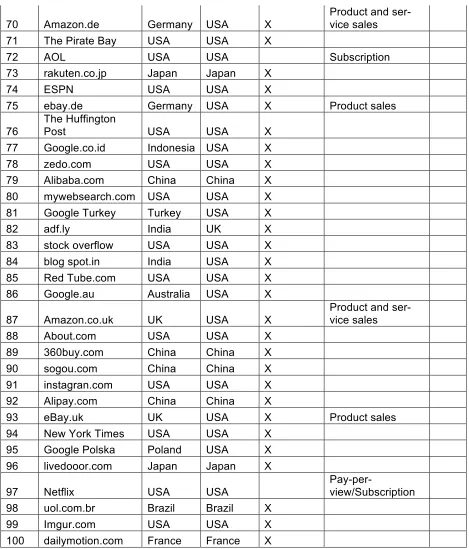
U.S. is not a dominant force in the Internet market. However, when we consider the origins of the websites, the story is not the same, because the websites that belong to these non-Western countries are of U.S.-origin, including Google, Yahoo, and Amazon. As Table 1 shows, other than a handful of countries, including China and Russia, developing countries have no websites that they originally created and operated themselves. Based on the origin of the websites, U.S. companies comprised 72% of the list, which means that only one coun-try controls three-fourths of the top Internet market.
Rank Websites Country Country Major Business Models
Origin Advertising Other Businesses Non-Profit
1 Google USA USA X
2 Facebook USA USA X
3 YouTube USA USA X
4 Yahoo USA USA X
5 Baidu.com China China X
6 Wikipedia USA USA X
7 Windows Live USA USA X
8 Twitter USA USA X
9 QQ.com China China X
10 Amazon USA USA X
Product and ser-vice sales
11 Taobao.com China China X
12 Linkedln USA USA X
13 Blogspot.com USA USA X
14 Google India India USA X
15 Yahoo Japan Japan USA X
16 Sina.com.cn China China X
17 Google.de Germany USA X
18 yandex.ru Russia Russia X
19 MSN USA USA X
20 WordPress.com USA USA
Blog services, anti-spam technology & hosting partners
21 Google.com.hk China USA X
22 Google.co.jp Japan USA X
23 Bing USA USA X
24 eBay USA USA X Product sales
25 Google uk UK USA X
26 Google fr France USA X
27 VK.COM Russia Russia X
28 Microsoft USA USA Product sales
29 Babylon USA USA X
30 Welbo.com China China X
32 163.com China China X
33 tumblr.com USA USA X
34 Apple USA USA X
35 T mail.ru Russia Russia X
36 soco.com China China X
37 Pinterest USA USA X
38 Google Brazil Brazil USA X
39 Tmall.com China China X
40 Google Espanol Spain USA X
41 PayPal USA USA X
42 Google.ru Russia USA X
43 Goole.it Italy USA X
44 xhamster.com USA USA
Pay-per-view/Subscription
45 Craigslist USA USA
Charging fees for job and apartment rental postings in some cities
46 sohu.com China China X
47 Blogger.com India USA X
48 fc2.com Japan Japan X
49 go.com USA USA X
50 imdb.com USA USA X
51 BBC Online UK UK X
52 xvideos.com USA USA
Pay-per-view/Subscription
53 ASK USA USA X
54 yonku.com China China X
55 Google Mexico Mexico USA X
56 Hao123.com China China X
57 Google.ca Canada USA X
58 Flickr.com USA USA X
59 odnoklassniki.ru Russia Russia X
60 Conduit.com USA USA X
61 Adobe USA USA Product sales
62 CNN Interactive USA USA X
63 ifeng.com China China X
64 AVG USA USA Product sales
65 to.co USA USA
Pay-per-view/Subscription
66 Amazon.co.jp Japan USA X
Product and ser-vice sales
67 Tudou.com China China X
68 LiveJasmin.com USA USA X
69 Pronhub.com USA USA
70 Amazon.de Germany USA X
Product and ser-vice sales
71 The Pirate Bay USA USA X
72 AOL USA USA Subscription
73 rakuten.co.jp Japan Japan X
74 ESPN USA USA X
75 ebay.de Germany USA X Product sales
76
The Huffington
Post USA USA X
77 Google.co.id Indonesia USA X
78 zedo.com USA USA X
79 Alibaba.com China China X
80 mywebsearch.com USA USA X
81 Google Turkey Turkey USA X
82 adf.ly India UK X
83 stock overflow USA USA X
84 blog spot.in India USA X
85 Red Tube.com USA USA X
86 Google.au Australia USA X
87 Amazon.co.uk UK USA X
Product and ser-vice sales
88 About.com USA USA X
89 360buy.com China China X
90 sogou.com China China X
91 instagran.com USA USA X
92 Alipay.com China China X
93 eBay.uk UK USA X Product sales
94 New York Times USA USA X
95 Google Polska Poland USA X
96 livedooor.com Japan Japan X
97 Netflix USA USA
Pay-per-view/Subscription
98 uol.com.br Brazil Brazil X
99 Imgur.com USA USA X
100 dailymotion.com France France X
Table 1: The Top 100 Sites on the Web (data source: alexa.com 2002: the top 500 sites on the web, http://www.alexa.com/topsites, accessed November 31, 2012.
charging fees to list an apartment rental in New York, USA. The revenues cover only the operating expenses; the company has not made a profit since its inception (Patrick 2012). Meanwhile, WordPress.com is run by Automatic which currently makes money from the aforementioned upgrades, blog services, Akismet anti-spam technology, and hosting partnerships. What is most significant about the contemporary Internet is the swift growth of capitalist platforms, such as Facebook, Google, and Twitter. As Baran and Sweezy (1968) argued, in a capitalism dominated by large corporations operating in oligopolistic markets, advertising especially becomes a necessary, competitive weapon. No matter whether West-ern or non-WestWest-ern, these websites and platforms are major engines appropriating advertis-ing for global capitalism.
Specifically speaking, while there are many U.S-based platforms that have increased their global influence, three major American-based platforms – Google, Facebook, and YouTube (also owned by Google) – made up the top three websites in November 2012 (Alexa.com, 2012). Except for two Chinese-based platforms (Baidu.com and QQ.com), the other eight platforms in the top 10 were all American-based platforms. Among these, Google is the world’s most accessed web platform: 46% of worldwide Internet users accessed Google in a three-month period in 2010 (Fuchs 2011b). Among search engines only, Google’s dominant position is furthermore phenomenal. As of November 2012, Google accounted for as much as 88.8% of the global search engine market, followed by Bing (4.2%), Baidu (3.5%), Yahoo (2.4), and others (1.1%) (Kamasnack 2012). Google even launched google.cn in 2006, agreeing to some censorship of search results to enter the country, to meet the requirements of the Chinese government. In China, Google’s market share stood at 16.7% as of December 2011, down from 27% in June 2010, while local web search engine Baidu’s market share increased from 70% as of June 2010 to 78.3% in December 2011 (La Monica 2012; Lee 2010; Lau 2010). Due to the fact that Baidu is limited mainly to Chinese language users, though, it can’t surmount Google’s global market share.
SNSs have also gained tremendous attention as popular online spaces for both youth and adults in recent years. American-based SNSs have rapidly penetrated the world and enjoyed an ample amount of capital gains. Several local-based SNSs, such as Mixi (Japan), Cyworld (Korea), and QQ (China), as well as VK (Originally VKontakte) – a European social network site that Russian-speaking users use around the world (VK was established in 2006 by Pavel Durov, a Russian entrepreneur, who is still the co-owner alongside the Mail.ru Group–the Russian Internet giant that owns a 39.9% stake in Vkontakte; East-West Digital News, 2012) – are competing with American-based SNSs. For example, Russian Cyberspace, including the Commonwealth of Independent States (CIS), such as Azerbaijan, Armenia, and Georgia, known as RUNET, is a self-contained linguistic and cultural environment with well-developed and highly popular search engines, web portals, social network sites, and free e-mail ser-vices. Within RUNET, Russian search engines dominate with Yandex (often called the Google of Russia), beating out Google (Geibert et al. 2010, 17-19). The market share of Yandex was 60.3% in November 2012, while Google’s share was 26.6% in November 2012, according to LiveInternet (2012). However, outside these few countries, the majority of coun-tries in the world have increased their usage of Facebook and Twitter. These Western-based platforms have managed to overtake some local incumbent SNSs and search engines in the past few years (Jin forthcoming). The U.S. has continued an asymmetrical relationship of interdependence between a few developed countries and the majority of developing coun-tries up to the present time.
others, and to see and be seen” (boyd 2011, 39). The site can be understood as an online communication platform that combines features of e-mail, instant messaging, photo-sharing, and blogging programs, as well as a way to monitor one's friends' online social activity. Since May 2007, members have been able to download and interact with Facebook applications, programs and accessories developed by outside companies that now have access to Face-book's operating platform and large networked membership (Cohen, 2008).
Facebook is indeed maintaining its rate of growth and generating thousands of new user registrations every day. The number of total users has grown from 585 million in December 2010 to 845 million in November 2011, and finally reached to 1 billion in October 2012, which means over 400 million new user registrations took place in just less than two years (Face-book 2012a; Socialbakers 2012). These numbers are significant because they have contrib-uted to the high valuation assigned to the company. Facebook’s value reached $50 billion in January 2011 (McGirt 2007; Rushe 2011). Right after its public offering on May 18, 2012, the capital value of Facebook was as much as $104 billion (AP 2012). However, the share price nosedived from $38 to $22.17, around 58% of its IPO price, as of close of business on No-vember 16, 2012. Critics claimed that the company was overvalued and had not devised a credible plan to generate revenue, and it subsequently turned out to be true (Sparkes 2012). Interestingly enough, before its public offering, Zuckerberg emphasized that “Facebook’s social mission was to make the world more open and connected,” and he stated that “the primary goal was not making money” (Channel 4 News 2012). This might be true and it will not always be easy to separate economic and social values as motives, but the public offer-ing of Facebook clearly proves that the development of new technology cannot be under-stood without its value embedded in design for commodity exchange, as van Dijck (2012) points out. At the very least, the technological design of online spaces and operating systems constitute a contested terrain where the imposition of designers' values and preferences are at odds with the values and preferences of the intended user base (Bodle 2010).
Meanwhile, Facebook has rapidly expanded its dominance in many countries. According to the World Map of Social Networks, showing the most popular SNSs by country, which is based on Alexa and Google Trends for Websites traffic data (2012), Facebook is the market leader in 126 countries out of 137 (92%) as of June 2012, up from 87% in June 2010, and up from 78% in December 2009 (Vincos Blog 2012). Facebook has outnumbered Iwiw in Hun-gary, Nasza-Klasa in Poland, Hi5 in Mongolia, and Orkut (Google) in Paraguay and India since June 2010 (in terms of the number of national users). Although several local-based SNSs are still market leaders in Asian countries, such as China, Japan, and Korea as well as Russia, which is very significant because these are some of the largest IT markets, Face-book has managed to overtake local incumbent SNSs, and has rapidly penetrated the majori-ty of countries in the world. At the end of November 2012, the U.S. was the largest country in terms of the number of users with 168.6 million users; however, other countries also rapidly increased their number of users. Brazil became the second largest country with 61.8 million users, followed by India (60 million), and Indonesia (49.8 million). Likewise, in Korea, Face-book has rapidly increased its user base to compete with Cyworld. As of December 2010, the number of users reached 3.5 million; however, it soared to 9.4 million users in November 2012 (Socialbakers 2012) (table 2). At the end of 2010, fewer than 7% of Koreans used Fa-cebook due to the dominant position of Cyworld, which had 25 million users; however, the penetration rate rose to 20% in November 2012. Facebook has encroached the Korean mar-ket, mainly because the opinion leaders, including college professors and researchers, have switched to Facebook from Cyworld (Socialbakers 2012). Facebook has positioned itself as the leader of interactive, participant-based online media, or Web 2.0, the descriptor for web-sites based on user-generated content that create value from the sharing of information be-tween participants (Hoegg et al. 2006, 1; O'Reilly 2005).
account-ed for 31%, South America 15%, and Europe for 14% (Semiocast 2010). Remarkably, users from Jakarta in Indonesia were the most active within all cities ranked by the number of post-ed tweets in June 2012 (Semiocast 2012). What is significant is that non-Western countries are able to advance the usage of Twitter primarily because they have also a large number of smartphone users, including iPhones. For example, the number of registered users of Twitter rapidly increased with the development of smartphones in Korea. As of June 2012, there were 6.4 million Twitter users in Korea. Since the growth in the number of smartphone users is steep, the amount of Twitter users is expected to grow.
Rank Country Number of Users Penetration
1 United States 168,642,820 54% 2 Brazil 61,813,580 31% 3 India 60,600,520 5% 4 Indonesia 49,884,160 21% 5 Mexico 39,583,000 35% 6 United Kingdom 33,785,600 54% 7 Turkey 31,822,360 41% 8 Philippines 29,877,060 30% 9 France 25,286,560 39% 10 Germany 25,189,320 31% 11 Italy 22,983,500 40% 12 Argentina 20,523,720 50% 13 Canada 18,600,020 55% 14 Thailand 17,609,460 27% 15 Colombia 17,594,640 40% 16 Spain 17,426,720 37% 17 Japan 16,303,480 13% 18 Malaysia 13,392,920 51% 19 Taiwan 13,047,140 57% 20 Egypt 11,891,660 15% 21 Australia 11,738,040 55% 22 Venezuela 10,017,680 37% 23 Vietnam 9,787,700 11% 24 Chile 9,754,320 58% 25 Peru 9,668,220 32% 26 Poland 9,600,760 25% 27 South Korea 9,484,480 20% 28 Pakistan 7,591,580 4% 29 Russia 7,469,540 5% 30 Netherlands 7,402,480 44%
The dominant positions of Facebook, Twitter and Google have been considered as clear examples of platform imperialism. While these sites can offer participants entertainment and a way to socialize, the social relations present on a site like Facebook can obscure economic relations that reflect larger patterns of capitalist development in the digital age. The connec-tion of SNSs to capitalism is especially significant. SNS users provide their daily activities as free labor to network owners, and thereafter, to advertisers, and their activities are primarily being watched and counted and eventually appropriated by large corporations and advertis-ing agencies (Jin forthcomadvertis-ing). As the number of SNS users has soared, advertisers, includ-ing corporations and advertisinclud-ing agencies, have focused more on SNSs as alternative adver-tising media. According to Facebook’s S-1 filing with the U.S. Securities and Exchange Commission (SEC), Facebook’s ad revenue in 2011 was $3.2 billion, up 69% from $1.9 bil-lion in 2010. Approximately 56% of Facebook's 2011 ad revenue of $3.1 bilbil-lion came from the U.S. alone, according to the company's regulatory filings (Facebook 2012b). However, the proportion of the U.S. significantly decreased from 70.5% in 2010 to 56% in 2011 (eMar-keter 2010), meaning Facebook has rapidly increased its profits from foreign countries. As Grewal (2008, 4) emphasizes, “the prominent elements of globalization can be under-stood as the rise of network power”. The notion of network power consists of the joining of two ideas: first, that coordinating standards are more valuable when greater numbers of peo-ple use them, and second, that this dynamic as a form of power backed by Facebook, which is one of the largest TNCs, can lead to the progressive elimination of the alternatives, as Lenin (1917) and H. Schiller (1991) emphasized. Facebook as the market leader in the SNS world has eliminated competitors as the number of users exponentially soars. “In the digital era, one of the main sources of social inequality is the access to technology” (Castells 1996, 32-33). Even when the issue is no longer that of lack of material access to technology, a power distribution and hegemonic negotiation of technologically mediated space is always at play (Gajjala and Birzescu 2011). The powers that can be marshaled through platforms are not exclusively centered in the U.S. However, as Lenin argued, the conflicts for hegemony between great powers, in this case, U.S-based SNSs and local-based SNSs have been evi-dent, and Facebook and Twitter have become dominant powers. In other words, a few U.S.-based platforms dominate the global order, which has resulted in the concentration of capital in a few hands within major TNCs and start-ups. This is far from a globalization model in which power is infinitely dispersed. Capital and power are not the form of monopoly; howev-er, a handful of U.S.-owned platforms have rapidly expanded their dominance in the global market, which has caused the asymmetrical gap between a few Western countries and the majority of non-Western countries.
6.
Intellectual Properties: Increasing Capital Accumulation for the U.S.
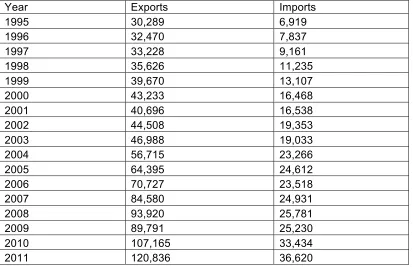
According to the International Monetary Fund (IMF), in 2009, the global IP marketplace was worth $173.4 billion and, within the U.S., $84.4 billion–nearly half of the global total (Mil-lien, 2010). This implies that the U.S. has benefited from innovation and IP. Although the total amount is a little bit different from the IMF, the U.S. Department of Commerce (2012; 2011; 2010) showed that the total amount of revenues from royalties and license fees that the U.S. received from foreign countries soared from $20.8 billion in 1992 to $120.8 billion in 2011, the highest in history. Royalties and license fees are payments and receipts between residents and nonresidents for the authorized use of intangible and nonfinancial assets as well as proprietary rights (such as patents, copyrights, trademarks) and for the use, through licensing agreements, of produced originals of prototypes (such as films and manuscripts) (The World Bank, 2011). However, royalties and license fees that the U.S. paid to foreign countries increased from $5.1 billion in 1992 to $36.6 billion in 2011 (Table 3). The net profits in 2011 were recorded as being as much as $84.2 billion; therefore, the U.S. has tried to es-tablish a rigorous global standard in IP rights.
Year Exports Imports
1995 30,289 6,919
1996 32,470 7,837
1997 33,228 9,161
1998 35,626 11,235
1999 39,670 13,107
2000 43,233 16,468
2001 40,696 16,538
2002 44,508 19,353
2003 46,988 19,033
2004 56,715 23,266
2005 64,395 24,612
2006 70,727 23,518
2007 84,580 24,931
2008 93,920 25,781
2009 89,791 25,230
2010 107,165 33,434
2011 120,836 36,620
Table 3. Royalties and License Fees of the U.S. (unit: millions of dollars), data source: U.S. Department of Commerce (2012; 2011; 2010). Survey of Current Business. Washington
D.C.: U.S. Department of Commerce.
While IP rights have become one of the most significant engines for developed countries, both the cultural industries and the IT industries are vital for the U.S. economy. They are among the all-too-few U.S. industries that generate substantial trade surpluses in the midst of growing U.S. trade deficits. As Greg Papadopoulos, chief technology officer of Sun Mi-crosystems, states, intellectual property has become more central to these U.S. industries (The Economist, 2005).
alle-gations against Samsung, which claims Samsung’s Galaxy line of phones and tablets bor-rows too much from the Apple iPhone and other products. Galaxy products use Google Inc’s Android operating system, the lawsuit says, which directly competes with Apple’s mobile software. It also alleges that Samsung infringes on a number of Apple patents for technology and trademarking of its mobile product line (Levine 2011). In a lawsuit filed in U.S. District Court for the Northern District of California, Apple alleges the product design, user interface and packaging of Galaxy products "slavishly copy" Apple (AP 2011a). Samsung Electronics Co. immediately responded and sued Apple claiming patent infringement, a week after the iPhone maker filed a complaint. Samsung submitted complaints to courts in Seoul, Tokyo, and Mannheil, Germany, alleging Apple infringed patents related to mobile-communications technologies. Samsung claims that Apple infringed Samsung patents related to communica-tion standards and a technology that connects mobile phones to personal computers for wireless data transfer (Yang 2011). While other countries are still weighing the case, two major verdicts showed totally opposite results. On the one hand, the nine-member jury in the U.S. court in August 2012 sided almost entirely with Apple in its patent dispute case with Samsung, awarding Apple nearly $1.05 billion in a sweeping victory over claims that the Ko-rean electronics maker copied the designs of its iPhone smartphone and iPad tablet (Gug-lielmo 2012). On the other hand, the Court of Appeal in the U.K. concluded that Samsung did not copy Apple’s iPad designs in building its Galaxy Tab product in October 2012 (Arthur 2012).
Regardless of these legal verdicts, what the two majors were trying to say is very simple: a company must protect its IP and ensure its continued innovation and growth in the mobile communications business (Yang 2011). It has been a war of innovative ideas and designs between Apple and Samsung, and it appears to be a life or death struggle between the two smartphone makers – no longer just mobile makers. When Steve Jobs unveiled the latest iPhone 4 mobile in 2010, Samsung, the world’s second-largest mobile phone producer, made public its new smartphone called Galaxy S only hours after Jobs’ presentation. Sam-sung has the ambition to beat out Apple to dominate the lucrative world market (Korea Times 2010). The tensions happen in the midst of the emergence of local-based smartphone pow-erhouses, which means a few emerging markets have competed with the U.S.-based smartphone providers. The reality, however, is that the U.S. has continued to dominate the smartphone market with its advanced technologies protected by intellectual property rights. Apple’s iPhones have been successful and have influenced subsequent smartphone makers and designers.
More specifically, ether iPhone or Android, both of them are symbols of American empire; in this case, platforms dominated by the U.S. iPhones and Android phones seem to be eve-rywhere, and they have formed an exclusive hegemonic power in the smartphone industry, just as Windows and Mac have in personal computers. According to the research firm IDC, Android, which was invented in 2003 and integrated by Google, has been the world’s best-selling smartphone platform and had a 75% share of smartphones worldwide during the third quarter of 2012, up from 57.5% in the third quarter of 2011. During the same period, Apple’s iSO also slightly increased from 13.5% to 14.9%, followed by Blackberry, Symbian and Win-dows Phone 7. This means that Android and iSO comprised almost 90% of the market share in the third quarter of 2012 (IDC, 2012).
Growth was bolstered by strong Android product performance from a number of vendors, including Samsung and LG in Korea, HTC in Taiwan, and ZTE and Huawei in China (Canalys 2011). Samsung, HTC and others are paying a small fee, between $10 and $15 for each Android smartphone they sell, to Microsoft that owns some of the Android patents (Hal-liday 2011). Only two platforms, both of which are based in the U.S., have dominated the global market, which has not been seen before. Digital technologies and culture have be-come among the most significant venues for many in the 21st century. The issue is that the U.S. has swiftly expanded its dominance in digitally-driven technologies and culture due to platforms as in the case of popular culture, such as films and music.
countries have advanced their own software and platforms, the lop-sided interaction between Western and non-Western countries remains unchanged and perhaps is even more magni-fied today than in the past. In particular, the formation of U.S. hegemony in IP rights has been extended through the efforts of international IP regimes, such as the World Intellectual Property Organization (WIPO) (Lu and Weber 2009). Since the U.S. is the biggest source of patent fees for WIPO, which earns the majority of its revenue from patent fees, there were occasional calls from the U.S. IP industry (which pays those fees) for the U.S. government to pull out of WIPO if it could not achieve breakthroughs in advancing global IP policy, in partic-ular the harmonization of national patent laws (New 2011). While the U.S. government some-times directly funds WIPO, it forces WIPO to actually internationalize U.S. versions of IP poli-cy because the U.S. government and TNCs believe that they could increase their revenues in the IP sector by better regulating the illegal usage of American-origin intellectual properties through WIPO. Global IP dominance redefines social identities and relations in economy, politics, and culture to reinforce and perpetuate the historically constructed and highly une-ven distribution of IP production and consumption, as the developed world serves as host to IP owners while the developing world houses the users (Pang 2006).
While several platforms driven by a handful of private corporations have increased their dominance, the U.S. government and its counterpart governments have also involved in in-ternational negotiations, as will be detailed in the next section. It implies that the nation-states have always been the strongest supporters of private corporations. While TNCs have developed and advanced new technologies, the U.S. government and other governments have been major players in the globalized world because they need to support the growth of their own platforms. With globalization, capital might crack the shell of the nation-state (Dyer-Witheford 1999, 138). However, platform technologies are not separate from governments, because they are the primary engines for the digital economy. Therefore, it is crucial to re-member that the classical Marxist accounts of the 19th century era of free trade and its suc-cession by the era of inter-imperial rivalry also confusingly counterpoised states and markets, as is so often done in contemporary discussions of globalization in the context of neoliberal free market policies. Among both classical Marxists and in neoliberal globalization theory, there have been some failures in appreciating the crucial role of the state in making free markets happen and work (Panitch and Gindin 2003, 11; Wood 2003), which needs to be carefully discussed.
7.
The Role of Nation-States in the Construction of Platform Imperialism
“on their own, new technologies do not take sides in the struggle for freedom and pro-gress, but the U.S. does. We stand for a single Internet where all of humanity has equal access to knowledge and ideas. And we recognize that the world’s information infrastruc-ture will become what we and others make of it. This challenge may be new, but our re-sponsibility to help ensure the free exchange of ideas goes back to the birth of our repub-lic” (U.S. Secretary of State 2010).
In her speech, Clinton cited China as among a number of countries where there has been “a spike in threats to the free flow of information” over the past year, and she also named Tuni-sia, Uzbekistan, Egypt, Iran, Saudi Arabia and Vietnam (U.S. Secretary of State 2010). Of course, China rejected a call by Clinton for the lifting of restrictions on the Internet in the communist country, denouncing her criticism as false and damaging to bilateral ties. Foreign Ministry spokesman Ma Zhaoxu said in a statement posted on the ministry’s Web site:
“regarding comments that contradict facts and harm China-U.S. relations, we are firmly opposed. We urged the U.S. side to respect facts and stop using the so-called freedom of the Internet to make unjustified accusations against China. The Chinese Internet is open and China is the country witnessing the most active development of the Internet” (Mufson 2010, A14).
Ma added that China regulated the Web according to law and in keeping with its national conditions and cultural traditions.
It is evident that the Chinese government understands the vast size of the Chinese Inter-net market, and it has taken measures to cultivate the growth of local information technology, including Google’s competitor, Baidu.cn. The Chinese government has maneuvered to pro-tect its own technology-driven corporations due to their significance for the national econo-my. China’s English-language Global Times therefore characterizes Clinton’s speech as a disguised attempt to impose [U.S.] values on other cultures in the name of democracy. The newspaper then dragged out another snarling phrase to denounce Clinton’s overtures on freedom of speech: information imperialism (Global Times 2010).
The second round of debate between the U.S. and China occurred in February 2011. Hil-lary Clinton again warned repressive governments, such as China, Cuba and Syria, not to restrict Internet freedom, saying such efforts will ultimately fail. Calling the Internet the public space of the future, Clinton enumerated all the reasons that freedom of expression must be the overriding ethos of this worldwide landscape (Goodale 2011). As expected, the Chinese government also warned the U.S. not to use the issues to meddle in China’s internal affairs. The government expressed that Internet freedom in China is guaranteed by law, and stated “we are opposed to any country using Internet freedom as a pretext for interference in Chi-nese affairs” (States News Service 2011).
As such, in the 21st century, the U.S. government has intensified its efforts to penetrate the global information market. As Panitch and Gindin (2003, 35-36) succinctly argue,
“neoliberal globalization is the acceleration of the drive to a seamless world of capital ac-cumulation, and the mechanisms of neoliberalism may have been economic, but in essence it was a political response to the democratic gains that had been previ-ously achieved by subordinate classes and which had become, in a new context and from capital’s perspective, barriers to accumulation…Once the American state itself moved in this direction, it had a new status: capitalism evolved to a new form of social rule that promised, and largely delivered, a) the revival of the productive base for American dominance; b) a universal model for restoring the conditions for profits in oth-er developed countries; and c) the economic conditions for integrating global capitalism.”
supported Hollywood backed by the Motion Picture Association of America and major film producers (Wasko 2003), the U.S government has been actively involved in the discourse of the free flow of information, and of course, one of the primary backgrounds is Google. The company lobbied 13 government agencies in 2009, spending just under $6 million in the pro-cess, and Google chiefly focused on freedom of speech on the Internet in 2010, particularly because of its highly publicized battles with the Chinese government. Google urged lawmak-ers to adopt policies that assure a neutral and open Internet at home and put pressure on foreign governments that censor the Web (Goldman 2010). The U.S. campaign for uncen-sored and free flow of information on an unrestricted Internet backed by Google and other platforms, including Microsoft has been a clear proof of the collaboration between the gov-ernment and TNCs, two major powers, in the global market.
Since the early 1990s, as H. Schiller (1999) criticized, several theoreticians have insisted that the market is the solution to all problems, that private enterprise is the preferred means to achieve solid economic results, and that government is the enemy. However, as the case of Google in China proves, as well as IP rights related global politics, the last several dec-ades’ record is of government initiative, support, and promotion of information and communi-cation policies. The principle – vital to the worldwide export of American cultural product and American way of life – of the free flow of information has arguably become a universal virtue to both the information industries and the U.S. government (H. Schiller 1999), and this fun-damental political agenda continues in the Obama government. The U.S. government has become a primary actor in tandem with TNCs, which also applies to platform imperialism. The U.S. is not the only country to actualize neoliberal policies. The Chinese government also capitalizes on neoliberal globalization, meaning the role of China in global capitalism has rapidly increased. One needs to be very careful, though, because “China is not capitalist despite the rise of a capitalist class and capitalist enterprises” (Arrighi 2007, 331).
“The capitalist character of marked-based development is not determined by the presence of capitalist institutions and dispositions but by the relation of state power to capital. Add as many capitalists as you like to a market economy, but unless the state has been sub-ordinated to their class interest, the market economy remains non-capitalist” (Arrighi 2007, 331–332).
The Chinese state in Arrighi’s view still retains a high degree of autonomy from the capitalist class and is therefore able to act in the national rather than in a class interest (Robinson 2010).
Since the late 1970s, the Chinese state has undergone a radical transformation in order to pursue substantive linkages with transnational capitalism. Neoliberal ideas have been in-fluential in China as the post-Mao leadership embraced the market system as a means to develop the country (Zhao, 2008). In A Brief History of Neoliberalism, David Harvey (2005, 120) clearly points out that “the outcome in China has been the construction of a particular kind of market economy that increasingly incorporates neoliberal elements interdigitated with authoritarian centralized control”. As The Top 100 Sites on the Web (table 1) show, Chinese platforms, including Baidu, QQ, and Taobao, utilize the targeted advertising capital business model, which is not different from US Internet capitalism. Of course, this does not imply that China has entirely adopted neoliberal capitalist reform. Although China’s transition from a planned economy to a socialist market economy is substantial, China also poses an alterna-tive to the Washington Consensus, which emphasizes the continuing role of the government in the market. As Zhao (2008, 37) aptly puts it, the Chinese government has developed both “neoliberalism as exception” and “exceptions to neoliberalism” for the national economy and culture. The Chinese government has developed a market-friendly economy; however, at the same time, it continues to play a primary role in the market.