Multisystemic engagement & nephrology based
educational intervention: a randomized controlled
trial protocol on the kidney team at home-study
Ismail
et al.
S T U D Y P R O T O C O L
Open Access
Multisystemic engagement & nephrology based
educational intervention: a randomized controlled
trial protocol on the kidney team at home-study
Sohal Y Ismail
1,3*, Annemarie E Luchtenburg
2, Willij C Zuidema
2, Charlotte Boonstra
1, Willem Weimar
2,
Emma K Massey
2and Jan J Busschbach
1Abstract
Background:Living donor kidney transplantation (LDKT) is the most successful form of renal replacement therapy in terms of wait time and survival rates. However, we observed a significant inequality in the number of LDKT performed between the Dutch and the non-Dutch patients. The objective of this study is to adapt, implement and test an educational home-based intervention to contribute to the reduction of this inequality. Our aim is to establish this through guided communication together with the social network of the patients in an attempt that well-informed decisions regarding renal replacement therapy can be made:Multisystemic Engagement & Nephrology. This manuscript is a detailed description of the Kidney Team At Home-study protocol.
Methods and design:All patients (>18 yrs) that are referred to the pre-transplantation outpatient clinic are eligible to participate in the study. Patients will be randomly assigned to either an experimental or a control group. The control group will continue to receive standard care. The experimental group will receive standard care plus a home-based educational intervention. The intervention consists of two sessions at the patient’s home, an initial session with the patient and a second session for which individuals from their social network are invited to take part. Based on the literature and behavioural change theories we hypothesize that reducing hurdles in knowledge, risk perception, subjective norm, self-efficacy, and communication contribute to well-informed decision making and reducing inequality in accessing LDKT programs. A change in these factors is consequently our primary outcome-measure. Based on power calculations, we aim to include 160 patients over a period of two years.
Discussion:If we are able to show that this home-based group educational intervention contributes to 1) achieving well-informed decision regarding treatment and 2) reducing the inequality in LDKT, the quality of life of patients will be improved while healthcare costs are reduced. As the intervention is investigated in a random heterogeneous patient group in daily practice, the transfer to clinical practice in other kidney transplant centers should be relatively easy.
Trial registration:Netherlands Trial Register, NTR2730.
Keywords:Family Therapy, Cultural Diversity, Kidney transplantation/psychology, Living Donors/psychology, Patient education, Accessibility of health services
* Correspondence:[email protected]
1
Departments of Medical Psychology and Psychotherapy, Erasmus MC, Burg. s’Jacobplein 51, Rotterdam, CA 3015, The Netherlands
3
Department of Medical Psychology and Psychotherapy, Erasmus MC, Postbox 2040, Rotterdam, CA 3000, The Netherlands
Full list of author information is available at the end of the article
Background
Patients with end-stage renal disease have various options for renal replacement therapy (RRT): hemodialysis, periton-eal dialysis, deceased donor kidney transplantation (DDKT) and living donor kidney transplantation (LDKT). Although dialysis is a life-saving treatment, the patient is faced with a substantial loss of quality of life and a significantly increased risk of morbidity and mortality [1]. At least one quarter of the patients die on the wait list for DDKT [2]. The calcula-tion of the time spent on the wait list for a DDKT starts on the first day of dialysis and is on average three to five years in the Netherlands [3]. Research shows that LDKT is asso-ciated with significant patient and graft survival benefits when compared to DDKT [4]. One of the benefits of early LDKT is avoiding or minimising time on dialysis. However, one of the main concerns among patients is the health of the living donor. Studies have shown that among healthy screened individuals, the health risks for the donor are lim-ited [5]. The donor is usually admitted for 3–4 days for the nephrectomy, can resume preoperative social and profes-sional activities within four to six weeks and in general the perceived quality of life remains the same [5,6]. LDKT rates have steadily been increasing and now exceed those of DDKT in the Netherlands [3]. However, there appears to be an inequality in access to the LDKT program between Dutch and the non-Dutch patients. In our center 44% of patients on the wait list for DDKT are from non-Dutch des-cent [7]. However, non-Dutch patients represent only 18% of the patients transplanted via the LDKT program (period: 2000–2010). Therefore, fewer non-Dutch than Dutch bene-fit from the advantages of LDKT. This inequality is also present in other western countries [8-10]. This health care inequity needs to be addressed [11,12]. This discrepancy is partly attributable to medical, socio-economic and ethnic factors, which exert an independent significant influence on the chance of receiving a LDKT [7]. Due to an accumula-tion of unfavourable factors in the non-European popula-tion, their chances for a LDKT dropped to only 10% compared to the reference population (69%) [13]. Of the socio-economic hurdles, health insurance is less relevant in the Netherlands due to a health insurance system which is accessible for all Dutch citizens. Other possibly contributing factors to this inequality are potentially modifiable psycho-social (e.g. patient education, cognitions and emotions) and culture-specific factors (social influences, communication attitudes) [14,15]. The Kidney Team At Home-study fo-cuses on addressing those potentially modifiable factors in a home-based educational intervention.
In response to this situation, we developed an educa-tional program based on some of the principles of Multi System Therapy (MST) [16]. MST is an evidence-based therapy, which has been developed for derailed adoles-cents and families. Such serious pathology is unlikely to be found in the current study population. This means
that the intervention applied here will be much less in-tense than MST in a pure form. The current interven-tion is an adaptainterven-tion of the interveninterven-tion developed by Rodrigue, which was also MST-based and proven to be effective in reducing inequality in patients with end-stage renal disease [17]. The intervention was adapted to the Dutch situation with regard to the culture specific factors and the content of the education appropriate to the Netherlands. We designed our intervention with re-spect to the MST framework in such a way that we strive for engagement of the patient’s family and social net-work in the disease process: Multisystemic Engagement & Nephrology.
We developed an intervention protocol based on em-pirical data on psychosocial hurdles to LDKT and influ-ential theories from health psychology that focus on decision-making process and behavioural change. A close fit was found between data-driven hurdles and the following theory: Attitude-Social influence-Efficacy model (ASE-Model) [18]. The ASE-Model is based on the theory of Theory of Planned Behaviour (TPB) of Fishbein and Ajzen [19] and is supplemented by elements from the Social Cognitive Theory (SCT) of Bandura [20]. ASE has a wide scientific acceptance and represents a the-oretical framework for explaining behaviour by connect-ing attitude, social influence, self-efficacy, knowledge, skills (communication), and barriers and resources (risk perception) to intention and behaviour. Firstly, the factor regarding‘attitude’in this theory is based on 1) the belief that people think that a certain behaviour will have posi-tive or negaposi-tive consequences and 2) their evaluation of the according consequences. In other words, attitude is a function of how we integrate the information that we have on a subject. Secondly, social influence is defined as the approval or disapproval of the pursued behaviour by others within the patient’s social network. Thirdly, self-efficacylooks at the extent to which individuals believe in their own abilities in relation to a particular behav-iour. These factors influence a person’sintentionto carry out certain behaviour. Empirical data in this area has shown that factors such asknowledge, risk perception, atti-tude, communication, social influence, self-efficacy and intentionreveal good predictive values in the light of living organ donation [21-26].
Objectives
The objective of the Kidney Team At Home-study is to contribute to the reduction of ethnic inequalities in LDKT health care access. We translated this objective in two concrete research questions. The primary research question is to investigate whether this home-based edu-cational intervention results in improved knowledge and communication as compared to the standard educational care. The intervention should in this matter help the
Ismailet al. BMC Nephrology2012,13:62 Page 2 of 9
patients and their social network to reach awell-informed decisionwith regard to the most suitable treatment option. This is deliberately set as a primary research question, as a well-informed decision does not necessarily have to lead to LDKT. The secondary research question is to investi-gate whether this intervention leads to reduced ethnic in-equality in the pursuit of LDKT. This is operationalized by looking into distribution of LDKT activities between the experimental and control group. This study protocol pro-vides a detailed description of the Kidney Team At Home-study and the design of the randomized controlled trial (RCT) in line with the CONSORT (consolidated standards of reporting trails) checklist [27,28].
Methods and design
Study population
Patients
Eligible candidates are end-stage renal patients who have been referred to the pre-transplant clinic and are currently listed on the wait list for a DDKT and who do not have a potential living donor yet. This includes patients (>18 yrs) newly referred for transplant preparation as well as patients who are already listed. Patients who are mentally incapable (e.g. mental deterioration, schizophrenic) or those with a compromised medical condition who are unable to with-stand the intervention will not be included.
Invitees
Individuals in the social network of the patients are also invited to take part in this study. This practice is in line with the multisystemic approach of MST. For the invi-tees there are no limits set to ethnicity or the relation-ship with the patient. The number (≥1) of invitees (>18 yrs) participating will depend on the number that responds to the invitation of the patient.
Design & procedure
In this prospective RCT all patients will be invited to participate by the educators after the consultation with the transplant nephrologists. During the face-to-face in-formational consultation the patient will receive written and verbal information on the aims and procedures of the study. Spouses, relatives or friends accompanying the patient to the hospital may be present during this consultation. Our target is to include 80 patients of Dutch origin and 80 patients of non-Dutch origin in the study over a period of two years in order to compare ef-fectiveness of the intervention among these two groups. With respect to the inequality in LDKT, patients of non-Dutch origin will inherently be overrepresented in the study. After informed consent is obtained, patients will be randomized to either the control or the experimental group. The control group will receive standard care. The experimental group will receive standard care plus a
home-based educational intervention. In the face of the equity principle, we will provide all the study materials (e.g. brochures, questionnaires) in the six most common foreign languages in the Rotterdam municipality namely, English, Arabic, Turkish, Papiamento, Portuguese and Modern Hindi [29].
Control condition
Patients assigned to the control group will receive stand-ard care only. In the standstand-ard care all patients visiting our pre-transplantation outpatient clinic receive a con-sultation with a transplant nephrologist, a transplant co-ordinator, and a social worker. Additional to this verbal information, the patients receive a variety of written educational material and a DVD regarding various living donation and transplantation programs. All materials are translated in the six afore mentioned foreign languages. They can study this material in the coming four weeks before their second visit to the outpatient clinic during which they have the opportunity to ask additional ques-tions. Additionally, our patients are invited to attend 4– 6 times a year informational meetings held in the various regional hospitals. The baseline and post-measurements will be either handed out by the educators during the hospital visit or sent via mail. If necessary the educators may help in completing the questionnaire. The question-naires are also available in six languages.
Experimental condition
accompanied by a brochure containing the 1) study pur-pose, 2) education content, and 3) contact information of the educators.
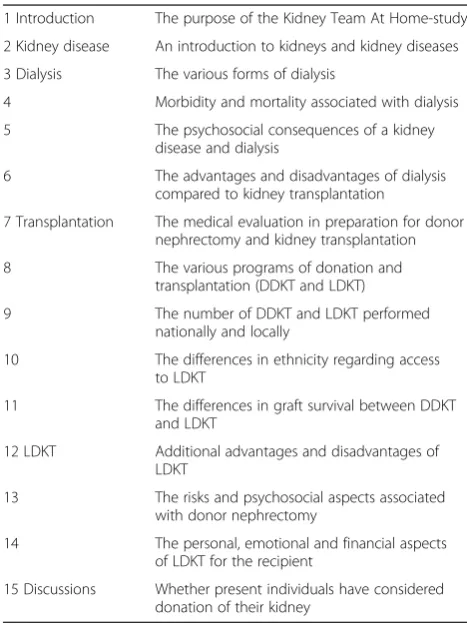
Session Two: The educators organize this session in such a way that they will do‘what ever it takes’, in line with one of the basic principles of MST, to make this event as patient-tailored as possible. This means that the interven-tion will usually take place in the evenings and weekends since most friends and family members are working during office hours. The primary goal of this intervention is educa-tional, therefore, it is not necessary that all the invitees are potential donors. The baseline-outcome measurement for the invitees will take place at the start of the second session. In exceptional cases multiple sessions are required in order to reach the goals set for those sessions. Table 1 shows the topics that will be discussed during the second session.
During both sessions at the patients’home we will use the therapeutic framework of MST in order to stimulate open communication between the patient and the family members and to use and profit of the strengths and possi-bilities of the natural network of the patient. The objective of MST is to achieve a lasting consensus on the patient’s goals and how these goals can be reached with engagement and/or support of his/her social ecology. Such long-term consensus can not be achieved if the interpersonal
relations, personal autonomy and feelings of those involved are not sufficiently considered. Therefore, creating a ‘safe’ environment during the intervention is regarded as an im-portant aspect of a successfully implemented intervention. The licensed psychologist who will be implementing this protocol is certified in practical systemic therapy. Both the psychologist and the transplant coordinator (educators) will be supervised by an official MST supervisor through-out the study period.
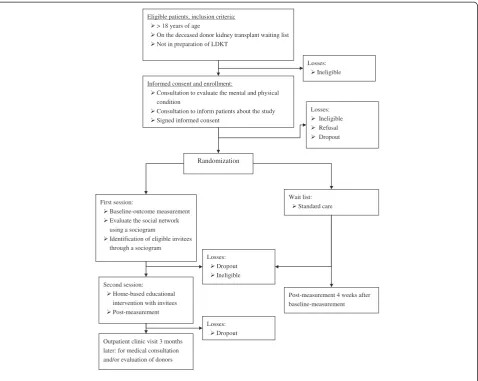
In order to minimize hurdles for participation inter-preters are used when Dutch is not the primary language of those present. The interpreter will also help patients and invitees with questionnaires or understanding the informed consent if that may ease the transfer of infor-mation. At the end of the second session the patient and the invitees will receive the post-measurement. This questionnaire can be completed immediately or returned via the mail within a week. In Figure 1 one can find the graphical depiction of the RCT.
Primary outcome measures
Knowledge Because there was no suitable instrument to measure knowledge on kidney diseases and all the pos-sible RRT’s, we developed the Rotterdam Renal Knowledge-Test (RRK-T) based on Devin et al (1990), Stothers et al (2005) and Rodrigue et al (2007). The RRK-T consists on 30 true / false or multiple choice questions on kidney disease, dialysis and transplantation with a living or deceased donor [29]. For example,‘Renal replacement therapy is necessary when the kidneys func-tion for only 50%’. A clinically significant change will be indicated by 8 points of difference compared to the baseline measurement and is additional to passing the clinical cut-off point of 17 points (each correctly answered questionnaire is awarded 1 point) [30].
AttitudeThis is operationalized as the attitude that one has towards the discussion of RRT’s (for patients and invitees) and the acceptance (patients) or the donation (invitees) of a kidney (TPB) [26,31-33]. For example, ‘From my point of view discussing renal replacement therapy with my family and friends is pleasant / un-pleasant’and‘I think that accepting a kidney from a liv-ing donor is good / bad.’ These were rated on a scale from 1–7.
Risk perception The questionnaire structure is similar to other studies in which the PMT is used [34,35]. Nega-tive and posiNega-tive aspects of living kidney donation were rated on a 5-point scale (1 = not at all - 5 = a lot). For ex-ample,‘I think discussing living kidney donation is emo-tionally burdensome’and‘I am afraid that in the future I could get a kidney disease from kidney donation.’
Table 1 The educational topics discussed in the second session
1 Introduction The purpose of the Kidney Team At Home-study
2 Kidney disease An introduction to kidneys and kidney diseases
3 Dialysis The various forms of dialysis
4 Morbidity and mortality associated with dialysis
5 The psychosocial consequences of a kidney disease and dialysis
6 The advantages and disadvantages of dialysis compared to kidney transplantation
7 Transplantation The medical evaluation in preparation for donor nephrectomy and kidney transplantation
8 The various programs of donation and transplantation (DDKT and LDKT)
9 The number of DDKT and LDKT performed nationally and locally
10 The differences in ethnicity regarding access to LDKT
11 The differences in graft survival between DDKT and LDKT
12 LDKT Additional advantages and disadvantages of LDKT
13 The risks and psychosocial aspects associated with donor nephrectomy
14 The personal, emotional and financial aspects of LDKT for the recipient
15 Discussions Whether present individuals have considered donation of their kidney
Ismailet al. BMC Nephrology2012,13:62 Page 4 of 9
Communication Patients and invitees are asked if and how often they talk about kidney diseases and RRT with their family and friends. The development and selection of these questions was based on the validated ‘Family Functioning Questionnaire’ [36]. This questionnaire is designed to pinpoint the way families communicate and make choices regarding psycho-educational interven-tions. For example,‘How often have you recently talked with the people close to you about kidney transplantation from a living donor’(1 = never - 5 = very often).
Self-efficacy We will measure the patients’and invitees self-efficacy to communicate about LDKT. Participants could answer on a 5-point scale ranging from ‘I am able to . . . .’ to ‘I am not able to . . .’ [25,37,38]. For ex-ample,‘I am able to discuss renal replacement therapies with my family and friends.’
Subjective norm Questions will be asked to determine if and how much patients and invitees value the thoughts of the other party regarding LDKT [37]. For example,‘I value the opinion of people who are important to me’(1 = not at all- 5 = very much).
Intention This factor measures the extent to which patients and invitees plan to / are willing to discuss RRT’s or if they would give or accept a kidney [25,26]. For example:‘How much do you want to donate a kidney to the patient’(1 = not at all - 5 = very much).
Secondary outcome measures
Secondary outcomes are operationalized in terms of behav-iour that may lead to LDKT or LDKT itself. This is divided into three categories: the number of applications for LDKT evaluation, the number of actual evaluations for LDKT, and the number of LDKT’s. These outcomes will be monitored Eligible patients, inclusion criteria:
> 18 years of age
On the deceased donor kidney transplant waiting list Not in preparation of LDKT
Informed consent and enrollment:
Consultation to evaluate the mental and physical condition
Consultation to inform patients about the study Signed informed consent
First session:
Baseline-outcome measurement Evaluate the social network using a sociogram
Identification of eligible invitees through a sociogram
Second session: Home-based educational intervention with invitees Post-measurement
Outpatient clinic visit 3 months later: for medical consultation and/or evaluation of donors
Wait list: Standard care
Post-measurement 4 weeks after baseline-measurement
Losses: Ineligible
Losses: Ineligible Refusal Dropout
Losses: Dropout Ineligible
Losses: Dropout
Randomization
using the patient’s medical records during the year follow-ing the intervention date. Furthermore, we will also moni-tor the timeframe between the intervention and the moment that the event arises (time-to-event).
Other outcome variables
Several other factors (e.g. confounders, effect modifiers) that may have an effect on the outcome of the interven-tion are defined as follows: Satisfacinterven-tion with the inter-vention and / the process leading to the well-informed decision for both the patient and the invitees, the num-ber of invitees, the relationship of the invitee to the pa-tient, the duration of the meeting, the use of an interpreter, the number of visits necessary for the inter-vention, the treatment adherence of the professionals and the satisfaction of the professionals. These outcomes are recorded by the educators on a questionnaire for each intervention.
Product evaluation Patients and invitees will be asked four questions on their opinion of the intervention pro-vided by the educators: satisfaction regarding the educa-tional intervention (e.g. usefulness, clarity). For example, ‘How satisfied are you with the clarity of the received in-formation’(1 = very dissatisfied - 5 = very satisfied).
Process evaluation Patients and invitees will be asked eight questions on their opinion and satisfaction regard-ing the way in which the intervention is delivered. (e.g. logistics, cooperation, understanding, professionalism). The questions asked are based upon the concepts and the structure of the Revised Treatment Adherence Measure (TAM; [39,40]. The main underlying question of the TAM is: ‘Did the health care providers do what they were ought to do in congruency with their proto-col?’For example,‘The researchers encouraged communi-cation between me and my family/friends’(1 = not at all - 5 = to a large degree).
Educator process evaluation This questionnaire (12 items) will be completed by the co-educator to deter-mine whether the intervention was able to reach the right audience (reach) and whether it was implemented as intended (fidelity) [41]. For example,‘How satisfied are you with the communicative aspects of the home visit?’(1 = very dissatisfied - 10 = very satisfied).Followed by, ‘What went well and what could have been improved?’(open questions).
Background variables
Socio-demographic data: date of birth, gender, educa-tion, employment status, marital status, number of chil-dren, ethnicity and religion will be collected through medical records. Medical data: medical diagnosis, history
of other RRT’s, current treatment, date of first dialysis and blood type.
Sample size calculation
Analphaof .05 and a powerof .80 was used in the fol-lowing calculations, as proposed to be appropriate for behavioural research [42]. To determine an adequate sample size for detecting the effect we did a power ana-lysis based on the proportion of LDKT’s performed in the control versus the experimental group in previous research [17]. We used this parameter since this is the only one on which there has been reported in the litera-ture with regard to the current study parameters. More-over the other parameters would reveal inconsistent sample estimates. For example, the knowledge parameter would show a large effect size which would result in a very low sample size whereas, self-efficacy would require a lager sample size. The required sample sizes to achieve a nominal power of 1-γ= 0.8 on a two-sided test with a α= 0.05 using a Fisher distribution revealed that at least 78 patients are required per study group to enable statis-tical judgments that are accurate and reliable. Calcula-tions were performed in SAS; Power and Sample Size version 3.1.
Statistical analysis
Following the updated CONSORT statement [43], for this study the intention-to-treat population is defined as all randomized patients who are known to have received at least one home visit and who provide data for at least one post-baseline measurement for one or more of the key efficacy variables: no patient will be excluded for protocol violations which occurred during subsequent follow-up (modified intention-to-treat) [44]. Additional effort will be exerted by the educators to ask the drop-out patients to complete the post-measurement for the primary outcome.
For comparing the patients’baseline-variables between the two research conditions the two tailed t-test for in-dependent samples for the continuous variables, the two-tailed Mann–Whitney U-tests for the ordinal ables and the Chi-square tests for the categorical vari-ables will be used. The effectiveness of our home-based educational intervention for the primary outcome vari-ables will be analyzed with mixed modeling, i.e. multi-level regression modeling. The additional value of this multilevel testing lies in the flexibility to model individ-ual growth trajectories and to handle missing data. The latter will only hold if structure of the missing data is Missing Completely At Random (MCAR) or Missing At Random (MAR), but not if the data turns out to be Missing Not At Random (MNAR). This technique is ap-propriate since missing data and drop-outs are inevitable in longitudinal research. Moreover, missing data affects
Ismailet al. BMC Nephrology2012,13:62 Page 6 of 9
study power simply by the reduced availability of data points [45]. We will strive to firstly minimize missing data, and to subsequently take this into account during analysis. The methodology of mixed modeling for repeated measures allows us the use of flexible error variance-covariance structure. Additionally, the predict-ive value of the baseline-parameters (main-outcome variables) on effectiveness can be estimated.
Finally, semiparametric regression analysis will be employed using Cox Proportional Hazard Model to examine the significance of the contingency between the hazard for an event of the experimental and con-trol group on the secondary outcome variables. This model enriches the analysis by incorporating covariates in the regression equation (e.g. age, gender, ethnicity, dialysis time). Time-to-event graphs will be depicted for the experimental and control group separately. Patients with a LDKT will be regarded as having the ‘event’ whereas patients who continue dialysis during the follow-up period will be censored. DDKT is mod-eled as a competing event and therefore patients who take-up this treatment will also be censored.
Ethical considerations
The Medical Ethical Committee of Erasmus Medical Cen-ter, Rotterdam, The Netherlands, has approved this study, registered under MEC-2011-004 / NL34535.078.10. Firstly, the ethical feasibility of an intervention as we propose in this protocol had been evaluated. In that research it had been argued that an active intervention in peoples’ live is justified [46]. The proposed education and therapeutic counseling in this protocol needs to be relative to the social context and the personal condition of the subsequent patients in order to ensure ethical justification. Secondly, in our center we have recently published an article on the eth-ical considerations of such a home-based educational inter-vention for kidney patients and their social network [47]. The authors concluded that a home-based approach is eth-ically justified when certain essential conditions had been satisfied. We consider the following as the most important: 1) participation must be completely voluntary at any point during the intervention, 2) the intervention must not be persuasive (i.e. advocating for a certain treatment option), and 3) the goal and the procedure of the intervention must be clear to all participants.
Discussion
LDKT has become a successful commonplace treatment option. The donor is often a family member but can also be a friend or an acquaintance in the Netherlands [48]. This has led to a broadened range of potential living donors. The graft survival rates of LDKT are better than those of the deceased donor transplantation [49]. Al-though research and clinical experience have shown
LDKT to be a better alternative for patients with end-stage renal disease, the uptake of LDKT remains stag-nant in culturally diverse populations. This inequity needs to be addressed [12,14,47]. Consequently, our aim was to address this inequality within a therapeutic framework that has already been scientifically estab-lished. We integrated the principles of MST within health behavioural change theories to create this home-based educational intervention. Combining these princi-ples with the results of previous research on psychosocial and culture specific potentially modifiable hurdles [14,15] has resulted in the Kidney Team At Home study. The primary research question of this study is to investi-gate whether a home-based educational intervention is effective for end-stage renal patients in reducing hurdles to LDKT. The secondary research question is to investi-gate whether the intervention increases the rates of LDKT among ethically diverse populations. We will try to establish this through guided communication, which if effective, can support and encourage well-informed deci-sion making. Discussing a difficult to broach topic such as living donation, which hitherto could not be ad-equately discussed [51], may be an emotional burden to the patients and their social network. Within the MST framework it is the explicitly framing of this very burden that is crucial to the intervention. With this multisyste-mic approach one seeks to resolve existing tensions in collaboration with the participants and try to pave the way for the emergence of a stable and suitable consensus on the issue at hand. This consensus will embrace a well-informed decision, which can be the pursuit of LDKT but may also be (continuation of ) dialysis. The discus-sion of living donation is for health care profesdiscus-sionals not one of the toughest conversations one can im-agine. Indeed, the discussion should be seen as a com-plicated but nevertheless as a mild social dilemma for the educators. Since MST is an evidence-based ther-apy, we believe that MST is able to provide us with tools that allow us to safely frame the transfer of in-formation and the discussion of LDKT in the family network of the patient.
Other ongoing studies
recently published [52]. However, also that study focuses on pre-emptive patients.
Practical considerations
Kidney patients in the experimental group are hosts for the sessions at their home. In most cases the patient and his/her family appreciate this informal setting and the fact that they do not have to make extra visits the hos-pital to participate in this study. However, if the patient does not wish to have the session at their home it may be held at a different location (e.g. community center, church). An additional flexibility in this protocol is that we will provide them with interpreters who were trained on the matter at hand for those to whom the Dutch lan-guage may be a barrier. Finally, if the per protocol num-ber of visits appears not to be sufficient enough to reach the pre-specified goal by the educators, multiple sessions may be held in agreement with the participants. All these flexibilities are justified under the ‘what ever it takes’ principle of MST and is being done to make the intervention easily accessible for the patients and the individuals from their social network.
Conclusion
If we show that this method is effective in reducing hur-dles for LDKT the hypotheses will hold that patients will reach more stable and well-informed decision regarding renal replacement treatment options together with their social network. This supplementary home-based educa-tional intervention may contribute to reducing inequal-ities in access to LDKT by addressing specific psychosocial and cultural hurdles at a grass-roots level.
Competing interest
The authors declare that they have no competing interest.
Authors’contributions
JJVB, WW, EKM and WCZ developed the original idea of the study, submitted a grand application to the Dutch Kidney Foundation, and all supervised the implementation of the project. SYI and AEL wrote the study protocol, the ad verbatimMultisystemic Engagement & Nephrologymanual and are the educators who are implementing the study in the outpatient pre-transplant clinic of the Erasmus Medical Center, Rotterdam, The Netherlands. CB, contributed to the development of the protocol, our therapeutic
multisystemic framework and will continue to supervise the implementation throughout. All authors read and corrected the draft versions. All authors approved the final version of this protocol.
Acknowledgements
This protocol is part of research funded by the Netherlands Kidney Foundation. We wish to thank the foundation for funding this study. Additionally, we wish to thank Dr L.W. Kranenburg and Pharos (the national Dutch knowledge and information centre on migrants, refugees and health care issues) for their contribution to the development of the original idea of the study.
Author details
1Departments of Medical Psychology and Psychotherapy, Erasmus MC,
Burg. s’Jacobplein 51, Rotterdam, CA 3015, The Netherlands.2Internal Medicine,‘s Gravendijkwal 230, Rotterdam, CE 3015, The Netherlands.
3Department of Medical Psychology and Psychotherapy, Erasmus MC,
Postbox 2040, Rotterdam, CA 3000, The Netherlands.
Received: 6 April 2012 Accepted: 23 May 2012 Published: 23 July 2012
References
1. Timmers L, Thong M, Dekker F, Boeschoten E, Heijmans M, Rijken M,et al: Illness perceptions in dialysis patients and their association with quality of life.Psychol Health Med2008,23:679–690.
2. de Jager D, Grootendorst DC, Jager KJ, van Dijk PC, Tomas LMJ, Ansell D,et al:Cardiovascular and noncardiovascular mortality among patients starting dialysis.JAMA2009,302:1782–1789.
3. Dutch Transplant Foundation. http://www.transplantatiestichting.nl. Leiden: Nederlandse Transplantatie Stichting; 2010.
4. Lamb KE, Lodhi S, Meier-Kriesche HU:Long-term renal allograft survival in the united states: a critical reappraisal.Am J Transplant2010,10:1–13. 5. Dols LF, Kok NF, Ijzermans JN:Live donor nephrectomy: a review of
evidence for surgical techniques.Transpl Int2010 Feb,23(2):121–130. 6. Ibrahim HN, Foley R, Tan L, Rogers T, Bailey RF, Guo H,et al:Long-term
consequences of kidney donation.N Engl J Med2009,360(5):459–469. 7. Roodnat JI, van de Wetering J, Zuidema W, van Noord MA, Kal-van Gestel
JA, Ijzermans JN,et al:Ethnically diverse populations and their participation in living kidney donation programs.Transplantation2010, 89(10):1263–1269.
8. Randhawa G:Developing culturally competent renal services in the United Kingdom: tackling inequalities in health.Transplant Proc2003 Feb, 35(1):21–23.
9. Waterman AD, Rodrigue JR, Purnell TS, Ladin K, Boulware LE: Addressing racial and ethnic disparities in live donor kidney transplantation: priorities for research and intervention.Semin Nephrol2010,30(1):90–98.
10. Ayanian JZ, Cleary PD, Weissman JS, Epstein AM:The effect of patients’ preferences on racial differences in access to renal transplantation.N Engl J Med1999,341(22):1661–1669.
11. Semplici S:The importance of‘social responsibility’in the promotion of health.Med Health Care Philos2011,14(4):355–363.
12. Rodrigue JR, Cornell DL, Kaplan B, Howard RJ:A randomized trial of a home-based educational approach to increase live donor kidney transplantation: effects in blacks and whites.Am J Kidney Dis2008, 51(4):663–670.
13. Roodnat JI, Laging M, Massey EK, Kho M, Kal-van Gestel JA, Ijzermans JN,et al:Accumulation of unfavorable clinical and socioeconomic factors precludes living donor kidney transplantation.Transplantation2012, 93(5):518–523.
14. Myaskovsky L, Almario Doebler D, Posluszny DM, Amanda Dew M, Unruh M, Fried LF,et al:Perceived discrimination predicts longer time to be accepted for kidney transplant.Transplantation2012.
15. Ismail SY, Claassens L, Luchtenburg AE, Roodnat JI, Zuidema WC, Busschbach JJ,et al:Living donor kidney transplantation among dutch ethnic minorities: a model for breaking the barriers.Patient Educ Couns
2012, Submitted.
16. Henggeler SW:Delinquency and Adolescent Psychopathology: A Family-Ecological Systems Approach. Littleton, MA: Wright-PSG; 1982.
17. Rodrigue JR, Cornell DL, Lin JK, Kaplan B, Howard RJ:Increasing live donor kidney transplantation: a randomized controlled trial of a home-based educational intervention.Am J Transplant2007,7(2):394–401. 18. De Vries H, Dijkstra M, Kuhlman P:Self-efficacy the third factor besides
attitude and subjective norm as a predictor of behavioural intentions.
Health Educ Res1988,3(3):273–282.
19. Ajzen I:The Theory of Planned Behavior.Organ Behav Hum Decis Process
1991,50:179–211.
20. Bandura A:Social foundations of thought and action. Englewood Cliffs NJ: Prentice Hall; 1986.
21. Hyde MK, White KM:Are organ donation communication decisions reasoned or reactive? A test of the utility of an augmented theory of planned behaviour with the prototype/willingness model.Br J Health Psychol2010,15:435–452.
22. Kranenburg LW, Zuidema WC, Weimar W, Hilhorst MT, Ijzermans JN, Passchier J,et al:Psychological barriers for living kidney donation: how to inform the potential donors?Transplantation2007,84(8):965–971.
Ismailet al. BMC Nephrology2012,13:62 Page 8 of 9
23. Ismail SY, Luchtenburg AE, Massey EK, Claassens L, Busschbach JJ, Weimar W:: Living kidney donation among ethnic minorities: A Dutch qualitative study on attitudes, communication, knowledge and needs of kidney patients; 2010. http://repubeurnl/resource/pub_20862/indexhtml. 24. Armitage CJ, Connor M:Social cognitive determinants of blood donation.
J Appl Soc Psychol2001,31:1431–1457.
25. Robinson NG, Masser BM, White KM, Hyde MK, Terry DJ:Predicting intentions to donate blood among nondonors in Australia: an extended theory of planned behavior.Transfusion2008,48:2559–2568.
26. Browne C, Desmond DM:Intention to Concent to Living Organ Donation; An exploratory study, Volume 5. 13th edition. 2007:605–609.
27. Moher D, Hopewell S, Schulz KF, Montori V, Gotzsche PC, Devereaux PJ,et al:CONSORT 2010 explanation and elaboration: Updated guidelines for reporting parallel group randomised trials.Int J Surg2011, .
28. Plint AC, Moher D, Morrison A, Schulz K, Altman DG, Hill C,et al:Does the CONSORT checklist improve the quality of reports of randomised controlled trials? A systematic review.Med J Aust2006,185(5):263–267. 29. Ismail SY, Massey EK, Luchtenburg AE, Da Silva A, Smak Gregoor PJH, Nette
RW,et al:Development of the Rotterdam Renal Knowledge-Test (R3K-T); 2011. Available from: http://repub.eur.nl/res/pub/23968/
Manuscript_Development%20of_R3K-T.pdf.
30. Hyde MK, White KM:Disclosing donation decisions: the role of organ donor prototypes in an extended theory of planned behaviour.Health Educ Res2009,24:1080–1092.
31. Lemmens KPH, Abraham C, Ruiter RAC, Veldhuizen IJT, Dehing CJG, Bos AER,et al:Modelling antecedents of blood donation motivation among non-donors of varying age and education.Br J Psychol2009,100:71–90. 32. Milne S, Sheeran P, Orbell S:Prediction and intervention in health-related
behavior: a meta-analytic review of protection motivation theory.J Appl Soc Psychol2000,30:106–143.
33. Helmes AW:Application of the protection motivation theory to genetic testing for breast cancer risk.Prev Med2002,35:453–462.
34. Rocone R, Mazza M, Ussorio D, Pollice R, Falloon IRH, Morosini P,et al:The questionnaire of family functioning: a preliminary validation of a standardized instrument to evaluate psychoeducational family treatments.Community Ment Health J2007,43(6):591–607.
35. Browne C, Desmond DM:Intention to concent to living organ donation; an exploratory study.Psychol Health Med2007,13(5):605–609. 36. Henggeler SW, Borduin CM, Schoenwald SK, Huey SJ, Chapman JE:
Multisystemic Therapy Adherence Scale–Revised (TAM-R). Unpublished instrument Charleston. SC: Department of Psychiatry & Behavioral Sciences, Medical University of South Carolina; 2006.
37. Borduin CM, Mann BJ, Cone LT, Henggeler SW, Fucci BR, Blaske DM: Multisystemic treatment of serious juvenile offenders: long - term prevention of criminality and violence.J Consult Clin Psychol1992, 60:953–961.
38. Bartholomew LK, Parcel GS, Kok G, Gottlieb NH:Planning health promotion programs. San Francisco: Jossey-Bass; 2006.
39. Cohen J:Statistical power analysis for the behavioral sciences. 2nd edition. New York: Academic; 1988.
40. Ioannidis JP, Evans SJ, Gotzsche PC, O’Neill RT, Altman DG, Schulz K,et al: Better reporting of harms in randomized trials: an extension of the CONSORT statement.Ann Intern Med2004,141(10):781–788.
41. Gillings D, Koch G:The application of the principle of intention-to-treat to the analysis of clinical trails.Drug Inf J1991,25:411.
42. Moerbeek M, Wong WK:Sample size formulae for trials comparing group and individual treatments in a multilevel model.Stat Med2008, 27(15):2850–2864.
43. Hilhorst MT, Kranenburg LW, Busschbach JJ:Should health care professionals encourage living kidney donation?Med Health Care Philos
2007,10(1):81–90.
44. Massey EK, Hilhorst MT, Nette RW, Smak Gregoor PJ, van den Dorpel MA, van Kooij AC,et al:Justification for a home-based education programme for kidney patients and their social network prior to initiation of renal replacement therapy.J Med Ethics2011,93(5):518–523.
45. Mimran A, Mourad G, Ribstein J:Early systemic and renal responses to nephrectomy in normotensive kidney donors.Nephrol Dial Transplant
1993,8(5):448–453.
46. Terasaki PI, Cecka JM, Gjertson DW, Takemoto S:High survival rates of kidney transplants from spousal and living unrelated donors.N Engl J Med1995,333(6):333–336.
47. Udayaraj U, Ben-Shlomo Y, Roderick P, Casula A, Dudley C, Johnson R,et al: Social deprivation, ethnicity, and access to the deceased donor kidney transplant waiting list in England and Wales.Transplantation2010, 90(3):279–285.
48. Kranenburg LW, Richards M, Zuidema WC, Weimar W, Hilhorst MT, JN IJ,et al:Avoiding the issue: patients’(non)communication with potential living kidney donors.Patient Educ Couns2009,74(1):39–44.
49. Boulware LE, Hill-Briggs F, Kraus ES, Melancon JK, McGuire R, Bonhage B,et al:Protocol of a randomized controlled trial of culturally sensitive interventions to improve African Americans’and non-African Americans’ early, shared, and informed consideration of live kidney transplantation: the Talking About Live Kidney Donation (TALK) Study.BMC Nephrol2011, 12:34.
doi:10.1186/1471-2369-13-62
Cite this article as:Ismailet al.:Multisystemic engagement &
nephrology based educational intervention: a randomized controlled trial protocol on the kidney team at home-study.BMC Nephrology2012
13:62.
Submit your next manuscript to BioMed Central and take full advantage of:
• Convenient online submission
• Thorough peer review
• No space constraints or color figure charges
• Immediate publication on acceptance
• Inclusion in PubMed, CAS, Scopus and Google Scholar
• Research which is freely available for redistribution