R E S E A R C H
Open Access
An experimental evaluation of the incidence of
fitness-function/search-algorithm combinations
on the classification performance of myoelectric
control systems with iPCA tuning
Guillermo A Camacho
1*, Carlos H Llanos
2, Pedro A Berger
3, Cristiano Jacques Miosso
4and Adson F Rocha
4*Correspondence: [email protected] 1Faculty of Engineering, University of La Salle, Bogotá, Colombia Full list of author information is available at the end of the article
Abstract
Background: The information of electromyographic signals can be used by Myoelectric Control Systems (MCSs) to actuate prostheses. These devices allow the performing of movements that cannot be carried out by persons with amputated limbs. The state of the art in the development of MCSs is based on the use of individual principal component analysis (iPCA) as a stage of pre-processing of the classifiers. The iPCA pre-processing implies an optimization stage which has not yet been deeply explored.
Methods: The present study considers two factors in the iPCA stage: namelyA(the fitness function), andB(the search algorithm). TheAfactor comprises two levels, namelyA1(the classification error) andA2(the correlation factor). Otherwise, theBfactor has four levels, specificallyB1(the Sequential Forward Selection, SFS),B2(the Sequential Floating Forward Selection, SFFS),B3(Artificial Bee Colony , ABC), andB4(Particle Swarm Optimization, PSO). This work evaluates the incidence of each one of the eight possible combinations betweenAandBfactors over the classification error of the MCS. Results: A two factor ANOVA was performed on the computed classification errors and determined that: (1) the interactive effects over the classification error are not significative (F0.01,3,72 =4.0659>fAB=0.09), (2) the levels of factorAhave significative effects on the classification error (F0.02,1,72 =5.0162<fA =6.56), and (3) the levels of factorBover the classification error are not significative (F0.01,3,72=4.0659>fB=0.08). Conclusions: Considering the classification performance we found a superiority of using the factorA2in combination with any of the levels of factorB. With respect to the time performance the analysis suggests that the PSO algorithm is at least 14 percent better than its best competitor. The latter behavior has been observed for a particular configuration set of parameters in the search algorithms. Future works will investigate the effect of these parameters in the classification performance, such as length of the reduced size vector, number of particles and bees used during optimal search, the cognitive parameters in the PSO algorithm as well as the limit of cycles to improve a solution in the ABC algorithm.
Keywords: Artificial bee colony (ABC), Electromyography, Individual principal component analysis (iPCA), Myoelectric control, Particle Swarm optimization (PSO), Prosthesis, Pattern recognition
Introduction
The loss of capabilities to manipulate objects with the hands is considered a high impact disease due to the physical, psychological and financial sequels related [1,2]. A current technological aid for upper limb amputation and deficiency is represented by the use of a myoelectric hand prosthesis. This device overcomes the inability to grasp and manipulate objects [3] and in some cases to sense and explore the surrounding world [4]. A myoelec-tric prosthesis is composed of two main systems: (a) the prosthesis and (b) the Myoelecmyoelec-tric Control System (MCS), which is the topic of this work. The electromyographic signals (EMG) are used as an input of the MCS, which classifies patterns of the EMG signals and operate actuators in the prosthesis.
The conventional MCS classifies the myoelectric patterns in movement classes. The processing in the MCS is composed of three stages: feature extraction, dimensional-ity reduction and classification. Recently, Hargrove et al. [5] proposed a complementary architecture which improves the performance of the conventional MCS. This new archi-tecture mixes 3 components: (a) a high crosstalk level EMG acquisition system, (b) an individual Principal Component Analysis (iPCA) transformation stage and (c) the con-ventional myoelectric control system. The main disadvantage of the iPCA projection is the dimensionality increment of the electromyographic patterns, in which the pattern dimensionNis incremented by a factor corresponding to the control system’s number of classesC.
To deal with the dimensionality increment it is possible to compute a reduced iPCA transformation that generates just theN1most discriminative dimensions instead of the
complete setC×N(withN1<C×N). The reduced iPCA transformation is used in [5] and
requires an optimization process that intends to find a subset ofN1elements from a given
set ofC×Nchannels, warranting the maximum discrimination information in the selected subset. The optimization is based on a search strategy and a fitness function, i.e. a function that measures the quantity of discriminative information in the selected subset of channels. The optimization in myoelectric control systems with iPCA tuning is explored by the authors in [6], where the analysis is focused on the effects of factors A and B over the performance of myoelectric control systems with iPCA tuning; withArepresenting the fitness function factor with two levels (A1 classification error and A2 correlation
factor) andBrepresenting the search algorithm factor with three levels (B1 sequential
forward selection (SFS),B2sequential floating forward selection,B3artificial bee colony
(ABC)). Our paper presents new results that complete the investigation in [6]. Specifically, we evaluate a new level for theBfactor:B4particle swarm optimization (PSO) for a total
of eight treatment alternatives.
The paper is organized as follows: Section ‘Related works’ discusses previous works in this research area. Section ‘Background’ describes the principal component analysis, the problem of channel optimization, the search algorithms and the fitness functions consid-ered. In Section ‘Methods’ we present the experimental methodology. In Section ‘Results’ the simulation results are given. In Section ‘Discussion’ the results are discussed, and finally the conclusions are presented in Section ‘Conclusions’.
Related works
which is the main topic of the current study. In the latter, the degrees of freedom are actu-ated one at a time, in a sequence, as one carries out a multifunction task. These systems are based on pattern recognition architectures where the patterns are represented by the EMG signal characteristics (x) and the classes are represented by the movements of the prosthesis (y).
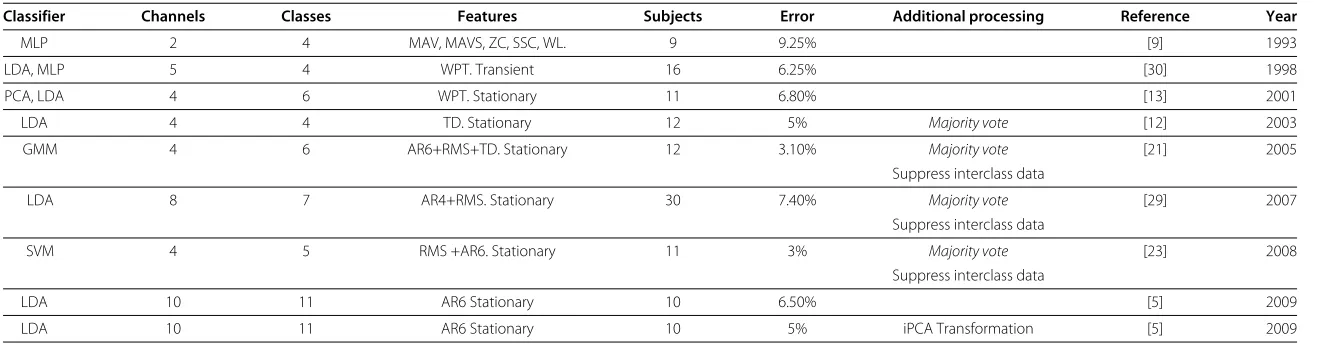
Starting from one of the first works that made use of a multilayer perceptron (MLP) neural networks (NNs) [9-11], various classifiers such as linear discriminant analysis (LDA) [12-14], (neuro) fuzzy [15-20], Gaussian mixture models (GMMs) [21,22], hidden Markov models (HMMs) [18], and support vector machines (SVMs) [23-25] have been used. Some commonly investigated feature sets include time domain (TD) features: MAV, MAVS, ZC, SSC, WL [12,26], autoregressive (AR) coefficients [27], cepstral coefficients [28], the short-time Fourier transform (STFT), the wavelet transform (WT), the wavelet packet transform [13] (WPT), and concatenated TD and AR (TDAR) [21,29] features. These solutions have reached different classification errors, depending on the number of classes and other factors (see Table 1 for a summary of the different errors reported in last years). For instance, in [29] an error of 7.4% is reported in a problem with 7 movement classes and 8 electromyography channels. Recently, a new strategy has been proposed in which the temporal-spatial information, contained within muscle crosstalk, may implic-itly add class discriminatory information to the classification problem [21]. This proposal has been investigated by Hargrove [5] observing a significative reduction in the classifica-tion error. In a problem with 7 movement classes and 6 EMG channels the system yielded a classification error of 1.9%.
The proposal in [5] mixes 3 components: (a) a high crosstalk level EMG acquisition system (i.e. an acquisition system with an special distribution of electrodes that permits that the signal generated by theM1muscle can be detected by the electrode associated
with theM2muscle, where musclesM1andM2are near [7]), (b) an iPCA
transforma-tion stage and (c) the conventransforma-tional myoelectric control system. The main disadvantage of the iPCA projection is the dimensionality increment of the electromyographic patterns, in which the original pattern dimensionN is incremented by a factor corresponding to the control system’s number of classesC, i.e. it generates a new pattern with dimension
CtimesN. To deal with the dimensionality increment it is possible to compute a reduced iPCA transformation that computes just theN1most discriminative dimensions instead
of the complete setC×N (withN1 < C×N). This solution requires an optimization
search to find a subset ofN1elements from a given set ofC×N channels, warranting
al.
B
ioMedical
Engineering
OnLine
2013,
12
:133
Page
4
o
f
2
3
Table 1 Summary of the classification parameters and errors reached in the last years
Classifier Channels Classes Features Subjects Error Additional processing Reference Year
MLP 2 4 MAV, MAVS, ZC, SSC, WL. 9 9.25% [9] 1993
LDA, MLP 5 4 WPT. Transient 16 6.25% [30] 1998
PCA, LDA 4 6 WPT. Stationary 11 6.80% [13] 2001
LDA 4 4 TD. Stationary 12 5% Majority vote [12] 2003
GMM 4 6 AR6+RMS+TD. Stationary 12 3.10% Majority vote [21] 2005 Suppress interclass data
LDA 8 7 AR4+RMS. Stationary 30 7.40% Majority vote [29] 2007
Suppress interclass data
SVM 4 5 RMS +AR6. Stationary 11 3% Majority vote [23] 2008
Suppress interclass data
LDA 10 11 AR6 Stationary 10 6.50% [5] 2009
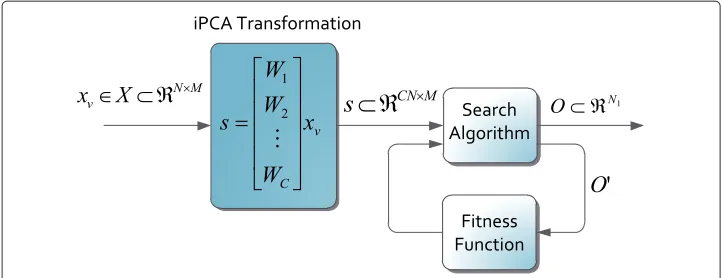
Figure 1 Optimization scheme used in the parameter configuration stage.Wiis a PCA matrix transformation of sizeN×Nfori=1,. . .,C. Note that eachWc(forc=1, 2,. . .C) matrix has aN×Nsize, then the projected vectorshas an incremental size ofCN×M.
computationally expensive, due to the need for evaluating the classifier’s output at each iteration.
In order to obtain a solution to the previous described disadvantages the authors pro-pose and evaluate in [6], a set of novel configurations for the iPCA tuning, based on two factors: (A) fitness function and (B) search algorithm. TheAfactor with two levels: (A1)
classification error and (A2) correlation factor. TheBfactor with three levels: (B1)
sequen-tial forward selection (SFS), (B2) sequential floating forward selection and (B3) artificial
bee colony (ABC). In this context, this article evaluates a new level for theBfactor:B4
particle swarm optimization (PSO). The overall results suggest an advantage on the use of the PSO algorithm with respect to other studied algorithms, with regard to the running time during the training stage.
Background
Principal Components Analysis
PCA is an orthogonal linear transformation used to convert a set of observations of possibly correlated variables into a set of values of uncorrelated variables called princi-pal components. GivenMobservations of anN dimensional random vectorz, the PCA transformation is performed by firstly subtracting the mean of the vector from z [5],
x=z−E{z}, computing theN×Ncovariance matrixCx =E{xxT}and, then, applying s=Wx, wheresis the vector of the main component andWis the matrix in which each column is an eigenvector ofCx. Usually theMobservations would typically be samples taken from anyC possible classes. This is known as universalPCA (uPCA) or global PCA [34]. This property of ignoring class information allows us to argue that PCA is suboptimal for classification purposes [35].
problem, a reduced iPCA transformation matrixWRis defined in [5]. This solution uses a transformation matrix with the bestN1basis of theWiPCAmatrix (N1<CN).
Channel optimization
The optimization task of finding a subset ofN1elements from a given set ofCN
chan-nels can be interpreted as a discrete optimization problem (integer elements from the selected subset). The optimization scheme in Figure 1 is used to carry out this task. In this scheme, a validation data setxvis projected with theWiPCA matrix. The projected pat-ternsis aCN×Msize vector. The vectorOis a subset of theCNdimensions insand its components change at each iteration, following a specific strategy defined by thesearch algorithm. Thefitness functionevaluates the quality of an EMG pattern with regard to the discriminative information. The evaluated patterns by the fitness function are established by the rows ofswhich compose theOvector. When the stop conditions are reached, the scheme provides the selected channel subsetOas output.
Search algorithms
The search algorithms treated in this study are the following: (a) Sequential Forward Selection (SFS), (b) Sequential Floating Forward Selection (SFFS), (c) Particle Swarm Optimization(PSO), and (d)Artificial Bee Colony(ABC); then, the same will be described.
Sequential Forward Selection (SFS)
This is one of the first developed search methods in the literature related to feature selec-tion issue. The search procedure consists of the following steps: (a) compute the fitness function for each of theCNchannels and then select the channel with the best value, and (b) form all possible two dimensional vectors that contain the winner from the previous step and compute the fitness for each of them, (c) select the vector with the best value, (d) continue the process until theN1vector length has been completed. The main drawback
of this algorithm is the nesting effect; that is, once a channel has been selected there is no possibility to discard it [32].
Sequential Floating Forward selection (SFFS)
This is a suboptimal search algorithm proposed by Pudil et al. in 1994 [31] with the pur-pose of eliminating the nesting effects of the SFS algorithm. This algorithm begins the search with an initial subset of two channels. For each subsequent iteration, two tasks are necessary: (a) search the candidate channel which minimizes the fitness function and add it to the selected subsetO, (b) verify if the fitness function can be optimized by replac-ing a channel from the selected subsetO. Consequently, the SFFS search is performed dynamically, incrementing and decrementing the selected channels in the subsetOuntil reach the target lengthN1. An efficient way to implement this algorithm is presented in
[31,37].
Particle Swarm Optimization (PSO)
This is a population based stochastic optimization technique developed by Eberhart and Kennedy in 1995 [38]. In this algorithm, it is assumed that there exists a swarm withS
particles. Consider that the search space isN1-dimensional, and thei-thparticle of the
velocity of the particle is denoted byvi = (vi1,vi2,. . .,viN1). Additionally, consider that
the best individual position for theiparticle ispbesti = (pi1,pi2,. . .,piN1)and also that the first and second best position explored so far aregfbestandgsbestrespectively. The velocity of the particle and its position are updated according to (1) and (2).
vij(t+1)=w∗r(vij(t))+c1∗r1∗r(pbestij−xij(t))+c2∗r2∗r(gfbestij−xij(t))
+c3∗r3∗r(gsbestij−xij(t))
(1)
xij(t+1)=xij(t)+r(vij(t+1)) (2)
where,iis the particle index fori ∈ 1,. . .,S;jis a specific dimension forj ∈ 1,. . .,N1;
wis the inertia weight;r1,r2andr3 are random numbers uniformly distributed in the
range(0, 1);c1is a cognitive parameter;c2andc3are social parameters;r(.)is a rounding
function used to adapt the original PSO for the discrete optimization problem [39,40]. The purpose of including the second best particlegsbestin the velocity update equation is to increase the diversity and slow convergence by addressing each particle to move toward the weighted sum of both the best and second best solution the swarm has gener-ated [41]. Considering a minimization problem the local best of each particle is updgener-ated according to (3).
pbesti(t+1)=
pbesti(t) iff(pbesti(t))≤f(xi);
xi(t) iff(pbesti(t)) >f(xi); (3)
where,f(.)is the fitness function. Finally, the first and second global best of the swarm are updated according to (4) and (5).
gfbest(t+1)=argminp∈pbestif(p(t+1)) (4)
gsbest(t+1)=argminp∈pbesti\g fbest(t+1)f(p(t+1)) (5)
It is possible that the solution computed with the PSO algorithm contains repeated ele-ments (i. e. that the vectorOhas repeated elements). This leads to EMG patterns with high level of redundancy and it does not benefit the localization of the global minimum on the considered fitness functions. To overcome this, a modification on the conven-tional PSO algorithm was added. Whenever the search process leads to a solution with repeated elements, then, that solution will be penalized with a high fitness value and with-out evaluating the fitness function. This will hinder the EMG patterns with high level of redundancy from being selected as the optimal solutions in the minimization problem.
Artificial Bee Colony (ABC)
This is an optimization technique proposed in 2005 by Karaboga [42]. In ABC, each solution to the optimization problem is called food source and is represented by a
N1-dimensional vector. The colony of artificial bees contains three groups of bees:
• Initialization step: the algorithm generates a random initial solution set of lengthS. Each solutionxi(i=1, 2. . .,S)is aN1-dimensional vector. The employed bees
measures the nectar amount of each solution, return to the hive and share the nectar information with the onlooker bees.
• Iterative step: the solution set is submitted to repetitive search cycles. During these cycles, the bees change its memory contents, searching the food source with the best fitness. Each bee is able to remember just one food source localizationxi. Each cycle
is computed in three phases: (a)employed phase, at this phase each employed looks for a new food sourceviaround its current positionxiusing (6). If the nectar quantity
of this new position improves the previous one, then the bee position is updated. Once each employed bee has finished this phase, a probability factorpiis computed
(7). Using this factor indicates the nectar level at eachxifood source. (b)Onlooker
phase, at this phase the onlooker bees use the probability factorpiof each employed
bee and select axifood source. Afterwards, a newvifood source around the selected
neighborhood localization is computed (6). Finally, if the fitness value of this new position improves the previous one, then the bee position is updated. (c)Scout phase, whenever the exploration of axifood source does not finish with a solution
improvement, a counter increments the number of trials of that food source. If the value in this counter is greater than a thresholdClim, thisxifood source is discarded
and a new food source is randomly selected by a scout bee.
vij=xij+φij(xij−xkj) (6)
wherek∈(1, 2,. . .S)andj∈(1, 2,. . .N1)are randomly chosen indexes, withk=i.φijis a random number in the range [−1, 1] that controls the production of food source positions aroundxi.
pi=
f(xi)
S
n=1f(xn)
(7)
where f(.) represents the fitness function value andS represents the number of food sources.
Fitness functions
A fitness function is a particular type of function used to summarise, as a single figure of merit, how close a design solution is to achieving the setting aims. In this case, the aim is related with the maximum discrimination information in a subset ofC×Nchannels obtained after the iPCA transformation. Two fitness functions have been used in this study: (a)Classification error, and (b)Correlation factor, which will be described here:
Classification error
iPCA tuning
Data Windowing
Feature Extraction
Dimensionality Reduction Classification
Measured Signals
Class Label
Conventional Classification Scheme
Figure 2 Steps of the pattern recognition based myoelectric control system with iPCA tuning [5].The dotted line shown in the figure is the conventional classification architecture for myoelectric control systems. The measured signal is represented by a generic vectorxand the class label by a generic vectory.
scheme composed of the block diagrams inside the dotted line in Figure 2 (i.e. the con-ventional myoelectric system) must be performed. Consequently, there is a significant computational complexity involved in classification error computation.
Correlation factor
Several factors have been proposed to quantify the amount of common signals presented between the two dimensions of a signal, the most common being the cross correlation factor [44]. The equation used to compute this factor for a discrete two dimension vector
xis
Cx(x1,x2)=E[(x1−μ1)(x2−μ2)] (8)
whereE is mathematical expectation andμi = E[xi]. For N-dimensional vectors, the correlation coefficient matrix is more used, where (9) defines each element of the matrix; each element varies within the range [1,−1].
Rx(p,q)=
Cx(p,q)
Cx(p,p)Cx(q,q)
(9)
forp=1,. . .,N;q=1,. . .,N.
Rxis anN×Nmatrix with correlation coefficients computed for each pair of dimensions of the vectorx. This matrix is symmetric and has ones in its main diagonal; therefore, to quantify the correlation level it is enough to consider the lower or upper diagonal elements. An alternative considering the lower elements is
fc=sum(tril(|Rx|)) (10)
wheretril(.)is a function that returns the lower triangular elements of the matrix without the main diagonal ones. To limit the correlation factor between [0, 100] we have defined the expression in (11), which has been used for computing the correlation factor between dimensions of the EMG signal.
Fc=100× 2fc
N2−N (11)
Myoelectric Control Systems with iPCA tuning
the PCA (Principal Component Analysis) that was initially used for improving the clas-sification performance in problems of face recognition [34]. The purpose of the iPCA transformation is to generate a new signal space where the discriminative information related to the movement class is amplified, as long as other types of information are atten-uated. However, there is a drawback: the patterns’ dimensions increase by a factor ofC. Considering an input pattern corresponding toNEMG channels and a classification sys-tem withCclasses, one has to use of a transformation matrixWiPCAwith sizeCN×N. Therefore, the projection of the input signal results in a new dimension pattern CN
(see Figure 1) [5].
A reduced iPCA transformation can be defined for reducing the effects of dimension pattern increments. In this solution, it is necessary to compute a reduced iPCA transfor-mation matrixWR. This matrix projects the input patterns and generates just theN1most
discriminative dimensions at the output (withN1<CN). To computeWRit is necessary to solve the block diagram in Figure 1. The output of this scheme is the vectorO, which containsN1channels selected from theCN set. Using this vector, the relation between
the iPCA transformation matrix and the reduced iPCA transformation matrix is defined, as stated in (12), where the Matlab [45] notation for sub-matrices is used.
WR=WiPCA(O, :) (12)
Methods
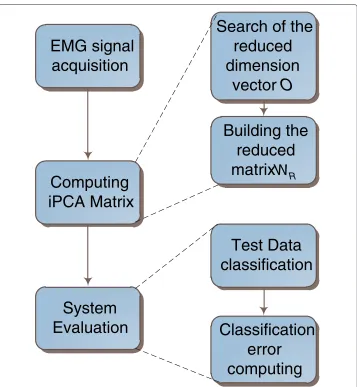
In order to evaluate the classification performance for each fitness-function/search-algorithm combination, a methodology based in three steps has been applied (namely,
EMG signal acquisition, computing the reduced iPCA matrix, andsystem evaluation) which are depicted in Figure 3.
EMG signal acquisition
We used data collected by the University of New Brunswick - Canada, with authoriza-tion of Dr. Levis Hargrove. These data were acquired in an experiment approved by the University of New Brunswick’s Research Ethics Board [5]. The data were sampled from ten healthy subjects performing eleven motion classes. EMG signals were acquired from ten sites on the forearm using adhesive duotrodes manufactured by 3M. These sig-nals were amplified to guarantee potentials in range [+5,−5]V and a bandwidth of 1Hz
to 500Hz. Afterwards, the signals were sampled at 1KHz and quantized with a 16-bit resolution.
Experimental data were collected during eight trials. Each trial consists of two repeti-tions of eleven motion classes performed in sequential order, namely: (1)wrist pronation, (2)wrist supination, (3)wrist flexion, (4)wrist extension, (5)hand open, (6)key grip, (7)
chuck grip, (8)power grip, (9)fine pinch grip, (10)tool grip, and (11)rest positionor no movement.
Computing
iPCA Matrix
System
Evaluation
Search of the
reduced
dimension
vector
O
Building the
reduced
matrix
W
RTest Data
classification
Classification
error
computing
EMG signal
acquisition
Figure 3 Sequence used to evaluate the classification error.Note that the blocks Computing iPCA Matrix and System Evaluation must run eight times, i.e. one iteration for each of the four search algorithms with the first fitness function (classification error) and one iteration for each of the four search algorithms with the second fitness function (correlation factor).
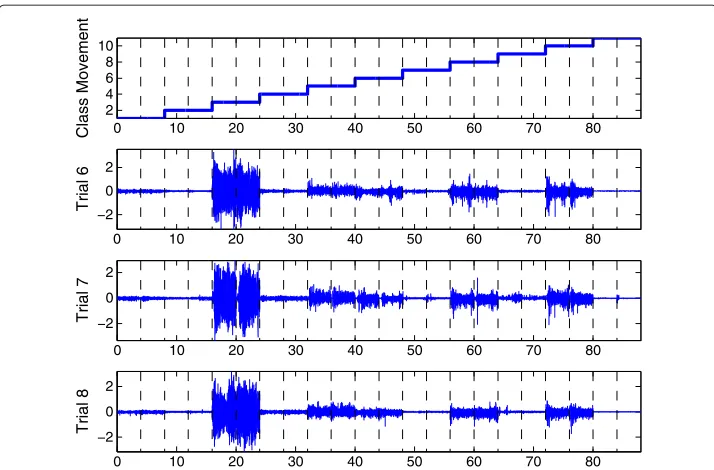
set composed of myoelectric signalsxin each channel and a vector of target classes asso-ciatedy. A sample of the collected data excluding the intermotion class delays is depicted in Figure 4.
In the present study, the EMG data recorded from trials 1 and 3 were used as a train-ing data set. EMG data recorded from trials 2 and 4 were used as a test data set. And finally, EMG data recorded from trials 5 and 6 were used as a validation set to resolve the optimization problem defined in the Background Section. Otherwise, for all these sets, the inter-motion class delays were excluded such as reported in [5].
Computing the reduced iPCA matrix
0 10 20 30 40 50 60 70 80 −2
0 2
Trial 6
0 10 20 30 40 50 60 70 80
−2 0 2
Trial 7
0 10 20 30 40 50 60 70 80
−2 0 2
Trial 8
0 10 20 30 40 50 60 70 80
2 4 6 8 10
Class Movement
Figure 4 Acquired signal with the sequence of movements from 1 to 11.Signals illustrated correspond to channel 3 during trials 6 to 8 and user 1. Dotted lines indicate the held time for the contraction (4 s). Note that the movements were evaluated in sequential ascending order for all trials.
transformation matrices and the transformed patternsswere used to run the optimal sub-set channel search. The result of this search is the vectorOcomposed of theN1channels
with most discriminative information. This search was evaluated with the eight possible combinations of fitness-function/search-algorithm. Therefore, at the end of this task the subsetsOijwere obtained, where the sub-indexesi,jindicate the fitness function and the search algorithm, respectively; fori=1, 2;j=1, 2, 3, 4.
In this case, for all search algorithms the N1 parameter was set to 30, such as
recommended in [5]. This value provides good classification accuracy.
The SFS algorithm was configured with just one stop criterion, namely: length of the selected subset equal toN1.
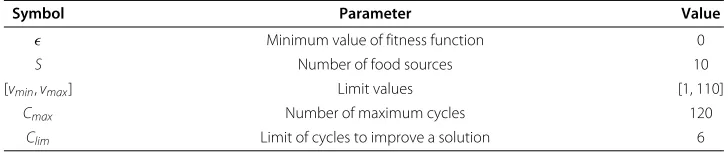
The SFFS algorithm used two stop criteria: (1) the same defined in SFS and (2) the maximum number of iterations (Cmax = 120). The latter was selected considering tests which show a mean number of iterations of 78.3 (with a standard deviation of 23.04) to find a solution. The PSO and ABC algorithms used other kind of parameters summed up in Table 2 and Table 3, respectively. For both fitness functions the optimization problem was defined as a minimization and the parameters were set with the next criteria:
a b
Table 2 PSO algorithm parameters
Symbol Parameters Value
Minimum value of fitness function 0
c1 Cognitive parameter 2
c2 Social parameter 2
c3 Social parameter 1
w Inertial weight [0.8 , 0.1]
S Swarm size 10
[vmin,vmax] Velocity limits [-109, 109]
[xmin,xmax] Position limits [1, 110]
Cmax Maximum number of iterations 120
For the PSO algorithm the minimum value of cost function () was defined by the minimum possible value for the classification error and correlation factor (in this case equal to zero). The number of particles (S) was set to 10; for greater values, the search time was increased and the time for the experiments could exceed the available time (2 months to get experimental data), specially when the classification error were used as fitness function. For lower values, the search performance could be compromised due to the characteristics of population based stochastic optimization algorithms. The limit val-ues (vmin,vmax,xmin,xmax) were defined by the dimension of the search space:C×N, whereCis the number of movement classes (C=10) andNis the number of acquisition channels (N = 11). The maximum number of iterationsCmaxwas set to 120; this value showed good results for both fitness functions. The algorithm used similar values for cog-nitive and social parameters (c1,c2andc3) allowing a neutral strategy, i.e. a strategy were
the confidence in the experience of each particle is equal to the confidence in the expe-rience of the swarm. The inertial weightwdecreases linearly allowing that the particles polish the search in the last iterations; this configuration induces an effect of global search in the first iterations and local search at the last ones.
In the ABC algorithm the parameters were configured having two requirements in mind: (a) high performance in the optimal search, (b) assurance of conditions to make fair comparisons between bio-inspired algorithms. Then, the number of food sources (S) was configured to 10, equal than the number of particles in the PSO algorithm. The limit val-ues (vmin,vmax) were defined by the dimension of the search space:C×N. The number of maximum cycles (Cmax) was set 120, equal that the maximum number of iterations in the PSO algorithm. The minimum value of the fitness function was set to 0, because this was the minimum value achievable by both fitness functions: classification error and cor-relation factor. The limit of cycles to improve a solution (Clim) was configured to 6; this value showed good classifications performances and affordable times of search.
To compute the classification error fitness function, the processing scheme formed by the blocks inside the dotted line in Figure 2, (i.e. the conventional myoelectric con-trol system) has been used. The configuration was the following: overriding windowing
Table 3 ABC algorithm parameters
Symbol Parameter Value
Minimum value of fitness function 0
S Number of food sources 10
[vmin,vmax] Limit values [1, 110]
Cmax Number of maximum cycles 120
feature extraction [12] with lengths of 150 ms and sliding windows of 25 ms, features conformed by the first 6 autoregressive coefficients (AR6) [18], dimensionality reduc-tion method based on Uncorrelated LDA (ULDA) [29] and LDA (Linear Discriminant Analysis) classifier [46]. At this stage, each channel was independently used to train and, subsequently, to test the control system, such as presented in [5].
At the second task (row selection block in Figure 5) we used equation (12) to com-pute the reduced iPCA transformation matrix corresponding to each pair fitness func-tion/search algorithm. Note that, at the output, eight reduced transformation matrices
WRijwere obtained as consequence of an optimization procedure computed eight times (the sub-indexesi,jindicate the fitness function and the search algorithm, respectively).
System evaluation
The last proceeding of the methodology was the evaluation of the classification system. This was carried out in two phases as depicted in Figure 6: (a) the test data (xtst) clas-sification, and (b) the classification error computing. The first phase was achieved with the iPCA preprocessing and the conventional classification scheme (see Figure 2), using the same configuration described for the classification error fitness function computing. This process was computed for each of the reduced iPCA transformation matricesWRij; the output of this phase was the predicted class vectoryˆij. The second phase compares the vectoryˆijwith the target vectoryto compute the classification error as defined in equation (13). The classification error was individually evaluated for each userkof the system.
eij(k)=100×
sum(y= ˆyij(k))
length(y) (13)
Results
The simulations proposed in this paper were performed on the Matlab platform and are based on the myoelectric control toolbox presented in [29]. Nevertheless, we have made some modifications and added some new functionalities to the myoelectric control tool-box presented in [29]. These modifications were necessary to appropriately parse the EMG data base that had a different structure than the used in [29]. The added functional-ities were done for configuring and implementing all the iPCA related functions, namely: optimal search, transformation matrices computing projections and performance indi-cators computing. The resulting simulator is a powerful tool for experimentation with iPCA myoelectric control, designed on a modular fashion that permits evaluation of dif-ferent approaches in each of the processing steps. Here we show results separated in two main stages: (a) first, the results registered during reduced iPCA transformation matrix computing, and secondly, (b) results registered during EMG pattern classification.
SFS SFFS PSO ABC 0
2 4 6 8 10
x 104
mean search time with classification error fitness function (s)
Search algorithm
WR1j WR2j
SFS SFFS PSO ABC 0
100 200 300 400 500
mean search time with correlation factor fitness function (s)
Search algorithm
Figure 7 Comparison of search time used for each of the eight treatment alternatives evaluated during optimization.The search time was computed as the product between the number-of-iterations and the mean-iteration-running-time.
SFS SFFS PSO ABC 0
5 10 15 20 25 30
fitness in the classification error function (%)
Search algorithm W
R 1j
SFS SFFS PSO ABC 0
10 20 30 40 50 60
fitness in the correlation factor function (%)
Search algorithm W
R 2j
Table 4 Comparison of number-of-iterations/mean-iteration-running-time for the eight treatment alternatives during optimization
Fitness function SFS SFFS PSO ABC
Class. error 30/1282s 64.9/1705s 120/155s 120/475s
Corr. factor 30/5.62s 78.3/7.61s 120/0.79s 120/1.12s
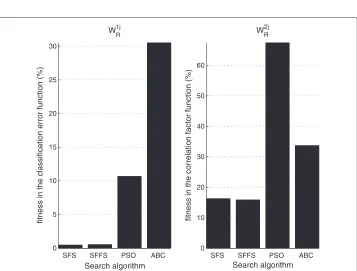
The results of the first stage of the system are shown in Figure 7 and Figure 8. Figure 7 depicts the mean search time, i.e. the time necessary to compute the optimal vectorO. The left figure shows the search time for classification error fitness function and the right figure for correlation factor fitness function. Complementary information on this subject is presented in Table 4. This table summarizes the mean values of the number of iter-ations and the time of each single iteration for each fitness-function/search-algorithm combination. Note that both bio-inspired algorithms were stopped by the maximum iter-ations criteria (120 iteriter-ations); this means that the time performance comparison among bio-inspired algorithms just depends on the time of each single iteration of the search algorithm. The SFS algorithm was stopped when reached 30 iterations and the SFFS have different mean iterations number for each fitness function. The times in Table 4 have been computed on a PC with 2.8GHz processor, 8Gb RAM memory and 4 cores. Figure 8 depicts the mean fitness value reached during the optimal search. This value is presented for the eight evaluated combinations of search algorithm and the fitness function.
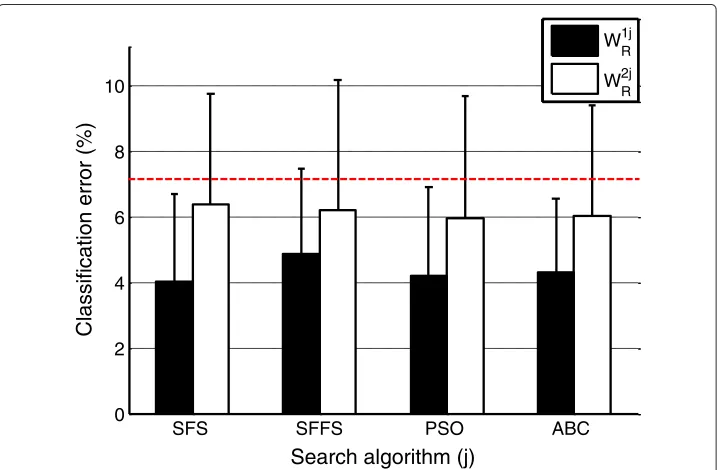
The results of the next main stage (the EMG pattern classification stage) are shown in Figure 9. This figure displays the mean classification errors generated when each of the eight reduced matricesWRijwere used in the myoelectric control system. The black bars indicate the classification errors obtained with the transformation matrixWR1j(i.e. the transformation matrices computed with the classification error fitness function) and white bars indicate the classification errors obtained with the transformation matrixWR2j
(i.e. transformation matrices computed with the correlation factor fitness function). The vertical line on the bars represents one standard deviation of inter-subject error variabil-ity. The red line indicates the mean classification error obtained when the EMG patterns were classified without the iPCA transformation.
A two factor analysis of variances (ANOVA) was performed over the error classifica-tion results, which has determined the following behaviors: (a) there was no statistical evidence of the dependence between the interaction of both factors (i.e. search algorithm and fitness function) and the classification error (F0.01,3,72 = 4.0659 > fAB = 0.09), (b) there was statistical evidence of the dependence between the fitness function factor and the classification error (F0.02,1,72 = 5.0162 < fA = 6.56), and (c) there was no sta-tistical evidence showing the dependence between the search algorithm factor and the classification error factor, (F0.01,3,72=4.0659>fB=0.08).
Discussion
With regard to the number of iterations is important to mention that: (a) the bio-inspired algorithms used the maximum number of iterations (120) in each search and (b) the sequential algorithms never reached the maximum number of iterations (120). Therefore, the number of iterations is irrelevant to develop comparisons among bio-inspired algorithms; otherwise, the same is important to compare both sequential and bio-inspired algorithms. The search time in Figure 7 shows that: (a) solutions founded with error classification fitness function are more susceptible to long search times. The data have shown a relation of 250:1 between the search time of the classification error fitness function and the search time of the correlation factor fitness function. This was already expected due to the complexity associated with the supervised and non-supervised fitness functions (see fitness functions in Background Section); (b) the major and minor search time of the algorithms, regardless of the fitness function, are for SFFS and PSO respec-tively. The difference between these two algorithms is significant and indicates that the SFFS algorithm consumes almost four times more iterations than the PSO algorithm, for the case of maximum number of iterations = 120. The PSO algorithm is 14 percent better than the ABC algorithm, when correlation factor was used as fitness function. The differ-ence (with respect to SFS) reaches 31 percent when classification error is used as fitness function.
This advantage of PSO over the other evaluated search algorithms is consequence of the low number of evaluations of the fitness function in each iteration of the PSO algorithm. The fitness values shown in Figure 8 indicate the following behaviors: (a) the fitness com-puted on the classification error fitness function was lower than that comcom-puted with correlation factor as fitness function; (b) the optimal solutions computed with sequential algorithms were closer to the global minimum than the ones computed with the bio-inspired algorithms. These results suggest a superiority of the solutions computed with
SFS SFFS PSO ABC 0
2 4 6 8 10
Search algorithm (j)
Classification error (%)
W
R 1j
W
R 2j
Figure 9 Comparison of the classification error reached with each of the eight treatment alternatives.
sequential algorithms. In order to generalize that behavior, it is necessary to test the bio-inspired algorithms using other configuration parameters; (c) the fitness reached with the sequential algorithms SFS and SFFS are similar and, therefore, we can suggest that the nesting effect associated with the SFS algorithm is not significant in the considered fitness functions.
Figure 9 shows the comparison of the performances reached when the patterns were tuned with the different transformation matricesWRij(i = 1, 2;j= 1,. . ., 4). The results indicate the following aspects: (a) the classification rates are similar to the previous ones published in [5] and the classification error of the conventional myoelectric control archi-tecture is superior to the classification error of the myoelectric control archiarchi-tecture with iPCA tuning; (b) there are similar levels of classification error when transformation matri-cesWRi•were used (i.e. transformation matrices computed with theifitness function and each of the search algorithms); and (c) there are differences between classification errors when transformation matrixWR•jwas used (i.e. transformation matrices computed with thejsearch algorithm and each of the fitness functions).
The response presented in (a) validates the superiority of the iPCA tuned architec-ture over the conventional myoelectric control architecarchitec-ture. Otherwise, the (b) response was not expected. Due to the superiority of fitness that was computed with sequen-tial algorithms (see Figure 8), greater differences between the classification errors were expected. For instance, that classification errors associated to transformation matrices computed with sequential algorithms (WRij with j = 1, 2) were less than classifica-tion errors associated to transformaclassifica-tion matrices computed with bio-inspired algorithms (WRijwithj = 3, 4). This suggests that finding of the minimal value for the fitness func-tion is not a sufficient condifunc-tion to guarantee minimal classificafunc-tion errors during the evaluation of the myoelectric control system.
Finally, the (c) response was expected, basically by two reasons: (i) the superiority of classification error over correlation factor in determining the discriminant information in the selected subsets. (ii) The superior fitness of computed solutions using systems with classification error fitness function (see Figure 8).
The confusion matrices displayed in Additional file 1: Table S5, Additional file 2: Table S6, Additional file 3: Table S7 and Additional file 4: Table S8 provide a direct compari-son between the optimization alternatives used. Additional file 1: Table S5 and Additional file 3: Table S7 compare classification accuracy when the transformation matricesWR2j
were used (i.e. the transformation matrices computed with the correlation factor fit-ness function and the sequential and bio-inspired algorithms). Additional file 2: Table S6 and Additional file 4: Table S8 compare classification accuracy when the transformation matricesWR1jwere used (i.e. the transformation matrices computed with the classification error fitness function and the sequential and bio-inspired algorithms).
In Additional file 1: Table S5 and Additional file 3: Table S7, the values in white (left columns) show processing with SFS algorithm and the values in gray (right columns) show the results with SFFS algorithm. In Additional file 2: Table S6 and Additional file 4: Table S8, the values in white (left columns) show processing with PSO algorithm and the values in gray (right columns) show the results with ABC algorithm.
values on these tables confirm two trends: (a) similar levels on classification error when transformation matricesWRi•were used and (b) differences between classification errors when transformation matricesWR•jwere used.
Conclusions
This paper has presented and evaluated the use of bio-inspired optimization algo-rithms in the iPCA stage of Myoelectric Control Systems for hand prosthesis. The influence of fitness function and searching algorithms on myoelectric control sys-tems with iPCA tuning were investigated in terms of optimization performance (e.g. running time, number of iterations, mean search time), solution fitness and clas-sification performance. The alternatives considered for fitness functions were the fol-lowing: classification error, correlation factor, and for search algorithms: SFS, SFFS, PSO and ABC. The experimental results suggest superiority on classification perfor-mance when reduced iPCA matrices computed with classification error fitness function were used. The results have also shown the independence of classification perfor-mance with regard to the search algorithm. However, a practical advantage was found in using PSO algorithm during the optimal search. This advantage is related to the computational time of the process during the parameter configuration stage and was corroborated for a particular set of configuration parameters in the algorithm. Future studies will be carried out to investigate other configuration parameters in the PSO algorithm as well as the effects of the selected subset length N1 on the classification
performance.
Nomenclature
MCSs Myoelectric Control Systems
iPCA individual principal component analysis PCA principal component analysis
ABC artificial bee colony
PSO particle swarm optimization EMG electromyographic signals
SFS sequential forward selection SFFS sequential floating forward selection MLP multilayer perceptron
NNs neural networks
LDA linear discriminant analysis
ULDA uncorrelated linear discriminant analysis GMMs Gaussian mixture models
HMMs hidden Markov models SVMs support vector machines
TD Time Domain MAV mean absolute value MAVS mean absolute value slope
ZC zero crossings SSC slope sign changes
STFT small time Fourier transform WT Wavelet transform
WPT Wavelet packets transform TDAR concatenated TD and AR features
x generic EMG signal
y vector of classes of movement
ˆ
y vector of predicted classes of movement
ˆ
yij vector of predicted classes of movement computed withWRij
eij classification error of the system configured with theWRijtransformation
matrix
xv validation data set of EMG signals xtr training data set of EMG signals xtst test data set of EMG signals
xi position vector of thei particle and position vector of the i food source in
the PSO algorithm and ABC algorithm respectively
vi velocity vector of thei particle and new position vector aroundxiin the
PSO algorithm and ABC algorithm respectively
pbesti best individual position for thei particle in the PSO algorithm
gfbest first best position explored so far in the PSO algorithm w inertial weight in the PSO algorithm
gsbest second best position explored so far in the PSO algorithm r1,r2andr3 random numbers uniformly distributed in the range(0, 1)
c1 cognitive parameter in the PSO algorithm
c2andc3 social parameters in the PSO algorithm
pi probability factor of each employed bee in the ABC algorithm Clim limit of cycles to improve a solution in the ABC algorithm
Cmax maximum number of iterations and maximum number of cycles in the
PSO algorithm and ABC algorithm respectively
φij random number in the range[−1, 1]that controls the production of
food source positions aroundxiin the ABC algorithm
s iPCA projected pattern fromx
M number of observations of the EMG signal O vector of possible optimal set of channels O vector of optimal set of channels
Oij vector of optimal set of channels computed with thei fitness function
and thej search algorithm
minimum value of fitness function Cx cross correlation factor
Rx correlation coefficient matrix Fc normalized correlation factor
S the number of particles and bees used during optimal search with bio-inspired algorithms
W PCA transformation matrix
Wc PCA transformation matrix for thec movement class WiPCA iPCA transformation matrix
WR reduced iPCA transformation matrix
WRij reduced iPCA transformation matrix computed with thei fitness function and thej search algorithm
Additional files
Additional file 1: Table S5 Confusion matrix for the sequential algorithms and correlation factor fitness function.
Additional file 2: Table S6 Confusion matrix for the bio-inspired algorithms and correlation factor fitness function.
Additional file 3: Table S7 Confusion matrix for the sequential algorithms and classification error fitness function.
Additional file 4: Table S8 Confusion matrix for the bio-inspired algorithms and classification error fitness function.
Competing interests
The authors declare that they have no competing interests.
Authors’ contributions
GAC implemented the modifications on the Matlab libraries to include the bio-inspired algorithms and developed the experiments. GAC and CHL sorted the results and were responsible for the statistical analysis. GAC, CHL and PAB participated in the design of the study and contributed to the result discussion. CJM and AFR helped drafting and revising the manuscript. All authors read and approved the final manuscript.
Acknowledgements
The Authors would like to thank Dr. Levi Hargrove from the Neural Engineering Center for Artificial Limbs at the Rehabilitation Institute of Chicago for providing us with the EMG data set, and Dr. A. D. C. Chan from the Department of Systems and Computing Engineering at Carleton University for providing us with the Matlab Library for myoelectric control. Additionally, thanks also to Daniel Muñoz from FGA-UnB for his help in the configuration of the bio-inspired algorithms.
Author details
1Faculty of Engineering, University of La Salle, Bogotá, Colombia.2Mechanical Engineering Department, University of Brasília, Brasília, Brazil.3Computer Science Department, University of Brasília, Brasília, Brazil.4Faculty of Gama, University of Brasília, Brasília, Brazil.
Received: 28 May 2013 Accepted: 18 December 2013 Published: 27 December 2013
References
1. Micera S, Carpaneto J, Raspopovic S:Control of hand prostheses using peripheral information.Biomed Eng, IEEE Rev2010,3:48–68.
2. McGimpsey G, Bradford TC:Limb prosthetics services and devices. Critical unmet need: market analysis - white paper.Tech. rep., Bioengineering Institute Center for Neuroprosthetics - Worcester Polytechnic Institution 2011. 3. Edeer D, Martin CW:Upper limb prostheses - A review of the literature with a focus on myoelectric hands. Tech. rep., Richmond, BC: WorkSafeBC Evidence-Based Practice Group February 2011. http://worksafebc.com/ health_care_providers/Assets/PDF/UpperLimbProstheses2011.pdf.
4. Yao J, Carmona C, Chen A, Kuiken T, Dewald J:Sensory cortical re-mapping following upper-limb amputation and subsequent targeted reinnervation: a case report.Engineering in, Medicine and Biology Society, EMBC, 2011 Annual International Conference of the IEEE, Aug. 30 2011–Sept. 3 2011, pp. 1065–1068. http://ieeexplore.ieee. org/stamp/stamp.jsp?tp=&;arnumber=6090248&;isnumber=6089866.
6. Camacho G, Llanos C, de A Berger P, Miosso C, da Rocha A:Evaluating different combinations of feature selection algorithms and cost functions applied to iPCA tuning in myoelectric control systems.Engineering in Medicine and Biology Society (EMBC), 2012 Annual International Conference of the IEEE, Aug. 28 2012–Sept. 1 2012, pp. 6508–6513. http://ieeexplore.ieee.org/stamp/stamp.jsp?tp=&;arnumber=6347485&;isnumber=6345844. 7. Merletti R, Parker P:Electromyography: Physiology, Engineering and Noninvasive Applications; 2004. http://dx.doi.org/
10.1002/0471678384.
8. Nielsen J, Holmgaard S, Jiang N, Englehart K, Farina D, Parker P:Simultaneous and proportional force estimation for multifunction myoelectric prostheses using mirrored bilateral training.Biomed Eng, IEEE Trans2011, 58(3):681–688.
9. Hudgins B, Parker P, Scott R:A new strategy for multifunction myoelectric control.Biomed Eng, IEEE Trans1993, 40:82–94.
10. Tenore F, Ramos A, Fahmy A, Acharya S, Etienne-Cummings R, Thakor N:Decoding of individuated finger movements using surface electromyography.Biomed Eng, IEEE Trans2009,56(5):1427–1434.
11. Kelly M, Parker P, Scott R:The application of neural networks to myoelectric signal analysis: a preliminary study.Biomed Eng, IEEE Trans1990,37(3):221–230.
12. Englehart K, Hudgins B:A robust, real-time control scheme for multifunction myoelectric control.Biomed Eng, IEEE Trans2003,50(7):848–854.
13. Englehart K, Hudgin B, Parker P:A wavelet-based continuous classification scheme for multifunction myoelectric control.Biomed Eng, IEEE Trans2001,48(3):302–311.
14. Chu JU, Moon I, Lee YJ, Kim SK, Mun MS:A supervised feature-projection-based real-time EMG pattern recognition for multifunction myoelectric hand control.Mechatronics, IEEE/ASME Trans2007,12(3):282–290. 15. Park SH, pil Lee S:EMG pattern recognition based on artificial intelligence techniques.Rehabil Eng, IEEE Trans
1998,6(4):400–405.
16. Micera S, Sabatini AM, Dario P, Rossi B:A hybrid approach to EMG pattern analysis for classification of arm movements using statistical and fuzzy techniques.Med Eng Phys1999,21(5):303–311. http://www.sciencedirect. com/science/article/pii/S1350453399000557.
17. Chan F, Yang YS, Lam F, Zhang YT, Parker P:Fuzzy EMG classification for prosthesis control.Rehabil Eng, IEEE Trans2000,8(3):305–311.
18. Chan A, Englehart K:Continuous myoelectric control for powered prostheses using hidden Markov models. Biomed Eng, IEEE Trans2005,52:121–124.
19. Ajiboye A, Weir R:A heuristic fuzzy logic approach to EMG pattern recognition for multifunctional prosthesis control.Neural Syst Rehabil Eng, IEEE Trans2005,13(3):280–291.
20. Khezri M, Jahed M:Real-time intelligent pattern recognition algorithm for surface EMG signals.BioMed Eng OnLine2007,6:45. http://www.biomedical-engineering-online.com/content/6/1/45.
21. Huang Y, Englehart K, Hudgins B, Chan A:A Gaussian mixture model based classification scheme for myoelectric control of powered upper limb prostheses.Biomed Eng, IEEE Trans2005,52(11):1801–1811. 22. Chu JU, Lee YJ:Conjugate-prior-penalized learning of gaussian mixture models for multifunction
myoelectric hand control.Neural Syst Rehabil Eng, IEEE Trans2009,17(3):287–297.
23. Oskoei M, Hu H:Support vector machine-based classification scheme for myoelectric control applied to upper limb.Biomed Eng, IEEE Trans2008,55(8):1956–1965.
24. Liu YH, Huang HP, Weng CH:Recognition of electromyographic signals using cascaded kernel learning machine.Mechatronics, IEEE/ASME Trans2007,12(3):253–264.
25. Shenoy P, Miller K, Crawford B, Rao R:Online electromyographic control of a robotic prosthesis.Biomed Eng, IEEE Trans2008,55(3):1128–1135.
26. Khokhar ZO, Xiao ZG, Menon C:Surface EMG pattern recognition for real-time control of a wrist exoskeleton. BioMed Eng OnLine2010,9:41. http://www.biomedical-engineering-online.com/content/9/1/41.
27. Graupe D, Salahi J, Kohn KH:Multifunctional prosthesis and orthosis control via microcomputer identification of temporal pattern differences in single-site myoelectric signals.J Biomed Eng1982,4:17–22.
http://www.sciencedirect.com/science/article/pii/0141542582900218.
28. Kang WJ, Shiu JR, Cheng CK, Lai JS, Tsao HW, Kuo TS:The effect of electrode arrangement on spectral distance measures for discrimination of EMG signals.Biomed Eng, IEEE Trans1997,44(10):1020–1023.
29. Chan ADC, Green GC:Myoelectric control development toolbox.30th Conference of the Canadian Medical & Biological Engineering Society, Toronto, Canada, Volume Paper M0100. 2007.
30. Kevin E:Signal representation for classification of the transient myoelectric signal.PhD thesis,University of New Brunswick, 1998.
31. Pudil P, Novovicova J, Kittler J:Floating search methods in feature selection.Pattern Recognit Lett1994, 15(11):1119–1125.
32. Theodoridis S, Koutroumbas K:Pattern Recognition (Third Edition). San Diego: Academic Press; 2006.
33. Karaboga D, Akay B:A survey: algorithms simulating bee swarm intelligence.Artif Intell Rev2009,31:61–85. 34. Liu X, Chen T, Kumar B:Face authentication for multiple subjects using eigenflow.Pattern Recognit2003,
36(2):313–328.
35. Das K, Osechinskiy S, Nenadic Z:A classwise PCA-based recognition of neural data for brain-computer interfaces.Engineering in Medicine and Biology Society, 2007. EMBS 2007. 29th Annual International Conference of the IEEE, 22–26 Aug. 2007, pp 6519–6522. http://ieeexplore.ieee.org/stamp/stamp.jsp?tp=&;arnumber=4353853&; isnumber=4352185.
36. Das K, Nenadic Z:An efficient discriminant-based solution for small sample size problem.Pattern Recognit
2009,42(5):857–866.
38. Eberhart R, Kennedy J:A new optimizer using particle swarm theory.Micro Machine and Human Science, 1995. MHS ‘95., Proceedings of the Sixth International Symposium on, 4-6 Oct 1995, pp. 39–43. http://ieeexplore.ieee.org/ stamp/stamp.jsp?tp=&;arnumber=494215&;isnumber=10679.
39. Khushaba R, Al-Ani A, Al-Jumaily A:Swarm intelligence based dimensionality reduction for myoelectric control. Intelligent Sensors, Sensor Networks and Information, 2007. ISSNIP 2007. 3rd International Conference on, 3-6 Dec. 2007, pp. 577–582. http://ieeexplore.ieee.org/stamp/stamp.jsp?tp=&;arnumber=4496907&;isnumber=4496790. 40. Jin J, Wang X, Zhang J:Optimal selection of EEG electrodes via DPSO algorithm.Intelligent Control and
Automation, 2008. WCICA 2008, 7th World Congress on, 25-27 June 2008, pp. 5095–5099. http://ieeexplore.ieee.org/ stamp/stamp.jsp?tp=&;arnumber=4593756&;isnumber=4592780.
41. Forbes R, Nayeem Mohammad T:Particle swarm optimization on multi-funnel functions. http://www.cs.colostate.edu/~nayeem/papers/pso_paper.pdf.
42. Karaboga D:An idea based on honey bee swarm for numerical optimization.Tech. Rep. TR06, Erciyes University 2005.
43. Karaboga D, Basturk B:A powerful and efficient algorithm for numerical function optimization: artificial bee colony (ABC) algorithm.J Glob Optimization2007,39:459–471.
44. Mogk JP, Keir PJ:Crosstalk in surface electromyography of the proximal forearm during gripping tasks. J Electromyography Kinesiol2003,13:63–71.
45. MATLAB:Version 7.10.0 (R2010a). Natick: The MathWorks Inc.; 2010.
46. Hargrove L, Englehart K, Hudgins B:A comparison of surface and intramuscular myoelectric signal classification.Biomed Eng, IEEE Trans2007,54(5):847–853.
doi:10.1186/1475-925X-12-133
Cite this article as:Camachoet al.:An experimental evaluation of the incidence of fitness-function/search-algorithm
combinations on the classification performance of myoelectric control systems with iPCA tuning.BioMedical
Engineering OnLine201312:133.
Submit your next manuscript to BioMed Central and take full advantage of:
• Convenient online submission • Thorough peer review
• No space constraints or color figure charges • Immediate publication on acceptance
• Inclusion in PubMed, CAS, Scopus and Google Scholar • Research which is freely available for redistribution
![Figure 2 Steps of the pattern recognition based myoelectric control system with iPCA tuning [5]](https://thumb-us.123doks.com/thumbv2/123dok_us/9152634.1910039/9.595.118.478.88.198/figure-steps-pattern-recognition-based-myoelectric-control-tuning.webp)